

OBD-II Code P2018: Intake Flap Position Sensor/Switch Circuit Intermittent
The Ultimate Guide: What P2018 Means, Why It Triggers, and Exactly How to Fix It
- P2018 specifically means the position sensor for the engine's air control flaps is sending an intermittent (on-and-off) electrical signal.
- The most common causes are a faulty sensor, damaged wiring, or carbon buildup that prevents the flaps from moving correctly.
- Symptoms are consistent: a Check Engine Light, reduced power, rough idle, and worse fuel economy.
- On VW, Audi, and other direct-injection engines, suspect carbon buildup first. On Mercedes V6/V8 engines, suspect a broken plastic linkage. On HEMI engines, suspect the wiring harness.
- Thorough diagnosis is critical. Use a scanner with live data graphing and perform a 'wiggle test' on the harness before replacing any parts to avoid misdiagnosis.
What Does P2018 Mean?

P2018 is a generic OBD-II code that signifies your car's main computer (PCM) has detected an unreliable, erratic, or intermittent signal from the intake manifold runner position sensor on Bank 1. These runners, or flaps, are inside the intake manifold and adjust to control the length of the air's path into the cylinders, optimizing engine performance for both low-end torque and high-RPM power. The 'Intermittent' part of the definition is key; it means the electrical fault isn't constant but is cutting in and out, often due to vibration, heat, or a loose connection.
Technical definition: Intake Manifold Runner Position Sensor/Switch Circuit Intermittent Bank 1.
Can I Drive With P2018?
Yes, But With Caution. Yes, you can typically drive with a P2018 code, but it is not recommended for long distances. You will experience reduced engine power, poor fuel economy, and hesitation, which can be a safety risk during acceleration. Continuing to drive for weeks or months can cause excessive carbon buildup and potentially stress the catalytic converter. A damaged catalytic converter is a costly repair, often ranging from $800 to $2500, so addressing the P2018 fault promptly is crucial to avoid escalating repair costs.
Common Causes

- Faulty Intake Manifold Runner Position Sensor (very_common) — The sensor is the most frequent culprit. Heat, vibration, and internal wear can cause the sensor's internal potentiometer to develop 'dead spots' or fail entirely, leading it to send erratic or no signals to the PCM.
- Carbon Buildup on Intake Runners (very_common) — Especially on direct-injection engines (like VW/Audi's TSI/TFSI), carbon deposits from oil vapor and combustion byproducts can encrust the runner flaps, causing them to stick, bind, or move slowly. When the flaps can't reach their commanded position, the sensor reports a value that conflicts with the PCM's expectation, triggering the code.
- Damaged Wiring or Corroded Connectors (common) — The engine bay is a harsh environment. Wires can become brittle and crack, or their insulation can rub through on a bracket. Connector pins can also corrode or lose tension ('fretting'), leading to a poor connection that drops out with engine movement.
- Failing Intake Manifold Runner Control (IMRC) Actuator (common) — The electric motor or vacuum-operated actuator that moves the flaps can fail. If the actuator doesn't move the flaps, the sensor will report a static position when it should be changing, leading to a fault.
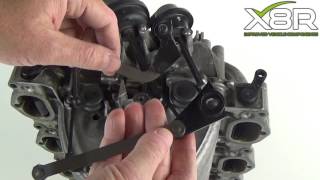
- Broken or Disconnected Plastic Linkages (common) — On many designs, particularly Mercedes-Benz V6/V8 and some Ford engines, the actuator connects to the flaps via plastic levers and arms. These can become brittle with age and heat, breaking and physically disconnecting the actuator from the flaps. 🎬 See how to repair broken plastic linkages on Mercedes engines.
- Vacuum Leaks (less_common) — For systems that use vacuum to move the runner flaps, a cracked, hardened, or disconnected vacuum line will prevent the flaps from moving correctly, causing the sensor to report an incorrect position.
- Software or Calibration Issues (rare) — Sometimes, the PCM's software calibration for the expected sensor voltage range is too sensitive. Manufacturers may release Technical Service Bulletins (TSBs) with a software update to widen the acceptable range and prevent false codes.
- Electrical Noise or Poor Ground (rare) — Voltage spikes from a failing alternator or ignition coils, or a corroded engine ground strap, can introduce electrical 'noise' into the sensor circuit. The PCM can misinterpret this noise as an intermittent signal dropout.
- Faulty Powertrain Control Module (PCM) (very_rare) — In extremely rare cases, the PCM itself can have an internal fault, like a failing driver or analog-to-digital converter. This should be the absolute last consideration after all other possibilities—wiring, sensor, and mechanical—have been exhaustively ruled out.
Symptoms
- Check Engine Light On — The Malfunction Indicator Lamp (MIL) will be illuminated. The light may have flashed intermittently at first before staying on solid.
- Reduced Engine Power — The vehicle may feel sluggish, especially at either low or high RPMs, depending on the position the flaps are stuck in. This is often described as the engine feeling 'choked' or 'flat'.
- Rough or Unstable Idle — The engine may idle erratically, with RPMs fluctuating, because the airflow is not optimized for low-speed operation.
- Poor Fuel Economy — When the engine cannot control airflow efficiently, combustion is compromised, leading to a noticeable drop in miles per gallon (MPG).
- Hesitation on Acceleration — A stumble or 'dead spot' may be felt when you press the accelerator, as the engine struggles with a non-optimal air-fuel mixture.
Diagnosis Steps

- Read Codes and Freeze Frame Data
Using an OBD-II scanner, confirm P2018 is active and check for any other codes. The freeze frame data is crucial—it shows the exact engine conditions (RPM, load, temperature) when the intermittent fault occurred, providing vital clues.
Tools: OBD-II Scanner (beginner) - Check for Technical Service Bulletins (TSBs)
Before any physical work, search for TSBs for your vehicle's make, model, and year. Manufacturers often release bulletins for known issues like updated parts, wiring harness problems, or software reflashes that can save hours of diagnostic time.
Tools: Internet Access (beginner) - Perform a Detailed Visual Inspection
Locate the IMRC actuator and sensor on Bank 1. Inspect the wiring harness for signs of rubbing, melting on hot engine components, or cracked insulation. Check the connector for corrosion, moisture, or pushed-out pins. Look for broken plastic linkage arms.
Tools: Flashlight, Inspection Mirror (beginner) - Analyze Live Data with Graphing
Use an advanced scanner to view the IMRC position sensor voltage or percentage as a graph. With the key on and engine off, the line should be steady. Rev the engine or use the scanner's actuator test; the graph should show a smooth, clean sweep. Jumps, dropouts, or a flat line indicate a problem. 🎬 Watch: How to diagnose intake manifold codes on VW/Audi engines.
Tools: Advanced OBD-II Scanner (intermediate) - PRO TIP: The 'Wiggle Test'
While watching the live data graph, carefully wiggle the wiring harness at the sensor connector, along its path, and near the PCM. If you can make the signal spike or drop out on the graph by moving the wires, you've found the location of your intermittent short or open circuit.
Tools: Advanced OBD-II Scanner, Gloves (intermediate) - Manually Test Runner Flap Movement
With the engine off, disconnect the linkage from the actuator. Try to move the flaps by hand using the lever. They should move smoothly with minimal resistance. If they are sticky, bind up, or feel gritty, they are clogged with carbon. 🎬 Watch this walkthrough on replacing a carbon-fouled intake manifold. If they feel loose or disconnected, the internal mechanism is likely broken.
Tools: Basic Hand Tools (intermediate) - PRO TIP: Backprobe the Sensor Connector
Use a digital multimeter to test the circuit with the sensor plugged in and the key on. Backprobe the connector to verify the three critical wires: Reference Voltage (should be a steady ~5.0V), Ground (should show less than 0.1V), and Signal. The signal wire voltage should sweep smoothly between a low value (e.g., ~0.5V) and a high value (e.g., ~4.5V) as you manually move the runner arm. Any dropouts to 0V or spikes to 5V during the sweep indicate a bad sensor.
Tools: Digital Multimeter (with backprobe pins) (advanced) - ADVANCED: Test Sensor Resistance
With the sensor disconnected, use a multimeter to measure the resistance between the signal and ground pins. While specifications vary, a typical reading might be between 1,000 and 3,000 ohms (1-3 kΩ). An open circuit (infinite resistance) or a short circuit (zero resistance) confirms a failed sensor. This test is less definitive than a live voltage test but can quickly identify a completely failed component.
Tools: Digital Multimeter (advanced) - PRO TIP: Use an Oscilloscope for Definitive Diagnosis
For the most accurate diagnosis, connect a lab scope to the sensor's signal and ground wires. A good sensor will produce a clean, smooth analog line as the flaps move. An intermittent fault will show up as sharp dropouts, hash, or noise on the waveform that perfectly corresponds with a wiggle test or a specific engine RPM, confirming an electrical issue that a multimeter might be too slow to catch.
Tools: Automotive Oscilloscope (Lab Scope) (professional)
Common Fixes & Costs

- Replacing the Intake Manifold Runner Position Sensor — Parts: $80-$160, Labor: $100-$200 (1-2 hours) (intermediate)
- Cleaning Carbon Buildup from Intake Manifold (Walnut Blasting) — Parts: $30-$60 (gaskets, cleaning chemicals), Labor: $400-$800+ (labor for removal and specialized cleaning) (professional)
- Repairing Damaged Wiring or Connector Pigtail — Parts: $15-$50, Labor: $150-$300 (1-2 hours of diagnostic and repair time) (intermediate)
- Replacing the Intake Manifold Runner Control (IMRC) Actuator — Parts: $75-$300, Labor: $100-$250 (1-2 hours) (intermediate)
- Replacing the Entire Intake Manifold Assembly — Parts: $450-$1500+, Labor: $350-$1000+ (professional)
Most Commonly Affected Vehicles
- Volkswagen GTI, Jetta, Passat, Tiguan (2006-2014) — The 2.0T TSI/TFSI engine is notorious for heavy carbon buildup causing P2018. The intake manifold was updated several times; the original part number 06J133201BH was superseded by 06J133201AS and later versions to improve durability.
- Audi A3, A4, A6, Q5 (2005-2013) — Shares the same 2.0T and 3.2L engines as VW, making them highly prone to carbon buildup. Repair costs are often higher than VW, with a full intake manifold replacement at a dealer potentially exceeding $1500.
- Mercedes-Benz C-Class, E-Class, ML-Class (V6 M272 & V8 M273 engines) (2006-2012) — The primary failure is the plastic lever arm on the front of the intake manifold snapping. This disconnects the actuator from the swirl flaps. While repair kits exist, the official fix is a full manifold replacement (Part No. A2721402401).
- Ford F-150, Mustang, Explorer (5.0L & 5.4L 3V engines) (2004-2017) — On these engines, the IMRC actuator can fail, or the plastic linkage clips can break. The 2015-2017 F-150 5.0L is particularly known for IMRC flaps getting stuck.
- Dodge / Chrysler / Ram Charger, 300, Ram 1500 (5.7L & 6.4L HEMI V8) (2009-2018) — The short-runner valve (SRV) actuator on the intake manifold is a common failure point. The wiring harness to the actuator is often too short, causing stress and intermittent connections, which can trigger P2018 or related codes.
- BMW 328i, 528i, X3, Z4 (N52 engine) (2006-2013) — The N52 engine uses a three-stage variable intake manifold (DISA). There are two DISA flap actuators that can fail electrically or have their plastic gears strip, causing rattling noises and fault codes.
- Hyundai / Kia Sonata, Santa Fe, Optima, Sorento (2011-2018) — Models with GDI engines feature a Variable Intake System (VIS). The actuator motor or the position sensor integrated into it can fail, often requiring replacement of the actuator assembly.
- Chevrolet / GMC Equinox, Terrain, Malibu (2.4L Ecotec) (2010-2017) — The intake manifold runner control actuator or sensor on the 2.4L engine is a known failure point. Due to the integrated design, this often necessitates the replacement of the entire intake manifold.
Manufacturer-Specific Notes
- Volkswagen / Audi: The 2.0T direct-injection engine is world-famous for extreme carbon buildup on intake valves and runner flaps. This is the #1 cause of P2018 on these cars. A professional 'walnut blasting' cleaning service is the standard, effective repair. VW has issued an extended warranty for the intake manifold on many 2.0T TSI engines (e.g., CBFA, CCTA) for 10 years or 120,000 miles. This is not a recall and only applies if the part has failed. Owners should check eligibility with a dealer.
- Mercedes-Benz: On M272 (V6) and M273 (V8) engines, the plastic control lever for the tumble flaps is the Achilles' heel. It becomes brittle and breaks. Aftermarket companies sell metal replacement levers, but the labor to install them is extensive, so many shops recommend replacing the entire manifold (OEM #A2721402401) to also address worn internal flap bushings.
- Dodge / Chrysler / Ram: On 5.7L and 6.4L HEMI engines, the wiring harness for the Short Runner Valve (SRV) actuator is notoriously too short from the factory. Engine movement puts constant strain on the wires and connector, leading to intermittent open circuits and P2018/P1004 codes. Dorman makes an OE FIX pigtail (911-933) that is longer to solve this specific design flaw.
- BMW: The N52 engine uses two separate DISA (Differentiated Air Intake) flap actuators. A common failure is the plastic gear inside the actuator stripping, or the pin holding the flap can break and get ingested by the engine in worst-case scenarios. Owners often hear a rattling sound from the intake manifold when a DISA flap is failing.
Related Codes
- P2015 — Indicates a 'Range/Performance' issue. This means the sensor's signal is outside the expected range (e.g., stuck at one voltage), often due to a mechanical problem like a stuck flap. P2018 points specifically to an electrical intermittency (a signal that cuts out), suggesting a wiring or connector problem.
- P2016 / P2017 — These are 'hard' electrical faults. P2016 means the circuit voltage is constantly low (short to ground), and P2017 means it's constantly high (short to power). P2018 is different because the fault is intermittent, not constant.
- P2004 / P2006 — These codes indicate the intake manifold runner control is mechanically stuck open (P2004) or stuck closed (P2006) on Bank 1. You will often see one of these alongside a P2015 or P2018 code, as the mechanical failure is what causes the sensor to report an implausible or erratic signal.
- P1004 (Chrysler/Dodge) — This is a manufacturer-specific code for 'Short Runner Valve Control Performance'. On HEMI engines, it's often caused by the same issues that trigger a generic P2018, such as a faulty actuator or binding flaps due to carbon.
DIY vs Professional
- Replacing Sensor or Actuator — Beginner: Maybe
Tools: Basic socket set, screwdrivers, pliers. Possibly Torx or E-Torx sockets. - Wiring Repair — Beginner: No
Tools: Multimeter, wire strippers, crimpers, heat shrink tubing, soldering iron (recommended), high-quality connectors. - Walnut Blasting (Carbon Cleaning) — Beginner: No
Tools: Specialized media blaster, air compressor, shop vacuum with port adapter, engine-specific valve cleaning tools, plus all tools for intake manifold removal. - Intake Manifold Replacement — Beginner: No
Tools: Extensive tool set, torque wrench, fuel line disconnect tools, new gaskets, and potentially programming tools.
Climate & Environmental Factors
- Engine Operating Conditions: The primary environmental factor is not climate, but the engine's internal environment. Direct injection engines are inherently prone to carbon buildup because fuel is not sprayed over the intake valves to clean them. Short-trip driving where the engine doesn't reach full operating temperature for extended periods can accelerate this buildup.
- Heat and Vibration: The high heat and constant vibration of the engine bay are the main drivers of electrical and material failure. Over time, plastic linkages and wiring insulation become brittle and crack, while electrical connectors can vibrate loose, causing the intermittent electrical faults characteristic of P2018.
Frequently Asked Questions
What is the most common misdiagnosis for P2018?
The most frequent mistake is replacing the IMRC position sensor without confirming the root cause. Often, the sensor is working perfectly, but it's reporting an intermittent signal because the flaps are mechanically stuck from carbon buildup or the wiring is faulty. Always test the flap movement and wiring before buying parts.
Can cleaning the intake manifold myself fix a P2018 code?
If carbon buildup is the cause, cleaning can be a permanent fix. However, a simple spray-can cleaner is often insufficient. A 'deep clean' requires removing the manifold and physically scrubbing the flaps or, more effectively, having it professionally walnut-blasted.
What does 'intermittent' actually mean for a car part?
Intermittent means the fault is not constant—it comes and goes. For P2018, this is almost always an electrical issue. Think of a loose headphone cable that only cuts out when you move it a certain way. A frayed wire, a loose pin in a connector, or a worn spot in the sensor only cause a problem under specific conditions like vibration or temperature changes.
Is it better to repair the intake manifold or replace it?
This depends on the failure. If only an external, bolt-on sensor or actuator has failed, replacement is simple. However, if the internal flaps, shafts, or linkage (like on a Mercedes M272) are broken, or if the manifold is heavily caked with carbon that's difficult to remove, replacing the entire assembly is often the more reliable and time-effective repair.
What's the difference between Bank 1 and Bank 2?
Bank 1 is the side of the engine that contains cylinder number one. Bank 2 is the opposite bank on a V-style engine (V6, V8, etc.). For inline or straight engines (like an inline-4 or inline-6), there is only one bank, which is always Bank 1.
Will the check engine light for P2018 turn off by itself?
Possibly, but it's unlikely to be a permanent fix. If the intermittent connection happens to stay stable for a few complete drive cycles, the PCM may temporarily turn off the MIL. However, the fault code will remain stored in memory, and the light will almost certainly return the next time the connection drops out.
Can a bad sensor be cleaned instead of replaced?
Generally, no. The P2018 fault is typically caused by an internal electrical failure within the sensor or a wiring issue. While cleaning carbon off the port where the sensor sits might help in rare cases, you cannot clean the electronic components inside the sealed sensor itself. If the sensor is proven to be faulty, it must be replaced.
Helpful Videos



The information in this article is provided for general reference and educational purposes only. Vehicle specifications, procedures, and part compatibility can vary by production date, trim level, and region. Always consult your vehicle's factory service manual and verify part numbers before purchasing or performing repairs. Safety-critical components such as airbags, seat belts, and braking systems should be installed by a qualified professional.
- 🎬 Helpful Videos
- What Does P2018 Mean?
- Can I Drive With P2018?
- Common Causes
- Symptoms
- Diagnosis Steps
- Common Fixes & Costs
- Most Commonly Affected Vehicles
- Manufacturer-Specific Notes
- Related Codes
- DIY vs Professional
- Climate & Environmental Factors
- Frequently Asked Questions
- What is the most common misdiagnosis for P2018?
- Can cleaning the intake manifold myself fix a P2018 code?
- What does 'intermittent' actually mean for a car part?
- Is it better to repair the intake manifold or replace it?
- What's the difference between Bank 1 and Bank 2?
- Will the check engine light for P2018 turn off by itself?
- Can a bad sensor be cleaned instead of replaced?
- 🎟️ Get 5% Off