

P2015 on 2010-2016 Volkswagen Golf: Intake Manifold Runner Fault Causes and Fixes
On the 2.0T TSI and 2.0L TDI engines, this code is almost always caused by a component on the intake manifold failing, which causes the runner flaps to report a position outside of their normal range. For the TSI, a plastic actuator lever on the manifold breaks. For the TDI, the flap motor mechanism wears out. In both cases, an affordable aftermarket metal bracket is the most common fix, avoiding a costly full manifold replacement.
- For the 2.0T TSI and 2.0L TDI engines, P2015 is most often a mechanical failure of the intake manifold actuator, not an electrical sensor failure.
- A simple, inexpensive metal repair bracket is a very common and often successful DIY fix that can save you from a $1,000+ repair bill.
- Before buying parts, visually inspect the actuator arm on the driver's side of the manifold for breakage or excessive play.
- If the repair bracket doesn't fix the code, or if you have other symptoms like vacuum leaks and misfires, a full intake manifold replacement is the next step.
- If you also have carbon buildup, it's efficient to perform a carbon cleaning service at the same time as the intake manifold replacement.
What's Unique About the 2010-2016 Volkswagen GOLF

The P2015 code is exceptionally common on Volkswagen's 2.0T TSI (CCTA/CBFA) and 2.0L TDI (CJAA/CBEA) engines from this era due to specific design flaws. On the TSI, the plastic actuator arm or its integrated stop on the intake manifold becomes brittle from engine heat cycles and breaks, allowing the runner flaps to move beyond their intended range. On the TDI, a similar wear-and-tear issue occurs in the V157 intake flap motor assembly, allowing for excessive movement. This widespread, known issue has spawned a large market of affordable aftermarket metal repair brackets from brands like Dieselgeek and ECS Tuning, designed to provide a new, durable stop for the actuator. This has become a well-known DIY fix that avoids a costly full manifold replacement.
Diagnostic Flowchart

Tap your situation to follow the diagnostic path that matches what you're seeing on this vehicle.
Generation note: The 2010-2016 range covers the Golf Mk6 (2010-2014) and the start of the Mk7 (2015-2016). The P2015 issue is most prevalent on the Mk6 GTI with the 2.0T TSI (EA888 Gen1/Gen2) engine and the 2.0L TDI engine found in both generations. The base 2.5L engine has a different intake design and is not typically associated with this code. The Mk7 GTI uses a revised engine (EA888 Gen3) with an updated intake manifold design that is less prone to this specific failure. VW acknowledged the issue with a warranty extension on many affected vehicles and released updated manifold designs.
Symptoms You May Notice
- Check Engine Light (MIL) is on.
- Reduced engine power or sluggish acceleration.
- Rough or unstable idle.
- Poor fuel economy.
- RPMs are slow to drop when letting off the gas or between shifts.
- Audible rattling or weird noise from the engine bay, particularly from the intake manifold area. [ODI #11097079]
- Engine may go into a low-power 'limp mode'.
- Replacing only the position sensor. The sensor is rarely the root cause and is not officially sold separately from the manifold anyway.
- Assuming the aftermarket repair bracket will fix all P2015 issues. If the internal flaps are broken, the actuator arm is disconnected, or the sensor itself has failed, the bracket will not solve the problem.
- Replacing the wrong part. One owner on a forum reported that a previous owner had replaced the flap motor with an incorrect model, causing the bracket fix to fail until the correct motor was reinstalled.
Most Likely Causes
- Broken Intake Manifold Actuator Arm/Stop (2.0T TSI) 🔴 High Probability The actuator mechanism is made of plastic that becomes brittle from heat and age, causing the limiter stop to break off. This allows the arm to over-rotate, sending an 'implausible signal' from the position sensor. This is a well-documented failure mode.
How to confirm: Visually inspect the actuator arm on the driver's side of the intake manifold. If the linkage arm can be easily pulled out from the manifold, it is broken internally, creating a vacuum leak and triggering the code.
Typical fix: The official VW repair is to replace the entire intake manifold assembly with the latest revised part (06J133201BH). A very common and much cheaper alternative is to install an aftermarket metal repair bracket that provides a new physical stop for the actuator arm. However, if the arm itself is broken and disconnected, a bracket will not fix it.
Est. part cost: $40-$80 for a repair bracket, $150-$400 for a full aftermarket or OEM manifold. - Worn Intake Flap Motor Mechanism (2.0L TDI) 🔴 High Probability Similar to the TSI, the TDI's V157 intake flap motor mechanism wears over time, allowing the flaps to travel beyond their specified range, which triggers the P2015 code. This is a very common failure on the common rail TDI engines with the aluminum manifold.
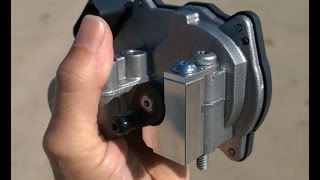
How to confirm: With the engine off, observe the actuator arm on the flap motor. If it moves slightly past its intended stop when released, the mechanism is worn. The Dieselgeek repair bracket is designed to physically limit this over-travel.
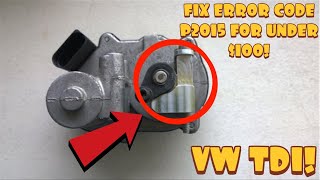
Typical fix: Install a model-specific repair bracket (e.g., from Dieselgeek) that limits the actuator's range of motion, preventing it from over-traveling. This is a highly effective and popular repair that costs significantly less than replacing the entire manifold.
Est. part cost: $60-$80 for a repair bracket. - Failed Intake Manifold Runner Position Sensor ⚪ Low Probability While possible, the sensor itself (G336) fails much less frequently than the mechanical components. The code is more often a result of the mechanical parts moving out of the sensor's expected range.
How to confirm: This is difficult to confirm without swapping parts. If the mechanical linkage and actuator arm are confirmed to be intact and moving correctly, the sensor becomes a more likely suspect. A capable scan tool can monitor the sensor's voltage and percentage, which should move smoothly when the actuator is moved by hand.
Typical fix: The sensor is not sold separately from the intake manifold by VW, though some aftermarket suppliers offer it. Replacement of the entire intake manifold assembly is the official repair.
Est. part cost: $150-$400 for a complete intake manifold. - Clogged or Restricted Vacuum Lines ⚪ Low Probability
How to confirm: Inspect the vacuum lines running to the intake manifold actuator for cracks, blockages, or disconnections. A TSB suggests debris can clog the lines or T-fittings, causing this fault.
Typical fix: Clean or replace the affected vacuum lines or fittings.
Est. part cost: $10-$30
Rare But Worth Checking
- Excessive Carbon Buildup: On direct-injection engines like the 2.0T TSI, carbon can build up on the intake valves and flaps, causing them to stick or bind. This can restrict movement and trigger the code. This is often addressed with a walnut blast cleaning service during an intake manifold replacement.
- Failed Intake Manifold Runner Control Solenoid (N316): This solenoid controls the vacuum supplied to the actuator. If it fails, the flaps won't move correctly. It can be tested and replaced separately.
Diagnosis Steps
- Read the fault codes with an OBD-II scanner (like VCDS for VW/Audi) and note any other codes present.
- Remove the engine cover and locate the intake manifold actuator on the driver's side of the engine (TSI) or the front of the engine (TDI).
- For TSI: Visually inspect the black plastic actuator arm and linkage. Check for obvious breaks or cracks. Gently try to pull the actuator arm's linkage away from the manifold. If it pops out or has significant play, the internal mechanism is broken, and the manifold needs replacement.
- For TDI: Observe the actuator motor. Have an assistant cycle the ignition and watch the arm's movement. If it over-travels its stop, a repair bracket is needed.
- If the linkage seems intact, check the vacuum lines connected to the actuator and control solenoid for any cracks, leaks, or blockages. TSB 24-17-03 specifically mentions checking for debris in vacuum tees.
- With a capable scan tool, monitor the live data for the intake manifold flap position (e.g., VCDS Group 142). Actuate the flaps and observe if the sensor readings change smoothly and within the specified range. A reading of 0% is expected at idle, while the ECU will command 99.2% during adaptation. A reading that is out of range or stuck indicates a fault.
- If the actuator arm stop is worn/broken, decide between installing an aftermarket repair bracket (a common, affordable fix) or replacing the entire intake manifold (the OEM-approved repair).
Parts You'll Likely Need

- Intake Manifold Runner Repair Bracket — This is the most common and cost-effective fix for the TSI and TDI engines when the actuator arm stop has failed or worn. It provides a new, durable stop for the lever, preventing over-travel.
Trusted brands: Dieselgeek, ECS Tuning, Various on Amazon/eBay
OEM price range: N/A
Aftermarket price range: $40-$80 - Intake Manifold Assembly
(OEM #06J133201BH)— This is the official repair and is necessary if the internal manifold components are broken, not just the external stop. It is the only way to get a new position sensor (G336) from the dealer.
Trusted brands: Volkswagen (OEM), URO Parts, Febi-Bilstein
OEM price range: $250-$400
Aftermarket price range: $150-$250
Related Codes That Often Appear With This One
- P2014 — This code for 'Intake Manifold Runner Position Sensor/Switch Circuit' is a closely related fault and is often listed in the same TSBs as P2015.
- P2004 — This code indicates 'Intake Manifold Runner Control Stuck Open' and points to the same system of components.
- P030x (e.g., P0300, P0301) — Misfire codes can occur if a broken intake manifold creates a significant vacuum leak.
- P2006 — This code for 'Intake Manifold Runner Control Stuck Closed' is also related to the same flap system.
Technical Service Bulletins (TSBs) & Recalls
- V241501 / 2038161: Published Jan 2015, this TSB addresses P2014 or P2015 faults on 2008-2011 2.0T engines. It notes the cause is a failure of the intake manifold and the production solution was an improved manifold design. It refers technicians to a warranty extension program.
- 24-17-03 / 2045138: Published Mar 2017 for 2008-2016 2.0T engines, this TSB advises inspecting vacuum lines and tee fittings for debris/clogs before replacing the entire manifold for P2004, P2014, or P2015 codes.
- VIN-4-A-PIN AUGU: A general TSB from Aug 2016 that lists P2015 as a known MIL-ON fault code to be aware of during service.
- 24M2/O3 / 2017354: An earlier TSB from 2008 mentioning an ECM software update to address several intake flap codes, including P2008 and P2004, related to the flap motor and sensor.
Platform-Specific Known Issues
- Real Owner Experience (TDI): On TDIClub and Reddit, numerous owners report getting a P2015 code, being quoted $1,000+ by a dealer for a new manifold, and successfully fixing it in under 30 minutes with the ~$65 Dieselgeek repair bracket. Many state the check engine light turns off on its own after a few drive cycles.
- Real Owner Experience (TSI): A user on the GolfMk6 forum with an intermittent P2015 code noted that since the actuator arm hadn't popped off and symptoms were absent, the likely culprit was a flaky position sensor. Since the warranty was expired, they planned to wait until symptoms appeared before replacing the whole manifold, as the sensor isn't sold separately.
- Warranty Extension: VW issued an extended warranty for the 2.0T TSI intake manifold, covering it up to 120,000 miles for many vehicles. Owners within this mileage should check with a dealer before paying for a repair. However, modifications, such as drilling a hole in the manifold for a boost gauge, could lead to the warranty claim being denied.
Mechanic-Grade Diagnostic Values
- VCDS Intake Flap Position (TSI) — expected: Actual angle should be ~0% at idle. During adaptation, ECU will command 99.2% and actual should match.. Failure: Actual angle does not match specified, is stuck, or reads out of range. An 'Adaptation Error' message after the test also indicates a problem.
- VCDS Intake Flap Adaptation (TDI) — expected: During a Basic Settings test, the V157 motor should cycle smoothly between its open and closed stops.. Failure: The motor does not move, moves erratically, or does not complete the full range of motion.
- TDI V157 Motor Wiring Continuity — expected: When checking continuity between the V157 connector pins and the corresponding ECU terminals, resistance should be 1.5 Ohms or less.. Failure: High resistance or an open circuit (no continuity) indicates a break in the wiring harness.
Scan Tool Commands That Help

- VCDS (VAG-COM): Basic Settings - Group 142 (TSI) or 'Intake manifold flap adaptation' (TDI) — This must be performed after replacing the intake manifold or actuator motor to teach the ECU the new end-stop positions of the flaps. Failure to adapt can cause the P2015 code to return even with new parts.
- VCDS (VAG-COM): Output Tests - Intake Manifold Flap — This allows a technician to command the flap motor to cycle, which helps verify if the motor, linkage, and sensor are responding to commands from the ECU. It's a good first step to see if the system is electrically functional.
Wiring & Ground Locations
- G336 - Intake Manifold Runner Position Sensor (TSI) — On the passenger side (RH side in US) of the intake manifold, just behind the oil filter housing.. This is the sensor that reports the flap position to the ECU. Its connector is hard to reach and can be damaged during other services.
- V157 - Intake Flap Motor (TDI) — On the front of the aluminum intake manifold on 2.0L TDI engines.. This is the assembly that wears out and is the target for the repair bracket. Its 5-pin connector wiring can be tested for continuity back to the ECU.
- TDI V157 Motor Pinout (for CBEA engine) — Connector on the V157 motor.. Allows for advanced electrical diagnosis. Pin 1 -> ECU T10, Pin 2 -> ECU T27, Pin 3 -> ECU T51 (Ground), Pin 4 -> ECU T35, Pin 5 -> ECU T50.
Real Owner Repair Stories
- Reddit user in /r/Volkswagen (2010 VW CC 2.0T TSI) — P2015 code, intermittent hard brakes at low speed (loss of brake boost).
❌ Tried (didn't work) Carbon cleaning, Throttle body replacement, Intake manifold replacement
✅ What actually fixed it Cleaning a small screen inside the vacuum pump. The user noted issues persisted after cleaning, so they removed the screen entirely, which resolved the P2015 code and the intermittent brake boost issue. - Reddit user in /r/mk6gti (VW Mk6 GTI) — P2015 code, rough running and sucking sound for the first 30 seconds after startup.
❌ Tried (didn't work) Replacing intake manifold with a new Febi-Bilstein unit., Disconnecting/reconnecting the battery to reset the ECU.
✅ What actually fixed it The official VW service manual (erWin) stated that the Intake Manifold Runner Position Sensor (G336) must be adapted to the ECU using a diagnostic tester after replacement. While some users reported not needing this step, for this user, the code persisted until the adaptation was performed. Another user noted that sometimes the adaptation fails via VCDS but will complete on its own after a few drive cycles. - Ross-Tech Forums user (2010 VW GTI) — P2015 and P2004 codes with CEL, VCDS adaptation shows 'ERROR'.
❌ Tried (didn't work) Smoke testing for vacuum leaks (passed)., Vacuum pump testing (passed)., Replacing intake manifold with newest revision., Replacing spark plugs., Manually verifying flap movement and sensor response via VCDS Measuring Blocks.
✅ What actually fixed it After exhausting all other possibilities, the user replaced the N316 Intake Manifold Runner Control Solenoid. This finally resolved the codes and allowed the adaptation to complete successfully. The old solenoid appeared to function but was faulty.
"I Checked Everything" — The Actual Cause
- A well-documented case on the Ross-Tech forums involved a 2010 GTI where P2015 and P2004 codes persisted despite the vehicle passing smoke and vacuum tests, and having a new intake manifold. The actuator moved correctly during VCDS output tests, and the sensor values appeared to respond. The root cause was a faulty N316 vacuum control solenoid, which was not caught by the standard leak tests.
When the Usual Fixes Don't Work
- While the aftermarket repair bracket is the most common fix, it is not a silver bullet. Multiple owner reports confirm that if the code returns after installing a bracket or even after a full manifold replacement, the root cause may be upstream. Two notable examples are a clogged screen in the main vacuum pump, which also affected brake assist, and a faulty N316 control solenoid that passed basic tests but failed during the ECU's adaptation sequence. In these cases, mechanics had to look beyond the manifold itself and diagnose the control and vacuum supply systems.
OEM Part Supersession History
06J133201AD, 06J133201AL, 06J133201AS, 06J133201BD→06J133201BH— The original plastic manifold designs were prone to the actuator arm breaking or the internal stop failing. The revised part is intended to be more durable.
Heads up: When upgrading from an early manifold to the revised 06J133201BH on some models, the mounting bracket for the fuel rail may not align perfectly and may require minor modification or grinding to fit correctly.
Model Year Variations Within This Range
- 2009-2014 (TDI): The popular aftermarket bracket fix for P2015 on TDI engines is specifically for models equipped with the aluminum intake manifold (Part No. 03L129711E). Later models may have a plastic intake manifold for which this specific bracket fix does not apply.
- 2010-2014 (TSI): The P2015 issue is most common on the EA888 Gen1 and Gen2 engines. The Golf Mk7 (2015+) introduced the EA888 Gen3 engine, which features a significantly redesigned cylinder head and intake system, making this specific failure mode far less common.
Helpful Videos
We Have This Part in Stock



The information in this article is provided for general reference and educational purposes only. Vehicle specifications, procedures, and part compatibility can vary by production date, trim level, and region. Always consult your vehicle's factory service manual and verify part numbers before purchasing or performing repairs. Safety-critical components such as airbags, seat belts, and braking systems should be installed by a qualified professional.
- Volkswagen GOLF:
- 🎬 Helpful Videos
- 🛍️ Shop This Part
- What's Unique About the 2010-2016 Volkswagen GOLF
- Diagnostic Flowchart
- Symptoms You May Notice
- Most Likely Causes
- Rare But Worth Checking
- Diagnosis Steps
- Parts You'll Likely Need
- Related Codes That Often Appear With This One
- Technical Service Bulletins (TSBs) & Recalls
- Platform-Specific Known Issues
- Mechanic-Grade Diagnostic Values
- Scan Tool Commands That Help
- Wiring & Ground Locations
- Real Owner Repair Stories
- "I Checked Everything" — The Actual Cause
- When the Usual Fixes Don't Work
- OEM Part Supersession History
- Model Year Variations Within This Range
- 🎟️ Get 5% Off