

P2015 on 2005-2009 Mercedes E-Class E280/E320 CDI: Intake Runner Sensor Causes and Fixes
On the OM642 diesel engine, code P2015 almost always points to a problem with the intake manifold's swirl flap system. The most common cause is the swirl flap actuator motor (M55) failing due to a recurring oil leak from the turbo intake seal located directly above it. A broken plastic linkage arm is another frequent culprit. Repair involves replacing the motor and the leaking seal.
- P2015 on an OM642 engine is a very common and well-understood problem.
- The root cause is almost always the swirl flap motor (actuator) or its plastic linkage.
- A leaking turbo intake seal is the primary killer of the swirl flap motor. You MUST replace this seal to achieve a lasting repair.
- Do not replace the entire intake manifold if only the external linkage is broken; durable metal aftermarket kits are a much better value.
- Expect the car to be in a low-power 'limp mode' until the issue is resolved.
What's Unique About the 2005-2009 Mercedes-Benz E-Class

The OM642 V6 diesel engine has a significant design flaw that makes it uniquely prone to this code. The electronic swirl flap actuator motor (officially called the Intake Port Shutoff Motor, M55) is positioned directly underneath the turbocharger's air inlet pipe. A seal on this pipe frequently leaks oil, which drips directly onto the actuator motor, shorting out its electronics and causing it to fail. This combination of a common oil leak and vulnerable component placement is the primary reason P2015 is a well-known issue for owners of these vehicles. Some owners have even fabricated metal shields to protect the new motor from future leaks.
Symptoms You May Notice
- Check Engine Light is on.
- Significant loss of engine power, often described as 'limp mode'.
- Sluggish or slow acceleration.
- Engine RPM may not go above 2,000-3,000 RPM.
- Reduced fuel economy.
- Rough or unstable idle.
- Gearbox may jerk when shifting between Drive and Reverse.
- Replacing only the swirl flap motor without replacing the leaking turbo intake seal. The new motor will inevitably fail again from oil contamination.
- Replacing the entire intake manifold assembly when only the external plastic linkage rods are broken. Upgraded metal linkage kits are a much cheaper and more durable repair.
- Mistaking the oil dripping from the turbo seal for the more severe OM642 oil cooler leak. While both are common, the swirl motor oil leak originates high on the front of the engine, whereas the oil cooler leak pools deep in the engine 'V' and drips down the back of the engine near the bellhousing.
Most Likely Causes


- Intake Port Shutoff Motor (Swirl Flap Motor) Failure due to Oil Contamination 🔴 High Probability The motor is located directly below the turbo intake pipe, which has a red/orange seal that commonly leaks oil directly onto the motor's electronics, causing it to short out and fail. This is the most widely documented cause for P2015 on the OM642 engine.
How to confirm: Visually inspect the swirl flap motor (M55), located in the 'V' of the engine. Look for signs of fresh oil coating the motor and dripping from the red/orange seal on the turbo intake pipe above it.
Typical fix: Replace the failed swirl flap motor and, crucially, replace the turbo intake seal (and any other related crankcase ventilation seals) to prevent the new motor from failing for the same reason. Some owners also install a 4.7k Ohm resistor in the motor's electrical connector as a bypass to trick the ECU and exit limp mode, though this disables swirl flap function.
Est. part cost: $130-$250 - Broken Intake Manifold Runner Connecting Rods (Swirl Flap Linkage) 🟡 Medium Probability The original connecting rods that link the motor to the swirl flaps are made of plastic. Over time, constant heat cycles and stress from carbon-caked flaps cause the plastic to become brittle, wear out at the connection points, and eventually break.
How to confirm: Visually inspect the linkage arms on the front of the intake manifolds. The plastic rods may be visibly snapped, or the connection points will be worn into an oval shape and loose, allowing for excessive play.
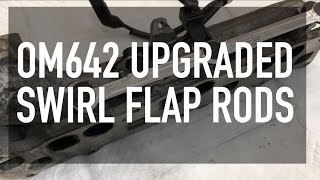
Typical fix: Replace the broken plastic rods. Aftermarket repair kits with more durable billet aluminum rods are widely available and recommended over the OEM plastic parts for a permanent fix. Mercedes does not sell the rods separately, only as part of a complete intake manifold assembly, making the aftermarket kits a much more cost-effective repair.
Est. part cost: $50-$150 - Stuck or Clogged Intake Manifold Swirl Flaps ⚪ Low Probability Like many diesel engines, the OM642's EGR (Exhaust Gas Recirculation) system can cause heavy carbon and oil deposits to build up inside the intake manifold over many miles. This buildup can physically jam the swirl flaps, preventing them from moving and putting stress on the linkage and motor.
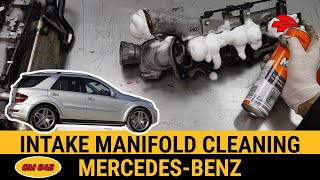
How to confirm: With the linkage disconnected, attempt to move the swirl flap arms by hand. If they are stiff, gritty, or will not move, they are clogged with carbon. 🎬 See this guide on deep cleaning your intake manifolds. This requires removing the intake manifolds for cleaning.
Typical fix: Remove both intake manifolds and thoroughly clean the carbon buildup from the internal passages and the swirl flaps themselves. This is a labor-intensive job. Some owners opt to delete the flaps entirely during this process by removing them and plugging the shaft holes with bolts.
Est. part cost: $20-$40 (for gaskets)
Rare But Worth Checking
- Faulty Position Sensor: While the code directly names the sensor, the sensor itself is integrated into the swirl flap motor assembly (A6421500494) on this engine. It rarely fails on its own; failure is almost always a consequence of the motor failing, usually from oil contamination.
Diagnosis Steps
- Scan the ECU for trouble codes. Confirm P2015 is present, and note any other related codes like P2006 or the Mercedes-specific 2513-001.
- Remove the top engine cover to access the front of the engine.
- Visually inspect the area in the 'V' of the engine, below the large black turbo intake pipe. Check for oil residue on the swirl flap motor (a black electronic component, M55).
- Inspect the red/orange seal on the turbo intake pipe (part A6420940080) directly above the motor. This is the most likely source of a leak.
- Examine the plastic linkage rods connecting the motor to the two intake manifolds. Check if they are snapped, disconnected, or have excessive play at their connection points.
- If the motor is oil-soaked, it has almost certainly failed and must be replaced along with the leaking seal(s).
- If the linkage is broken, it must be replaced. Consider using an upgraded metal repair kit from a brand like IDParts or X8R.
- If the motor and linkage appear intact, the flaps themselves may be seized with carbon. This requires a more extensive teardown to clean the intake manifolds.
- Check fuse F44 (15 amp) in the engine bay fuse box, as a shorted swirl motor can blow this fuse, which also powers the turbo actuator.
Parts You'll Likely Need

- Intake Port Shutoff Motor / Swirl Flap Motor
(OEM #A6421500494)— This motor is the most common point of failure, typically due to oil contamination from a leaking seal above it.
Trusted brands: Pierburg (OEM), Bosch, Mercedes-Benz Genuine
OEM price range: $200-$250
Aftermarket price range: $130-$180 - Intake Manifold Runner Linkage Repair Kit — The original plastic linkage becomes brittle and breaks. Aftermarket metal kits provide a permanent solution.
Trusted brands: X8R, IDParts
OEM price range: N/A (Not sold separately by Mercedes)
Aftermarket price range: $50-$150 - Turbocharger Intake Seal
(OEM #A6420940080)— This orange/red seal is the source of the oil leak that destroys the swirl flap motor. It is essential to replace this seal when replacing the motor.
Trusted brands: Mercedes-Benz Genuine, Elring
OEM price range: $15-$25
Aftermarket price range: $10-$20 - Crankcase Breather Hose Seal
(OEM #A6420940580)— This is another seal in the intake tract that is often replaced at the same time as the main turbo seal to prevent all sources of oil leaks in the area. Often sold in a kit with A6420940080.
Trusted brands: Mercedes-Benz Genuine
OEM price range: $10-$20
Aftermarket price range: $5-$15
Related Codes That Often Appear With This One
- P2006 — This code indicates 'Intake Manifold Runner Control Stuck Closed'. It often appears alongside P2015 as it points to the same root problem with the swirl flap system.
- 2513-001 — This is a Mercedes-specific fault code for 'Inlet port shutoff motor'. It directly points to an electrical fault or position error with the M55 swirl flap motor and is often the underlying code when a generic P2015 is read.
- P2510 — This code for the 'Y77/1 (Boost pressure regulator positioner) signals fault'. It can appear with P2015 because the swirl motor, turbo actuator, and other sensors may share the same fuse, which can blow when the swirl motor shorts out.
Platform-Specific Known Issues
- The placement of the swirl flap motor directly under the turbo intake pipe is a major design flaw leading to frequent, predictable failures from oil leaks.
- Mercedes-Benz does not sell the plastic swirl flap linkage rods separately, forcing dealers to recommend replacing the entire intake manifold assemblies at great expense when a simple aftermarket metal linkage kit can provide a permanent fix.
Mechanic-Grade Diagnostic Values
- M55 Swirl Flap Motor Resistance — expected: ~1.4 kΩ between pins 2 and 3.. Failure: This resistance value may be identical on both good and faulty motors. The true failure is often mechanical. A key indicator is a slow (~2 seconds) return time of the actuator arm when manually rotated against its spring, whereas a new motor's arm snaps back instantly.
- M55 Swirl Flap Motor Bench Test PWM Signal — expected: 141 Hz. Failure: The motor will not respond to common PWM frequencies in the 1-5 kHz range, causing many bench tests to incorrectly show a good motor as failed. It must be driven at 141 Hz to function.
- Resistor Bypass Value — expected: 4.7k Ohm (4700 Ohm), typically 2W to 5W rating.. Failure: This is not a diagnostic value for a part, but a value for a common workaround. The resistor is installed between pins 2 and 3 of the wiring harness connector for the M55 motor to trick the ECU.
Hidden / Shadow Codes Worth Checking
- 2513-001: Check component M55 (Inlet port shutoff motor). Positioner signals fault. This is the manufacturer-specific code that directly identifies a problem with the swirl flap motor's position feedback. (see via Mercedes-Benz specific diagnostic tools like STAR/XENTRY or higher-end professional scanners (iCarsoft for Mercedes, etc.). Basic OBD-II readers will typically only show the generic P2015 code.)
Scan Tool Commands That Help
- Mercedes STAR/XENTRY: M55 (Inlet port shutoff motor) Actuation Test — To command the motor to cycle open and closed while observing its physical movement and the linkage. This confirms if the motor is receiving the command and is mechanically capable of moving the flaps.
- Mercedes STAR/XENTRY: Adaptation/Teach-in Process for M55 — After replacing the M55 motor. The ECU may need to learn the new motor's end stops and range of motion. Some users report the P2015 code remains after motor replacement until this procedure is run.
Wiring & Ground Locations
- M55 Motor Connector — In the 'V' of the engine, plugged into the swirl flap motor, underneath the main turbo air intake pipe.. This 4-pin connector is where all electrical testing occurs. Pin 2 is +12V and Pin 3 is the signal wire. The common resistor bypass is installed between these two pins. The connector is highly susceptible to oil contamination from the leaking seal above it.
- W11 Ground Point — Main ECU/engine wiring harness ground point, typically located on the chassis near the ECU box.. While not a common cause for this specific code, a poor engine computer ground can cause a wide range of erratic sensor reading faults. If the M55 motor and wiring test good, verifying the main ECU ground is a valid next step.
- Engine-to-Chassis Ground Strap — Large braided cable connecting the engine block/transmission bell housing area to the vehicle's chassis.. A corroded or loose main engine ground can cause a variety of electrical issues. A simple test is to measure voltage between the battery negative terminal and the engine block while cranking; it should be less than 0.5V.
Real Owner Repair Stories

- MBWorld.org Forums user 'Dhollenback' (2006 E320 CDI, 191,567 miles) — Sudden loss of power, engine would not exceed 2,000 RPM, CEL came on with code P2015.
✅ What actually fixed it Replacing the intake manifold actuator (swirl flap motor) resolved the issue and restored power. The user noted to be very careful with the plastic ball clips during the repair. - Mercedes-Benz Owners' Forums user 'merc mad' (ML320 CDI (OM642 engine)) — Multiple fault codes including reference to M55 inlet motor.
❌ Tried (didn't work) Measuring resistance of the motor, as the faulty unit and the new unit both showed an identical reading of 1.394 kOhm.
✅ What actually fixed it The user noticed the actuating arm on the old motor was very slow to return when rotated against its spring (approx. 2 seconds), while the new motor arm snapped back instantly. The failure was internal friction, not an electrical fault detectable by a simple resistance check. Replacing the motor fixed the problem. - MBWorld.org Forums user 'krzysiek' (W211 E280 CDI V6 (OM642.920)) — P2015 error code.
❌ Tried (didn't work) Replacing the flap actuator with a new Pierburg unit did not solve the problem; the P2015 error remained.
✅ What actually fixed it The user was still diagnosing the issue, suspecting the intake flaps themselves were dirty or there was an EGR problem. As a temporary solution to get the car running properly, they installed a resistor to bypass the motor. This story highlights that a new motor may not fix the code if the flaps are seized.
When the Usual Fixes Don't Work
- In one documented case, a technician replaced the M55 swirl flap motor with a new OEM unit, but the P2015 fault code persisted. The technician then suspected the root cause was not the motor itself, but rather that the swirl flaps inside the intake manifolds were physically seized due to heavy carbon buildup. As a temporary measure, the owner resorted to using the resistor bypass trick to exit limp mode while awaiting a more intensive intake manifold cleaning. This demonstrates that while the motor is the most common failure point, it's not the only one, and seized flaps can produce the same code.
OEM Part Supersession History
A6421500194, A6421500294, A6421500394→A6421500494— Progressive updates and consolidation of the part number for the M55 Intake Port Shutoff Motor.
Heads up: The latest part number, A6421500494, is the correct replacement for the specified vehicle range.
Model Year Variations Within This Range
- 2009+: For OM642 engines from 2009 onwards, the simple 4.7k Ohm resistor bypass may not be sufficient. These later engines have additional sensors to verify the physical movement of the swirl flaps. Disconnecting the motor and using a resistor will still trigger a fault. A successful bypass on these models requires ECU tuning to disable the swirl flap system check entirely.
Diagnostic Flowchart
Other Known Issues on This Vehicle
Issues unrelated to this code that are worth knowing about as an owner of this generation:
- Oil Cooler Seal Leak 🔴 High — Very common, typically occurs after 80,000-100,000 miles. Original orange seals degrade; updated purple Viton seals last longer.
- Timing Chain Stretch 🔴 High — Can occur as early as 70,000-90,000 miles, causing a rattling noise on cold startup for a few seconds.
- Fuel Injector Seal Failure ('Black Death') 🟠 Medium — Common at higher mileage. Leaking injector seals cause a buildup of hard, black carbon deposits around the injectors in the cylinder head.
- Turbocharger Actuator Failure 🟠 Medium — The electronic actuator for the variable geometry turbo can fail, causing a loss of boost. Often sold only as a complete turbo assembly by the dealer.
- NOx Sensor Failure 🟠 Medium — Common on BlueTec models. Failure can trigger a start-countdown, eventually immobilizing the vehicle until repaired.
Used vs. New Parts: Buying Guide for This Vehicle
When a used part is the smart pick: Buying a complete, used intake manifold assembly from a documented low-mileage (<60,000 miles) donor vehicle can be a viable option, as it includes the manifolds, flaps, and linkages. However, buying a standalone used M55 swirl flap motor is very risky, as it's a common failure item with no easy way to verify its remaining lifespan.
Donor-vehicle mileage cap: roughly under 60000 miles for the part to have meaningful remaining life.
What to inspect on the donor part:
- Verify the donor vehicle's mileage.
- Inspect the intake ports for signs of excessive carbon buildup; light soot is normal, but thick, tar-like deposits are a red flag.
- Manually actuate the swirl flap linkage on the donor manifold; it should move smoothly with minimal resistance.
- Check for any signs of oil leaks around the turbo intake area on the donor engine, as this would suggest the M55 motor was subjected to the same failure conditions.
OEM-only on this vehicle (don't cheap out):
- Turbocharger Intake Seal (A6420940080) and other related crankcase seals. They are inexpensive and absolutely critical to preventing a repeat failure of the M55 motor. Using genuine or OEM-supplier (Elring) parts is strongly advised.
Aftermarket brands forum-validated for this vehicle:
- Pierburg (for the M55 swirl flap motor, as they are the Original Equipment Manufacturer).
- X8R, IDParts (for metal swirl flap linkage repair kits, which are considered a permanent upgrade over the OEM plastic parts).
Brands owners have reported issues with on this vehicle:
- Unbranded, low-cost resistor bypass modules/plugs, especially those with a simple black epoxy/plastic coating. These have been reported to melt from engine heat, creating a potential fire hazard.
Real Owner Stories
Aggregated from forums and TSBs cited above. Mileages and costs reflect what owners reported in those sources.
2007 Mercedes-Benz E320 Bluetec (OM642)
Symptoms: Classic limp mode symptoms with a Check Engine Light and code P2015.
What fixed it: The community identified the swirl flap motor as the likely cause due to the common oil leak issue.
Source hint: MBWorld.org: Thread 'Error code p2015'
Mercedes-Benz E320 CDI (W211)
Symptoms: Limp mode accompanied by codes P2015, 2510, and 2513.
What fixed it: Diagnosis revealed a blown common fuse caused by the swirl motor failing from an oil leak, which also affected the turbo actuator.
Source hint: MBClub.co.uk: Thread 'W211 E320cdi limp mode,codes'
2014 Mercedes-Benz E320 CDI
Symptoms: P2015 code and an 'oily mess' in the engine valley.
What fixed it: Replacement of the inlet port motor (M55) and the leaking turbo seal.
Source hint: BenzWorld.org: 'E320CDI Inlet port flaps'
Related OBD-II Codes
Frequently Asked Questions
Why does my E320 CDI keep blowing fuse F44, and how is it related to the P2015 code?
My Mercedes dealer says I need to replace the entire intake manifold for a broken linkage. Is there a cheaper way?
What is the 'red/orange seal' everyone mentions regarding the OM642 engine and P2015?
Can I bypass the swirl flap motor to get my E280 CDI out of limp mode?
How can I tell if my P2015 is caused by carbon buildup or a failed motor?
Is the P2015 code on my E-Class related to the 'Black Death' injector issue?
Helpful Videos
Used OEM Parts in Stock


New Aftermarket Parts Available



The information in this article is provided for general reference and educational purposes only. Vehicle specifications, procedures, and part compatibility can vary by production date, trim level, and region. Always consult your vehicle's factory service manual and verify part numbers before purchasing or performing repairs. Safety-critical components such as airbags, seat belts, and braking systems should be installed by a qualified professional.
- Mercedes-Benz E-Class:
- 🎬 Helpful Videos
- 🛍️ Shop This Part
- What's Unique About the 2005-2009 Mercedes-Benz E-Class
- Symptoms You May Notice
- Most Likely Causes
- Rare But Worth Checking
- Diagnosis Steps
- Parts You'll Likely Need
- Related Codes That Often Appear With This One
- Platform-Specific Known Issues
- Mechanic-Grade Diagnostic Values
- Hidden / Shadow Codes Worth Checking
- Scan Tool Commands That Help
- Wiring & Ground Locations
- Real Owner Repair Stories
- When the Usual Fixes Don't Work
- OEM Part Supersession History
- Model Year Variations Within This Range
- Diagnostic Flowchart
- Other Known Issues on This Vehicle
- Used vs. New Parts: Buying Guide for This Vehicle
- Real Owner Stories
- 2007 Mercedes-Benz E320 Bluetec (OM642)
- Mercedes-Benz E320 CDI (W211)
- 2014 Mercedes-Benz E320 CDI
- Related OBD-II Codes
- Frequently Asked Questions
- 🎟️ Get 5% Off