

P2015 on 2010-2012 Kia Sorento: Intake Runner Position Sensor Causes and Fixes
On a 2010-2012 Kia Sorento, especially with the 2.4L engine, code P2015 usually points to a problem with the intake manifold runner control (IMRC) system. The most common fix is replacing the entire intake manifold assembly due to a broken internal plastic rod that connects the runner flaps. For diesel models, the issue is often a faulty actuator.
- P2015 on a 2010-2012 Sorento points to an issue with the intake manifold's variable airflow system.
- For the 2.4L gas engine, the cause is almost always a broken plastic component inside the intake manifold, requiring a full replacement of the manifold.
- For diesel engines, the problem is typically a failed electronic actuator that controls the flaps.
- Simply replacing the position sensor without checking the mechanical parts is a common misdiagnosis and will not fix the problem if the manifold or actuator has failed.
What's Unique About the 2010-2012 Kia Sorento
While the code points to a sensor, the actual problem on the 2.4L gasoline engine is almost always a mechanical failure inside the intake manifold itself. A plastic rod connecting the internal flaps breaks, causing them to go out of sync; one flap may be stuck open while the other is closed. The sensor correctly reports this implausible position. On the less common diesel models, the failure is more likely to be the electronic actuator that moves the flaps. This guide will focus primarily on the 2.4L gasoline engine, which is part of the Theta II engine family known for this issue across several Hyundai and Kia models.
Symptoms You May Notice
- Check Engine Light is on
- Reduced engine power and sluggish acceleration
- Poor fuel economy
- Rough or unstable idle
- Inability to accelerate past a certain RPM (e.g., 3,500 RPM)
- Replacing only the position sensor when the intake manifold itself has failed internally on the 2.4L engine.
- Replacing the MAP (Manifold Absolute Pressure) sensor, which is a different component with a different function.
- Replacing the intake manifold when only the external VCM actuator has failed (on models where it is a separate part).
Most Likely Causes
- Internal Failure of Intake Manifold (2.4L Gas Engine) 🔴 High Probability The design uses a plastic rod and flaps inside the manifold which can become brittle and break over time, leading to a loss of synchronized movement. This is a well-documented failure on the Theta II engine platform.
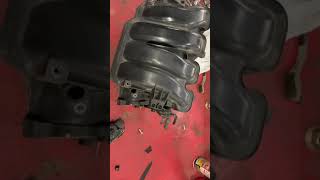
How to confirm: Visually inspect the actuator arm and linkage for movement. On some models, you can see the flaps through the throttle body opening. A definitive confirmation involves removing the manifold and observing the flaps; a video shows one flap stuck open while another is closed, confirming the internal break. 🎬 Watch: See a broken internal flap demonstration Manually trying to move the external linkage may reveal it feels loose or disconnected.
Typical fix: The entire intake manifold assembly must be replaced. The internal components are not serviced separately. The original position sensor is usually transferred to the new manifold. The OEM part number for the manifold is often cited as 28310-2GGA0.
Est. part cost: $250-$400 - Failed Intake Manifold Runner Actuator (Diesel Engine) 🔴 High Probability The electronic actuator that controls the swirl flaps is a known failure point on the diesel variants. Corrosion can build up on the linkage, causing it to bind and overload the actuator motor.
How to confirm: Scan tool data may show the actuator is not responding to commands. A physical inspection may show the actuator arm is not moving when the engine is running or revved. The linkage can be disconnected and cleaned as a first step.
Typical fix: Replace the intake manifold runner actuator. A modified/updated part may be available. The part number is often cited as 28320-2A400 or 28320-2A410.
Est. part cost: $100-$200 - Faulty Intake Manifold Runner Position Sensor / Actuator (VCM) ⚪ Low Probability On GDI engines, the actuator motor itself (also called a Variable Charge Motion or VCM actuator) can fail. The internal gears may strip or the motor can burn out, which is a common issue on the greater Hyundai/Kia 2.4L platform. The sensor is often integrated into this actuator.
How to confirm: If the manifold flaps are confirmed to be working correctly, the actuator/sensor unit can be tested. A capable scan tool can command the actuator to move; listening for a squeaking or grinding noise, or no movement at all, points to a faulty unit. The actuator can also be bench-tested. The part number for this actuator is commonly 28323-2GGA1.
Typical fix: Replace the position sensor/actuator assembly. Note that on some models, this sensor is sold as part of the complete intake manifold assembly, but it is often available separately.
Est. part cost: $50-$120 - Wiring or Connector Issue ⚪ Low Probability
How to confirm: Visually inspect the wiring harness and connector going to the position sensor and actuator for any signs of damage, corrosion, or loose connections.
Typical fix: Repair the damaged wiring or clean/replace the connector.
Est. part cost: $10-$50
Rare But Worth Checking
- Carbon Buildup: On high-mileage engines, especially GDI (Gasoline Direct Injection) models, carbon can build up on the intake valves and runner flaps, causing them to stick. This is less common than outright mechanical failure but is worth considering. A walnut shell blast cleaning service is sometimes recommended to resolve this.
Diagnosis Steps
- Read the trouble codes with an OBD-II scanner and note any other codes present, especially P200A.
- Identify the engine in the vehicle (2.4L Gas or Diesel) as the diagnostic path differs.
- Visually inspect the wiring and connector for the Intake Manifold Runner Position Sensor and actuator for any obvious damage.
- With the engine cover off, observe the actuator and linkage arm (if visible). Use a capable scan tool to perform an actuation test, commanding the runner flaps to open and close. Listen for noise and watch for movement.
- For 2.4L Gas: If the actuator moves but the code persists, or if movement feels disconnected, suspect a broken internal rod. If the actuator makes a grinding/squeaking noise or doesn't move, the actuator itself is likely bad. If the linkage feels stiff or gritty, carbon buildup may be the cause. Final confirmation of a broken rod requires removing the intake manifold.
- For Diesel: Test the actuator's response using a capable scan tool. If it fails to respond, inspect the linkage for corrosion/binding before condemning the actuator.
- If all mechanical parts appear to be working, test the position sensor's voltage output and resistance to ensure it is within the manufacturer's specified range.
Parts You'll Likely Need
- Intake Manifold Assembly (2.4L Gas)
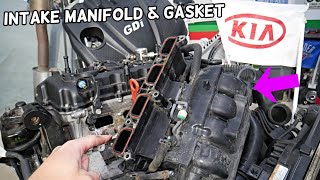
(OEM #28310-2GGA0)— This is the most common failure. The internal runner control mechanism breaks, and the manifold is serviced as a complete assembly. 🎬 Watch: Step-by-step intake manifold removal guide
Trusted brands: Kia (Genuine OE), Hyundai (Genuine OE)
OEM price range: $260-$400
Aftermarket price range: $200-$350 - Intake Manifold Gasket — Should always be replaced when the intake manifold is removed to ensure a proper seal. A new OEM manifold often includes this gasket.
Trusted brands: Fel-Pro, Mahle, Kia (Genuine OE)
OEM price range: $20-$40
Aftermarket price range: $15-$30 - Intake Manifold Swirl Flap Actuator (Diesel)
(OEM #28320-2A410)— The electronic actuator is the common failure point for this code on diesel engines.
Trusted brands: Kia (Genuine OE), Hella
OEM price range: $150-$250
Aftermarket price range: $100-$180 - Variable Charge Motion (VCM) Actuator (2.4L Gas)
(OEM #28323-2GGA1)— If the manifold itself is not broken internally, this external motor/sensor unit is the next most likely failure point.
Trusted brands: Kia/Hyundai (Genuine OE), Dorman (911-923)
OEM price range: $80-$150
Aftermarket price range: $50-$100
Related Codes That Often Appear With This One
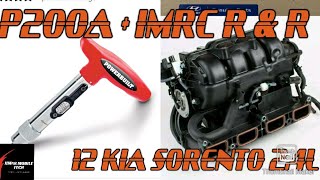
- P200A — P200A ('Intake Manifold Runner Performance - Bank 1') is very common on the 2.4L engine and often appears alongside P2015. It specifically points to a performance problem with the runners (i.e., they are stuck or broken), while P2015 points to the sensor's reading of that problem.
- P2009 — P2009 ('Intake Manifold Runner Control Circuit Low Bank 1') can appear with P2015, pointing to an electrical issue in the control circuit for the actuator solenoid.
- P1326 — This code for the Knock Sensor Detection System (KSDS) is not directly related to the intake runners, but is extremely common on this platform due to the widespread Theta II engine bearing failures. It may appear coincidentally.
Technical Service Bulletins (TSBs) & Recalls
- TSB ENG158 / SA240: While for a slightly later model year (2016 Sorento/Optima), this TSB addresses the related P200A code on the same 2.4L GDI engine. It recommends an ECM software update and inspection of the VCM motor.
Platform-Specific Known Issues
- On the 2.4L GDI engine, the code P200A is more frequently documented for the same mechanical failure (broken intake runner flaps) but P2015 can accompany it or be set independently.
- A user on Reddit reported getting an IMRC-related code just two months after a shop replaced the entire intake manifold, highlighting the importance of correct diagnosis and ensuring all related components (like wiring) are checked.
Mechanic-Grade Diagnostic Values
- VCM Actuator Motor Resistance — expected: 1 to 99 Ohms. Failure: A reading of infinite resistance (open circuit) or 0 ohms (short) indicates a failed motor.
- VCM Position Sensor Resistance (Feedback Coil) — expected: 3,000 to 5,000 Ohms (3kΩ - 5kΩ). Failure: A reading outside this range indicates a failed position sensor within the actuator assembly.
- VCM Position Sensor Live Data Voltage (Scan Tool) — expected: Approximately 0.5V (flaps closed) to 4.5V (flaps open). Failure: Voltage that is stuck at one value, does not change when the engine is revved, or responds erratically to a scan tool command test indicates a sensor, wiring, or mechanical binding issue.
- VCM Actuator Connector Pinout (for bench testing) — expected: Pins 4 and 5 are for the motor. Pins 1 and 3 are for the position sensor coil.. Failure: Applying power to pins 4 and 5 should cause the actuator to move. Measuring resistance across pins 1 and 3 should yield the expected 3k-5k Ohms.
Scan Tool Commands That Help
- Kia GDS (Global Diagnostic System): Actuation Test > VCM Motor (Option) — This bidirectional command is used to force the VCM actuator to move the intake runner flaps. It is the primary method for confirming if the actuator motor is receiving the command and is mechanically capable of moving. It helps differentiate between a failed actuator, a wiring issue, or a mechanically stuck flap.
Wiring & Ground Locations
- Intake Manifold Ground — The intake manifold itself can serve as a grounding point for various components on some Kia vehicles.. While not directly cited as a cause for P2015, a poor ground at the manifold could potentially affect sensor readings. Ensure any ground straps attached to the manifold are clean and secure during reassembly.
Real Owner Repair Stories
- Reddit user in r/kia (2011 Kia Sorento 4-cylinder with 220,000 km) — Check Engine Light with code P200A (often appears with P2015). No other driveability symptoms noted.
❌ Tried (didn't work) Waiting for the light to clear on its own.
✅ What actually fixed it A dealership diagnosed a bad VCM (Variable Control Motor). The owner paid $684 CDN for the dealer to replace the motor assembly, which resolved the check engine light. - YouTube video 'KIA and Hyundai OBD Error Code P2015 Solution' (Kia with 2.2L diesel engine (features a similar VCM design)) — Check Engine Light with code P2015.
❌ Tried (didn't work) Initial diagnosis suggested replacing the entire actuator assembly.
✅ What actually fixed it The owner disassembled the actuator linkage and found the pivot point for the arm was corroded and binding. The pivot shaft was cleaned with sandpaper and lubricated with grease, allowing the linkage to move freely again. This resolved the code without replacing any parts.
OEM Part Supersession History
28323-2GGA1→28323-2GGA1 (current)— This is the established OEM part number for the VCM actuator. No supersession information was found, indicating the part number has remained stable.
Heads up: Dorman offers an aftermarket alternative, part number 911-923.28310-2GGA0→28310-2GGA0 (current)— This is the established OEM part number for the intake manifold assembly. No supersession information was found.
Heads up: A TSB for 2015+ models mentions a 'VCM Service Kit' to repair the external linkage separately, but this kit does not apply to the 2010-2012 models and will not fix the common internal rod failure.
Model Year Variations Within This Range
- 2011: A TSB for the related P200A code exists for some Sorento models manufactured between October 1, 2010, and June 3, 2011. The TSB involved a PCM software update to correct the diagnostic logic. It's worth checking if a vehicle in this date range has had this update performed.
Diagnostic Flowchart
Other Known Issues on This Vehicle
Issues unrelated to this code that are worth knowing about as an owner of this generation:
- Catastrophic Engine Failure (Theta II) 🔴 High — Widespread across 2011-2016 models with 2.4L & 2.0T engines. Failures often occur before 100,000 miles due to connecting rod bearing wear from manufacturing debris. (Ref: Multiple recalls (e.g., SC147, 17V224000) and a class-action lawsuit settlement led to lifetime warranties and the KSDS (Knock Sensor Detection System) software update (TSB SC200) to detect failure.)
- Failing Door Lock Actuators / Latches 🟠 Medium — Very common problem where doors fail to open from the outside handle, or power locks become inoperative on one or more doors. (Ref: Kia issued Customer Satisfaction Program CS1603 (related to TSB BOD150) which extended the warranty on the door latches for some models.)
- Engine Compartment Fire Risk (HECU) 🔴 High — Affects 2011-2012 models. The Hydraulic Electronic Control Unit (HECU) for the ABS can short circuit due to moisture ingress, potentially causing a fire even when the vehicle is parked. (Ref: NHTSA recall campaign 23V877000 was issued to address this defect.)
- Peeling / Delaminating Paint 🟡 Low — Common complaint, particularly on white-painted vehicles, where the paint peels off in large sheets, exposing the primer underneath.
- Faulty Headlight Assemblies 🟠 Medium — Numerous complaints of headlights randomly turning off while driving, or connectors melting, posing a significant safety risk.
Used vs. New Parts: Buying Guide for This Vehicle
When a used part is the smart pick: A used VCM actuator (the external motor) can be a cost-effective choice if sourced from a low-mileage vehicle and if you can test its resistance values before purchase. A used intake manifold is NOT recommended.
Donor-vehicle mileage cap: roughly under 75000 miles for the part to have meaningful remaining life.
What to inspect on the donor part:
- For a VCM actuator, check for a clean connector with no corrosion.
- Manually move the actuator arm; it should have smooth, spring-loaded resistance, not feel loose or gritty.
- If possible, test the motor and sensor resistance with a multimeter before buying to ensure it's within spec (1-99Ω for motor, 3k-5kΩ for sensor).
OEM-only on this vehicle (don't cheap out):
- Intake Manifold Assembly: The primary failure is an internal plastic rod that becomes brittle with age and heat cycles. A used manifold from a junkyard will have the same design flaw and is likely near the end of its life, making it a very risky purchase. Always buy this part new.
Aftermarket brands forum-validated for this vehicle:
- Dorman (part 911-923 for the VCM actuator) is a commonly cited aftermarket replacement.
- Standard Motor Products (SMP) is also mentioned as a trusted brand for the VCM actuator.
Brands owners have reported issues with on this vehicle:
- Unbranded, no-name intake manifolds from online marketplaces should be avoided, as their internal construction quality is unknown and may fail prematurely.
Real Owner Stories
Aggregated from forums and TSBs cited above. Mileages and costs reflect what owners reported in those sources.
2012 Kia Sorento 2.4L
Symptoms: Getting an IMRC-related code just two months after a shop replaced the entire intake manifold.
What fixed it: The report highlights the need to check related components like wiring, as the manifold replacement alone did not permanently resolve the issue.
Source hint: Reddit r/AskMechanics: Replaced entire intake manifold on 2012 Kia Sorento now getting code IMRC issue
2011 Kia Sorento 2.4L
Symptoms: P200A intake manifold runner code present on the 4 cylinder engine.
What fixed it: Diagnosis of the intake manifold runner system, often involving the VCM motor or internal flaps.
Source hint: YouTube: P200a intake manifold runner code. 2011 Kia Sorento 2.4 liter 4 cylinder.
Related OBD-II Codes
Frequently Asked Questions
Does TSB ENG158 apply to my 2012 Kia Sorento with the 2.4L GDI engine?
Can I just replace the internal flaps in my 2.4L gas engine's intake manifold?
What is the part number for the VCM actuator on a 2011 Sorento?
My diesel Sorento has P2015; do I need a new manifold?
Is the P2015 code related to the Theta II engine failure recalls?
Can I reuse my old sensor if I buy a new intake manifold?
Helpful Videos
We Have This Part in Stock



The information in this article is provided for general reference and educational purposes only. Vehicle specifications, procedures, and part compatibility can vary by production date, trim level, and region. Always consult your vehicle's factory service manual and verify part numbers before purchasing or performing repairs. Safety-critical components such as airbags, seat belts, and braking systems should be installed by a qualified professional.
- Kia Sorento:
- 🎬 Helpful Videos
- 🛍️ Shop This Part
- What's Unique About the 2010-2012 Kia Sorento
- Symptoms You May Notice
- Most Likely Causes
- Rare But Worth Checking
- Diagnosis Steps
- Parts You'll Likely Need
- Related Codes That Often Appear With This One
- Technical Service Bulletins (TSBs) & Recalls
- Platform-Specific Known Issues
- Mechanic-Grade Diagnostic Values
- Scan Tool Commands That Help
- Wiring & Ground Locations
- Real Owner Repair Stories
- OEM Part Supersession History
- Model Year Variations Within This Range
- Diagnostic Flowchart
- Other Known Issues on This Vehicle
- Used vs. New Parts: Buying Guide for This Vehicle
- Real Owner Stories
- 2012 Kia Sorento 2.4L
- 2011 Kia Sorento 2.4L
- Related OBD-II Codes
- Frequently Asked Questions
- 🎟️ Get 5% Off