

P2015 on 2007-2011 Audi A5 3.2L V6: Intake Manifold Runner Sensor Causes and Fixes
On the Audi A5 3.2L V6, code P2015 is most often caused by a faulty intake manifold runner actuator or excessive carbon buildup jamming the flaps. The fix is typically replacing the actuator (around $150-$250 for the part) or, in severe cases, performing a manual carbon cleaning and potentially replacing the entire intake manifold.
- P2015 on the A5 3.2L V6 is a mechanical fault, not a sensor failure. The cause is usually a bad actuator or stuck flaps.
- Unlike the 2.0T engine, there is no simple bracket repair kit. The fix involves replacing the actuator or the entire manifold.
- Severe carbon buildup is a very common underlying issue on this engine and should be addressed by cleaning the intake ports (walnut blasting) when the manifold is off.
- The actuator (part #06E133619) can be replaced separately from the manifold, potentially saving significant cost if the manifold itself is okay.
What's Unique About the 2007-2011 Audi A5
Unlike the 2.0T Audi engine where a cheap metal bracket often fixes P2015, the 3.2L V6 FSI (CALA) engine has a different failure mode. The issue is rarely the sensor itself, but rather a failure of the vacuum-operated actuator that moves the flaps, or the linkage connecting it. Furthermore, as a direct injection (FSI) engine, it is highly prone to heavy carbon buildup on the intake valves and runners, which can physically jam the flaps, leading to this code. This carbon issue is widely documented on the 3.2L FSI across multiple Audi platforms.
Symptoms You May Notice
- Check Engine Light is on
- Reduced engine power and performance
- Rough or unstable idle
- Hesitation during acceleration
- Decreased fuel economy
- Engine sputtering on a cold start
- Replacing only the position sensor. The sensor is usually reporting a real mechanical problem, so replacing it without addressing the mechanical fault will not solve the issue.
- Assuming the fix is the same as the 2.0T engine. The common, inexpensive repair bracket for the 2.0T engine does not apply to the 3.2L V6's intake manifold design.
Most Likely Causes
- Faulty Intake Manifold Runner Actuator 🔴 High Probability The plastic and diaphragm components of the vacuum actuator (Part # 06E133619) can fail over time due to heat and age, causing vacuum leaks or an inability to move the runner flap linkage.
How to confirm: With the engine off, manually try to move the actuator linkage arm. Use a handheld vacuum pump to test if the actuator holds a vacuum and moves its full range of motion. Visually inspect for cracks in the actuator body. A failure to hold vacuum confirms a bad diaphragm.
Typical fix: Replace the intake manifold runner actuator. This part is available separately from the manifold and is a common point of failure.
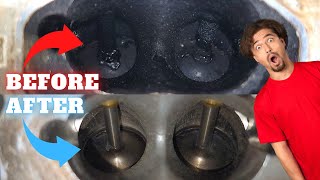
Est. part cost: $150-$250 - Heavy Carbon Buildup 🔴 High Probability The 3.2L FSI is a direct-injection engine. Fuel is injected directly into the cylinder, so it never washes over the intake valves. This allows oil vapor and combustion byproducts to bake onto the valves and intake runners, eventually restricting movement. This is a well-documented issue requiring service every 40,000-60,000 miles.
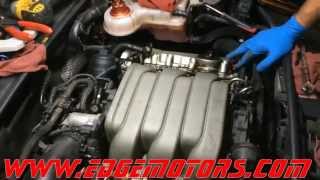
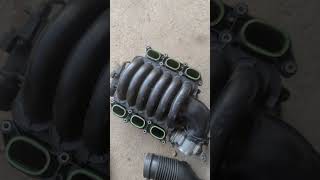
How to confirm: This requires removing the intake manifold 🎬 Watch: Professional step-by-step guide to removing the intake manifold. to visually inspect the intake ports and valves in the cylinder head. A borescope can also be used to inspect the valves with less disassembly. Significant black, hard deposits indicate a problem.
Typical fix: Perform a manual carbon cleaning service (often called 'walnut blasting') on the intake ports and valves. This is typically done whenever the intake manifold is removed.
Est. part cost: $0 (service cost is labor, typically $500-$1000) - Worn or Broken Runner Flap Linkage 🟡 Medium Probability The plastic linkage connecting the actuator to the flaps can wear out or break, causing a disconnect between the actuator's movement and the flaps' actual position. The pivot points can develop excessive play.
How to confirm: Visually inspect the linkage arm and pivot points for excessive play, cracks, or complete separation. This may require a small mirror and flashlight. Check if the arm has popped off the actuator or the manifold.
Typical fix: In most cases, the linkage is integral to the intake manifold assembly, requiring the entire manifold to be replaced. Unlike the 2.0T engine, aftermarket repair kits for the 3.2L V6 linkage are not widely available.
Est. part cost: $500-$800
Rare But Worth Checking
- Faulty Position Sensor: While the code directly names the sensor (Part # 03C907386B), it is rarely the point of failure. The sensor usually reports an 'implausible' signal because the mechanical parts (actuator, flaps) aren't moving correctly. Replacing the sensor alone is unlikely to fix the issue.
- Wiring Harness Issue: Damage to the wiring or connector for the position sensor or actuator solenoid can cause this code. Check for chafed wires or corrosion in the connectors, especially if the manifold has been serviced recently.
Diagnosis Steps
- Scan the ECU for P2015 and any other related codes (e.g., P2006, P2007). Note the freeze-frame data.
- With the engine off, locate the intake manifold runner actuator on Bank 1. Visually inspect the actuator and its linkage for any obvious damage, such as cracks or a disconnected arm.
- Start the engine and observe the actuator arm. It should move as you rev the engine. If it doesn't move, the problem could be the actuator or the vacuum supply solenoid.
- Test the actuator with a handheld vacuum pump. Apply vacuum and see if the arm moves smoothly through its full range of motion and holds the vacuum. If it doesn't, the actuator diaphragm is faulty.
- If the actuator works but the code persists, the flaps are likely binding internally. Use a borescope inserted into the intake manifold to inspect the flaps and look for heavy carbon deposits without full removal.
- If a borescope is unavailable or if further inspection is needed, remove the intake manifold to inspect the runner flaps for free movement and to check the intake ports for carbon deposits.
- If significant carbon is present, a walnut blasting service is required. If the manifold's internal flap mechanism is broken, the entire manifold must be replaced.
Parts You'll Likely Need
- Intake Manifold Assembly
(OEM #06E133210Q (supersedes 06E133210M))— Required if the internal runner flap mechanism is broken or cannot be cleaned. This is the most comprehensive fix.
Trusted brands: Audi Genuine
OEM price range: $600-$800
Aftermarket price range: $450-$600 - Intake Manifold Actuator
(OEM #06E133619)— This is a common failure point due to a ruptured diaphragm and can be replaced separately if the manifold itself and the flaps are in good condition.
Trusted brands: Audi Genuine, URO Parts, Pierburg
OEM price range: $200-$250
Aftermarket price range: $150-$200 - Intake Manifold Gaskets
(OEM #06E129717B (Upper))— Must be replaced any time the intake manifold is removed to prevent vacuum leaks.
Trusted brands: Victor Reinz, Elring
OEM price range: $40-$60
Aftermarket price range: $20-$40
Related Codes That Often Appear With This One
- P2006 — Indicates 'Intake Manifold Runner Control Stuck Closed', a more specific version of the mechanical fault that P2015 points to. Often appears with P2015.
- P2007 — Indicates 'Intake Manifold Runner Control Stuck Closed (Bank 2)', suggesting the problem may be affecting both cylinder banks.
- P0300, P0301-P0306 — Random or specific cylinder misfire codes can be triggered by the incorrect airflow caused by stuck runner flaps or, more commonly, by the severe carbon buildup that is often the root cause of the P2015 code.
Platform-Specific Known Issues
- The 3.2L V6 FSI engine is known for severe carbon accumulation in the intake ports, which is a primary contributor to this fault code. Cleaning the carbon is recommended any time the manifold is removed for this repair and should be considered preventative maintenance every 40k-60k miles.
- Unlike the 2.0T engine which has a well-known aftermarket bracket to fix P2015, the 3.2L V6 does not have a similar common 'cheap fix'. The repair almost always involves replacing a component like the actuator or the entire manifold, or performing a carbon clean.
- Manufacturer service documentation, such as TSB Bulletin #A0124312072273_2, provides specific guidance for when the MIL is on with codes P2015, P2004, P2006, or P2014, specifically referencing the electric changeover valve N316.
Mechanic-Grade Diagnostic Values
- Intake Manifold Runner Position Sensor (G410/G336) Reference Voltage — expected: ~5.0 V. Failure: Voltage significantly lower or higher than 5.0 V indicates a wiring or ECU fault.
- Intake Manifold Runner Position Sensor (G410/G336) Signal Voltage — expected: Varies smoothly between ~0.5 V and ~4.5 V as the flaps move from one end to the other.. Failure: Voltage that is stuck, jumps abruptly, or is below the minimum threshold (e.g., 0.3V) suggests a faulty sensor or a mechanically jammed flap.
- Intake Manifold Runner Position Sensor (Potentiometer) Resistance — expected: Typically in the 1 kΩ to 10 kΩ range.. Failure: An open circuit (infinite resistance) or a short circuit (near zero resistance) indicates a failed sensor.
Scan Tool Commands That Help
- VCDS (VAG-COM): Engine > Basic Settings > Group 142 (or similar, group may vary by ECU) — To run the adaptation/basic setting for the intake manifold runner flaps after replacing the manifold, actuator, or sensor. This allows the ECU to learn the end-stops of the flap travel. Failure to do this can cause the P2015 code to return even with new parts.
- VCDS (VAG-COM): Engine > Output Tests — To command the intake manifold flap motor/actuator to cycle. This allows a technician to visually confirm if the actuator and linkage are moving as commanded, helping to isolate a mechanical problem from an electrical one.
Wiring & Ground Locations
- Engine Ground (General) — A key ground connection point is located on a bolt for the oil filter housing. It is a small gauge wire coming from the main harness.. A poor or missing engine ground can cause a host of implausible signal faults from various sensors, including the intake runner position sensor, due to floating ground reference voltages.
- Ground Connection 615 — On the left suspension strut tower in the engine compartment.. This is a primary chassis ground point in the engine bay. While not directly for the sensor, poor connection here can affect the entire engine management system's electrical stability.
- Intake Runner Position Sensor (G336/G410) Connector — On the intake manifold, connected to the position sensor which is often integrated with the actuator or manifold assembly.. This is the direct connection point for testing. Pin 1 is typically the 5V reference, Pin 2 is the signal wire, and Pin 3 is the sensor ground.
Real Owner Repair Stories
- Ross-Tech Forums user (2008 Audi A6 3.2L V6 FSI) — Rough running, multiple fault codes including P2070 (Intake Manifold Tuning Valve Stuck Open), and fuel smell in oil.
❌ Tried (didn't work) Initial diagnosis was unclear, pointing towards injectors or manifold issues.
✅ What actually fixed it The user discovered a previous mechanic had misplaced the right-side runner flap bank, causing one flap to be stuck closed. Additionally, a wrong part number injector (for a turbo model) had been installed. Correcting the flap bank installation and replacing the incorrect injector resolved the issues. - NHTSA Owner Report (Audi Platform) — An owner filed NHTSA ODI #11542990 after receiving an emissions failure report with code P2015. The report noted that a technical service bulletin detailed the repair and how it should be covered under warranty or EPA guidelines.
OEM Part Supersession History
06E133210H, 06E133210L, 06E133210M→06E133210Q— Revisions to improve durability of the internal flap mechanism and linkage.
Heads up: All previous versions are superseded by 06E133210Q, which should be used for replacement.
Diagnostic Flowchart
Other Known Issues on This Vehicle
Issues unrelated to this code that are worth knowing about as an owner of this generation:
- Timing Chain Tensioner Failure 🔴 High — Becomes a concern around 80,000-120,000 miles. A rattling noise on cold starts is the primary warning sign.
- Excessive Oil Consumption 🟠 Medium — Can occur at any mileage but often noted after 60,000 miles. Consumption of 1 quart every 1,500-2,000 miles is reported by some owners. Caused by piston ring design, PCV issues, or various gasket leaks. (Ref: While a formal recall was more focused on the 2.0T engine, the 3.2L is also known for this issue.)
- Water Pump & Thermostat Failure 🟠 Medium — Plastic components can become brittle and fail, leading to coolant leaks and overheating. Often occurs between 60,000 and 100,000 miles.
Used vs. New Parts: Buying Guide for This Vehicle
When a used part is the smart pick: A used intake manifold assembly can be a cost-effective option if the internal flap mechanism of the original is confirmed broken. It is a gamble, as the used part may have significant carbon buildup or a worn actuator.
Donor-vehicle mileage cap: roughly under 60000 miles for the part to have meaningful remaining life.
What to inspect on the donor part:
- Ask for photos of the intake ports to gauge the level of carbon buildup.
- Verify the linkage arm is intact and moves without excessive play.
- If possible, test the vacuum actuator with a handheld pump to ensure it holds vacuum.
- Confirm the part number is the latest revision (06E133210Q) if possible.
OEM-only on this vehicle (don't cheap out):
- Intake Manifold Position Sensor: While rarely the cause, if it does need replacement, using a genuine or OEM-supplier part (e.g., Bosch, if applicable) is critical to ensure correct voltage signaling to the ECU.
Aftermarket brands forum-validated for this vehicle:
- Pierburg: A well-regarded OEM supplier for many VAG components, their replacement actuators are considered reliable.
- Victor Reinz, Elring: These brands are trusted for gaskets and seals, which are essential to replace when the manifold is removed.
Brands owners have reported issues with on this vehicle:
- Unbranded, no-name intake manifold assemblies from online marketplaces should be avoided. A forum user reported installing a used manifold that came from a car with 'no problem', yet the fault persisted, highlighting the risk of unknown history.
Real Owner Stories
Aggregated from forums and TSBs cited above. Mileages and costs reflect what owners reported in those sources.
2009 Audi A6 3.2L FSI (CALA)
Symptoms: Owner needed to inspect carbon deposit on intake valves and clean it; documented the complexity of removing the intake manifold to address buildup.
What fixed it: Manual carbon cleaning service (walnut blasting) of the intake ports and valves.
Source hint: AudiWorld - '3.2L FSI, How to inspect carbon deposit on intake valves and clean it'
Audi A5 3.2L V6 FSI — ~60000 miles
Symptoms: P2015 code triggered; owner noted that fuel system cleaners were ineffective because fuel never touches the valves on this engine.
What fixed it: Carbon cleaning service to address known buildup issues.
Source hint: BobIsTheOilGuy - 'Audi A5 3.2 v6 FSI - carbon issues?'
Audi A5 3.2L V6 FSI
Symptoms: P2015 code present; owner discovered the code was caused by a vacuum valve that operates the manifold rather than the sensor itself.
What fixed it: Replacement of the vacuum valve/actuator.
Source hint: Audizine - General discussions
Audi A5 3.2L V6 FSI — ~60000 miles
Symptoms: Code P2015 along with general reliability concerns; owner highlighted the necessity of carbon cleaning as a major service item.
What fixed it: Carbon cleaning every ~60k miles.
Source hint: Reddit r/Audi - 'Im going to buy an Audi A5 is 3.2 tsi reliable engine ?'
Related OBD-II Codes
Frequently Asked Questions
Can I use the aftermarket bracket fix for P2015 on my Audi A5 3.2L V6?
How often should I perform carbon cleaning on my 3.2L FSI engine to prevent P2015?
Is there a specific part number for the intake manifold runner actuator on the CALA engine?
Will fuel system cleaners help resolve the P2015 code on my Audi A5?
Can I replace just the linkage arm if it is broken on my 3.2L V6?
What should I look for when buying a used intake manifold to fix this code?
Helpful Videos
We Have This Part in Stock


The information in this article is provided for general reference and educational purposes only. Vehicle specifications, procedures, and part compatibility can vary by production date, trim level, and region. Always consult your vehicle's factory service manual and verify part numbers before purchasing or performing repairs. Safety-critical components such as airbags, seat belts, and braking systems should be installed by a qualified professional.
- Audi A5:
- 🎬 Helpful Videos
- 🛍️ Shop This Part
- What's Unique About the 2007-2011 Audi A5
- Symptoms You May Notice
- Most Likely Causes
- Rare But Worth Checking
- Diagnosis Steps
- Parts You'll Likely Need
- Related Codes That Often Appear With This One
- Platform-Specific Known Issues
- Mechanic-Grade Diagnostic Values
- Scan Tool Commands That Help
- Wiring & Ground Locations
- Real Owner Repair Stories
- OEM Part Supersession History
- Diagnostic Flowchart
- Other Known Issues on This Vehicle
- Used vs. New Parts: Buying Guide for This Vehicle
- Real Owner Stories
- 2009 Audi A6 3.2L FSI (CALA)
- Audi A5 3.2L V6 FSI — ~60000 miles
- Audi A5 3.2L V6 FSI
- Audi A5 3.2L V6 FSI — ~60000 miles
- Related OBD-II Codes
- Frequently Asked Questions
- 🎟️ Get 5% Off