

P2008 on 2017-2019 Nissan Sentra: Intake Runner Control Circuit Causes and Fixes
On a 2017-2019 Sentra, code P2008 is most likely caused by a software glitch in the Engine Control Module (ECM). A simple reprogram at a Nissan dealer, per TSB NTB19-045b, is the primary fix. The TSB updates the ECM's logic for storing permanent codes and is required even if a part is replaced. If a hardware fault exists, the Intake Manifold Runner Control (IMRC) solenoid has likely failed.
- First, check with a Nissan dealer about TSB #NTB19-045b. The most likely fix is a simple ECM software update, not a part replacement.
- P2008 indicates an electrical problem (an open circuit), not a mechanical blockage.
- If a hardware repair is needed, the IMRC solenoid is the most likely culprit and is a relatively simple and inexpensive part to replace.
- This code is often seen with P0087, P0101, and P0448 due to the same software issue.
What's Unique About the 2017-2019 Nissan SENTRA
For this specific generation of Nissan Sentra, the P2008 code has a well-documented history of being triggered by a software error, not a hardware failure. Nissan issued Technical Service Bulletins (TSBs) stating that due to calibration errors, the ECM can improperly store a permanent P2008 trouble code even when no fault exists. Crucially, the TSB clarifies that the reprogram is not a fix for a bad part, but an update to how the permanent DTC is stored and erased *after* a valid repair is made. This makes checking for and performing the recommended ECM software update the most critical step, potentially saving you from replacing perfectly good parts or allowing the code to be cleared after a necessary repair.
Diagnostic Flowchart
Tap your situation to follow the diagnostic path that matches what you're seeing on this vehicle.
Symptoms You May Notice
- Check Engine Light is on
- Reduced engine power and poor acceleration
- Hesitation or stumbling during acceleration
- Rough or fluctuating idle
- Decreased fuel economy
- Engine surging
- Replacing the IMRC solenoid without first checking for the ECM software update specified in Nissan's TSBs. The permanent DTC may not clear even with a new part until the ECM is reprogrammed.
Most Likely Causes
- Engine Control Module (ECM) Software Calibration Error 🔴 High Probability Nissan issued TSBs #NTB19-045b and #P9328_P9343_P934 specifically for this issue on this platform, indicating a known software glitch in how permanent DTCs are stored and cleared. NOTE: The TSB text specifies the 1.6L Turbo (MR16DDT) engine, not the 1.8L (MRA8DE). Applicability to the 1.8L engine should be confirmed with a dealer by VIN, as the ECM part numbers may differ.
How to confirm: Contact a Nissan dealership and provide your vehicle's VIN. They can check if TSB NTB19-045b or P9328_P9343_P934 applies to your car and if the reprogram has already been performed.
Typical fix: The ECM must be reprogrammed with updated software by a Nissan dealer or a qualified shop with the appropriate tools. This is often required even after replacing a faulty part to clear the permanent code.
Est. part cost: $0 (if under warranty) or $100-$250 (dealer labor charge) - Faulty Intake Manifold Runner Control (IMRC) Solenoid 🟡 Medium Probability The solenoid is an electro-mechanical part that can fail from heat cycles and vibration over time. Its internal coil can break, causing an open circuit. It is located on the intake manifold, often near the throttle body, with two vacuum hoses and an electrical connector attached.
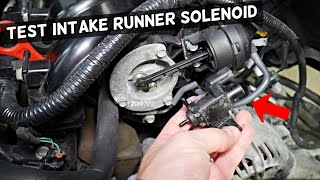
How to confirm: Disconnect the solenoid and test its resistance with a multimeter; an infinite reading (Open Loop) indicates failure. A reading between 8-12 ohms is typically considered good. Alternatively, use a scan tool's active test to command it on and listen for a click, or briefly apply 12V power to its terminals and listen for a click. 🎬 Watch: How to test the intake runner solenoid with a battery.
Typical fix: Replace the IMRC/VIAS control solenoid. The Nissan OEM part number is often 14930-3YM0A (cross-reference K5T48595). Always verify the part number with your VIN.
Est. part cost: $30-$80 - Damaged Wiring or Electrical Connector ⚪ Low Probability Wires in the engine bay are exposed to heat and vibration, which can lead to breaks or corrosion. Rodents are also known to chew on wiring harnesses in this area. An unplugged connector after recent service (like an air filter change) is also a common cause.
How to confirm: Visually inspect the wiring harness leading to the IMRC solenoid for any signs of damage, fraying, or rodent chew marks. Check that the connector is securely plugged in. Use a multimeter to check for voltage at the connector with the key on and to test for continuity from the connector back to the ECM.
Typical fix: Repair the broken wire or replace the damaged connector pigtail.
Est. part cost: $5-$25
Rare But Worth Checking
- Stuck Intake Runner Flaps: While P2008 is an electrical code, it's worth noting that the mechanical flaps inside the intake manifold can get stuck with carbon buildup. This usually triggers a P2006 (stuck closed) or P2004 (stuck open) code, but it is part of the same system. Ignoring P2008 can lead to P2006 because the solenoid cannot open the flaps.
- Faulty Powertrain Control Module (PCM): In very rare cases where the software, solenoid, and wiring are all confirmed to be good, the internal driver circuit within the PCM itself may have failed. This is an expensive last resort, with replacement costs potentially exceeding $1,000.
Diagnosis Steps
- Check for Technical Service Bulletins (TSBs): This is the most important first step. Contact a Nissan dealer with your VIN to see if TSB #NTB19-045b applies. If it does, understand that an ECM reprogram is the required final step to fix the code-storage logic, even if a hardware repair is also needed.
- Scan for Codes: Use an OBD-II scanner to confirm P2008 is the active code and check for any other related codes, such as P2006.
- Visual Inspection: Locate the IMRC solenoid on the intake manifold. It will have two vacuum hoses and one electrical connector. Check that its electrical connector is plugged in securely and inspect the visible wiring for any obvious damage, such as cracks, burns, or rodent chew marks.
- Perform an Active Test: If you have a capable bidirectional scanner, use the actuation test feature to command the IMRC solenoid on and off. Listen for an audible 'click' from the solenoid. If it clicks, the solenoid and wiring are likely okay. If you don't have a scanner, you can briefly apply 12V and ground to the solenoid's pins to listen for the same click.
- Test the Solenoid Circuit: If no click is heard, disconnect the solenoid. Use a multimeter to check for battery voltage at the connector with the ignition on. If voltage is present, the problem is likely the solenoid itself. If no voltage is present, the issue is in the wiring or the ECM.
- Test the Solenoid Resistance: With the solenoid disconnected, use a multimeter set to Ohms (Ω) to measure the resistance across the two pins on the solenoid. A good solenoid should typically read between 8 and 12 ohms. An infinite reading (OL) confirms the solenoid has failed internally.
- Inspect Runner Flaps (if accessible): With the engine off, try to manually move the linkage for the runner flaps. It should move smoothly. If it is stuck or binding, the intake manifold may need to be cleaned or replaced.
- Perform ECM Reprogram: After any necessary hardware repairs (like replacing the solenoid), have the ECM reprogrammed by a dealer per TSB NTB19-045b to ensure the permanent code can be cleared.
Parts You'll Likely Need
- Intake Manifold Runner Control Solenoid
(OEM #14930-3YM0A (cross-reference K5T48595))— This solenoid is the most common hardware component to fail for this code. Its internal coil can break, creating the 'open circuit' condition detected by the ECM.
Trusted brands: Hitachi, Dorman, Genuine Nissan
OEM price range: $60-$100
Aftermarket price range: $30-$80
Related Codes That Often Appear With This One
- P0087 — Listed in Nissan TSBs #NTB19-045b and #P9328_P9343_P934 as another code that can be falsely triggered by the same ECM software glitch.
- P0101 — Also listed in the same Nissan TSBs as a code that can be incorrectly stored by the ECM due to the calibration error.
- P0448 — This EVAP system code is also mentioned in TSBs #NTB19-045b and #P9328_P9343_P934 as part of the group of codes affected by the software issue.
- P2006 — This code means 'Intake Manifold Runner Control Stuck Closed'. It often appears after P2008 has been present for a while, because an open electrical circuit (P2008) prevents the solenoid from activating, causing the runners to remain in their default closed position.
Technical Service Bulletins (TSBs) & Recalls
- NTB19-045b: "MIL ON WITH DTC P0087, P0101, P0448, OR P2008, VEHICLES REGISTERED OUTSIDE OF CALIFORNIA"
- P9328_P9343_P934: Mentions reprogramming the ECM if a permanent DTC for P0448, P0101, P2008, or P0087 is recorded due to calibration errors.
- NTB19-045a: An earlier version of the bulletin addressing the same set of DTCs.
Platform-Specific Known Issues
- A primary issue for the 2017-2019 Sentra is an ECM software glitch that can cause a permanent P2008 code to be stored incorrectly. This is documented in Nissan TSBs #NTB19-045b and #P9328_P9343_P934, which call for an ECM reprogram. The reprogram updates the logic for how the ECM stores and clears permanent codes, and is a necessary step after any hardware repair to finally resolve the issue.
Mechanic-Grade Diagnostic Values
- Intake Manifold Tuning Valve Motor Power Supply — expected: Battery voltage (~12V). Failure: 0V indicates a wiring or fuse issue.
- ECM Pin Voltage (Pin 28 - RED wire) — expected: Battery Voltage with Key On. Failure: No voltage points to a fault in the power supply to the motor.
- ECM Pin Continuity (Pins 27 & 29) — expected: Continuity (low resistance) from the motor connector back to the ECM connector pins.. Failure: Infinite resistance (OL) indicates a broken wire in the harness.
Hidden / Shadow Codes Worth Checking
- Permanent DTC (P-DTC): This is not a separate code, but a special status for a standard DTC like P2008. Once a fault is repaired, a P-DTC will not clear with a generic scanner or by disconnecting the battery. It remains until the ECM's internal self-diagnostic tests (monitors) have successfully run multiple times, proving the fix is valid. The TSB for this issue addresses a glitch in the logic that allows this P-DTC to be cleared. (see via A professional scan tool like the Nissan CONSULT can display the P-DTC status and the readiness state of the required monitors.)
- Mode $06 Test Data: This is a diagnostic mode on advanced scan tools that shows the results of the ECM's self-tests. Before a P-code is set, a technician can view the raw test data for the IMRC system (identified by a Test ID and Component ID) to see if it is passing or failing its self-test, which can help pinpoint intermittent issues. (see via An OBD-II scanner with Mode $06 capabilities.)
Scan Tool Commands That Help
- Nissan CONSULT-III plus: Active Test — From the 'Engine' system menu, select 'Active Test' to command the IMRC motor/solenoid. This allows a technician to attempt to cycle the valve and listen for mechanical operation, confirming if the component is responding to ECM commands.
- Nissan CONSULT-III plus: Re/programming, Configuration — This function is required to perform the ECM update as specified in TSB NTB19-045b. It reprograms the ECM with new software to correct the logic for storing and clearing permanent DTCs.
- Nissan CONSULT-III plus: SRT (System Readiness Test) & PDTC Status — After a repair, this screen is used to monitor the status of the required drive patterns. Once the patterns are complete, the tool can be used to confirm the Permanent DTC has been erased by the ECM.
Wiring & Ground Locations
- Intake Manifold Tuning Valve Motor Connector (at ECM) — At the main Engine Control Module (ECM) harness connector.. These are the specific pins for testing the IMRC motor circuit directly at the ECM. Pin 27 (Green wire) is for Motor Close, Pin 29 (Purple wire) is for Motor Open, and Pin 28 (Red wire) is the power supply.
- Ground E5 — Located on the right rear side of the engine block.. A poor engine ground can cause a variety of electrical issues and incorrect sensor readings. Verifying this ground is clean and tight is a fundamental step when diagnosing any engine-related electrical fault code.
- ECM Ground Pins — At the ECM harness connector, specifically Pin 123 (Black/Yellow wire).. This is the direct ground connection for the Engine Control Module itself. A fault at this specific pin could cause the ECM to malfunction and potentially set false codes.
"I Checked Everything" — The Actual Cause
- The electrical equivalent of a 'smoke test clean' scenario for P2008 is when the IMRC motor and all associated wiring test perfectly fine, yet the code cannot be cleared. For many Nissan models, this exact situation is described by TSB NTB19-045b. The root cause is a software glitch where the *permanent* DTC (P-DTC) will not erase using standard methods. The actual fix is to have a Nissan dealer reprogram the ECM *after* confirming the hardware is functional.
When the Usual Fixes Don't Work
- The most significant counter-evidence to the common wisdom for this code is found within the primary TSB itself. While Nissan TSB NTB19-045b is widely cited as the fix for a P2008 software glitch on the Sentra, the document explicitly states it applies to the '2017–2019 Sentra (B17) with MR16DDT' (1.6L Turbo) engine. It does NOT list the base 1.8L MRA8DE engine. Therefore, a technician who assumes this TSB applies to a 1.8L model may find that the vehicle's ECM part number is not listed in the bulletin, and the reprogram cannot be performed. For the 1.8L engine, the cause of P2008 may more likely be a standard hardware failure (wiring or the IMRC motor itself) without an associated software issue, contradicting the prevailing advice.
OEM Part Supersession History
Unknown→Unknown— The part number provided in pass 2 (14930-3YM0A) is for the EVAP Canister Purge Valve, not the IMRC actuator. The correct part for the 1.8L MRA8DE engine's IMRC system appears to be an integrated motor, which may only be serviced with the intake manifold assembly.
Model Year Variations Within This Range
- 2017-2019: The 2017-2019 Sentra was available with a standard 1.8L MRA8DE engine or an optional 1.6L MR16DDT Turbo engine. This is a critical distinction because the key Technical Service Bulletin (NTB19-045b) that addresses the P2008 software glitch specifically lists the Sentra 'with MR16DDT' engine. Its applicability to the more common 1.8L engine is not guaranteed by this document.
Helpful Videos

Used OEM Parts in Stock

New Aftermarket Parts Available



The information in this article is provided for general reference and educational purposes only. Vehicle specifications, procedures, and part compatibility can vary by production date, trim level, and region. Always consult your vehicle's factory service manual and verify part numbers before purchasing or performing repairs. Safety-critical components such as airbags, seat belts, and braking systems should be installed by a qualified professional.
- Nissan SENTRA:
- 🎬 Helpful Videos
- 🛍️ Shop This Part
- What's Unique About the 2017-2019 Nissan SENTRA
- Diagnostic Flowchart
- Symptoms You May Notice
- Most Likely Causes
- Rare But Worth Checking
- Diagnosis Steps
- Parts You'll Likely Need
- Related Codes That Often Appear With This One
- Technical Service Bulletins (TSBs) & Recalls
- Platform-Specific Known Issues
- Mechanic-Grade Diagnostic Values
- Hidden / Shadow Codes Worth Checking
- Scan Tool Commands That Help
- Wiring & Ground Locations
- "I Checked Everything" — The Actual Cause
- When the Usual Fixes Don't Work
- OEM Part Supersession History
- Model Year Variations Within This Range
- 🎟️ Get 5% Off