

P2004 on 2013-2020 Nissan Altima: Intake Runner Control Stuck Open Causes and Fixes
On 2013-2020 Nissan Altimas, P2004 usually means the intake manifold runner control (IMRC) system has a problem. For 2013-2018 models with the QR25DE engine, it's often a faulty position sensor (Part No. 226A0-3TA0B) per TSB NTB17-091. For 2019-2020 models with the PR25DD engine, it's commonly triggered by cold weather (below 0°F) and may require replacing the entire intake manifold per TSB NTB20-083A. Expect costs from $150 for a DIY sensor replacement to over $800 for a shop to replace the man
- P2004 on a Nissan Altima means the intake runner control system is stuck open.
- The fix is highly dependent on the model year. Check for TSBs before buying parts.
- For 2013-2017 models, the problem is likely the IMRC position sensor.
- For 2019-2020 models, if the code appeared in extreme cold, you will likely need to replace the entire intake manifold per Nissan's recommendation.
- Driving with this code won't leave you stranded, but it will negatively impact performance and fuel economy.
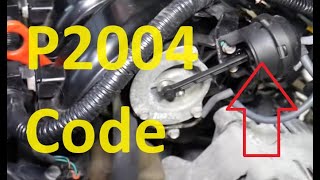
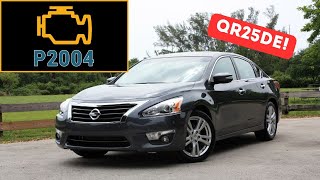
What's Unique About the 2013-2020 Nissan ALTIMA 🎬 Watch: A complete overview of Altima P2004 causes and fixes.

The Nissan Altima exhibits two distinct, generation-specific issues for this code, tied to its engine change. The fifth generation (2013-2018) with the QR25DE engine is known for failures of the IMRC valve position sensor, as documented in Nissan TSB NTB17-091, which also applies to the 2014-2017 Nissan Rogue with the same engine. In contrast, the sixth generation (2019-2020) with the newer PR25DD direct-injection engine has a known issue where the code appears specifically after a cold start in weather below 0°F, which Nissan addressed with TSB NTB20-083A, recommending a full intake manifold replacement.
Diagnostic Flowchart

Tap your situation to follow the diagnostic path that matches what you're seeing on this vehicle.
Generation note: This guide covers the 5th generation (2013-2018) with the QR25DE engine and the 6th generation (2019-2020) with the PR25DD engine. The causes and factory-recommended fixes are different for each generation. TSB NTB17-091 applies to 2013-2017 models, while TSB NTB20-083A applies to 2019-2020 models.
Symptoms You May Notice

- Check Engine Light is on
- Traction control light may also illuminate
- Decrease in low-end engine torque and power
- Rough idle
- Reduced fuel economy
- In some cases, no noticeable symptoms other than the Check Engine Light
- Replacing the intake manifold gaskets alone. While gaskets should be replaced when the manifold is removed, they are not the cause of the P2004 code itself, unless a significant vacuum leak is diagnosed via a smoke test.
Most Likely Causes

- Faulty Intake Manifold Runner Control (IMRC) Position Sensor 🔴 High Probability Specifically cited for 2013-2017 models with the QR25DE engine in Nissan TSB NTB17-091. The sensor fails and sends incorrect position data to the ECM. This is a very common failure, often occurring with no other symptoms.
How to confirm: Test the sensor's voltage output with a multimeter to see if it changes as the IMRC actuator is commanded to move. The TSB is the primary confirmation, applied when P2004 is stored and there are no drivability issues. A Reddit user confirmed this was the issue on their 2017 Altima.
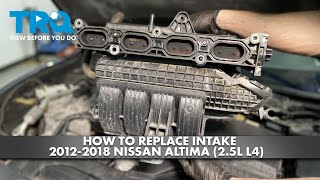
Typical fix: Replace the IMRC position sensor. This requires removing the intake manifold to access the sensor, which is held by two Torx bolts.
Est. part cost: $50-$100 - Intake Manifold Assembly Failure in Cold Weather 🔴 High Probability Specifically for 2019-2020 models with the PR25DD engine, as per TSB NTB20-083A. The issue occurs after starting the engine in temperatures below 0°F (-18°C). Forum users with 2019+ models corroborate general electronic issues and warning lights during extreme cold snaps.
How to confirm: Confirm the code appeared after a cold start in extreme cold and that no other issues are found during diagnosis. The code P2015 may also be present.
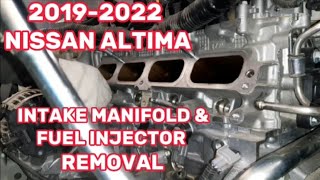
Typical fix: Replace the entire intake manifold assembly with the updated part number specified in the TSB.
Est. part cost: $400-$600 - Faulty Intake Manifold Runner Control (IMRC) Actuator/Solenoid 🟡 Medium Probability The actuator is a common failure point across many vehicles. It can fail electrically or the linkage can break.
How to confirm: Visually inspect the actuator and its linkage for movement when the engine is started or when commanded by a capable scan tool. Listen for an audible click. Test for power and ground at the solenoid connector.
Typical fix: Replace the IMRC actuator/solenoid.
Est. part cost: $100-$180 - Binding or Sticking Runner Flaps ⚪ Low Probability Over time, carbon deposits can build up inside the intake manifold, causing the runner flaps to stick and preventing the actuator from moving them. This is more common on direct-injection engines like the PR25DD (2019+).
How to confirm: After removing the IMRC actuator, attempt to move the runner flap linkage by hand. It should move smoothly with little resistance. If it's stuck, the manifold is the issue.
Typical fix: In some cases, the manifold can be removed and cleaned. More often, the entire intake manifold assembly needs to be replaced.
Est. part cost: $400-$600
Rare But Worth Checking
- Damaged Wiring or Connectors: The wiring to the IMRC actuator or sensor can become frayed, corroded, or damaged, causing an intermittent signal. A user on Reddit reported the P2004 code appeared after driving through a deep puddle, suggesting water intrusion into a connector could be a cause. This should be checked before replacing more expensive components.
- Vacuum Leaks: If the IMRC system is vacuum-operated, a cracked or disconnected vacuum line can prevent the actuator from functioning correctly. A diagnostic smoke test can reveal leaks from the intake manifold gasket or associated hoses.
Diagnosis Steps
- Read the code with an OBD-II scanner and note any other codes present.
- Check for applicable TSBs based on your vehicle's year. For 2019-2020 models, note if the light appeared in extreme cold. For 2013-2017 models, if there are no drivability issues, suspect the position sensor per TSB NTB17-091.
- Visually inspect the IMRC actuator, its linkage, and electrical connector for any obvious damage, corrosion, or water intrusion.
- With the engine off, try to move the IMRC linkage by hand to check if the flaps are stuck inside the manifold. It should move freely.
- Use a capable scan tool to command the IMRC actuator on and off while observing the actuator for movement and monitoring the position sensor data (PID).
- If the actuator doesn't move, test for power (typically 12V) and ground at its connector. If power and ground are present, the actuator is likely faulty.
- If the actuator moves but the code returns, the position sensor is the primary suspect, especially on 2013-2017 models.
- If the actuator tries to move but can't, or if the linkage is stiff, the intake manifold flaps are likely binding due to carbon buildup, requiring manifold cleaning or replacement.
Parts You'll Likely Need
- Intake Manifold Runner Control Valve Position Sensor
(OEM #226A0-3TA0B)— This is the most common failure point for 2013-2017 models with the QR25DE engine, as identified in TSB NTB17-091. It is often sold under the Hitachi brand as part number IMR0001.
Trusted brands: Nissan (OEM), Hitachi (OEM supplier)
OEM price range: $70-$120
Aftermarket price range: $40-$80 - Intake Manifold Assembly
(OEM #14001-6CA0C)— This is the required fix for the cold-weather issue on 2019-2020 models with the PR25DD engine, per TSB NTB20-083A.
Trusted brands: Nissan (OEM)
OEM price range: $450-$600
Aftermarket price range: $350-$500 - Intake Manifold Runner Control Actuator/Solenoid
(OEM #14955-8J10A)— The actuator motor can burn out or the linkage can fail, preventing the flaps from moving. This part is shared across many Nissan models.
Trusted brands: Dorman, Standard Motor Products
OEM price range: $140-$200
Aftermarket price range: $90-$150 - Intake Manifold Gasket
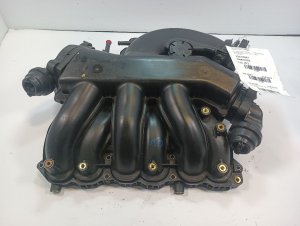
(OEM #14035-6CA0A)— This is a single-use part that must be replaced anytime the intake manifold is removed for service, such as replacing the position sensor or the entire manifold.
Trusted brands: Fel-Pro, Mahle, Nissan (OEM)
OEM price range: $20-$40
Aftermarket price range: $10-$25
Related Codes That Often Appear With This One
- P2015 — This code for 'Intake Manifold Runner Position Sensor/Switch Circuit Range/Performance' is often stored alongside P2004, especially in the cold weather issue affecting 2019-2020 models, as they both relate to the IMRC system's position and function.
Technical Service Bulletins (TSBs) & Recalls
- NTB20-083A: For 2019-2020 Altima (PR25DD engine), addresses P2004 or P2015 stored after a start in weather below 0°F. The fix is to replace the entire intake manifold assembly.
- NTB17-091: For 2013-2017 Altima and 2014-2017 Rogue (QR25DE engine), addresses P2004 stored without drivability issues. The fix is to replace the IMRC position sensor.
Platform-Specific Known Issues
- On 2019-2020 Altimas with the PR25DD engine, DTC P2004 may be stored after starting the engine in temperatures below 0°F. Nissan TSB NTB20-083A recommends replacing the entire intake manifold to resolve this.
- On 2013-2017 Altimas with the QR25DE engine, DTC P2004 is often stored without any noticeable drivability issues. TSB NTB17-091 points to a faulty intake manifold runner control valve position sensor as the cause and directs technicians to replace only the sensor.
- An owner of a 2017 Altima reported that the P2004 code was triggered by a faulty 'value position sensor' which controls the swirl/tumble flaps, leading to a decrease in low-end engine torque.
- A Reddit user with a 2017 Altima experienced the P2004 code and traction control light immediately after driving through a large puddle, suggesting a vulnerability in the wiring or connectors to water intrusion.
Mechanic-Grade Diagnostic Values
- IMRC Position Sensor Torx Bolt Torque — expected: 4.62 – 5.55 N·m (41 – 49 in-lbs). Failure: N/A - this is an installation specification.
- Battery Voltage for IAVL (Idle Air Volume Learn) — expected: More than 12.9V (At idle). Failure: The IAVL procedure may not complete successfully if voltage is too low.
Scan Tool Commands That Help
- Nissan CONSULT-III plus: Data Monitor — To monitor live data PIDs from the engine control system, such as sensor voltages and actuator commands, to diagnose the IMRC system.
- Nissan CONSULT-III plus: Idle Air Volume Learn (IAVL) — This procedure is required after replacing the throttle body or intake manifold to allow the ECM to relearn the idle position. It may also be necessary after disconnecting the battery or clearing codes.
Wiring & Ground Locations
- J/C E09 — Lower left end of the dash on a 2017 Altima.. This is a junction connector for multiple circuits in the engine control system. A fault at this shared connector could potentially cause issues with sensor readings or actuator commands.
- Fuse Block (J/B) — Under the dashboard near the driver's side for the passenger compartment fuse box; near the battery for the engine compartment fuse box (2019 model).. The IMRC actuator and sensor receive power via a fused circuit. A blown fuse would cause a loss of function. The engine control system fuses are critical to check.
Real Owner Repair Stories
- Reddit user in /r/NissanAltima (2013 Nissan Altima) — Check engine light and traction light on with code P2004.
❌ Tried (didn't work) Replacing the intake manifold twice with aftermarket parts.
✅ What actually fixed it The user concluded that an OEM (Original Equipment Manufacturer) manifold should have been used, as the aftermarket parts did not resolve the issue. They also mentioned needing to replace the runner valve as well. The issue was ultimately not resolved on the car, and the owner planned to replace the vehicle. - Reddit user in /r/MechanicAdvice (2017 Altima 2.5L) — Check engine light and traction control light came on with code P2004 immediately after driving through a large puddle.
❌ Tried (didn't work) Clearing the code (it returned).
✅ What actually fixed it The user identified the likely faulty part as the IMRC position sensor based on a service bulletin. The story highlights the vulnerability of the system's wiring/connectors to water intrusion. The final repair was not posted, but the diagnosis pointed directly to the sensor cited in TSB NTB17-091.
When the Usual Fixes Don't Work
- One owner on a Reddit forum reported that replacing the IMRC position sensor on their 2017 Altima did not fix the P2004 code, as it came back. This suggests that while the sensor is the most common cause for that model year according to the TSB, other issues like a binding linkage, faulty actuator, or wiring problems can still be the root cause.
OEM Part Supersession History
14001-6CA0C→14001-6CA1B— This is a part number update from Nissan for the intake manifold assembly used on the 2019+ Altima and 2021+ Rogue with the 2.5L engine. The reason for the supersession is not officially stated, but it often relates to design improvements or manufacturing changes.
Model Year Variations Within This Range
- 2013-2018 (QR25DE Engine): The primary cause for P2004 is a faulty IMRC position sensor, addressed by TSB NTB17-091. The repair involves replacing only the sensor, which requires intake manifold removal.
- 2019-2020 (PR25DD Engine): The primary cause for P2004 is related to cold weather starts (below 0°F), addressed by TSB NTB20-083A. The repair requires replacing the entire intake manifold assembly with an updated part.
Helpful Videos

We Have This Part in Stock




The information in this article is provided for general reference and educational purposes only. Vehicle specifications, procedures, and part compatibility can vary by production date, trim level, and region. Always consult your vehicle's factory service manual and verify part numbers before purchasing or performing repairs. Safety-critical components such as airbags, seat belts, and braking systems should be installed by a qualified professional.
- Nissan ALTIMA:
- 🎬 Helpful Videos
- 🛍️ Shop This Part
- What's Unique About the 2013-2020 Nissan ALTIMA
- Diagnostic Flowchart
- Symptoms You May Notice
- Most Likely Causes
- Rare But Worth Checking
- Diagnosis Steps
- Parts You'll Likely Need
- Related Codes That Often Appear With This One
- Technical Service Bulletins (TSBs) & Recalls
- Platform-Specific Known Issues
- Mechanic-Grade Diagnostic Values
- Scan Tool Commands That Help
- Wiring & Ground Locations
- Real Owner Repair Stories
- When the Usual Fixes Don't Work
- OEM Part Supersession History
- Model Year Variations Within This Range
- 🎟️ Get 5% Off