

P2002 on 2013-2019 Land Rover Range Rover: DPF Causes and Fixes
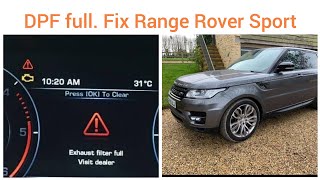
P2002 on a 2013-2019 Range Rover means the Diesel Particulate Filter (DPF) efficiency is below the required threshold. This is often caused by a cracked or ash-filled DPF requiring replacement, but can also be due to faulty pressure sensors or their connecting pipes. A forced regeneration may offer a temporary fix, but replacement is often necessary. Soot on the tailpipe is a strong indicator of a cracked DPF.
- P2002 on a 2013-2019 Range Rover is a serious code indicating the Diesel Particulate Filter (DPF) is no longer working efficiently.
- Unlike on some vehicles, a simple regeneration is often not a permanent fix. Land Rover's own service documents suggest the DPF is likely unrecoverable and needs replacement once this code is set.
- Before committing to a very expensive DPF replacement, it is crucial to first rule out cheaper potential causes like a faulty DPF pressure sensor or damaged sensor pipes.
- After replacing the DPF, a PCM software update is highly recommended to prevent the problem from returning.
- Driving habits matter; frequent, short trips can contribute to premature DPF clogging.
What's Unique About the 2013-2019 Land Rover RANGE ROVER

On these Range Rover models, the P2002 code is particularly problematic. Manufacturer bulletins state that once the P2002 code is stored, the DPF often cannot be recovered by a simple regeneration and may require replacement along with a PCM software update to prevent recurrence. Owners report that even dealer-performed forced regenerations sometimes fail to provide a permanent solution, with the light returning shortly after, sometimes within two days. This suggests a high likelihood of the DPF itself being internally cracked or permanently clogged with non-combustible ash, rather than just being overloaded with soot. The Federal Emissions Warranty may cover DPF replacement for 8 years/80,000 miles, a fact owners have used to get warranty coverage after initial denial.
Diagnostic Flowchart

Tap your situation to follow the diagnostic path that matches what you're seeing on this vehicle.
Symptoms You May Notice

- Check Engine Light is illuminated. [SFCC-14MAR19-Sli, SSM73738]
- Reduced engine performance or vehicle entering 'limp mode' with restricted RPM.
- Decreased fuel efficiency.
- Black, sooty residue inside the tailpipe(s).
- No other symptoms may be present, as noted in TSBs. [SSM73738]
- Replacing the DPF without checking the pressure sensor and its pipes first. A faulty sensor is a much cheaper fix and can produce the same code.
- Performing a forced regeneration when the DPF is actually cracked. A regen will not fix a cracked filter, and the P2002 code will return quickly. A technician on a forum stated, 'Why a regen was attempted is a mystery. Your $560 fix wasn't a success at all, this was incorrect diagnosis.'
Most Likely Causes

- Cracked or Internally Damaged DPF 🔴 High Probability TSBs and owner forums indicate a high failure rate. A Land Rover TSB explicitly states that when P2002 is stored, the DPF often cannot be recovered and requires replacement. Forum users report needing multiple DPF replacements, sometimes even under warranty, indicating a potential design or material flaw. The issue is so common that technicians consider a sooty tailpipe a direct confirmation of a cracked DPF requiring replacement.
How to confirm: After ruling out sensors and leaks, a mechanic can check live data. A DPF with very low backpressure readings (e.g., near 0 mbar at idle, and only 10-20 mbar at 2000 RPM) despite a calculated soot load suggests the exhaust is passing through a crack instead of the filter media. A visual inspection of the tailpipes for soot is a very strong indicator of a cracked filter core.
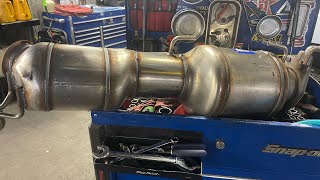
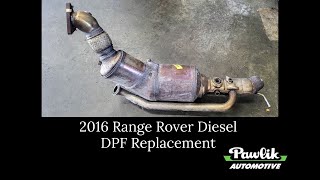
Typical fix: Replacement of the Diesel Particulate Filter assembly. 🎬 See this walkthrough of a Range Rover diesel DPF replacement. A PCM software update is also required to prevent future occurrences. Some owners have had success getting this covered under the 8-year/80,000-mile federal emissions warranty.
Est. part cost: $2000-$4500 - Clogged DPF (Ash Accumulation) 🟡 Medium Probability Primarily affects vehicles used for frequent short trips where the exhaust doesn't get hot enough for passive or active regeneration to complete, leading to soot and eventually non-combustible ash buildup. Poor quality diesel fuel can also accelerate clogging.
How to confirm: A diagnostic scan tool will show high soot or ash load values (e.g., above 25-30 grams). A forced regeneration may be attempted; if it fails, the soot mass doesn't drop significantly (e.g., below 6g), or the code returns quickly, the DPF is likely clogged beyond recovery.
Typical fix: Attempt a forced (dynamic) regeneration with a diagnostic tool. If unsuccessful, the DPF needs professional off-car cleaning or replacement.
Est. part cost: $2000-$4500 - Faulty DPF Pressure Sensor 🟡 Medium Probability The sensor provides the critical data for the PCM to evaluate DPF efficiency. These sensors can fail and provide incorrect pressure readings, falsely triggering the P2002 code. 🎬 Watch: Understanding the P2002 DPF efficiency below threshold code. TSB SSM73738 for the Range Rover Sport suggests replacing the DPF, Particulate Matter Sensor, and Differential Pressure Sensor together to rectify the concern.
How to confirm: Using a scan tool, monitor the DPF pressure sensor readings at idle and while driving. The readings should be plausible and change with engine load. A technician can also use a manometer to apply known pressure to the sensor and verify its output on the scan tool. With the engine off, the sensor should read 0 mbar/hPa.
Typical fix: Replace the DPF pressure sensor. It is often recommended to replace the sensor whenever the DPF is replaced.
Est. part cost: $40-$220 - Damaged or Leaking DPF Pressure Sensor Pipes/Hoses ⚪ Low Probability The rubber or metal pipes connecting the DPF to the pressure sensor can crack, perish, get blocked with soot, or be damaged by road debris or chafing against other components like the propshaft. This causes an incorrect pressure differential reading.
How to confirm: Visually inspect the full length of the pipes from the DPF to the sensor for cracks, holes, blockages, or loose connections. A smoke test can help identify small leaks. The pipes can be removed and blown through with compressed air to check for blockages.
Typical fix: Replace the damaged pipes or hoses.
Est. part cost: $50-$150
Rare But Worth Checking
- Exhaust leak before the DPF: A leak in the exhaust system upstream of the DPF can alter the pressure readings and trigger the code.
- Faulty Low-Pressure EGR System: A technician on a forum noted that if the DPF is confirmed to be good, the next step should be to inspect the LP EGR filter and cooler for soot deposits, as a fault here can contribute to DPF issues.
Diagnosis Steps

- Read all stored fault codes with a Land Rover compatible scanner (SDD or Pathfinder). Note if P2002 is stored in isolation or with other codes. [SSM73738]
- Visually inspect the tailpipes. The presence of black soot is a strong indication of a cracked DPF, making replacement the likely fix.
- Visually inspect the DPF assembly and the full exhaust system for any signs of physical damage or black soot indicating leaks upstream of the filter.
- Carefully inspect the DPF pressure sensor pipes for cracks, chafing, blockages, or loose connections.
- Using a scan tool, monitor live data from the DPF pressure sensor. Check for plausible values at idle (should be near 0-5 mbar) and under load (should increase). Compare the reading to a manual pressure gauge if possible.
- If sensor and pipe integrity are confirmed, check the DPF soot load value on the scan tool. A value over ~25g indicates a high soot load.
- If soot load is high AND there is no soot in the tailpipe, attempt a forced (dynamic) regeneration using the scan tool. Follow the on-screen procedure precisely.
- If regeneration fails, if the soot level does not drop significantly, or if the code returns quickly after a successful regeneration, the DPF is likely cracked or permanently clogged with ash.
- If the DPF is replaced, ensure the PCM software is updated to the latest level as recommended by TSBs to prevent recurrence. It is also recommended to replace the DPF pressure sensor at the same time.
Parts You'll Likely Need
- Diesel Particulate Filter (DPF)
(OEM #LR072193 (3.0L, supersedes LR062484), LR022602 (4.4L, supersedes LR061105))— This is the most common failure for code P2002 on this platform, often being cracked or clogged beyond recovery, as noted by manufacturer TSBs. [9, 16, Tech_RS_NOV19_77]
Trusted brands: Land Rover (Genuine), Walker Exhaust, BM Catalysts
OEM price range: $2500-$4500+
Aftermarket price range: $1500-$2500 - DPF Differential Pressure Sensor
(OEM #LR066321)— This sensor provides the data used to calculate DPF efficiency. A faulty sensor can send incorrect data, leading to a false P2002 code. TSBs sometimes recommend replacing it along with the DPF.
Trusted brands: Land Rover (Genuine), Bosch, Hitachi
OEM price range: $150-$220
Aftermarket price range: $40-$100
Related Codes That Often Appear With This One
- P049B - 'Exhaust Gas Recirculation B Flow Insufficient Detected' can sometimes appear alongside P2002, pointing to related EGR system issues.
Technical Service Bulletins (TSBs) & Recalls
- Tech_RS_NOV19_77: 'Check Engine lamp illuminated with DTC P2002-00 stored in the PCM which requires DPF replacement'
- SSM73738: 'The customer may experience a Check Engine Light on the instrument cluster and DTC, P2002, stored in the PCM in isolation.'
- SFCC-14MAR19-Sli: 'Check Engine Light illuminated - P2002-00 for DPF Efficiency below threshold is stored in the PCM. This is usually not paired with any Red/Amber warnings for unsuccessful regeneration.'
Platform-Specific Known Issues
- A Land Rover Technical Service Bulletin (#Tech_RS_NOV19_77) explicitly states that a P2002-00 code requires DPF replacement. [Tech_RS_NOV19_77, 16]
- Another bulletin confirms that once P2002 is stored, the DPF is often unrecoverable and must be replaced, followed by a PCM software update to prevent the issue from happening again.
- TSB #SFCC-14MAR19-Sli notes that the P2002 code often appears without the typical red or amber warnings for an unsuccessful regeneration, which can be misleading for the driver. [SFCC-14MAR19-Sli]
- TSB #SSM73738 advises that for vehicles prior to Feb 1, 2017, the DPF should be replaced if diagnosis is exhausted. For later vehicles, a technical assistance case should be submitted. An earlier version of the same TSB recommended replacing the DPF, Particulate Matter Sensor, and Differential Pressure Sensor together.
- The Federal Emissions Warranty of 8 years/80,000 miles specifically covers the DPF, and owners have successfully used this to get warranty coverage for P2002-related replacements, sometimes after initially being denied by the dealer.
Mechanic-Grade Diagnostic Values
- DPF Differential Pressure at Idle — expected: 0-10 mbar. Ideally below 5 mbar on a clean filter.. Failure: A reading significantly above 10 mbar at idle suggests a blockage. A reading of 0 mbar that doesn't rise with RPM could indicate a cracked DPF or sensor issue.
- DPF Differential Pressure at ~2,200 RPM — expected: Increases with RPM. A healthy system might show 10-40 mbar.. Failure: Extremely low pressure (e.g., only 10 mbar at 2200 RPM) is a strong sign of a cracked DPF, as exhaust is bypassing the filter media. Conversely, very high pressure (e.g., over 200 mbar) indicates a severe blockage.
- DPF Soot Mass (Calculated) — expected: Varies, but should be low after a successful regeneration (e.g., < 6 g).. Failure: A high value (e.g., > 25-30 g) triggers a regeneration request. If the value does not drop after a forced regeneration, the DPF is clogged or the calculation is faulty. A high calculated soot mass (e.g., 16g) combined with very low differential pressure is a contradictory reading that points to a cracked DPF.
- DPF Pressure Sensor Voltage (Engine Off) — expected: ~0.5 Volts. Failure: A significantly different voltage indicates a sensor or wiring fault.
- DPF Pressure Sensor Supply Voltage — expected: 5 Volts. Failure: No voltage or incorrect voltage points to a wiring or PCM issue.
Hidden / Shadow Codes Worth Checking
- P2002-00: This is a sub-code for P2002. The '-00' suffix often indicates a general or no-subtype information fault, which is consistent with the TSBs that state the code can appear in isolation. It confirms the PCM has registered the efficiency fault without pointing to a specific electrical failure (like a short or open circuit) in a related component. (see via Land Rover dealer-level scanners like SDD (Symptom Driven Diagnostics) or Pathfinder, as well as some advanced aftermarket scan tools like Launch X431.)
Scan Tool Commands That Help
- JLR SDD / Pathfinder: Diesel Particulate Filter (DPF) dynamic regeneration — Used to command the vehicle to perform a forced regeneration while driving. This is the first step when a high soot load is detected and the DPF is believed to be intact. A successful dynamic regen should lower the soot mass value below the specified threshold (e.g., <6g).
- JLR SDD / Pathfinder: Particulate filter system - Replacement — This is a critical service function that must be run after physically replacing the DPF. It resets the learned values and adaptation data for the old DPF in the Powertrain Control Module (PCM), including ash and soot counters. Failure to perform this reset will cause the PCM to continue operating with incorrect data, potentially leading to premature clogging of the new filter or the P2002 code returning.
- JLR SDD / Pathfinder: Reset engine adaptations / Air path setup routine — Often performed alongside a DPF replacement or after servicing related components like the throttle body or EGR system. This function resets the learned values for various powertrain components, ensuring they operate correctly with the new DPF and software.
Wiring & Ground Locations
- DPF Differential Pressure Sensor — Typically mounted in the engine bay, away from direct exhaust heat, often on the firewall or an engine-side bracket. It is not on the DPF itself but is connected to it by two rubber or metal pipes.. The sensor's location makes it and its connecting pipes vulnerable to heat, vibration, and physical damage. A fault in the sensor, its connector, or the pipes leading to it can cause false pressure readings, incorrectly triggering a P2002 code. Technicians must inspect the full length of the pipes for cracks or blockages and ensure the electrical connector is secure and free of corrosion.
Real Owner Repair Stories
- Reddit user on r/RangeRover (2016 Range Rover Sport HSE TD6) — Check Engine Light with code P2002.
❌ Tried (didn't work) A dealer-performed 'dynamic regeneration' which cost $560. The check engine light returned just two days later.
✅ What actually fixed it The dealer's final diagnosis was that the DPF/SCR assembly itself was faulty and required replacement, quoted at $9,000. The initial regeneration was an incorrect diagnosis and failed to provide a permanent fix, highlighting that a returning code often points to a hard part failure (cracked DPF) rather than just a soot clog.
Model Year Variations Within This Range
- 2013-2014: Owner forums and buyer's guides suggest that the very early L405 models (2013-2014) were more prone to general electronic and mechanical issues. While not specific to P2002, early production models may have had less refined engine management software, potentially contributing to DPF issues.
- 2016+: Diesel models from 2016 onwards are equipped with the AdBlue (SCR) system to meet stricter emissions standards. While P2002 is specific to the DPF, faults in the AdBlue system (e.g., bad NOx sensors, injector issues) can sometimes occur concurrently and complicate diagnosis.
- 2018-2021: The L405 received a facelift for the 2018 model year, which included some powertrain updates. While the core 3.0L and 4.4L diesel engines remained, software and potentially some ancillary components may have been revised. It's important to ensure the correct part numbers are used for post-facelift models.
Helpful Videos

The information in this article is provided for general reference and educational purposes only. Vehicle specifications, procedures, and part compatibility can vary by production date, trim level, and region. Always consult your vehicle's factory service manual and verify part numbers before purchasing or performing repairs. Safety-critical components such as airbags, seat belts, and braking systems should be installed by a qualified professional.
- Land Rover RANGE ROVER:
- 🎬 Helpful Videos
- What's Unique About the 2013-2019 Land Rover RANGE ROVER
- Diagnostic Flowchart
- Symptoms You May Notice
- Most Likely Causes
- Rare But Worth Checking
- Diagnosis Steps
- Parts You'll Likely Need
- Related Codes That Often Appear With This One
- Technical Service Bulletins (TSBs) & Recalls
- Platform-Specific Known Issues
- Mechanic-Grade Diagnostic Values
- Hidden / Shadow Codes Worth Checking
- Scan Tool Commands That Help
- Wiring & Ground Locations
- Real Owner Repair Stories
- Model Year Variations Within This Range
- 🎟️ Get 5% Off