

OBD-II Code P2000: NOx Trap Efficiency Below Threshold
The Ultimate Guide to What P2000 Means, Why It Triggers, and How to Fix It for Good
- Code P2000 indicates your diesel's NOx trap is operating below the required 250°C-350°C efficiency window, failing to capture nitrogen oxides.
- Always check for manufacturer Technical Service Bulletins (TSBs) first; a 1-hour dealership software update fixes this code on thousands of 2007-2013 Dodge Ram trucks.
- Do not replace the $2,000+ DPF assembly without first testing the upstream and downstream NOx sensors, which frequently fail and cause false P2000 readings.
- Driving more than 100 miles with an active P2000 code risks irreversible soot clogging, potentially turning a $300 sensor replacement into an $8,000 DPF and turbocharger failure.
- Call your local VW, Audi, or Mercedes-Benz dealership with your VIN to check for active 'Dieselgate' or 'BlueTEC' extended warranties, which cover this exact repair up to 11 years or 162,000 miles.
What Does P2000 Mean?

P2000 means your vehicle's Engine Control Unit (ECU) detects the emissions system is failing to reduce harmful Nitrogen Oxides (NOx) on engine bank 1. A NOx trap or adsorber, typically integrated into the Diesel Particulate Filter (DPF), captures these pollutants. This code triggers when the trap's efficiency drops below the manufacturer's minimum acceptable threshold.
🎬 Watch: A deep dive into NOx trap efficiency and fixes.Technical definition: The SAE/OBD-II definition is "NOx Adsorber Efficiency Below Threshold (Bank 1)". The powertrain control module (PCM) compares readings from NOx sensors located before and after the NOx trap. It triggers the code when the trap fails to capture and convert nitrogen oxides during regeneration cycles. Effective NOx adsorption requires a strict temperature window between 250°C and 350°C.
Can I Drive With P2000?
Yes, But With Caution. You can drive for a short period, but continued driving over 100 miles forces the vehicle into 'limp mode' (severely reducing power) and causes irreversible soot clogging in the DPF/NOx trap. Ignoring this code turns a simple sensor replacement into a $2,000-$8,000 DPF assembly replacement.
Common Causes

- Outdated Engine Control Module (ECM) Software (Very Common) — Manufacturers frequently release software updates to correct overly sensitive emissions monitoring logic. A dealership ECM reflash resolves the P2000 code by adjusting efficiency parameters, serving as the primary fix for 2007-2013 Dodge/Ram trucks.
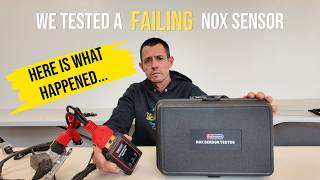
- Faulty or Fouled NOx Sensor(s) (Very Common) — Sensors measuring NOx levels before and after the trap fail internally or become coated in soot, sending false data to the ECU. This is the most frequent hardware failure and the first component to test. 🎬 See how to bench test NOx sensors to save money.
- Saturated or Failed NOx Trap / DPF (Common) — The NOx trap clogs with soot and ash over time, especially from frequent short trips that prevent high-temperature regeneration. Eventually, the catalyst material degrades and permanently loses its ability to trap NOx.
- Exhaust System Leaks (Common) — A leak in the exhaust manifold, flex pipe, or gasket upstream of the NOx trap introduces outside oxygen. This skews sensor readings, tricking the ECU into diagnosing a failed trap.
- Faulty DPF Differential Pressure Sensor (Less Common) — This sensor measures pressure before and after the filter to trigger regeneration. If it fails, the ECU misses regeneration cycles, overloading the DPF/NOx trap with soot and triggering P2000.
- Damaged Wiring Harness or Connectors (Less Common) — Wiring for the NOx sensors runs under the vehicle, exposed to extreme heat and road debris. Frayed wires, shorts, or moisture-filled connectors cause erratic sensor signals.
- Poor Quality Diesel Fuel or DEF (Rare) — High-sulfur diesel fuel poisons the catalyst materials in the NOx trap. Similarly, contaminated Diesel Exhaust Fluid (DEF) prevents the SCR system from functioning, contributing to NOx-related codes.
- Improper Component Replacement or ECU Reset (Rare) — Replacing a DPF or NOx sensor requires an ECU reset to clear learned baseline values (like the ash counter). Failing to perform this calibration with a scan tool causes the code to return immediately.
Symptoms

- Check Engine Light is On — The MIL steadily illuminates on the dashboard. This is universally the first and often only initial symptom.
- Frequent DPF Regeneration Cycles — The vehicle attempts to perform regeneration cycles constantly as the ECU tries unsuccessfully to clean the overloaded NOx trap.
- Reduced Engine Power / Limp Mode — The ECU intentionally limits engine power and turbo boost to prevent catastrophic emissions system damage, resulting in sluggish acceleration.
- Decreased Fuel Economy — The engine consumes 5-15% more fuel as it attempts to compensate for inefficiency and performs constant, fuel-heavy active regenerations.
- Failed Emissions Test — The vehicle releases excessive NOx pollutants and automatically fails state or local OBD-II emissions inspections. 🎬 Watch: Three proven methods to fix the P2000 code.
Diagnostic Flowchart
Tap your situation to follow the diagnostic path that matches what you're seeing on this code.
Common Fixes & Costs
- Update ECM/PCM Software — Parts: $0, Labor: $150 - $250, ~1.0 hr book time (Professional)
- Replace one or both NOx/O2 Sensors
— Parts: $250 - $600 per sensor, Labor: $150 - $300, ~1.5 hr book time
(Intermediate)
Dodge/Ram 6.7L Cummins: OEM Mopar: 05149263AA (Updated O2 Sensor), 68067521AB (NOx) (Alt: Dorman: 904-6030)
Ford 6.7L Powerstroke: OEM Motorcraft: DC3Z-9D378-D (Upstream), DC3Z9D378C (Downstream) (Alt: Bosch)
Chevy/GMC 6.6L Duramax: OEM ACDelco: 19330002 (LML Upstream), 12741484 (L5P Downstream) (Alt: Bosch) - Perform a Forced Regeneration or Professional DPF Cleaning — Parts: $0, Labor: $150 - $400 (forced regen), $500 - $1,500 (off-vehicle cleaning), ~1.5 hr book time (Professional)
- Repair Exhaust Leak — Parts: $20 - $150, Labor: $150 - $400, ~2.0 hr book time (Intermediate)
- Replace the NOx Trap / DPF Assembly — Parts: $1,500 - $8,000+, Labor: $250 - $600, ~3.0 hr book time (Professional)
Used vs. New Parts: Buying Guide
When a used part is worth it: A used DPF/NOx assembly from a low-mileage donor vehicle saves thousands. Never buy used NOx sensors; they are wear items with unpredictable lifespans.
Donor-vehicle mileage cap: roughly under 80000 miles for the part to have meaningful remaining life.
Donor quality checklist:
- Verify the donor vehicle was not scrapped due to engine or turbo failure, which contaminates the exhaust.
- Match the OEM part number exactly; superseded numbers cause software compatibility issues.
- Inspect the DPF substrate for cracks, melting, or extreme discoloration.
Decision logic:
- If The part is a NOx sensor → Buy new OEM. The labor to replace a failed used sensor negates any savings.
- If The part is a DPF/NOx assembly and the vehicle is over 150,000 miles → Buy a used part from a low-mileage donor to avoid spending more than the vehicle's value.
- If An extended emissions warranty applies (e.g., VW Dieselgate) → Go to the dealer. The repair is free with brand new OEM parts.
Warranty tradeoff: Used DPFs offer 30-90 day parts-only warranties. New OEM parts carry 1-2 year nationwide dealer warranties.
Worst-case if a used part fails: $1,000 if a used DPF assembly fails, covering repeat labor and sourcing a replacement.
What Happens If You Wait — Timeline
- 0-1 month: Check Engine Light illuminates. The vehicle fails emissions testing. No drivability symptoms are noticed. (MPG impact: 0-5%% · Added cost: $0-50 in wasted fuel.)
- 1-4 months: The DPF/NOx trap becomes moderately clogged. The ECU attempts frequent regenerations. Fuel economy drops, and the vehicle occasionally enters limp mode. (MPG impact: 5-10%% · Added cost: $500 - $1,500 for professional off-vehicle DPF cleaning.)
- 4-8 months: The DPF is severely clogged with hardened ash. High exhaust backpressure strains the turbocharger. The vehicle frequently enters limp mode. (MPG impact: 10-15%% · Added cost: $2,000 - $8,000 for full DPF assembly replacement.)
- 8+ months: Catastrophic failure. Extreme backpressure destroys the turbocharger, sending metal into the engine. The DPF substrate melts. (MPG impact: 15-25%+% · Added cost: $4,000 - $10,000+ for DPF and turbocharger replacement.)
Cost of Not Fixing It
- 0-1 month: Failed emissions test and a 5-10% decrease in fuel economy. The Check Engine Light remains illuminated. (Added cost: $50 in wasted fuel.)
- 1-6 months: The DPF/NOx trap clogs with soot. Exhaust backpressure increases, straining the turbocharger. The vehicle frequently enters 'limp mode'. (Added cost: $500 - $1,500 for professional off-vehicle DPF cleaning.)
- 6+ months: Irreversible thermal damage to the DPF substrate. Extreme backpressure destroys turbocharger seals and bearings, rendering the vehicle undrivable. (Added cost: $4,000 - $10,000+ for a complete DPF assembly and turbocharger replacement.)
Diagnosis Steps

- Check for Manufacturer TSBs and Software Updates
Before touching a wrench, check with a dealership or online for Technical Service Bulletins (TSBs). A 1-hour software update is the definitive fix for many Dodge Ram, Ford, and VW TDI vehicles.
Tools: Phone or Computer, VIN Number (Beginner) - Scan for All Trouble Codes & Review Freeze Frame
Use an OBD-II scanner to read P2000 and note the freeze-frame data. Address sensor circuit codes (P229F) or DPF pressure codes (P2002) first, as they guarantee a P2000 code by disabling efficiency monitoring.
Tools: OBD-II Scanner (Beginner) - Analyze Live NOx Sensor Data (Pro Tip)
View live data from the upstream and downstream NOx sensors with the engine fully warm at a steady 2000 RPM cruise. The upstream reading should fluctuate, while the downstream reading must remain stable and significantly lower (<50 ppm). If the downstream reading mirrors the upstream, the sensor is lying or the trap has failed.
Tools: Advanced OBD-II Scanner with Live Data (Intermediate) - Test DPF Differential Pressure Sensor
Monitor the DPF pressure sensor live data. At idle, pressure should be 0.5-2.0 kPa (5-20 mbar). Readings above 5 kPa (50 mbar) at idle indicate a severely clogged DPF or a faulty sensor, preventing regeneration.
Tools: Advanced OBD-II Scanner with Live Data (Advanced) - Inspect the Exhaust System for Leaks
Visually inspect the exhaust from the manifold to the NOx trap. Look for black soot stains indicating a leak. A smoke machine test is the only definitive way to find hairline cracks that skew oxygen readings.
Tools: Flashlight, Smoke Machine (recommended) (Intermediate) - Inspect and Electrically Test NOx Sensors
Remove the NOx sensors to inspect for heavy soot buildup. Use a multimeter to test the resistance of the internal heater circuit against factory manual specs (typically 5-20 ohms). Infinite or zero resistance confirms internal failure.
Tools: O2 Sensor Socket, Multimeter, Factory Service Manual (Advanced) - Attempt a Forced Regeneration
If live data shows a soot clog, use a bidirectional scan tool to initiate a forced regeneration. This burns off accumulated soot and restores trap efficiency if the catalyst isn't permanently degraded.
Tools: Advanced Bidirectional OBD-II Scanner (Intermediate) - Check DEF Quality and Injection System
For vehicles with SCR systems, verify DEF fluid is fresh. Use a scan tool to command the DEF injector pump to ensure it sprays correctly. A failing DEF system contributes to overall NOx reduction failure.
Tools: Advanced OBD-II Scanner, DEF Refractometer (Advanced)
When This Code Triggers (Freeze-Frame Conditions)
- Engine Coolant Temp: 170-230°F (75-110°C) (The engine must be fully warmed up to ensure the system is in closed-loop operation.)
- Vehicle Speed: 40-70 mph (64-113 km/h) (Sustained highway driving for at least 10-15 minutes is required for the catalyst monitor to run.)
- Engine Load: 30-60% (A moderate, steady engine load is required, avoiding heavy acceleration or deceleration.)
- RPM: 1500-2500 RPM (A steady engine speed, typical of highway cruising, is required for the monitor to run.)
Related Codes
- P20EE — P20EE indicates failure of the Selective Catalytic Reduction (SCR) system, which uses DEF to convert NOx. P2000 points to the NOx Trap. A failure in the SCR system often triggers P2000.
- P229F — P229F is a NOx sensor circuit fault. A P229F guarantees a P2000 code because the ECU cannot measure efficiency with a dead sensor. Fix P229F first.
- P2002 — P2002 indicates DPF Efficiency Below Threshold (a soot clog). Because the NOx trap is inside the DPF, a clog (P2002) prevents NOx reduction (P2000). Diagnose the clog first.
- P0420 — The gasoline-engine equivalent for catalyst efficiency. While the diagnostic principle is identical, P2000 is strictly for diesel NOx traps.
Climate & Environmental Factors
- Cold Climates / Short Trips: Low temperatures and short drives prevent the exhaust from reaching the 250-350°C required for passive regeneration, rapidly clogging the NOx trap with soot.
- High Altitude: Lower air density reduces combustion efficiency, increasing soot production and placing a heavier load on the DPF and NOx trap.
- High Humidity: High humidity lowers internal combustion temperatures, altering baseline NOx formation and occasionally skewing ECU efficiency calculations.
How to Talk to a Mechanic About This Code
Say this: "I have a P2000 code. Please start by checking for applicable TSBs or software updates, inspecting for exhaust leaks, and analyzing live data from the upstream and downstream NOx sensors before quoting a DPF replacement."
This directs the technician to follow a logical diagnostic procedure, starting with the least expensive causes, rather than immediately assuming the $3,000 DPF has failed.
Avoid saying:
- 'My check engine light is on, can you just fix it?'
- 'I think I need a new DPF.'
- 'Just do whatever you think is best.'
Questions to ask before authorizing the repair:
- Did you confirm my ECM software is up to date?
- What were the readings from the upstream and downstream NOx sensors during a test drive?
- What was the DPF differential pressure at idle?
- Can you show me the location of the exhaust leak if you found one?
Where to Take It: Dealer vs Independent vs Chain
- Dealer:
Highly Recommended. Their access to proprietary software updates and warranty coverage is a major advantage for P2000.
Best for: Vehicles under extended emissions warranties (VW, Audi, Mercedes)., Vehicles requiring TSB software updates (Dodge/Ram)., Complex diagnostics requiring proprietary manufacturer tools.
Downsides: Highest labor rate., Quick to recommend expensive OEM part replacement. (Typical cost: +50% vs. baseline) - Independent Shop:
Good alternative, but only if they specialize in diesel emissions. General mechanics lack the tools for an accurate P2000 diagnosis.
Best for: Out-of-warranty vehicles., Post-diagnosis part replacement.
Downsides: Must be a reputable diesel specialist., May lack the capability to perform ECM software updates. (Typical cost: +0% vs. baseline) - Chain Shop:
AVOID. These shops are not equipped to properly diagnose or repair a P2000 code.
Best for: Oil changes and tire rotations.
Downsides: Technicians lack advanced training for diesel emissions., High risk of misdiagnosis and unnecessary parts replacement. (Typical cost: -10% vs. baseline)
When to Walk Away From the Repair
If the estimated repair cost for the P2000 code exceeds 40-50% of your vehicle's current private-party value, consider alternatives.
- Car worth $15000, fix is $800: Fix it. This is a routine repair cost.
- Car worth $8000, fix is $3500: Borderline. Get a second opinion to confirm it's not a simpler sensor fix before authorizing a DPF replacement.
- Car worth $5000, fix is $3000: Walk away. The repair cost is 60% of the vehicle's value.
What Scan Tool You Need for This Code
Minimum: A tool that reads manufacturer-specific live data, including upstream/downstream NOx sensor readings (in ppm) and DPF differential pressure.
A basic $20 code reader only shows the P2000 code. It cannot display the live sensor data needed to determine if the fix is a $300 sensor or a $4,000 DPF.
Budget: BlueDriver Pro (~$100) — Displays live data for many vehicles, including NOx sensor readings, allowing you to graph sensor performance.
Mid-range: Foxwell NT510 Elite (~$180) — Offers bidirectional control to initiate a forced DPF regeneration and provides deep diagnostics for one chosen manufacturer.
Professional: Autel MaxiCOM MK808 / XTOOL D7 (~$450-600) — Provides extensive bidirectional controls (forced DPF regen), component resets (DPF ash counter, NOx sensor adaptation), and full module access.
Rent vs buy: Buy a mid-range tool. Rental tools lack the bidirectional functions (like forced regeneration) required to diagnose and fix P2000.
How to Clear the Code After You Fix It
- Use an OBD-II scan tool to clear the P2000 code.
- Perform a specific NOx sensor or DPF reset procedure using an advanced scan tool to clear learned ECU values.
- Complete a full drive cycle to run the readiness monitors.
Drive cycle (~30 minutes): Start the engine cold and idle for 3 minutes. Drive in mixed conditions, ensuring at least 15 minutes of steady-state cruising between 50-70 mph to allow the catalyst monitor to run. Allow the vehicle to cool completely and repeat.
Readiness monitors affected: Catalyst Monitor, Oxygen Sensor Monitor, NOx/SCR Aftertreatment Monitor
Before emissions retest: drive at least 100 miles to fully set monitors.
Watch out for:
- Clearing the code without a drive cycle results in an automatic 'Not Ready' emissions failure.
- Failing to reset the ECU's ash counter after replacing a DPF guarantees the code will return.
- Disconnecting the battery resets all monitors, requiring a massive drive cycle from scratch.
Will This Fail Emissions / State Inspection?
Yes — this code typically fails an OBD-II emissions inspection.
- California: P2000 is an automatic smog check failure. After repairs, you must drive up to 100 miles to set all readiness monitors to 'Ready' before re-testing.
- New York: The NYS DMV inspection includes an OBD-II scan. An active P2000 code fails the emissions portion immediately.
- Texas: In the 17 emissions-testing counties, an active P2000 code fails the OBD-II portion of the annual safety inspection.
Most Commonly Affected Vehicles

- Dodge/Ram 2500/3500 with 6.7L Cummins (2007-2013) — TSB #25-001-13 REV. A requires replacing outdated O2 sensors with part #05149263AA. TSB #18-001-13 provides an ECM software update. The NOx trap itself rarely fails on these models.
- Ford F-250/F-350 with 6.7L Powerstroke (2011-2019) — Prone to NOx sensor failures. Ford SSM 49065 warns that aftermarket intake cleaners permanently damage NOx sensors and void warranties.
- Chevrolet/GMC Silverado/Sierra 2500HD/3500HD with 6.6L Duramax (2011-2024) — Common on LML and L5P engines. Causes are frequently tied to NOx sensor failures and DPF clogging from excessive city driving.
- Mercedes-Benz Sprinter, E-Class, GLK, ML-Class with BlueTEC (2009-2016) — NOx sensor failures trigger a 'starts remaining' countdown. Most are covered by the BlueTEC settlement extended emissions warranty.
- Volkswagen Jetta, Golf, Passat, Touareg TDI (2009-2015) — Highly susceptible to DPF saturation from city driving. Covered by the 'Dieselgate' extended emissions warranty up to 11 years/162,000 miles.
- Audi Q7, A6, A8 with 3.0L TDI (2009-2016) — Shares the VW emissions system. Triggered by failed NOx sensors or ash-saturated DPFs. Check for 'Dieselgate' warranty coverage.
Manufacturer-Specific Notes
- Dodge/Ram (Cummins): For 2007-2013 models, the root cause is almost always outdated software or a faulty oxygen sensor. TSB 25-001-13 REV. A is the mandatory first check.
- Ford (Powerstroke): Ford explicitly warns that using aftermarket intake and EGR cleaning sprays permanently destroys NOx sensors, triggering P2000 and voiding the warranty.
- Mercedes-Benz: A failing NOx sensor triggers a hard 'start countdown' on the dashboard. The vehicle will refuse to start after the countdown reaches zero.
- Volkswagen/Audi: If the DPF warning light appears alongside P2000, perform a sustained highway regeneration drive immediately to prevent limp mode. Check for 'Dieselgate' warranty coverage before paying.
Real Owner Stories
2012 Ram 2500 6.7L Cummins with recurring P2000
Check engine light came on two days after buying the truck. The code was P2000.
Outcome: The issue remained unresolved due to a 'parts cannon' misdiagnosis.
Lesson: For this specific vehicle, TSBs point to software updates and specific updated O2 sensor part numbers. Always ask if relevant TSBs have been checked before authorizing parts replacement.
2011 Ram with 6.7L Cummins at 110k miles
Vehicle threw a P2000 code along with EGR codes. The owner noticed no major symptoms.
Outcome: The codes cleared on their own as the built-up soot burned off during a passive regeneration.
Lesson: If your driving consists of short trips, drive at sustained highway speeds for 30+ minutes to allow a full regeneration cycle. This costs nothing and often resolves soot-induced codes.
2007 Dodge Ram 6.7L with P2000 after a major repair
A week after a turbocharger replacement, the check engine light came on with a P2000 code.
Outcome: The root cause was ignored. The failing turbo likely sent oil downstream, damaging the NOx absorber, or a sensor was left unplugged.
Lesson: If a new code appears immediately after a major repair, the events are related. Insist the shop diagnose the new fault as a consequence of the original repair.
How to Prevent This Code From Triggering
- Perform a weekly highway drive (Once per week) — Driving at 55+ mph for 30 minutes allows the exhaust to reach 600°C, burning off accumulated soot before it causes a blockage.
- Use high-quality diesel fuel and low-ash engine oil (Every fill-up / Every oil change) — Top-tier fuels reduce soot formation. OEM-spec low-ash oil (API CJ-4/CK-4) prevents non-combustible ash from irreversibly clogging the DPF.
- Avoid unnecessary idling (Daily habit) — Idling cools the exhaust, preventing regeneration and rapidly building soot. It also causes failed regenerations that dilute engine oil with fuel.
- Address other engine faults immediately (As they occur) — Faulty EGR valves or leaking injectors dramatically increase soot production, quickly overwhelming the DPF and NOx trap.
Frequently Asked Questions
Can I just clear the P2000 code and keep driving?
You can clear it, but it will return within 50-100 miles. Clearing the code does not fix the physical inefficiency, and the ECU will catch the failure during its next monitor cycle.
Is a P2000 code covered under warranty?
The federal emissions warranty covers the ECU and DPF for 8 years or 80,000 miles. Additionally, many Mercedes, VW, and Audi diesels have extended legal settlement warranties covering NOx sensors and DPFs up to 11 years or 162,000 miles. Always call a dealership with your VIN to verify coverage.
What is the most common misdiagnosis for P2000?
The most expensive mistake is replacing the $3,000 DPF assembly without testing the sensors. A faulty $300 NOx sensor or a $150 software update are far more common root causes.
Why do shops charge a diagnostic fee if the code already tells them the problem?
An OBD-II code only reports a symptom, not the failed part. A technician must perform live data analysis and physical tests to pinpoint the root cause. This $150-$200 fee prevents you from wasting $3,000 on a new DPF when a software update fixes the issue.
Can I clean a NOx sensor to fix the P2000 code?
Gently cleaning heavy soot from the sensor tip with compressed air provides a temporary fix. However, sensors usually fail due to internal electrical degradation, requiring full replacement.
Can my driving habits cause a P2000 code?
Yes. Frequent short trips prevent the exhaust from reaching regeneration temperatures. This clogs the DPF/NOx trap with soot and triggers the code.
Will a fuel additive or cleaner fix a P2000 code?
No. Additives cannot repair a failed sensor, a damaged wire, or a physically degraded NOx trap. On Ford trucks, certain cleaners actually cause permanent sensor damage.
What does 'Bank 1' mean?
Bank 1 refers to the side of the engine containing the #1 cylinder. On inline engines (Cummins, TDI), there is only one bank. On V-style engines (Powerstroke, Duramax), it identifies which specific exhaust bank has the fault.
Key Takeaways
- Code P2000 indicates your diesel's NOx trap is operating below the required 250°C-350°C efficiency window, failing to capture nitrogen oxides.
- Always check for manufacturer Technical Service Bulletins (TSBs) first; a 1-hour dealership software update fixes this code on thousands of 2007-2013 Dodge Ram trucks.
- Do not replace the $2,000+ DPF assembly without first testing the upstream and downstream NOx sensors, which frequently fail and cause false P2000 readings.
- Driving more than 100 miles with an active P2000 code risks irreversible soot clogging, potentially turning a $300 sensor replacement into an $8,000 DPF and turbocharger failure.
- Call your local VW, Audi, or Mercedes-Benz dealership with your VIN to check for active 'Dieselgate' or 'BlueTEC' extended warranties, which cover this exact repair up to 11 years or 162,000 miles.
Helpful Videos

The information in this article is provided for general reference and educational purposes only. Vehicle specifications, procedures, and part compatibility can vary by production date, trim level, and region. Always consult your vehicle's factory service manual and verify part numbers before purchasing or performing repairs. Safety-critical components such as airbags, seat belts, and braking systems should be installed by a qualified professional.
- 🎬 Helpful Videos
- What Does P2000 Mean?
- Can I Drive With P2000?
- Common Causes
- Symptoms
- Diagnostic Flowchart
- Common Fixes & Costs
- Used vs. New Parts: Buying Guide
- What Happens If You Wait — Timeline
- Cost of Not Fixing It
- Diagnosis Steps
- When This Code Triggers (Freeze-Frame Conditions)
- Related Codes
- Climate & Environmental Factors
- How to Talk to a Mechanic About This Code
- Where to Take It: Dealer vs Independent vs Chain
- When to Walk Away From the Repair
- What Scan Tool You Need for This Code
- How to Clear the Code After You Fix It
- Will This Fail Emissions / State Inspection?
- Most Commonly Affected Vehicles
- Manufacturer-Specific Notes
- Real Owner Stories
- 2012 Ram 2500 6.7L Cummins with recurring P2000
- 2011 Ram with 6.7L Cummins at 110k miles
- 2007 Dodge Ram 6.7L with P2000 after a major repair
- How to Prevent This Code From Triggering
- Frequently Asked Questions
- Can I just clear the P2000 code and keep driving?
- Is a P2000 code covered under warranty?
- What is the most common misdiagnosis for P2000?
- Why do shops charge a diagnostic fee if the code already tells them the problem?
- Can I clean a NOx sensor to fix the P2000 code?
- Can my driving habits cause a P2000 code?
- Will a fuel additive or cleaner fix a P2000 code?
- What does 'Bank 1' mean?
- Key Takeaways
- 🎟️ Get 5% Off