

OBD-II Code P1990: A Multi-Make Diagnostic Guide
What P1990 means, why it triggers, and how to fix it based on your vehicle's make
- P1990 is a manufacturer-specific code that means an engine oil temperature fault on Fords, a PDK transmission failure on Porsches, and a high-voltage hybrid system error on Hyundais.
- On Ford 7.3L and 6.0L Power Stroke diesels, P1990 almost always indicates a chafed wiring harness over the driver-side valve cover or a failed Engine Oil Temperature (EOT) sensor.
- Porsche owners seeing P1990 face a PDK transmission control unit fault requiring a PIWIS factory scan tool for diagnosis, with repairs ranging from a $3,000 mechatronics fix to a $25,000 full replacement.
- Hyundai and Kia hybrid owners with a P1990 code and a no-start condition should immediately check for Service Campaign T4M, which provides a free dealer replacement of the Power Relay Assembly.
- Never replace the Ford EOT sensor without first performing a live-data wiggle test on the wiring harness, as repairing a $30 pigtail connector resolves the issue frequently.
What Does P1990 Mean?

P1990 is a manufacturer-specific code with distinct definitions based on your vehicle's make. For Ford vehicles (especially Power Stroke diesels), it indicates an Engine Oil Temperature (EOT) sensor circuit fault, where the PCM detects voltage higher than the normal operating range. For Porsche, Hyundai, and Volkswagen, this code points to critical transmission or hybrid system failures.
Technical definition: For Ford vehicles, P1990 is a variation of P0198, defined as 'Engine Oil Temperature (EOT) Sensor Circuit High'. For Porsche, it means 'Positive engine torque intervention not possible' related to the PDK transmission. For Hyundai hybrids, it is 'OPU Input high voltage wiring line open'. For older Volkswagen models, it relates to the transmission cooling fan command circuit.
Can I Drive With P1990?
Yes, But With Caution. For Ford vehicles, short-term driving (under 100 miles) is possible but not recommended. The PCM uses incorrect fuel delivery and engine timing strategies, causing poor performance, hard starting, and reduced fuel economy. Prolonged driving with a faulty EOT sensor causes a rich fuel condition, damaging the catalytic converter—a $1,500-$2,500 repair. For Porsche, Volkswagen, and Hyundai, do not drive; the vehicle enters 'limp-home' mode, fails to engage gears, or refuses to start, requiring a tow.
Common Causes

- Wiring Harness Chafing or Damage (Ford) (Very Common) — The main engine harness on 7.3L and 6.0L Power Stroke engines routes over the driver-side valve cover, a notorious spot for chafing. This damages the EOT sensor wires, causing an open circuit. General wire fraying or melted connectors also trigger this.
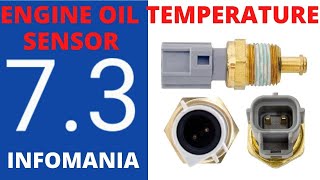
- Failed Engine Oil Temperature (EOT) Sensor (Ford) (Common) — The thermistor inside the sensor breaks, sending an out-of-range signal to the PCM. 🎬 Watch: How to locate and replace the 7.3L EOT sensor.
- Faulty Transmission Control Module (TCM) or Mechatronics Unit (Porsche/VW) (Common) — Internal hardware failure, distance sensor failure, or software corruption within the transmission's electronic control unit requires reprogramming or replacement.
- Faulty Power Relay Assembly (PRA) (Hyundai/Kia) (Common) — A loose connection within the high-voltage PRA triggers this code, addressed by Service Campaign T4M. 🎬 Watch: DIY fix for Hyundai and Kia hybrid no-start issues.
- Low or Degraded Engine Oil (Less Common) — Extremely low or degraded oil causes abnormal temperature readings, contributing to the PCM flagging a sensor issue.
- PCM Software Glitch (Less Common) — A software error erroneously sets the P1990 code, requiring a dealer re-flash.
- Faulty Powertrain Control Module (PCM) (Rare) — The vehicle's main computer fails internally, misinterpreting sensor data. This is the last component to suspect.
Symptoms

- Check Engine Light or Transmission Warning Light — The Check Engine Light (Ford) or a transmission-specific warning light (Porsche/VW) illuminates on the dashboard.
- Hard Starting, Rough Idle, or Stalling (Ford) — An incorrect oil temperature reading causes the engine to run rough, idle high, stall, or be difficult to start.
- Erratic Shifting or Limp Mode (Porsche/VW) — The vehicle experiences harsh shifts, an inability to select gears, or gets stuck in a single gear with a 'Transmission Emergency Run' message.
- Decreased Fuel Economy — The PCM defaults to a rich fuel mixture, noticeably decreasing MPG.
- No Start or 'Check Hybrid System' Warning (Hyundai/Kia) (scan-tool only — no driver-felt sign) — The vehicle fails to enter 'Ready' mode or start, displaying a 'Check Hybrid System' warning message.
- Default EOT Reading on Scan Tool (scan-tool only — no driver-felt sign) — Live data shows the EOT value at an illogical default, such as -40°F, confirming an open circuit.
Diagnostic Flowchart

Tap your situation to follow the diagnostic path that matches what you're seeing on this code.
Common Fixes & Costs
- Repair Damaged Wiring or Pigtail Connector — Parts: $15-$50, Labor: $100-$300, ~1.5 hr book time (Intermediate)
- Replace Engine Oil Temperature (EOT) Sensor (Ford) — Parts: $25-$60, Labor: $75-$175, ~1.0 hr book time (DIY)
- Replace Power Relay Assembly (PRA) (Hyundai/Kia) — Parts: $250-$450, Labor: $200-$400, ~2.5 hr book time (Professional)
- Replace PDK Mechatronics/Control Unit (Porsche) — Parts: $1,500-$3,500, Labor: $1,000-$2,000, ~8.0 hr book time (Professional)
- Reprogram or Replace Powertrain Control Module (PCM) — Parts: $300-$1200, Labor: $150-$300, ~2.0 hr book time (Professional)
Used vs. New Parts: Buying Guide
When a used part is worth it: For a $60 Ford EOT sensor, always buy new OEM. For a Porsche PDK Mechatronics unit or Hyundai Power Relay Assembly, a tested, warrantied remanufactured part from a reputable supplier saves thousands ($1,500 vs $3,500+ new).
Donor-vehicle mileage cap: roughly under 60000 miles for the part to have meaningful remaining life.
Donor quality checklist:
- Verify the part number matches exactly; electronic modules are not interchangeable.
- Ensure the seller offers a warranty (90 days minimum) for electronic modules.
- Buy from specialists who test the components, not just pull them from a wreck.
- Avoid parts from flood-damaged or high-rust vehicles.
Decision logic:
- If The part is a simple, inexpensive sensor (e.g., Ford EOT sensor) → Always buy new OEM or high-quality aftermarket.
- If The part is a complex electronic module (Porsche Mechatronics, Hyundai PRA) and the vehicle is out of warranty → A remanufactured or tested used unit from a specialist is a viable cost-saving option.
- If The part requires programming to the vehicle's VIN → Factor in the cost of dealer/specialist programming ($150-$400) when comparing to a new part.
Warranty tradeoff: Used parts typically offer a 30-90 day warranty. Remanufactured parts often come with a 1-year or limited lifetime warranty. New OEM parts carry a 1-2 year warranty.
Worst-case if a used part fails: $500-$2000 if a used electronic module fails after installation, requiring repeat labor costs.
What Happens If You Wait — Timeline
- 0-1 month: Ford: Check Engine Light on. Occasional hard starting or slightly rough idle. Porsche: 'Transmission Emergency Run' light appears intermittently. Hyundai: 'Check Hybrid System' light on, possible no-start. (MPG impact: 5-10% (Ford)% · Added cost: $0-$50 in wasted fuel)
- 1-3 months: Ford: Hard starting becomes frequent. Noticeable drop in fuel economy. Porsche: Limp mode becomes frequent and requires multiple restarts. Hyundai: No-start events become common. (MPG impact: 10-15% (Ford)% · Added cost: $50-$200 in wasted fuel and potential towing costs)
- 3-6 months: Ford: Prolonged rich condition fouls spark plugs and overloads the catalytic converter. Porsche: The underlying electronic issue causes mechanical stress, grinding, or clutch slip. (MPG impact: 15-20% (Ford)% · Added cost: $1,500-$2,800 (Ford, for potential catalytic converter damage). For Porsche, a sensor/mechatronics repair ($3k-$7k) is critical here.)
- 6+ months: Ford: Catalytic converter failure is highly likely, causing a major exhaust restriction. Porsche: Continued operation leads to catastrophic mechanical failure of the clutches or gear sets. (MPG impact: >20% (Ford)% · Added cost: $7,000-$25,000+ (Porsche, for a full PDK transmission replacement).)
Cost of Not Fixing It
- 0-1 month: Ford: Hard starting, rough idle, and a 5-15% drop in fuel economy as the PCM defaults to a rich fuel mixture. Porsche: Vehicle stuck in limp mode. (Added cost: $50-$150 in wasted fuel.)
- 1-6 months: Ford: Continued rich fuel conditions overheat and destroy the catalytic converter. Porsche: Ignoring transmission warnings causes cascading mechatronics failures. (Added cost: $1,500-$2,800 for catalytic converter replacement.)
- 6+ months: Porsche: Complete transmission failure requiring full replacement. Ford: Severe engine performance issues and fouled spark plugs. (Added cost: $7,000-$25,000+ for PDK repair or replacement.)
Diagnosis Steps
- Identify the Correct Definition for Your Vehicle
Confirm what P1990 means for your specific make. A P1990 on a Ford F-250 is an engine issue; on a Porsche Cayman, it is a transmission issue. Diagnosing the wrong system is a common mistake.
Tools: OBD-II Scanner, Online Service Information (Beginner) - Check for Hyundai/Kia Service Campaigns
For 2016-2017 Hyundai Sonata and Kia Optima Hybrids, check if Service Campaign T4M (TSB 20-01-003H) has been performed. This campaign addresses a known issue with the Power Relay Assembly (PRA) that directly causes the P1990 code.
Tools: VIN, Dealer Service History or NHTSA Website (Beginner) - Scan and Check Live Data (Ford)
Use an OBD-II scanner to view live data from the EOT sensor. After a cold soak (sitting overnight), the EOT reading should be within 2-4 degrees of the Engine Coolant Temperature (ECT). If it reads a default low value (like -40°F), the sensor or circuit is open.
Tools: Advanced OBD-II Scanner (Beginner) - Visual Inspection of Sensor and Wiring
Locate the relevant component. Inspect the connector for looseness, corrosion, or pushed-out pins. Follow the wiring harness, looking for chafing, melting, or breaks. On Power Stroke engines, pay close attention to the harness crossing the driver-side valve cover.
Tools: Flashlight, Mirror (optional) (Beginner) - Perform a 'Wiggle Test'
With the engine running and live data displayed, gently wiggle the connector and wiring harness at the sensor. If the reading changes, you have confirmed a bad connection or a break in the wire.
Tools: OBD-II Scanner (Intermediate) - Advanced: Test the Sensor Circuit Voltage (Ford)
Disconnect the EOT sensor. Turn the ignition 'On' (engine off). Use a multimeter to test the connector harness. One wire is the signal return and should have continuity to ground (<1 Ohm). The other is the 5-volt reference from the PCM. If you have ~5 volts and a good ground, the wiring to the sensor is intact.
Tools: Multimeter (Advanced) - Advanced: Test the Sensor's Resistance vs. Temperature (Ford)
With the sensor unplugged, measure the resistance across the sensor's two pins. Compare your reading to a temperature/resistance chart. An infinitely high reading (OL - Open Line) indicates an open circuit and a failed sensor.
Tools: Multimeter, Service Manual (Advanced) - Advanced Diagnosis (Porsche/VW)
For transmission-related P1990 codes, diagnosis requires a professional-level scan tool capable of communicating with the TCM. The technician checks for software updates, performs calibrations, and analyzes internal sensor data (e.g., distance sensor voltage).
Tools: Manufacturer-Specific Scan Tool (e.g., PIWIS) (Professional)
When This Code Triggers (Freeze-Frame Conditions)
- Engine Oil Temperature: -40°F (-40°C) (The PCM detects an open circuit and defaults to a minimum value.)
- Engine Coolant Temp: 180-210°F (82-99°C) (The fault sets when the engine is at normal operating temperature, creating a large, illogical discrepancy between the EOT and ECT readings.)
- RPM: 1200-2500 (Triggered during steady-state driving or light acceleration.)
- Vehicle Speed: 40-65 mph (64-105 kph) (Commonly registered during highway or city cruise conditions.)
Related Codes
- P0197 — This code means 'EOT Sensor Circuit Low', which is the opposite of a 'Circuit High' code but points to the same system.
- P0198 — This is the generic SAE code for 'EOT Sensor Circuit High'. P1990 is a manufacturer-specific variant of this same fault on Ford vehicles.
- P1991 — On Porsche vehicles, this code for 'Negative engine torque intervention not possible' appears alongside P1990, indicating a comprehensive failure in the PDK.
- P1B77 — On Hyundai Hybrids, this code for 'High Voltage Battery Precharging Fault' is stored along with P1990. Both are caused by the faulty Power Relay Assembly (PRA).
Climate & Environmental Factors
- Cold Weather: Extreme cold makes wiring harnesses brittle and susceptible to cracking, causing an open circuit.
- High Humidity / Water Ingress: Moisture accelerates corrosion on connector pins. On Jaguars, water ingress into the cabin destroys the TCM.
- Engine Bay Heat: Prolonged exposure to diesel engine heat degrades wire insulation, causing the harness chafing issues on Ford Power Strokes.
How to Talk to a Mechanic About This Code
Say this: "For a Ford: 'I have a P1990 code. Can you perform a circuit diagnosis, including checking the harness for chafing over the valve cover, before replacing any parts?'. For a Porsche: 'I have a P1990 code on my PDK transmission. Do you have a PIWIS scan tool to properly diagnose a transmission control module fault?'. For a Hyundai Hybrid: 'I have a P1990 code and a Check Hybrid System light. Can you check if my VIN has an open Service Campaign T4M for the Power Relay Assembly?'."
This language directs the technician toward the most likely cause (wiring on a Ford, software on a Porsche, a TSB on a Hyundai) and prevents them from performing generic, unnecessary diagnostics.
Avoid saying:
- 'Just fix the check engine light.'
- 'I have a P1990 code, just replace the sensor.'
- 'My transmission is acting weird.'
Questions to ask before authorizing the repair:
- For Ford: Did you find the fault in the sensor, the connector, or the wiring harness?
- For Porsche: What specific fault did the PIWIS tool find within the transmission control unit?
- For Hyundai: Was my vehicle covered under the service campaign?
- What is the warranty on this specific repair, including both parts and labor?
Where to Take It: Dealer vs Independent vs Chain
- Dealer:
Required for Hyundai/Kia service campaign and highly recommended for Porsche due to specialized tool requirements.
Best for: Hyundai/Kia Hybrids to check for and perform Service Campaign T4M., Porsche vehicles, as they have the proprietary PIWIS diagnostic tool required for PDK transmission faults., Any vehicle still under its powertrain or emissions warranty.
Downsides: Highest labor rates., May recommend complete component replacement (e.g., entire PDK transmission) when a specialized repair is possible. (Typical cost: +50% vs. baseline) - Independent Shop:
The best choice for a Ford Power Stroke. A viable, cost-effective alternative to the dealer for Porsche if the independent shop is a well-equipped specialist.
Best for: Ford Power Stroke repairs, especially a shop that specializes in diesel trucks., Out-of-warranty Porsche vehicles, but ONLY if the shop is a German car specialist with a PIWIS or equivalent high-level scan tool., Out-of-warranty vehicles where cost is a major factor.
Downsides: Quality and expertise vary widely; must vet the shop's specialty., A general-purpose shop lacks the specific tools or knowledge for Porsche PDK or Hyundai hybrid systems. (Typical cost: +0% vs. baseline) - Chain Shop:
AVOID. The complexity and manufacturer-specific nature of P1990 are beyond the scope of most chain repair shops.
Best for: Simple, unrelated maintenance like tire changes or oil changes.
Downsides: Technician skill varies dramatically., Unlikely to have the specialized diagnostic tools (PIWIS) or high-voltage training (Hyundai hybrid) for this code., High pressure to upsell parts leads to misdiagnosis. (Typical cost: -10% vs. baseline)
When to Walk Away From the Repair
If the estimated repair cost exceeds 40-50% of the car's Kelley Blue Book (KBB) private-party value, you should pause and consider selling or trading in the vehicle.
- Car worth $8000, fix is $4500: Walk away. The repair cost is over 50% of the car's value. This is especially true for the Porsche PDK fix, which can be followed by other expensive repairs.
- Car worth $15000, fix is $400: Fix it. This cost is well below the threshold and likely represents a straightforward repair like the EOT sensor/wiring on a Ford.
- Car worth $3000, fix is $1800: Walk away. The repair cost is 60% of the vehicle's value. It is not financially sound to invest this much into an older, lower-value car.
What Scan Tool You Need for This Code
Minimum: A basic OBD-II code reader retrieves the P1990 code, but is insufficient for a full diagnosis. For Ford, you need live data capability. For Porsche/Hyundai, you need a tool that reads manufacturer-specific transmission and hybrid system codes.
A $20 reader only tells you the code exists. It cannot see the live EOT/ECT data on a Ford needed to confirm the fault, and it absolutely cannot communicate with the PDK module on a Porsche or the hybrid controller on a Hyundai.
Budget: BlueDriver Pro / FORScan Lite with OBDLink Adapter (~$100) — For Ford, these tools display the critical live data streams (EOT, ECT, IAT) needed to diagnose the sensor circuit. For Porsche and Hyundai, they read the specific code definition but lack advanced functions.
Mid-range: Foxwell NT510/NT530 / ANCEL FD500 (Ford Specific) (~$150) — These scanners offer deeper access into manufacturer-specific modules. The Foxwell accesses Ford, Porsche, and Hyundai systems. The ANCEL FD500 is excellent for Ford-specific diagnostics.
Professional: Autel MaxiCOM MK808 / OTOFIX D1 Lite (~$450-600) — These provide full bidirectional control and perform the PDK calibration and adaptation functions required for a Porsche repair. They also offer comprehensive diagnostics for Ford and Hyundai systems.
Rent vs buy: You can borrow a basic OBD-II reader from stores like AutoZone for free to get the initial code. However, because P1990 requires advanced diagnostics, you will likely need to buy a more capable scanner or take the vehicle to a qualified shop.
How to Clear the Code After You Fix It
- Use an OBD-II scan tool to clear the diagnostic trouble codes (DTCs).
- Reconnect the battery if it was disconnected for the repair.
- Perform a complete drive cycle to allow the vehicle's readiness monitors to run.
Drive cycle (~20 minutes): For Ford, perform a cold start (sit for 8+ hours), idle for 3 minutes, drive for 15 minutes with mixed city/highway speeds (including steady 55 mph cruising), and perform several decelerations without braking. This allows the PCM to verify sensor operation.
Readiness monitors affected: Comprehensive Component Monitor, Catalyst Monitor, Oxygen Sensor Monitor
Before emissions retest: drive at least 50 miles to fully set monitors.
Watch out for:
- Disconnecting the battery clears the code but resets all readiness monitors, causing an immediate emissions test failure.
- The code returns immediately if the underlying electrical fault remains.
- For Porsche PDK faults, clearing the code is insufficient; a PIWIS tool is required for transmission calibration.
Will This Fail Emissions / State Inspection?
Yes — this code typically fails an OBD-II emissions inspection.
- California: An illuminated Check Engine Light from code P1990 is an automatic failure. After repair, a full drive cycle must be completed to set all readiness monitors before a re-test is possible.
- New York: NYS vehicle inspection includes an OBD-II scan. Any active trouble code, including P1990, results in an automatic emissions failure.
- Texas: In the 17 counties requiring emissions testing, an active P1990 code causes the vehicle to fail the OBD-II portion of the inspection.
Most Commonly Affected Vehicles

- Ford F-250/F-350 Super Duty (1999-2010) — Very common on 7.3L, 6.0L, and 6.4L Power Stroke diesel engines. The 7.3L EOT sensor is located on the front of the high-pressure oil pump reservoir.
- Ford Excursion (2000-2005) — Shares the Power Stroke diesel engines with the Super Duty trucks and experiences the same EOT sensor and wiring issues.
- Ford E-Series Vans (E-350/E-450) (1999-2010) — Commercial vans equipped with Power Stroke engines are highly susceptible to this code due to high mileage and harsh operating conditions.
- Porsche 911 (997.2), Cayman/Boxster (987.2) (2009-2012) — P1990 is a PDK transmission fault, indicating a control unit, distance sensor, or software problem requiring a PIWIS tester for diagnosis.
- Hyundai Sonata Hybrid (2016-2017) — P1990 points to an issue with the high-voltage oil pump wiring. Hyundai issued Service Campaign T4M to fix this by replacing the Power Relay Assembly (PRA).
- Kia Optima Hybrid (2016-2017) — Shares a platform and hybrid system with the Hyundai Sonata Hybrid and experiences the same PRA issues.
- Volkswagen Golf, Jetta, Passat (1990-2005) — On older VW models with automatic transmissions, P1990 indicates a fault in the transmission cooling fan control circuit or the TCM.
- Jaguar XJ6, X-Type (1990-2008) — P1990 relates to a faulty Transmission Control Module (TCM), causing communication errors and shifting problems.
Manufacturer-Specific Notes
- Porsche: For Porsche vehicles with a PDK transmission, P1990 means 'Positive engine torque intervention not possible'. It indicates a serious transmission fault requiring a dealer visit for diagnostics with a PIWIS tester. While a full PDK replacement costs over $25,000, specialized shops repair the mechatronics unit or replace the internal distance sensor for a fraction of that cost.
- Hyundai: On 2016-2017 Sonata Hybrids, P1990 is defined as 'OPU Input high voltage wiring line open'. Hyundai issued Technical Service Bulletin 20-01-003H and Service Campaign T4M to address this, which involves inspecting and replacing the Power Relay Assembly (PRA). This is a recall-level action performed by a dealer.
- Ford: While P1990 on Power Stroke diesels is almost always EOT-related, wiring harness damage is extremely common. The main harness that runs over the driver-side valve cover is a known weak point for chafing. Always inspect this area thoroughly before replacing the sensor.
- Jaguar: On older models like the XJ6 and X-Type, P1990 indicates a failure of the Transmission Control Module (TCM). Water ingress into the cabin near the TCM is a common cause. Used or remanufactured TCMs are available as a cost-effective repair.
Real Owner Stories
2002 Ford F-250 7.3L Power Stroke with rough idle
Check Engine Light came on during a trip, accompanied by a rough idle. The owner scanned the code and found P0197 (EOT Circuit Low), a related fault to P1990.
What they tried:
- Replaced the Engine Oil Temperature (EOT) sensor, but the problem persisted.
- Discovered the main 42-pin wiring harness connector bracket over the driver's side valve cover had broken, allowing the harness to rub.
Outcome: A single wire for the EOT sensor had chafed through its insulation, causing a short. The owner repaired the wire and secured the harness, permanently fixing the issue.
Lesson: On Ford Power Stroke engines, always inspect the wiring harness for chafing over the driver's side valve cover before replacing the EOT sensor.
2011 Porsche 911 (997.2) with PDK transmission failure
The car failed to engage gears properly, getting stuck in 1st. A scan revealed code P1990 and other communication faults.
What they tried:
- Used a basic OBD-II scanner which could read the codes but could not diagnose the transmission module.
- Consulted a specialist indicating the issue was a fault within the PDK control unit requiring a PIWIS diagnostic tool.
Outcome: The issue was a CAN bus communication problem. The fix required a specialist with a PIWIS tester to diagnose the network and reprogram the PDK control unit.
Lesson: For Porsche PDK faults like P1990, a generic OBD-II scanner is inadequate. The problem requires a specialist with a PIWIS tool for proper diagnosis.
2016 Hyundai Sonata Hybrid with a no-start condition
The car intermittently failed to start, displaying a 'Check Hybrid System' warning. A scan showed code P1990.
What they tried:
- Reset the code with an OBD-II reader, but the problem returned.
- Identified the issue as a known problem covered by Hyundai's Service Campaign T4M.
Outcome: The root cause was a loose connection within the Power Relay Assembly (PRA). The dealer performed the service campaign, replacing the PRA and resolving the code.
Lesson: If you own a 2016-2017 Hyundai/Kia hybrid with a P1990 code, check for open service campaigns first. This specific issue has a free dealer fix.
How to Prevent This Code From Triggering
- Protect the Ford Power Stroke wiring harness (Once, during other maintenance) — The harness on 7.3L and 6.0L engines chafes on the driver's side valve cover. Proactively wrap the area with anti-abrasion tape and secure it away from the engine.
- Perform regular Porsche PDK fluid and filter changes (Every 40,000-60,000 miles or 4-6 years) — Degraded fluid loses its hydraulic properties, causing stress on solenoids and sensors within the mechatronics unit, leading to electronic faults like P1990.
- Avoid excessive stop-and-go 'creeping' in a Porsche PDK (Daily driving habit) — Constantly inching forward causes the clutches to slip continuously, generating excessive heat that degrades sensors and electronic components.
- Use high-quality engine oil and change it on schedule (Ford) (Per manufacturer's schedule) — Clean oil ensures the EOT sensor gets accurate readings and is not subjected to excessive temperatures from sludged oil.
- Check for open service campaigns (Hyundai/Kia) (Annually or if symptoms appear) — For the 2016-2017 Sonata/Optima Hybrid, the P1990 code is directly addressed by Campaign T4M, a free repair at a dealership.
Frequently Asked Questions
What does 'Circuit High' actually mean?
It means the engine's computer sees a voltage from the sensor that is higher than the maximum expected value. This is caused by an open circuit, such as a broken wire, an unplugged connector, or an internally failed sensor. The PCM sees the full 5-volt reference returning instead of a lower, temperature-modified voltage.
What is the most common misdiagnosis for P1990?
The most common mistake is not understanding that P1990 has different meanings for different car brands. A technician might start testing engine sensors on a Porsche, when the code actually points to a complex transmission problem. Always verify the code's specific definition for your vehicle.
Can I just replace the EOT sensor to fix P1990 on my Ford?
You can, but wiring issues are a very common cause. Inspect the wiring harness for damage first, especially where it passes over the valve cover, to avoid replacing a perfectly good sensor. A 'wiggle test' on the harness while watching live data is a great diagnostic step.
My truck is a Ford but the code is P0198, not P1990. Is it the same thing?
Yes, P0198 is the standard SAE code for the same fault ('EOT Sensor Circuit High'). The causes, symptoms, and diagnostic steps are identical.
I have a Porsche and got code P1990. Is a $25,000 transmission replacement my only option?
No, this is a common myth. Independent specialists diagnose and repair the specific failed component, such as the mechatronics unit or distance sensor, for a significantly lower cost. A repair typically costs $3,000-$7,000, compared to tens of thousands for a replacement.
Can a bad oil cooler cause a P1990 code?
Not directly, as P1990 is an electrical circuit fault. However, on a Ford 6.0L Power Stroke, a failing oil cooler causes extreme heat. If ignored, this heat eventually damages the EOT sensor or its wiring, leading to a P1990 code.
Is the EOT sensor the same as the oil pressure sensor?
No. The EOT sensor is a thermistor that measures the temperature of the engine oil. The oil pressure sensor measures the pressure in the oil system. They are different sensors with different functions.
Key Takeaways
- P1990 is a manufacturer-specific code that means an engine oil temperature fault on Fords, a PDK transmission failure on Porsches, and a high-voltage hybrid system error on Hyundais.
- On Ford 7.3L and 6.0L Power Stroke diesels, P1990 almost always indicates a chafed wiring harness over the driver-side valve cover or a failed Engine Oil Temperature (EOT) sensor.
- Porsche owners seeing P1990 face a PDK transmission control unit fault requiring a PIWIS factory scan tool for diagnosis, with repairs ranging from a $3,000 mechatronics fix to a $25,000 full replacement.
- Hyundai and Kia hybrid owners with a P1990 code and a no-start condition should immediately check for Service Campaign T4M, which provides a free dealer replacement of the Power Relay Assembly.
- Never replace the Ford EOT sensor without first performing a live-data wiggle test on the wiring harness, as repairing a $30 pigtail connector resolves the issue frequently.
Helpful Videos


The information in this article is provided for general reference and educational purposes only. Vehicle specifications, procedures, and part compatibility can vary by production date, trim level, and region. Always consult your vehicle's factory service manual and verify part numbers before purchasing or performing repairs. Safety-critical components such as airbags, seat belts, and braking systems should be installed by a qualified professional.
- 🎬 Helpful Videos
- What Does P1990 Mean?
- Can I Drive With P1990?
- Common Causes
- Symptoms
- Diagnostic Flowchart
- Common Fixes & Costs
- Used vs. New Parts: Buying Guide
- What Happens If You Wait — Timeline
- Cost of Not Fixing It
- Diagnosis Steps
- When This Code Triggers (Freeze-Frame Conditions)
- Related Codes
- Climate & Environmental Factors
- How to Talk to a Mechanic About This Code
- Where to Take It: Dealer vs Independent vs Chain
- When to Walk Away From the Repair
- What Scan Tool You Need for This Code
- How to Clear the Code After You Fix It
- Will This Fail Emissions / State Inspection?
- Most Commonly Affected Vehicles
- Manufacturer-Specific Notes
- Real Owner Stories
- 2002 Ford F-250 7.3L Power Stroke with rough idle
- 2011 Porsche 911 (997.2) with PDK transmission failure
- 2016 Hyundai Sonata Hybrid with a no-start condition
- How to Prevent This Code From Triggering
- Frequently Asked Questions
- What does 'Circuit High' actually mean?
- What is the most common misdiagnosis for P1990?
- Can I just replace the EOT sensor to fix P1990 on my Ford?
- My truck is a Ford but the code is P0198, not P1990. Is it the same thing?
- I have a Porsche and got code P1990. Is a $25,000 transmission replacement my only option?
- Can a bad oil cooler cause a P1990 code?
- Is the EOT sensor the same as the oil pressure sensor?
- Key Takeaways
- 🎟️ Get 5% Off