

OBD-II Code P1887: TCC Release Switch & Wheel Speed Signal Fault
The Ultimate Guide to What P1887 Means, Why It Triggers, and How to Fix It
- Code P1887 indicates a transmission Torque Converter Clutch (TCC) circuit fault on American and Japanese vehicles, but signals an ABS wheel speed error on European and Mazda models.
- Inspect the transmission and ABS wiring harnesses for chafing before replacing any parts, as a $10 wire repair fixes this code more often than a $300 sensor replacement.
- Stop driving immediately if your engine stalls when braking, as a stuck TCC solenoid creates a severe traffic hazard and requires an immediate tow to a repair shop.
- Scan all vehicle modules for secondary codes; the presence of a 'C' (Chassis) code confirms an ABS fault, while a P0700 code isolates the issue to the transmission.
What Does P1887 Mean?
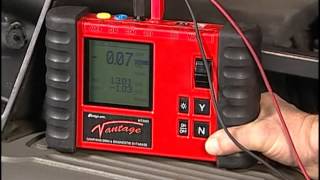
The P1887 code indicates a manufacturer-specific fault with either the transmission's torque converter clutch (TCC) system or the vehicle's wheel speed-sensing system. On American and Japanese cars (GM, Ford, Honda), it points to a fault in the TCC release switch circuit, 🎬 Watch: Diagnosing P1887 and P0742 on GM vehicles which tells the computer if the torque converter is locked. On European and some Asian cars (VW, Audi, Mazda), it means the speed signal from the ABS module is illogical or contradicts other sensors.
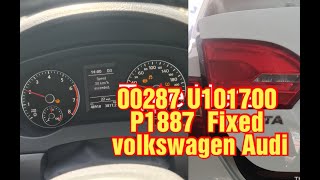
Technical definition: The formal SAE/OBD-II definition varies by manufacturer. For General Motors, it is 'TCC Release Switch Circuit Malfunction,' set when the Powertrain Control Module (PCM) detects a discrepancy between the commanded TCC state and the release switch feedback. For Volkswagen and Audi, it is 'Vehicle Speed Signal Wheel Speed from Brake Control Module: Implausible Signal,' set when ABS module speed data is irrational.
Can I Drive With P1887?
Yes, But With Caution. You can drive short distances, but it carries significant risks. If the fault is TCC-related and the clutch is stuck on, the engine stalls when you stop, creating a severe traffic hazard. If stuck off, continuous driving generates excess transmission heat, degrading fluid and causing a $3,000+ rebuild. If the fault is ABS-related, your traction and stability control are disabled, significantly increasing stopping distances in emergencies. Limit driving to reaching a repair shop.
Common Causes

- Damaged or Chafed Wiring Harness (Very Common) — Wires for the transmission or ABS sensors short out or corrode. This is the most frequent cause, often due to harnesses rubbing against components like the air cleaner box on 2002-2005 Buick Rendezvous models.
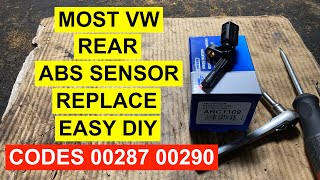
- Faulty ABS Wheel Speed Sensor (Common) — On vehicles where P1887 relates to speed signals, a single failed ABS wheel speed sensor is the primary culprit. These sensors fail from metallic debris contamination or internal electronic breakdown. 🎬 Watch: How to replace a VW ABS wheel speed sensor
- Faulty Torque Converter Clutch (TCC) Solenoid or Switch (Common) — The solenoid controlling the TCC fails electrically or mechanically. This component is located inside the transmission on the valve body and requires dropping the transmission pan to replace.
- Faulty or Contaminated Magnetic Tone Ring (Less Common) — The ABS sensor reads a toothed or magnetic ring on the wheel hub. A cracked, rusted, or debris-covered ring produces an erratic signal that the ABS module interprets as a sensor fault.
- Water Intrusion into AWD Coupling (Less Common) — On Mazda CX-5 and CX-9 models, water enters the rear differential coupling unit through a poorly sealed grommet, corroding internal wiring and the control solenoid.
- Low or Dirty Transmission Fluid (Less Common) — Incorrect fluid levels or degraded fluid causes solenoids and valves to stick, triggering TCC-related codes and transmission overheating.
- Internally Blocked Transmission Passages (Rare) — Debris blocks a spacer plate release exhaust port or a turbine shaft O-ring seal fails. This causes incorrect hydraulic pressure, disrupting the TCC circuit.
- Faulty ABS Control Module (Rare) — If wheel speed sensors, tone rings, and wiring test perfectly, the ABS control module itself is failing and sending corrupt data to the main computer.
- Faulty Powertrain Control Module (PCM) (Rare) — The main computer is the least likely cause. Exhaustively rule out wiring and sensors before considering a module replacement.
Symptoms

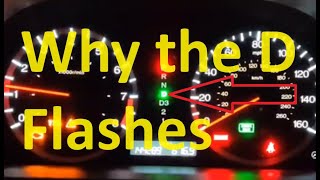
- Check Engine Light or Blinking 'D' Light — The primary indicator is an illuminated Check Engine Light or a flashing 'D' (Drive) light on the dashboard, common on Honda and VW vehicles. 🎬 See why your Honda's D light is flashing
- ABS and Traction Control Lights On — If the code relates to a wheel speed signal, the ABS and stability control warning lights illuminate, and those safety systems disable entirely.
- Engine Stalls When Stopping — If the torque converter clutch fails to disengage, it acts like stopping a manual car without pressing the clutch, stalling the engine and creating a major safety hazard.
- Harsh Shifting or Limp Mode — The transmission shifts roughly, especially between 1st and 2nd gear, or locks into a single gear (limp mode) to prevent internal damage.
- Erratic Speedometer — Because the ABS wheel speed signal drives the speedometer on many vehicles, a faulty sensor causes the needle to bounce or drop to zero intermittently.
- Poor Fuel Economy and Overheating (also visible on scanner) — If the TCC cannot engage at highway speeds, the engine runs at a higher RPM, dropping fuel economy by 5-15% and overheating the transmission fluid.
Diagnostic Flowchart
Tap your situation to follow the diagnostic path that matches what you're seeing on this code.
Common Fixes & Costs

- Repair Damaged Wiring Harness — Parts: $10-$50, Labor: $150-$500, ~1.5 hr book time (Intermediate)
- Replace ABS Wheel Speed Sensor — Parts: $40-$200, Labor: $100-$300, ~1.0 hr book time (DIY)
- Replace Torque Converter Clutch (TCC) Solenoid — Parts: $20-$120, Labor: $200-$500, ~3.0 hr book time (Intermediate)
- Replace AWD Coupling Unit / Solenoid — Parts: $800-$1500, Labor: $200-$500, ~2.5 hr book time (Professional)
- Replace/Rebuild Transmission Valve Body — Parts: $300-$900, Labor: $400-$800, ~5.0 hr book time (Professional)
DIY vs Professional
- Replace ABS Wheel Speed Sensor — Beginner: No, but an intermediate DIYer can.
Tools: Jack and stands, socket set, hex bit set, torque wrench, wire brush, penetrating fluid. - Replace Torque Converter Clutch (TCC) Solenoid — Beginner: No.
Tools: Jack and stands, large drain pan, socket set, torque wrench, transmission fluid, new filter/gasket. - Repair Damaged Wiring Harness — Beginner: Depends on location. Visible repairs are beginner-friendly.
Tools: Wire cutters/strippers, soldering iron, heat shrink tubing, electrical tape, multimeter.
Used vs. New Parts: Buying Guide
When a used part is worth it: Buy used only for high-cost, low-wear assemblies like a complete AWD coupling unit from a verified low-mileage donor. Never buy used electronic sensors.
Donor-vehicle mileage cap: roughly under 60000 miles for the part to have meaningful remaining life.
Donor quality checklist:
- Verify the donor vehicle's VIN to confirm mileage.
- Avoid parts from flood-damaged or rust-belt vehicles.
- Ensure the part number is an exact match.
Decision logic:
- If Part is an electronic sensor or solenoid (ABS sensor, TCC solenoid) → Buy new. The savings are minimal and not worth the risk of repeating labor.
- If Part is a major assembly (e.g., AWD coupling) for an older vehicle → A used part from a low-mileage donor is a viable budget option.
- If Vehicle is sensitive to part quality (e.g., VW/Audi ABS sensors) → Buy new OEM parts exclusively.
Warranty tradeoff: Used salvage parts carry a 30-90 day parts-only warranty. New aftermarket parts offer 1-year to lifetime warranties. OEM dealer parts include a 12-month/12,000-mile parts and labor warranty.
Worst-case if a used part fails: $300-$800 to repeat labor if a used part fails after installation.
What Happens If You Wait — Timeline
- 0-1 month: Check Engine Light illuminates. If TCC is stuck off, RPMs run slightly higher at highway speeds. If ABS fault, safety lights turn on. No severe drivability issues. (MPG impact: 0-5%% · Added cost: $0-$40 in wasted fuel.)
- 1-4 months: If TCC is stuck off, transmission fluid runs consistently hotter. Increased slippage drops fuel economy. Fluid begins breaking down, causing slight shuddering. (MPG impact: 5-15%% · Added cost: $100-$300 in wasted fuel.)
- 4-9 months: Sustained overheating causes permanent damage. Transmission seals harden, leading to internal pressure leaks. Clutch material glazes over, causing harsh shifting. (MPG impact: 10-20%% · Added cost: $2,000-$4,000 for an internal transmission rebuild.)
- 9+ months: Catastrophic failure occurs. Constant overheating and burnt fluid destroy clutch packs and the torque converter. The transmission enters limp mode or fails completely. (MPG impact: 20%+% · Added cost: $3,500-$7,000+ for a full transmission replacement.)
Cost of Not Fixing It
- Short-Term (0-3 months): Fuel economy drops by 5-15%. If caused by an ABS fault, safety systems (ABS, Traction Control) disable, increasing crash risk. (Added cost: $50-$200 in wasted fuel.)
- Medium-Term (3-9 months): Driving with a non-locking TCC causes excessive heat, breaking down transmission fluid, hardening seals, and glazing clutch packs. (Added cost: $2,500-$5,000 for a transmission rebuild due to overheating damage.)
- Long-Term (9+ months): Catastrophic transmission failure occurs. Constant overheating destroys internal components. If the TCC is stuck ON, repeated stalling damages engine mounts. (Added cost: $3,000-$7,000+ for a complete transmission replacement.)
Diagnosis Steps

- Read All Trouble Codes from All Modules
Scan the Engine (PCM), Transmission (TCM), and ABS modules. The presence of ABS-specific 'C' codes confirms a wheel speed issue, while a lone P1887 points to the transmission.
Tools: ['Advanced OBD-II Scan Tool'] (Beginner) - Perform Detailed Visual Inspection
Inspect all visible wiring harnesses going to the transmission and each wheel's ABS sensor. Look for rubbing, melting, or corrosion. On GM SUVs, check the harness near the air cleaner box.
Tools: ['Flashlight', 'Safety Glasses'] (Beginner) - Check Transmission Fluid Level and Condition
Verify the transmission fluid level. Low, dark, or burnt-smelling fluid indicates an internal transmission problem causing the TCC fault.
Tools: ['Clean rag'] (Beginner) - Live Data Scan Tool Analysis
For ABS faults, watch wheel speed sensor data while driving to identify dropouts. For TCC faults, monitor 'TCC Slip Speed'. A consistent slip of >50 RPM under lockup indicates a failure.
Tools: ['Advanced OBD-II Scan Tool with Live Data'] (Intermediate) - Test Component Resistance with a Multimeter
For TCC faults, measure the resistance of the TCC solenoid (typically 12-25 Ohms for Honda, 7-20 Ohms for GM). For ABS faults, measure the suspect wheel speed sensor against a known good one.
Tools: ['Multimeter', 'Vehicle-specific wiring diagram'] (Intermediate) - Test the TCC Release Switch Circuit
Check for continuity and proper voltage at the TCC release switch connector on the transmission and at the PCM connector to verify wiring integrity.
Tools: ['Multimeter', 'Vehicle-specific wiring diagram', 'Back-probe pins'] (Advanced) - [PRO TIP] Perform Scan Tool Actuation Test
Manually command the TCC solenoid ON and OFF using a bi-directional scanner. If the release switch status doesn't change, it confirms a fault in the solenoid or internal wiring.
Tools: ['Advanced Bi-directional Scan Tool'] (Advanced) - [PRO TIP] Analyze Wheel Speed Sensor Signal with an Oscilloscope
Connect a lab scope to the sensor's signal wire. Spinning the wheel should produce a clean square or sine wave. A noisy pattern indicates a bad sensor or damaged tone ring.
Tools: ['Oscilloscope (Lab Scope)', 'Back-probe pins'] (Advanced)
When This Code Triggers (Freeze-Frame Conditions)
- Engine Coolant Temp: 180-210°F (82-99°C) (Engine at full operating temperature.)
- Vehicle Speed: 40-60 mph (65-97 km/h) (Highway cruising speed where the torque converter is expected to lock.)
- TCC Command Status: ON / OFF Transition (The fault logs when the PCM commands the TCC to disengage (e.g., when braking) but the release switch feedback contradicts the command.)
Related Codes
- P0700 — A generic code from the Transmission Control Module requesting the Check Engine Light turn on. It is almost always present alongside P1887 on GM/Honda vehicles.
- P189C — Seen with P1887 on VW models, indicating 'function restriction due to insufficient pressure.' P1887 is the root cause; fix the wheel speed signal first.
- P0741 — Indicates 'TCC Circuit Performance or Stuck Off.' P0741 is a mechanical/hydraulic performance problem, while P1887 is an electrical circuit fault.
- C-Codes (e.g., C100A, C1011) — Chassis codes specific to the ABS module. Seeing these alongside P1887 confirms the problem is a wheel speed sensor, ABS module, or wiring.
Climate & Environmental Factors
- Road Salt (Winter Climates): Highly corrosive road salt attacks the undercarriage, degrading ABS sensor wiring and connectors. It also builds up on the tone ring, increasing the air gap and causing signal loss.
- High Humidity / Heavy Rain: Moisture penetrates failing seals. This is the primary cause of Mazda AWD coupling failures, where water intrusion destroys the internal solenoid.
How to Talk to a Mechanic About This Code
Say this: "I have a [Year, Make, Model] with a P1887 code. I know this code means either an ABS wheel speed issue or a transmission TCC circuit fault depending on the manufacturer. Please check for ABS codes and inspect the related wiring harnesses before recommending any internal part replacements."
This signals you are an informed consumer. It directs the technician to perform a proper diagnosis rather than guessing, saving you from paying for an unnecessary transmission solenoid when the fault is a simple ABS sensor.
Avoid saying:
- 'My Check Engine light is on, can you just fix it?'
- 'I think I need a new transmission.'
- 'Just do whatever you think is best.'
Questions to ask before authorizing the repair:
- What specific tests did you perform to isolate the fault?
- If it's an ABS sensor: Did you inspect the wiring and tone ring? Are you using an OEM part?
- If it's a TCC solenoid: Did you test the solenoid's resistance and check the wiring harness for damage first?
- Can you show me the damaged part after the repair?
- What is the warranty on this specific repair, including parts and labor?
Where to Take It: Dealer vs Independent vs Chain
- Dealer:
A safe but expensive choice. Necessary for warranty work or specific manufacturer campaigns.
Best for: Vehicles still under warranty, Known TSBs (like the Mazda water intrusion), Complex electrical issues on European brands
Downsides: Highest labor rates, often 1.5-2x higher than independent shops., May prefer replacing entire wiring harnesses instead of performing targeted repairs. (Typical cost: +40% vs. baseline) - Independent Shop:
Best fit for most out-of-warranty P1887 issues. A good indie shop performs cost-effective wiring repairs and accurately differentiates between ABS and transmission causes.
Best for: Out-of-warranty vehicles, Diagnosing common wiring or sensor issues, Providing better value and personalized service
Downsides: Diagnostic capability varies; look for ASE certifications in electrical work. (Typical cost: +0% vs. baseline) - Chain Shop:
AVOID for initial diagnosis. They lack the equipment to handle wiring faults or internal transmission issues, leading to wasted money on incorrect repairs.
Best for: Simple, clear-cut part replacements like batteries.
Downsides: High potential for misdiagnosis of complex codes., Technicians often lack advanced diagnostic tools or oscilloscope experience. (Typical cost: -10% vs. baseline)
When to Walk Away From the Repair
If the estimated repair cost exceeds 40-50% of the car's private-party value, seriously consider selling or trading it in instead of repairing.
- Car worth $5000, fix is $400: Fix it. A $400 repair for an ABS sensor is well below the threshold.
- Car worth $4000, fix is $1800: Borderline. The repair is 45% of the car's value. Get a second opinion and evaluate the car's overall condition.
- Car worth $3000, fix is $3500: Walk away. The transmission rebuild costs more than the car is worth. Do not make this repair.
What Scan Tool You Need for This Code
Minimum: A scanner that reads codes from the ABS and Transmission modules, and displays live data for individual wheel speed sensors.
A basic $20 code reader only shows the P1887 code from the engine computer. It cannot see the crucial ABS codes that pinpoint the problem's origin or show live wheel speed data.
Budget: Ancel AD410 / Foxwell NT301 (~$50) — These read engine codes and display live data. Alternatively, auto parts stores offer free scanning services with tools that read ABS and transmission codes.
Mid-range: Innova 5610 / Autel MaxiCOM MK808S (~$300-400) — Offers full system diagnostics and vital bi-directional controls. This allows you to manually command the TCC solenoid on/off to test its function, saving you from unnecessary repairs.
Professional: Autel MaxiIM IM608 / Launch X431 Series (~$1200+) — Provides OEM-level functions and seamless integration with an oscilloscope for definitive waveform analysis of wheel speed sensors.
Rent vs buy: For a one-time diagnosis, use a free scanning service at an auto parts store. If you repair vehicles regularly, buying a mid-range scanner pays for itself after avoiding one diagnostic fee.
How to Clear the Code After You Fix It
- Use an OBD-II scan tool to clear the DTC from the PCM, TCM, and ABS modules.
- Perform the manufacturer-specific drive cycle to run readiness monitors.
Drive cycle (~20 minutes): Cold start and idle for 3 minutes. Drive in stop-and-go traffic. Drive at a steady 55 mph for 10 minutes to verify TCC lock-up and wheel speed sensor operation. Allow the vehicle to cool completely.
Readiness monitors affected: Comprehensive Component Monitor (CCM), Transmission Component Monitor
Before emissions retest: drive at least 50 miles to fully set monitors.
Watch out for:
- Disconnecting the battery clears the code but erases readiness monitors, causing an automatic emissions failure.
- The code returns immediately if the underlying electrical fault remains.
- Some vehicles require a bi-directional scan tool to perform a relearn procedure for new ABS sensors.
Will This Fail Emissions / State Inspection?
Yes — this code typically fails an OBD-II emissions inspection.
- California: P1887 is an automatic Smog Check failure. The vehicle must complete a full drive cycle after repair to set readiness monitors before re-testing.
- New York: An active Check Engine Light for P1887 causes an automatic failure. Clearing the code without repairing the fault results in a 'Not Ready' status, also preventing a pass.
- Texas: In emissions-testing counties, an illuminated MIL due to P1887 results in a failed OBD test.
Most Commonly Affected Vehicles
- Buick Rendezvous (2002-2005) — Extremely prone to the transmission wiring harness chafing against the air cleaner box, causing a short in the TCC release switch circuit.
- Chevrolet Silverado, Cruze, Cavalier (2000-2015) — Commonly sets P1887 for a TCC fault. Check service bulletin PIP5094A for specific electrical terminal testing procedures before replacing parts.
- Volkswagen / Audi Golf, Polo, Passat, A3, A4 (2005-2015) — Sets P1887 for an implausible wheel speed signal. Often caused by a faulty ABS sensor. Highly sensitive to aftermarket sensors; OEM parts are required.
- Honda City, Fit (2003-2013) — Frequently experiences a blinking 'D' light with P1887, pointing directly to a failed TCC release switch or solenoid inside the transmission.
- Mazda CX-5, CX-9 (2013-2016) — TSB 03-004/16 covers water entering the rear differential coupling unit through a grommet, corroding wiring and setting code P1887.
- Ford Explorer, F-150 (2002-2014) — P1887 often points to a failing TCC solenoid or worn bores within the transmission valve body, causing hydraulic pressure loss.
- Hyundai Elantra (2021-2021) — Service campaign T6V updates ICU software to fix multiple DTCs, including C181887, a CAN timeout code related to wheel speed signal faults.
- Jeep Wrangler (2007-2018) — Notorious for ABS/traction control light issues caused by failed wheel speed sensors or damaged wiring, a primary trigger for this code family.
Manufacturer-Specific Notes
- General Motors, Honda: P1887 almost always relates to the Torque Converter Clutch (TCC) release switch circuit. Diagnosis must focus on transmission wiring and the TCC solenoid.
- Volkswagen, Audi, Mazda: P1887 points to an 'implausible signal' from the ABS module regarding wheel speed. Diagnosis must focus on wheel speed sensors and the ABS module.
- Ford: TCC-related codes are often traced back to wear in the solenoid bores of the main valve body, requiring specialized sleeves or a replacement valve body.
- Mercedes-Benz: P1887 has a unique meaning: '1-4 or 2-5 shift slide valve jamming,' indicating a specific internal hydraulic issue in the valve body.
Real Owner Stories
2002 Buick Rendezvous with intermittent P1887
Owner experienced an intermittent Check Engine Light with code P1887. No major drivability symptoms were present initially.
What they tried:
- Technician checked the wiring circuit between the PCM and transmission.
- Connectors were inspected for corrosion or loose pins.
- Considered replacing the TFP switch or PCM.
Outcome: A physical inspection revealed the wiring harness was chafed through near the air cleaner box. The sharp edge cut into the TCC release circuit wire, causing an intermittent ground. Repairing the wire and smoothing the box edge resolved the code permanently.
Lesson: On 2002-2005 Buick Rendezvous models, physically inspect the transmission wiring harness where it passes the air cleaner box before replacing any components.
2010 VW Polo with blinking 'D' light and multiple codes
Check Engine Light was on, 'D' indicator was blinking, and the car logged codes P1887 (implausible wheel speed signal) and P189c (insufficient pressure).
What they tried:
- Suspected a transmission failure due to the blinking 'D' light.
- Replaced the ABS wheel speed sensor and wheel bearing, but the code remained.
Outcome: The ultimate culprit was the ABS control module itself, which failed to process the signal from the new sensor. Replacing the ABS module with a used unit resolved the issue.
Lesson: On VW/Audi vehicles, P1887 is almost always an ABS issue. Do not be misled by transmission symptoms like a blinking 'D' light. Diagnose the wheel speed sensors, wiring, and ABS module first.
2016 Mazda CX-5 at 150k miles with AWD Light
The 'AWD' warning light illuminated with code P1887. The dealer diagnosed water intrusion into the rear differential and quoted $7,600 for a full replacement.
What they tried:
- Third-party warranty denied the claim, citing outside influence (water).
- Mazda corporate declined assistance despite TSB 03-004/16 detailing this exact failure.
Outcome: The owner paid an independent mechanic $330 to replace the faulty breather pipe and flush the differential fluid. This gamble paid off, avoiding the $7,600 replacement.
Lesson: Mazda CX-5/CX-9 owners must be aware of TSB 03-004/16. High-pressure car washes force water past a faulty grommet, destroying the AWD coupling. Proactively seal this grommet.
2007 Honda City with blinking 'D' light
While driving, the 'D' light began to blink, and a scan showed code P1887. The transmission shifted normally.
What they tried:
- Mechanic confirmed the transmission was mechanically sound but could not pinpoint the electrical fault.
Outcome: Forum experts identified the code as a fault with the TCC release switch circuit. The owner replaced the TCC solenoid assembly inside the transmission valve body for $78, fixing the problem.
Lesson: On Honda models, a blinking 'D' light combined with P1887 points directly to a faulty TCC solenoid. This inexpensive part is a common failure point and should be the primary suspect.
How to Prevent This Code From Triggering
- Perform regular transmission fluid and filter changes. (Every 30,000 to 60,000 miles.) — Clean fluid ensures proper function of hydraulic components like the TCC solenoid. Degraded fluid causes solenoids to stick and accelerates internal wear.
- Clean and protect undercarriage wiring and connectors. (Annually, especially before winter in rust-belt regions.) — Corrosion destroys ABS sensors and transmission wiring. Rinsing the undercarriage and applying dielectric grease to critical connectors prevents moisture intrusion.
- Inspect and secure wiring harnesses. (During every oil change.) — Vibrations cause wires to chafe and short out. Ensuring harnesses are secured in their clips and away from sharp edges prevents electrical faults.
- Seal the rear differential grommet on Mazda AWD models. (Once, proactively.) — Applying automotive-grade sealant around the ABS wheel-speed sensor harness grommet prevents water from destroying the expensive AWD coupling unit (TSB 03-004/16).
Frequently Asked Questions
Can I fix P1887 myself?
Replacing an accessible ABS wheel speed sensor is manageable for an intermediate DIYer. However, if the cause is a wiring short or an internal transmission solenoid, it requires professional tools and experience. Leave internal transmission work to a qualified technician.
What is the most common misdiagnosis for P1887?
Shops frequently recommend a full transmission rebuild when the actual cause is a simple chafed wire. For ABS faults, mechanics often replace the expensive ABS module when the real problem is a $50 wheel speed sensor.
I replaced the ABS sensor, but the P1887 code came back. Now what?
The sensor was not the root cause. The problem lies in the wiring harness, a damaged magnetic tone ring, or the ABS module itself. On European cars, using a cheap aftermarket sensor also causes the code to return immediately.
How do I know if the problem is the transmission or an ABS sensor?
Check your dashboard warning lights. If your ABS and Traction Control lights are illuminated, the problem is in the wheel speed sensing system. If only the Check Engine Light is on, the fault is within the transmission's TCC circuit.
Can I just clean my ABS sensor to fix the code?
Cleaning metallic dust off the sensor tip restores the signal temporarily in some cases. However, heavy metal shavings indicate a failing wheel bearing. The sensor itself has likely already sustained internal damage and requires replacement.
Will clearing the code fix the problem?
No. Clearing the code only turns the light off temporarily. The code returns as soon as the computer runs its self-test and detects the active electrical or mechanical fault.
Can a bad brake light switch cause this code?
A faulty brake light switch prevents the TCC from disengaging properly when you brake. While it rarely sets P1887 directly, it causes identical stalling symptoms. It is worth checking before replacing internal transmission parts.
Key Takeaways
- Code P1887 indicates a transmission Torque Converter Clutch (TCC) circuit fault on American and Japanese vehicles, but signals an ABS wheel speed error on European and Mazda models.
- Inspect the transmission and ABS wiring harnesses for chafing before replacing any parts, as a $10 wire repair fixes this code more often than a $300 sensor replacement.
- Stop driving immediately if your engine stalls when braking, as a stuck TCC solenoid creates a severe traffic hazard and requires an immediate tow to a repair shop.
- Scan all vehicle modules for secondary codes; the presence of a 'C' (Chassis) code confirms an ABS fault, while a P0700 code isolates the issue to the transmission.
Helpful Videos

The information in this article is provided for general reference and educational purposes only. Vehicle specifications, procedures, and part compatibility can vary by production date, trim level, and region. Always consult your vehicle's factory service manual and verify part numbers before purchasing or performing repairs. Safety-critical components such as airbags, seat belts, and braking systems should be installed by a qualified professional.
- 🎬 Helpful Videos
- What Does P1887 Mean?
- Can I Drive With P1887?
- Common Causes
- Symptoms
- Diagnostic Flowchart
- Common Fixes & Costs
- DIY vs Professional
- Used vs. New Parts: Buying Guide
- What Happens If You Wait — Timeline
- Cost of Not Fixing It
- Diagnosis Steps
- When This Code Triggers (Freeze-Frame Conditions)
- Related Codes
- Climate & Environmental Factors
- How to Talk to a Mechanic About This Code
- Where to Take It: Dealer vs Independent vs Chain
- When to Walk Away From the Repair
- What Scan Tool You Need for This Code
- How to Clear the Code After You Fix It
- Will This Fail Emissions / State Inspection?
- Most Commonly Affected Vehicles
- Manufacturer-Specific Notes
- Real Owner Stories
- 2002 Buick Rendezvous with intermittent P1887
- 2010 VW Polo with blinking 'D' light and multiple codes
- 2016 Mazda CX-5 at 150k miles with AWD Light
- 2007 Honda City with blinking 'D' light
- How to Prevent This Code From Triggering
- Frequently Asked Questions
- Can I fix P1887 myself?
- What is the most common misdiagnosis for P1887?
- I replaced the ABS sensor, but the P1887 code came back. Now what?
- How do I know if the problem is the transmission or an ABS sensor?
- Can I just clean my ABS sensor to fix the code?
- Will clearing the code fix the problem?
- Can a bad brake light switch cause this code?
- Key Takeaways
- 🎟️ Get 5% Off