

OBD-II Code P1876: Transfer Case 2WD Solenoid Circuit Failure
The Ultimate 2026 Guide to What P1876 Means, Why It Triggers, and How to Fix It for Good
- P1876 is strictly an electrical circuit fault, meaning you must test wiring, the $15 relays, and ground connections before replacing the $400 shift motor.
- A failed transfer case shift motor causes 60% of P1876 codes, but a simple 'tap test' with a screwdriver handle confirms a dead spot before buying parts.
- Ford owners must swap the two shift motor relays in the engine bay, while GM owners must wire-brush the TCCM frame ground under the driver's door to fix the two most common manufacturer quirks.
- Driving with P1876 is safe, but if the transfer case is stuck in 4WD, driving on dry pavement destroys your U-joints and transfer case chain within 2 to 6 months.
What Does P1876 Mean?

P1876 means the Powertrain Control Module (PCM) or Transfer Case Control Module (TCCM) detected an electrical fault in the 2WD solenoid circuit. In modern trucks, this 'solenoid' is actually the transfer case shift motor. The 4WD system disables as a fail-safe, triggering a 'Service 4WD' light.
Technical definition: The SAE/OBD-II definition is "Transmission Transfer Case 2-Wheel Drive Solenoid Circuit Failure." The TCCM detected an abnormal voltage reading (open or short circuit) or incorrect resistance in the circuit controlling the 2WD selection mechanism.
Can I Drive With P1876?
Yes, But With Caution. You can drive, but the 4WD system is disabled and locked in its current mode. If stuck in 4WD, avoid dry pavement to prevent driveline binding and severe damage. If stuck in 2WD, avoid slippery conditions.
Common Causes

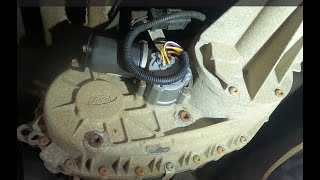
- Failed Transfer Case Shift Motor (Encoder Motor) (Very Common) — This electric motor physically moves the shift forks inside the transfer case. The internal contacts wear out or the motor burns up, making it the most frequent failure point. 🎬 Watch: Step-by-step Ford F-150 shift motor replacement guide.
- Failed 4WD Shift Motor Relay (Ford Specific) (Common) — Ford models use a pair of small, inexpensive relays to control power to the shift motor. Failure of one relay is extremely common and routinely misdiagnosed as a bad shift motor.
- Poor TCCM Ground Connection (GM Specific) (Common) — A corroded ground wire for the TCCM causes a floating voltage and erratic behavior. This is a notorious, documented issue on GM trucks. 🎬 See how to clean and repair corroded GM ground wires.
- Damaged Wiring or Corroded Connectors (Common) — The transfer case wiring harness is exposed to road salt and moisture. Corrosion on the connector pins or frayed wires causes an open or short circuit.
- Faulty Transfer Case Position Sensor (Encoder Ring) (Common) — This sensor reports the current gear to the TCCM and is usually integrated into the shift motor. If it fails, the TCCM cannot verify the motor's position.
- Faulty 4WD Selector Switch (Less Common) — The dashboard switch fails internally, sending an erratic or dead signal to the TCCM.
- Faulty Transfer Case Control Module (TCCM) (Less Common) — The dedicated 4WD computer fails internally due to water intrusion or electrical surges.
- Blown Fuse (Uncommon) — A blown fuse cuts power to the control module or shift motor, immediately triggering the code.
- Failed Pulse Vacuum Hub (PVH) Solenoid (Ford Specific) (Uncommon) — On Ford trucks with Electronic-Shift-On-the-Fly (ESOF), a fault in the vacuum solenoid locking the front hubs triggers P1876.
Symptoms

- Service 4WD / Check 4x4 Warning Light — The warning illuminates on the instrument cluster immediately after the TCCM detects the fault.
- Unable to Shift Between 2WD and 4WD — The vehicle ignores the selector switch and remains stuck in its current gear.
- Blinking 4WD Indicator Lights — The selector switch lights blink for a few seconds during a shift attempt, then go out, indicating a failed shift.
- Clicking or Grinding Noise When Attempting to Shift — You hear a single relay click or grinding from the shift motor as it attempts to engage but fails.
- HVAC Airflow Defaults to Defrost (Ford Specific) — A vacuum leak related to the PVH solenoid causes the climate control vents to default to the defrost position.
Diagnostic Flowchart

Tap your situation to follow the diagnostic path that matches what you're seeing on this code.
Common Fixes & Costs
- Replace Transfer Case Shift Motor (Encoder Motor) — Parts: $150-$450, Labor: $120-$300, ~1.5 hr book time (Intermediate)
- Replace 4WD Shift Motor Relays (Ford) — Parts: $20-$50, Labor: $0-$60, ~0.2 hr book time (DIY)
- Repair Damaged Wiring or Clean Ground Connection — Parts: $10-$60, Labor: $100-$250, ~1.2 hr book time (Intermediate)
- Replace 4WD Selector Switch — Parts: $30-$90, Labor: $60-$120, ~0.8 hr book time (DIY)
- Replace Transfer Case Control Module (TCCM) — Parts: $250-$600, Labor: $100-$200, ~0.7 hr book time (Professional)
DIY vs Professional
- Replace 4WD Fuses and Relays — Beginner:
Tools: Fuse puller, owner's manual. - Clean Ground Connection — Beginner:
Tools: Socket set, wire brush, dielectric grease. - Replace 4WD Selector Switch — Beginner:
Tools: Plastic trim removal tools, screwdriver. - Replace Transfer Case Shift Motor — Beginner:
Tools: Jack and jack stands, socket set, torque wrench. - Replace Transfer Case Control Module (TCCM) — Beginner:
Tools: Socket set, manufacturer-specific programming software.
Used vs. New Parts: Buying Guide
When a used part is worth it: A used Transfer Case Shift Motor is viable for vehicles over 100k miles when budget is the primary concern, saving 50-70% over a new OEM part.
Donor-vehicle mileage cap: roughly under 80000 miles for the part to have meaningful remaining life.
Donor quality checklist:
- Purchase from a salvage yard offering a written warranty of at least 90 days.
- Visually inspect the electrical connector for heavy corrosion.
- Match the part number exactly to ensure correct internal wiring.
Decision logic:
- If Vehicle has under 80k miles → Buy a new OEM or high-quality aftermarket part.
- If Vehicle has over 150k miles and you plan to keep it for 1-2 years → A used part with a warranty is a cost-effective choice.
- If The price difference between a new aftermarket part and a used part is less than $100 → Buy the new part for the warranty coverage.
Warranty tradeoff: Used parts typically come with a 30-90 day warranty. Remanufactured and new aftermarket parts carry a 1-year to limited lifetime warranty.
Worst-case if a used part fails: $250-$500. If a used part fails, you pay for the replacement part and the labor to install it again.
What Happens If You Wait — Timeline
- Immediate: Code P1876 is set. Vehicle is stuck in its last known mode (2WD or 4WD). No physical damage occurs. (MPG impact: 0%% · Added cost: $0)
- 0-2 months (if stuck in 4WD): Driving on dry pavement causes driveline binding, 'crow hopping' in tight turns, and accelerated tire wear. Fuel economy drops. (MPG impact: 5-15%% · Added cost: $50 - $400)
- 2-6 months (if stuck in 4WD): Constant driveline stress leads to premature failure of U-joints. The transfer case chain begins to stretch. (MPG impact: 10-20%% · Added cost: $400 - $1,200)
- 6+ months (if stuck in 4WD): Catastrophic failure. The over-stressed transfer case chain snaps, destroying internal gears and requiring a full transfer case replacement. (MPG impact: N/A% · Added cost: $2,500 - $4,000+)
Cost of Not Fixing It
- Immediate: Loss of 4WD capability. The vehicle is stuck in whatever mode it was in when the fault occurred. (Added cost: $0)
- 0-3 Months: If stuck in 4WD, driving on dry pavement causes accelerated tire wear and a 5-15% drop in fuel economy due to driveline binding. (Added cost: $50 - $400)
- 3+ Months: Continued driving in 4WD on high-traction surfaces destroys U-joints, axle shafts, and internal transfer case components. (Added cost: $500 - $3500)
Diagnosis Steps
- Scan for All DTCs
Use a professional-grade OBD-II scanner to communicate with the Transfer Case Control Module (TCCM). Generic engine readers miss manufacturer-specific chassis codes (e.g., C0327 on GM). Record all codes.
Tools: Advanced OBD-II Scanner (Beginner) - Check 4WD Fuses and Relays
Locate the 4WD system fuses and relays. On Fords, swap the two shift motor relays in the engine bay with a known-good relay (like the horn relay) to instantly test for failure.
Tools: Owner's Manual, Fuse Puller (Beginner) - Inspect Key Ground Connections
On GM trucks, locate the TCCM ground wire on the frame rail under the driver's door. Remove the bolt, clean the frame and wire terminal to bare metal with a wire brush, and re-secure tightly.
Tools: Socket Set, Wire Brush (Intermediate) - Perform Visual and 'Tap' Test
Inspect the wiring harness at the shift motor for green corrosion or loose pins. While a helper operates the 4WD switch, tap the shift motor with a screwdriver handle. If it suddenly works, the motor has a dead spot and requires replacement.
Tools: Flashlight, Safety Glasses, Screwdriver (Intermediate) - Test the Shift Motor Circuit with a Multimeter
Disconnect the shift motor. Identify the power and ground pins. Have a helper operate the 4WD switch. You must see battery voltage (12-14V) for a few seconds. If you have voltage, the motor is bad. If no voltage, the problem is upstream.
Tools: Multimeter, Vehicle-Specific Wiring Diagram (Advanced) - Test the 4WD Selector Switch (Resistance)
Disconnect the dashboard switch and measure resistance across the center pins. Readings must match the selected mode (e.g., Ford: 3.9 kΩ for 2WD, 1.1 kΩ for 4HI, 360 Ω for 4LO). A reading of 0 ohms or OL indicates a faulty switch.
Tools: Multimeter, Trim Removal Tools (Advanced) - Check Encoder Sensor Resistance
If code P1867 (Ford) or C0327 (GM) is present, check resistance between the motor control pins. GM requires 0.5 to 35 ohms. Ford requires < 5 ohms on specific pins. Incorrect readings confirm a failed motor assembly.
Tools: Multimeter, Vehicle-Specific Wiring Diagram (Advanced) - Verify Encoder Sensor Voltage (Live Data)
Use a scan tool to monitor the 'Encoder Position' PID. Voltage must be steady and within range (0.5V - 4.5V). Voltage stuck at 0V or 5V points to a sensor or wiring fault.
Tools: Advanced OBD-II Scanner (Advanced) - Scope the Encoder Signal
For intermittent issues, back-probe the encoder sensor signal wires with an oscilloscope. A clean square wave pattern is required during a shift. Glitches indicate a failing sensor.
Tools: Oscilloscope, Wiring Diagram (Professional)
When This Code Triggers (Freeze-Frame Conditions)
- Event: Key On or Shift Attempt (The TCCM runs a self-test at key-on or when the driver requests a 4WD mode change.)
- Battery Voltage: 11.8-14.5V (Normal operating voltage; low voltage triggers false codes during a shift.)
- Vehicle Speed: 0-55 mph (Fault detects at a standstill during self-test or while driving when a shift is commanded.)
- Commanded Gear: 2WD, 4HI, or 4LO (The fault logs when the module commands a shift but does not receive the expected electrical feedback.)
Related Codes
- P1867 — Means 'Transfer Case Contact Plate General Circuit Failure.' P1876 is a generic motor circuit failure, while P1867 condemns the sensor inside the assembly. Getting both codes guarantees the shift motor assembly is faulty.
- C0327 — GM's direct equivalent of P1876. It points to the exact same problems: the encoder motor, wiring, TCCM, or dash switch. Diagnosis is identical but requires a scanner that reads GM 'C' codes.
- P1832 — Means 'Transfer Case Differential Lock-Up Solenoid Circuit Failure.' Having both P1876 and P1832 strongly suggests a common failure point like the shift motor assembly, a shared power/ground wire, or the TCCM.
- U0102 — Means 'Lost Communication With Transfer Case Control Module.' If present with P1876, the problem is a power/ground failure to the TCCM. Diagnose the U-code first.
Climate & Environmental Factors
- Road Salt / High Humidity (Rust Belt): Salt and moisture accelerate corrosion on the exposed transfer case wiring harness and the TCCM ground point on the vehicle frame. This creates high resistance, directly triggering P1876.
- Extreme Cold: Cold weather thickens transfer case fluid, putting extra mechanical strain on the shift motor. This increased load causes an already weakened motor or relay to fail.
How to Talk to a Mechanic About This Code
Say this: "I have a 'Service 4WD' light and a P1876 code. I'd like to book a diagnostic appointment. Based on the vehicle, I'd like you to start by checking the common failure points like the shift motor relays/TCCM ground and verifying power and ground at the shift motor connector before recommending a new shift motor."
This signals that you expect them to perform a logical, cost-effective diagnosis instead of immediately replacing the most expensive part.
Avoid saying:
- 'My 4x4 is broken, can you fix it?'
- 'My 'Service 4WD' light is on, just replace whatever is needed.'
- 'I think I need a new transfer case motor.'
Questions to ask before authorizing the repair:
- Did you test the shift motor relays and check the TCCM ground?
- Did you confirm that the shift motor is receiving voltage when a shift is commanded?
- If the shift motor needs to be replaced, what is the warranty on the part and your labor?
- If the TCCM needs to be replaced, does the new module require programming and is that included in the quote?
Where to Take It: Dealer vs Independent vs Chain
- Dealer:
Best for: Vehicles under warranty., Complex cases where a TCCM replacement and manufacturer-specific programming are required., When previous attempts at an independent shop have failed.
Downsides: Highest labor rates., May replace a whole shift motor assembly rather than diagnosing a simpler wiring or relay fault. (Typical cost: +50% vs. baseline) - Independent Shop:
Best overall fit. An experienced independent mechanic diagnoses the common electrical faults (wiring, grounds, relays) that cause P1876, saving money over a dealer.
Best for: Most P1876 scenarios on common domestic trucks (Ford, GM, Dodge)., Out-of-warranty vehicles where cost is a factor., Shops with ASE-certified technicians specializing in electrical work.
Downsides: May not have the specific software to program a new TCCM if needed., Diagnostic skill varies widely between shops. (Typical cost: +0% vs. baseline) - Chain Shop:
Avoid for diagnosis. The risk of misdiagnosis and being sold an unnecessary shift motor is high.
Best for: Simple parts replacement IF the diagnosis is already certain (e.g., you diagnosed a bad selector switch yourself).
Downsides: Not recommended for electrical diagnostic work like P1876., Technicians lack specialized 4WD system knowledge., Less likely to perform nuanced checks like cleaning ground connections. (Typical cost: -10% vs. baseline)
When to Walk Away From the Repair
If the estimated repair cost exceeds 40-50% of the vehicle's private-party value, and you don't critically need 4WD, consider your options. If stuck in 2WD, you can continue driving without further damage.
- Car worth $5000, fix is $750: Fix it. This is a reasonable cost to restore a key feature and is well below the walk-away threshold.
- Car worth $3500, fix is $1800: Walk away. The repair cost is over 50% of the vehicle's value. Unless you absolutely need 4WD for safety, it's not an economical repair.
What Scan Tool You Need for This Code
Minimum: A scanner that reads manufacturer-specific codes from the Transfer Case Control Module (TCCM), often listed as 'All System' access.
A basic $20 engine code reader will not see the P1876 code, as it resides in the TCCM, not the Engine Control Module (ECM).
Budget: BlueDriver Pro (~$100) — Reads and clears enhanced codes (like P1876) from the TCCM on Ford, GM, and Chrysler vehicles.
Mid-range: Foxwell NT510 Elite (~$180) — Provides bidirectional control, allowing you to command the shift motor to activate, which confirms if the motor is working or if the fault is in the wiring.
Professional: Autel MaxiCOM MK808BT / XTOOL D7S (~$450-600) — Offers full bidirectional control, all-system access, and advanced service functions to streamline troubleshooting for complex electrical faults.
Rent vs buy: For a one-time fix, auto parts stores offer loaner tools, but verify they read Transfer Case codes. If you own an aging 4x4, buying a midrange scanner pays for itself quickly.
How to Clear the Code After You Fix It
- Use an OBD-II scan tool to clear diagnostic trouble codes (DTCs).
- Perform a transfer case relearn procedure if required by the manufacturer (common on GM after component replacement).
- Perform a complete drive cycle to ensure all readiness monitors have run.
Drive cycle (~30 minutes): 1) Cold start and idle for 2-3 minutes. 2) Drive in stop-and-go traffic. 3) Maintain highway speed (55 mph) for 10 minutes. 4) Safely stop and idle for 1 minute before shutting down.
Readiness monitors affected: Catalyst Monitor, Evaporative System (EVAP) Monitor, Oxygen (O2) Sensor Monitor, Oxygen Sensor Heater Monitor
Before emissions retest: drive at least 100 miles to fully set monitors.
Watch out for:
- Clearing the code with a scanner does not fix the electrical problem; the code returns on the next key cycle.
- Disconnecting the battery resets all emissions readiness monitors to 'Not Ready', causing an automatic smog check failure.
- Failing to perform a manufacturer-specific relearn procedure after replacing a TCCM results in a non-functional system.
Will This Fail Emissions / State Inspection?
Yes — this code typically fails an OBD-II emissions inspection.
- California: An illuminated 'Service 4WD' light due to a powertrain code like P1876 causes an automatic smog check failure.
- New York: Any fault code commanding a warning light on the dashboard results in an emissions test failure.
- Texas: In emissions-testing counties, an active P1876 code automatically fails the OBD-II inspection.
Most Commonly Affected Vehicles
- Ford F-150 / F-250 / F-350 (2002-2016) — Extremely common. Check the two shift motor relays first. On ESOF models, a faulty PVH solenoid or vacuum leak is a prime suspect.
- Chevrolet Silverado / Tahoe / Suburban (1999-2007) — Known for encoder motor failure and failure of the push-button switch. Always clean the TCCM ground on the frame under the driver's door before replacing parts.
- GMC Sierra / Yukon (1999-2007) — Mechanically identical to Chevrolet; prone to encoder motor failure and poor TCCM ground connections.
- Dodge Ram 1500 / 2500 (2002-2008) — The transfer case position sensor and shift motor are the most common failure points. A faulty Transmission Control Relay within the TIPM also causes this code.
- Ford Explorer / Expedition (2002-2015) — Frequently experiences issues with the transfer case shift motor and the wiring harness leading to it.
- Jeep Grand Cherokee (2007-2019) — The TCCM, located under the passenger seat, is a known failure point causing this code and driveline binding.
- Nissan Frontier / Titan (2005-2021) — Triggered by a faulty TCCM or issues within the transfer case actuator assembly. Check the actuator connector for corrosion.
- Honda Pilot / Ridgeline (2006-2013) — The code points to issues with the VTM-4 control unit or the clutch pressure sensor, rather than a traditional shift motor.
Manufacturer-Specific Notes
- General Motors (Chevy/GMC): A corroded ground wire for the TCCM, located on the outside of the frame rail beneath the driver's door, is the top cause for this code. Clean this ground before replacing any parts.
- Ford: Always check the two small shift motor relays before condemning the shift motor. If the AC defaults to defrost, a vacuum leak from the PVH solenoid is causing the P1876 code.
- Dodge / Ram: A faulty Transmission Control Relay inside the TIPM (main fuse box) causes intermittent power loss to the transfer case system, triggering this code.
- Jeep: On Grand Cherokees (WK2), a failing TCCM under the front passenger seat causes P1876 and a 'crow hop' feeling when turning. It is a common DIY replacement.
Real Owner Stories
2005 Ford F-250, mileage unknown
P1876 code appeared. While driving, the HVAC vents suddenly switched to defrost, indicating a vacuum loss.
What they tried:
- Plugged hub vacuum lines to isolate them, but the code persisted.
- Connected a vacuum gauge to the HVAC line to monitor while driving.
- Suspected the Pulse Vacuum Hub (PVH) solenoid.
Outcome: Replaced the PVH solenoid with a used part for $25. This immediately cleared the P1876 code and fixed the HVAC issue.
Lesson: On Ford trucks with ESOF, P1876 is caused by a faulty PVH solenoid. If you also have HVAC issues, the PVH solenoid is a primary suspect.
1997 Ford F-150 with 168k miles
Could shift from 2H to 4H, but could not shift back to 2H without turning the truck off and on again.
What they tried:
- Tested the 4WD selector switch with a multimeter.
- The switch showed correct resistance in 4H and 4L.
- In the 2H position, the switch read 0 ohms instead of the expected 3.9k ohms.
Outcome: The incorrect resistance reading confirmed the selector switch was faulty. Replacing the switch allowed the control module to receive the proper command.
Lesson: Testing the dashboard switch's resistance with a multimeter is a definitive, no-cost diagnostic step before replacing expensive components.
Early 2000s Chevrolet Silverado, mileage unknown
'Service 4WD' light on. The owner had already replaced the dashboard switch and the transfer case shift motor, but the problem persisted.
What they tried:
- Replaced 4WD selector switch.
- Replaced transfer case shift motor.
- Inspected the TCCM ground wire on the frame rail under the driver's side door.
Outcome: The TCCM ground connection was heavily corroded. After cleaning the wire terminal and frame contact point to bare metal, the 4WD system worked perfectly. The P1876 code cleared.
Lesson: On GM trucks, always inspect and clean the TCCM ground connection on the frame before replacing any parts. This saves hundreds of dollars in misdiagnosis.
How to Prevent This Code From Triggering
- Engage 4WD system periodically (Once a month for at least 10 miles) — Keeps the shift motor, actuators, and internal transfer case components lubricated and prevents them from seizing.
- Clean and protect underbody electrical connectors (Once a year or after winter in salt-prone areas) — Prevents moisture and salt from causing corrosion that leads to circuit faults like P1876.
- Inspect and clean key ground points (Every 2-3 years, especially on GM trucks) — Prevents high resistance from developing, which causes erratic module behavior and triggers false codes.
- Change transfer case fluid (Every 30,000 to 60,000 miles) — Old fluid increases mechanical drag, forcing the shift motor to work harder, which causes an older motor to fail.
Frequently Asked Questions
What is a '2WD Solenoid' in a modern truck?
It is an older term for the electric transfer case shift motor (or encoder motor) that physically shifts gears.
What is the most common misdiagnosis for P1876?
Immediately replacing the $400 shift motor without testing the $15 relays (Ford) or cleaning the frame ground (GM). Always test the cheap electrical components first.
Can I fix P1876 myself to save money?
Yes, replacing relays, cleaning grounds, or swapping the dashboard switch are easy DIY tasks. Replacing the shift motor requires basic hand tools and safely lifting the vehicle.
Will clearing the code fix the problem?
No. The TCCM runs a self-test on the next key cycle, and the code immediately returns if the electrical fault persists.
Can low transfer case fluid cause code P1876?
No, P1876 is strictly an electrical circuit fault. Low fluid causes mechanical grinding and overheating, but will not trigger this specific electrical code.
Why does my 4WD work sometimes with the code present?
This indicates an intermittent electrical fault, such as a relay failing when hot or a loose, corroded connector. The TCCM stores the code the first time the fault occurs.
What does it cost to fix code P1876?
Simple relay or ground fixes cost under $50. Replacing the shift motor averages $300-$750, while a new programmed TCCM exceeds $800.
Key Takeaways
- P1876 is strictly an electrical circuit fault, meaning you must test wiring, the $15 relays, and ground connections before replacing the $400 shift motor.
- A failed transfer case shift motor causes 60% of P1876 codes, but a simple 'tap test' with a screwdriver handle confirms a dead spot before buying parts.
- Ford owners must swap the two shift motor relays in the engine bay, while GM owners must wire-brush the TCCM frame ground under the driver's door to fix the two most common manufacturer quirks.
- Driving with P1876 is safe, but if the transfer case is stuck in 4WD, driving on dry pavement destroys your U-joints and transfer case chain within 2 to 6 months.
Helpful Videos


The information in this article is provided for general reference and educational purposes only. Vehicle specifications, procedures, and part compatibility can vary by production date, trim level, and region. Always consult your vehicle's factory service manual and verify part numbers before purchasing or performing repairs. Safety-critical components such as airbags, seat belts, and braking systems should be installed by a qualified professional.
- 🎬 Helpful Videos
- What Does P1876 Mean?
- Can I Drive With P1876?
- Common Causes
- Symptoms
- Diagnostic Flowchart
- Common Fixes & Costs
- DIY vs Professional
- Used vs. New Parts: Buying Guide
- What Happens If You Wait — Timeline
- Cost of Not Fixing It
- Diagnosis Steps
- When This Code Triggers (Freeze-Frame Conditions)
- Related Codes
- Climate & Environmental Factors
- How to Talk to a Mechanic About This Code
- Where to Take It: Dealer vs Independent vs Chain
- When to Walk Away From the Repair
- What Scan Tool You Need for This Code
- How to Clear the Code After You Fix It
- Will This Fail Emissions / State Inspection?
- Most Commonly Affected Vehicles
- Manufacturer-Specific Notes
- Real Owner Stories
- 2005 Ford F-250, mileage unknown
- 1997 Ford F-150 with 168k miles
- Early 2000s Chevrolet Silverado, mileage unknown
- How to Prevent This Code From Triggering
- Frequently Asked Questions
- What is a '2WD Solenoid' in a modern truck?
- What is the most common misdiagnosis for P1876?
- Can I fix P1876 myself to save money?
- Will clearing the code fix the problem?
- Can low transfer case fluid cause code P1876?
- Why does my 4WD work sometimes with the code present?
- What does it cost to fix code P1876?
- Key Takeaways
- 🎟️ Get 5% Off