

OBD-II Code P1801: Manufacturer-Specific Fault
What P1801 means, common causes, and how to fix it on your vehicle
- P1801 is a manufacturer-specific code: it means a failed VIAS solenoid on Nissans, a broken clutch switch on Fords, or an immobilizer fault on Hyundais.
- On Nissan and Infiniti V6 engines, test the Bank 2 VIAS solenoid by measuring its resistance; a healthy unit reads between 33 and 38 Ohms.
- For manual transmission Fords experiencing a no-crank condition with P1801, bypass the clutch safety switch with a jumper wire to instantly confirm if the switch is dead.
- Hyundai and Kia vehicles with P1801 will not start due to an anti-theft error; try your spare key first to rule out a dead transponder chip before replacing the $150 antenna coil.
What Does P1801 Mean?

P1801 is a manufacturer-specific code, meaning its definition changes based on your car's make. For Nissan and Infiniti, it signals a failure in the Variable Intake Air System (VIAS) Control Solenoid for bank 2. For Ford, it points to an open circuit in the clutch safety switch, preventing the engine from starting. For Hyundai and Kia, it indicates an anti-theft immobilizer system failure, also resulting in a no-start condition.
Technical definition: The official SAE/OBD-II definition for P1801 is 'Manufacturer-Specific'. Common applications include 'Variable Intake Air System (VIAS) Control Solenoid Valve 2 Circuit Malfunction' (Nissan/Infiniti), 'Transmission Clutch Interlock Safety Switch Open Circuit' (Ford), and 'Immobilizer Transponder Error' (Hyundai/Kia).
Can I Drive With P1801?
Yes, But With Caution. For Nissan/Infiniti VIAS faults, you can drive, but expect reduced power and poor fuel economy. Long-term driving causes carbon buildup and damages the catalytic converter due to an imbalanced air-fuel ratio, a repair costing $800-$2500. For Ford, Hyundai, or Kia, this code causes a no-start condition, making driving impossible.
Common Causes

- Faulty VIAS Control Solenoid Valve (Nissan/Infiniti) (Very Common) — The electronic solenoid fails internally over time, losing its ability to switch vacuum to the actuator. This is the primary cause of P1801 in Nissan and Infiniti vehicles. 🎬 Watch: How to fix P1800 and P1801 codes on Nissan and Infiniti.
- Faulty Clutch Interlock Safety Switch (Ford) (Common) — On manual Fords, the switch at the top of the clutch pedal fails, breaking the circuit and blocking the starter from engaging. 🎬 See this walkthrough for replacing Ford clutch pedal switches.
- Faulty Immobilizer Key or Transponder (Hyundai/Kia) (Common) — The transponder chip inside the key is damaged, has a dead battery, or lost its programming. The car fails to recognize the key and disables the starter.
- Cracked or Disconnected Vacuum Hoses (Nissan/Infiniti) (Common) — Small rubber hoses connected to the VIAS solenoid crack or disconnect, creating a vacuum leak that disables the system even if the solenoid functions perfectly.
- Damaged Wiring or Corroded Connector (Common) — Wires leading to the solenoid, switch, or immobilizer break, or connector pins corrode from moisture, blocking the PCM's electrical signal.
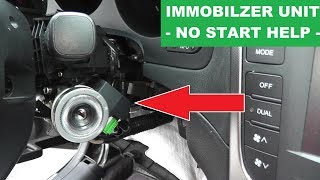
- Faulty Immobilizer Antenna Coil (Hyundai/Kia) (Less Common) — The coil around the ignition switch that reads the key's transponder chip fails, preventing communication between the key and the immobilizer module. 🎬 Watch: How to test and replace a faulty immobilizer antenna coil.
- Faulty VIAS Power Valve Actuator (Nissan/Infiniti) (Less Common) — The diaphragm inside the vacuum actuator ruptures. It cannot hold a vacuum and fails to move the intake runner flap.
- Faulty Powertrain Control Module (PCM) (Rare) — The engine computer fails to send the ground signal to the solenoid or misreads the security key. Rule out all other components before replacing the PCM.
Symptoms

- Engine Will Not Start or Crank — For Ford manual vehicles or Hyundai/Kia models, the engine refuses to crank or cranks indefinitely without starting.
- Reduced Engine Power — Nissan/Infiniti vehicles feel sluggish during hard acceleration or hill climbs due to restricted high-RPM airflow.
- Rough or Unstable Idle — The engine idles roughly because the air-fuel mixture is imbalanced, especially if the VIAS flap is stuck open.
- Check Engine Light On (also visible on scanner) — The dashboard Check Engine Light illuminates immediately when the PCM detects the circuit fault.
- Poor Fuel Economy (also visible on scanner) — The engine burns excess fuel because the intake runner length is incorrect for the current RPM.
Diagnostic Flowchart

Tap your situation to follow the diagnostic path that matches what you're seeing on this code.
Common Fixes & Costs
- Replace VIAS Control Solenoid Valve — Parts: $40-$150, Labor: $75-$150, ~0.7 hr book time (DIY)
- Replace Clutch Interlock Switch (Ford) — Parts: $20-$50, Labor: $100-$150, ~1.0 hr book time (Intermediate)
- Replace or Reprogram Immobilizer Key (Hyundai/Kia) — Parts: $50-$200, Labor: $100-$200, ~1.0 hr book time (Pro Only)
- Replace Cracked Vacuum Hoses — Parts: $10-$40, Labor: $0-$50, ~0.3 hr book time (DIY)
- Repair Damaged Wiring or Clean Connector — Parts: $5-$25, Labor: $125-$250, ~1.5 hr book time (Intermediate)
Used vs. New Parts: Buying Guide
When a used part is worth it: Buying a used OEM VIAS solenoid makes sense only for older, high-mileage cars on a strict budget. Otherwise, new aftermarket parts offer warranties for a negligible price difference.
Donor-vehicle mileage cap: roughly under 80000 miles for the part to have meaningful remaining life.
Donor quality checklist:
- Verify the donor vehicle's mileage.
- Inspect the part for physical cracks or heavy corrosion on the electrical pins.
- Ensure the part number (e.g., 14955-8J10A) matches exactly.
Decision logic:
- If A new OEM or premium aftermarket part costs under $100. → Buy new. The minimal savings from a used part do not justify the risk of premature failure.
- If The vehicle has over 150,000 miles and the budget is extremely tight. → Buy a used OEM part, but test its resistance (33-38 Ohms) before installation.
Warranty tradeoff: Salvage yards offer 30-90 day warranties. New aftermarket parts include 1-year to lifetime warranties. New OEM parts carry a 1-year/12,000-mile warranty.
Worst-case if a used part fails: $150-$250. If a cheap used solenoid fails, you pay for the replacement part plus repeat labor.
What Happens If You Wait — Timeline
- 0-1 Month: Check Engine Light illuminates. The VIAS system sticks in one position. Drivers rarely notice a difference in casual city driving. (MPG impact: 0-5%% · Added cost: $0-$25 in wasted fuel)
- 1-6 Months: The car feels sluggish when accelerating onto highways. Fuel economy drops by 2-4 MPG. (MPG impact: 5-15%% · Added cost: $50-$150 in wasted fuel)
- 6-12 Months: Incorrect air-fuel mixtures foul oxygen sensors and cause carbon buildup on intake valves. Misfire codes (P030x) appear. (MPG impact: 10-20%% · Added cost: $250-$600 for O2 sensor replacement)
- 12+ Months: Sustained operation with an imbalanced air-fuel ratio overheats and destroys the catalytic converter. (MPG impact: 15-25%% · Added cost: $1200-$2800 for catalytic converter replacement)
Cost of Not Fixing It
- 0-1 Month: Fuel economy drops 5-15% and engine performance feels sluggish. No immediate risk of permanent damage. (Added cost: $20-$60 in wasted fuel.)
- 1-6 Months: Imbalanced air-fuel ratios cause carbon buildup on intake valves and foul O2 sensors, triggering secondary fault codes. (Added cost: $200-$500 for O2 sensor replacement.)
- 6+ Months: Sustained incorrect air-fuel mixtures overheat and destroy the catalytic converter, a critical emissions component. (Added cost: $1200-$2800 for catalytic converter replacement.)
Diagnosis Steps
- Scan for Codes & Identify Definition
Use an OBD-II scanner to confirm P1801. Identify the specific definition for your vehicle's make (Nissan VIAS, Ford Clutch Switch, Hyundai Immobilizer). Check for context codes like P1800, P1805, or P1610.
Tools: OBD-II Scanner (Beginner) - Visual Inspection
For Nissan, inspect VIAS solenoid connectors and vacuum hoses for cracks. For Ford, check the clutch switch connector under the dash. For Hyundai/Kia, inspect wiring around the ignition cylinder.
Tools: Flashlight (Beginner) - Pro Tip: The 'Click Test' (Nissan/Infiniti)
Disconnect the VIAS solenoid. Use jumper wires to apply 12V battery power and ground to its terminals. An audible 'click' confirms the internal plunger moves. No click means the solenoid is dead.
Tools: Jumper wires or Bi-directional Scan Tool (Intermediate) - Test the Solenoid's Resistance (Nissan/Infiniti)
Set a multimeter to Ohms (Ω). Measure across the two pins of the disconnected VIAS solenoid. A healthy solenoid reads 33-38 ohms. Infinity (OL) indicates an open circuit; zero indicates a short.
Tools: Multimeter (Intermediate) - Test the Clutch Switch (Ford)
Disconnect the clutch interlock switch. Set a multimeter to continuity mode. The meter must show no continuity (OL) with the pedal released, and near zero ohms when fully depressed. If it fails either, replace it.
Tools: Multimeter (Intermediate) - Check Immobilizer System (Hyundai/Kia)
Try starting the car with your spare key. If it works, the primary key's transponder is dead. If neither works, the immobilizer antenna coil or module is faulty.
Tools: Spare Key (Beginner) - Test the Control Circuit (Nissan/Infiniti)
Check for 12V on the power wire at the solenoid connector with the key on. Use a scan tool to command the solenoid 'On'. The control wire pin must show a good ground. No ground points to wiring damage or a bad PCM.
Tools: Multimeter, Bi-directional Scan Tool (Advanced) - Test the VIAS Actuator with Vacuum (Nissan/Infiniti)
Disconnect the vacuum hose from the intake manifold actuator. Apply 15-20 inHg with a hand vacuum pump. The actuator rod must move and hold vacuum for 30 seconds. If vacuum bleeds off, the diaphragm is ruptured.
Tools: Hand-held vacuum pump with gauge (Advanced) - Check Immobilizer Antenna Coil Resistance (Hyundai/Kia)
Disconnect the immobilizer antenna coil near the ignition switch. Measure resistance across the terminals. A healthy coil reads 14-16 Ohms. Infinity (OL) indicates a broken coil.
Tools: Multimeter (Advanced) - Monitor VIAS Live Data (Nissan/Infiniti)
Monitor the 'INT/V TIM SOL (B2)' PID on an advanced scan tool. Accelerate firmly while driving. The status must switch from 'OFF' to 'ON' at 3,500-4,000 RPM. No change confirms a control issue.
Tools: Advanced Scan Tool (Advanced)
When This Code Triggers (Freeze-Frame Conditions)
- Engine Coolant Temp: 180-200°F (82-93°C) (The engine reached full operating temperature.)
- RPM: 2000-3500 RPM (The fault triggers when the ECU commands the VIAS solenoid to switch states in the mid-RPM range.)
- Engine Load: 30-60% (Sets under moderate acceleration or steady cruising, rarely at idle.)
- Vehicle Speed: 35-55 mph (56-88 km/h) (Occurs during city or highway driving when the VIAS system is actively adjusting airflow.)
Related Codes
- P1800 — Indicates a failure in VIAS Control Solenoid Valve 1 (Bank 1). P1801 is for Valve 2 (Bank 2). Swap the solenoids; if the code changes to P1800, the solenoid is confirmed faulty.
- P1805 / P1610 (Hyundai/Kia) — These codes frequently accompany P1801 on Hyundai/Kia vehicles, confirming a fault within the anti-theft immobilizer system (key, antenna, or module).
- P0300-P0306 — Random or specific cylinder misfire codes. An incorrect air-fuel ratio from a malfunctioning VIAS causes incomplete combustion. Fixing P1801 often resolves these misfires.
- P1168 (Nissan) — A closed-loop control fault on Bank 2. Because the VIAS system impacts Bank 2's air-fuel mixture, a VIAS fault forces the O2 sensor to report a fuel trim problem.
Climate & Environmental Factors
- Cold Weather: Extreme cold turns rubber vacuum hoses and wire insulation brittle, causing cracks that lead directly to vacuum leaks or open electrical circuits.
- High Humidity / Road Salt: Moisture and salt penetrate unsealed electrical connectors, accelerating corrosion on pins. This creates high resistance, triggering P1801.
How to Talk to a Mechanic About This Code
Say this: "I have a P1801 code. For my Nissan, please diagnose the VIAS Bank 2 circuit (solenoid, wiring, or actuator). For my Ford, please test the clutch interlock switch. For my Hyundai, please diagnose the immobilizer system for a no-start condition."
This directs the technician to the correct system for your specific make, preventing a costly, open-ended diagnostic search.
Avoid saying:
- 'Just fix whatever's wrong'
- 'My check engine light is on, can you look at it?'
- 'Whatever you recommend'
Questions to ask before authorizing the repair:
- For Nissan: Did you test the solenoid's resistance and check for vacuum leaks?
- For Ford: Did the clutch switch fail a continuity test, or is the wiring damaged?
- For Hyundai: Is the fault with the key transponder, the antenna coil, or the module?
- What is the warranty on this specific repair and the new part?
Where to Take It: Dealer vs Independent vs Chain
- Dealer:
Best for: Vehicles under powertrain or emissions warranty., Hyundai/Kia immobilizer issues requiring proprietary key programming tools.
Downsides: Charges 1.5-2x the labor rate of independent shops., Often replaces entire assemblies instead of single failed components. (Typical cost: +50% vs. baseline) - Independent Shop:
The most cost-effective choice for Nissan and Ford variants. Stop DIY and go to a shop if electrical testing reveals a PCM fault.
Best for: Out-of-warranty Nissan VIAS solenoid and Ford clutch switch repairs.
Downsides: May lack specific tools for late-model immobilizer programming. (Typical cost: +0% vs. baseline) - Chain Shop:
Acceptable only for a straightforward VIAS solenoid swap if you already confirmed the diagnosis. Avoid for Hyundai/Kia immobilizer faults.
Best for: Simple, routine maintenance.
Downsides: High pressure to upsell; lacks diagnostic depth for electrical faults. (Typical cost: -10% vs. baseline)
When to Walk Away From the Repair
If the estimated repair cost exceeds 40-50% of the car's Kelley Blue Book (KBB) private-party value, pause and consider alternatives.
- Car worth $2500, fix is $550: Borderline. The repair is 22% of the car's value. Fix it if the car is otherwise reliable.
- Car worth $8000, fix is $150: Fix it. This low-cost repair restores key functionality and is well below the threshold.
- Car worth $1500, fix is $250: Fix it. The car is undrivable (no-start) without this repair, making the cost necessary to retain any vehicle value.
What Scan Tool You Need for This Code
Minimum: A basic OBD-II code reader that pulls manufacturer-specific codes to identify the P1801 definition for your make.
Basic readers cannot perform bidirectional 'active tests' on Nissan solenoids or access Hyundai immobilizer live data.
Budget: Bluetooth OBD2 Adapter (e.g., OBDLink) with Torque Pro app (~$30) — Reads and clears the code, provides freeze-frame data, and confirms the manufacturer definition. Sufficient for Ford, but not Nissan or Hyundai.
Mid-range: Foxwell NT510 Elite (~$180) — Performs bidirectional 'active tests' to command the Nissan VIAS solenoid on/off and accesses Hyundai immobilizer data.
Professional: Autel MaxiCOM MK808S (~$400) — Offers full bidirectional control, live data graphing, and advanced immobilizer functions for all three variations of P1801.
Rent vs buy: Rent a free scanner from an auto parts store for a Ford clutch switch or simple Nissan solenoid swap. Buy a mid-range scanner to properly diagnose Nissan VIAS systems or Hyundai immobilizers.
How to Clear the Code After You Fix It
- Use an OBD-II scan tool to clear the P1801 code.
- Ensure the fuel tank is between 1/4 and 3/4 full.
- Perform a complete drive cycle to run the readiness monitors.
Drive cycle (~30 minutes): Start the engine cold. Idle for 3 minutes. Drive in mixed city traffic (25-40 mph) for 15 minutes, including complete stops. Accelerate to 55-60 mph on a highway and cruise steadily for 5 miles. Coast to a stop without hard braking. Shut off the engine.
Readiness monitors affected: Catalyst (CAT) monitor, Oxygen (O2) Sensor monitor, Evaporative (EVAP) System monitor
Before emissions retest: drive at least 100 miles to fully set monitors.
Watch out for:
- Clearing the code without fixing the hardware guarantees the code returns immediately.
- Disconnecting the battery clears the code but resets all emissions monitors, causing an automatic emissions test failure.
Will This Fail Emissions / State Inspection?
Yes — this code typically fails an OBD-II emissions inspection.
- California: An illuminated Check Engine Light from P1801 is an automatic failure. The vehicle must complete a drive cycle to set readiness monitors before re-testing.
- New York: An active P1801 code causes an automatic failure during the OBD-II emissions scan.
- Texas: In the 17 emissions-testing counties, an illuminated Check Engine Light results in an automatic failure.
Most Commonly Affected Vehicles
- Nissan Maxima (2002-2014) — Extremely common on V6 models with the VQ35DE engine. Solenoid part number is 14955-8J10A.
- Nissan Altima (2002-2018) — Frequent VIAS solenoid failure on V6 models.
- Nissan Murano (2003-2015) — Shares the VQ35DE V6 engine and prone to identical VIAS solenoid failures.
- Nissan Pathfinder (2005-2020) — Both 3.5L and 4.0L V6 engines experience this fault regularly.
- Infiniti I35 (2002-2004) — Shares the Maxima's VQ35DE engine and common VIAS solenoid faults.
- Hyundai Accent (2000-2010) — P1801 points to an immobilizer transponder error, often appearing with P1805 and causing a no-start.
- Kia Spectra / Sedona (2002-2009) — Indicates an immobilizer programming or transponder failure, preventing the engine from starting.
- Ford Focus / Mustang / Ranger (1996-2011) — On manual models, P1801 points to the clutch interlock switch circuit, causing a no-crank condition.
- Mahindra 1533 / 3550 / 4540 (2017-2024) — Indicates the fuel rail pressure relief valve (PRV) has opened 50 times, triggering limp mode. Requires a dealer tool to reset.
Manufacturer-Specific Notes
- Nissan / Infiniti: P1801 almost exclusively refers to the Variable Intake Air System (VIAS) Control Solenoid Valve 2. The solenoids for Bank 1 (P1800) and Bank 2 (P1801) are identical and interchangeable for diagnostics.
- Ford / Peugeot / Citroen: On manual transmissions, P1801 means 'Transmission Clutch Interlock Safety Switch Open Circuit'. This switch prevents starting unless the clutch is depressed, resulting in a no-crank condition.
- General Motors (GM): P1801 indicates a 'Performance Selector Switch Failure', relating to driver-selectable suspension or transmission modes (like Sport or Touring), not engine performance.
- Hyundai / Kia: P1801 is an 'Immobilizer Transponder Error' that prevents the engine from starting. It is usually accompanied by P1805.
Real Owner Stories
2010 Nissan Maxima at 115K miles with P1801
Check Engine Light illuminated, and the car felt sluggish with a noticeable loss of power across all RPMs.
What they tried:
- Tested the VIAS solenoid resistance and found it was dead (open circuit).
Outcome: The owner temporarily bypassed the solenoid by disconnecting the vacuum line, keeping the intake butterfly valve permanently open and restoring power. They later installed a new solenoid.
Lesson: A failed VIAS solenoid causes a significant loss of power. Perform a 'click test' with 12V or an Ohms test (~34 Ohms is good) to confirm failure before buying parts.
2005 Ford Focus ZX3 Manual with no-crank
The owner accidentally kicked a connector loose in the pedal box area. The car worked fine until shut off, but refused to crank upon restart.
What they tried:
- Plugged the connector back into the clutch switch, but the car still would not start.
- Towed the vehicle to a mechanic.
Outcome: The mechanic diagnosed a failed clutch switch and a damaged wiring harness above the pedals, replacing both to restore starting capability.
Lesson: On a manual Ford, a no-crank condition is almost always the clutch interlock switch. Bypassing the switch with a jumper wire is a fast, definitive diagnostic step.
2015 Nissan Pathfinder with P1800 and P1801
The check engine light was on with P1800 (VIAS Bank 1) as the active code. The owner wanted to diagnose it correctly before replacing parts.
What they tried:
- Swapped the positions of the two identical VIAS solenoids (Bank 1 and Bank 2).
Outcome: After swapping the solenoids, the code changed from P1800 to P1801. This definitively proved the solenoid itself was faulty, not the wiring or PCM.
Lesson: Swapping the identical Bank 1 (P1800) and Bank 2 (P1801) VIAS solenoids is the best diagnostic trick. If the trouble code follows the solenoid, the solenoid is bad.
How to Prevent This Code From Triggering
- Inspect VIAS vacuum hoses (Every oil change) — Small rubber vacuum hoses degrade from engine heat. Catching a cracked hose early prevents performance loss and the P1801 code.
- Apply dielectric grease to connectors (When replacing a related part) — Applying dielectric grease to electrical connector pins seals out moisture, preventing the corrosion that causes high resistance and circuit faults.
- Handle car keys with care (Daily habit) — Dropping a Hyundai/Kia key onto a hard surface damages the internal transponder chip, leading to a P1801 no-start condition.
Frequently Asked Questions
What is the VIAS system and what does it do?
The Variable Intake Air System uses flaps inside the intake manifold to change the airflow path length, optimizing torque at low RPMs and horsepower at high RPMs. P1801 on a Nissan means the solenoid controlling these flaps for engine bank 2 has failed.
How do I know if P1801 is for Bank 1 or Bank 2 on my Nissan?
P1801 refers to the VIAS solenoid on Bank 2, while P1800 is for Bank 1. On V6 Nissans, Bank 2 is the cylinder bank closer to the radiator. Swap the two identical solenoids; if the code changes to P1800, the solenoid is faulty.
My Hyundai won't start and has a P1801. I tried my spare key and it still won't work. What's next?
If both keys fail to start the car, the problem is likely the immobilizer antenna coil around the ignition switch. This coil reads the key's chip and can fail or suffer a wiring break. A less common cause is a failed immobilizer control module.
Can I bypass the clutch safety switch on my Ford to fix P1801?
Yes, for temporary diagnostic purposes, unplug the switch and use a fused jumper wire to connect the two terminals in the connector. If the car starts, the switch is faulty. Do not leave this permanently, as it bypasses a critical safety feature.
What are common misdiagnosis mistakes for P1801 on a Nissan?
The most common mistake is replacing the VIAS solenoid without testing it first. Technicians often find the actual problem is a cracked vacuum line, a corroded electrical connector, or a ruptured actuator diaphragm. Always test the solenoid, wiring, and vacuum system before buying parts.
My car won't start. Could P1801 be the cause?
Yes, depending on your vehicle make. On a manual Ford, P1801 indicates a failed clutch safety switch, preventing cranking. On a Hyundai or Kia, it signals an immobilizer failure, preventing the engine from starting.
Where is the P1801 VIAS solenoid located on a Nissan V6?
The two VIAS solenoids mount directly on the upper intake manifold. On a Nissan VQ35DE V6, they are typically brown or black plastic components located on the passenger side of the intake. They are easily accessible after removing the plastic engine cover.
Key Takeaways
- P1801 is a manufacturer-specific code: it means a failed VIAS solenoid on Nissans, a broken clutch switch on Fords, or an immobilizer fault on Hyundais.
- On Nissan and Infiniti V6 engines, test the Bank 2 VIAS solenoid by measuring its resistance; a healthy unit reads between 33 and 38 Ohms.
- For manual transmission Fords experiencing a no-crank condition with P1801, bypass the clutch safety switch with a jumper wire to instantly confirm if the switch is dead.
- Hyundai and Kia vehicles with P1801 will not start due to an anti-theft error; try your spare key first to rule out a dead transponder chip before replacing the $150 antenna coil.
Helpful Videos



The information in this article is provided for general reference and educational purposes only. Vehicle specifications, procedures, and part compatibility can vary by production date, trim level, and region. Always consult your vehicle's factory service manual and verify part numbers before purchasing or performing repairs. Safety-critical components such as airbags, seat belts, and braking systems should be installed by a qualified professional.
- 🎬 Helpful Videos
- What Does P1801 Mean?
- Can I Drive With P1801?
- Common Causes
- Symptoms
- Diagnostic Flowchart
- Common Fixes & Costs
- Used vs. New Parts: Buying Guide
- What Happens If You Wait — Timeline
- Cost of Not Fixing It
- Diagnosis Steps
- When This Code Triggers (Freeze-Frame Conditions)
- Related Codes
- Climate & Environmental Factors
- How to Talk to a Mechanic About This Code
- Where to Take It: Dealer vs Independent vs Chain
- When to Walk Away From the Repair
- What Scan Tool You Need for This Code
- How to Clear the Code After You Fix It
- Will This Fail Emissions / State Inspection?
- Most Commonly Affected Vehicles
- Manufacturer-Specific Notes
- Real Owner Stories
- 2010 Nissan Maxima at 115K miles with P1801
- 2005 Ford Focus ZX3 Manual with no-crank
- 2015 Nissan Pathfinder with P1800 and P1801
- How to Prevent This Code From Triggering
- Frequently Asked Questions
- What is the VIAS system and what does it do?
- How do I know if P1801 is for Bank 1 or Bank 2 on my Nissan?
- My Hyundai won't start and has a P1801. I tried my spare key and it still won't work. What's next?
- Can I bypass the clutch safety switch on my Ford to fix P1801?
- What are common misdiagnosis mistakes for P1801 on a Nissan?
- My car won't start. Could P1801 be the cause?
- Where is the P1801 VIAS solenoid located on a Nissan V6?
- Key Takeaways
- 🎟️ Get 5% Off