

OBD-II Code P1778: Stepper Motor Malfunction - The Ultimate Guide
What P1778 means, why it triggers, and how to fix it for good
- Code P1778 indicates a mechanical or hydraulic failure in the CVT's ratio control system, affecting over 10 million Jatco-equipped Nissan, Dodge, Jeep, and Mitsubishi vehicles.
- Vehicles with this code experience a severe 20-40% drop in fuel economy and dangerous acceleration lag because the transmission is stuck in a high gear ratio.
- P1778 is a functional code meaning the pulleys failed to move, whereas the companion code P1777 points directly to an electrical short in the stepper motor circuit.
- Replacing the $50 stepper motor only fixes the issue 30% of the time; mechanics must verify line pressure (aiming for 140 PSI at idle) to rule out a failing $800 valve body.
- Driving with an active P1778 code destroys the CVT's steel pushbelt within weeks, escalating a $500 repair into a mandatory $4,000 to $8,000 full transmission replacement.
What Does P1778 Mean?

P1778 indicates the Transmission Control Module (TCM) detected a functional failure with the CVT's stepper motor. This motor changes gear ratios by moving a control valve to adjust hydraulic pressure on the pulleys. The code triggers when the TCM commands a specific gear ratio, but the speed sensors report the transmission failed to achieve it. This signifies a mechanical or hydraulic failure to perform the ratio change, not an electrical short.
Technical definition: SAE/OBD-II defines P1778 as 'Step Motor Function' or 'Step Motor Circuit Intermittent.' It logs when a significant discrepancy exists between the commanded motor steps and the resulting gear ratio. This guide focuses on the Jatco CVT stepper motor definition.
Can I Drive With P1778?
No — Do Not Drive. Do not drive. The transmission is in a critical failure state and fails to shift ratios correctly, causing dangerously slow acceleration. Continued driving destroys the CVT's steel belt and pulley surfaces, guaranteeing a catastrophic failure that adds $4,000 to $8,000 to the repair bill. The vehicle enters a fail-safe 'limp mode' to limit speed and prevent immediate destruction.
🎬 Watch: See what a high-mileage CVT failure looks likeCommon Causes

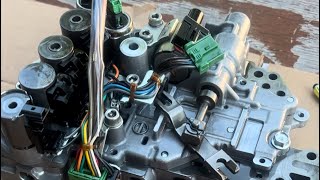
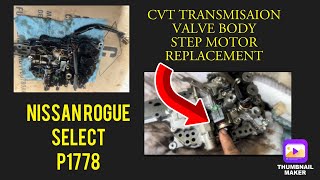
- Faulty CVT Stepper Motor (Very Common) — The stepper motor is a small electric actuator inside the transmission that fails mechanically (jammed internal parts) or electrically (open coils) over time, preventing ratio changes. 🎬 See this step-by-step stepper motor replacement walkthrough
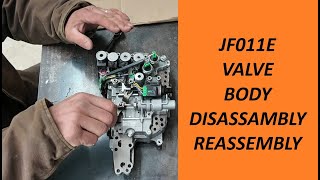
- Faulty Transmission Valve Body (Common) — The stepper motor mounts to the valve body. Blocked passages, sticking solenoids, or a worn ratio control valve prevent proper hydraulic flow, perfectly mimicking a stepper motor failure. 🎬 Watch: Detailed valve body disassembly and reassembly guide
- Low, Dirty, or Incorrect Transmission Fluid (Common) — CVTs require precise fluid pressure. Low, contaminated, or incorrect fluid (like standard ATF instead of Nissan NS-3) causes a pressure drop, preventing the pulleys from moving and triggering a ratio error.
- Damaged Wiring or Connectors (Less Common) — Corroded or disconnected wiring interrupts the signal from the TCM to the stepper motor. This usually triggers P1777 alongside P1778.
- Worn Internal CVT Components (Pulleys/Belt) (Less Common) — Worn pulley faces or a damaged steel belt prevent the transmission from holding the commanded ratio. The TCM misinterprets this mechanical slippage as a stepper motor fault.
- Incorrect Stepper Motor Installation (Rare) — During a DIY repair, failing to align the primary pulley pressure lever with the correct hole during valve body reassembly causes an immediate P1778 code.
- Failing Transmission Control Module (TCM) (Rare) — The TCM itself fails or requires a software update, causing it to send incorrect signals or misinterpret sensor data.
Symptoms

- Severe Acceleration Lag (Stuck in High Gear) — The vehicle feels extremely underpowered and struggles to accelerate from a stop. The transmission enters 'limp mode' and locks into a single gear ratio to prevent further damage.
- Harsh Shuddering or Jerking — The failing stepper motor or fluctuating hydraulic pressure causes violent shuddering and unpredictable lurching as the transmission struggles to adjust pulley ratios.
- Inability to Engage Drive or Reverse — In severe cases, the transmission fails to engage gears from a standstill, feeling as though it slipped into neutral.
- Check Engine Light is On (also visible on scanner) — The Malfunction Indicator Lamp (MIL) illuminates immediately upon the TCM detecting the ratio mismatch.
Diagnostic Flowchart
Tap your situation to follow the diagnostic path that matches what you're seeing on this code.
Common Fixes & Costs
- Replace CVT Stepper Motor — Parts: $25-$75, Labor: $350-$700, ~4 hr book time (Professional)
- Replace Transmission Valve Body — Parts: $300-$900, Labor: $450-$900, ~4 hr book time (Professional)
- Transmission Fluid and Filter Change — Parts: $120-$250, Labor: $150-$300, ~1.5 hr book time (Intermediate)
- Replace Entire CVT Transmission — Parts: $3,000-$5,500, Labor: $1,000-$1,800, ~10 hr book time (Professional)
- TCM Software Update or Replacement — Parts: $0-$1000, Labor: $100-$250, ~2.5 hr book time (Professional)
Used vs. New Parts: Buying Guide
When a used part is worth it: A used OEM valve body from a low-mileage donor vehicle is a cost-effective alternative for older cars. Avoid aftermarket 'rebuilt' valve bodies, which use inferior solenoids. Always buy the stepper motor brand new due to its low cost.
Donor-vehicle mileage cap: roughly under 80000 miles for the part to have meaningful remaining life.
Donor quality checklist:
- Verify the donor vehicle was not in a severe front-end collision.
- Match the casting part number exactly; visual similarities guarantee nothing.
- Look for original manufacturer markings (e.g., 'Jatco', 'TOSOK').
Decision logic:
- If The part is the stepper motor only → Buy new; the $50 cost outweighs the risk of a used part.
- If Vehicle is over 120,000 miles and budget is tight → Buy a used OEM valve body from a donor under 80,000 miles.
- If You want the longest-lasting repair → Buy a brand new OEM valve body assembly from the dealer.
Warranty tradeoff: Salvage yards offer 30-90 day warranties. New OEM parts carry a 1-year/12,000-mile warranty.
Worst-case if a used part fails: $600-$1200 if a used valve body fails, representing repeat labor and a second replacement part.
What Happens If You Wait — Timeline
- 0-1 month: Check Engine Light illuminates with P1778. Intermittent hesitation occurs at steady speeds but disappears when the transmission warms up. (MPG impact: 0-5%% · Added cost: $0-$50 in wasted fuel.)
- 1-3 months: Hesitation becomes severe. The CVT belt begins slipping under high load, generating excessive heat and glazing the belt surface. (MPG impact: 10-20%% · Added cost: $100-$300 in wasted fuel. The repair escalates beyond a simple fluid change.)
- 3-6 months: The vehicle enters 'limp mode' and struggles to reach highway speeds. Belt slippage generates metal shavings that contaminate the fluid and score the pulley surfaces. (MPG impact: 20-40%% · Added cost: $1,500-$2,500. Pulley damage now requires a comprehensive valve body replacement or rebuild.)
- 6+ months: Catastrophic failure. The CVT belt breaks or the pulleys shatter, filling the transmission pan with metal chunks. The vehicle stops moving entirely. (MPG impact: N/A (Vehicle is undrivable)% · Added cost: $4,000 - $8,000+. A complete transmission replacement is mandatory.)
Cost of Not Fixing It
- Immediate (0-1 month): Severe loss of acceleration creates a safety hazard. Abnormally high RPMs cause a 20-40% drop in fuel economy. (Added cost: $50-$150 in wasted fuel per month.)
- Short-Term (1-3 months): The CVT's steel belt slips on the pulleys, generating intense heat and metal shavings that score the pulley surfaces. (Added cost: A $500 stepper motor repair escalates into a $1,500 valve body replacement.)
- Medium-Term (3+ months): Catastrophic failure. The belt and pulleys are destroyed, leaving you stranded. (Added cost: $4,000 - $8,000+ for a remanufactured CVT.)
Diagnosis Steps

- Scan for All Trouble Codes
Use an OBD-II scanner to check for companion codes. P1777 indicates an electrical circuit issue. P0868 (low line pressure) or P1715 (speed sensor mismatch) indicates a hydraulic or mechanical problem. Diagnose speed sensor and pressure codes first.
Tools: OBD-II Scanner (Beginner) - Check Transmission Fluid Level and Condition
Check the fluid with the engine warm. It must be translucent (green or red). Dark brown fluid, a burnt smell, or visible metal shavings signify severe internal damage requiring a full transmission replacement.
Tools: Gloves, Rag, White Paper Towel (Beginner) - Analyze Live Data with a Scan Tool
Monitor the 'STM STEP' (commanded steps) and 'GEAR RATIO' PIDs while driving. If the step count changes but the gear ratio remains stuck, you have a confirmed functional failure. Monitor secondary pressure sensor voltage; expect ~0.7 volts at idle in gear.
Tools: Advanced OBD-II Scanner with Live Data (Advanced) - Drop the Transmission Pan for Internal Inspection
Drain the fluid and remove the pan. Inspect the magnets. Fine metallic paste is normal. Large metal flakes, chunks, or pieces of the steel belt indicate catastrophic internal failure. Stop DIY diagnosis and tow the vehicle to a transmission specialist if you find metal chunks.
Tools: Socket set, Drain pan, Gasket scraper (Advanced) - Test the Stepper Motor Circuit Resistance
Disconnect the transmission harness. Measure resistance between the stepper motor coil pins. For a Jatco JF011E, expect 15 Ohms between the center tap and end pins, and 30 Ohms across the full coil. Open or shorted readings confirm a dead motor.
Tools: Multimeter, Vehicle-specific wiring diagram (Advanced) - Perform a Transmission Line Pressure Test
Connect a pressure gauge to the line pressure port. Jatco CVTs require ~140 PSI at idle. Low pressure confirms a failing oil pump or massive valve body leak, proving the stepper motor is not the root cause.
Tools: Transmission pressure gauge set, Service manual (Professional) - Inspect the Valve Body and Ratio Control Arm
With the pan off, manually move the ratio control arm actuated by the stepper motor. It must move smoothly. Binding indicates a worn valve body linkage, which triggers P1778 even with a brand-new stepper motor.
Tools: Flashlight, Pick tool (Professional) - Test Stepper Motor Actuation
Apply a 12V source to the removed stepper motor's input pins. The actuator arm must extend and retract smoothly. Failure to move confirms mechanical binding inside the motor.
Tools: 12V Power Source, Jumper Wires (Advanced)
When This Code Triggers (Freeze-Frame Conditions)
- Engine Coolant Temp: 180-210°F (82-99°C) (The engine is fully warmed up and at normal operating temperature.)
- Vehicle Speed: 35-60 mph (56-97 km/h) (The code sets during steady-state cruising when the transmission expects to be in overdrive.)
- Engine RPM: 2500-4500 RPM (RPM is abnormally high for the vehicle's speed because the transmission failed to shift into a higher ratio.)
- Transmission Fluid Temperature: 170-220°F (77-104°C) (The transmission is at full operating temperature; issues are less apparent when the fluid is cold and thick.)
Related Codes
- P1777 — Indicates a 'Step Motor Circuit Fault.' This is an electrical code. If present with P1778, the stepper motor's internal coils or wiring harness have failed.
- P0868 — Indicates 'Secondary Pressure Down.' Low line pressure prevents the stepper motor from achieving the correct ratio. Diagnose the oil pump and valve body first.
- P0725 — Indicates an 'Engine Speed Input Circuit Malfunction.' A P1778 fault causes a ratio discrepancy that tricks the TCM into flagging the engine speed signal.
- P1715 — Indicates a mismatch between the two main speed sensors. If the pulleys fail to change ratio (P1778), the speed sensors report conflicting data (P1715).
Climate & Environmental Factors
- High Ambient Temperature: Hot climates accelerate CVT fluid breakdown. Degraded fluid loses hydraulic pressure, increasing wear on the pump and valve body, which triggers P1778.
- Cold Weather: Thick fluid at startup causes temporary hesitation, exacerbating pre-existing mechanical issues until the transmission warms up.
How to Talk to a Mechanic About This Code
Say this: "I have a P1778 code on my vehicle and I'm experiencing hesitant acceleration. I'd like to schedule a diagnostic. Please check for related codes like P1777 or P0868, inspect the fluid condition, and check line pressure before recommending a course of action."
This directs the mechanic to perform a thorough diagnosis to distinguish between an electrical fault, a hydraulic fault, or a functional fault, preventing them from immediately quoting an unnecessary full transmission replacement.
Avoid saying:
- 'My car is acting weird and won't accelerate.'
- 'The check engine light is on, can you just fix it?'
- 'My friend said it's probably the stepper motor, can you just replace that?'
Questions to ask before authorizing the repair:
- What was the result of the line pressure test?
- Did you find any metal shavings in the transmission pan, and if so, how much?
- Are there any other transmission-related codes stored in the TCM?
- Why do you believe replacing this specific part is the correct fix versus another component?
- What is the warranty on the parts and labor for this specific repair?
Where to Take It: Dealer vs Independent vs Chain
- Dealer:
Recommended only if the vehicle is under warranty. For out-of-warranty vehicles, get a second opinion from a transmission specialist.
Best for: Vehicles still under a powertrain or extended CVT warranty., Repairs requiring a TCM software update or programming.
Downsides: Highest labor rates., Defaults to recommending a full transmission replacement to minimize comebacks. (Typical cost: +50% vs. baseline) - Independent Shop:
Best fit, provided you seek out an independent transmission specialist. They have the expertise to accurately diagnose the fault and perform a component-level repair.
Best for: Out-of-warranty vehicles where cost is a major factor., Shops that are explicitly 'Transmission Specialists' with CVT experience.
Downsides: General mechanics lack the specific tools to diagnose internal CVT issues correctly. (Typical cost: +0% vs. baseline) - Chain Shop:
AVOID. P1778 indicates a complex internal transmission fault that is beyond the scope of chain repair shops.
Best for: Simple services completely unrelated to the transmission.
Downsides: Technicians lack specialized training for complex internal transmission work., High risk of misdiagnosis and using generic CVT fluid. (Typical cost: -10% vs. baseline)
When to Walk Away From the Repair
If the estimated repair cost exceeds 50% of the car's private-party value, seriously consider selling the car as-is.
- Car worth $4000, fix is $3500: Walk away. The repair cost is nearly the entire value of the car.
- Car worth $10000, fix is $1500: Fix it. The repair cost is well below the 50% threshold and restores the vehicle's value.
- Car worth $6000, fix is $4500: Walk away. The repair is 75% of the car's value. Unless the car is in perfect condition, it's time to move on.
What Scan Tool You Need for This Code
Minimum: An OBD-II scanner that reads manufacturer-specific transmission codes and displays live data for fluid temperature, commanded gear ratio, and stepper motor steps.
A basic $20 code reader cannot display the live data needed to diagnose why the code is setting, nor can it read the transmission fluid temperature essential for a correct fluid level check.
Budget: Veepeak OBDCheck BLE+ with Torque Pro / ActiveOBD App (~$45) — Reads live data, including CVT fluid temperature on many models, allowing for advanced monitoring on a budget.
Mid-range: Foxwell NT510 Elite / Launch CReader CRP129X (~$150) — Reads live transmission data, accesses manufacturer-specific codes across all modules, and includes special reset functions.
Professional: Autel MaxiCOM MK808S / Foxwell NT809BT (~$450) — Provides full bidirectional control to command specific components and performs the TCM calibration relearn procedures required after replacing a valve body.
Rent vs buy: Buy at least a budget-level scanner that reads live data to aid in diagnosis. If you perform the repair yourself, a pro-level tool is necessary for post-repair relearn procedures.
How to Clear the Code After You Fix It
- Use an OBD-II scan tool to clear all diagnostic trouble codes.
- Perform a complete CVT relearn drive cycle.
Drive cycle (~30 minutes): Start the engine and idle in Park for 3 minutes. Shift through all gears (P-R-N-D), pausing for 5 seconds in each. Drive for 20 minutes, mixing stop-and-go city driving with steady-speed highway cruising to allow the TCM to relearn shift patterns.
Readiness monitors affected: Catalyst Monitor, Evaporative System Monitor, Oxygen Sensor Monitor
Before emissions retest: drive at least 100 miles to fully set monitors.
Watch out for:
- Clearing the code resets all OBD-II readiness monitors to 'Not Ready', causing an automatic emissions test failure.
- The code returns immediately if the underlying mechanical or hydraulic fault remains unfixed.
Will This Fail Emissions / State Inspection?
Yes — this code typically fails an OBD-II emissions inspection.
- California: An illuminated Check Engine Light causes an automatic smog check failure. You must complete a specific drive cycle to set all readiness monitors after repairs.
- New York: Any active powertrain trouble code like P1778 triggers an automatic NYS inspection failure.
- Texas: An active P1778 code causes immediate failure. After clearing the code, 2001+ vehicles are allowed only one 'Not Ready' monitor to pass.
Most Commonly Affected Vehicles

- Nissan Altima (2007-2013) — Notorious for P1778 due to failures in the Jatco JF011E CVT. The stepper motor is a primary weak point.
- Nissan Rogue (2008-2015) — Uses the same problematic Jatco CVT as the Altima, making P1778 a highly documented failure.
- Nissan Sentra (2007-2012) — Highly susceptible to stepper motor issues, presenting with the classic 'no acceleration' symptom.
- Dodge Caliber (2007-2012) — Equipped with the Jatco JF011E CVT and suffers identical stepper motor and valve body failures.
- Jeep Patriot / Compass (2007-2017) — Shares the platform and Jatco CVT with the Dodge Caliber; frequently diagnosed with P1778.
- Mitsubishi Outlander / Lancer (2008-2015) — Sets P1778 often in conjunction with P0868 (low pressure), pointing to hydraulic circuit issues.
Manufacturer-Specific Notes
- Nissan: Nissan issued warranty extensions doubling coverage to 10 years/120,000 miles for many 2003-2010 vehicles, and 7 years/84,000 miles for 2012-2017 models. Always check your VIN with a dealer before paying for repairs.
- Jatco (Supplier): Technicians consider the stepper motor the most over-replaced part in these CVTs. P1778 indicates a ratio problem; a worn oil pump or contaminated valve body often triggers the code while the motor itself is perfectly fine.
- Ford: On Ford vehicles, P1778 means 'Transmission Reverse I/P Circuit Malfunction,' an entirely different reverse input circuit problem. Verify the code definition for your specific vehicle.
Real Owner Stories
2009 Nissan Murano with P1777/P1778
Vehicle had very slow acceleration and the Check Engine Light was on. Mechanics advised a $4,500 transmission replacement.
Outcome: Replacing the stepper motor restored full performance. The owner fixed the issue for under $150 in parts and 5 hours of labor.
Lesson: When P1777 accompanies P1778, replacing the stepper motor is a highly viable, cheap alternative to a full transmission replacement.
2012 Nissan Rogue with recurring P1778
Car revved high but failed to shift into overdrive once warm, triggering P1778. The owner replaced the stepper motor.
Outcome: The P1778 code returned after a 45-minute drive. The new motor did not solve the underlying hydraulic pressure issue.
Lesson: If a new stepper motor fails to fix P1778, the root cause is a worn valve body or a failing oil pump preventing the system from achieving the commanded ratio.
2014 Nissan Rogue with P1778 and no reverse
Owner bought a used valve body online to fix a P1778 code.
Outcome: The car lost reverse gear entirely. The used part had a slightly different manual valve design (casting #AF0#2B vs original #AF0#1A).
Lesson: Never install a used valve body without matching the casting numbers exactly. Visually imperceptible differences cause complete failure of core transmission functions.
How to Prevent This Code From Triggering
- Change CVT fluid and filters regularly (Every 30,000 to 60,000 miles) — Clean, proper-spec fluid maintains hydraulic pressure and lubrication. Degraded fluid destroys the pump, valve body, and belt, directly causing P1778.
- Install an auxiliary external transmission cooler (One-time installation) — Heat destroys CVT fluid. An external cooler drastically reduces operating temperatures, preserving fluid integrity and preventing premature valve body wear.
- Reset CVT fluid degradation counter (Every fluid change) — The TCM estimates fluid life to adjust line pressure. Failing to reset this counter with a scan tool causes the TCM to apply incorrect pressure for the new fluid.
Frequently Asked Questions
My mechanic says I need a new transmission for a P1778 code. Is that true?
Not always. Many owners successfully fix P1778 by replacing the stepper motor or valve body, saving thousands. However, if significant metal debris is in the pan, a full replacement is the only guaranteed fix.
Why would a shop refuse to just replace the stepper motor?
Shops recommend full replacements to eliminate liability and prevent comebacks. If they only replace the motor and another internal part fails shortly after, the customer blames the shop. A remanufactured transmission includes a warranty that protects both parties.
Is a P1778 code serious?
Yes, it is extremely serious. It indicates a major transmission failure that causes sudden, dangerous loss of acceleration. Continued driving destroys the CVT belt and pulleys, guaranteeing a $4,000+ replacement.
Will changing the transmission fluid fix a P1778 code?
A fluid change rarely provides a permanent fix for P1778. While fresh fluid restores hydraulic pressure temporarily, it cannot repair a failed stepper motor or scored valve body. Only attempt this if the fluid is severely degraded but no metal shavings are present.
I replaced the stepper motor and the code came back. What now?
If a new motor fails to clear the code, the root cause is hydraulic or mechanical. Common culprits include a misaligned ratio control arm during installation, a worn valve body, or a failing fluid pump causing low pressure. You must diagnose the hydraulic system before replacing more parts.
How can I prevent code P1778?
Diligent maintenance is the only prevention. Change the CVT fluid and filters every 30,000 to 60,000 miles using only the manufacturer-specified fluid (e.g., Nissan NS-3). Incorrect fluid or neglected maintenance accelerates wear on the pump and valve body, triggering this code.
Can my car pass a smog test with a P1778 code?
No, an active P1778 code automatically fails a smog test. The Check Engine Light illuminates, and the vehicle's OBD-II system reports a critical emissions-impacting powertrain fault. You must repair the issue and complete a full drive cycle to pass.
Key Takeaways
- Code P1778 indicates a mechanical or hydraulic failure in the CVT's ratio control system, affecting over 10 million Jatco-equipped Nissan, Dodge, Jeep, and Mitsubishi vehicles.
- Vehicles with this code experience a severe 20-40% drop in fuel economy and dangerous acceleration lag because the transmission is stuck in a high gear ratio.
- P1778 is a functional code meaning the pulleys failed to move, whereas the companion code P1777 points directly to an electrical short in the stepper motor circuit.
- Replacing the $50 stepper motor only fixes the issue 30% of the time; mechanics must verify line pressure (aiming for 140 PSI at idle) to rule out a failing $800 valve body.
- Driving with an active P1778 code destroys the CVT's steel pushbelt within weeks, escalating a $500 repair into a mandatory $4,000 to $8,000 full transmission replacement.
Helpful Videos


The information in this article is provided for general reference and educational purposes only. Vehicle specifications, procedures, and part compatibility can vary by production date, trim level, and region. Always consult your vehicle's factory service manual and verify part numbers before purchasing or performing repairs. Safety-critical components such as airbags, seat belts, and braking systems should be installed by a qualified professional.
- 🎬 Helpful Videos
- What Does P1778 Mean?
- Can I Drive With P1778?
- Common Causes
- Symptoms
- Diagnostic Flowchart
- Common Fixes & Costs
- Used vs. New Parts: Buying Guide
- What Happens If You Wait — Timeline
- Cost of Not Fixing It
- Diagnosis Steps
- When This Code Triggers (Freeze-Frame Conditions)
- Related Codes
- Climate & Environmental Factors
- How to Talk to a Mechanic About This Code
- Where to Take It: Dealer vs Independent vs Chain
- When to Walk Away From the Repair
- What Scan Tool You Need for This Code
- How to Clear the Code After You Fix It
- Will This Fail Emissions / State Inspection?
- Most Commonly Affected Vehicles
- Manufacturer-Specific Notes
- Real Owner Stories
- 2009 Nissan Murano with P1777/P1778
- 2012 Nissan Rogue with recurring P1778
- 2014 Nissan Rogue with P1778 and no reverse
- How to Prevent This Code From Triggering
- Frequently Asked Questions
- My mechanic says I need a new transmission for a P1778 code. Is that true?
- Why would a shop refuse to just replace the stepper motor?
- Is a P1778 code serious?
- Will changing the transmission fluid fix a P1778 code?
- I replaced the stepper motor and the code came back. What now?
- How can I prevent code P1778?
- Can my car pass a smog test with a P1778 code?
- Key Takeaways
- 🎟️ Get 5% Off