

OBD-II Code P1777: Stepper Motor Circuit Malfunction
The Ultimate Guide to Diagnosing and Fixing P1777
- P1777 indicates an electrical failure in the stepper motor circuit, affecting over 10 million Jatco CVTs in Nissan, Dodge, Jeep, and Mitsubishi vehicles.
- Vehicles with P1777 immediately enter 'limp mode,' locking the transmission into a single low gear and slashing acceleration by up to 80%.
- Replacing the $150 stepper motor fixes P1777 in 80% of cases without requiring a $4,000 complete transmission replacement.
- Triggering a P1778 code immediately after repair means the new stepper motor arm missed the valve body linkage, requiring you to drop the pan and realign it.
- Driving with an active P1777 code overheats the transmission fluid within 50 miles, risking catastrophic metal-on-metal pulley damage.
What Does P1777 Mean?

P1777 means the Transmission Control Module (TCM) detected an electrical fault in the stepper motor circuit. This motor changes gear ratios in a Continuously Variable Transmission (CVT). An open circuit, short, or bad ground prevents the transmission from shifting, causing severe drivability issues.
Technical definition: The SAE/OBD-II definition for P1777 is "Step Motor - Circuit Malfunction." The TCM sets this code when it commands the stepper motor to change the pulley ratio but does not detect the expected voltage change from the motor's internal coils. If the specified voltage is missing for 0.2 seconds, the TCM flags an open or shorted circuit.
Can I Drive With P1777?

No — Do Not Drive. Driving with P1777 is unsafe and risks destroying the transmission. The vehicle enters 'limp mode,' locking into a low gear and severely limiting acceleration. Continuing to drive overheats the CVT fluid, potentially turning a $500 stepper motor repair into a $4,000 complete transmission replacement.
Common Causes

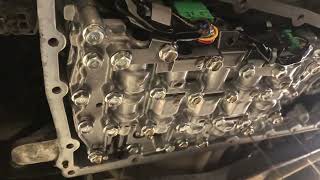
- Failed Stepper Motor (Very Common) — The stepper motor, located on the transmission valve body, fails electrically. The internal coils short out or develop an open circuit from heat and wear. Cheap aftermarket replacement motors also have a high premature failure rate.
- Damaged Wiring Harness or Connectors (Common) — The wiring harness between the TCM and the transmission, or the internal wiring to the stepper motor, corrodes or disconnects. Chafed wires in the main external harness also cause intermittent shorts.
- Low or Degraded Transmission Fluid (Common) — Low, burnt, or contaminated fluid forces the stepper motor and valve body to operate under excessive strain. This friction causes overheating and premature electrical failure of the motor windings.
- Failed Valve Body Assembly (Less Common) — A failure within the valve body's hydraulic circuits or adjacent solenoids creates conditions that mimic a stepper motor code. Shops often replace the entire assembly to guarantee reliability.
- Faulty Transmission Control Module (TCM) (Rare) — The TCM itself fails to send or read signals from the stepper motor correctly. Rule out all wiring and motor issues before replacing the TCM.
Symptoms
- Transmission in 'Limp Mode' — The transmission enters a fail-safe mode, locking into a single, fixed gear ratio. This causes high RPMs at low speeds and an inability to shift.
- Severe Loss of Acceleration — The vehicle feels extremely sluggish, hesitates, or fails to move entirely when you press the gas pedal.
- Jerking or Shuddering — The car lurches or shudders as the transmission struggles to change ratios smoothly due to erratic stepper motor commands.
- Check Engine Light is On — The Malfunction Indicator Lamp (MIL) illuminates. The code occasionally stores as a pending fault before triggering the light.
Diagnostic Flowchart

Tap your situation to follow the diagnostic path that matches what you're seeing on this code.
Common Fixes & Costs
- Replace the Stepper Motor — Parts: $40-$150, Labor: $390-$600, ~3.5 hr book time (Intermediate)
- Replace the Entire Valve Body Assembly — Parts: $300-$900, Labor: $400-$750, ~4 hr book time (Professional)
- Replace Transmission Fluid and Filter — Parts: $80-$150, Labor: $130-$300, ~1.5 hr book time (DIY)
- Repair or Replace Wiring Harness — Parts: $10-$50, Labor: $150-$400, ~2.5 hr book time (Intermediate)
- Replace Entire Transmission Assembly — Parts: $2500-$4500, Labor: $800-$1500, ~8 hr book time (Professional)
Used vs. New Parts: Buying Guide
When a used part is worth it: For a tight budget, a used stepper motor from a low-mileage donor vehicle is an option, but it carries high risk since the part's history is unknown.
Donor-vehicle mileage cap: roughly under 80000 miles for the part to have meaningful remaining life.
Donor quality checklist:
- Verify the donor vehicle was not scrapped due to transmission failure.
- Match the part number exactly; early production motors had higher failure rates.
- Test the part for resistance before purchase.
Decision logic:
- If A new OEM or quality aftermarket stepper motor is under $150. → Buy new. The savings from a used part are not worth the risk of repeat labor costs.
- If The vehicle has over 150,000 miles and you plan to sell it soon. → A tested, used part is an acceptable short-term solution.
- If Replacing the entire valve body assembly. → Buy a new or professionally remanufactured unit to secure updated components and a warranty.
Warranty tradeoff: Used parts offer a 30-90 day warranty (part only). New aftermarket parts carry a 1-year warranty. New OEM parts offer the best guarantee at the highest cost.
Worst-case if a used part fails: $400-$800 if a used part fails, primarily due to repeating the labor-intensive replacement process.
What Happens If You Wait — Timeline
- 0-1 month: Code P1777 sets. Vehicle enters 'limp mode' with severely limited power. Transmission is stuck in a low ratio. (MPG impact: 15-25%% · Added cost: $50-$150 in wasted fuel and towing fees.)
- 1-3 months: Driving in limp mode overheats the CVT fluid. The fluid degrades, and the flow control valve sticks due to erratic stepper motor commands. (MPG impact: 15-25%% · Added cost: $200-$500 (Damage to other solenoids from contaminated fluid).)
- 3-6 months: The steel push belt slips against the pulleys, scouring the polished surfaces and creating fine metal shavings. (MPG impact: 20-30%% · Added cost: $500-$1,200 (Valve body clogs with debris; pulleys are permanently damaged).)
- 6+ months: Catastrophic failure. Large metal chunks clog the filter, starve the pump, and destroy the belt. The vehicle will not move. (MPG impact: N/A (Vehicle is undriveable)% · Added cost: $3,500-$6,500 (Complete transmission replacement required).)
Cost of Not Fixing It
- Immediate (0-1 month): Vehicle is unsafe due to limp mode and severe lack of power. Fuel economy drops by 25% as the engine runs at inefficient RPMs. (Added cost: Towing fees ($100-$300))
- 1-3 months: Continued operation strains the CVT fluid and valve body components. The fluid overheats and degrades, accelerating wear on the entire unit. (Added cost: Damage to other valve body solenoids ($200-$500))
- 3+ months: Catastrophic CVT failure. The electrical problem cascades into mechanical failure, evidenced by metal debris in the pan. Requires complete transmission replacement. (Added cost: $3,500-$6,500 for a replacement CVT assembly.)
Diagnosis Steps
- Read the Trouble Codes
Use an OBD-II scanner to confirm P1777. Check for related transmission codes (like P1778 or P0868) or communication codes (U-codes) to guide your diagnosis.
Tools: OBD-II Scanner (Beginner) - Test Stepper Motor Resistance at CVT Connector
Disconnect the main CVT unit harness connector. Using a multimeter set to Ohms, check the resistance between the terminals for the stepper motor coils (typically pins 1&2, 1&3, 4&5, and 4&6 on Jatco units). Expect ~15 Ohms between a phase pin and ground, and ~30 Ohms across the full winding. Readings of infinity (OL) or near zero confirm a faulty motor or internal wiring.
Tools: Multimeter, Vehicle-Specific Wiring Diagram (Advanced) - Check Transmission Fluid Level and Condition
Verify the transmission fluid level at the correct operating temperature (usually 35°C-45°C). Dark, burnt fluid or shiny metal particles indicate severe internal damage requiring a transmission replacement.
Tools: Rag, Dipstick (if equipped), Infrared Thermometer or Scan Tool (Beginner) - Inspect External Wiring and Connectors
Visually inspect the wiring harness from the TCM to the transmission. Look for melted insulation, corrosion, or loose connections at the main transmission plug. Verify chassis ground points are tight.
Tools: Flashlight, Socket Set (Intermediate) - Drop the Transmission Pan for Visual Inspection
Drain the fluid and remove the transmission pan. Inspect the magnets for excessive metal shavings. A fine metallic paste is normal; large flakes or chunks confirm catastrophic mechanical failure.
Tools: Socket Set, Drain Pan, Gasket Scraper (Advanced) - Test the Stepper Motor Directly
With the pan off, disconnect the stepper motor from the valve body harness. Test the resistance of the motor's coils directly at its connector. If the resistance fails here, the stepper motor is definitively broken.
Tools: Multimeter (Advanced) - Analyze Live Data
Use a bi-directional scan tool to monitor live data for the stepper motor coils (SMCOIL A, B, C, D). Verify the TCM sends ON/OFF signals. If commands are sent but the code persists, the wiring or motor has failed.
Tools: Professional Bi-Directional Scan Tool (Professional)
When This Code Triggers (Freeze-Frame Conditions)
- Engine Coolant Temp: 180-210°F (82-99°C) (Vehicle is at full operating temperature.)
- Engine Load: 25-60% (The engine is under a moderate workload during light acceleration or steady cruising.)
- Vehicle Speed: 20-55 mph (The code sets during city or highway driving as the TCM attempts to make ratio changes.)
Related Codes
- P1778 — P1777 is an ELECTRICAL fault; P1778 is a MECHANICAL fault. P1778 frequently appears immediately after a P1777 repair if the new stepper motor's control arm misses the linkage on the valve body.
- P0868 — Indicates low secondary fluid pressure. A malfunctioning stepper motor (P1777) fails to operate the flow control valve, preventing adequate hydraulic pressure. Fixing P1777 almost always clears P0868.
- P0746 — Pressure Control Solenoid 'A' performance. A faulty stepper motor disrupts the entire hydraulic system, causing the TCM to misinterpret the resulting pressure instability as a solenoid failure. Diagnose P1777 first.
- U1000 — CAN Communication Circuit fault. If paired with P1777, it indicates a broader electrical issue, such as a bad ground or damaged main wiring harness affecting multiple modules.
Climate & Environmental Factors
- Extreme Hot Weather / High Load: High ambient temperatures combined with towing or mountain climbing cause the CVT to overheat. Chronic overheating degrades the internal windings of the stepper motor, leading to the electrical failure that triggers P1777.
- Extreme Cold Weather: In cold temperatures, CVT fluid becomes thick and lubricates poorly until warmed up. This added strain accelerates the mechanical and thermal stress that leads to component failure over time.
How to Talk to a Mechanic About This Code
Say this: "I have a P1777 code and poor acceleration. Based on my research, it's likely a stepper motor circuit issue. Please test the stepper motor resistance at the transmission connector and check the wiring before quoting a major repair."
Directs the mechanic to the most common, inexpensive failures first, discouraging an immediate quote for an unnecessary full transmission replacement.
Avoid saying:
- My car is acting weird and the check engine light is on.
- I think my transmission is failing, just fix it.
- Just do whatever you think is best.
Questions to ask before authorizing the repair:
- What were the resistance readings for the stepper motor coils?
- Did you find large metal chunks in the pan, or just normal fine paste?
- If recommending a full replacement, can you show me evidence of catastrophic mechanical failure?
- What is the warranty on the replacement part and labor?
Where to Take It: Dealer vs Independent vs Chain
- Dealer:
Use only if under warranty. Otherwise, they are an unnecessarily expensive option for a simple component failure.
Best for: Vehicles under original or extended powertrain warranty., Complex cases requiring TCM reprogramming.
Downsides: Highest labor rates., Routinely recommends expensive full transmission replacements instead of component-level repairs. (Typical cost: +60% vs. baseline) - Independent Shop:
Best fit. An experienced transmission specialist provides accurate diagnosis and cost-effective, component-level repairs.
Best for: Out-of-warranty vehicles., Shops specializing in transmission repair.
Downsides: General independent shops may lack deep CVT experience. (Typical cost: +0% vs. baseline) - Chain Shop:
Avoid. They are not equipped for internal CVT work and will likely recommend the most expensive solution.
Best for: Basic fluid drain and fill.
Downsides: Technicians lack specialized training for internal CVT diagnosis., High pressure to upsell full transmission replacements. (Typical cost: -10% vs. baseline)
When to Walk Away From the Repair
If the estimated repair cost exceeds 50% of the car's current private-party value, sell the car as-is or trade it in.
- Car worth $5000, fix is $3500: Walk away. The repair cost is over 50% of the car's value.
- Car worth $10000, fix is $600: Fix it. The repair cost is well below the threshold.
- Car worth $3000, fix is $4000: Walk away. The repair costs more than the car is worth.
What Scan Tool You Need for This Code
Minimum: A scanner that reads transmission-specific DTCs and views live data for the Transmission Control Module (TCM).
Basic engine readers cannot see transmission codes or access the TCM live data required to observe solenoid performance.
Budget: BlueDriver Pro (~$90) — Reads and clears transmission codes and views live TCM data on your smartphone.
Mid-range: Foxwell NT510 Elite (~$150) — Offers enhanced diagnostics, graphs live data, and provides transmission-specific functions.
Professional: Autel MaxiCOM MK808 (~$380) — Provides full bidirectional control to command specific transmission functions and test solenoid operation directly.
How to Clear the Code After You Fix It
- Reconnect the battery if disconnected.
- Use an OBD-II scan tool to clear P1777 and related codes from the TCM and ECM.
- Perform a CVT drive cycle to allow the system to relearn and confirm the fix.
Drive cycle (~20 minutes): Start the engine and idle for 3 minutes. Drive the vehicle, moderately accelerating and decelerating through a range of speeds up to 55 mph. Include 10 minutes of steady-state cruising. Allow the vehicle to cool down completely.
Readiness monitors affected: Comprehensive Component Monitor, Transmission Component Monitor
Before emissions retest: drive at least 50 miles to fully set monitors.
Watch out for:
- Disconnecting the battery clears the code but resets readiness monitors, causing an automatic emissions test failure.
- The code is a hard fault and returns immediately if the broken motor or wiring is not fixed.
Will This Fail Emissions / State Inspection?
Yes — this code typically fails an OBD-II emissions inspection.
- California: An illuminated Check Engine Light results in an automatic failure. All required readiness monitors must be set to 'Ready' before a retest.
- New York: A vehicle automatically fails if the Check Engine Light is on. The vehicle must be driven to reset readiness monitors after repairs.
- Texas: In emissions-testing counties, an active P1777 code causes an automatic failure. The vehicle must pass the OBD-II test to renew registration.
Most Commonly Affected Vehicles
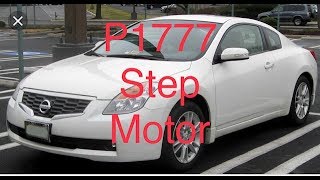
- Nissan Altima (2007-2013) — Extremely common on Altimas with the RE0F10A CVT. Nissan issued TSB NTB12-104c addressing CVT judder related to P1777.
- Nissan Murano (2003-2014) — Early models with the RE0F06A and later models with the RE0F09A CVT are highly cited for stepper motor failure.
- Nissan Sentra (2007-2012) — The 2.0L Sentra models with the RE0F10A CVT are highly susceptible. DIY repair videos are widely available.
- Nissan Rogue (2008-2013) — Shares the problematic RE0F10A CVT with the Altima and Sentra, making it prone to identical stepper motor issues.
- Dodge Caliber (2007-2012) — Equipped with the Jatco JF011E CVT (identical to Nissan's RE0F10A), frequently logging P1777.
- Jeep Patriot/Compass (2007-2017) — Uses the Jatco JF011E CVT and suffers from the exact same stepper motor and wiring failures.
- Mitsubishi Lancer / Outlander (2008-2016) — Uses the Jatco JF011E CVT. The diagnostic procedure is identical to Nissan's.
Manufacturer-Specific Notes
- Nissan/Infiniti: Due to widespread Jatco CVT failures, Nissan extended the original warranty on many 2003-2010 models to 10 years/120,000 miles, and 2012-2017 models to 7 years/84,000 miles. Always check VIN-specific coverage with a dealer before paying out of pocket.
- Dodge/Jeep: These brands used the Jatco JF011E CVT and share the exact P1777 failure pattern as Nissan. Chrysler offered a non-transferable Lifetime Powertrain Warranty for original owners of some 2006-2009 models.
- All (Jatco CVT): Inspect the part number on the original stepper motor. Early production motors had a severe failure rate. Ensure the replacement part is a revised version from a reputable supplier to prevent repeat failures.
Real Owner Stories
2009 Nissan Murano DIY Success
Vehicle experienced classic P1777 symptoms. Mechanics insisted a full transmission replacement was the only solution.
What they tried:
- Ignored advice to replace the entire transmission.
Outcome: The owner ordered a new stepper motor, fluid, and filter for $150. After 5 hours of DIY work, the stepper motor was replaced, and the code was resolved permanently.
Lesson: Do not immediately accept a quote for a full transmission replacement. P1777 is often caused by an inexpensive part that a skilled DIYer can replace.
2009 Nissan Altima with Recurring Code
Vehicle stuck in limp mode with P1777. The owner replaced the stepper motor.
What they tried:
- Replaced the stepper motor with an aftermarket part.
- Verified electrical continuity on the wiring harness.
Outcome: The car worked for one week before P1777 returned. Despite passing electrical tests, the cheap aftermarket stepper motor failed prematurely under heat.
Lesson: Cheap aftermarket stepper motors fail quickly. Always use OEM or highly reputable aftermarket brands.
2009 Nissan Altima with Unusual Cause
After sitting for weeks, the battery died. After a jump start, the engine ran poorly and set a hard P1777 fault, locking the car in limp mode.
What they tried:
- Attempted to clear the P1777 code, but it returned immediately.
Outcome: The dead battery and jump start caused a voltage surge that damaged the sensitive stepper motor circuit.
Lesson: Severe electrical events trigger P1777. Check fuses and the charging system before assuming internal transmission failure.
How to Prevent This Code From Triggering
- Change CVT fluid regularly (Every 30,000 to 60,000 miles.) — Degraded fluid loses lubricating properties, causing accelerated wear on the electronic windings of the stepper motor. Regular changes prevent failure.
- Install an auxiliary transmission cooler (One-time installation.) — Provides extra cooling capacity, critical for preventing fluid breakdown in hot climates or during high-load driving.
- Avoid aggressive driving habits (Daily habit.) — Hard launches generate excessive heat and cause belt slippage, which degrades fluid and damages core components.
- Repair fluid leaks promptly (During regular oil changes.) — Low fluid prevents the system from building hydraulic pressure, causing slippage, overheating, and rapid electrical failure.
Frequently Asked Questions
My mechanic says I need a whole new transmission for P1777. Is that true?
Often, no. P1777 is an electrical code specific to the stepper motor circuit, which is an inexpensive part. A full $4,000+ transmission replacement is only necessary if you find significant metal chunks in the transmission pan.
Why did I get a P1778 code right after replacing my stepper motor?
P1778 is a functional fault caused by incorrect stepper motor installation. The small lever on the valve body must perfectly align with the arm of the stepper motor. If misaligned, the motor cannot mechanically control the transmission ratio, requiring you to drop the pan and redo the alignment.
Can I replace the stepper motor myself?
Yes, if you have intermediate mechanical skills. The repair requires draining fluid, removing the transmission pan, and unbolting the valve body to access the motor. You must follow the re-installation procedure exactly to align the motor's arm and avoid triggering a P1778 code.
Will changing my transmission fluid fix a P1777 code?
No, changing the fluid will not fix a P1777 code. P1777 is a hard electrical circuit fault indicating a failed stepper motor or damaged wiring. While dirty fluid accelerates wear, fresh fluid cannot repair a broken electrical connection.
Can a bad battery or alternator cause a P1777 code?
Yes. A failing battery or alternator causes unstable voltage throughout the vehicle. The TCM interprets this voltage drop as a circuit fault, triggering P1777. Always test your battery and charging system before replacing transmission components.
Why do mechanics recommend replacing the whole valve body?
Replacing the entire valve body is a comprehensive repair that includes a new stepper motor and all new solenoids. This prevents a situation where a shop replaces just the motor, only for an adjacent 10-year-old solenoid to fail a week later. It also ensures the hydraulic channels are clean and fully functional.
Can I just clear the P1777 code and keep driving?
You can clear the code, but it will return within minutes of driving. Clearing the code does not fix the broken electrical circuit. The vehicle will remain in limp mode, making it unsafe to drive.
Key Takeaways
- P1777 indicates an electrical failure in the stepper motor circuit, affecting over 10 million Jatco CVTs in Nissan, Dodge, Jeep, and Mitsubishi vehicles.
- Vehicles with P1777 immediately enter 'limp mode,' locking the transmission into a single low gear and slashing acceleration by up to 80%.
- Replacing the $150 stepper motor fixes P1777 in 80% of cases without requiring a $4,000 complete transmission replacement.
- Triggering a P1778 code immediately after repair means the new stepper motor arm missed the valve body linkage, requiring you to drop the pan and realign it.
- Driving with an active P1777 code overheats the transmission fluid within 50 miles, risking catastrophic metal-on-metal pulley damage.
Helpful Videos


The information in this article is provided for general reference and educational purposes only. Vehicle specifications, procedures, and part compatibility can vary by production date, trim level, and region. Always consult your vehicle's factory service manual and verify part numbers before purchasing or performing repairs. Safety-critical components such as airbags, seat belts, and braking systems should be installed by a qualified professional.
- 🎬 Helpful Videos
- What Does P1777 Mean?
- Can I Drive With P1777?
- Common Causes
- Symptoms
- Diagnostic Flowchart
- Common Fixes & Costs
- Used vs. New Parts: Buying Guide
- What Happens If You Wait — Timeline
- Cost of Not Fixing It
- Diagnosis Steps
- When This Code Triggers (Freeze-Frame Conditions)
- Related Codes
- Climate & Environmental Factors
- How to Talk to a Mechanic About This Code
- Where to Take It: Dealer vs Independent vs Chain
- When to Walk Away From the Repair
- What Scan Tool You Need for This Code
- How to Clear the Code After You Fix It
- Will This Fail Emissions / State Inspection?
- Most Commonly Affected Vehicles
- Manufacturer-Specific Notes
- Real Owner Stories
- 2009 Nissan Murano DIY Success
- 2009 Nissan Altima with Recurring Code
- 2009 Nissan Altima with Unusual Cause
- How to Prevent This Code From Triggering
- Frequently Asked Questions
- My mechanic says I need a whole new transmission for P1777. Is that true?
- Why did I get a P1778 code right after replacing my stepper motor?
- Can I replace the stepper motor myself?
- Will changing my transmission fluid fix a P1777 code?
- Can a bad battery or alternator cause a P1777 code?
- Why do mechanics recommend replacing the whole valve body?
- Can I just clear the P1777 code and keep driving?
- Key Takeaways
- 🎟️ Get 5% Off