

OBD-II Code P1774: Low Coast Brake Solenoid Circuit Fault
What P1774 means, why it triggers, and how to fix it
- P1774 on Nissan and Infiniti vehicles almost always requires replacing the $800-$1,600 integrated valve body and TCM assembly due to cracked internal circuit traces.
- Test the low coast brake solenoid resistance; a reading outside the 23-40 Ohm range confirms a dead solenoid, while a normal reading points directly to a failed TCM.
- Inspect the transmission fluid immediately: pink, milky fluid indicates a failed radiator (SMOD) that has destroyed the transmission, requiring a $3,500+ rebuild.
- Do not diagnose the transmission if you see P1774 on a BMW or a Hyundai/Kia Hybrid; it indicates a $250 wheel speed sensor fault on BMWs and an electric oil pump issue on Hybrids.
What Does P1774 Mean?

P1774 indicates the Transmission Control Module (TCM) detected a functional failure with the low coast brake solenoid. This electro-hydraulic valve controls fluid flow for smooth gear changes and engine braking. When the TCM commands the solenoid to activate but does not see the expected gear ratio or hydraulic pressure change, it triggers this code.
Technical definition: The SAE/OBD-II definition for P1774 is "Low Coast Brake Solenoid Valve Function". The TCM detects an electrical open/short, a mechanically stuck valve, or a discrepancy between the commanded gear and the transmission pressure switch signals.
Can I Drive With P1774?
Yes, But With Caution. You can drive, but it is not recommended for any significant distance. The transmission enters a 'limp mode' (stuck in 2nd or 3rd gear) to prevent damage. Continuing to drive causes rapid wear on internal clutches and bands, turning a $1,500 valve body repair into a $4,000 full transmission rebuild.
Common Causes

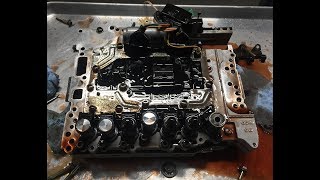
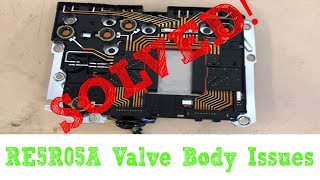
- Failed TCM / Valve Body Assembly (Very Common) — On Nissan RE5R05A transmissions, the TCM is integrated into the valve body. 🎬 Watch: How to identify and fix common TCM circuit issues. Microscopic cracks develop in the copper circuit traces on the control board, creating an open circuit for the solenoid. This often appears only when the transmission heats up.
- Faulty Low Coast Brake Solenoid (Common) — The solenoid fails electrically due to an internal short or open circuit, or mechanically from debris causing the internal plunger to stick.
- Coolant Contamination (SMOD) / Dirty Fluid (Common) — Old or contaminated fluid causes solenoids to stick. On 2005-2010 Nissans, a failed radiator cooler leaks coolant into the transmission (the 'SMOD' issue), destroying the valve body electronics and clutches.
- Damaged Wiring or Connectors (Less Common) — Wires leading to the transmission harness can fray, short, or corrode, interrupting the signal from the TCM.
- Failed ATF Pressure Switch (Rare) — The TCM uses an ATF pressure switch to verify the solenoid's action. If this switch fails, the TCM incorrectly flags the solenoid as non-functional.
Symptoms

- Check Engine Light is On — The Malfunction Indicator Lamp (MIL) illuminates on the dashboard.
- Vehicle Enters 'Limp Mode' — The transmission locks into a single gear (usually 3rd or 4th) to prevent damage, resulting in poor acceleration and high RPMs at cruising speed.
- Sudden Downshift While Coasting — The vehicle cruises at a steady speed and suddenly downshifts harshly, causing a massive spike in engine RPM.
- Harsh, Erratic, or Delayed Shifting — The transmission slams into gear, hesitates before shifting, or feels unpredictable.
- Transmission Slips — Engine RPMs flare up during acceleration without the vehicle speeding up, as if briefly in neutral.
- No Engine Braking — The vehicle does not slow down as expected when coasting downhill in a low gear.
Diagnostic Flowchart

Tap your situation to follow the diagnostic path that matches what you're seeing on this code.
Common Fixes & Costs
- Replace the Transmission Valve Body Assembly 🎬 Watch: Step-by-step guide to removing the Nissan valve body. — Parts: $800-$1600, Labor: $300-$600, ~3.5 hr book time (Professional)
- Replace the Low Coast Brake Solenoid — Parts: $50-$100, Labor: $250-$450, ~3 hr book time (Professional)
- Transmission Fluid and Filter Change — Parts: $75-$200, Labor: $100-$250, ~1.5 hr book time (Intermediate)
- Repair Damaged Wiring or Connectors — Parts: $10-$50, Labor: $150-$400, ~2 hr book time (Intermediate)
- Reprogram Transmission Control Module (TCM) — Parts: $0, Labor: $150-$250, ~1 hr book time (Professional)
DIY vs Professional
- Transmission Fluid and Filter Change — Beginner: Yes
Tools: Socket set, drain pan, funnel, correct fluid, new pan gasket. - Repair Damaged Wiring or Connectors — Beginner: No
Tools: Multimeter, soldering iron, heat shrink tubing, wire strippers. - Replace the Low Coast Brake Solenoid — Beginner: No
Tools: Socket set, torque wrench, drain pan, multimeter, snap ring pliers. - Replace the Transmission Valve Body Assembly — Beginner: No
Tools: Socket set, inch-pound torque wrench, drain pan, scan tool for programming.
Used vs. New Parts: Buying Guide
When a used part is worth it: A used RE5R05A valve body is a massive gamble due to the high failure rate of the TCM traces. It only makes sense if the budget is extremely tight and the part comes from a verified low-mileage donor.
Donor-vehicle mileage cap: roughly under 60000 miles for the part to have meaningful remaining life.
Donor quality checklist:
- Verify the donor VIN is not a 2005-2010 model susceptible to SMOD.
- Match the part number stamped on the valve body exactly.
- Reject parts with any sign of milky fluid residue.
Decision logic:
- If Budget allows → Purchase a remanufactured valve body from a reputable supplier. It corrects factory flaws and includes a warranty.
- If The vehicle is a 2005-2010 Nissan → Replace the radiator simultaneously to prevent SMOD from destroying the new valve body.
Warranty tradeoff: Used parts offer 30-day warranties. Remanufactured units offer 1-year to lifetime warranties, protecting you against repeat labor costs.
Worst-case if a used part fails: $800 to pay for labor a second time when the used part fails.
What Happens If You Wait — Timeline
- 0-1 month: Intermittent Check Engine Light and limp mode. Resets after turning the car off. (MPG impact: 5%% · Added cost: $0)
- 1-3 months: Limp mode becomes frequent. Harsh downshifts cause minor internal wear on clutches. (MPG impact: 15%% · Added cost: $100 in wasted fuel.)
- 3-9 months: Harsh shifting causes significant wear on clutches and bands. Clutch material contaminates the fluid. (MPG impact: 20%% · Added cost: $2000 (Internal soft parts require replacement).)
- 9+ months: Catastrophic failure. Clutches burn out, the transmission fails to engage, and the vehicle is undrivable. (MPG impact: N/A% · Added cost: $4000 (Full transmission replacement).)
Cost of Not Fixing It
- 0-1 month: Annoying driving experience due to harsh shifting and limp mode. Fuel economy decreases by 10% due to being stuck in a lower gear. (Added cost: $50-$100 in extra fuel.)
- 1-3 months: Harsh shifting causes accelerated wear on transmission clutches and bands. Overheating damages internal seals. (Added cost: $1500-$2500 for internal transmission repairs beyond the initial valve body fix.)
- 3+ months: Catastrophic transmission failure. Clutches burn out and the vehicle becomes undrivable. A complete transmission replacement is required. (Added cost: $3500-$6000 for a full transmission replacement.)
Diagnosis Steps
- Check Transmission Fluid Level and Condition
Use the dipstick to check the fluid. It must be bright red/pink. Dark brown fluid indicates severe wear. Milky, strawberry-milkshake-colored fluid confirms coolant contamination (SMOD), requiring a full transmission rebuild.
Tools: Rag or paper towel (Beginner) - Scan for All Transmission Codes
Read all stored codes. P1774 is often accompanied by P1772 (electrical circuit fault) or P1731 (A/T 1st Engine Brake), which confirms an electrical failure in the valve body assembly.
Tools: OBD-II Scanner (Beginner) - Check for Technical Service Bulletins (TSBs)
Search manufacturer TSBs. Nissan TSB NTB04-109 (2004 Titan/Armada) and ITB10-006a (Infiniti) mandate a TCM software update or valve body replacement for this exact code.
Tools: Internet access (Intermediate) - Inspect External Wiring and Connectors
Visually inspect the main wiring harness plugging into the transmission. Look for physical damage, corrosion, or loose connections. Clean the contacts with electrical cleaner.
Tools: Flashlight, electrical contact cleaner (Intermediate) - Test Solenoid Resistance
Remove the transmission oil pan. Measure the resistance across the two pins of the Low Coast Brake Solenoid. For the Nissan RE5R05A, it must read 23-40 Ohms. Infinite resistance confirms a dead solenoid. A normal reading points to a failed TCM circuit board.
Tools: Multimeter, socket set, drain pan (Advanced) - Test Solenoid Circuit for Voltage and Continuity
With the key on, verify battery voltage at the solenoid supply wire. Test for continuity between the TCM connector and the transmission harness to rule out broken wires.
Tools: Multimeter, vehicle wiring diagram (Advanced) - Monitor Live Data with a Scan Tool
Monitor the 'LOW COAST BRAKE SOL' and 'ATF PRES SW 2' PIDs while driving. If the solenoid is commanded 'ON' but the pressure switch reads 'OFF', the valve body or solenoid has functionally failed.
Tools: Advanced OBD-II Scan Tool (Advanced) - Inspect the Valve Body and TCM Circuit Board
Inspect the TCM surface for discoloration or missing shiny metal finish (signs of coolant damage). Look for hairline cracks in the copper traces leading to the solenoid pins.
Tools: Flashlight, magnifying glass (Advanced)
When This Code Triggers (Freeze-Frame Conditions)
- Engine Coolant Temp: 180-210°F (The code typically sets at full operating temperature, as heat expands cracked circuits on the TCM board.)
- Vehicle Speed: 35-55 mph (The fault manifests at cruising speeds when the TCM commands a downshift or monitors solenoid activity during coast-down.)
- Gear: 3rd, 4th, or 5th (Occurs when the TCM monitors solenoid activity during higher gear operation.)
Related Codes
- P1772 — Low Coast Brake Solenoid Valve Circuit. Indicates a hard electrical fault (open/short). If present with P1774, the issue is definitively electrical, not mechanical.
- P1731 — A/T 1st Engine Brake. Closely related to the low coast brake function and points to the same underlying valve body/TCM failure.
- P0729 — Incorrect 6th Gear Ratio. A consequence code. The transmission cannot achieve the correct gear state because the low coast brake solenoid failed.
- P0700 — Transmission Control System Malfunction. A generic alert code that always accompanies specific transmission codes like P1774 to illuminate the Check Engine Light.
Climate & Environmental Factors
- High Temperatures: Heat expands hairline cracks on the TCM circuit board, creating an open circuit. This is why P1774 often triggers only after the vehicle reaches full operating temperature.
- Humidity / Moisture: Water intrusion corrodes external wiring harnesses and the main transmission plug, increasing electrical resistance and interrupting the TCM signal.
How to Talk to a Mechanic About This Code
Say this: "I have a [Year/Model] with a P1774 code and limp mode. I know this often points to the valve body and TCM assembly. I'd like to schedule a diagnostic to test the solenoid resistance and confirm the failure before replacing parts."
Shows you understand the common failure point and want a specific diagnosis, preventing a shop from immediately suggesting a $4,000 transmission rebuild.
Avoid saying:
- 'Just fix whatever's wrong'
- 'My check engine light is on, can you look at it?'
- 'I need a new transmission'
Questions to ask before authorizing the repair:
- Did you test the resistance of the low coast brake solenoid? What was the reading?
- Are you using a new OEM or a remanufactured valve body? What is the warranty?
- Does your quote include new transmission fluid and the required TCM programming?
Where to Take It: Dealer vs Independent vs Chain
- Dealer:
Recommended only if warranty or a specific TSB software flash applies.
Best for: Vehicles under warranty., Repairs requiring a mandatory TCM software update per a TSB.
Downsides: Highest cost. Will exclusively use expensive new OEM parts. (Typical cost: +50% vs. baseline) - Independent Shop:
Best Fit. Ideal for a cost-effective repair using remanufactured parts.
Best for: Out-of-warranty Nissan/Infiniti vehicles., Transmission specialty shops familiar with the RE5R05A.
Downsides: Quality varies. Must verify they have experience with this specific TCM failure. (Typical cost: +0% vs. baseline) - Chain Shop:
AVOID. Highly likely to misdiagnose or fail to program the new TCM correctly.
Best for: Simple services like oil changes.
Downsides: Lack specialized diagnostic tools and programming capabilities. (Typical cost: -10% vs. baseline)
When to Walk Away From the Repair
If the estimated repair cost exceeds 40-50% of the car's private-party value, consider selling the car as-is.
- Car worth $5000, fix is $2200: Borderline. At 44% of the car's value, get a second opinion and weigh the car's overall condition.
- Car worth $12000, fix is $1800: Fix it. The repair cost is 15% of the vehicle's value.
- Car worth $3000, fix is $4000: Walk away. The repair exceeds the car's value (likely due to SMOD).
What Scan Tool You Need for This Code
Minimum: A scanner that reads manufacturer-specific transmission codes and views live data PIDs for solenoid command status.
A $20 code reader cannot display live TCM data. Without seeing if the solenoid is commanded 'ON', you cannot distinguish between a wiring, solenoid, or TCM fault.
Budget: BlueDriver Pro (~$100) — Reads manufacturer-specific transmission codes and displays enhanced live data PIDs for the TCM.
Mid-range: Foxwell NT510 Elite (~$150-200) — Offers deep diagnostics for Nissan/Infiniti. Accesses all transmission PIDs and offers bi-directional tests to command the solenoid directly.
Professional: Autel MaxiCOM MK808 (~$500-800) — Provides professional bi-directional control to activate the solenoid while watching pressure switch data. Handles TCM reprogramming.
Rent vs buy: Buy a mid-range scanner. Rental scanners are too basic to view the live TCM data required to diagnose this code accurately.
How to Clear the Code After You Fix It
- Use an OBD-II scan tool to clear the DTCs from the TCM.
- Perform the specific DTC Confirmation Procedure from the service manual.
- Complete a full drive cycle to set readiness monitors to 'Ready'.
Drive cycle (~30 minutes): Cold start and warm up. Accelerate to 45-55 mph and cruise for 10 minutes. Perform several smooth decelerations to below 20 mph without harsh braking. Drive in stop-and-go traffic for 10 minutes.
Readiness monitors affected: Transmission Component Monitor, Comprehensive Component Monitor
Before emissions retest: drive at least 50 miles to fully set monitors.
Watch out for:
- Disconnecting the battery clears the code but resets all monitors to 'Not Ready', guaranteeing an emissions failure.
- The code returns immediately if the underlying TCM circuit crack is not repaired.
Will This Fail Emissions / State Inspection?
Yes — this code typically fails an OBD-II emissions inspection.
- California: An active Check Engine Light is an automatic failure. All readiness monitors must be 'Ready' before passing.
- Texas: In emissions counties, an illuminated Check Engine Light is an automatic failure. You must drive 50 miles after clearing the code to reset monitors.
Most Commonly Affected Vehicles
- Nissan Frontier (2005-2019) — Extremely common on the RE5R05A 5-speed automatic. 2005-2010 models are highly susceptible to SMOD (coolant in transmission).
- Nissan Xterra (2005-2015) — Shares the RE5R05A transmission and identical failure rates, including the 2005-2010 SMOD vulnerability.
- Nissan Pathfinder (2005-2012) — V6 and V8 models frequently report this code due to TCM trace failures.
- Infiniti G35 / G37 (2003-2011) — TSB ITB10-006a addresses this code directly, recommending valve body replacement.
- Infiniti FX35 / M35 (2003-2009) — Very common fault pointing to the integrated valve body/TCM assembly.
- Hyundai Sonata Hybrid (2011-2015) — P1774 refers to a 'Speed Command PWM Line' fault for the Electric Oil Pump (EOP), not the low coast brake solenoid. See TSB 14-HC-003.
- Kia Optima Hybrid (2011-2016) — Shares the Sonata platform. P1774 relates to the electric oil pump (EOP).
- BMW 1-Series, 3-Series (2006-2013) — Manufacturer-specific code for 'No signal from rear left wheel speed sensor'. This is an ABS fault, not a transmission fault.
Manufacturer-Specific Notes
- Nissan / Infiniti: The root cause is almost always a cracked circuit trace on the TCM, which is permanently integrated into the valve body. The standard repair is replacing the entire $1,000+ assembly.
- Nissan / Infiniti: 2005-2010 trucks suffer from SMOD (Strawberry Milkshake of Death) where the radiator leaks coolant into the transmission, destroying the TCM and triggering P1774.
- Hyundai / Kia: On 2011-2016 hybrids, P1774 points to a fault in the electric oil pump (EOP) circuit, completely unrelated to the low coast brake solenoid.
- BMW: P1774 indicates a fault with the rear left wheel speed sensor. This is an ABS/DSC system fault and requires a $250 sensor replacement, not transmission work.
Real Owner Stories
2013 Nissan Frontier, intermittent limp mode
At 150,000 miles, the truck randomly entered limp mode with P1774. Restarting temporarily fixed it.
What they tried:
- Multiple fluid changes.
- Replaced individual solenoids.
- Visually inspected the TCM circuit board.
Outcome: The problem remained. The true culprit was a microscopic hairline crack in the TCM assembly that expanded with heat.
Lesson: Replacing only the solenoids is a gamble. Intermittent P1774 almost always requires replacing the entire valve body/TCM assembly.
2007 Infiniti G35x, sudden highway failure
Cruising at 60 mph, the transmission downshifted harshly, spiking RPMs and throwing P1774.
What they tried:
- Received a $1,400 dealer quote for a new valve body.
- Sourced a remanufactured valve body online for $800.
Outcome: Replacing the valve body assembly permanently resolved the issue.
Lesson: A sudden, harsh downshift at cruising speed is the classic symptom of TCM trace failure. Buying remanufactured parts saves significant money.
2007 BMW 328xi, ABS lights on
ABS and DSC warning lights illuminated, and the car logged P1774.
What they tried:
- Replaced the rear left wheel speed sensor.
Outcome: The fault was resolved. It was an ABS system issue, not a transmission fault.
Lesson: P1774 has a completely different meaning on BMWs. Never perform transmission diagnostics for this code on a BMW.
How to Prevent This Code From Triggering
- Proactively replace the radiator (2005-2010 Nissan models) (Immediately if original, or every 100,000 miles) — Prevents SMOD (Strawberry Milkshake of Death), where the internal cooler fails and destroys the transmission. A $300 radiator saves a $5,000 transmission.
- Perform regular transmission fluid drain-and-fills (Every 30,000-40,000 miles) — Clean fluid prevents varnish buildup that causes solenoids to stick. Do not perform high-pressure flushes.
- Install an external auxiliary transmission cooler (Once) — Reduces operating temperatures, extending the life of the TCM electronics and fluid. Can be used to bypass the factory radiator entirely.
Frequently Asked Questions
What is the most common fix for P1774 on a Nissan Frontier or Xterra?
The most common fix is replacing the entire transmission valve body assembly. The TCM is integrated into the valve body, and the failure is usually a cracked internal circuit, not just the individual solenoid.
Can I just replace the low coast brake solenoid instead of the whole valve body?
You can, but it rarely fixes the problem on Nissan/Infiniti vehicles. If the issue is a cracked circuit trace on the integrated TCM, a new solenoid will not resolve the code. You will likely end up paying for labor twice.
My mechanic quoted me $3,000 to fix P1774. Is this reasonable?
Dealerships often quote $2,500-$3,500 using new OEM parts. Independent shops typically charge $1,200-$2,200 using high-quality remanufactured valve bodies. Always ask if the quote includes the required TCM programming.
What does it mean if the P1774 code is intermittent?
Intermittent codes indicate an electrical issue, like a hairline crack in a circuit that opens when the transmission gets hot. The problem will become permanent over time.
What is the 'Strawberry Milkshake of Death' (SMOD) and how does it relate to P1774?
SMOD affects 2005-2010 Nissan trucks when the radiator fails and mixes coolant with transmission fluid. This pink, milky mixture destroys the transmission's electronics and clutches, triggering P1774 and requiring a complete rebuild.
Why does my car go into 'limp mode' with code P1774?
Limp mode is a protective feature. The TCM locks the transmission into a single gear to allow you to drive to a repair shop while preventing catastrophic internal damage.
Is P1774 the same on a BMW as it is on a Nissan?
No. On a BMW, P1774 indicates a missing signal from the rear left wheel speed sensor, which is an ABS/traction control issue. Always verify manufacturer-specific codes.
Key Takeaways
- P1774 on Nissan and Infiniti vehicles almost always requires replacing the $800-$1,600 integrated valve body and TCM assembly due to cracked internal circuit traces.
- Test the low coast brake solenoid resistance; a reading outside the 23-40 Ohm range confirms a dead solenoid, while a normal reading points directly to a failed TCM.
- Inspect the transmission fluid immediately: pink, milky fluid indicates a failed radiator (SMOD) that has destroyed the transmission, requiring a $3,500+ rebuild.
- Do not diagnose the transmission if you see P1774 on a BMW or a Hyundai/Kia Hybrid; it indicates a $250 wheel speed sensor fault on BMWs and an electric oil pump issue on Hybrids.
Helpful Videos

The information in this article is provided for general reference and educational purposes only. Vehicle specifications, procedures, and part compatibility can vary by production date, trim level, and region. Always consult your vehicle's factory service manual and verify part numbers before purchasing or performing repairs. Safety-critical components such as airbags, seat belts, and braking systems should be installed by a qualified professional.
- 🎬 Helpful Videos
- What Does P1774 Mean?
- Can I Drive With P1774?
- Common Causes
- Symptoms
- Diagnostic Flowchart
- Common Fixes & Costs
- DIY vs Professional
- Used vs. New Parts: Buying Guide
- What Happens If You Wait — Timeline
- Cost of Not Fixing It
- Diagnosis Steps
- When This Code Triggers (Freeze-Frame Conditions)
- Related Codes
- Climate & Environmental Factors
- How to Talk to a Mechanic About This Code
- Where to Take It: Dealer vs Independent vs Chain
- When to Walk Away From the Repair
- What Scan Tool You Need for This Code
- How to Clear the Code After You Fix It
- Will This Fail Emissions / State Inspection?
- Most Commonly Affected Vehicles
- Manufacturer-Specific Notes
- Real Owner Stories
- 2013 Nissan Frontier, intermittent limp mode
- 2007 Infiniti G35x, sudden highway failure
- 2007 BMW 328xi, ABS lights on
- How to Prevent This Code From Triggering
- Frequently Asked Questions
- What is the most common fix for P1774 on a Nissan Frontier or Xterra?
- Can I just replace the low coast brake solenoid instead of the whole valve body?
- My mechanic quoted me $3,000 to fix P1774. Is this reasonable?
- What does it mean if the P1774 code is intermittent?
- What is the 'Strawberry Milkshake of Death' (SMOD) and how does it relate to P1774?
- Why does my car go into 'limp mode' with code P1774?
- Is P1774 the same on a BMW as it is on a Nissan?
- Key Takeaways
- 🎟️ Get 5% Off