

OBD-II Code P1751: A/T Control Solenoid Valve Performance
What P1751 means, why it triggers, and how to fix it
- P1751 indicates a shift solenoid performance failure, most often caused by dirty transmission fluid or a solenoid resistance reading outside the typical 12-25 ohm range.
- Stop driving immediately; operating a vehicle in 'limp mode' for more than 50 miles overheats the transmission and turns a $200 solenoid fix into a $3,000 rebuild.
- Always scan for companion codes before buying parts; on Dodge 48RE transmissions, seeing P1751 alongside P1753 guarantees a failed Transmission Throttle Valve Actuator (TTVA).
- Check your transmission ground strap voltage drop before replacing internal parts; a reading above 0.50 volts causes erratic TCM behavior that mimics a failed solenoid.
What Does P1751 Mean?

P1751 is a manufacturer-specific OBD-II code indicating the Transmission Control Module (TCM) detected a performance failure in a shift solenoid or its hydraulic circuit. Solenoids are electronic valves that direct fluid to engage gears. This code triggers when the TCM commands a gear change, but the expected gear ratio does not occur, signaling a mechanical or electrical fault.
Technical definition: P1751 definitions vary by manufacturer, but generally indicate a performance issue within a specific shift solenoid circuit (often designated 'A' or '1'). For example, Chevrolet defines it as 'Shift Valve 1 Performance', while Acura uses 'A/T Hydraulic Pressure Control Malfunction'. Ultimately, the solenoid fails to respond to TCM commands, or a mechanical blockage prevents hydraulic pressure from executing the shift.
Can I Drive With P1751?
Yes, But With Caution. You can drive short distances, but extreme caution is required. The transmission shifts harshly, unpredictably, or locks into a single gear ('limp mode'), creating a safety risk in traffic. Driving more than 50 miles causes the transmission to overheat, accelerating internal clutch and seal wear. This turns a $200 solenoid repair into a $3,000 transmission rebuild.
Common Causes

- Low or Dirty Transmission Fluid (Very Common) — Low, old, or contaminated fluid is the primary cause. Debris clogs the microscopic passages in solenoids and the valve body, preventing valve movement.
- Faulty Transmission Shift Solenoid (Common) — The solenoid fails electrically via internal wiring shorts, or mechanically when the internal plunger seizes.
- Clogged Solenoid Screens or Passages (Common) — Many solenoids feature small filter screens. These clog with clutch material, restricting fluid flow and triggering a performance code even if the solenoid tests perfectly.
- Damaged Wiring or Connectors (Common) — Wiring harnesses fray, short, or corrode. Fluid intrusion or road salt corrosion at the electrical connector interrupts the TCM signal.
- Bad Ground Connection (Uncommon) — A corroded or broken ground strap between the transmission and chassis causes erratic voltage, leading to unpredictable TCM and solenoid behavior.
- Faulty Transmission Valve Body (Less Common) — The hydraulic control center warps, cracks, or fills with sludge, disrupting the pressure required for solenoid operation.
- Internal Mechanical Failure (Less Common) — Worn, slipping clutch packs or broken control valve springs prevent gear engagement regardless of solenoid health.
- Failing TCM or Control Relay (Rare) — The computer controlling the transmission fails, or a faulty relay cuts power to the transmission's electrical grid. On Nissan/Infiniti models, the TCM is integrated into the valve body and frequently fails due to coolant contamination.
Symptoms

- Check Engine Light On — The vehicle's computer illuminates the Malfunction Indicator Lamp (MIL) on the dashboard.
- Harsh, Delayed, or Erratic Shifting — The transmission slams into gear, hesitates before shifting, or shifts at the wrong RPMs.
- Transmission Stuck in Gear (Limp Mode) — The transmission enters a fail-safe mode, locking into a single gear (usually 2nd or 3rd) to prevent further damage.
- Poor Acceleration and Reduced Fuel Economy — The engine revs high but the car fails to accelerate properly, causing a noticeable drop in fuel efficiency.
- Transmission Overheating — Improper fluid flow increases friction and heat, triggering a transmission temperature warning light.
- Transmission Service Required Message — Some vehicles display a specific text warning on the instrument cluster alongside the Check Engine Light.
Diagnostic Flowchart

Tap your situation to follow the diagnostic path that matches what you're seeing on this code.
Common Fixes & Costs
- Transmission Fluid and Filter Change — Parts: $50-$150, Labor: $100-$250, ~1.5 hr book time (Intermediate)
- Replace Shift Solenoid(s)
— Parts: $20-$120 per solenoid, Labor: $200-$500, ~2.5 hr book time
(Intermediate)
: OEM
: OEM - Replace Transmission Throttle Valve Actuator (TTVA)
— Parts: $150-$450, Labor: $100-$150, ~1 hr book time
(Intermediate)
: OEM - Repair or Replace Ground Straps — Parts: $15-$50, Labor: $50-$150, ~0.8 hr book time (Beginner)
- Replace Transmission Valve Body
— Parts: $300-$1,200, Labor: $400-$800, ~4.5 hr book time
(Professional)
: OEM
Used vs. New Parts: Buying Guide
When a used part is worth it: For external, easily-replaced parts like a single solenoid or the Dodge TTVA, a used part from a low-mileage vehicle is a cost-effective option. Avoid used internal parts like a complete valve body, especially on models requiring VIN programming.
Donor-vehicle mileage cap: roughly under 80000 miles for the part to have meaningful remaining life.
Donor quality checklist:
- Verify the donor vehicle's mileage; do not rely on a seller's guess.
- Ensure the part number is an exact match for your vehicle's VIN.
- Ask the seller for a warranty, even if it's only 30-90 days.
- Avoid parts from vehicles scrapped due to transmission failure or high mileage.
Decision logic:
- If The part is internal (valve body, internal solenoid pack) and/or requires programming. → Buy new or professionally remanufactured. The risk of a used part failing and requiring repeat labor is too high.
- If The part is external and the vehicle is over 150,000 miles. → A used part is a viable option to save money, but understand it has a limited lifespan.
- If The part is known for high failure rates (e.g., early Honda/Acura solenoids). → Favor new OEM or a high-quality aftermarket brand, as even low-mileage used parts are prone to the original design flaw.
Warranty tradeoff: Used parts typically come with a 30-90 day part-only warranty, which does not cover labor costs if it fails. New aftermarket parts often have a 1-year to limited-lifetime warranty. New OEM parts offer the best guarantee but at the highest cost.
Worst-case if a used part fails: $500-1000. This represents the cost of repeat labor to remove the failed used part and install another one, plus the cost of the replacement part itself.
What Happens If You Wait — Timeline
- 0-1 month: Check Engine Light is on. Shifting is slightly harsh or delayed, but often intermittent. The transmission unexpectedly enters 'limp mode' (stuck in one gear), creating a safety hazard. (MPG impact: 0-5%% · Added cost: $0)
- 1-3 months: Symptoms become consistent. Harsh shifts are daily, and transmission slipping occurs (engine revs but car doesn't accelerate). The increased friction from slipping overheats and breaks down the transmission fluid. (MPG impact: 5-10%% · Added cost: $50-$150 in wasted fuel)
- 3-6 months: Transmission overheating is a severe risk. The fluid is dark, burnt, and loses its protective qualities. Internal seals harden and leak. Debris from wearing clutches circulates, clogging the valve body. (MPG impact: 10-15%% · Added cost: $400 - $900)
- 6+ months: Catastrophic failure is imminent. Clutch packs are destroyed, the valve body warps from heat, and the entire system is contaminated with metal shavings. The vehicle fails to move at all. (MPG impact: 15-25%+% · Added cost: $2,500 - $5,000+)
Cost of Not Fixing It
- Short-Term (0-1 month): Erratic shifting, poor fuel economy (5-15% drop), and risk of being stranded when the transmission enters limp mode. (Added cost: Negligible, besides increased fuel cost.)
- Medium-Term (1-6 months): Increased friction from slipping clutches overheats the transmission, breaking down fluid and destroying seals. This leads to fluid leaks and widespread component wear. (Added cost: $800 - $1500)
- Long-Term (6+ months): Catastrophic transmission failure. Continued operation destroys clutch packs, warps the valve body, and contaminates the system with metal debris. This turns a $200 solenoid repair into a $3,000 rebuild. (Added cost: $2,500 - $5,000+)
Diagnosis Steps
- Scan for Companion Codes
Use an OBD-II scanner to check for other transmission codes. Codes like P0700, P1753, or P1757 provide critical diagnostic direction. Always fix power or communication codes first.
Tools: OBD-II Scanner (Beginner) - Check Transmission Fluid
Verify fluid level and condition. Fluid must be at the correct level and appear reddish. Low, brown, or burnt-smelling fluid requires immediate replacement.
Tools: Dipstick (if equipped), rag or paper towel (Beginner) - Inspect Wiring and Connectors
Visually examine the transmission wiring harness. Look for frayed wires, corrosion, or loose connections at the main transmission plug and accessible solenoids.
Tools: Flashlight (Intermediate) - Check for Bad Grounds (Pro Tip)
Set a multimeter to DC volts. Connect the negative lead to the battery negative and positive lead to the transmission case. With the engine running, voltage drop must be under 0.10 volts. Readings above 0.50 volts require ground strap replacement.
Tools: Multimeter (Intermediate) - Test Solenoid Electrical Resistance
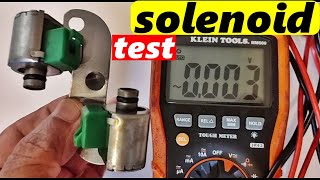
Disconnect the solenoid and measure resistance across its pins with a multimeter. Compare to OEM specs (e.g., Honda shift solenoids are 12-25 ohms). An infinite (OL) or out-of-spec reading confirms a dead solenoid.
Tools: Multimeter, basic hand tools, service manual (Intermediate) - Test Solenoid Mechanical Function
Remove the solenoid and briefly apply 12V power to its terminals. A distinct 'click' confirms the internal valve moves. No click means the solenoid is mechanically seized.
Tools: 12V power source, jumper wires (Advanced) - Monitor Live Data
Use an advanced scanner to view live transmission sensor data. Compare 'Desired' vs 'Actual' pressures. Discrepancies at idle point directly to faulty pressure sensors.
Tools: Advanced OBD-II Scan Tool (Advanced) - Check Governor Pressure (Dodge 48RE)
Connect a pressure gauge to the governor pressure port. Pressure must be near 0 PSI at a stop and increase 1 PSI per 1 MPH. Back-probe the transducer wire; voltage should be 0.60V at 0 PSI.
Tools: Pressure gauge kit, multimeter, back-probe pins (Advanced) - Inspect the Valve Body
If external components test good, drop the transmission pan. Inspect the valve body for sludge, metal shavings, or stuck valves.
Tools: Socket set, drain pan, torque wrench (Professional) - Perform Solenoid Current Ramp Test
Use an oscilloscope and low-amp clamp on the solenoid power wire. The waveform must show a sharp vertical spike. Rounded spikes indicate a sluggish, sticky solenoid.
Tools: Oscilloscope, low-amp current clamp (Professional)
When This Code Triggers (Freeze-Frame Conditions)
- Engine Coolant Temp: 175-210°F (The code sets most often when the transmission reaches full operating temperature.)
- RPM: 1200-2800 RPM (The fault detects during a commanded gear shift under light to moderate acceleration.)
- Vehicle Speed: 25-55 mph (The problem occurs during shifts at city or highway cruising speeds, typically during a 2-3 or 3-4 upshift.)
- Transmission Fluid Temperature: 160-200°F (The TCM runs its most sensitive performance checks when the fluid is warm and viscosity is stable.)
Related Codes
- P0751 — P0751 is the generic OBD-II code for 'Shift Solenoid A Performance/Stuck Off', while P1751 is often the manufacturer-specific equivalent. They point to the same issue: the TCM commanded a shift involving solenoid 'A' but did not see the expected gear ratio change.
- P1753 — This code often appears with P1751 on Dodge trucks with the 48RE transmission. P1751 indicates the TTVA position is out of range, while P1753 indicates a mechanical failure of the same part. Seeing them together confirms the TTVA needs replacement.
- P1757 — On Dodge and Infiniti vehicles, this code appears alongside P1751, indicating a wider problem within the valve body. On an Infiniti G35, P1757 ('Front Brake Solenoid Circuit') is caused by a broken solder joint on the TCM, suggesting the entire assembly is faulty.
- P0700 — P0700 is a generic 'gateway' code meaning the TCM detected a fault and requested the Check Engine Light. It does not specify the fault itself. When you see P0700, it is always accompanied by a specific code like P1751.
Climate & Environmental Factors
- Cold Weather: Low temperatures cause transmission fluid to thicken, increasing viscosity. This slows the response time of solenoids and internal valves, leading to delayed engagement and harsh shifting until the vehicle warms up.
- Road Salt & Humidity: Saltwater acts as an electrolyte, accelerating corrosion on transmission wiring harnesses, electrical connectors, and ground points. This causes intermittent or total loss of signal between the TCM and solenoids.
How to Talk to a Mechanic About This Code
Say this: "I have a P1751 transmission code and I'm experiencing harsh shifting and getting stuck in gear. I'd like to schedule a diagnostic to pinpoint the cause. Please start by checking the fluid, wiring, and grounds before assuming it's a major internal part."
This signals you've done research and directs the shop toward a logical, step-by-step diagnosis rather than jumping to the most expensive conclusion. It shows you're aware that external factors cause this code, protecting you from an immediate upsell to a rebuild.
Avoid saying:
- 'My transmission is acting up, just fix it.'
- 'I got a P1751, how much for a new solenoid?' (This encourages part-swapping without proper diagnosis).
- 'Just give me a ballpark over the phone.' (Reputable shops won't quote major repairs without seeing the car).
Questions to ask before authorizing the repair:
- What specific tests did you perform to confirm this part has failed? (e.g., 'Did you test the solenoid's resistance and wiring?')
- Can you provide a written estimate with a 'best case' and 'worst case' cost?
- Is this repair performed in-house, or do you send the transmission out?
- What is the warranty on this specific repair, and does it cover both parts and labor?
Where to Take It: Dealer vs Independent vs Chain
- Dealer:
Recommended only if the vehicle is under warranty or has a known, complex manufacturer-specific issue that requires programming.
Best for: Vehicles under powertrain warranty., Complex, manufacturer-specific issues like the Nissan radiator/TCM failure., Repairs requiring VIN-specific programming of a new valve body/TCM.
Downsides: Highest labor rates., More likely to replace a whole assembly (like a valve body) rather than repair a smaller component. (Typical cost: +50% vs. baseline) - Independent Shop:
Acceptable, but a Transmission Specialist is better. A general shop is fine for external part swaps, but lacks the deep knowledge for complex internal diagnosis.
Best for: Out-of-warranty vehicles where cost is a major factor., Diagnosing common P1751 causes like bad solenoids, wiring, or fluid issues., Straightforward part replacements like the Dodge TTVA.
Downsides: Quality and expertise vary widely; not all general mechanics are transmission experts. (Typical cost: +0% vs. baseline) - Chain Shop:
AVOID for diagnosis and repair. While suitable for a simple fluid change, they are not the right choice for diagnosing a nuanced performance code like P1751.
Best for: Basic fluid and filter changes.
Downsides: Technician skill varies dramatically., Often lack the specialized tools and experience for in-depth transmission diagnosis., Some chains are known for upselling unnecessary services or full replacements. (Typical cost: -10% vs. baseline)
When to Walk Away From the Repair
If the estimated repair cost exceeds 50% of the car's current market value, sell or trade it in as-is.
- Car worth $4000, fix is $2500: Walk away. The repair cost is over 60% of the car's value. It's not a sound investment.
- Car worth $12000, fix is $1800: Fix it. The repair is only 15% of the vehicle's value and is a worthwhile investment.
- Car worth $3000, fix is $800: Borderline, but likely worth fixing. The cost is around 27% of the value. Get a firm quote before proceeding.
What Scan Tool You Need for This Code
Minimum: A scanner that reads manufacturer-specific transmission codes and views live data, specifically transmission fluid temperature.
A basic $20 code reader only shows a generic P0700 'Transmission Fault' code, not the specific P1751. It lacks the live sensor data needed for proper diagnosis, leading you to guess and waste money on parts.
Budget: XTOOL A30M (~$90) — Reads manufacturer-specific codes for the transmission module and displays live data streams, including transmission fluid temperature, which is crucial for diagnosis.
Mid-range: Foxwell NT510 Elite / XTOOL D7 (~$180) — Offers bidirectional control. This allows you to actively command individual shift solenoids to turn on and off, letting you hear if they 'click' and function mechanically without removing them from the vehicle.
Professional: Autel MaxiCOM MK808 / MK906BT (~$500-1200) — Provides full, dealer-level bidirectional control and access to all manufacturer-specific data PIDs. It performs advanced functions like transmission relearn procedures required after a valve body replacement.
Rent vs buy: For a one-time diagnosis, many auto parts stores scan your codes for free. However, their free tools often fail to read the P1751 code correctly. If you plan to diagnose the issue yourself, buying a budget or midrange scanner is a wise investment.
How to Clear the Code After You Fix It
- Use an OBD-II scan tool to clear the Diagnostic Trouble Codes (DTCs).
- Perform a specific transmission relearn procedure if required by the manufacturer.
- Conduct a complete OBD-II drive cycle to allow the vehicle's readiness monitors to run and confirm the fix.
Drive cycle (~20 minutes): A general drive cycle includes a cold start, 2-3 minutes of idling, followed by mixed city driving and steady-state cruising at highway speeds (10-15 minutes at 55 mph). The goal is to operate the transmission through all gears, up and down.
Readiness monitors affected: Comprehensive Component Monitor (CCM), Transmission
Before emissions retest: drive at least 50 miles to fully set monitors.
Watch out for:
- Disconnecting the battery clears the code but resets all readiness monitors to 'Not Ready', causing an automatic emissions test failure.
- The code returns within a few drive cycles if the underlying mechanical or electrical fault remains.
- Some manufacturers require a specific drive cycle procedure to test transmission components; a generic drive cycle is often insufficient.
Will This Fail Emissions / State Inspection?
Yes — this code typically fails an OBD-II emissions inspection.
- California: An illuminated Check Engine Light is an automatic failure. All readiness monitors must be 'Ready'. After a repair, a full drive cycle is required before re-testing.
- New York: The NYS DMV inspection includes an OBD-II scan. A P1751 code causes an automatic failure. The Check Engine Light must be off and the required readiness monitors must be set.
- Texas: In counties requiring emissions testing, an illuminated Check Engine Light is an automatic fail. After clearing the code, you must complete a drive cycle, as Texas allows for only one 'Not Ready' monitor on model year 2001+ vehicles.
Most Commonly Affected Vehicles
- Honda Odyssey, Accord (1998-2007) — These models are notorious for transmission issues. P1751 often points to a mechanical fault in the hydraulic system related to clutch pressure control solenoids. Diagnosis involves checking resistance on solenoid pairs; one pair should be 3-10 ohms and the other 12-25 ohms.
- Dodge Ram 2500/3500 with 48RE transmission (2003-2007) — P1751 is defined as 'Transmission Throttle Valve Position Minimum Range Performance' and is almost always caused by a faulty Transmission Throttle Valve Actuator (TTVA) mounted on the driver's side of the case. It often appears with code P1753.
- Nissan / Infiniti Various models with RE5R05A transmission (G35, Frontier, Titan, etc.) (2002-2010) — This code is frequently caused by a failing solenoid pack or a bad TCM, which is integrated into the valve body. A common cause of TCM failure is internal coolant leakage from the radiator into the transmission fluid.
- Ford Ranger, Explorer (1998-2011) — P1751 points to a 'Shift Solenoid A Performance' issue. It is caused by a faulty solenoid or a damaged shifter cable bushing that prevents the transmission from fully engaging a gear.
- Mitsubishi Lancer, Eclipse, Montero (2001-2012) — P1751 relates to a communication issue or a problem with the transmission control relay, defined as 'A/T Control Relay Malfunction'. Temporarily resetting the code by pulling the transmission fuse is a common but short-lived workaround.
- Chevrolet / GM Corvette, Yukon XL with 6L80/6L90 (2006-2013) — P1751 points to a stuck 'Shift Valve 1' (also called clutch select valve 2) in the lower control valve body, which prevents control of the R1 and 4-5-6 clutches.
- BMW 3 Series (E46, E90), 5 Series (E39, E60) (2000-2010) — P1751 typically indicates 'Secondary Pressure Solenoid Open Circuit', pointing to an electrical fault in the solenoid's circuit, a bad fuse, or a faulty TCM.
- Hyundai Veracruz, Santa Fe (2007-2012) — P1751 has a unique definition: 'FR Wheel Speed Sensor' malfunction. This indicates a communication problem between the ABS module and the TCM via the CAN bus, not a solenoid issue.
Manufacturer-Specific Notes
- Honda / Acura: The code points to a mechanical problem with the hydraulic control system related to clutch pressure control solenoids 'A' and 'B'. A common first step is to remove and clean the external solenoid screens, which clog with clutch material.
- Dodge / Chrysler: P1751 is defined as 'Transmission Throttle Valve Position Minimum Range Performance' and is almost always linked to a failing Transmission Throttle Valve Actuator (TTVA) on the side of the 48RE transmission.
- Nissan / Infiniti: On vehicles with the RE5R05A transmission, P1751 condemns the entire valve body/TCM assembly. A common cause is a breach in the radiator, allowing coolant to mix with transmission fluid and destroying the TCM's electronics.
- Mitsubishi: The definition is often 'A/T Control Relay Malfunction,' pointing to a power or communication breakdown between the engine and transmission computers. This is often caused by a faulty relay in the engine bay fuse box.
- Ford / Lincoln: The definition is typically 'Shift Solenoid A Performance.' Before condemning internal parts, check for recalls related to the shifter cable bushing. A degraded bushing causes a mismatch between the gear selected and the actual gear engaged.
Real Owner Stories
2007 Honda Odyssey with 213K miles - The Easy Fix
Bought a high-mileage Odyssey for $1,600. The engine was strong, but the transmission lurched hard when shifting into 3rd and 4th gear, with P1751 stored.
What they tried:
- The owner was initially advised by a mechanic that replacing solenoids rarely fixes the issue and to just live with it.
- Forum members suggested the issue was common and likely due to dirty fluid or clogged solenoid screens.
Outcome: The owner removed the external clutch pressure control solenoids and cleaned their small filter screens with brake cleaner and compressed air. This free DIY job restored normal shifting by removing accumulated clutch debris.
Lesson: On many Hondas/Acuras from this era, P1751 is triggered by clogged solenoid screens, not a failed solenoid. Always try cleaning the screens before spending hundreds on replacement parts.
2005 Dodge Ram 2500 - A Clear-Cut Diagnosis
Truck threw codes P1751 and P1753. It shifted very late (1-2 shift at 20-25 mph) and had no power.
What they tried:
- The owner replaced the Transmission Throttle Valve Actuator (TTVA) and the governor pressure switch, but the problem persisted.
- A transmission shop tested the TTVA and wiring, finding moisture in a connector but no definitive fault. They suspected a bad computer (ECM).
Outcome: The combination of P1751 and P1753 on a 48RE transmission is a textbook failure of the TTVA itself. The part costs around $180 from a dealer and is located on the driver's side of the transmission, making it an easy swap with two bolts.
Lesson: When P1751 and P1753 appear together on a Dodge Ram with a 48RE, the TTVA is the culprit over 95% of the time. Don't get sidetracked by other components until this known failure point is replaced.
2006 Nissan Titan - The Misdiagnosis Trap
Truck suddenly wouldn't shift properly and threw multiple solenoid codes, including P1754. A shop quoted $3,800 for a transmission rebuild, suspecting water contamination.
What they tried:
- The owner had been diligent with fluid changes and saw no evidence of water.
- The actual root cause on many 2005-2010 Nissan/Infiniti trucks is a failure of the internal radiator cooler, which allows engine coolant to mix with the transmission fluid.
Outcome: The coolant contaminates the fluid (creating a 'strawberry milkshake' appearance) and destroys the Transmission Control Module (TCM), located inside the transmission on the valve body. Replacing only the valve body/TCM without replacing the faulty radiator guarantees the new TCM will be destroyed.
Lesson: On a Nissan/Infiniti with the RE5R05A transmission, if you have solenoid codes, your first check must be for coolant in the transmission fluid. If present, replace the radiator along with the valve body/TCM assembly.
How to Prevent This Code From Triggering
- Change transmission fluid and filter regularly (Every 30,000-60,000 miles) — This is the single most effective preventative measure. It removes abrasive metal particles and clutch material that clogs solenoid screens and wears out internal components.
- Use only the manufacturer-specified fluid (OEM) (Every fluid change) — Universal or 'multi-vehicle' fluids lack the specific friction modifiers and additives your transmission requires, leading to premature wear, overheating, and solenoid damage.
- Protect electrical connectors with dielectric grease (During any under-vehicle service or once every 2-3 years) — Applying a non-conductive dielectric grease to the outside of connectors creates a barrier against moisture, road salt, and oxygen, preventing the corrosion that causes intermittent electrical faults.
- Install an external transmission cooler (Once, especially for towing or known-problem vehicles) — Heat is the #1 killer of automatic transmissions. An auxiliary cooler keeps fluid temperatures stable, extending fluid life and protecting electronics. On Nissan/Infiniti models, it bypasses the failure-prone radiator cooler.
- Check and clean transmission ground straps (During routine maintenance) — A clean, tight ground connection is critical for the TCM and solenoids. A corroded ground causes erratic voltage, leading to phantom codes and poor performance.
Frequently Asked Questions
Can I fix P1751 myself?
For a skilled DIYer, topping off fluid, replacing external solenoids, or fixing ground straps are manageable tasks. However, accessing the valve body or internal solenoids requires dropping the transmission pan. Stop DIY and go to a transmission specialist if the repair requires internal transmission work or TCM programming.
Will changing the transmission fluid fix a P1751 code?
A fluid change only fixes P1751 if the root cause is dirty or low fluid restricting hydraulic pressure. It clears minor debris and restores proper flow. However, fresh fluid cannot fix a dead solenoid, broken wiring, or a warped valve body.
What is the most common misdiagnosis for P1751?
The most common mistake is replacing a solenoid without testing electrical grounds or checking for clogged filter screens. Technicians frequently overlook simple wiring faults and jump straight to expensive part swaps. Always verify voltage drops and resistance before buying replacement parts.
Can a bad ground wire really cause transmission problems?
Yes, the transmission control module (TCM) and solenoids require a stable voltage and clean ground path to function. A corroded ground strap causes erratic voltage drops, forcing the TCM to misinterpret data. This triggers phantom performance codes like P1751 and causes harsh shifting.
Is a shift solenoid expensive to replace?
Individual shift solenoids cost between $20 and $120, while complete solenoid packs range from $65 to $300. The primary expense is labor, which runs $200 to $500 depending on whether the solenoid is externally accessible or hidden inside the oil pan. Expect a total repair bill between $250 and $600 for a single solenoid.
What's the difference between a shift solenoid and a pressure control solenoid?
A shift solenoid is an on/off valve that directs fluid to apply a clutch and change gears. A pressure control solenoid (linear solenoid) modulates hydraulic pressure to ensure smooth clutch engagement. Both cause severe shifting problems and trigger performance codes when they fail.
How is P1751 different from a generic code like P0751?
P0751 is a generic OBD-II code for 'Shift Solenoid A Performance' used across all vehicle brands. P1751 is a manufacturer-specific code that carmakers use to provide more granular diagnostic information. For example, Dodge uses P1751 specifically for the Throttle Valve Actuator, which a generic code cannot specify.
Key Takeaways
- P1751 indicates a shift solenoid performance failure, most often caused by dirty transmission fluid or a solenoid resistance reading outside the typical 12-25 ohm range.
- Stop driving immediately; operating a vehicle in 'limp mode' for more than 50 miles overheats the transmission and turns a $200 solenoid fix into a $3,000 rebuild.
- Always scan for companion codes before buying parts; on Dodge 48RE transmissions, seeing P1751 alongside P1753 guarantees a failed Transmission Throttle Valve Actuator (TTVA).
- Check your transmission ground strap voltage drop before replacing internal parts; a reading above 0.50 volts causes erratic TCM behavior that mimics a failed solenoid.
Helpful Videos

The information in this article is provided for general reference and educational purposes only. Vehicle specifications, procedures, and part compatibility can vary by production date, trim level, and region. Always consult your vehicle's factory service manual and verify part numbers before purchasing or performing repairs. Safety-critical components such as airbags, seat belts, and braking systems should be installed by a qualified professional.
- 🎬 Helpful Videos
- What Does P1751 Mean?
- Can I Drive With P1751?
- Common Causes
- Symptoms
- Diagnostic Flowchart
- Common Fixes & Costs
- Used vs. New Parts: Buying Guide
- What Happens If You Wait — Timeline
- Cost of Not Fixing It
- Diagnosis Steps
- When This Code Triggers (Freeze-Frame Conditions)
- Related Codes
- Climate & Environmental Factors
- How to Talk to a Mechanic About This Code
- Where to Take It: Dealer vs Independent vs Chain
- When to Walk Away From the Repair
- What Scan Tool You Need for This Code
- How to Clear the Code After You Fix It
- Will This Fail Emissions / State Inspection?
- Most Commonly Affected Vehicles
- Manufacturer-Specific Notes
- Real Owner Stories
- 2007 Honda Odyssey with 213K miles - The Easy Fix
- 2005 Dodge Ram 2500 - A Clear-Cut Diagnosis
- 2006 Nissan Titan - The Misdiagnosis Trap
- How to Prevent This Code From Triggering
- Frequently Asked Questions
- Can I fix P1751 myself?
- Will changing the transmission fluid fix a P1751 code?
- What is the most common misdiagnosis for P1751?
- Can a bad ground wire really cause transmission problems?
- Is a shift solenoid expensive to replace?
- What's the difference between a shift solenoid and a pressure control solenoid?
- How is P1751 different from a generic code like P0751?
- Key Takeaways
- 🎟️ Get 5% Off