

Ultimate P1718 Guide: Beyond the Basics for a First-Time Fix
What P1718 means, why it triggers, and how to fix it for good
- Verify your vehicle's specific P1718 definition, as it means a CAN communication failure on Subarus but a Transmission Fluid Temperature sensor fault on Fords.
- Check your VIN for Subaru recall WRQ-23, as a faulty inhibitor switch causes P1718 on 2021-2023 models and qualifies for a free dealer replacement.
- Scan for companion codes like P0700 or U0101 before replacing parts, as these confirm a network communication loss rather than a mechanical transmission failure.
- Stop driving immediately if the vehicle enters limp mode (stuck in 2nd or 3rd gear) to prevent a $3,000+ internal transmission rebuild.
- Test the battery voltage and perform a 60-second hard reset before buying a $1,000 Transmission Control Module, as low voltage frequently triggers false communication codes.
What Does P1718 Mean?

P1718 is a manufacturer-specific code with varying definitions. For Subaru, it indicates a CAN bus communication problem between the Transmission Control Module (TCM) and other computers. For Ford and Mazda, it points to a Transmission Fluid Temperature (TFT) sensor issue. For Chevrolet, it means 'Incorrect Gear Ratio in Neutral', and for specific Hyundai models, it indicates a 'Steering Wheel Angle Sensor' fault.
Technical definition: The official definition of P1718 varies by manufacturer. Subaru defines it as 'Automatic Transmission CAN Communication Circuit'. Ford and Mazda define it as 'Transmission Fluid Temperature Sensor Performance'. Chrysler/Dodge uses 'EEPROM Integrity Failure'. Chevrolet defines it as 'Incorrect Gear Ratio in Neutral'. Hyundai (2006-2010 Tucson/Santa Fe) defines it as 'Steering Wheel Angle Sensor 2-Input Signal'.
Can I Drive With P1718?
Yes, But With Caution. You can drive cautiously for a limited distance to a repair shop. The transmission often shifts harshly, unpredictably, or enters 'limp mode,' 🎬 Learn about the risks and fixes for a flashing AT Oil Temp light. limiting speed to 30-45 mph. Ignoring severe symptoms causes accelerated wear on internal transmission components like clutches and bands, turning a sub-$500 repair into a $3,000+ transmission rebuild.
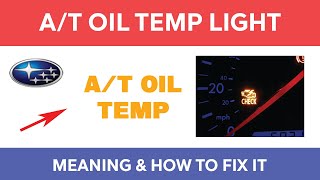
🎬 See why the AT Oil Temp light flashes and how to fix it.Common Causes

- Defective Inhibitor Switch (Neutral Safety Switch) (Very Common) — On many Subarus, a faulty inhibitor switch disrupts the CAN signal, triggering P1718. Subaru issued recall WRQ-23 for this part on 2021-2023 models due to water intrusion causing internal corrosion.
- Faulty Turbine Speed Sensor (Very Common) — For Subaru models with the 5EAT transmission (2005-2014), a failing turbine speed sensor provides implausible data that the TCM interprets as a communication fault.
- Faulty Wiring, Connectors, or Grounds (Common) — The CAN bus network relies on intact wiring and solid grounds. A corroded pin, chafed wire, or loose ground strap creates a floating voltage potential, disrupting communication between modules.
- Low Battery Voltage or Failing Alternator (Common) — Control modules require a stable voltage (above 12V) to communicate. A weak battery or a failing alternator providing erratic voltage causes widespread communication errors, including P1718.
- Aftermarket Electrical Accessories (Uncommon) — Poorly installed aftermarket parts, such as HID/LED headlights or remote starters, create electromagnetic interference (EMI) that disrupts the CAN bus network.
- Failing Transmission Control Module (TCM) (Uncommon) — The TCM is the transmission's brain. Internal component failure stops communication, triggering P1718. Suspect this only after ruling out wiring, sensors, and voltage issues.
Symptoms

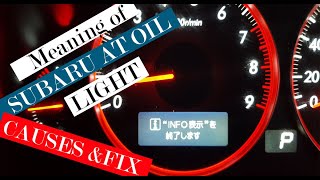
- Check Engine Light and Flashing AT TEMP Light — The Check Engine Light illuminates immediately. On Subarus, the 'AT TEMP' light flashes to specifically indicate a transmission-related electronic fault. 🎬 Watch: What your flashing AT TEMP light is trying to tell you.
- Vehicle Stuck in Limp Mode — The computer forces the transmission into 'limp mode' to protect it, locking it in a single gear (usually 2nd or 3rd) and limiting engine RPM.
- Harsh, Erratic, or Delayed Shifting — Without proper communication, the engine and transmission cannot coordinate shifts smoothly, resulting in heavy clunks or long delays between gears.
- No Start or Intermittent No Crank — A faulty inhibitor switch prevents the car from recognizing it is in Park or Neutral, blocking the starter from engaging.
- Abnormal Instrument Cluster Behavior — Because the instrument cluster is on the CAN network, a communication fault causes gauges to behave erratically, or the gear position indicator (P, R, N, D) disappears entirely.
- Cruise Control/Traction Control Disabled — These systems rely on TCM data. When the TCM goes offline, these features disable automatically as a safety precaution.
Diagnostic Flowchart
Tap your situation to follow the diagnostic path that matches what you're seeing on this code.
Common Fixes & Costs
- Replacing the Inhibitor Switch (Neutral Safety Switch) — Parts: $70-$150, Labor: $100-$250, ~1.0 hr book time (Intermediate)
- Replacing the Turbine Speed Sensor (Subaru 5EAT) — Parts: $80-$220, Labor: $150-$300, ~2.0 hr book time (Intermediate)
- Replacing the Transmission Fluid Temperature Sensor (Ford) — Parts: $50-$150, Labor: $200-$400, ~2.5 hr book time (Intermediate)
- Repairing Damaged Wiring or Connectors — Parts: $10-$50, Labor: $150-$400, ~1.5 hr book time (Intermediate)
- Replacing the Transmission Control Module (TCM) — Parts: $500-$1500+, Labor: $150-$350, ~2.0 hr book time (Professional)
DIY vs Professional
- Replacing the Inhibitor Switch — Beginner: no
Tools: Wrench/socket set, pliers, trim removal tools, multimeter. - Replacing the Turbine/TFT Sensor — Beginner: no
Tools: Wrench/socket set, drain pan, torque wrench, new transmission fluid, fluid pump. - Repairing Damaged Wiring or Connectors — Beginner: no
Tools: Digital Multimeter, wire strippers, crimpers, soldering iron, heat shrink. - Replacing the Transmission Control Module (TCM) — Beginner: no
Tools: Socket set, professional scan tool capable of module programming.
Used vs. New Parts: Buying Guide
When a used part is worth it: Buying used electronic parts like an inhibitor switch or speed sensor is risky. It makes sense only if the budget is extremely tight and you accept the risk of a short lifespan. Given the labor involved, a new part is more cost-effective.
Donor-vehicle mileage cap: roughly under 50000 miles for the part to have meaningful remaining life.
Donor quality checklist:
- Verify the donor vehicle was not scrapped due to transmission or electrical issues.
- Match the OEM part number exactly; superseded numbers have important internal revisions.
- Never buy a used part that is under an active manufacturer recall.
Decision logic:
- If Part is under recall (e.g., Subaru inhibitor switch) → Only accept a new OEM part from a dealer, which is free.
- If Labor for replacement is high (e.g., internal transmission sensor) → Buy a new OEM or high-quality aftermarket part to avoid paying for labor twice.
- If Vehicle is very old and has low value → A used part from a reputable salvage yard with a short-term warranty is a practical choice.
Warranty tradeoff: Used parts offer a 30-90 day warranty for the part only. New aftermarket parts come with a 1-year to limited lifetime warranty. New OEM parts carry a 1-year/12,000-mile warranty.
Worst-case if a used part fails: $300-600 if a used sensor fails after the warranty period, requiring a second part and repeat labor costs.
What Happens If You Wait — Timeline
- 0-1 month: Intermittent symptoms. AT TEMP light flashes but goes out. Occasional hard shift or brief hesitation. No-start occurs once and resolves after shifting gears. (MPG impact: 0-2%% · Added cost: $0)
- 1-3 months: Symptoms become frequent. Check Engine Light stays on. Shifting is consistently harsh. Vehicle enters limp mode (stuck in 2nd or 3rd gear) but resets after restarting. (MPG impact: 5-15%% · Added cost: $50-$150 in wasted fuel due to inefficient operation.)
- 3-6 months: Vehicle is consistently in limp mode. High hydraulic line pressure causes accelerated wear on internal clutch packs and bands. The electrical problem causes mechanical wear. (MPG impact: 10-25%% · Added cost: $800 - $1,800 (Damage extends to the valve body or solenoids).)
- 6+ months: Catastrophic internal damage. Slipping clutches generate excessive heat and metal debris, contaminating the transmission. The vehicle stops moving altogether. (MPG impact: 25%+% · Added cost: $3,000 - $6,000+ (A complete transmission rebuild or replacement is required).)
Cost of Not Fixing It
- 0-1 month: Erratic and harsh shifting causes driver annoyance and potential safety issues. Possible intermittent no-start conditions if related to the inhibitor switch. (Added cost: Negligible)
- 1-6 months: Continued harsh shifting and high hydraulic line pressure (a default state in limp mode) causes accelerated wear on transmission clutches and bands. (Added cost: $500 - $1,500 for valve body or solenoid repairs.)
- 6+ months: Catastrophic internal transmission failure. Accelerated wear leads to widespread internal damage, requiring a complete transmission rebuild or replacement. (Added cost: $3,000 - $6,000+)
Diagnosis Steps
- Check for Other Codes
P1718 rarely appears alone. P0700 is a generic transmission fault code. U-codes (like U0101) indicate specific communication loss with the TCM. The presence of these codes confirms a network issue rather than a mechanical failure.
Tools: OBD-II Scanner (Beginner) - Inspect Battery and Perform Hard Reset
Ensure battery terminals are clean and provide over 12.4V at rest. To clear a potential 'logic lock', disconnect both battery terminals and touch the cable ends together for 60 seconds to drain residual power. Reconnect and check if the code returns.
Tools: Wrench set, Digital Multimeter (Beginner) - Test Inhibitor Switch Continuity (Subaru)
Check your VIN for recalls. Test the switch by checking continuity between specific pins for each gear position. In Park (P), there must be continuity (less than 2 Ω) between pins 3 and 8, and pins 1 and 9.
Tools: Digital Multimeter, basic hand tools (Intermediate) - Test Turbine Speed Sensor Resistance (Subaru 5EAT)
For 2005-2014 Subarus, disconnect the Turbine Speed Sensor and measure internal resistance. A healthy sensor reads between 1,000 and 2,000 ohms. Readings over 3,500 ohms or an open circuit confirm a failed sensor.
Tools: Digital Multimeter, vehicle-specific wiring diagram (Advanced) - Monitor TFT Sensor Live Data (Ford/Mazda)
Use a scan tool to monitor the Transmission Fluid Temperature (TFT) PID. Start the engine cold. The temperature must increase smoothly. Erratic jumps (e.g., 70°F to 250°F) or a stuck value (-40°F) indicate a faulty sensor or circuit.
Tools: OBD-II Scanner with live data capability (Advanced) - Visually Inspect Wiring Harnesses
Inspect wiring going to the transmission and TCM. Look for chafing, melting near exhaust components, or corrosion on connectors. Pay close attention to the twisted pair of CAN bus wires.
Tools: Flashlight, inspection mirror (Intermediate) - Test CAN Bus Network Resistance
Turn the ignition OFF and disconnect the battery. At the OBD-II port, measure resistance between Pin 6 (CAN High) and Pin 14 (CAN Low). A healthy network reads ~60 ohms. A reading of 120 ohms means a terminating resistor is offline. 0 ohms indicates a short.
Tools: Digital Multimeter (Advanced) - Pro Tip: Perform CAN Bus Voltage & Waveform Check
With ignition ON, check voltages at the OBD-II port. Pin 6 to ground should be ~2.6-3.5V; Pin 14 to ground should be ~1.5-2.4V. Using an oscilloscope, verify two clean, square-wave signals that perfectly mirror each other.
Tools: Digital Multimeter, Oscilloscope (Professional) - Pro Tip: Isolate the Faulty Module or Wire
If the CAN waveform is corrupted, disconnect one module branch at a time at a junction block. When the waveform becomes clean and stable on the oscilloscope, you have isolated the faulty module or wiring branch.
Tools: Oscilloscope, vehicle-specific wiring diagram (Professional)
When This Code Triggers (Freeze-Frame Conditions)
- System Voltage: 12.0-14.8V (Code triggers if voltage drops below a stable threshold, indicating a potential electrical system issue.)
- Vehicle Speed: 25-60 mph (Often occurs during city or highway driving when the transmission is actively shifting.)
- RPM: 1200-2800 (During light acceleration, cruising, or when a gear shift is commanded.)
- Engine Coolant Temp: 175-210°F (Vehicle is fully warmed up after several minutes of driving.)
Related Codes
- P0700 — P0700 is a generic code from the Engine Control Module (ECM) stating a fault is stored in the TCM. It almost always appears with P1718 on communication faults because the ECM cannot talk to the TCM.
- U-codes (e.g., U0101, U0121) — U0101 specifically means 'Lost Communication with TCM'. Seeing U0101 and P1718 together strongly confirms a network fault. Multiple U-codes point to a widespread CAN bus problem, not just a TCM issue.
- P0851, P0852 — These relate directly to the Park/Neutral (Inhibitor) Switch. P0851 indicates a low input. Seeing this alongside P1718 on a Subaru strongly suggests the inhibitor switch is the root cause.
- P0711, P0712, P0713 — These codes are for the Transmission Fluid Temperature (TFT) sensor. On a Ford where P1718 relates to the TFT sensor, these codes specify if the fault is erratic performance, a circuit low (short), or circuit high (open).
Climate & Environmental Factors
- Humidity and Water Intrusion: A primary cause for P1718 on 2021-2023 Subarus. Recall WRQ-23 addresses an insufficient weld on the inhibitor switch that allows water to enter, causing corrosion and failure.
- Extreme Cold: Temperatures below -15°F make wiring insulation brittle and cause intermittent opens as materials contract. Cold snaps frequently trigger failures in aging turbine speed sensors.
- Road Salt and Corrosion: Salt spray compromises connectors, ground straps, and wiring harnesses exposed underneath the vehicle, leading to the electrical resistance that triggers P1718.
How to Talk to a Mechanic About This Code
Say this: "I have a P1718 code on my [Year, Make, Model] and the AT Temp light is flashing. I'd like to schedule a diagnostic for a transmission communication circuit fault. Please start by checking for recalls, and then checking the CAN bus resistance, wiring, and related sensors like the inhibitor switch before quoting a TCM replacement."
This signals you understand the code's meaning. It directs the technician to follow a logical, cost-effective diagnostic path (wiring, sensors) instead of immediately suggesting the most expensive repair (TCM replacement).
Avoid saying:
- 'My check engine light is on, can you look at it?'
- 'My transmission is acting weird.'
- 'Just fix whatever is wrong, I need it back today.'
Questions to ask before authorizing the repair:
- Did you check for any open recalls on my VIN? (Especially Subaru WRQ-23)
- What was the resistance reading between CAN high and CAN low at the OBD-II port?
- If you're recommending a part, how did you test it and rule out a wiring or connector issue?
- Is programming required for this new part, and is that included in the quote?
- What is the warranty on the parts and the labor for this specific repair?
Where to Take It: Dealer vs Independent vs Chain
- Dealer:
Best choice if your vehicle is under the Subaru inhibitor switch recall (WRQ-23). Also a strong choice for complex electrical issues if you are willing to pay a premium for specialized expertise.
Best for: Vehicles under warranty., Confirmed recall-related issues (e.g., the Subaru inhibitor switch recall is a free repair at a dealer)., Complex, model-specific electronic issues requiring proprietary diagnostic tools.
Downsides: Highest labor rates., Quicker to replace modules rather than diagnose and repair wiring. (Typical cost: +50% vs. baseline) - Independent Shop:
Excellent fit for most P1718 scenarios. Prioritize shops that specialize in your car's brand or have excellent reviews for electrical and transmission diagnostics.
Best for: Out-of-warranty vehicles where cost is a major factor., Diagnosing common, well-documented P1718 causes like a Subaru turbine speed sensor or Ford TFT sensor.
Downsides: Shop quality and diagnostic skill vary widely., May lack access to the very latest manufacturer-specific software. (Typical cost: +0% vs. baseline) - Chain Shop:
AVOID for initial diagnosis. The complexity and brand-specific nature of P1718 are a poor match for the chain shop model.
Best for: Simple, clear-cut repairs where the diagnosis is already 100% certain.
Downsides: Not equipped or trained for complex network/communication diagnostics., High pressure to upsell parts; risk of misdiagnosis is high for a nuanced code like P1718. (Typical cost: -10% vs. baseline)
When to Walk Away From the Repair
If the estimated repair cost exceeds 50% of the car's private-party value, pause and carefully consider if the investment is worthwhile.
- Car worth $3500, fix is $1800: Walk away. The repair cost is over 50% of the car's value. It is not a sound financial decision.
- Car worth $15000, fix is $450: Fix it. This is a low-cost repair relative to the vehicle's value and restores its reliability.
- Car worth $5000, fix is $2500: Borderline. This is right at the 50% threshold. Get a second opinion. If the rest of the car is in excellent condition, it might be worth it.
What Scan Tool You Need for This Code

Minimum: A scanner that reads manufacturer-specific transmission codes (not just generic P0700) and displays live data.
A $20 reader only shows a generic P0700 'transmission fault'. You need to see the specific P1718 code from the TCM and view live data (like sensor readings or module voltage) to find the root cause.
Budget: BlueDriver Pro or Foxwell NT301 (~$99) — Reads specific engine and transmission codes, shows freeze-frame data, and graphs live sensor data. This is enough to see if a Ford's TFT sensor is erratic or check system voltage.
Mid-range: Autel AL619 or Innova 5610 (~$150) — Adds ABS/SRS diagnostics and enhanced manufacturer-specific data. Tools like the Innova 5610 offer basic bidirectional tests, allowing you to command a component and see if it responds.
Professional: Autel MaxiCOM MK808S or Launch CRP919 (~$450-650) — Offers full-system, bidirectional diagnostics. You can perform advanced functions like TCM resets or adaptations after a repair. These tools provide dealer-level insight into the communication network.
How to Clear the Code After You Fix It
- Reconnect battery if it was disconnected for the repair.
- Use a quality OBD-II scan tool to erase the P1718 and any related codes (like P0700).
- Perform a complete drive cycle to allow the vehicle's readiness monitors to run.
Drive cycle (~20 minutes): Cold start, idle for 2+ minutes. Drive for 15+ minutes at a steady highway speed (over 50 MPH). Stop and idle for 30+ seconds. Repeat highway driving and idling 1-2 more times.
Readiness monitors affected: Comprehensive Component Monitor, Transmission Control System
Before emissions retest: drive at least 50 miles to fully set monitors.
Watch out for:
- Disconnecting the battery clears the code from the dash but resets all readiness monitors to 'Not Ready', causing an immediate emissions test failure.
- The code returns immediately if the underlying electrical or mechanical fault is not properly repaired.
Will This Fail Emissions / State Inspection?
Yes — this code typically fails an OBD-II emissions inspection.
- California: An illuminated Check Engine Light is an automatic failure. After repairs, the vehicle must be driven through a complete drive cycle to set all required readiness monitors to 'Ready'.
- New York: An active P1718 code causes an automatic failure. For 2001+ models, only one non-continuous monitor is allowed to be 'Not Ready' after repairs.
- Texas: In counties requiring emissions testing, an illuminated Check Engine Light is an automatic failure. For 2001+ models, only one monitor is permitted to be 'Not Ready'.
Most Commonly Affected Vehicles
- Subaru Outback / Legacy (2021-2023) — Subject to recall WRQ-23 (NHTSA 23V755000) for a faulty inhibitor switch allowing water intrusion, causing a no-start or loss of the gear indicator.
- Subaru Outback / Legacy (2005-2014) — For models with the 5EAT transmission, P1718 is very commonly caused by a failed Turbine Speed Sensor.
- Subaru Forester (2014-2018, 2022) — Often related to wiring or inhibitor switch issues. The 2022 model year is included in the WRQ-23 inhibitor switch recall.
- Subaru Crosstrek (2021) — Included in the WRQ-23 inhibitor switch recall due to potential water intrusion.
- Subaru Impreza (2007-2012) — Often appears with P0700. Frequently linked to the installation of aftermarket HID or LED lighting causing CAN bus interference.
- Ford F-150, Explorer, Focus (2003-2018) — P1718 points to a Transmission Fluid Temperature (TFT) sensor performance issue, not a communication error.
- Chevrolet Traverse, Equinox, Malibu (2008-2017) — P1718 is defined as 'Incorrect gear ratio in neutral', pointing to an internal transmission or TCM logic problem rather than a network issue.
- Hyundai Tucson, Santa Fe (2006-2010) — Refers to 'Steering Wheel Angle Sensor 2-Input Signal'. The 4WD control unit loses the signal from the steering sensor.
Manufacturer-Specific Notes

- Subaru: P1718 means 'AT CAN Communication Circuit' failure. A safety recall (NHTSA: 23V-755, Subaru: WRQ-23) was issued for the inhibitor switch (part #31918AA120) on 2021-2023 models due to water intrusion.
- Ford / Mazda: P1718 means 'Transmission Fluid Temperature Sensor Performance,' indicating the fluid temperature sensor provides erratic readings, completely unrelated to communication.
- Chevrolet: P1718 is defined as 'Incorrect gear ratio in neutral', suggesting the TCM detected an unexpected gear engagement while in neutral, pointing to an internal hydraulic fault.
- Hyundai: On 2006-2010 Tucson and Santa Fe models, P1718 indicates a 'Steering Wheel Angle Sensor 2-Input Signal' fault, requiring a model-specific service manual for accurate diagnosis.
- Chrysler / Dodge / Jeep: P1718 indicates an 'EEPROM Integrity Failure,' which is an internal memory error within a control module requiring replacement or reprogramming.
Real Owner Stories
2011 Subaru Outback 2.5i (5EAT) with ~110k miles
Check Engine Light and flashing AT TEMP light appeared after a rainy drive. The car hesitated on shifts and eventually got stuck in 2nd gear (limp mode).
What they tried:
- Read codes, which showed only P1718.
- Based on forum research for the 5EAT transmission, the owner suspected the Turbine Speed Sensor.
Outcome: The owner tested the sensor's resistance and confirmed it was faulty. Replacing the Turbine Speed Sensor resolved the shifting issues and cleared the codes.
Lesson: For 2005-2014 Subarus with the 5EAT transmission, P1718 is frequently caused by a failing Turbine Speed Sensor, not a more expensive TCM failure.
2005 Subaru Legacy GT (5EAT)
Car stalled when shifting from Park to Drive. A mobile mechanic disconnected the battery to reset the system, triggering codes P0700 and P1718.
What they tried:
- The mechanic advised replacing the Transmission Control Module (TCM).
- Owner discovered online that aftermarket LED brake lights cause CAN bus interference.
Outcome: The owner removed their aftermarket LED bulbs. The electrical interference from these non-compliant bulbs disrupted CAN bus communication, triggering P1718.
Lesson: Before replacing an expensive module like the TCM, investigate simpler causes. Poorly designed aftermarket electronics introduce electrical noise onto the CAN bus and cause communication faults.
2022 Subaru Forester with no-start condition
Vehicle would not crank or start. All other electronics worked. Owner suspected the battery or starter.
What they tried:
- After checking the battery and starter, the owner suspected the inhibitor switch.
- The owner attempted to remove and test the switch themselves but had difficulty.
Outcome: This vehicle falls under Subaru's recall WRQ-23 for a faulty inhibitor switch. Water intrusion causes corrosion, leading to a no-start condition and P1718. The fix is a free replacement at a dealership.
Lesson: Always check for recalls. For 2021-2023 Subaru models, a no-start condition accompanied by P1718 is very likely due to the recalled inhibitor switch, and the repair is free at a dealer.
How to Prevent This Code From Triggering
- Clean and inspect battery terminals and main ground straps (Every oil change or annually) — Corrosion creates unwanted resistance, leading to unstable voltage. A stable 12.6V+ is critical for CAN bus communication.
- Apply dielectric grease to critical electrical connectors (Anytime a connector is disconnected for service) — Dielectric grease seals out moisture, preventing pin corrosion that causes intermittent communication faults like P1718.
- Change transmission fluid at manufacturer-recommended intervals (Every 30,000 to 60,000 miles) — Clean fluid prevents contamination of internal sensors. Dirty fluid causes sensors like the Turbine Speed Sensor or TFT sensor to fail.
- Avoid high-pressure washing directly on transmission components (During every car wash) — High-pressure water forces past weather seals on connectors like the inhibitor switch, introducing moisture that leads to corrosion and failure.
Frequently Asked Questions
What is the most common cause of a P1718 code on a Subaru?
It depends on the model year. For 2005-2014 models with the 5EAT transmission, a faulty turbine speed sensor is extremely common. For newer models (2021-2023), a defective inhibitor switch is the most likely cause and is subject to recall WRQ-23.
Can I fix a P1718 code myself?
Simple steps like checking the battery and performing a hard reset are DIY-friendly. Replacing an inhibitor switch or speed sensor is possible for an intermediate DIYer but carries risks like improper adjustment or creating fluid leaks. Stop DIY and tow to a shop if you need to diagnose the CAN bus network with an oscilloscope.
How much does it cost to fix a P1718 code?
The cost depends entirely on the cause. An inhibitor switch replacement on a Subaru typically costs $170-$400, while replacing a Ford TFT sensor runs $250-$550. The most expensive repair is a TCM replacement, which exceeds $1,000-$1,500 after parts, labor, and programming.
Will my car fail an emissions test with a P1718 code?
Yes. Any active Check Engine Light, including one caused by P1718, results in an automatic failure of an emissions inspection in most jurisdictions.
Why is my AT TEMP light flashing?
A flashing AT TEMP light on a Subaru specifically indicates an electronic fault within the automatic transmission system. It is the transmission's equivalent of the Check Engine Light and almost always illuminates when code P1718 is stored.
What are the most common misdiagnosis pitfalls for P1718?
The biggest pitfall is assuming the code has the same meaning across all brands. Another common mistake is immediately replacing the expensive Transmission Control Module (TCM) when the root cause is a corroded wire, bad ground, or a faulty $100 sensor. Always diagnose systematically using a multimeter.
Can a bad battery or alternator cause a P1718 code?
Yes. The CAN bus network is highly sensitive to voltage drops. A weak battery or a failing alternator providing unstable voltage causes modules to malfunction and stop communicating, triggering P1718 alongside U-prefix communication codes.
Key Takeaways
- Verify your vehicle's specific P1718 definition, as it means a CAN communication failure on Subarus but a Transmission Fluid Temperature sensor fault on Fords.
- Check your VIN for Subaru recall WRQ-23, as a faulty inhibitor switch causes P1718 on 2021-2023 models and qualifies for a free dealer replacement.
- Scan for companion codes like P0700 or U0101 before replacing parts, as these confirm a network communication loss rather than a mechanical transmission failure.
- Stop driving immediately if the vehicle enters limp mode (stuck in 2nd or 3rd gear) to prevent a $3,000+ internal transmission rebuild.
- Test the battery voltage and perform a 60-second hard reset before buying a $1,000 Transmission Control Module, as low voltage frequently triggers false communication codes.
Helpful Videos

The information in this article is provided for general reference and educational purposes only. Vehicle specifications, procedures, and part compatibility can vary by production date, trim level, and region. Always consult your vehicle's factory service manual and verify part numbers before purchasing or performing repairs. Safety-critical components such as airbags, seat belts, and braking systems should be installed by a qualified professional.
- 🎬 Helpful Videos
- What Does P1718 Mean?
- Can I Drive With P1718?
- Common Causes
- Symptoms
- Diagnostic Flowchart
- Common Fixes & Costs
- DIY vs Professional
- Used vs. New Parts: Buying Guide
- What Happens If You Wait — Timeline
- Cost of Not Fixing It
- Diagnosis Steps
- When This Code Triggers (Freeze-Frame Conditions)
- Related Codes
- Climate & Environmental Factors
- How to Talk to a Mechanic About This Code
- Where to Take It: Dealer vs Independent vs Chain
- When to Walk Away From the Repair
- What Scan Tool You Need for This Code
- How to Clear the Code After You Fix It
- Will This Fail Emissions / State Inspection?
- Most Commonly Affected Vehicles
- Manufacturer-Specific Notes
- Real Owner Stories
- 2011 Subaru Outback 2.5i (5EAT) with ~110k miles
- 2005 Subaru Legacy GT (5EAT)
- 2022 Subaru Forester with no-start condition
- How to Prevent This Code From Triggering
- Frequently Asked Questions
- What is the most common cause of a P1718 code on a Subaru?
- Can I fix a P1718 code myself?
- How much does it cost to fix a P1718 code?
- Will my car fail an emissions test with a P1718 code?
- Why is my AT TEMP light flashing?
- What are the most common misdiagnosis pitfalls for P1718?
- Can a bad battery or alternator cause a P1718 code?
- Key Takeaways
- 🎟️ Get 5% Off