

P1715 on 2010-2015 Subaru Forester: Input Pulley Speed Sensor Causes and Fixes
For the 2014-2015 Subaru Forester with a CVT, code P1715 points to a fault with the input pulley speed sensor. While it can be a simple sensor failure, it's often a symptom of a more serious internal CVT problem like a failing valve body, which may require professional diagnosis. Check if your vehicle is covered under Subaru's extended CVT warranty (10 years/100,000 miles) as detailed in TSB 16-107-17R before paying for repairs.
- P1715 on a 2014-2015 Forester is specific to the CVT and points to the input pulley speed sensor.
- Before paying for any repairs, check with a Subaru dealer if your vehicle is covered by the 10-year/100,000-mile extended CVT warranty (TSB 16-107-17).
- The cause can be a simple, inexpensive sensor swap, but it is frequently a symptom of a more expensive internal valve body failure.
- Do not simply replace the sensor without proper diagnosis, as the code may return if the root cause is internal.
- Due to the complexity of the CVT, professional diagnosis is strongly recommended to avoid unnecessary repairs.
What's Unique About the 2010-2015 Subaru Forester
This code is primarily relevant to the 2014-2015 Forester models, which introduced the Lineartronic TR580 CVT to the platform. Earlier 2010-2013 models used a conventional 4-speed automatic transmission to which this specific code definition does not typically apply. While P1715 can mean a simple sensor fix, it gained notoriety on early Subaru CVTs as a potential early warning for more significant internal issues, such as a failing valve body or torque converter lock-up solenoid. This concern was widespread enough that Subaru issued a CVT warranty extension (TSB 16-107-17R) for these vehicles.
Generation note: The 2010-2015 range covers two Forester generations. The third generation (SH, 2010-2013) primarily used a 4-speed automatic transmission and is not the subject of this code. The fourth generation (SJ, 2014-2015) introduced the Lineartronic CVT, and code P1715 is specific to these models.
Symptoms You May Notice
- Check Engine Light is on
- AT OIL TEMP light may flash
- Harsh or jerky shifting
- Hesitation or stumbling during acceleration, sometimes described as 'bucking'.
- Vehicle may feel like it's stuck in a low 'gear'
- Reduced fuel economy
- Rattling noises from the transmission area 🎬 Watch: A breakdown of every Subaru CVT transmission warning light.
- Replacing the input speed sensor when the actual fault is within the CVT valve body. This results in the code and symptoms returning shortly after the repair.
Most Likely Causes
- Failing CVT Valve Body 🔴 High Probability Early Lineartronic CVTs were known to have issues with the control valve body, where solenoids (particularly the torque converter lock-up solenoid) can fail or passages can become blocked, causing improper hydraulic pressure control. This is the most common cause when drivability symptoms are present.
How to confirm: This is diagnosed after ruling out the speed sensor and wiring. A technician will use a high-end scan tool (like the Subaru Select Monitor) to check for other codes (e.g., P2763, P0971) and monitor solenoid performance. Failure is often intermittent at first.
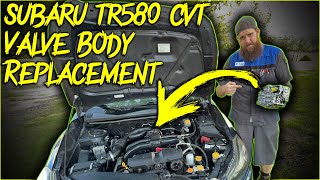
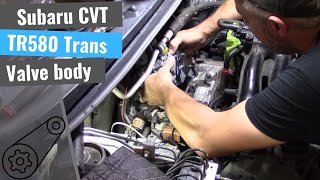
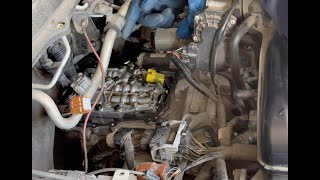
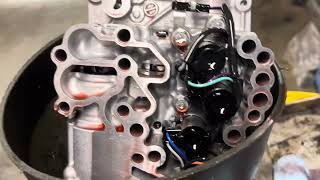
Typical fix: Official Subaru procedure is the replacement of the entire CVT valve body assembly, which is located on top of the transmission. 🎬 See this DIY walkthrough for replacing the TR580 valve body. This is a complex job that requires a CVT fluid drain/fill and a 'relearn' procedure. Some owners have had success replacing only the failed solenoid.
Est. part cost: $800-$1500 - Faulty Input Pulley Speed Sensor ⚪ Low Probability The sensor is an electronic component that can fail over time due to heat and vibration, but it is a less common failure point for this code than the valve body.
How to confirm: After checking for wiring damage, a technician can test the sensor's signal with a scan tool. If the signal is absent or erratic while the engine is running and no other transmission codes are present, the sensor is likely bad.
Typical fix: Replace the input pulley speed sensor. It is typically located on the exterior of the transmission case and held in by a single bolt.
Est. part cost: $80-$150 - Damaged Wiring or Connectors ⚪ Low Probability The wiring harness to the sensor is located under the vehicle and is exposed to road debris, moisture, and heat, which can cause corrosion or physical damage over time.
How to confirm: Visually inspect the wiring harness and connector leading to the input speed sensor for any signs of fraying, breaks, or corrosion. Perform a continuity test on the wires.
Typical fix: Repair the damaged section of the wiring harness or replace the connector pigtail.
Est. part cost: $20-$100
Rare But Worth Checking
- Internal CVT Mechanical Failure: While less common than a valve body issue, P1715 can be a symptom of a more severe internal failure, such as a damaged torque converter, CVT belt, or pulley. This is often accompanied by metallic debris in the transmission fluid and usually requires a complete transmission replacement.
- Faulty Transmission Control Module (TCM): A failure of the TCM itself is rare but possible. It's usually diagnosed only after all other possibilities (sensor, wiring, valve body) have been exhaustively ruled out.
Diagnosis Steps
- Read all trouble codes with an OBD-II scanner capable of reading transmission codes.
- Check for any Technical Service Bulletins (TSBs) related to the code and vehicle, specifically the revised TSB 16-107-17R regarding the CVT warranty extension.
- Using a professional scan tool, monitor live data from the input speed sensor and check for other related transmission codes that could point to the valve body (e.g., P0971, P2763).
- Inspect the wiring and connector for the input pulley speed sensor for any visible damage, corrosion, or loose connections.
- Inspect the condition and level of the CVT fluid. Dark, burnt, or metallic fluid indicates a serious internal mechanical problem requiring transmission replacement.
- If the sensor signal is faulty, wiring is confirmed good, and no other codes are present, replace the input pulley speed sensor.
- If other solenoid or pressure codes are present, or if drivability issues like hesitation are the primary complaint, the problem is most likely the CVT valve body.
- After any repair involving the valve body or transmission replacement, clear the codes and perform a CVT relearn procedure with a compatible scan tool, followed by a test drive.
Parts You'll Likely Need
- CVT Valve Body Assembly
(OEM #31825AA052 (supersedes 31825AA050, 31825AA051))— This is the most common internal component to fail on early Subaru TR580 CVTs that causes this code and drivability issues. Subaru dealers typically replace the entire assembly rather than individual solenoids.
Trusted brands: Subaru (OEM)
OEM price range: $800-$1500
Aftermarket price range: $250-$400 (Remanufactured) - Input Pulley Speed Sensor
(OEM #31937KA060)— This is the component directly identified by the code and is the simplest potential fix, though less common to be the true cause.
Trusted brands: Subaru (OEM), Standard Motor Products
OEM price range: $80-$110
Aftermarket price range: $60-$90
Related Codes That Often Appear With This One
- P2763 - Torque Converter Clutch Pressure Control Solenoid Circuit High
- P0971 - Pressure Control Solenoid 'A' Control Circuit High
Technical Service Bulletins (TSBs) & Recalls
- 16-107-17R: CVT Warranty Extension - This revised bulletin confirms the extension of the original CVT warranty to 10 years / 100,000 miles for 2014-15 Forester models (and others) to address concerns about performance and longevity.
Platform-Specific Known Issues
- Subaru extended the powertrain warranty on the Lineartronic CVT in 2014-2015 Foresters to 10 years or 100,000 miles due to customer satisfaction concerns, as detailed in TSB 16-107-17R. If your vehicle is within this range, contact a Subaru dealer to check for coverage before paying for repairs. Some owners just outside the warranty period have had mixed success requesting 'goodwill' assistance from Subaru of America.
Mechanic-Grade Diagnostic Values
- Lock-up Duty Solenoid Resistance — expected: Approx. 10 — 13.5 Ω at 20°C (68°F). Failure: A significantly lower reading (e.g., 2-3 Ω) indicates a shorted solenoid.
- Primary UP / DOWN Solenoid Resistance — expected: Approx. 10 — 13.5 Ω at 20°C (68°F). Failure: Readings outside this range indicate a faulty solenoid.
- AWD Solenoid Resistance — expected: Approx. 2.0 — 4.5 Ω at 20°C (68°F). Failure: Readings outside this range indicate a faulty solenoid.
- Secondary Solenoid Resistance — expected: Approx. 5 — 7 Ω at 20°C (68°F). Failure: Readings outside this range indicate a faulty solenoid.
- F&R Clutch Solenoid Resistance — expected: Approx. 4 — 6 Ω at 20°C (68°F). Failure: Readings outside this range indicate a faulty solenoid.
- Scan Tool PID: 'Input Speed Sensor' vs 'Engine RPM' — expected: In Park or Neutral, the values should be nearly identical.. Failure: An erratic or zero reading from the input speed sensor while the engine is running indicates a sensor or circuit fault.
- Scan Tool PID: 'CVTF Deterioration' — expected: A numerical value.. Failure: A value exceeding 210,000 points suggests the CVT fluid is severely degraded and the transmission has likely experienced high heat and wear.
- CVT Fluid Level Check Temperature — expected: 95°F to 113°F (35°C to 45°C). Failure: Checking the fluid when it is too cold or too hot will result in an inaccurate level reading.
Scan Tool Commands That Help
- Subaru Select Monitor or equivalent professional scan tool: CVT Relearn Procedure — This is a mandatory final step after replacing the valve body, transmission, or performing any major service. The command erases the old adaptive learning data from the Transmission Control Module (TCM), which had adjusted to the failing components. This allows the TCM to relearn shift pressures and timing with the new, functional parts.
- Subaru Select Monitor: Check for TCM Software Updates — Before replacing parts, it's wise to check if a software update is available. Subaru has released updates for 'Improved Pressure Control' and to correct logic that could falsely set certain DTCs. This could potentially resolve the issue without a hardware replacement.
- Subaru Select Monitor: Current Data Display & Save — Used during diagnosis to monitor live data PIDs from transmission sensors and solenoids, such as input speed, output speed, and fluid temperature, to identify erratic or illogical readings.
Wiring & Ground Locations
- Input/Primary Speed Sensor — On the right (passenger) side of the TR580 transmission case, externally mounted.. This is the sensor directly implicated by code P1715. Its wiring and connector are a primary inspection point.
- Transmission Control Module (TCM) — Located on the left (driver's) side of the dash, typically behind the glove box or lower dash panel.. The TCM receives the signal from the input speed sensor. All sensor wiring terminates here, making it a key location for circuit testing.
- Transmission Radio Ground Terminal — A ground strap bolted to the top of the transmission case.. A poor ground connection at this point can cause a variety of electrical issues and fault codes, including sensor signal problems. It should be clean and tight (13 N·m torque spec).
- Main Transmission Harness Connectors — Two large grey connectors located on a bracket on top of the transmission, near the valve body cover.. These are the main interface between the engine bay harness and the transmission's internal components, including the valve body solenoids and sensors. They are a critical point for checking continuity and resistance of internal components without opening the transmission.
Real Owner Repair Stories
- YouTube channel 'sixtyfiveford' (2015 Subaru Forester) — Dashboard lit up with warning lights, codes for bad solenoids.
❌ Tried (didn't work) Replacing individual solenoids with aftermarket parts., Installing a rebuilt/remanufactured valve body from an online seller.
✅ What actually fixed it Installing a brand new, factory OEM valve body from a Subaru dealer. The mechanic noted that the aftermarket/rebuilt options failed within weeks, and the new OEM part worked perfectly immediately and resolved all issues after a short re-learning drive cycle. - Reddit user 'LameBicycle' (2016 Subaru with TR580 CVT, 175,000 miles) — Solenoid failure.
✅ What actually fixed it The owner performed a DIY repair (details not specified, but implied solenoid or valve body work) and reported the car was running fine with no issues at 180,000 miles. The owner admitted to neglecting fluid changes, with the first one at 90k and the second at 175k miles. - YouTube channel 'MrSubaru1387' (2013 Subaru Crosstrek with TR580 CVT) — Unspecified CVT issues.
✅ What actually fixed it A valve body replacement was performed at 171,000 miles, which was the only major repair the vehicle needed before being sold at 235,000 miles. This demonstrates the longevity possible after a proper valve body repair.
When the Usual Fixes Don't Work
- While replacing the entire valve body with a new OEM unit is the most reliable fix, some owners have reported success with less expensive, higher-risk repairs. Multiple forum users have successfully replaced only the single failed lock-up solenoid with an aftermarket part from Dorman, resolving their codes for a fraction of the cost of a full valve body. However, at least one professional mechanic has documented that these aftermarket solenoids and even complete remanufactured valve bodies often fail within weeks, leading them to recommend only new OEM parts for a lasting repair. This presents a clear trade-off between cost and reliability.
OEM Part Supersession History
31825AA050, 31825AA051→31825AA052— Standard part revision and improvement over time.Pre-2019 Valve Body Assemblies→Updated Valve Body Assembly (per TSB 16-119-19)— The shape of internal fluid pressure circuits was changed to prevent air bubbles (aeration) from causing incorrect pressure calculations and triggering false DTCs like P0841.
Heads up: This is an improvement, not an incompatibility. Using the newer part is recommended to prevent potential future issues related to fluid aeration.
Model Year Variations Within This Range
- 2014-2015: These are the first years the Forester used the TR580 CVT, making them prone to the early-generation valve body issues. Later models benefited from running production changes and improved part designs, such as the updated valve body mentioned in TSB 16-119-19.
Diagnostic Flowchart
Other Known Issues on This Vehicle
Issues unrelated to this code that are worth knowing about as an owner of this generation:
- Excessive Engine Oil Consumption 🔴 High — Common on 2.5L FB25 engines from 2011-2015. Owners report needing to add a quart of oil every 1,000-3,000 miles. The issue was subject to a class-action lawsuit. (Ref: TSB 02-157-14R advises dealers to replace the entire short block assembly to correct the issue.)
- A/C Compressor Clutch Failure 🟠 Medium — Widespread on 2014-2016 models. The clutch fails to engage, especially when hot, resulting in intermittent or no cooling. Often misdiagnosed as a failed compressor. (Ref: TSB 10-84-16R addresses the faulty A/C compressor clutch and advises replacement of the compressor/clutch assembly.)
- Rear Suspension Sag / Broken Coil Springs 🟠 Medium — Affects both SH (2009-2013) and early SJ (2014-2016) generations. The SH models had self-leveling struts that would fail and cause a 'saggy butt' appearance. The SJ models had rear coil springs prone to corrosion and breaking. (Ref: Subaru Service Program WQU-99 (NHTSA 20V035000) was issued for 2014-2016 models to replace the rear coil springs due to risk of fracture.)
Used vs. New Parts: Buying Guide for This Vehicle
When a used part is the smart pick: For this specific repair, sourcing a used or remanufactured valve body is a significant gamble. A used OEM valve body from a low-mileage, rear-ended donor vehicle could be a viable option if its history is known, but it carries the same inherent risk of failure as the original part. It is generally not recommended.
Donor-vehicle mileage cap: roughly under 60000 miles for the part to have meaningful remaining life.
What to inspect on the donor part:
- Verify the donor vehicle's VIN to ensure it had the same transmission type (TR580).
- Ask for the mileage of the donor vehicle; lower is significantly better.
- Inspect the fluid from the donor transmission if possible. Any metallic sheen or burnt smell is a red flag.
- Ensure all electrical connectors on the valve body are intact with no broken clips or bent pins.
OEM-only on this vehicle (don't cheap out):
- CVT Valve Body Assembly
Aftermarket brands forum-validated for this vehicle:
- Dorman (for individual solenoids): Some DIY success stories exist, but it is considered a riskier repair than a full OEM valve body replacement.
Brands owners have reported issues with on this vehicle:
- Unbranded/generic remanufactured valve bodies (e.g., from eBay/Amazon): Multiple reports indicate these often use low-quality Chinese solenoids and are prone to premature failure, sometimes within weeks.
Real Owner Stories
Aggregated from forums and TSBs cited above. Mileages and costs reflect what owners reported in those sources.
2015 Subaru Forester — ~58000 miles
Symptoms: Owner was quoted for a valve body replacement due to code P0971.
What fixed it: Replaced only the faulty AWD solenoid and performed a CVT relearn with an aftermarket tool.
Cost: $55-$55
Source hint: Reddit r/SubaruForester - Thread titled 'Yet another valve body issue'
2015 Subaru Forester — 72000 miles
Symptoms: Vehicle presented with codes P0971, C1431, and C1532 just three months after the extended warranty expired.
What fixed it: Two independent shops recommended a full valve body replacement as the only fix.
Cost: $2300-$2300
Source hint: Reddit r/MechanicAdvice - Thread titled '2015 Subaru Forester transmission codes, valve body replacement quoted at $2300'
2015 Subaru Forester
Symptoms: A common progression of issues starting with hesitation.
What fixed it: The issue required a valve body replacement, and later a torque converter replacement, all performed under the extended warranty.
Source hint: Reddit r/SubaruForester - Thread titled 'Valve body & torque converter replaced. What else could fail?'
Related OBD-II Codes
Frequently Asked Questions
My 2015 Forester has a P1715 code. Is this covered by a warranty or recall?
What's the likely cost to fix a P1715 code on my Forester if it's out of warranty?
Do I have to replace the entire expensive valve body, or can I just replace the bad solenoid?
Besides the Check Engine Light, what are the main symptoms of a failing valve body on this Forester?
My Forester is just over 100,000 miles. Do I have any options for getting the CVT repair covered?
Are there other trouble codes that often appear with P1715 and point to the valve body?
Helpful Videos

We Have This Part in Stock

The information in this article is provided for general reference and educational purposes only. Vehicle specifications, procedures, and part compatibility can vary by production date, trim level, and region. Always consult your vehicle's factory service manual and verify part numbers before purchasing or performing repairs. Safety-critical components such as airbags, seat belts, and braking systems should be installed by a qualified professional.
- Subaru Forester:
- 🎬 Helpful Videos
- 🛍️ Shop This Part
- What's Unique About the 2010-2015 Subaru Forester
- Symptoms You May Notice
- Most Likely Causes
- Rare But Worth Checking
- Diagnosis Steps
- Parts You'll Likely Need
- Related Codes That Often Appear With This One
- Technical Service Bulletins (TSBs) & Recalls
- Platform-Specific Known Issues
- Mechanic-Grade Diagnostic Values
- Scan Tool Commands That Help
- Wiring & Ground Locations
- Real Owner Repair Stories
- When the Usual Fixes Don't Work
- OEM Part Supersession History
- Model Year Variations Within This Range
- Diagnostic Flowchart
- Other Known Issues on This Vehicle
- Used vs. New Parts: Buying Guide for This Vehicle
- Real Owner Stories
- 2015 Subaru Forester — ~58000 miles
- 2015 Subaru Forester — 72000 miles
- 2015 Subaru Forester
- Related OBD-II Codes
- Frequently Asked Questions
- 🎟️ Get 5% Off