

OBD-II Code P1656: Oil Control Valve Circuit Malfunction
What P1656 means, why it triggers, and how to fix it
- Code P1656 indicates an electrical fault in the Oil Control Valve (VVT Solenoid) circuit, most frequently found on 2000-2017 Toyota and Lexus vehicles.
- Check your engine oil first; dirty or low oil causes up to 40% of VVT-related faults and is fixed with a simple $50-$120 oil change.
- Test the solenoid's resistance using a multimeter before replacing it; a healthy Toyota 1ZZ-FE solenoid reads between 6.9 and 7.9 Ohms at 68°F.
- Verify your manufacturer's specific definition for P1656, as it means 'Engine Restart Bypass Relay' on Nissan models and requires a $150-$250 battery replacement rather than engine work.
- Do not ignore P1656 for more than 6 months, as chronically incorrect engine timing forces unburnt fuel into the exhaust, destroying the catalytic converter and causing a $1,200+ repair.
What Does P1656 Mean?

The P1656 code indicates your car's Engine Control Module (ECM) detected an electrical circuit problem with the engine's oil control valve (OCV). This valve controls the Variable Valve Timing (VVT) system, adjusting engine timing for performance and fuel economy. An open or short circuit prevents the ECM from controlling the valve's position.
Technical definition: The SAE/OBD-II definition for P1656 is manufacturer-specific. On Toyota, Lexus, and Scion vehicles, it means 'Oil Control Valve Circuit Malfunction (Bank 1)'. On other makes, it means entirely different things: 'Automatic Transmission System Malfunction' (Honda), 'Wastegate Solenoid Control Circuit Malfunction' (Chevrolet Diesel), 'Engine Restart Bypass Relay' (Nissan), or 'A/C clutch relay circuit short to ground' (Volkswagen).
Can I Drive With P1656?
Yes, But With Caution. You can drive with this code, but you must fix it soon to avoid escalating damage. Your car will experience a rough idle, poor acceleration, bad gas mileage, and stalling in traffic. Ignoring it for months forces unburnt fuel into the exhaust, destroying the catalytic converter and causing a $1,200 to $2,800 repair.
Common Causes

- Faulty Oil Control Valve (VVT Solenoid) (Very Common) — The solenoid fails electrically with an internal short or an open circuit in its coil windings, or it fails mechanically by getting stuck. This is the most frequent direct cause of the P1656 code.
- Low, old, or incorrect viscosity engine oil (Very Common) — The oil control valve is a hydraulic solenoid requiring precise oil pressure. Dirty, sludgy, or low oil causes the valve to stick, which the ECM flags as a circuit fault.
- Damaged wiring or corroded electrical connector (Common) — Wires leading to the oil control valve fray, melt from engine heat, or break internally. Connector pins suffer from corrosion or oil contamination, disrupting the electrical connection.
- Clogged Oil Control Valve filter screen (Common) — Many oil control valves feature a small, integrated filter screen to block sludge. A clogged screen restricts oil flow, causing the valve to malfunction and trigger a fault.
- Weak or failing battery (Nissan specific) (Common) — On Nissan vehicles with start-stop systems (like the Qashqai), P1656 refers to an 'Engine Restart Bypass Relay'. A weak battery causing a voltage drop below 8 volts during an engine restart triggers this fault.
- Blown fuse or faulty relay (Less Common) — A dedicated fuse protects the oil control valve circuit. A blown fuse cuts power to the solenoid and immediately triggers this code.
- Faulty Engine Control Module (ECM) (Rare) — The driver circuit inside the ECM fails, preventing it from sending the correct signal to the valve. Check this only after ruling out the valve, oil, and wiring.
Symptoms

- Rough, unstable, or shaky idle — Incorrect engine timing at low speeds causes a rough, fluctuating, or hunting idle.
- Poor engine performance and acceleration — The car feels sluggish, hesitates, and lacks power during hard acceleration or hill climbs.
- Decreased fuel economy — Unoptimized engine timing forces the engine to burn 5% to 15% more fuel than usual.
- Engine stalling at low speeds — If the OCV sticks in an advanced position, the engine stalls when coming to a stop.
- Check Engine Light is on (also visible on scanner) — The Malfunction Indicator Lamp (MIL) illuminates on your dashboard.
- Start-Stop system disabled (also visible on scanner) — On Nissan vehicles, a warning message appears and the start-stop feature disables itself.
Diagnostic Flowchart

Tap your situation to follow the diagnostic path that matches what you're seeing on this code.
Common Fixes & Costs
- Engine oil and filter change — Parts: $30-$80, Labor: $50-$120, ~0.5 hr book time (DIY)
- Replacing the Oil Control Valve (VVT Solenoid) — Parts: $50-$150, Labor: $100-$250, ~1.2 hr book time (DIY)
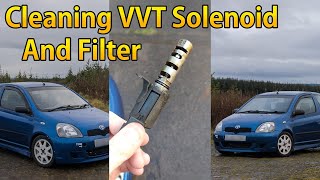
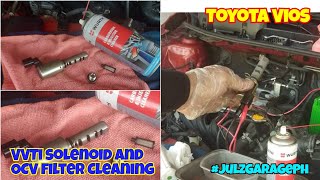
- Cleaning the Oil Control Valve and Filter Screen — Parts: $5-$15, Labor: $50-$150, ~1.0 hr book time (DIY)
- Repairing or replacing the wiring harness/connector — Parts: $10-$50, Labor: $100-$400, ~3.5 hr book time (Intermediate)
- Replacing the vehicle's main battery (Nissan) — Parts: $150-$250, Labor: $50-$100, ~0.8 hr book time (DIY)
- Replacing the Engine Control Module (ECM) — Parts: $200-$1200, Labor: $150-$300, ~2.0 hr book time (Professional)
Used vs. New Parts: Buying Guide
When a used part is worth it: Buying a used VVT solenoid rarely makes sense. The savings are minimal compared to the risk of the used part failing soon after installation. Only consider a used part if the vehicle is very old and a new part is unavailable.
Donor-vehicle mileage cap: roughly under 60000 miles for the part to have meaningful remaining life.
Donor quality checklist:
- Verify the part number on the used solenoid exactly matches the original part.
- Inspect the electrical connector for corrosion or cracks.
- Check the filter screen for metallic debris, indicating the donor engine had severe internal problems.
Decision logic:
- If The cost of a new aftermarket solenoid is under $100. → Buy a new aftermarket part. The low cost and warranty make it a better value.
- If The vehicle is under 100k miles and you plan to keep it long-term. → Buy a new OEM part. It offers the best reliability and longevity.
- If The vehicle is very high mileage (>150k miles) and you are on a strict budget. → A low-mileage used part is a viable risk, but a new aftermarket part is preferable.
Warranty tradeoff: Salvage yard parts carry a 30-90 day warranty covering only the part. New aftermarket solenoids offer 1-year to limited lifetime warranties. New OEM parts carry a 1-year warranty.
Worst-case if a used part fails: $200-$400 if a used part fails shortly after the warranty period, requiring a second replacement part and repeat labor.
What Happens If You Wait — Timeline
- 0-1 month: Code sets and Check Engine Light illuminates. Driver notices a slightly rough idle or minor decrease in throttle response. (MPG impact: 3-5%% · Added cost: $10-$30 in wasted fuel.)
- 1-4 months: Engine performance decline becomes obvious. Sluggish acceleration, noticeable hesitation, consistent rough idle, and stalling at low speeds occur. (MPG impact: 5-15%% · Added cost: $50-$150 in wasted fuel and increased engine strain.)
- 4-8 months: Chronically incorrect valve timing leads to incomplete combustion. Unburnt fuel enters the exhaust, causing the catalytic converter to run hotter than designed and degrading its precious metals. (MPG impact: 10-20%% · Added cost: $200-$400 in wasted fuel; early-stage catalytic converter damage begins.)
- 8+ months: Sustained overheating melts or cracks the catalytic converter substrate. This triggers code P0420 and results in a failed emissions test. (MPG impact: 15-25%% · Added cost: $1,200 - $2,800 for catalytic converter replacement, plus accumulated fuel waste.)
Cost of Not Fixing It
- 0-1 month: Noticeable drop in fuel economy (5-15%), rough idle, and poor acceleration. Risk of stalling in traffic. (Added cost: $20-$60 in wasted fuel per month.)
- 1-6 months: Increased engine strain and carbon buildup on internal components. Unburnt fuel overheats the catalytic converter, reducing its lifespan. (Added cost: $100-$300 in cumulative fuel costs.)
- 6+ months: Complete catalytic converter failure due to sustained overheating. This triggers additional codes (e.g., P0420) and results in a failed emissions test. (Added cost: $1200-$2800 for catalytic converter replacement.)
Diagnosis Steps
- Check Engine Oil Level and Condition
Pull the dipstick to ensure the oil level is correct. If the oil is extremely dark, thick, or low, perform an oil change before replacing any parts.
Tools: Rag or paper towel (Beginner) - Read Freeze Frame Data
Use an OBD-II scanner to read the freeze frame data. This reveals the engine's speed, temperature, and load when the fault triggered, providing crucial diagnostic context.
Tools: OBD-II Scan Tool (Beginner) - Visually Inspect the Wiring and Connector
Locate the oil control valve on the valve cover or cylinder head. Inspect the electrical connector and wires for melted plastic, corrosion, oil contamination, or loose pins.
Tools: Flashlight (Beginner) - Check for Power at the Solenoid
With the ignition on (engine off), unplug the OCV connector. Use a multimeter set to DC volts to check for battery voltage (11.5-12.6 volts) at the power supply pin. No voltage indicates a blown fuse or broken wire.
Tools: Multimeter (Intermediate) - Test the Oil Control Valve's Resistance
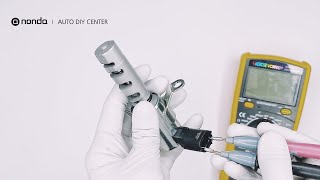
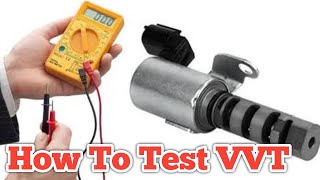
Set your multimeter to Ohms (Ω). Touch the probes to the two electrical pins on the oil control valve. For Toyota 1ZZ-FE engines, expect 6.9 to 7.9 Ω at 68°F (20°C). An 'OL' reading means an open circuit, and near 0 Ω indicates a short circuit. Both require valve replacement.
Tools: Multimeter (Intermediate) - [Pro Tip] Perform a 'Wiggle Test'
While monitoring voltage or resistance with the multimeter, gently wiggle the OCV wiring harness. Fluctuating readings indicate an intermittent connection or a hidden break in the wire.
Tools: Multimeter (Intermediate) - Perform an Active Test
Use a bidirectional scan tool to command the OCV 'ON' at idle. The engine must start to run rough or stall. If the engine's behavior doesn't change, the valve is stuck, clogged, or not receiving the signal.
Tools: Advanced Bidirectional Scan Tool (Advanced) - [Advanced] Analyze Live Data PIDs
Monitor the 'VVT Desired Angle' vs. 'VVT Actual Angle' PIDs on a scan tool. At idle, they must match. As you raise RPM to 2500, both angles must change together. A large discrepancy indicates a faulty OCV or restricted oil flow.
Tools: Advanced Scan Tool (Advanced) - [Advanced] Analyze the OCV Control Signal with an Oscilloscope
Connect an oscilloscope to the OCV signal and ground wires. You must see a square wave (duty cycle signal) from the ECM when the engine runs. A flat line (0V or 12V) points to a wiring issue or a faulty ECM driver.
Tools: Oscilloscope, Wiring Diagrams (Advanced) - [Professional] Inspect the ECM Driver Resistors
If all else fails, test the ECM driver. On Toyota 1ZZ-FE ECUs, technicians test specific resistors on the circuit board for correct resistance (e.g., 42 ohms). Failure here requires ECM repair or replacement.
Tools: Multimeter with fine probes, ECU-specific knowledge (Professional)
When This Code Triggers (Freeze-Frame Conditions)
- Engine Coolant Temp: 175-210°F (80-99°C) (The fault logs when the engine is fully warmed up.)
- RPM: 1500-3000 RPM (Triggers during steady-state cruise or light acceleration when the ECM commands the VVT system to adjust timing.)
- Engine Load: 25-70% (Sets under moderate engine load, where camshaft phasing provides the most benefit.)
- Vehicle Speed: 30-60 mph (50-95 km/h) (Occurs during city or highway cruising speeds when the ECM actively monitors the VVT circuit's response.)
Related Codes
- P1349 — This 'VVT System Malfunction' code frequently accompanies P1656 on Toyota and Lexus vehicles. P1656 points to the electrical circuit, while P1349 points to the mechanical performance. Diagnose P1656 first; fixing the electrical failure resolves the mechanical failure.
- P0011 / P0012 — Generic codes for 'Camshaft Position Timing - Over-Advanced' (P0011) or 'Over-Retarded' (P0012). A faulty OCV circuit (P1656) prevents correct camshaft timing, directly causing these codes.
- P0340 — Indicates a 'Camshaft Position Sensor Circuit Malfunction.' P1656 is for the actuator (OCV) changing the timing, while P0340 is for the sensor reporting it. A shared wiring harness issue affects both.
- P1663 — On some Toyota models, this companion code to P1656 also defines an 'OCV Circuit Malfunction'. Seeing both confirms a definitive fault in the OCV, wiring, or ECM.
Climate & Environmental Factors
- Cold Weather: In sub-freezing temperatures, engine oil thickens. This slows the hydraulic response of the VVT system, triggering a P1656 code if the camshaft timing fails to change quickly during a cold start.
- High Humidity / Salt: Coastal climates and winter road salt accelerate corrosion on the oil control valve's electrical connector. This corrosion increases circuit resistance, directly causing the P1656 fault.
How to Talk to a Mechanic About This Code
Say this: "I have a P1656 code on my [Make, Model]. I'd like to book a diagnostic appointment. Please check the oil condition and test the oil control valve circuit's resistance and wiring before recommending any part replacement."
This signals you want a proper diagnosis, not a part swap. It directs the mechanic to check the cheapest causes first (oil, wiring) and verify the solenoid failed before you pay for a new one.
Avoid saying:
- 'My check engine light is on, can you look at it?'
- 'Just fix whatever's wrong.'
- 'My car is running rough, I think it needs a new sensor.'
Questions to ask before authorizing the repair:
- What did my oil look like? Was the level correct?
- What was the resistance reading on the oil control valve? Was it within spec?
- Did you find power at the connector and check the wiring for damage?
- For my specific car, does P1656 mean VVT solenoid, or something else like the battery or transmission?
- What is the warranty on this specific repair, including parts and labor?
Where to Take It: Dealer vs Independent vs Chain
- Dealer:
Recommended for non-Toyota/Lexus vehicles where the code has a unique meaning (like Nissan or Honda), or if an independent shop fails to fix the issue.
Best for: Vehicles under warranty, Models with known ECM software updates (e.g., Nissan), Complex electrical issues requiring ECM replacement
Downsides: Highest labor rate, Recommends expensive OEM parts when quality aftermarket options exist (Typical cost: +50% vs. baseline) - Independent Shop:
Best fit for the vast majority of P1656 cases. This is a routine repair for competent independent shops.
Best for: Out-of-warranty vehicles, especially Toyota and Lexus, Standard diagnosis and replacement of the oil control valve and wiring checks
Downsides: Quality varies greatly; check for ASE certifications, Lacks access to manufacturer-specific software updates (Typical cost: +0% vs. baseline) - Chain Shop:
Acceptable for a simple oil change, but AVOID for diagnosing the electrical circuit fault due to high risk of misdiagnosis.
Best for: Simple oil changes if you suspect dirty oil is the cause
Downsides: Technician skill varies dramatically, High pressure to upsell services; frequently replaces the OCV without proper electrical diagnosis (Typical cost: -10% vs. baseline)
When to Walk Away From the Repair
If the estimated repair cost exceeds 40-50% of your car's private-party value, consider selling or trading it in instead of repairing it.
- Car worth $4000, fix is $350: Fix it. The repair cost for a new VVT solenoid and labor is well below the threshold.
- Car worth $3000, fix is $1500: Walk away. A $1,500 bill for an ECM replacement is 50% of the car's value.
- Car worth $8000, fix is $1400: Borderline. If the diagnosis points to a complex ECM issue, get a second opinion before proceeding.
What Scan Tool You Need for This Code
Minimum: A scanner that reads live data streams and offers bidirectional control (active tests).
A basic $20 code reader only gives you the P1656 code. It cannot command the solenoid to activate (an 'active test'), which is critical to confirm if the valve is stuck or if the problem lies in the wiring.
Budget: BlueDriver Pro (~$99) — Reads and clears the code, shows freeze frame data, and graphs live data PIDs (like desired vs. actual cam angle). It lacks full bidirectional control but provides enough data to move beyond simple code reading.
Mid-range: Foxwell NT510 Elite (~$159) — Provides full bidirectional control, allowing you to perform an 'active test' to command the OCV on and off directly from the scanner. This confirms if the solenoid works before replacing it.
Professional: Autel MaxiCOM MK808S (~$359) — Offers robust bidirectional control and active tests for VVT systems, plus access to special functions and resets for a wide range of vehicles.
Rent vs buy: For a one-time diagnosis, borrow a scanner for free from an auto parts store's 'Loan-A-Tool' program. Buy a scanner only if you perform your own diagnostics regularly.
How to Clear the Code After You Fix It
- Use an OBD-II scan tool to clear the diagnostic trouble codes.
- Reconnect the battery if disconnected during repair.
- Perform a complete OBD-II drive cycle to allow the readiness monitors to run.
Drive cycle (~30 minutes): A typical Toyota drive cycle involves: 1) Cold start and idle for 3 minutes. 2) Drive at a steady 40-55 mph for 7 minutes. 3) Stop and idle for 3 minutes. 4) Repeat the steady-speed driving and idle. This process helps the ECU verify the repair.
Readiness monitors affected: Catalyst (CAT) monitor, Oxygen (O2) Sensor monitor, Oxygen Sensor Heater monitor, Evaporative (EVAP) System monitor
Before emissions retest: drive at least 100 miles to fully set monitors.
Watch out for:
- Clearing the code resets all readiness monitors to 'Not Ready', guaranteeing an emissions test failure until you complete a drive cycle.
- The code returns immediately if the underlying electrical fault remains unfixed.
- Failing to drive at steady highway speeds prevents the monitors from setting.
Will This Fail Emissions / State Inspection?
Yes — this code typically fails an OBD-II emissions inspection.
- California: An illuminated Check Engine Light results in an automatic smog check failure. You must complete a full OBD-II drive cycle to set all readiness monitors before a retest.
- New York: The NYS DMV inspection includes an OBD-II scan. An active P1656 code causes an automatic emissions failure.
- Texas: In counties requiring emissions testing, an illuminated Check Engine Light is an automatic failure. You cannot pass until you repair the issue and clear the code.
Most Commonly Affected Vehicles
- Toyota Camry (2002-2017) — Extremely common on 2.4L (2AZ-FE) engines. These engines suffer from oil consumption and sludge issues that directly cause OCV failure. 2002-2004 models frequently exhibit a start-and-stall condition with this code.
- Toyota Corolla (2000-2017) — Affects 1.8L (1ZZ-FE) engines, where the OCV is a frequent failure point that occasionally destroys the ECM driver circuit.
- Toyota RAV4 (2001-2012) — Models with 2.0L (1AZ-FE) and 2.4L (2AZ-FE) engines are highly prone to this code.
- Lexus IS200 / IS300 (1999-2005) — The 1G-FE engine frequently triggers this code alongside the mechanical fault code P1349.
- Scion tC, xB (2005-2015) — Uses Toyota's 2.4L (2AZ-FE) engine, sharing its high susceptibility to OCV circuit faults and oil sludge problems.
- Chevrolet 3500 HD / Silverado (1996-2002) — On 6.5L turbo diesels, P1656 indicates a 'Wastegate Solenoid Control Circuit Malfunction'.
- Nissan Qashqai (2013-2017) — Triggers P1656 for an 'Engine Restart Bypass Relay' fault, caused by a weak battery. Nissan issued an ECM software update for P1656 on the J11 model.
- Honda Pilot, Ridgeline (2003-2015) — P1656 indicates a communication problem with the VTM-4 (Variable Torque Management 4WD) control unit or a general automatic transmission system malfunction, not a VVT issue.
Manufacturer-Specific Notes
- Toyota/Lexus/Scion: P1656 almost exclusively refers to the Oil Control Valve circuit. In rare cases, a faulty ECM driver is the root cause, requiring ECM replacement even after installing a new OCV.
- Honda/Acura: P1656 indicates an 'Automatic Transmission System Malfunction' or a communication issue with the VTM-4 (4WD) control unit. Diagnosing the engine VVT system is incorrect.
- GM (Chevrolet/GMC): P1656 means 'Wastegate Solenoid Control Circuit Malfunction' on 6.5L diesels, unrelated to the engine's VVT system.
- Nissan: On models with a start-stop system, P1656 defines an 'Engine Restart Bypass Relay' fault caused by a weak battery.
- Ford: P1656 indicates a 'CAN Link PCM/PCM Circuit/Network' failure, pointing to a module communication problem rather than a specific component circuit.
- Volkswagen: P1656 defines an 'A/C clutch relay circuit short to ground,' an air conditioning issue completely unrelated to engine performance.
Real Owner Stories
2002 Toyota Corolla (1ZZ-FE) with P1656 & P1349
Check engine light illuminated, car felt sluggish and hesitated on hills. Codes P1656 and P1349 were present.
What they tried:
- Replaced the Oil Control Valve (OCV), but codes returned.
- Checked wiring from the ECM to the OCV and found it intact.
- Inspected the ECM connector and found significant carbon and corrosion on the pins.
Outcome: Cleaned the carbon from the ECM connector pins. This resolved the issue, cleared both codes, and restored engine performance.
Lesson: Before replacing expensive parts like the ECM, inspect and clean all related electrical connectors. A bad connection is a common cause for circuit codes.
2015 Nissan Qashqai (1.5 dCi) with P1656
A 'Start Stop System Error' message appeared. An OBD-II scan revealed a P1656 'Engine Restart Bypass Relay' fault.
What they tried:
- Tested the main vehicle battery.
- The battery test showed health at 42% with a very low charge.
Outcome: Replaced the 9-year-old battery. The P1656 code cleared permanently, and the Start-Stop system functioned correctly again.
Lesson: On Nissan vehicles, P1656 is unrelated to the VVT system. A weak battery causing a voltage drop below 8V on restart is the primary cause.
2002 Toyota Fielder with P1656
The check engine light illuminated intermittently with code P1656. The OCV sensor and wiring tested perfectly.
What they tried:
- Inspected the small filter screen located underneath the OCV.
- Found the filter heavily clogged with sludge and silicone debris.
Outcome: Cleaned the filter screen thoroughly with carburetor spray. This single action fixed the problem permanently.
Lesson: A clogged OCV filter restricts oil flow, causing a performance issue the ECM flags as an electrical fault. Cleaning this filter is a vital, low-cost diagnostic step.
How to Prevent This Code From Triggering
- Perform regular oil changes with high-quality synthetic oil. (Every 5,000-7,500 miles.) — Clean, correct-viscosity oil is the lifeblood of the VVT system. Regular changes prevent oil sludge, the leading cause of clogged OCV filter screens and stuck solenoids.
- Use high-quality, top-tier gasoline. (Every fill-up.) — Top-tier fuels contain detergent additives that keep engine internals clean and reduce contaminant buildup in the oil, preventing sludge formation.
- Avoid frequent short trips and excessive idling. (Daily habit.) — Short trips prevent engine oil from reaching optimal operating temperature, allowing moisture and fuel to build up and accelerate sludge formation.
- Clean or replace the OCV filter screen. (Every 60,000 miles.) — This small filter protects the OCV from debris. It clogs with sludge over time, starving the solenoid of oil pressure.
- Inspect and protect electrical connectors. (During routine engine maintenance.) — Applying a thin layer of dielectric grease to the connector seal prevents moisture intrusion and corrosion, ensuring a reliable electrical connection.
Frequently Asked Questions
Can I just clean the oil control valve instead of replacing it?
Sometimes, yes. If the valve is sticky from oil sludge or the internal filter screen is clogged, cleaning it with brake cleaner restores function. However, if the valve fails an electrical resistance test, cleaning will not help and you must replace it.
Is the oil control valve the same as the VVT solenoid?
Yes, the terms are used interchangeably. 'Oil Control Valve' (OCV) is the term Toyota uses, while 'VVT Solenoid' is the generic industry term.
I replaced the oil control valve, but the P1656 code came back. What now?
If a new valve didn't fix it, the problem lies in the wiring or the Engine Control Module (ECM). Re-inspect the connector for a solid connection and perform a 'wiggle test' on the wiring harness to find intermittent breaks. If the wiring is flawless, you likely have a failed ECM driver circuit requiring professional repair.
What are common misdiagnosis pitfalls for P1656?
The biggest mistake is assuming the code means the same thing on all cars, such as diagnosing a VVT system on a Honda where P1656 actually points to the transmission. Another common error is immediately replacing the OCV without checking for simple root causes like low oil or a weak battery.
My car has a Start-Stop system and threw a P1656 code. What should I check first?
On vehicles like the Nissan Qashqai, P1656 relates to the 'Engine Restart Bypass Relay' rather than the VVT system. The most frequent cause is an aging battery that drops below 8 volts during a restart. Have your battery's health professionally tested before inspecting relays or wiring.
Can a bad VVT solenoid cause a no-start condition?
Yes, a bad VVT solenoid occasionally causes a no-start condition. If the solenoid fails and leaves the camshaft timing severely advanced or retarded, the engine cannot start. This is documented in several 2002-2004 Toyota Camry and RAV4 models.
What are the long-term risks of driving with P1656?
Chronically poor engine timing causes carbon buildup on valves and forces unburnt fuel into the exhaust. This raw fuel overheats and destroys the catalytic converter. Replacing a melted catalytic converter costs between $1,200 and $2,800.
How important is using the right kind of oil?
Using the correct oil is critical because the VVT system relies on precise hydraulic pressure. Oil that is too thick, too thin, or full of sludge clogs the OCV filter screen and triggers P1656. Always use the exact oil viscosity specified in your owner's manual.
Where is the oil control valve located?
The oil control valve sits on the engine's valve cover or the side of the cylinder head near the camshaft gears. It is a small, cylindrical solenoid with an electrical connector on top. Mechanics typically secure it with a single 10mm bolt.
Key Takeaways
- Code P1656 indicates an electrical fault in the Oil Control Valve (VVT Solenoid) circuit, most frequently found on 2000-2017 Toyota and Lexus vehicles.
- Check your engine oil first; dirty or low oil causes up to 40% of VVT-related faults and is fixed with a simple $50-$120 oil change.
- Test the solenoid's resistance using a multimeter before replacing it; a healthy Toyota 1ZZ-FE solenoid reads between 6.9 and 7.9 Ohms at 68°F.
- Verify your manufacturer's specific definition for P1656, as it means 'Engine Restart Bypass Relay' on Nissan models and requires a $150-$250 battery replacement rather than engine work.
- Do not ignore P1656 for more than 6 months, as chronically incorrect engine timing forces unburnt fuel into the exhaust, destroying the catalytic converter and causing a $1,200+ repair.
Helpful Videos



The information in this article is provided for general reference and educational purposes only. Vehicle specifications, procedures, and part compatibility can vary by production date, trim level, and region. Always consult your vehicle's factory service manual and verify part numbers before purchasing or performing repairs. Safety-critical components such as airbags, seat belts, and braking systems should be installed by a qualified professional.
- 🎬 Helpful Videos
- What Does P1656 Mean?
- Can I Drive With P1656?
- Common Causes
- Symptoms
- Diagnostic Flowchart
- Common Fixes & Costs
- Used vs. New Parts: Buying Guide
- What Happens If You Wait — Timeline
- Cost of Not Fixing It
- Diagnosis Steps
- When This Code Triggers (Freeze-Frame Conditions)
- Related Codes
- Climate & Environmental Factors
- How to Talk to a Mechanic About This Code
- Where to Take It: Dealer vs Independent vs Chain
- When to Walk Away From the Repair
- What Scan Tool You Need for This Code
- How to Clear the Code After You Fix It
- Will This Fail Emissions / State Inspection?
- Most Commonly Affected Vehicles
- Manufacturer-Specific Notes
- Real Owner Stories
- 2002 Toyota Corolla (1ZZ-FE) with P1656 & P1349
- 2015 Nissan Qashqai (1.5 dCi) with P1656
- 2002 Toyota Fielder with P1656
- How to Prevent This Code From Triggering
- Frequently Asked Questions
- Can I just clean the oil control valve instead of replacing it?
- Is the oil control valve the same as the VVT solenoid?
- I replaced the oil control valve, but the P1656 code came back. What now?
- What are common misdiagnosis pitfalls for P1656?
- My car has a Start-Stop system and threw a P1656 code. What should I check first?
- Can a bad VVT solenoid cause a no-start condition?
- What are the long-term risks of driving with P1656?
- How important is using the right kind of oil?
- Where is the oil control valve located?
- Key Takeaways
- 🎟️ Get 5% Off