

P1621 on 2010-2015 Cadillac SRX: Transmission Control Module Memory Fault Guide
This code almost always points to an internal failure of the Transmission Control Module (TCM), which on the SRX is located inside the transmission housing. The fix is typically reprogramming or replacing the TCM, which requires a professional shop or dealer due to the location and need for programming. Expect costs to range from $200 for a reprogram to over $1,200 for a replacement due to the labor involved.
- P1621 on a 2010-2015 SRX is a serious code pointing to an internal memory fault in the Transmission Control Module (TCM).
- The TCM is located inside the transmission housing as part of the TEHCM, making replacement a labor-intensive and costly repair.
- Do not attempt to replace other parts; diagnosis should focus on the TCM.
- The fix is not DIY-friendly. The first professional step is attempting a software reprogram ('reflash') of the TCM.
- If reprogramming fails, the entire TEHCM must be replaced and programmed by a qualified shop with GM-specific tools.
What's Unique About the 2010-2015 Cadillac SRX

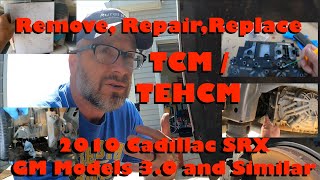
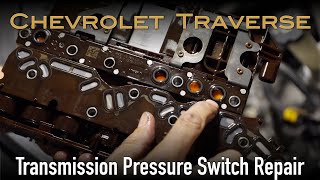
While P1621 can technically occur in various modules, on the 2010-2015 Cadillac SRX equipped with the 6T70/6T75 6-speed automatic transmission, the Transmission Control Module (TCM) is the overwhelming culprit. This is confirmed by GM Technical Service Bulletin #PIP4653E. A critical distinction for this vehicle is that the TCM is not a separate, easily accessible box; it is integrated into the Transmission Electro-Hydraulic Control Module (TEHCM) located inside the transmission, bolted to the valve body. 🎬 Watch: See how to access and repair the internal TEHCM. This internal location makes replacement a much more labor-intensive job that involves removing the transmission valve body cover and draining the fluid.
Diagnostic Flowchart
Tap your situation to follow the diagnostic path that matches what you're seeing on this vehicle.
Symptoms You May Notice
- Check Engine Light (Malfunction Indicator Lamp) is on
- Transmission may shift harshly or erratically, especially a delayed or hard shift between gears.
- Vehicle may enter 'limp mode,' getting stuck in a single gear (often 2nd or 3rd).
- Potential no-start condition or the engine cuts out while driving.
- Transmission warning light may be illuminated ('Service Transmission' message).
- Gear position indicator on the dashboard may be blank or incorrect.
- Door locks may cycle while driving (as noted in related TSB PIC4740F). 🎬 Watch: 7 common symptoms of a failing transmission control module.
- Replacing the Engine Control Module (ECM) when the fault is in the Transmission Control Module (TCM).
- Replacing internal transmission components like solenoids or sensors before verifying the health of the TCM. While the TEHCM contains solenoids, the P1621 code specifically points to a memory/processor fault, not a solenoid mechanical failure.
Most Likely Causes

- Failing Transmission Control Module (TCM/TEHCM) 🔴 High Probability As identified in GM TSB #PIP4653E, the TCM is the specified location for this fault. The TCM is part of the TEHCM assembly located inside the transmission, where it is subjected to constant heat and vibration, leading to a high failure rate of its internal electronics and memory. This is a well-documented issue on GM vehicles with the 6T70/6T75 transmission.
How to confirm: A professional-grade scan tool is needed to confirm the code is stored in the TCM. Diagnosis involves attempting to reprogram the module. If reprogramming fails, the code returns immediately, or the module is unresponsive (often accompanied by a U0100 code), the TEHCM is condemned.
Typical fix: First, attempt to reprogram (reflash) the TCM with the latest GM software. If that fails, the entire TEHCM assembly must be replaced. This involves draining the transmission fluid, removing the side cover, and replacing the module, followed by programming the new unit to the vehicle's VIN.
Est. part cost: $400-$900 - Software Corruption / Glitch 🟡 Medium Probability Control module software can become corrupted due to voltage fluctuations or age. TSB #05-06-04-060A notes that this code can appear in multiple modules, suggesting software-level issues are a known possibility across GM platforms.
How to confirm: The only way to confirm a software issue is to attempt a reprogram. If the reprogram is successful and the code does not return after a drive cycle, the issue was software-based.
Typical fix: Reprogramming the TCM with an official GM tool (like MDI with GDS2/SPS). This is often the first step a dealer will take.
Est. part cost: $0 (Labor cost for programming will be $150-$300) - Low Battery Voltage or Poor Connections ⚪ Low Probability All modern vehicles with multiple control modules are sensitive to low voltage, which can cause erroneous internal fault codes during startup.
How to confirm: Test the battery with a digital multimeter or electronic tester; it should read ~12.6V at rest and >13.5V when the engine is running. Inspect battery terminals and the main power/ground connections to the ECM and transmission case for corrosion or looseness.
Typical fix: Charge or replace the battery. Clean and tighten all relevant electrical connections, paying special attention to chassis grounds.
Est. part cost: $150-$300
Rare But Worth Checking
- Damaged Wiring Harness:
Diagnosis Steps
- Connect a professional scan tool to verify that P1621 is present and confirm it was stored by the Transmission Control Module (TCM).
- Check for other related control module codes (P0601, P0603, P0604, U0100, P0700, etc.).
- Test the vehicle's battery and charging system to ensure stable voltage is being supplied to all modules. A weak battery can cause random electronic faults.
- Inspect the main transmission wiring harness connector for any signs of damage, corrosion, or loose pins, as noted in TSB PIC4740F.
- Following the guidance in TSB #PIP4653E, attempt to reprogram the TCM with the latest calibration using a GM-approved programming interface (SPS).
- If reprogramming fails or the code returns immediately, the TCM (as part of the TEHCM) is internally faulty.
- To replace the TEHCM, the transmission fluid must be drained and the transmission side cover removed to access the module.
- Install the new TEHCM, reassemble the transmission, and refill with the correct specification of fluid (DEXRON-VI).
- Program the new TEHCM to the vehicle's VIN and specific configuration using a GM programming tool. The vehicle will not operate correctly until this is done.
Parts You'll Likely Need
- Transmission Electro-Hydraulic Control Module (TEHCM)
(OEM #24256797 (Superseded by other numbers, always verify with VIN))— This assembly contains the Transmission Control Module (TCM) that has failed its internal memory check. On the SRX, it is not sold separately from the valve body solenoids. Failure is common due to its internal location.
Trusted brands: ACDelco (GM Genuine), Dorman (Remanufactured)
OEM price range: $600-$900
Aftermarket price range: $450-$700
Related Codes That Often Appear With This One
- P0601 — This code means 'Internal Control Module Memory Check Sum Error' and is a very similar internal module fault. Both are mentioned together in TSBs #05-06-04-060A and #PIP4653E.
- P0603 — This code means 'Internal Control Module Keep Alive Memory (KAM) Error'. It also points to an internal memory problem within a control module and is cited in the same TSBs.
- P0604 — This code means 'Internal Control Module Random Access Memory (RAM) Error'. It's another internal processor fault often grouped with P1621, as seen in TSBs #05-06-04-060A and #PIP4653E.
- U0100 — This code means 'Lost Communication With ECM/PCM'. If the TCM fails completely, it may stop communicating on the CAN bus, triggering this code in other modules.
- P0700 — This is a generic code meaning 'Transmission Control System Malfunction'. It is often set in the ECM to turn on the Check Engine Light when the TCM has stored a more specific code like P1621.
Technical Service Bulletins (TSBs) & Recalls
- PIP4653E: Addresses P1621 and other codes specifically setting in the Transmission Control Module (TCM).
- 05-06-04-060A: Discusses a family of control module integrity codes (including P1621) that can appear in various modules.
- PIC4740F: While not directly for P1621, it addresses similar symptoms (no crank, hard shifting, communication loss) on SRX models and points to unseated pins in the transmission connector as a potential cause.
Platform-Specific Known Issues
- TSB #PIP4653E specifically notes that for vehicles with a Malfunction Indicator Lamp on, codes P0601, P0603, P0604, P062F or P1621 may be stored in the Transmission Control Module, indicating a need to follow the specific diagnostic path for a TCM fault.
- TSB #05-06-04-060A provides a broader context, informing technicians that a group of codes including P1621 can be set in multiple different control modules, and the diagnostic procedure should focus on module integrity.
- The location of the TCM inside the transmission (as part of the TEHCM) is the most significant vehicle-specific issue, dramatically increasing the labor time and cost for replacement compared to vehicles with an externally mounted TCM.
Mechanic-Grade Diagnostic Values
- TEHCM/Valve Body Bolt Torque — expected: 106 in-lb (12 Nm). Failure: Incorrect torque can lead to leaks or damage to the transmission case or module.
- Shift Solenoid (On/Off) Resistance — expected: 20-40 ohms. Failure: Readings outside this range indicate a failed solenoid within the TEHCM, requiring module replacement.
- Shift and Line Pressure Solenoid (PWM) Resistance — expected: 3-8 ohms. Failure: Readings outside this range indicate a failed solenoid within the TEHCM, requiring module replacement.
Scan Tool Commands That Help
- GDS2/SPS: Replace and Reprogram ECU — This function is mandatory after installing a new TEHCM. It downloads the correct VIN-specific software and calibration files to the new module.
- GDS2: Reset Transmission Adapts (Fast Learn) — This must be performed after reprogramming a new TEHCM to allow the module to learn the clutch fill volumes and shift points. Failure to do this will result in poor shift quality.
- GDS2: Solenoid Cleaning Procedure — For issues related to solenoid performance codes (not P1621), this function cycles the solenoids to dislodge debris. It is not a fix for the P1621 memory fault.
Wiring & Ground Locations

- G101 — Located at the lower front of the engine, on the engine block.. This is a primary ground point for both the Engine Control Module (ECM) and the Transmission Control Module (TCM). A poor or corroded connection here can cause unstable voltage and communication errors, potentially leading to memory codes like P1621.
- Transmission Pass-Through Connector — The large, round 20-pin connector on the side of the transmission case.. This is the single electrical interface for all power, ground, and data signals to the TEHCM. Verifying power and ground at this connector's pins is a critical step before condemning the internal module.
Real Owner Repair Stories
- YouTube - Best Car Fixes (2013 Cadillac SRX) — Not specified, but required TCM replacement.
❌ Tried (didn't work) Installing and programming a used Transmission Control Module did not work.
✅ What actually fixed it Replacing the failed used module with a brand new TEHCM and successfully programming it to the vehicle using GM's SPS (Techline Connect) software resolved the issue. - YouTube - My Looney Bin (2010 Cadillac SRX 3.0L) — Transmission issues pointing to the TEHCM.
❌ Tried (didn't work) Initial diagnosis pointed to an internal TEHCM failure.
✅ What actually fixed it The owner removed the TEHCM from the transmission and used an aftermarket repair kit to fix the internal plastic position sensor plate, which had cracked. After reinstallation and adding fluid, the transmission functioned correctly. This avoided the need for reprogramming.
OEM Part Supersession History
24256797→24264683, 24287422, among others.— Standard part updates for reliability and manufacturing process improvements.
Heads up: While multiple part numbers may be listed for the 6T70 TEHCM, it is critical to verify the correct, latest part number with the vehicle's VIN before ordering. Some vendors offer pre-programming services if the VIN is provided.
Model Year Variations Within This Range
- 2010-2011: The standard engine was the 3.0L V6 (LF1). A 2.8L Turbo V6 was offered in 2010 but was quickly discontinued.
- 2012-2015: The 3.6L V6 (LFX) became the sole engine option, replacing the 3.0L V6.
- 2013-2015: The vehicle received a facelift which included the introduction of the Cadillac User Experience (CUE) infotainment system and revised front-end styling. While the core 6T70 transmission remained, software calibrations for the TEHCM may differ from pre-facelift models.
Helpful Videos

Used OEM Parts in Stock

New Aftermarket Parts Available




The information in this article is provided for general reference and educational purposes only. Vehicle specifications, procedures, and part compatibility can vary by production date, trim level, and region. Always consult your vehicle's factory service manual and verify part numbers before purchasing or performing repairs. Safety-critical components such as airbags, seat belts, and braking systems should be installed by a qualified professional.
- Cadillac SRX:
- 🎬 Helpful Videos
- 🛍️ Shop This Part
- What's Unique About the 2010-2015 Cadillac SRX
- Diagnostic Flowchart
- Symptoms You May Notice
- Most Likely Causes
- Rare But Worth Checking
- Diagnosis Steps
- Parts You'll Likely Need
- Related Codes That Often Appear With This One
- Technical Service Bulletins (TSBs) & Recalls
- Platform-Specific Known Issues
- Mechanic-Grade Diagnostic Values
- Scan Tool Commands That Help
- Wiring & Ground Locations
- Real Owner Repair Stories
- OEM Part Supersession History
- Model Year Variations Within This Range
- 🎟️ Get 5% Off