

OBD-II Code P1615: Immobilizer Communication Failure
The Ultimate Guide: What P1615 Means, Why It Happens, and How to Fix It for Good
- Code P1615 disables your engine because the main computer cannot authenticate the transponder chip in your key.
- Isolate your key from other electronics and replace the CR2032 fob battery before spending money on diagnostics.
- A solid or flashing red security light on the dashboard confirms the immobilizer system is actively blocking the engine from starting.
- Test your main vehicle battery under load; voltage dropping below 9.6V during cranking corrupts the key signal and triggers this code.
- If a new battery or spare key fails, you must hire a locksmith or dealer with a bi-directional scan tool to reprogram the immobilizer module.
What Does P1615 Mean?

P1615 is a manufacturer-specific code signaling a critical problem within the vehicle's immobilizer system. It means the car's main computer (ECU) failed to authenticate the transponder chip in your car key. This communication breakdown causes the vehicle to believe it is being stolen, activating the anti-theft system to cut fuel and spark, which prevents the engine from starting or causes it to stall immediately.
Technical definition: P1615 indicates a communication or authentication error within the vehicle's immobilizer system. The Engine Control Module (ECM) or Body Control Module (BCM) detected an invalid or missing security signal from the transponder key, the immobilizer antenna (receiver), or the immobilizer control unit. The exact definition varies by manufacturer; on Nissan and Infiniti vehicles, it is defined as 'NATS (Nissan Anti-Theft System) Malfunction' or 'Difference of Key'.
Can I Drive With P1615?
No — Do Not Drive. This code indicates a failure in the vehicle's anti-theft system, which is designed to prevent the engine from starting. If the engine won't start, you cannot drive. In the rare event the engine is running with this code present, drive directly to a repair facility. The system is unstable and the engine will shut off unexpectedly while driving, creating a serious safety hazard. It will not restart, leaving you stranded.
Common Causes

- Low Main Vehicle Battery Voltage (Very Common) — A weak car battery causes significant voltage drops during the cranking phase. This disrupts the sensitive communication between the key, immobilizer module, and ECM, triggering a false P1615 code and corrupting key memory.
- Defective or Weak Key Fob Battery (Very Common) — The simplest cause. The coin-cell battery inside the key fob is too weak to transmit a signal strong enough for the car's immobilizer receiver to read.
- Unprogrammed, Incorrect, or Damaged Key (Very Common) — Using a new unprogrammed key, a poorly cloned key, or a key with a damaged internal transponder chip triggers this code. Attempting to start the car five or more times with an unregistered key locks the entire system.
- Radio Frequency (RF) Interference (Common) — Strong RF signals from other keys on the same ring, aftermarket remote starters, toll passes, or powerful external radio towers disrupt the sensitive communication between the key and the vehicle.
- Faulty Immobilizer Antenna/Receiver Ring (Common) — A small antenna coil wrapped around the ignition cylinder powers and reads the transponder chip in the key. If this antenna or the ignition switch fails, it cannot read the key's code.
- Faulty Immobilizer Control Module (or BCM) (Less Common) — The control module that processes the key's signal fails due to internal faults or water intrusion from leaking windshields or sunroofs. On many modern vehicles, this function is integrated into the Body Control Module (BCM).
- Wiring and Connection Issues (Less Common) — Damaged, corroded, or loose wires between the immobilizer module, antenna, BCM, and ECM interrupt the security signal. This is often caused by vibrations or rodent damage.
- Faulty Engine Control Module (ECU) (Rare) — The ECU itself has an internal hardware fault preventing it from correctly processing the valid security handshake from the immobilizer system.
Symptoms
- Engine Cranks But Will Not Start — The primary symptom. The starter turns the engine over, but it will not fire up because the immobilizer disabled the fuel pump and ignition system.
- Security Light is On or Flashing — A dashboard light shaped like a key or a car with a lock remains solidly illuminated or blinks rapidly, signaling an active anti-theft lockout. Some vehicles display a 'Key Not Recognized' message.
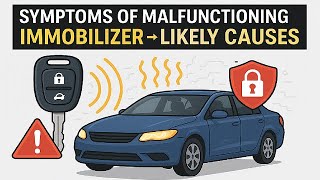
- Engine Starts and Immediately Stalls — The engine runs for 1-2 seconds before the immobilizer confirms the key mismatch and cuts fuel and spark, abruptly shutting it down. 🎬 Watch: A breakdown of common immobilizer symptoms and their causes.
- Intermittent No-Start or No-Crank Condition — The problem is inconsistent. The car starts fine one day and refuses to start the next, pointing to a failing component, a loose connection, or RF interference.
- Erratic Electrical Behavior — If the Body Control Module (BCM) is failing, you experience unrelated electrical problems, such as malfunctioning interior lights, power locks, or wipers alongside the P1615 code.
- Engine Stalls Intermittently While Driving — In dangerous cases, a severe wiring issue or failing module causes the security system to lose communication while the car is in motion, shutting the engine off.
Diagnostic Flowchart
Tap your situation to follow the diagnostic path that matches what you're seeing on this code.
Common Fixes & Costs
- Replace Key Fob Battery — Parts: $5-$15, Labor: $0, ~0.1 hr book time (DIY)
- Replace Main Vehicle Battery — Parts: $150-$250, Labor: $0-$50, ~0.5 hr book time (DIY)
- Replace and Reprogram Car Key — Parts: $75-$250, Labor: $75-$150, ~0.8 hr book time (Professional)
- Replace Immobilizer Antenna Ring — Parts: $50-$150, Labor: $100-$200, ~1.2 hr book time (Intermediate)
- Replace Immobilizer Control Module / BCM — Parts: $350-$800, Labor: $150-$300, ~2.0 hr book time (Professional)
- Replace and Reprogram ECU — Parts: $800-$2000+, Labor: $100-$250, ~1.5 hr book time (Professional)
Used vs. New Parts: Buying Guide
When a used part is worth it: Buying a used Body Control Module (BCM) is highly risky. It only makes sense if sourced from a specialized electronics recycler that 'virginizes' the module (resets it to factory state) and provides a warranty.
Donor-vehicle mileage cap: roughly under 50000 miles for the part to have meaningful remaining life.
Donor quality checklist:
- Part number must be an exact match.
- Verify the seller can virginize the module before buying.
- Avoid modules from flood-damaged or heavily corroded vehicles.
Decision logic:
- If The part is a BCM or Immobilizer Module → Strongly favor a new OEM part to ensure compatibility and avoid programming nightmares.
- If A reputable specialist offers a refurbished/virginized BCM with a warranty → This is a cost-effective alternative to a new OEM part.
- If The part is from a private seller or standard junkyard with no programming service → Avoid entirely. The module is VIN-locked and will be a paperweight.
Warranty tradeoff: Used parts from junkyards offer a 30-day warranty and do not cover labor. New OEM parts carry a 1-year warranty. Specialist-refurbished modules offer a 6-month to 1-year warranty.
Worst-case if a used part fails: $500-$1000 if a used BCM cannot be programmed—cost of the useless part plus diagnostic and labor fees.
What Happens If You Wait — Timeline
- Immediate: Initial failure. The car cranks but does not start, or starts and immediately stalls. The security light is illuminated. The vehicle is undrivable. (MPG impact: N/A% · Added cost: $75-$200 if a tow is required.)
- 5-10 minutes (Repeated Start Attempts): After 5 consecutive failed start attempts, the system enters 'Lock Mode,' setting a P1610 code. The ECU is locked and will not allow a start even with a valid key. (MPG impact: N/A% · Added cost: $100-$250 for a professional diagnostic scan and reset procedure.)
- 1-3 Days (Misdiagnosis): Believing it's a fuel or spark issue, the owner replaces the fuel pump or starter. The problem persists because the immobilizer is the root cause. (MPG impact: N/A% · Added cost: $300-$700 for unnecessary parts and labor with no resolution.)
- Weeks to Months (Ignoring Root Cause): If caused by water intrusion, ongoing moisture corrodes the BCM and wiring harnesses, leading to widespread, erratic electrical problems beyond the no-start issue. (MPG impact: N/A% · Added cost: $800-$2000+ for replacing and programming a water-damaged BCM and repairing wiring.)
Cost of Not Fixing It
- Immediate: The vehicle will not start, leaving you stranded. (Added cost: $75-$200 for a tow to a repair shop or locksmith.)
- Minutes (Multiple Failed Attempts): The immobilizer system enters 'Lock Mode' (triggering code P1610). The vehicle will not start even with a valid key until the lock mode is cleared using a dealer-level tool. (Added cost: $100-$250 for advanced diagnostics and reset procedures.)
- Days to Weeks: No progressive mechanical damage occurs, but the vehicle remains undrivable. Secondary issues like a drained battery occur from repeated failed start attempts. (Added cost: $150-$250 for a new battery if drained beyond recovery.)
Diagnosis Steps

- Try the Spare Key
If the car starts and runs normally with the spare key, the problem lies entirely with your primary key's damaged transponder or dead battery.
Tools: Spare car key (Beginner) - Check for RF Interference
Remove all other keys, fobs, and electronic devices from your keychain. Try starting the car with the key isolated. If it starts, RF interference was blocking the signal.
Tools: None (Beginner) - Replace the Key Fob Battery
Open the key fob and replace the coin-cell battery. This inexpensive fix resolves weak signal issues immediately.
Tools: Small screwdriver, new key fob battery (e.g., CR2032 or CR2025) (Beginner) - [PRO TIP] Perform a Battery Load Test
Check the static voltage with a multimeter; it must be at least 12.4V. Perform a load test by measuring the voltage while an assistant cranks the engine. The voltage must NOT drop below 9.6V. If it does, the battery is weak and corrupting the immobilizer signal.
Tools: Multimeter (Advanced) - Inspect the Key for Damage
Examine the key's housing for cracks or water damage. If the key was dropped or submerged, the internal transponder chip is compromised, even if the remote buttons work.
Tools: None (Beginner) - Check Immobilizer-Related Fuses
Inspect the fuse boxes for fuses labeled 'ANTI-THEFT,' 'NATS,' 'IMMOBI,' 'BCM,' or 'IGN.' A blown fuse points to a short circuit in the corresponding component.
Tools: Fuse puller, owner's manual (Beginner) - Inspect Immobilizer Antenna Wiring
Remove the plastic shrouds around the steering column to access the ignition cylinder. Visually inspect the immobilizer antenna ring and its connector for frayed, pinched, or corroded wires.
Tools: Screwdrivers, trim removal tools (Intermediate) - [PRO TIP] Test Immobilizer Antenna Ring Resistance
With the antenna connector unplugged, use a multimeter set to Ohms (Ω) to measure the resistance across the two pins of the antenna coil. The reading must match the specification in your service manual (typically 5-20 Ohms). Infinite or zero resistance indicates a failed antenna.
Tools: Multimeter, vehicle-specific service manual (Advanced) - Scan with an Advanced Bi-Directional Tool
A standard OBD-II scanner only reads the code. A professional-grade scan tool is required to access the immobilizer/BCM data stream, verify key insertion recognition, and perform key reprogramming functions.
Tools: Professional bi-directional scan tool (Professional) - [PRO TIP] Check for Zero Fuel Pressure
Connect a fuel pressure gauge to the fuel rail's service port. Turn the key to the 'ON' position. The fuel pressure should be 0 PSI. The immobilizer disables the fuel pump, confirming the system is active and the no-start is not a mechanical fuel issue.
Tools: Fuel pressure gauge (Advanced) - [PRO TIP] Inspect Module Grounds and Check for Voltage Drop
Locate the primary ground points for the ECM and BCM. Check for voltage drop between the negative battery post and the BCM/ECM ground point while the key is on. The reading must be less than 0.2 volts; higher readings indicate excessive resistance.
Tools: Socket set, wire brush, multimeter, service manual (Advanced) - [PRO TIP] Test Communication Bus Integrity
Check the CAN bus at the OBD-II port. With the key on, CAN High (Pin 6) should be ~2.5-3.5V and CAN Low (Pin 14) should be ~1.5-2.5V. With the battery disconnected, resistance between Pin 6 and Pin 14 should be ~60 Ω. Incorrect values point to a network wiring issue.
Tools: Multimeter, Oscilloscope (optional) (Advanced)
When This Code Triggers (Freeze-Frame Conditions)
- Engine RPM: 0 - 250 RPM (Engine is off or being cranked by the starter.)
- Vehicle Speed: 0 mph (Vehicle is stationary during the failed start attempt.)
- Engine Load: 0 - 25% (No load on the engine as it is not running or is only cranking.)
- Battery Voltage: 9.5 - 12.5V (Reflects battery voltage during the key-on or cranking event; low voltage confirms battery failure.)
- Engine Coolant Temp: Ambient Temperature (Typically reflects a cold engine, as the fault usually occurs on initial startup.)
Related Codes
- P1610 — Appears with P1615 on Nissan/Infiniti. P1610 means 'Lock Mode,' indicating the immobilizer locked the ECU after multiple failed start attempts. You must fix the P1615 cause before clearing P1610.
- P1614 — A sister code to P1615 on Nissan/Infiniti. While P1615 means the key was read but rejected, P1614 means the key could not be read at all. They point to the same components but differentiate between a bad code and total signal loss.
- P1612 — Points to a communication chain issue between the immobilizer module and the Body Control Module (BCM). P1615 is a general key error, while P1612 specifically flags a wiring or protocol problem.
- U1000 / U0100 — General CAN communication network failure codes. If present with P1615, a wider network problem is affecting the immobilizer system, requiring diagnosis of the entire communication bus.
Climate & Environmental Factors
- Extreme Cold: Cold temperatures reduce a car battery's cranking power. This causes system voltage to drop below 9.6V during startup, leading to a communication error and triggering P1615. This is the most common cause in winter.
- High Humidity / Water Ingress: Water leaks from windshields or sunroofs cause corrosion on the pins of the BCM, ECU, and fuse box. This creates high resistance, interrupting immobilizer data signals.
How to Talk to a Mechanic About This Code
Say this: "My car won't start and is showing a P1615 code. I need a diagnostic for an immobilizer communication failure. I've already tried my spare key and checked the key fob battery. Please check for power at the immobilizer antenna and communication with the BCM before recommending a new module."
This signals you're an informed customer, directing the technician to perform specific, logical diagnostic steps rather than immediately suggesting an expensive module replacement.
Avoid saying:
- 'My car won't start, I think it's the battery.'
- 'The anti-theft light is on, can you just turn it off?'
- 'My key isn't working, just make me a new one.' (without proper diagnosis)
Questions to ask before authorizing the repair:
- What was the specific point of failure in the immobilizer system (key, antenna, BCM, wiring)?
- If a new key or module is needed, does the quoted price include the cost of programming and synchronizing it with the vehicle?
- Can you show me the diagnostic readings from the BCM or immobilizer module that confirm the diagnosis?
- What is the warranty on the new part and the labor for this repair?
Where to Take It: Dealer vs Independent vs Chain
- Dealer:
A safe but expensive option. They have the correct diagnostic tools and guaranteed access to parts and programming.
Best for: Vehicles under warranty., Very new models (less than 3 years old) where aftermarket tools lack support., Complex cases involving multiple module failures or manufacturer-specific software updates.
Downsides: Highest labor rates and parts costs., May default to replacing entire modules when a simpler wiring repair is possible. (Typical cost: +50% vs. baseline) - Independent Shop:
Excellent choice, IF the shop is properly equipped. Ask specifically if they have advanced bi-directional scanners and key programming capabilities before towing it there.
Best for: Out-of-warranty vehicles where cost is a major factor., Shops that specialize in your vehicle's make or in-vehicle electronics., Building a long-term relationship with a trusted mechanic.
Downsides: Quality and equipment vary widely; you must vet the shop., May not have the latest manufacturer-specific tools for programming. (Typical cost: +0% vs. baseline)
When to Walk Away From the Repair
If the estimated repair cost exceeds 50% of the car's current private-party value, seriously consider selling or trading it in.
- Car worth $3500, fix is $1100: Borderline. The repair is 31% of the car's value. If the rest of the car is reliable, it's worth fixing. Get a second opinion.
- Car worth $12000, fix is $450: Fix it. The repair cost is low compared to the vehicle's value.
- Car worth $2500, fix is $1500: Walk away. The repair cost is 60% of the car's value. It is not economically sensible to proceed.
What Scan Tool You Need for This Code

Minimum: A bi-directional scan tool with specific IMMO (immobilizer) and key programming functions for your vehicle's make.
A basic $20-$100 code reader is completely inadequate for a P1615. It reads the code but cannot access the BCM, immobilizer data, or perform key programming procedures. You will waste money guessing.
Budget: None (~$0) — No scanner under $100 has the necessary bi-directional control and immobilizer programming functions to solve a P1615.
Mid-range: Foxwell NT710 / NT510 Elite (~$150-250) — Provides OE-level diagnostics for a specific brand. It accesses the IMMO system, reads security data, and performs some key programming and reset functions.
Professional: Autel MaxiIM IM508S / XTOOL D7S (~$500-1000) — Professional-grade tools that combine all-system diagnostics with advanced IMMO and key programming functions. They handle 'all keys lost' scenarios, BCM/ECU coding, and have bi-directional controls.
Rent vs buy: Renting is not a viable option. Auto parts stores do not rent out high-level, bi-directional scanners required for key programming. Buy a mid-range or pro-level tool only if you are a serious DIYer who will use the advanced diagnostic features for multiple repairs.
How to Clear the Code After You Fix It
- Fix the root cause (e.g., reprogram key, replace antenna).
- Use an OBD-II scan tool to clear the P1615 and any related codes (like P1610).
- For Nissan/Infiniti in 'Lock Mode' (P1610), cycle the ignition ON with a registered key for 5 seconds, then OFF, repeated 3 times before attempting to start.
- Disconnecting the battery for 30 minutes resets modules but clears readiness monitors.
Drive cycle (~20 minutes): A specific drive cycle is not required to clear the P1615 fault, but is needed to set emissions readiness monitors after disconnecting the battery. A typical cycle includes a cold start, idling, mixed city/highway driving, and steady cruising.
Readiness monitors affected: Catalyst (CAT), Evaporative System (EVAP), Oxygen (O2) Sensor, Oxygen Sensor Heater
Before emissions retest: drive at least 50 miles to fully set monitors.
Watch out for:
- Clearing the code with a scanner without fixing the underlying problem causes the code to return immediately.
- Failing to clear a P1610 'Lock Mode' code prevents the car from starting even after the P1615 cause is fixed.
- Attempting an emissions test before the readiness monitors are 'Ready' results in an automatic failure.
Will This Fail Emissions / State Inspection?
Yes — this code typically fails an OBD-II emissions inspection.
- California: An illuminated security light that prevents the engine from starting is an automatic failure. If the battery was disconnected, readiness monitors must be set to 'Ready' before testing.
- New York: The NYS DMV inspection includes an OBD-II scan. An active P1615 code results in an automatic failure.
- Texas: In counties requiring emissions testing, an active diagnostic trouble code like P1615 is an automatic failure. The vehicle cannot complete the OBD-II test.
Most Commonly Affected Vehicles
- Nissan Altima, Maxima, 350Z, Frontier, X-Trail, Sentra (2002-2018) — Extremely common due to the NATS system. Failures point to the BCM, a bad key, or the immobilizer antenna. The system locks after 5 failed start attempts.
- Infiniti G35, G37, Q50, FX35, QX70 (2003-2019) — Uses the same NATS system as Nissan. For push-to-start models (2007+), the Smart Keyless Switch Assembly is a frequent failure point.
- Subaru Impreza, Forester, Outback, Legacy, WRX (2008-2020) — Highly sensitive to low voltage from the main vehicle battery, which causes the system to lose key memory.
- Ford Focus, Fiesta, Transit, Mondeo (2000-2015) — Ford's PATS (Passive Anti-Theft System) triggers P1615 during key transponder or antenna communication errors.
- Mazda 3, 6, CX-5, MX-5 (2003-2016) — Appears related to failures in the key-to-immobilizer handshake process, similar to Ford's PATS.
- Chevrolet / GM Colorado, Silverado, Cobalt, Trailblazer (2004-2012) — Indicates a 'Loss of VTD (Vehicle Theft Deterrent) Serial Data', pointing to a communication failure between the BCM and ECM.
- Mitsubishi Lancer, Outlander, ASX, Colt (2004-2017) — Indicates a failure in the immobilizer system communication link.
- Hyundai Accent, Elantra, Tiburon, Tucson (2005-2015) — Points to an immobilizer communication error or a fault within the Electronic Throttle System (ETS) controller.
Manufacturer-Specific Notes

- Nissan/Infiniti: A solid red security light on the dash with the key 'ON' is the tell-tale sign of a NATS malfunction. The BCM is a very common failure point and requires programming with a Nissan CONSULT diagnostic tool.
- Honda/Acura: A flashing green key symbol on the dashboard is the primary indicator of an immobilizer problem. The system requires a specialized scan tool for key reprogramming.
- Subaru: Subaru immobilizer systems are notoriously sensitive to low main vehicle battery voltage. A dead battery causes the system to lose its memory of programmed keys. Newer models (2020+) require an 8-digit 'Authentication Key' for repairs.
- Toyota/Lexus: On certain models, P1615 indicates a 'Communication Error from Distance Control ECU to ECM', related to the dynamic radar cruise control system, not the immobilizer.
- BMW: P1615 signifies an 'Engine control module (ECM), processor fault - SPI-bus failure', pointing to an internal hardware problem within the main computer rather than a key issue.
Real Owner Stories
2002 Nissan Pathfinder, mileage unknown
After several weeks of sitting in extreme cold (-30°C), the battery went completely flat. After charging and reconnecting the battery, the car would crank but not start.
What they tried:
- Charged the battery.
- Checked for spark and found none.
- Read codes and found P1610 (Lock Mode).
Outcome: Owner had the vehicle towed to the dealership. The dealer reprogrammed the immobilizer and provided a second key. The total cost was $387.
Lesson: A dead battery in extreme cold causes the immobilizer system to lose its key memory and enter 'Lock Mode' (P1610). A dealer or specialist with programming tools is required to fix this.
2003 Nissan 350Z, 'Flood Car'
While driving, the car intermittently shut off for 2-3 seconds and then turned back on, occurring every 20 minutes. This happened despite the car starting normally.
What they tried:
- The owner noted the car was a 'flood car' but the BCM and ECU had been replaced.
- The primary key being used was the original.
Outcome: The owner planned to try their newly made key to see if the problem was the original key's transponder. The intermittent nature pointed towards a failing BCM, NATS antenna, or the key itself.
Lesson: While P1615 typically causes a no-start, a severe electrical fault or failing module causes the engine to shut off while driving, which is extremely dangerous. This is highly likely in vehicles with water damage.
2001 Nissan Sentra SE, ~18 years old
Car was moved a short distance and shut off. A few hours later, it would crank but not start. The original 18-year-old battery was weak.
What they tried:
- Read codes, finding pending P1610 and P1612.
- Tried all three factory keys.
- Replaced the weak battery, which made it crank faster but didn't solve the no-start.
- Attempted a key-cycle reset procedure with the old battery, which failed.
Outcome: The owner correctly identified that a weak battery triggered the NATS system to lock out the keys. The next step was to try the key-cycle reset with the new battery or call a locksmith.
Lesson: A weak battery causes the NATS system to trigger a fault, even if it has enough power to crank the engine. The low voltage during cranking disrupts communication, leading to codes P1610 and P1612.
2003 Subaru Impreza, mileage unknown
Car suddenly stalled while driving and would not restart, though it would turn over. The fuel pump seemed to be working.
What they tried:
- Confirmed the fuel pump was priming.
- Fuse boxes looked clean.
- The owner suspected a fuel pressure issue or another sensor.
Outcome: A common cause for this specific symptom on this vehicle is a failed crankshaft position sensor. Low battery voltage is also a known trigger for strange electrical issues on Subarus.
Lesson: On a Subaru, a sudden crank-no-start condition is often a failed crankshaft position sensor, which does not always set a trouble code. Rule out primary engine sensors before assuming immobilizer failure.
How to Prevent This Code From Triggering
- Maintain Main Car Battery Health (Test annually after 3 years of use) — A weak battery is a top cause of P1615. Low voltage during cranking corrupts communication between the key and immobilizer, causing the system to lose key memory.
- Protect Key Fobs from Damage (Daily habit) — Dropping the key or exposing it to water damages the internal transponder chip, rendering it useless even if the remote buttons work.
- Replace Key Fob Battery Proactively (Every 2-3 years) — A weak fob battery provides an inconsistent signal that the car fails to read, triggering the code. Replacing the CR2032 battery is a cheap preventive measure.
- Check for and Clear Water Drains (Annually, especially in the fall) — Clogged sunroof or cowl drains cause water to leak into the cabin and onto the BCM, causing corrosion and failure.
- Use Dielectric Grease on Connectors (When servicing related components) — Applying dielectric grease to connector pins seals out moisture and prevents future corrosion, a primary cause of electrical failures.
Frequently Asked Questions
Can I bypass the immobilizer to fix P1615?
While technically possible for a professional, it is not recommended. Bypassing the system requires permanent modification to your car's wiring and computer. Diagnose and repair the root cause instead.
Why did P1615 appear right after my car battery died or was replaced?
A sudden loss of power during cranking corrupts the key memory stored in the immobilizer. When power is restored, the system no longer recognizes the valid key. Disconnecting the battery for 30 minutes sometimes resets the modules, but reprogramming is usually required.
Do I have to go to the dealership for a new key?
Not necessarily. Most modern automotive locksmiths have the equipment to cut and program transponder keys at a lower cost than a dealership. However, for very new or high-end models, the dealer is the only option.
Can a cheap, universal OBD-II scanner fix this?
No. A basic scanner reads and clears the code, but the code returns immediately because the underlying security fault remains. You need a professional, bi-directional scan tool to reprogram keys and access the BCM.
My car starts but then dies in 2 seconds. Is this P1615?
Yes, this is a classic symptom. The immobilizer system allows the engine to fire briefly before verifying the key's security code. When authentication fails, the system cuts fuel and spark, shutting the engine down.
What happens if I try to start the car too many times with the wrong key?
Most immobilizer systems enter a 'lock mode' after 5 to 10 consecutive failed attempts. This locks out the ECU and sets a separate code like P1610. The car will not start even with a correct key until a professional clears the lock mode.
Can I replace the BCM or ECU myself?
You can physically swap the module, but the car will not start. These modules are part of the security system and must be programmed to your specific vehicle using dealer-level diagnostic tools. This is not a DIY plug-and-play repair.
Can a faulty instrument cluster cause a P1615 code?
Yes. On vehicles like certain Infiniti models, the instrument cluster is an integral part of the immobilizer communication network. A fault within the cluster interrupts the security data exchange and triggers a P1615 code.
Key Takeaways
- Code P1615 disables your engine because the main computer cannot authenticate the transponder chip in your key.
- Isolate your key from other electronics and replace the CR2032 fob battery before spending money on diagnostics.
- A solid or flashing red security light on the dashboard confirms the immobilizer system is actively blocking the engine from starting.
- Test your main vehicle battery under load; voltage dropping below 9.6V during cranking corrupts the key signal and triggers this code.
- If a new battery or spare key fails, you must hire a locksmith or dealer with a bi-directional scan tool to reprogram the immobilizer module.
Helpful Videos

The information in this article is provided for general reference and educational purposes only. Vehicle specifications, procedures, and part compatibility can vary by production date, trim level, and region. Always consult your vehicle's factory service manual and verify part numbers before purchasing or performing repairs. Safety-critical components such as airbags, seat belts, and braking systems should be installed by a qualified professional.
- 🎬 Helpful Videos
- What Does P1615 Mean?
- Can I Drive With P1615?
- Common Causes
- Symptoms
- Diagnostic Flowchart
- Common Fixes & Costs
- Used vs. New Parts: Buying Guide
- What Happens If You Wait — Timeline
- Cost of Not Fixing It
- Diagnosis Steps
- When This Code Triggers (Freeze-Frame Conditions)
- Related Codes
- Climate & Environmental Factors
- How to Talk to a Mechanic About This Code
- Where to Take It: Dealer vs Independent vs Chain
- When to Walk Away From the Repair
- What Scan Tool You Need for This Code
- How to Clear the Code After You Fix It
- Will This Fail Emissions / State Inspection?
- Most Commonly Affected Vehicles
- Manufacturer-Specific Notes
- Real Owner Stories
- 2002 Nissan Pathfinder, mileage unknown
- 2003 Nissan 350Z, 'Flood Car'
- 2001 Nissan Sentra SE, ~18 years old
- 2003 Subaru Impreza, mileage unknown
- How to Prevent This Code From Triggering
- Frequently Asked Questions
- Can I bypass the immobilizer to fix P1615?
- Why did P1615 appear right after my car battery died or was replaced?
- Do I have to go to the dealership for a new key?
- Can a cheap, universal OBD-II scanner fix this?
- My car starts but then dies in 2 seconds. Is this P1615?
- What happens if I try to start the car too many times with the wrong key?
- Can I replace the BCM or ECU myself?
- Can a faulty instrument cluster cause a P1615 code?
- Key Takeaways
- 🎟️ Get 5% Off