

OBD-II Code P1612: Immobilizer Communication Error
What P1612 means, why it triggers, and how to fix it
- Code P1612 disables your vehicle's fuel and ignition systems because the engine computer cannot verify the security chip inside your key.
- Test your car battery with a multimeter to ensure it reads at least 12.6 volts, as low voltage is the leading trigger for immobilizer communication failures.
- Attempt to start the car with your spare key before calling a tow truck to instantly rule out a damaged primary key transponder.
- Expect to pay an automotive locksmith between $150 and $300 to reprogram your keys or immobilizer module, as DIY scanners cannot perform this security reset.
What Does P1612 Mean?

Code P1612 means your Engine Control Module (ECM) is not receiving the correct security signal from the immobilizer system. The immobilizer checks for a specific transponder chip in your key before allowing the engine to start. When this communication fails, the vehicle assumes it is being stolen and disables the ignition and fuel systems.
Technical definition: A manufacturer-specific code indicating a communication failure between the Engine Control Module (ECM) and the Immobilizer Control Module (IMMU). It points to a break in the anti-theft system's data chain, most notably in the Nissan Anti-Theft System (NATS).
Can I Drive With P1612?
No — Do Not Drive. The engine will not start, or it will stall immediately. The vehicle's anti-theft system is actively preventing the engine from running. Repeatedly trying to start the car will engage a permanent 'lock mode' on many systems, requiring an expensive dealer reset.
Common Causes

- Faulty or Unprogrammed Key (Very Common) — The transponder chip inside the key is damaged, the fob battery is dead, or you are using an unprogrammed aftermarket key. Using the wrong key multiple times triggers this code.
- Weak or Dead Car Battery (Common) — Low voltage from a failing battery disrupts the communication handshake between the immobilizer and the engine computer. This fault often persists even after jump-starting or replacing the battery.
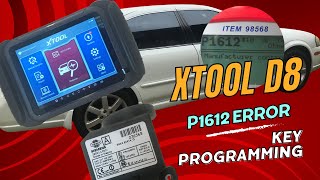
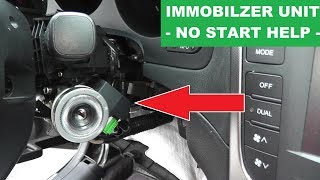
- Faulty Immobilizer Control Module (IMMU) (Common) — The immobilizer module, which reads the key and signals the ECM, has failed internally. This is a widespread issue on Nissan and Infiniti models. 🎬 Watch: How to replace the immobilizer and reprogram your keys.
- Aftermarket Remote Starter or Alarm (Common) — Improperly installed aftermarket security systems splice into factory wiring and interrupt the immobilizer data bus, causing communication errors.
- Wiring or Connector Issues (Less Common) — Damaged, corroded, or loose wires between the key reader antenna, immobilizer module, and ECM block the security signal.
- Blown Fuse (Less Common) — A blown fuse for the immobilizer system, instrument panel, or ECM cuts power and instantly halts communication.
- Faulty Engine Control Module (ECM) (Rare) — The main engine computer has an internal fault, such as a corrupted EEPROM, preventing it from communicating with other modules.
Symptoms
- Engine Cranks But Won't Run — You turn the key and the starter engages, but the engine will not fire because the ECM has disabled the fuel injectors and ignition coils.
- Security/Anti-Theft Light is Solid or Flashing — The dashboard security icon (often a car with a key) stays illuminated solid or flashes rapidly while cranking.
- Engine Stalls Immediately After Starting — The engine fires up for one to two seconds and then shuts off as the ECM fails to verify the key's security code.
- Check Engine Light is On — The malfunction indicator lamp (MIL) illuminates to log the P1612 communication error.
Diagnostic Flowchart

Tap your situation to follow the diagnostic path that matches what you're seeing on this code.
Common Fixes & Costs
- Reprogram or Replace Car Key/Fob — Parts: $50-$200, Labor: $100-$150, ~1.0 hr book time (Professional)
- Replace Car Battery — Parts: $150-$250, Labor: $0-$50, ~0.5 hr book time (DIY)
- Replace Immobilizer Control Unit (IMMU) — Parts: $200-$500, Labor: $150-$300, ~2.0 hr book time (Professional)
- Remove/Repair Aftermarket Remote Starter — Parts: $0-$50, Labor: $100-$200, ~1.5 hr book time (Intermediate)
- Replace Engine Control Module (ECM) — Parts: $600-$1200, Labor: $200-$350, ~2.5 hr book time (Professional)
Used vs. New Parts: Buying Guide
When a used part is worth it: Buying a used immobilizer module or ECM is never recommended for a DIY repair. These parts contain security data specific to the donor vehicle and will not work without advanced EEPROM cloning.
Donor-vehicle mileage cap: roughly under 200000 miles for the part to have meaningful remaining life.
Donor quality checklist:
- The only viable used option is buying a complete, matched set: the ECM, immobilizer module, and keys from the exact same donor vehicle.
- Verify the part numbers match exactly.
Decision logic:
- If The vehicle is your daily driver and reliability is critical. → Buy a new OEM part and have it programmed by a dealer or qualified locksmith.
- If You are a DIYer with a standard OBD-II scanner. → Do not buy a used immobilizer or ECM. You cannot program it.
Warranty tradeoff: Used parts from a salvage yard carry a 30-day warranty that does not cover programming labor. New OEM parts include a 1-year warranty.
Worst-case if a used part fails: $800 if a used module strategy fails, factoring in the useless part, wasted labor, and the eventual cost of a new programmed unit.
What Happens If You Wait — Timeline
- Immediate: The vehicle cranks but does not start. The security light on the dashboard illuminates. (MPG impact: N/A% · Added cost: $75-$200 (Cost of a tow to a repair shop).)
- 0-1 Day: Owner repeatedly tries to start the car. On Nissan/Infiniti models, this triggers 'Lock Mode' (P1610) after five failed attempts. (MPG impact: N/A% · Added cost: $150-$300 (Additional cost for a locksmith to reset the 'Lock Mode').)
- 1-5 Days: Owner misdiagnoses the issue and replaces unrelated parts (e.g., fuel pump, starter) without success. (MPG impact: N/A% · Added cost: $200-$500 (Cost of incorrect parts and wasted labor).)
Cost of Not Fixing It
- Immediate: Vehicle will not start, leaving you stranded. (Added cost: $75-$200 for a tow to a repair shop.)
- 0-1 Day: Repeatedly trying to start the vehicle with an unrecognized key triggers a permanent 'Lock Mode' (P1610). (Added cost: $150-$300 added to the repair bill for a specialized dealer reset.)
Diagnosis Steps

- Check the Key and Try a Spare
Inspect your primary key for physical damage. Attempt to start the vehicle with your spare key. If the spare works, the transponder chip in your primary key is dead. Remove other electronic fobs from your keychain to rule out signal interference.
Tools: Spare key (Beginner) - Test the Car Battery
Measure the battery voltage across the terminals. A healthy battery reads at least 12.6 volts with the engine off. If voltage drops below 10V during cranking, charge or replace the battery. Low voltage is the leading trigger for this code.
Tools: Multimeter (Beginner) - Inspect Fuses
Check the cabin and under-hood fuse boxes for blown fuses related to the immobilizer, anti-theft system, ECM, or instrument panel. Replace any blown fuses with the exact same amperage.
Tools: Fuse puller, owner's manual (Beginner) - Reset the System
Disconnect the negative battery terminal for 30 minutes. Reconnect it and attempt to start the car. This clears temporary low-voltage glitches but will not fix a hard module failure or a 'lock mode' state.
Tools: Wrench (Intermediate) - Scan for Related Codes
Connect an advanced OBD-II scanner. Look for companion codes like U1000 (CAN bus failure), P1610 (Lock Mode), or P1614 (Key-to-IMMU failure). These pinpoint exactly where the communication chain broke.
Tools: Advanced OBD-II scanner (Intermediate) - Inspect Wiring and Connectors
Remove the steering column shroud. Visually inspect the wiring at the immobilizer antenna ring and the IMMU module. Look for chafed wires, loose pins, or poorly spliced aftermarket remote starter wiring.
Tools: Flashlight, trim removal tools, screwdriver (Intermediate) - Check Fuel Pressure (KOEO)
Turn the key to the 'On' position without cranking. The fuel pump should prime. If a fuel pressure gauge reads 0 PSI at the rail, the ECM has actively disabled the fuel pump due to the anti-theft system.
Tools: Fuel pressure gauge (Advanced) - Advanced: Verify Communication Line Integrity
Check the data lines between the IMMU and ECM. For Nissan/Infiniti, back-probe the communication wire at the ECM with the ignition on; an oscilloscope should show a fluctuating 0V to 5V digital signal. For GM/Ford, measure resistance between CAN High and CAN Low at the OBD-II port (pins 6 and 14) with the battery disconnected; it should read 60 ohms.
Tools: Multimeter, Oscilloscope, Wiring Diagram (Professional) - Advanced: Check Immobilizer Antenna Signal
Use an oscilloscope to check for a signal from the immobilizer antenna ring when the key is turned on. A healthy antenna produces a distinct waveform as it pings the key's transponder. No signal indicates a dead antenna.
Tools: Oscilloscope (Professional)
When This Code Triggers (Freeze-Frame Conditions)
- Engine RPM: 200-300 RPM (Engine cranking, but not starting.)
- Vehicle Speed: 0 mph (Vehicle is stationary during the start attempt.)
- System Voltage: Below 10.5V (Often reveals a severe voltage drop during cranking, pointing to a weak battery as the root cause.)
Related Codes
- P1610 — Indicates 'Lock Mode' on Nissan/Infiniti. Sets when the immobilizer activates after five consecutive failed start attempts. P1612 is the communication problem; P1610 is the resulting lockdown.
- P1614 — Indicates 'Chain of IMMU-KEY'. Points specifically to a failure between the key's transponder chip and the immobilizer antenna. Seeing P1614 isolates the problem to the key itself.
- U1000 — A general CAN bus failure code. If P1612 appears with U1000, a broader network problem (like a bad Body Control Module or a shorted data bus) is causing the immobilizer to fail.
- B3040 — A body code indicating a 'Communication Malfunction on Wire Line'. Points directly to a physical wiring fault between the immobilizer and another module.
Climate & Environmental Factors
- Low Temperatures: Freezing weather weakens marginal car batteries, causing voltage to drop below the threshold required for the immobilizer and ECM to communicate during cranking.
- High Humidity / Water Ingress: Moisture causes corrosion on the pins of the immobilizer module, ECM, or related connectors, leading to intermittent communication failures.
How to Talk to a Mechanic About This Code
Say this: "My car is cranking but won't start and I have a P1612 code. I've already checked the battery and tried my spare key. I need a diagnosis of the immobilizer system, specifically the communication between the key, the immobilizer module, and the ECM."
This signals you've done basic troubleshooting and focuses the technician on the anti-theft system, preventing them from wasting diagnostic time on the fuel pump or starter.
Avoid saying:
- 'My car won't start, I think it's the battery.'
- 'My check engine light is on, can you just fix it?'
- 'A guy online said to replace the crankshaft sensor.'
Questions to ask before authorizing the repair:
- What is your diagnostic fee for an immobilizer issue?
- Does your quoted price include programming and any necessary key codes?
- Do you have the specific equipment to program keys and modules for my exact make and model?
Where to Take It: Dealer vs Independent vs Chain
- Dealer:
A reliable but expensive option. They have the correct tools but default to replacing more parts than necessary.
Best for: Vehicles still under warranty., Complex cases where multiple modules need replacement and programming.
Downsides: Highest cost for parts and labor., Requires towing the vehicle to the lot. (Typical cost: +50% vs. baseline) - Independent Shop:
Risky. Call ahead and ask specifically if they have advanced immobilizer tools. Otherwise, they will just diagnose it and send you to a dealer.
Best for: Diagnosing related issues like wiring faults or battery problems.
Downsides: Many lack the expensive, specialized tools needed for key and immobilizer programming. (Typical cost: +0% vs. baseline) - Chain Shop:
Avoid for this code, except for a simple battery check.
Best for: Battery testing and replacement.
Downsides: Never equipped for immobilizer diagnostics or key programming., High risk of misdiagnosis. (Typical cost: -10% vs. baseline)
When to Walk Away From the Repair
If the estimated repair cost exceeds 50% of the car's private-party market value, seriously consider selling the car as-is.
- Car worth $4000, fix is $2200: Walk away. The repair cost is over half the car's value. The money is better put toward a replacement vehicle.
- Car worth $12000, fix is $800: Fix it. This repair is well below the threshold and restores a valuable asset.
What Scan Tool You Need for This Code
Minimum: A scanner with IMMO (immobilizer) and key programming functions for your specific vehicle make.
A basic $50 code reader only clears the P1612 code; it cannot perform the security programming required to make new keys or modules work. The code returns instantly.
Budget: None Recommended (~$0) — Scanners in this price range lack immobilizer programming functions.
Mid-range: XTOOL D7 (~$350) — Offers robust key programming functions, including reading PIN codes and adding keys for many brands.
Professional: Autel MaxiIM IM508S or XTOOL D8 (~$500-800) — Professional-grade tools offering comprehensive IMMO functions, including 'all keys lost' scenarios and module replacement coding.
Rent vs buy: You cannot rent key programming tools. For a one-time fix, paying a professional locksmith is far more cost-effective than buying a capable $350+ scanner.
How to Clear the Code After You Fix It
- Perform the physical repair (e.g., replace immobilizer module, program new key).
- Use an OBD-II scan tool to clear P1612 and any companion codes.
- Cycle the ignition off, then start the engine to verify the security light turns off.
Drive cycle (~20 minutes): Start the engine and idle for 3 minutes. Accelerate to 55 mph and hold a steady speed for 5 minutes. Decelerate without braking. Perform 10 minutes of mixed city driving to reset readiness monitors.
Readiness monitors affected: Comprehensive Component Monitor, Misfire Monitor
Before emissions retest: drive at least 50 miles to fully set monitors.
Watch out for:
- Clearing the code without fixing the underlying hardware issue causes the code to return instantly.
- Disconnecting the battery will not clear a 'Lock Mode' (P1610) fault on Nissan/Infiniti vehicles.
Will This Fail Emissions / State Inspection?
Yes — this code typically fails an OBD-II emissions inspection.
- California: Automatic failure. A P1612 code illuminates the Check Engine Light (MIL), which is an immediate fail for a Smog Check.
- New York: Automatic failure. An active P1612 code and illuminated MIL prevents the vehicle from passing the OBD-II scan.
Most Commonly Affected Vehicles
- Nissan Versa, Maxima, Pathfinder, Sentra, Frontier (2001-2015) — Extremely common due to flaws in the Nissan Anti-Theft System (NATS). Often caused by a bad immobilizer unit (IMMU part 28590-C9901) or low battery voltage.
- Infiniti G35, I35, QX4 (2001-2012) — Shares the NATS system with Nissan. A weak battery is the most frequent trigger for this 'CHAIN OF ECM-IMMU' error.
- Chevrolet / GMC Silverado, Tahoe, Impala, Malibu, Sierra (2003-2015) — Defined as 'Loss of IPM Serial Data,' pointing to a communication failure with the Instrument Panel Module, which disables the starting circuit.
- Subaru Legacy, Outback, Forester, Impreza (2005-2014) — Indicates an EEPROM (internal memory) error within the ECM, usually caused by a failed programming attempt or internal ECM fault.
- Hyundai / Kia Accent, Elantra, Rio, Sportage (2003-2016) — On Hyundai, points to the SMARTRA immobilizer module. On Kia, P1612 is uniquely defined as a 'Throttle Offset Malfunction,' pointing to the electronic throttle body, not the immobilizer.
Manufacturer-Specific Notes
- Nissan/Infiniti: The NATS system enters a permanent 'lock mode' (P1610) if an unregistered key is used five times consecutively. No amount of battery disconnecting clears this; it requires a dealer or locksmith reset.
- General Motors: P1612 is defined as 'Loss of IPM Serial Data'. A dead or malfunctioning instrument cluster disrupts the data bus and causes a no-start condition.
- Kia: Kia uses P1612 to indicate a 'Throttle Offset Malfunction.' Diagnosis must focus on the electronic throttle body and its wiring, completely ignoring the immobilizer system.
- Volkswagen/Audi: P1612 means 'Engine Control Module Incorrect Coding.' This occurs after an ECM replacement or software update where the module was not correctly adapted to the vehicle's immobilizer.
Real Owner Stories
2002 Nissan Pathfinder, ~130K miles
Car cranked but would not start after replacing a dead battery. Security light on the dash was solid.
What they tried:
- Disconnecting the new battery for several hours.
- Trying the spare key.
Outcome: The issue was a NATS malfunction triggered by the battery change. The owner had the vehicle towed to a dealer who reprogrammed the immobilizer and keys for $387.
Lesson: On Nissan/Infiniti vehicles, a simple battery replacement can de-sync the immobilizer system. A dealer or locksmith reprogram is the only solution.
2005 Nissan Maxima with aftermarket remote start
Car intermittently failed to start, eventually becoming a permanent crank-no-start with code P1612. The owner had a Viper remote start system installed years prior.
What they tried:
- Clearing the code.
- Replacing a weak battery.
Outcome: The final diagnosis was a failing immobilizer control unit (IMMU). The owner replaced the IMMU (part # 28590-C9901) and used an XTool D8 scanner to perform the key reprogramming procedure themselves.
Lesson: While a weak battery contributed, the root cause was a failed IMMU module, a highly common hardware failure on this platform.
2001 Infiniti QX4, mileage unknown
Car wouldn't start one morning, just rapid clicking. It started sluggishly an hour later with the Check Engine Light on and code P1612 stored.
What they tried:
- Mechanic recommended key reprogramming based on the code.
Outcome: The owner replaced the battery, which permanently resolved the starting issue. The P1612 code was a phantom error caused by low voltage.
Lesson: Always test the battery first when P1612 appears. A low voltage event is a primary trigger and does not always indicate a true immobilizer hardware failure.
How to Prevent This Code From Triggering
- Maintain Car Battery Health (Test annually after 3 years) — Low voltage is a primary trigger for P1612. A healthy battery ensures stable power to the ECM and immobilizer modules during startup.
- Protect Your Transponder Key (Daily habit) — Avoid dropping the key on hard surfaces or getting it wet, as this shatters or shorts the internal transponder chip.
- Replace Key Fob Battery Proactively (Every 2-3 years) — In integrated keys, a weak coin battery (e.g., CR2032) causes signal degradation.
- Avoid Heavy Keychains (Daily habit) — Multiple RFID cards or other transponder keys on the same ring cause radio frequency interference, preventing the car from reading the correct key.
Frequently Asked Questions
Can I fix P1612 myself?
You can perform basic checks like testing the battery, inspecting fuses, and trying a spare key. However, most fixes require specialized diagnostic and programming tools. Replacing an immobilizer module or reprogramming a key must be done by a professional locksmith or dealer.
How much does it cost to fix P1612?
A simple fuse or battery replacement costs under $250. A locksmith reprogramming keys costs between $150 and $300. Replacing a failed immobilizer or ECM at a shop ranges from $500 to $1,500 including parts, labor, and programming.
Will disconnecting the battery clear code P1612?
Disconnecting the battery for 30 minutes clears the code only if it was a temporary low-voltage glitch. If there is a hardware failure or the system is in 'lock mode' (P1610), the code returns immediately. You cannot bypass a hard immobilizer fault by unhooking the battery.
Can an aftermarket remote starter cause a P1612 code?
Yes, aftermarket remote starters and alarms frequently cause P1612. These systems splice into the vehicle's ignition wiring and interrupt the immobilizer data bus. A poor installation or failing bypass module blocks the security signal to the ECM.
I have P1612, should I replace my crankshaft sensor?
No, this is a common misdiagnosis. While a bad crankshaft sensor causes a crank-no-start condition, it does not trigger a P1612 anti-theft code. If your tachometer shows RPMs while cranking, your crank sensor works fine.
Why did this code appear after my battery died?
A dead battery causes severe voltage drops that corrupt the communication handshake between the immobilizer and the engine computer. The modules fail to resynchronize even after you install a new battery. This requires a professional scan tool to reset the immobilizer system.
What is the difference between P1612 and P1610?
P1612 indicates a communication failure between the immobilizer module and the engine computer. P1610 is a secondary 'Lock Mode' code triggered after five failed start attempts with an unrecognized key. P1612 is the root problem, while P1610 is the resulting security lockdown.
Key Takeaways
- Code P1612 disables your vehicle's fuel and ignition systems because the engine computer cannot verify the security chip inside your key.
- Test your car battery with a multimeter to ensure it reads at least 12.6 volts, as low voltage is the leading trigger for immobilizer communication failures.
- Attempt to start the car with your spare key before calling a tow truck to instantly rule out a damaged primary key transponder.
- Expect to pay an automotive locksmith between $150 and $300 to reprogram your keys or immobilizer module, as DIY scanners cannot perform this security reset.
Helpful Videos

The information in this article is provided for general reference and educational purposes only. Vehicle specifications, procedures, and part compatibility can vary by production date, trim level, and region. Always consult your vehicle's factory service manual and verify part numbers before purchasing or performing repairs. Safety-critical components such as airbags, seat belts, and braking systems should be installed by a qualified professional.
- 🎬 Helpful Videos
- What Does P1612 Mean?
- Can I Drive With P1612?
- Common Causes
- Symptoms
- Diagnostic Flowchart
- Common Fixes & Costs
- Used vs. New Parts: Buying Guide
- What Happens If You Wait — Timeline
- Cost of Not Fixing It
- Diagnosis Steps
- When This Code Triggers (Freeze-Frame Conditions)
- Related Codes
- Climate & Environmental Factors
- How to Talk to a Mechanic About This Code
- Where to Take It: Dealer vs Independent vs Chain
- When to Walk Away From the Repair
- What Scan Tool You Need for This Code
- How to Clear the Code After You Fix It
- Will This Fail Emissions / State Inspection?
- Most Commonly Affected Vehicles
- Manufacturer-Specific Notes
- Real Owner Stories
- 2002 Nissan Pathfinder, ~130K miles
- 2005 Nissan Maxima with aftermarket remote start
- 2001 Infiniti QX4, mileage unknown
- How to Prevent This Code From Triggering
- Frequently Asked Questions
- Can I fix P1612 myself?
- How much does it cost to fix P1612?
- Will disconnecting the battery clear code P1612?
- Can an aftermarket remote starter cause a P1612 code?
- I have P1612, should I replace my crankshaft sensor?
- Why did this code appear after my battery died?
- What is the difference between P1612 and P1610?
- Key Takeaways
- 🎟️ Get 5% Off