

OBD-II Code P1611: A Comprehensive Guide to Immobilizer & Communication Failures
What P1611 means, its multiple definitions across brands, and how to diagnose and fix it like a pro
- 1. Verify your manufacturer's specific definition for P1611 before replacing parts, as it means 'Immobilizer Failure' on Nissans but 'Transmission Control Module Short' on Volkswagens.
- 2. Test your spare key immediately; if the engine starts, the primary key's transponder chip is dead and requires a $150-$300 replacement.
- 3. Measure your main vehicle battery voltage during engine cranking; a drop below 9.6V corrupts the immobilizer synchronization and triggers P1611.
- 4. Stop DIY repairs and tow the vehicle to a shop with a bi-directional scanner if replacing the key fob battery and the immobilizer fuse fails to clear the code.
What Does P1611 Mean?

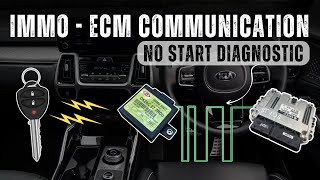
P1611 is a manufacturer-specific diagnostic trouble code (DTC) indicating a communication failure between the Engine Control Module (ECM) and the vehicle's immobilizer system. The immobilizer prevents the engine from starting unless it authenticates a key with a correctly coded transponder chip. When this communication link fails, the ECM cannot verify the key's identity and cuts fuel and ignition to prevent theft.
Technical definition: While the official SAE/ISO definition varies by manufacturer, the most common interpretation is "Engine Control Module (ECM) – Immobilizer Communication Failure." It sets when the ECM fails to receive a valid signal from the immobilizer control module within a specific timeframe after turning the ignition on. For Nissan and Infiniti, it is defined as "ID Discord -- IMMU-ECM," meaning ID verification between the immobilizer unit and the ECM failed. For Volkswagen or Hyundai, this code points to entirely different systems, such as the transmission control module or MIL request circuits.
Can I Drive With P1611?
No — Do Not Drive. The engine will not start. If the engine starts, it stalls unexpectedly, making the vehicle unsafe to drive. Continuing to try and start the vehicle leaves you stranded, requiring a tow that costs between $100 and $300.
Common Causes

- Faulty or Damaged Key Transponder (Very Common) — The key fob's internal microchip sustains damage from drops, water exposure, or strong magnetic fields, preventing it from transmitting its security code.
- Low Vehicle Battery Voltage (Very Common) — A weak car battery causes significant voltage drops during engine cranking, leading to communication glitches and synchronization loss between modules.
- Damaged Immobilizer Wiring or Connectors (Common) — The wiring harness connecting the immobilizer module, key reader antenna, and ECM frays, corrodes, or shorts due to vibrations or rodent damage.
- Failed Immobilizer Control Module (Common) — The immobilizer module degrades internally or suffers water damage, halting all communication with the anti-theft system.
- Blown Immobilizer Fuse (Less Common) — A blown fuse cuts all power to the immobilizer system, resulting in a complete communication loss with the ECM.
- Abrupt Power Loss or Improper ECU Shutdown (Less Common) — Disconnecting the vehicle's battery while the ignition is on corrupts the memory synchronization between the immobilizer and the ECM.
- Radio Frequency (RF) Interference (Less Common) — Strong RF signals from aftermarket remote starters, alarm systems, or toll passes interfere with the low-frequency communication between the key transponder and immobilizer antenna.
- Faulty Engine Control Module (ECM) (Rare) — The ECM suffers an internal hardware fault or corrupted memory, preventing it from communicating with other modules.
Symptoms

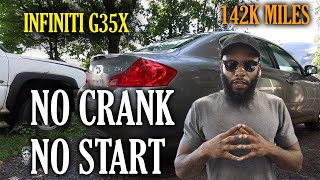
- Engine Cranks But Will Not Start 🎬 Watch: A step-by-step diagnostic for an Infiniti no-start condition. — The starter motor turns the engine over, but the ECM disables fuel injection and ignition because it lacks key authentication.
- Flashing or Solid Security Light — The vehicle's security indicator light blinks rapidly or stays illuminated during startup attempts, signaling a system fault.
- Check Engine Light is On — The ECM illuminates the Malfunction Indicator Lamp immediately upon detecting the communication failure.
- Intermittent Starting Issues — The vehicle starts only after multiple key cycles, indicating a failing component, loose connection, or RF interference.
- Remote Key Fob Malfunctions — Remote functions like door lock/unlock fail because the entire key fob unit loses synchronization with the vehicle's security system.
Diagnostic Flowchart
Tap your situation to follow the diagnostic path that matches what you're seeing on this code.
Common Fixes & Costs
- Replace Key Fob Battery — Parts: $1-$15, Labor: $0, ~0.1 hr book time (DIY)
- Replace and Program New Key — Parts: $70-$450, Labor: $100-$250, ~1 hr book time (Professional)
- Replace Immobilizer Fuse — Parts: $1-$5, Labor: $0, ~0.1 hr book time (DIY)
- Repair Immobilizer Wiring/Connectors — Parts: $10-$50, Labor: $150-$450, ~1.5 hr book time (Intermediate)
- Replace Immobilizer Control Module
— Parts: $150-$600, Labor: $150-$350, ~2 hr book time
(Professional)
: OEM 28590-C9901 (Altima), 28590-C9968 (350Z), BEM320-600 (Micra K13) (Alt: Walker, Standard Motor Products)
: OEM 89780-06041 (Camry), 89780-33291 (Camry) (Alt: Denso, Dorman)
: OEM 28590-C9968 (Shared with Nissan) (Alt: Standard Motor Products) - Replace Engine Control Module (ECM)
— Parts: $400-$1200, Labor: $200-$400, ~1.5 hr book time
(Professional)
: OEM Various, often sold as repair service (e.g., for 350Z, Altima) (Alt: Bosch, Hitachi, Cardone (Remanufactured))
: OEM 89661-06G10 (Example for Camry, often sold with key/immobilizer) (Alt: Denso, Cardone (Remanufactured))
: OEM 23710-CM30B, 23710-CF91A (G35) (Alt: Hitachi, Flagship One (Programmed))
DIY vs Professional
- Replace Key Fob Battery / Immobilizer Fuse — Beginner:
- Repair Immobilizer Wiring/Connectors — Beginner:
- Replace and Program New Key — Beginner:
- Replace Immobilizer Control Module / ECM — Beginner:
Used vs. New Parts: Buying Guide
When a used part is worth it: For older vehicles where a new OEM ECM or immobilizer module exceeds the vehicle's value.
Donor-vehicle mileage cap: roughly under 100000 miles for the part to have meaningful remaining life.
Donor quality checklist:
- Verify the exact part number match; superseded numbers may not be compatible.
- Purchase from a reputable recycler that offers a warranty.
- Visually inspect the part for signs of corrosion, physical damage, or burnt electronics.
Decision logic:
- If Part requires programming (ECM, Immobilizer) → Factor in the cost of professional programming ($150-$400), as a used part will not be plug-and-play.
- If Vehicle is over 10 years old and budget is the primary concern → A used part with a 90-day warranty is a reasonable risk.
- If The fault is intermittent and hard to diagnose → Avoid buying a used part to prevent paying for labor twice if it doesn't solve the problem.
Warranty tradeoff: Used parts offer a 30-90 day part-only warranty. New aftermarket parts offer 1-year warranties. New OEM parts carry a 1-year/12,000-mile warranty.
Worst-case if a used part fails: $400-$800 if a used module is faulty or incompatible, requiring repeat labor costs.
What Happens If You Wait — Timeline
- 0-4 weeks: Intermittent no-start. The car fails to start once, but works on the second or third try. The security light flashes during the failed attempt. (MPG impact: 0%% · Added cost: $0)
- 1-3 months: Frequent no-start. The problem occurs several times a week. The owner tries the spare key or waits 10 minutes with the key on to get it to start. (MPG impact: 0%% · Added cost: $60-$180 in diagnostic fees.)
- 3-6 months: Permanent no-start. The vehicle no longer starts under any circumstances. The security light is constantly on or flashing when the key is turned. (MPG impact: 0%% · Added cost: $100-$300 for a tow truck.)
- 6+ months (if cause is water leak): Compounded failure. Moisture that initially damaged the immobilizer wiring corrodes the connectors on the Body Control Module (BCM) or ECM. (MPG impact: 0%% · Added cost: $800-$1600)
Cost of Not Fixing It
- Immediate: Vehicle will not start or will be completely unreliable, leading to being stranded. (Added cost: $100-$300 for a tow.)
- Weeks to Months: An intermittent starting problem becomes a permanent no-start condition. Continued moisture intrusion damages expensive control modules. (Added cost: $500-$1600 if a simple wiring fix is ignored and leads to a failed ECM or Immobilizer module.)
- Long-Term: A faulty immobilizer system fails to secure the vehicle, making it vulnerable to theft. (Added cost: Potential total loss of vehicle.)
Diagnosis Steps

- Try a Different Key
Insert the spare key. If the car starts, the primary key's transponder chip is dead.
Tools: Spare key (Beginner) - Inspect and Replace Key Fob Battery
Replace the key fob battery to rule out weak signal transmission, even if remote door locks still function.
Tools: New key fob battery (e.g., CR2032, CR2025) (Beginner) - Check the Immobilizer Fuse
Locate the fuse for the immobilizer system (labeled IMMO, NATS, or Anti-Theft) and replace it if blown.
Tools: Owner's manual, fuse puller or pliers (Beginner) - Perform a Voltage Drop Test During Cranking
Connect a multimeter to the battery. A healthy battery reads ~12.6V at rest and stays above 9.6V during cranking. Drops below 9.6V reset control modules and trigger P1611.
Tools: Multimeter (Intermediate) - Scan for Other Codes
Use an advanced OBD-II scanner to read manufacturer-specific codes from the BCM and Immobilizer modules. Codes like P1610 or P1614 provide critical context.
Tools: Advanced OBD-II scanner (Beginner) - Inspect Wiring and Connectors
Visually inspect the wiring harness around the ignition switch antenna ring and ECM. Wiggle connectors while observing scan tool data to spot intermittent faults.
Tools: Flashlight, trim removal tools (Intermediate) - Attempt Immobilizer System Initialization
Use a bi-directional scan tool to access Immobilizer special functions and perform a 'System Relearn'. This fixes desynchronization on Nissan/Infiniti vehicles after a battery dies.
Tools: Bi-directional scan tool (Advanced) - Advanced: Check Live Data PIDs
Access the live data stream for the Immobilizer. A healthy system shows 'Registered' or 'OK' when the correct key is inserted. 'Unregistered' confirms a recognition problem.
Tools: Advanced bi-directional scan tool (Advanced) - Advanced: Test Immobilizer Antenna Coil
Check resistance between the antenna coil terminals around the ignition switch. Readings should show low resistance (e.g., 18-24 Ohms), not an open circuit or short.
Tools: Multimeter, vehicle-specific wiring diagram (Advanced) - Test Fuel Pressure
Connect a fuel pressure gauge. A reading of 0 PSI during a P1611 no-start confirms the ECM shut off the fuel pump due to failed key authentication.
Tools: Fuel pressure gauge set (Intermediate) - Advanced: Scope the Communication Line
Tap the communication wire between the immobilizer and ECM with an oscilloscope. A noisy or absent square wave signal confirms a wiring or module hardware problem.
Tools: Oscilloscope, vehicle-specific wiring diagram (Advanced)
When This Code Triggers (Freeze-Frame Conditions)
- DTC That Caused Freeze Frame: P1611 (Code is logged when ECM detects a communication failure with the immobilizer module.)
- Engine RPM: 0 - 300 RPM (Code is set during key-on or while cranking the engine, before it successfully starts.)
- Vehicle Speed: 0 mph (The vehicle is stationary when the communication failure is detected.)
- System Voltage: 9.5V - 12.0V (Shows a low voltage reading if a weak battery is the root cause, especially during an attempted crank.)
- Engine Coolant Temperature: Ambient to Operating Temp (Fault occurs at any temperature, but is common on cold starts when battery performance is reduced.)
Related Codes
- P1610 — Indicates 'Lock Mode' after 5+ consecutive failed start attempts with an invalid key. P1611 is the underlying communication failure.
- P1612 — Indicates a 'Chain of Error'. The ECM and immobilizer are communicating but cannot agree on the security code, unlike P1611's total communication breakdown.
- P1614 — Points specifically to a problem between the key's transponder chip and the immobilizer antenna. P1611 is the broader communication fault.
- B2192 — An Infiniti/Nissan body control module code identical in meaning to P1611, confirming an immobilizer synchronization issue.
Climate & Environmental Factors
- Low Temperatures: Cold weather reduces battery cranking amperage, causing system voltage to drop below the 9.6V threshold and triggering P1611.
- High Humidity / Water Intrusion: Water leaking from clogged sunroof drains directly damages the immobilizer control module and accelerates wiring corrosion.
How to Talk to a Mechanic About This Code
Say this: "My car cranks but won't start and the security light is flashing with a P1611 code. Please check the keys, battery voltage during cranking, and the immobilizer fuse before checking modules."
Guides the technician to a logical, cost-effective diagnostic path and prevents them from immediately assuming the ECM failed.
Avoid saying:
- 'My car won't start, can you fix it?'
- 'Just do whatever it takes to get it running.'
- 'My friend said it's probably the computer, can you replace it?'
Questions to ask before authorizing the repair:
- Did you try the spare key and check the key fob battery?
- What was the battery voltage during a crank test?
- If you are recommending a module or key replacement, can you confirm you have the ability to program it here?
- Can you show me the corroded wiring or the failed component?
- What is the warranty on this specific repair, including parts and labor?
Where to Take It: Dealer vs Independent vs Chain
- Dealer:
A safe but expensive option. Necessary for warranty work or if your vehicle requires proprietary software that independent shops lack.
Best for: Vehicles under warranty, Complex, brand-specific programming issues on newer cars (2018+), When other shops have failed to diagnose the problem
Downsides: Highest labor rates and part costs., Defaults to replacing entire modules instead of attempting a wiring or component repair. (Typical cost: +50% vs. baseline) - Independent Shop:
Best fit for most situations. A good independent shop or an automotive locksmith handles the vast majority of P1611 repairs at a lower cost than the dealer.
Best for: Out-of-warranty vehicles with common P1611 causes (key, wiring, immobilizer module)., Vehicle owners seeking the best balance of expertise and value., Shops specializing in your vehicle's brand (e.g., a Toyota specialist).
Downsides: Shop must have modern, bi-directional scan tools with immobilizer function., Quality varies; check for ASE certifications and good reviews. (Typical cost: +0% vs. baseline) - Chain Shop:
AVOID for P1611 diagnosis. This code requires specialized knowledge and tools that are typically beyond the scope of a chain repair shop.
Best for: Simple, unrelated maintenance like oil changes or tires.
Downsides: Not equipped for complex electronic or security-related diagnostics., High risk of misdiagnosis, leading to unnecessary part replacement., Technician skill level is inconsistent. (Typical cost: -10% vs. baseline)
When to Walk Away From the Repair
Consider selling the car as-is if the estimated repair cost exceeds 50% of its private-party value.
- Car worth $3000, fix is $1600: Walk away. The repair cost is over 50% of the car's value. The risk of another major repair is too high.
- Car worth $8000, fix is $500: Fix it. This repair represents a small fraction of the vehicle's value and restores its primary function.
- Car worth $4000, fix is $1800: Borderline. The repair is 45% of the car's value. Get a second opinion before proceeding. Consider the car's overall condition.
What Scan Tool You Need for This Code
Minimum: Reads manufacturer-specific codes from the Body Control Module (BCM) and Immobilizer module.
A $20 code reader only shows the ECM's perspective and cannot access live security data or perform key relearn procedures.
Budget: BlueDriver Pro (~$100) — Excellent for initial diagnosis. It reads codes from all modules (ECM, BCM, ABS, etc.) and shows freeze-frame data, but lacks bi-directional control to program keys.
Mid-range: Foxwell NT510 Elite (~$180) — A powerful tool for a specific car brand. It offers bi-directional control, allowing you to access advanced immobilizer functions and potentially perform key relearn procedures.
Professional: Autel MaxiCOM MK808S / MK906BT (~$400-1200) — Professional-level diagnostics. These tools have extensive immobilizer and key programming functions, including reading PIN codes, adding/deleting keys, and performing system initializations.
Rent vs buy: Renting is not viable. Free rental scanners lack the immobilizer and programming functions required to solve P1611. Buy a scanner if you plan to diagnose and repair yourself.
How to Clear the Code After You Fix It
- Reconnect battery if disconnected for repair
- Use an OBD-II scan tool to clear the code from all modules (ECM, BCM, Immobilizer)
- Perform a key relearn or system initialization if required by the manufacturer (especially Nissan)
- Complete a full drive cycle to ensure the code does not return and to set readiness monitors
Drive cycle (~30 minutes): Start with a cold engine. Idle for 3 minutes with rear defroster and A/C on. Drive for 15 minutes in mixed city/highway conditions. Maintain 55 mph for 10 minutes. Cool down completely.
Readiness monitors affected: All monitors are reset to 'Not Ready' when codes are cleared, Catalyst and EVAP monitors are often the last to become 'Ready'
Before emissions retest: drive at least 50-100 miles to fully set monitors.
Watch out for:
- Disconnecting the battery to clear the code resets all readiness monitors, leading to a failed emissions test.
- The code returns immediately if the root cause is not properly fixed.
- Forgetting to perform a key/system re-initialization after replacing a component prevents the car from starting.
Will This Fail Emissions / State Inspection?
Yes — this code typically fails an OBD-II emissions inspection.
- California: An illuminated Check Engine Light results in an automatic smog check failure. After repairs, a drive cycle must be completed to set readiness monitors before a retest is possible.
- New York: A vehicle fails the OBD-II inspection if the Check Engine Light is on. For model year 2001 and newer vehicles, the test fails if more than one readiness monitor is 'Not Ready'.
- Texas: In counties requiring emissions testing, an illuminated Check Engine Light is an automatic failure. After clearing the code, you may only have one or two monitors 'Not Ready' depending on vehicle year.
Most Commonly Affected Vehicles
- Nissan Micra, Altima, 350Z, Qashqai (2002-2012) — Defined as 'ID Discord'. Triggered by a discharged battery causing the NATS to lose synchronization.
- Toyota Camry, Corolla, RAV4 (2000-2020) — Prone to P1611 due to failures in the immobilizer control module or wiring caused by cabin water leaks.
- Infiniti M45, G35 (2003-2007) — Defined as 'ID Discord -- IMMU-ECM'. Sets with P1610 after an invalid key is used.
- Volkswagen Jetta, Golf, Passat (2002-2010) — Defined as 'MIL Call-Up Circuit, Transmission Control Module Short to Ground.' This is a wiring issue, NOT an immobilizer fault.
- Kia/Hyundai Sorento, Optima / Santa Fe, Elantra (2005-2015) — Defined as 'MIL Request Signal Circuit Low Voltage.' Points to a problem in the check engine light request circuit.
- Chevrolet Optra, Aveo, Captiva (2004-2011) — Indicates low voltage in the ignition relay circuit or a loss of communication with the variable suspension control module.
- Honda Accord, Civic, CR-V (2003-2012) — Indicates an immobilizer communication failure caused by a faulty key transponder or bad receiver unit.
- Subaru Forester, Impreza (2005-2012) — Indicates an 'EEPROM Error,' a memory corruption issue within the Engine Control Module requiring replacement.
Manufacturer-Specific Notes
- Nissan/Infiniti: Means 'ID Discord' pointing to a synchronization problem after a dead battery. Requires a 'C/U Initialization'.
- Toyota/Lexus: Points to a failure in the immobilizer system communication chain. Diagnosis focuses on the module, wiring, and key transponder.
- Hyundai/Kia: Means 'MIL Request Signal Circuit Low Voltage', indicating a check engine light circuit problem, not an anti-theft issue.
- Volkswagen/Audi: Defined as 'MIL Call-Up Circuit, Transmission Control Module Short to Ground', indicating a TCM wiring issue.
- Mitsubishi: Defined as 'Battery Voltage Sensor System', related to the battery current sensor communicating with the ECM.
- Subaru: Indicates an 'EEPROM Error', a memory chip problem inside the ECM requiring replacement.
- Chevrolet/GM: Points to a low voltage condition in the main ignition relay circuit or a communication loss with the variable suspension module.
- Ford: Defined as 'SBDS Interactive Codes', relating to the Service Bay Diagnostic System and not tied to the immobilizer.
Real Owner Stories
2006 Nissan Micra with ~90K miles
Car struggled to start, especially when cold, and would cut out without revving the engine. Eventually, it became a crank-no-start condition with the security light on.
Outcome: The issue was identified as a synchronization problem between the key and the immobilizer (NATS). The ultimate fix required reprogramming the key to the immobilizer module.
Lesson: Address security codes before replacing mechanical parts. On Nissans, starting problems combined with P1611 strongly point to the NATS immobilizer system.
2004 Infiniti M45 after ECU swap
Owner replaced the original ECU with a used unit to fix other codes. After reinstalling the original ECU, the car cranked but did not start and showed codes P1610 and P1611.
Outcome: The immobilizer module paired with the new ECU and lost communication with the old one. The fix required using a professional scan tool to re-register the original keys to the original ECM and IMMU.
Lesson: Swapping ECUs desynchronizes the immobilizer system. A working remote door lock does not mean the key is authenticated to start the car.
2006 MINI Cooper with 90K miles
Car died at a stoplight, then restarted with the 'EP' (Emergency Program) and SES lights on. The transmission would not shift correctly. Code P1611 was present.
Outcome: For this vehicle, P1611 indicated a 'Serial Communication Link Transmission Control Module' error, not an immobilizer fault. The root cause was a communication breakdown with the transmission module.
Lesson: Verify the code's meaning for your specific make and model. On many European cars, P1611 is a transmission or network communication code.
How to Prevent This Code From Triggering
- Replace key fob battery proactively (Every 1-2 years) — A weak key fob battery is a top cause of intermittent signal transmission, which leads to failed key authentication and triggers a P1611 code.
- Maintain vehicle battery health (Test annually after 3 years) — A healthy car battery prevents voltage drops during cranking that corrupt communication between the ECM and immobilizer.
- Protect key fobs from damage (Daily habit) — The transponder chip inside the key is fragile. Avoid dropping keys, exposing them to moisture, or storing them near strong magnets.
- Address water leaks immediately (As needed) — Moisture from clogged sunroof drains or bad seals seeps into the dashboard and destroys the immobilizer control module or its connectors.
- Have the electrical system inspected periodically (Every 2 years) — A technician spots early signs of wiring corrosion, loose grounds, or damaged harnesses that lead to intermittent communication faults.
Frequently Asked Questions
Can a locksmith fix a P1611 code?
Sometimes. An automotive locksmith diagnoses and replaces faulty keys, programs new keys, and replaces immobilizer modules. However, if the problem is a wiring fault, an internal ECM failure, or a manufacturer-specific issue, you need a qualified auto technician.
How do I reset my car's immobilizer?
Insert the key, turn the ignition to 'ON' without starting the engine, and wait 10-15 minutes to allow system re-authentication. Turn the ignition off, remove the key, and attempt to start the car, repeating up to three times. If this fails, a professional scan tool is required for system initialization.
What are the most common misdiagnoses for P1611?
The most frequent mistake is unnecessarily replacing the expensive ECM when the actual cause is a dead key fob battery, a weak vehicle battery, or a corroded wire. Another pitfall is failing to recognize the code's different meaning on brands like VW or Hyundai.
Will disconnecting the battery clear a P1611 code?
Disconnecting the battery clears the code temporarily if caused by a minor voltage glitch. However, for many vehicles like Nissan, this action causes the P1611 code by desynchronizing the system. If there is an underlying hardware fault, the code returns immediately.
How much does it cost to fix code P1611?
Costs range from $15 for a key fob battery to $150-$450 for wiring repairs. Replacing and programming a new key costs $250-$600 depending on the vehicle. Immobilizer or ECM replacements are the most expensive, totaling $500-$1600 for parts, labor, and programming.
Is P1611 a serious problem?
Yes, it is a serious problem because it directly prevents you from starting and using your vehicle, effectively leaving you stranded. While it doesn't indicate an immediate mechanical danger to the engine itself, the lack of reliability is a critical issue.
My car starts sometimes with this code. Why?
Intermittent starting is a classic symptom of a failing component, a loose connection in the immobilizer circuit, or random RF interference. Each time you try to start the car, the connection is just strong enough to work, but it signals an impending complete failure.
Key Takeaways
- 1. Verify your manufacturer's specific definition for P1611 before replacing parts, as it means 'Immobilizer Failure' on Nissans but 'Transmission Control Module Short' on Volkswagens.
- 2. Test your spare key immediately; if the engine starts, the primary key's transponder chip is dead and requires a $150-$300 replacement.
- 3. Measure your main vehicle battery voltage during engine cranking; a drop below 9.6V corrupts the immobilizer synchronization and triggers P1611.
- 4. Stop DIY repairs and tow the vehicle to a shop with a bi-directional scanner if replacing the key fob battery and the immobilizer fuse fails to clear the code.
Helpful Videos

The information in this article is provided for general reference and educational purposes only. Vehicle specifications, procedures, and part compatibility can vary by production date, trim level, and region. Always consult your vehicle's factory service manual and verify part numbers before purchasing or performing repairs. Safety-critical components such as airbags, seat belts, and braking systems should be installed by a qualified professional.
- 🎬 Helpful Videos
- What Does P1611 Mean?
- Can I Drive With P1611?
- Common Causes
- Symptoms
- Diagnostic Flowchart
- Common Fixes & Costs
- DIY vs Professional
- Used vs. New Parts: Buying Guide
- What Happens If You Wait — Timeline
- Cost of Not Fixing It
- Diagnosis Steps
- When This Code Triggers (Freeze-Frame Conditions)
- Related Codes
- Climate & Environmental Factors
- How to Talk to a Mechanic About This Code
- Where to Take It: Dealer vs Independent vs Chain
- When to Walk Away From the Repair
- What Scan Tool You Need for This Code
- How to Clear the Code After You Fix It
- Will This Fail Emissions / State Inspection?
- Most Commonly Affected Vehicles
- Manufacturer-Specific Notes
- Real Owner Stories
- 2006 Nissan Micra with ~90K miles
- 2004 Infiniti M45 after ECU swap
- 2006 MINI Cooper with 90K miles
- How to Prevent This Code From Triggering
- Frequently Asked Questions
- Can a locksmith fix a P1611 code?
- How do I reset my car's immobilizer?
- What are the most common misdiagnoses for P1611?
- Will disconnecting the battery clear a P1611 code?
- How much does it cost to fix code P1611?
- Is P1611 a serious problem?
- My car starts sometimes with this code. Why?
- Key Takeaways
- 🎟️ Get 5% Off