

OBD-II Code P1608: Internal Control Module & Engine Performance Fault
What P1608 means, why it triggers, and how to fix it
- Code P1608 has entirely different definitions based on the manufacturer, ranging from a critical PCM failure in Fords to a simple informational 'limp mode' alert in Toyotas.
- On Ford, Chrysler, and Acura vehicles, P1608 flags a severe internal failure within the Powertrain Control Module (PCM) or a shorted wiring harness.
- Toyota models use P1608 as an informational code indicating engine power was reduced; you must diagnose secondary codes or check the secondary fuel filter to find the root cause.
- Harley-Davidson motorcycles frequently log P1608 as a harmless historical code after a battery disconnection or voltage drop below 9.5V during cranking.
- Never replace a $1,000+ PCM without first verifying battery voltage (12.6V+), testing ground connections, and inspecting the wiring harness for chafing.
What Does P1608 Mean?

P1608 is a manufacturer-specific code with entirely different definitions based on your car brand. On Ford, Chrysler, and Acura, it signals a critical internal failure within the main engine computer (PCM). On Toyota, it is an informational code indicating the engine's power was reduced due to a fault in the intake, fuel, or cooling system. On Harley-Davidson, it flags a loss of continuous battery power.
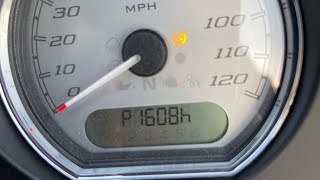
Technical definition: Because P1608 is a manufacturer-specific code, its formal definition varies: * **Ford:** Internal Control Module Malfunction; Watchdog Malfunction; Fuel Injection Pump (FIP) Monitoring Malfunction. * **Toyota:** Engine Lack of Power. * **Acura/Honda:** PCM Internal Circuit 'B' Malfunction. * **Chrysler/Jeep:** Internal TCM Failure or Loss of Serial Communications. * **Harley-Davidson:** Intermittent Loss of Power / Loss of Continuous Battery. 🎬 Watch: How to clear the P1608H code on a Harley Davidson. * **Mitsubishi:** Battery Current Sensor System Malfunction. * **Chevrolet/GM:** Ignition System Malfunction or Serial Communication Fault. * **Hyundai:** ECM Fault (Internal Digital/Analog Converter Fault). * **Volkswagen:** Steering Angle Sensor Malfunction. * **Mazda:** Engine Control Module (ECM) Internal Failure or TPMS Reception Failure.
Can I Drive With P1608?
No — Do Not Drive. Do not drive the vehicle. On Ford or Acura models, an internal computer failure causes unexpected stalling or a no-start condition. On Toyota models, the vehicle enters limp mode with dangerously slow acceleration, making highway driving unsafe. Ignoring the root cause in a Toyota (like fuel starvation or overheating) causes severe engine damage.
Common Causes

- Faulty Powertrain Control Module (PCM) (Very Common) — The most frequent cause for Ford, Chrysler, and Acura vehicles. The PCM's internal self-check detects a critical error in its own processor, memory, or circuits.
- Damaged Wiring Harness or Connectors (Common) — Wires leading to the PCM or Fuel Injection Pump chafe, corrode, or break. On Ford Transit vans, the harness frequently rubs against the starter motor case, causing a direct short.
- Underlying System Fault or Clogged Filter (Toyota) (Common) — On Toyota vehicles, P1608 is triggered by a secondary issue. Common culprits include a clogged secondary fuel filter, a dirty Mass Air Flow (MAF) sensor, or a stuck EGR valve.
- Faulty Fuel Injection Pump (FIP) (Common) — On older diesel engines, particularly Fords with Bosch VP30/VP44 pumps, the electronics on the pump fail. This disrupts the 'watchdog' signal to the PCM and triggers P1608.
- Low Battery Voltage or Bad Alternator (Less Common) — A weak battery, poor connections, or voltage spikes from a failing alternator cause communication errors and trigger internal module faults across many makes, especially Harley-Davidson.
- Faulty Battery Current Sensor (Rare) — On specific Mitsubishi models, this code points directly to a failure of the sensor monitoring the battery's state of charge and health.
Symptoms

- Engine will not start — The engine cranks but refuses to fire up, or does not crank at all. Highly common with Ford 'Watchdog' faults.
- Engine stalls unexpectedly — The engine shuts off while driving or idling without warning, creating a critical safety hazard.
- Reduced engine power ('Limp Mode') — The vehicle feels sluggish and refuses to accelerate as the computer limits engine output. This is the primary symptom for Toyota.
- Check Engine Light is on — A constant or flashing Check Engine Light illuminates on the dashboard.
Diagnostic Flowchart

Tap your situation to follow the diagnostic path that matches what you're seeing on this code.
Common Fixes & Costs
- Replace the Powertrain Control Module (PCM/ECM) — Parts: $500-$1,500, Labor: $150-$400, ~1.5 hr book time (Professional)
- Repair Damaged Wiring Harness — Parts: $10-$50, Labor: $200-$700, ~3.0 hr book time (Intermediate)
- Replace Secondary Fuel Filter (Toyota Diesel) — Parts: $30-$80, Labor: $75-$150, ~1.0 hr book time (DIY)
- Replace Fuel Injection Pump (Diesel) — Parts: $700-$2,500, Labor: $400-$800, ~5.5 hr book time (Professional)
- Clean or Replace Mass Air Flow (MAF) Sensor — Parts: $20-$250, Labor: $50-$100, ~0.5 hr book time (DIY)
Used vs. New Parts: Buying Guide
When a used part is worth it: For a PCM/ECM, a used part makes sense on older, lower-value vehicles where a new module is prohibitively expensive. For a diesel fuel injection pump, a professionally rebuilt unit offers a good balance of cost savings and reliability.
Donor-vehicle mileage cap: roughly under 100000 miles for the part to have meaningful remaining life.
Donor quality checklist:
- For PCMs, ensure the part number matches exactly. Verify the donor vehicle was not scrapped due to flood or fire damage.
- For fuel pumps, avoid 'as-is' used parts from junkyards due to contamination risks.
- Purchase from sellers who offer a warranty and a return policy.
Decision logic:
- If The part is a PCM for a vehicle newer than 10 years → Favor a new or professionally remanufactured unit due to complex programming and security integration.
- If The part is a high-pressure fuel pump and vehicle uptime is critical → Buy new or a high-quality remanufactured unit with a strong warranty.
- If The vehicle is over 15 years old and the budget is the primary concern → A used PCM from a reputable salvage yard is a viable option, but factor in the cost of professional programming.
Warranty tradeoff: Used parts typically have a 30-90 day warranty for part replacement only. Remanufactured parts offer a 1-year to limited lifetime warranty. New OEM parts carry the manufacturer's standard 12-month warranty.
Worst-case if a used part fails: $500-1500 if a used PCM or fuel pump fails after installation, requiring repeat labor costs.
What Happens If You Wait — Timeline
- 0-1 month: For a PCM/wiring fault, the vehicle experiences intermittent no-start or stalling. For a system fault (Toyota), the car enters 'limp mode' with severely limited power. (MPG impact: 5-25%% · Added cost: $100-$300 (Potential tow))
- 1-3 months: The intermittent wiring short worsens, potentially damaging the Fuel Injection Pump or PCM permanently. Driving a Toyota in limp mode puts extra strain on the transmission and causes the underlying fuel restriction to damage the main fuel pump. (MPG impact: 10-30%% · Added cost: $500-$2,000 (Cascading damage))
- 3-6 months: The intermittent fault becomes a hard fault. The Ford Transit refuses to start entirely. The Toyota driven with a clogged intake develops a damaged EGR valve and potentially a warped head from overheating. (MPG impact: N/A (Vehicle likely undriveable)% · Added cost: $1,500-$4,000 (Initial simple repair + damaged major components))
- 6+ months: Catastrophic failure. A persistent electrical short or voltage spike destroys the PCM beyond repair. An ignored cooling system fault on a Toyota leads to complete engine failure. (MPG impact: N/A% · Added cost: $4,000-$10,000+ (Full engine or multiple major component replacement))
Cost of Not Fixing It
- 0-1 month: For PCM-related faults, the primary risk is being stranded due to a no-start or stalling condition. For 'limp mode' faults, you experience dangerously slow acceleration. (Added cost: Towing costs ($100-$300))
- 1-6 months: Continuing to drive in limp mode causes cascading damage. An unaddressed fuel restriction burns out the fuel pump, or a severe intake clog leads to overheating. (Added cost: $500-$2,000+)
- 6+ months: Catastrophic engine or transmission damage. If P1608 is triggered by a severe cooling system failure that the driver ignores, it leads to complete engine failure. (Added cost: $4,000-$10,000+)
Diagnosis Steps
- Scan for All Trouble Codes & Analyze Freeze Frame Data
Use an OBD-II scanner to read all codes. P1608 is often accompanied by codes pointing to the root cause. On Toyota vehicles, analyzing freeze frame data is critical to identify the engine conditions (e.g., high coolant temp, low fuel pressure) present when the code set.
Tools: OBD-II Scanner with Freeze Frame capability (Beginner) - Check the Battery and Charging System
Ensure the battery is fully charged (12.6V+ engine off) and the alternator charges correctly (13.7V-14.7V engine running). Clean battery terminals and tighten loose cables. A weak power supply causes electronic faults.
Tools: Multimeter, Battery Terminal Brush (Beginner) - Perform a Thorough Visual Inspection
Inspect the wiring harness going to the PCM and fuel injection pump. Look for chafing where the harness rubs against other components, specifically the starter motor on Ford Transits.
Tools: Flashlight (Intermediate) - Inspect PCM Connectors and Grounds
Disconnect the PCM connectors (battery disconnected) and check for bent, corroded, or pushed-out pins. Ensure the PCM's ground connections to the chassis and engine block are clean and tight. Look for water intrusion inside the connector.
Tools: Socket Set, Screwdrivers (Intermediate) - Test Suspect Circuits (Toyota-Specific)
If a Toyota has another code (like a MAF sensor or EGR valve), diagnose that specific component first. If no other codes exist, visually inspect the EGR system for carbon buildup and check the secondary fuel filter for blockages.
Tools: Multimeter, Vehicle-Specific Repair Manual (Advanced) - Test CAN Bus Network Resistance
Disconnect the battery. Measure resistance between Pin 6 (CAN High) and Pin 14 (CAN Low) on the OBD-II port. A healthy network reads ~60 Ω. A reading of 120 Ω indicates an open circuit. A reading near 0 Ω indicates a short between the CAN lines.
Tools: High-Quality Multimeter (Advanced) - Test CAN Bus Network Voltage
With the key on (engine off), check CAN bus voltages. Pin 6 (CAN High) should read ~2.6V-2.7V, and Pin 14 (CAN Low) should read ~2.3V-2.4V. Significant deviation points to a short to ground or power.
Tools: High-Quality Multimeter (Advanced) - Check Fuel Pressure Under Load (Toyota)
Connect a fuel pressure gauge. Check for a pressure drop under heavy load (hard acceleration). A significant drop points to a restriction, like the secondary fuel filter, which remains hidden at idle.
Tools: Fuel Pressure Gauge Kit (Advanced) - Cranking Voltage Test (Harley-Davidson)
Connect a multimeter to the battery terminals. While cranking the engine, watch the voltage. If it drops below 9.5V, the battery fails the load test and cannot provide stable power to the ECM, triggering the code.
Tools: Multimeter (Advanced) - Diagnose the Powertrain Control Module (PCM)
If all tests pass and the code definition points to an internal fault (Ford/Chrysler/Acura), the PCM has failed. Diagnose this by elimination. Replacement requires professional programming.
Tools: Professional Diagnostic Scan Tool (Professional)
When This Code Triggers (Freeze-Frame Conditions)
- Engine Coolant Temp: 170-210°F (The engine is at full operating temperature. The code is less likely to set on a cold engine.)
- RPM: 1500-3000 (On a Toyota, this code sets during steady-state cruising or under acceleration when the ECU detects a lack of power.)
- Engine Load: 40-80% (The fault appears when the engine is under moderate to heavy load, such as climbing a hill or accelerating onto a highway.)
- Vehicle Speed: 40-65 mph (Consistent with highway driving, this is a common speed range for the code to trigger due to fuel starvation or intake restrictions.)
Related Codes
- P1664 — On Ford diesel vehicles, this code for 'Fuel Injection Pump Malfunction' often appears alongside P1608. If both are present, the fault is with the injection pump or its wiring, not the main PCM.
- P0101 — On a Toyota, a MAF Sensor code like P0101 is the root cause for the informational P1608 code. Fix the P0101 fault, and the P1608 resolves automatically.
- U0100 — A 'Lost Communication With ECM/PCM' code. If seen with P1608, it points to a major power, ground, or CAN network wiring problem rather than an internal PCM fault.
Climate & Environmental Factors
- Humidity and Moisture: Water intrusion is a leading cause of PCM failure. Moisture enters the PCM or connectors from clogged sunroof drains or leaking windshield seals, causing circuit board corrosion and triggering P1608.
- Cold Weather: Cold temperatures reduce battery cranking amperage. During a cold start, voltage drops low enough to cause a temporary communication glitch in the PCM, setting a P1608 code on sensitive systems like Harley-Davidson.
- Road Salt: Salty moisture accelerates corrosion of wiring harnesses, ground points, and module connectors exposed to the elements, increasing electrical faults.
How to Talk to a Mechanic About This Code
Say this: "I have a [Your Vehicle Make/Model] with a P1608 code. For a Ford/Acura, I'd say: 'I'd like to schedule a diagnostic for a P1608 code. Before condemning the PCM, please perform a thorough check of the PCM's power, grounds, and the wiring harness for any damage.' For a Toyota, I'd say: 'My Toyota has a P1608 limp mode code. Can you please retrieve the freeze-frame data and check for underlying mechanical issues like fuel or intake restrictions before looking at expensive electronics?'"
This signals to the shop that you are an informed consumer. It directs them to perform a proper diagnosis instead of jumping to the most expensive conclusion (a new PCM). It establishes a logical diagnostic path and protects you from paying for a misdiagnosis.
Avoid saying:
- 'My Check Engine light is on, can you fix it?'
- 'The car is stalling, just do whatever it takes to fix it.'
- 'I think I need a new computer.'
Questions to ask before authorizing the repair:
- What specific diagnostic steps did you take to isolate the cause of the P1608?
- If you are recommending a PCM replacement, can you show me proof that all power and ground circuits to the module are good?
- For my Toyota, what was the root cause that triggered the limp mode and the P1608 code?
- Does the quoted price for a replacement module include the necessary programming and security relearn procedures?
- What is the warranty on this repair, covering both the parts and your labor?
Where to Take It: Dealer vs Independent vs Chain
- Dealer:
A strong choice if PCM replacement is confirmed, as they have the specific tools for programming. Also good for warranty work. For out-of-warranty diagnosis, consider an independent specialist first.
Best for: Vehicles under warranty, Complex PCM programming and security integration is required, Known manufacturer-specific issues covered by a Technical Service Bulletin (TSB)
Downsides: Highest labor rates, May be quick to replace modules rather than diagnose complex wiring issues (Typical cost: +50% vs. baseline) - Independent Shop:
The best fit for most P1608 scenarios. A skilled independent diagnostician is more likely to trace a bad wire or find the underlying mechanical fault on a Toyota, saving you from an unnecessary PCM replacement.
Best for: Out-of-warranty vehicles, Diagnosing complex electrical and wiring issues, Finding cost-effective solutions like repairing a harness instead of replacing it
Downsides: Quality is highly variable; look for shops with ASE Master Technicians, specifically with an L1 certification for advanced engine performance. (Typical cost: +0% vs. baseline) - Chain Shop:
AVOID for P1608 diagnosis. The risk of an expensive misdiagnosis is extremely high. They are generally not equipped for the in-depth electrical and mechanical troubleshooting this code requires.
Best for: Simple, unrelated maintenance like oil changes or tires
Downsides: Technicians often lack the advanced diagnostic training for complex codes like P1608., High pressure to sell parts leads to misdiagnosis and unnecessary replacement of expensive components like the PCM. (Typical cost: -10% vs. baseline)
When to Walk Away From the Repair
If the estimated repair cost for the P1608 fault exceeds 50% of the car's current private-party value, it's time to seriously consider selling or trading it in rather than repairing it.
- Car worth $3500, fix is $1850: Walk away. The repair cost is over 50% of the car's value. The risk of other age-related failures is too high to justify this expensive repair.
- Car worth $15000, fix is $2200: Fix it. The repair cost is well under the 50% threshold and restores a significant amount of the vehicle's value and utility.
- Car worth $5000, fix is $3000: Walk away. The repair cost is 60% of the vehicle's value. It is not a sound financial decision.
What Scan Tool You Need for This Code
Minimum: A scanner that can read manufacturer-specific codes, display live data streams, and access freeze-frame data. This is crucial for seeing the conditions when the P1608 was set.
A basic $20 code reader only shows 'P1608' with no context. It cannot tell you if it's a Toyota's informational code, a Ford's wiring issue, or an Acura's PCM fault. Diagnosis is impossible without access to live data and freeze-frame data.
Budget: TOPDON TopScan Pro (~$90) — A Bluetooth dongle that pairs with your smartphone. It reads codes from all modules, views live data, and performs some service functions. It's a powerful entry point for diagnosing the context around a P1608.
Mid-range: Foxwell NT510 Elite (~$180) — A handheld scanner offering OE-level diagnostics for a specific car brand. It provides bi-directional control, allowing you to command components like fans or solenoids to test their function, which is vital for advanced electrical diagnosis.
Professional: Autel MaxiCOM MK808S (~$450) — A full-featured diagnostic tablet. Offers comprehensive all-system diagnostics, a wide range of service functions, and strong bi-directional control. Its robust vehicle coverage makes it a top choice for serious DIYers tackling complex issues like P1608.
Rent vs buy: For a one-time check, the free code reading service at auto parts stores gives you the code and a basic report. However, for a complex code like P1608, these free scans are insufficient. If you are serious about diagnosing it yourself, you must buy at least a mid-range scanner with live data and bi-directional capabilities.
How to Clear the Code After You Fix It
- Reconnect the battery if it was disconnected for the repair.
- Use an OBD-II scan tool to formally clear the diagnostic trouble codes from the PCM's memory.
- Perform a complete OBD-II drive cycle to allow the vehicle's readiness monitors to run and confirm the fix.
Drive cycle (~30 minutes): A general drive cycle involves: 1) A cold start (vehicle sat for 8+ hours). 2) 2-3 minutes of idling. 3) 10-15 minutes of mixed city/highway driving, including steady cruising (e.g., 55 mph for 3-5 minutes) and some stop-and-go. 4) Allowing the vehicle to cool down.
Readiness monitors affected: Catalyst (CAT) monitor, Evaporative System (EVAP) monitor, Oxygen (O2) Sensor monitor
Before emissions retest: drive at least 100 miles to fully set monitors.
Watch out for:
- Disconnecting the battery clears the code but resets all readiness monitors to 'Not Ready', causing an automatic failure at an emissions testing station.
- The code returns immediately if the underlying root cause (e.g., bad wiring, failing sensor) was not correctly repaired.
Will This Fail Emissions / State Inspection?
Yes — this code typically fails an OBD-II emissions inspection.
- California: An illuminated Check Engine Light is an automatic failure. After repair, most gasoline vehicles from 2000 and newer can only have the EVAP monitor incomplete to pass.
- New York: The NYS DMV inspection includes an OBD-II scan. An active P1608 code causes an automatic failure. A drive cycle must be completed to set readiness monitors before a re-test.
- Texas: In the 17 counties requiring emissions testing, an illuminated Check Engine Light results in a failed inspection. The vehicle cannot be re-tested until the code is cleared.
Most Commonly Affected Vehicles
- Ford Transit (2000-2014) — Extremely common for P1608 ('Watchdog Malfunction') due to the fuel injection pump wiring harness rubbing through on the starter motor case, causing a short circuit.
- Toyota Hilux (Diesel) (2005-2020) — Frequently logs P1608 as an informational code pointing to reduced power. Check for a clogged secondary fuel filter or carbon buildup in the EGR valve.
- Ford Focus / Mondeo (TDDI) (1999-2007) — Prone to electronic failure of the Bosch VP30/VP44 fuel injection pump, which directly causes P1608 and P1664 codes.
- Acura TL, MDX (2003-2008) — This code points directly to a 'PCM Internal Circuit Malfunction', making PCM failure a very high probability after verifying power and ground connections.
- Harley-Davidson Touring, Softail (2010-2023) — P1608 ('Loss of continuous power') is commonly a historical code set after the battery is disconnected. It clears easily unless a loose battery cable persists.
- Volkswagen Various (2000-2010) — For many VW models, P1608 points to a malfunction in the Steering Angle Sensor signal, an unusual definition compared to other brands.
- Infiniti M37 / G37 (2011-2013) — On vehicles with the VQ37VHR engine, P1608 indicates a power supply issue for the Variable Valve Event and Lift (VVEL) system.
Manufacturer-Specific Notes
- Toyota: P1608 is an informational code stored to tell the technician that engine power was actively reduced due to a fault detected in another system. You must diagnose other codes or use freeze frame data to find the true cause.
- Ford: The term 'Watchdog' refers to a self-test function where the PCM expects a constant 'heartbeat' signal from the fuel injection pump. If lost, the 'watchdog' triggers this code.
- Harley-Davidson: P1608 means 'intermittent loss of power' and triggers simply by disconnecting the battery or pulling a main fuse during service. Clear it and ignore unless it returns.
- Mazda: The definition of P1608 is inconsistent. Depending on the model and year, it indicates a critical internal failure of the ECM or a less severe 'TPMS Reception Failure'.
Real Owner Stories
2004 Ford Transit 2.4L TDDI with No-Start
Van cranked but would not fire. A garage replaced the fuel injection pump and ECU, but the P1608 'Watchdog signal lost' code kept returning.
What they tried:
- Replaced fuel injection pump (FIP)
- Replaced Engine Control Module (ECM)
- Replaced wiring harness
Outcome: The issue was a known wiring harness chafing problem. The loom running from the FIP to the PCM rubbed through on the back of the starter motor case, causing an intermittent short. Repairing the specific damaged wire resolved the issue.
Lesson: On a Ford Transit with P1608, always perform a thorough visual inspection of the wiring harness where it passes the starter motor before replacing expensive components.
2022 Harley-Davidson Low Rider S with Intermittent P1608
Check Engine Light came on with code P1608 'loss of continuous power'. The owner tightened a slightly loose negative battery cable, but the code returned a month later.
What they tried:
- Tightened battery terminals
- Checked for loose ground-to-frame bolts
Outcome: The owner discovered that on modern Harleys, this code is highly sensitive and appears as a historical code simply from disconnecting the battery or a voltage drop during cranking. A battery load test confirmed a weak battery.
Lesson: On a Harley, P1608 is not an immediate cause for panic. Check battery connections, clear the code, and perform a battery load test if it returns.
2017 Toyota Hilux 1GD-FTV with P1608 and Lack of Power
Vehicle went into 'limp mode' with severely reduced power, logging only code P1608.
What they tried:
- Scanned for codes
- Inspected EGR valve
Outcome: The underlying cause was a clogged secondary fuel filter. When it clogs, it restricts fuel flow, triggering the general P1608 'Engine Lack of Power' code as a symptom. Replacing this filter restored full power.
Lesson: For a Toyota diesel with P1608 and no other codes, a clogged secondary fuel filter is a common and overlooked culprit. Check this before diagnosing complex systems.
Acura TL with P1608 Misdiagnosis
Car exhibited erratic behavior and stalling, with code P1608 'PCM Internal Circuit Malfunction'. The owner immediately purchased a used PCM online.
What they tried:
- Replaced PCM with a used unit
Outcome: After installing the used PCM, the car would not start because it lacked dealer programming. The actual root cause was a corroded ground wire, which cost under $100 to fix. The owner wasted over $500 on the unnecessary PCM and towing.
Lesson: Never condemn a PCM before verifying all power and ground connections are clean and tight. Replacing a PCM requires professional programming.
How to Prevent This Code From Triggering
- Inspect and clean main battery and ground connections (Every 12 months or with every oil change) — Prevents voltage drops and electrical noise caused by corrosion. A stable power supply is critical for the PCM to operate without throwing spurious communication faults.
- Protect wiring harnesses in vulnerable areas (During any repair, or as a one-time preventative measure) — Adding protective conduit or loom to harnesses near heat sources or sharp edges prevents chafing and shorts, a direct cause of P1608 on Ford Transits.
- Apply dielectric grease to critical connectors (When connectors are disconnected for service) — Dielectric grease seals connectors from moisture, preventing pin corrosion which leads to high resistance and module communication errors.
- Replace Toyota diesel secondary fuel filter (Every 40,000-70,000 km, or per manufacturer recommendation) — This filter protects the DPF injector. When it clogs, it causes a 'lack of power' condition that triggers P1608. Proactive replacement prevents limp mode.
- Avoid high-pressure washing in the engine bay (Always) — High-pressure water forces its way past connector seals and into modules like the PCM, causing immediate short circuits or long-term corrosion.
Frequently Asked Questions
What's the difference between P1608 on a Ford versus a Toyota?
On a Ford, P1608 means the engine computer (PCM) detected a serious internal fault or a problem with the fuel injection pump. On a Toyota, it is an informational code indicating the computer reduced engine power because of a separate problem, like a clogged filter.
Can I replace the PCM myself to fix P1608?
Physically swapping the module is simple, but it is not a DIY job for modern cars. The new PCM requires professional programming with specialized software to recognize your vehicle's keys and immobilizer. Without this programming, the engine will not start.
Why did I get a P1608 code on my Toyota if the car seems to be running fine now?
Toyota sets this code when it detects a problem and reduces engine power to protect itself. The original problem was likely temporary, like a momentary sensor glitch or fuel pressure dip. A technician clears the code to see if it returns.
What is the most common misdiagnosis with P1608?
The most expensive mistake is replacing the PCM without performing a thorough diagnosis. The actual cause is often a simple fix like a loose ground wire, a corroded battery terminal, or a chafed wire in the harness. Always verify power and grounds before replacing computers.
I have P1608 on my Toyota, but no other codes. What should I check?
If P1608 is the only code, the fault is mechanical and lacks a dedicated sensor. Two common culprits are a clogged secondary fuel filter restricting flow under load, or a carbon-caked EGR valve limiting airflow. Inspect these components first.
Can a bad ground wire cause a P1608 code?
Yes. A poor ground to the PCM causes erratic behavior and voltage fluctuations that make the module fail its internal self-test, triggering a P1608 code even though the PCM itself is perfectly fine.
My Harley-Davidson has a P1608 code, should I be worried?
Usually not. This code is most often set as a historical fault after the battery is disconnected or a fuse is pulled. If the bike starts and runs fine, clear the code; if it returns, tighten your battery cables.
Why is the repair cost for P1608 so high?
The high cost occurs because the code frequently points to a failed Powertrain Control Module (PCM) or Fuel Injection Pump. These expensive components require specialized labor for installation and programming.
Key Takeaways
- Code P1608 has entirely different definitions based on the manufacturer, ranging from a critical PCM failure in Fords to a simple informational 'limp mode' alert in Toyotas.
- On Ford, Chrysler, and Acura vehicles, P1608 flags a severe internal failure within the Powertrain Control Module (PCM) or a shorted wiring harness.
- Toyota models use P1608 as an informational code indicating engine power was reduced; you must diagnose secondary codes or check the secondary fuel filter to find the root cause.
- Harley-Davidson motorcycles frequently log P1608 as a harmless historical code after a battery disconnection or voltage drop below 9.5V during cranking.
- Never replace a $1,000+ PCM without first verifying battery voltage (12.6V+), testing ground connections, and inspecting the wiring harness for chafing.
Helpful Videos

The information in this article is provided for general reference and educational purposes only. Vehicle specifications, procedures, and part compatibility can vary by production date, trim level, and region. Always consult your vehicle's factory service manual and verify part numbers before purchasing or performing repairs. Safety-critical components such as airbags, seat belts, and braking systems should be installed by a qualified professional.
- 🎬 Helpful Videos
- What Does P1608 Mean?
- Can I Drive With P1608?
- Common Causes
- Symptoms
- Diagnostic Flowchart
- Common Fixes & Costs
- Used vs. New Parts: Buying Guide
- What Happens If You Wait — Timeline
- Cost of Not Fixing It
- Diagnosis Steps
- When This Code Triggers (Freeze-Frame Conditions)
- Related Codes
- Climate & Environmental Factors
- How to Talk to a Mechanic About This Code
- Where to Take It: Dealer vs Independent vs Chain
- When to Walk Away From the Repair
- What Scan Tool You Need for This Code
- How to Clear the Code After You Fix It
- Will This Fail Emissions / State Inspection?
- Most Commonly Affected Vehicles
- Manufacturer-Specific Notes
- Real Owner Stories
- 2004 Ford Transit 2.4L TDDI with No-Start
- 2022 Harley-Davidson Low Rider S with Intermittent P1608
- 2017 Toyota Hilux 1GD-FTV with P1608 and Lack of Power
- Acura TL with P1608 Misdiagnosis
- How to Prevent This Code From Triggering
- Frequently Asked Questions
- What's the difference between P1608 on a Ford versus a Toyota?
- Can I replace the PCM myself to fix P1608?
- Why did I get a P1608 code on my Toyota if the car seems to be running fine now?
- What is the most common misdiagnosis with P1608?
- I have P1608 on my Toyota, but no other codes. What should I check?
- Can a bad ground wire cause a P1608 code?
- My Harley-Davidson has a P1608 code, should I be worried?
- Why is the repair cost for P1608 so high?
- Key Takeaways
- 🎟️ Get 5% Off