

P1604 on 2007-2015 Jaguar XF: Internal Module Error Causes and Fixes
On a Jaguar XF, P1604 is not the common 'Startability Malfunction' but likely indicates an internal Engine Control Module (ECM) error. Before replacing the expensive ECM, thoroughly check for low battery voltage or poor connections, which are common causes of module faults.
- P1604 on a Jaguar XF is very likely an internal Engine Control Module (ECM) fault, not a generic starting problem.
- Before condemning the expensive ECM, always test the battery and check all power and ground connections to the module.
- Symptoms are severe, often resulting in a no-start or stalling condition, making the vehicle unsafe to drive.
- Replacing the ECM requires special tools to program the new module to the vehicle's immobilizer system, making it a job for a professional.
What's Unique About the 2007-2015 Jaguar XF
Unlike many Toyota or Subaru vehicles where P1604 is a symptom-based code for a 'no-start' condition, on European vehicles like Jaguar, P1-series codes often point to more specific hardware or internal logic faults. Several automotive repair databases associate Jaguar's P1604 with definitions like 'Internal Control Module Driver Error' or 'PCM Internal Dual-Port RAM error'. This means the diagnostic approach is different; while a no-start might be a symptom, the root cause is presumed to be the ECM itself until proven otherwise by ruling out power supply issues. The generic 'Startability Malfunction' definition is triggered by the engine cranking too long without starting, which can be a symptom of the ECM fault but is not the fault itself on a Jaguar.
Generation note: The 2007-2015 Jaguar XF covers the first generation (X250). While there were facelifts (in 2011) and engine changes, the underlying electrical architecture (a heavily modified Ford DEW98 platform) and the meaning of this code are expected to be consistent across this generation. However, water ingress issues causing module failures are noted in technical service bulletins for 2012-2015 models.
Symptoms You May Notice
- Engine will not start (cranks but does not fire) 🎬 See this diagnostic walkthrough for a Jaguar XF that cranks but won't start
- Engine stalls intermittently or immediately after starting
- Check Engine Light is illuminated
- Vehicle enters a restricted performance or 'limp' mode
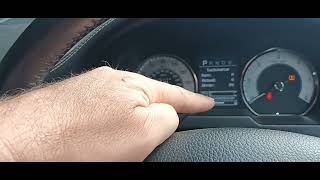
- No communication with the ECM using a scan tool 🎬 Watch: How to access the Jaguar XF hidden engineering menu
- Other seemingly unrelated electrical gremlins
- Multiple, widespread fault codes appearing simultaneously across different systems.
- Replacing fuel pumps, spark plugs, or sensors. Because the generic definition is 'Startability Malfunction', mechanics may chase fuel and ignition issues when the true fault lies with the ECM's power supply or the module itself.
Most Likely Causes
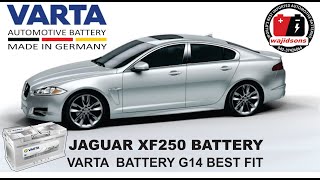
- Low or Unstable Battery Voltage 🔴 High Probability Modern vehicles with complex electronics like the XF are highly sensitive to voltage fluctuations. A weak battery or failing alternator can cause control modules to set internal fault codes. These cars often require an AGM (Absorbent Glass Mat) battery, and using a conventional battery can cause issues.
How to confirm: Test the battery voltage with a multimeter. It should be approximately 12.6V with the engine off and 13.7-14.7V with the engine running. Perform a load test on the battery, as static voltage is not a definitive test of health. Check for a parasitic drain if the battery dies frequently.
Typical fix: Recharge or replace the battery with the correct AGM type. 🎬 Watch: How to replace and register a Jaguar XF battery Inspect and test the alternator and charging system.
Est. part cost: $200-$450 (AGM Battery) - Poor Power or Ground Connections to the ECM 🟡 Medium Probability Corrosion on terminals or loose ground straps can create intermittent voltage drops to the ECM, tricking it into setting an internal fault code. Key ground points are located in the engine bay, often near the strut towers or on the bulkhead.
How to confirm: Visually inspect the main battery terminals, engine ground straps (braided cable from engine/transmission to chassis), and the ECM connector for corrosion, looseness, or damage. Perform a voltage drop test on the ECM power and ground circuits using a wiring diagram.
Typical fix: Clean, tighten, or repair the affected wiring, terminals, or ground points. This is a common and inexpensive fix that should always be checked first.
Est. part cost: $5-$50 - Internal ECM/PCM Failure ⚪ Low Probability While not common, internal component failure (like RAM or driver ICs) can occur due to age, heat cycles, or voltage spikes. Water ingress is a notable cause of failure on some Jaguar models, where clogged cowl drains allow water to seep into the ECM.
How to confirm: This is a diagnosis of exclusion. If all power, ground, and communication circuits to the ECM test perfectly, and the code persists after a hard reset (battery disconnect), the module itself is condemned.
Typical fix: Replace the Engine Control Module. This requires programming the new unit to the vehicle's VIN and immobilizer system. 'Cloning' services exist that can copy the data from the old ECM to a used one, making it plug-and-play.
Est. part cost: $800-$2000
Rare But Worth Checking
- Software Corruption: In some cases, a software glitch can cause this code. A dealer or specialist may be able to re-flash the ECM with updated software, which is cheaper than replacement. This is worth asking about before ordering a new module. TSBs are sometimes issued for software updates to fix stalling or drivability.
- Aftermarket Tuning: Improperly applied engine tunes can sometimes corrupt the ECM's memory or cause it to fail self-checks, leading to a P1604 code.
Diagnosis Steps
- Scan for all codes in all modules. Pay close attention to any other P06xx or U-series codes, as they strongly support an ECM-related fault.
- Clear the codes and attempt to start the engine. Note if the code returns immediately without cranking, or only after a failed start attempt.
- Perform a thorough battery and charging system test. Check the battery's state of health, not just its static voltage. Ensure it is the correct AGM type and that alternator output is stable and within the 13.7-14.7V range.
- Inspect all battery connections, main power feeds, and chassis grounds. Key locations include the engine block to chassis strap and grounds on the firewall/bulkhead. Look for any signs of corrosion, looseness, or physical damage. Clean and tighten as necessary.
- Locate the ECM and inspect its connectors for any signs of water intrusion, corrosion, or pushed-out pins. On many Jaguars, the ECM is in the engine bay near the cowl, an area prone to water collection if drains are clogged.
- If tools and schematics are available, perform a voltage drop test on the ECM's main power and ground wires to ensure it is receiving full battery voltage under load.
- If all external power and ground circuits are confirmed to be good and the code persists, the fault is highly likely to be internal to the ECM.
- Before replacing the ECM, consult with a Jaguar dealership or specialist to check for any available software updates (re-flashes) that might address this code. This is a less expensive potential solution.
Parts You'll Likely Need
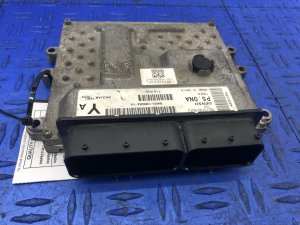
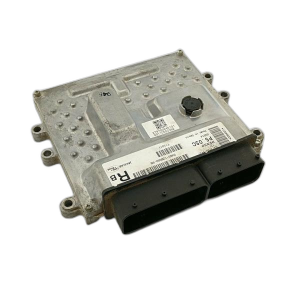
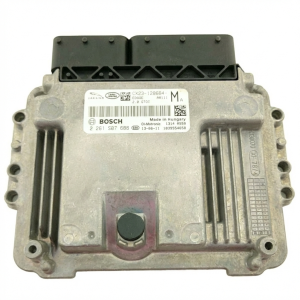
- Engine Control Module (ECM/PCM) — If all external electrical issues are ruled out, this code points to an internal failure of the ECM itself.
Trusted brands: Bosch, Denso, Genuine Jaguar
OEM price range: $1200-$2000
Aftermarket price range: $600-$1000 (Remanufactured/Cloned) - Battery — A weak or failing battery is a primary cause of spurious control module fault codes due to unstable voltage. An AGM battery is typically required.
Trusted brands: Interstate, Bosch, Deka
OEM price range: $250-$400
Aftermarket price range: $200-$300
Related Codes That Often Appear With This One
- U-series codes (e.g., U0100) — If the P1604 is due to an ECM failure, other modules on the vehicle's network will often log U-codes indicating 'Lost Communication With ECM'.
- P06xx codes (e.g., P0603, P0605) — These codes also relate to internal ECM/PCM memory or processor faults (e.g., 'Keep Alive Memory (KAM) Error' or 'ROM Error') and can appear alongside P1604.
Technical Service Bulletins (TSBs) & Recalls
- JTB00377NAS1
Platform-Specific Known Issues
- Water Ingress into ECM: A Reddit user with a 2012 Jaguar XF Supercharged experienced ECM failure after getting water into the module. This highlights the importance of keeping cowl drains clear, as water damage is a known failure mode for ECMs located in the engine bay. A similar issue involves water wicking through the windshield washer jet wiring harness and corroding the Central Junction Box on 2012-2015 models, covered by TSB JTB00377NAS1.
Mechanic-Grade Diagnostic Values
- CAN Bus Voltage (at OBD-II Port) — expected: CAN High (Pin 6): ~2.7V; CAN Low (Pin 14): ~2.3V. Failure: Voltages that are significantly different, stuck high (at battery voltage), or stuck low (near 0V) can indicate a shorted module or wiring fault on the network, preventing communication with the ECM.
- CAN Bus Resistance (at OBD-II Port) — expected: 60 Ohms (with battery disconnected). Failure: A reading of 120 Ohms indicates one of the two terminating resistors (one of which is in the ECM) is not seen by the network. A reading near 0 Ohms indicates a short between the CAN High and Low lines.
Scan Tool Commands That Help
- Jaguar SDD / IDS: Configure New Module - Powertrain Control Module — This function is required when installing a NEW, unprogrammed ECM. It writes the vehicle's VIN and configuration (VID block) to the module and syncs it with the immobilizer system.
- Jaguar SDD / IDS: Re-flash / Calibrate Existing Module — Used to update the software on the existing ECM to a newer version. This can sometimes resolve software-related glitches that could trigger a P1604 code, and is a valid diagnostic step before condemning the hardware.
- Jaguar SDD / IDS: Read VID Block Data — This should be performed on the original, functioning (if possible) ECM before replacement. Saving this Vehicle Identification block data allows it to be written to the new module, ensuring all vehicle options are correctly configured.
Wiring & Ground Locations
- ECM Location — In the engine bay, under the plastic cowl panel at the base of the windshield, on the right (passenger) side for LHD vehicles. Wiper arms and cowl cover must be removed for access.. This location is highly susceptible to water ingress from clogged cowl drains, a primary cause of ECM failure and related codes like P1604.
- G1D120 / G1D123 — Main engine compartment ground studs. G1D120 is on the right rear of the engine compartment, G1D123 is on the left rear.. These are primary ground points for engine bay components. Corrosion or looseness here can cause unstable voltage supply to the ECM.
- G3D133 / G3D138 — Kick panel grounds. G3D133 is in the left (driver LHD) kick panel, G3D138 is in the right (passenger LHD) kick panel.. Grounds for interior modules. While less likely to be the primary cause for an ECM code, poor grounds here can contribute to a 'noisy' electrical environment that causes module confusion.
- Alternator-to-Bulkhead Stud — Inside a plastic box behind the right-side (passenger side in US) front wheel arch liner.. This is a critical power pass-through. Road grime and salt can accumulate in this box, causing the main power feed to arc to ground, leading to severe voltage drops and potential module damage.
Real Owner Repair Stories
- JaguarForums user 'Blairware' (Jaguar X350 (similar architecture, known issue)) — Car went through a car wash, then developed massive electrical faults, including engine management, cruise control, and parking brake errors. Scanner showed numerous powertrain faults pointing to the ECU.
❌ Tried (didn't work) Cleaning the external ECU connectors with contact cleaner did not resolve the issue, as the plugs themselves appeared dry.
✅ What actually fixed it The user removed the ECM from the vehicle. Upon tilting it, a large amount of water ran out of the aluminum housing. He carefully opened the ECM case, found the circuit board was wet but had a protective conformal coating, dried the board thoroughly with a blow dryer, reassembled everything, and all faults cleared. The root cause was a clogged drain under the cabin air filter. - Reddit user r/Jaguar (2012 Jaguar XF Supercharged 5.0) — Water got into the ECM, causing failure.
❌ Tried (didn't work) N/A - user was asking for advice before attempting a fix.
✅ What actually fixed it The user was advised that a used ECM cannot be easily reprogrammed by a dealer using standard tools (SDD/Pathfinder) because the VIN is permanently written. The recommended solution is to use a specialist 'cloning' service that can transfer the data from the old, damaged ECM to a matching used donor ECM.
OEM Part Supersession History
C2D30319→C2D54092— Revision/update for various 3.0L and 5.0L applications.
Heads up: Always order by VIN. While part numbers may supersede, specific software calibrations are tied to the vehicle's original configuration.C2Z3051→N/A— Part for early 4.2L non-supercharged models.
Heads up: This part is specific to the 4.2L V8 engine and is not interchangeable with the later 5.0L or 3.0L V6 units.
Model Year Variations Within This Range
- 2012-2015: These later X250 models are specifically mentioned in TSB JTB00377NAS1 regarding a design flaw where water can wick through the windshield washer pump harness and damage the Central Junction Box, causing widespread electrical faults that could be confused with a primary ECM failure.
- 2007-2009 (4.2L V8) vs 2010+ (5.0L V8 / 3.0L V6): The Engine Control Modules are physically different and use different part numbers between the early 4.2L engines and the later 5.0L/3.0L engines. Diagnosis and replacement procedures are similar, but parts are not interchangeable.
Diagnostic Flowchart
Other Known Issues on This Vehicle
Issues unrelated to this code that are worth knowing about as an owner of this generation:
- Timing Chain Tensioner & Guide Wear (5.0L V8) 🔴 High — Common on 2010-2014 models. A metallic rattle on cold startup is the primary warning sign. Failure to address can lead to catastrophic engine failure. (Ref: JLR TSB LTB00474NAS3)
- Water Pump Failure (Especially 5.0L V8) 🔴 High — A well-documented weak point. Symptoms include coolant leaks from the front of the engine, overheating, and whining noises. Failure can cause severe engine damage.
- Rear Differential Whine/Failure 🟠 Medium — Often occurs after 50,000 miles, caused by leaking pinion seals leading to fluid loss and gear wear. Results in a whining noise that changes with acceleration/deceleration.
- Sticky Interior Buttons / Melting Dashboard 🟡 Low — The soft-touch coating on center console buttons and the dashboard material can degrade and become sticky, especially in heat. This is a cosmetic issue.
- Gear Selector Stuck 🟠 Medium — The rotary gear selector can fail to rise or get stuck, often due to a weak battery or a faulty brake switch. A recall (K063) was issued for early models to replace the transmission control switch. (Ref: Recall K063)
- Crankshaft Failure (V6 Diesel) 🔴 High — The 2.7L and 3.0L diesel engines have a reputation for crankshaft failure, which is terminal for the engine. A knocking noise is the main symptom.
Used vs. New Parts: Buying Guide for This Vehicle
When a used part is the smart pick: A used ECM is a viable and cost-effective option ONLY if you send both your original (failed) module and the used donor module to a reputable 'cloning' service. These services specialize in transferring the VIN, immobilizer data, and software from your old ECM to the replacement, making the used part plug-and-play.
Donor-vehicle mileage cap: roughly under 120000 miles for the part to have meaningful remaining life.
What to inspect on the donor part:
- MUST be the exact same OEM part number (e.g., C2P16956, C2Z3051). Do not rely on visual similarity.
- Inspect the connector pins for any signs of corrosion, damage, or previous water intrusion.
- Source the part from a vehicle that was not involved in a flood or fire.
- Ideally, source from a vehicle of a similar model year to your own.
OEM-only on this vehicle (don't cheap out):
- Engine Control Module (ECM/PCM). While you can use a 'used' OEM module via cloning, aftermarket 'new' units are generally not available or trustworthy. A new module must be a Genuine Jaguar part programmed by a dealer.
Aftermarket brands forum-validated for this vehicle:
- For ECM repair/cloning services, look for established automotive electronics repair shops with positive reviews on Jaguar forums (e.g., Module Experts, SIA Electronics), though specific brand recommendations are scarce.
Brands owners have reported issues with on this vehicle:
- Avoid generic, no-name 'rebuilders' from online marketplaces without a clear warranty and a history of successfully working with Jaguar Denso or Bosch modules.
Real Owner Stories
Aggregated from forums and TSBs cited above. Mileages and costs reflect what owners reported in those sources.
2012 Jaguar XF Supercharged
Symptoms: The owner experienced an ECM failure after water entered the module.
What fixed it: Replacement of the Engine Control Module (ECM) due to water ingress.
Source hint: Reddit r/Jaguar - ECM Replacement (https://www.reddit.com/r/Jaguar/comments/17x0l3z/)
Related OBD-II Codes
Frequently Asked Questions
Does TSB JTB00377NAS1 apply to my 2012-2015 Jaguar XF?
Can I use a standard lead-acid battery in my Jaguar XF to resolve voltage-related codes?
Is there a recall for the gear selector getting stuck on early XF models?
Where are the main ground points I should check on my XF for ECM power issues?
Can a software update fix code P1604 on my Jaguar?
Why is my 5.0L V8 XF making a metallic rattle on cold starts?
Helpful Videos

We Have This Part in Stock




The information in this article is provided for general reference and educational purposes only. Vehicle specifications, procedures, and part compatibility can vary by production date, trim level, and region. Always consult your vehicle's factory service manual and verify part numbers before purchasing or performing repairs. Safety-critical components such as airbags, seat belts, and braking systems should be installed by a qualified professional.
- Jaguar XF:
- 🎬 Helpful Videos
- 🛍️ Shop This Part
- What's Unique About the 2007-2015 Jaguar XF
- Symptoms You May Notice
- Most Likely Causes
- Rare But Worth Checking
- Diagnosis Steps
- Parts You'll Likely Need
- Related Codes That Often Appear With This One
- Technical Service Bulletins (TSBs) & Recalls
- Platform-Specific Known Issues
- Mechanic-Grade Diagnostic Values
- Scan Tool Commands That Help
- Wiring & Ground Locations
- Real Owner Repair Stories
- OEM Part Supersession History
- Model Year Variations Within This Range
- Diagnostic Flowchart
- Other Known Issues on This Vehicle
- Used vs. New Parts: Buying Guide for This Vehicle
- Real Owner Stories
- 2012 Jaguar XF Supercharged
- Related OBD-II Codes
- Frequently Asked Questions
- 🎟️ Get 5% Off