

OBD-II Code P1590: The Ultimate Diagnosis & Repair Guide
A Deep Dive into What P1590 Means for Your Mitsubishi, Land Rover, Subaru, and More
- P1590 is a manufacturer-specific code: it indicates a frozen relay on a Mitsubishi, an ABS fault on a Land Rover, or a failed neutral switch on a Subaru.
- For Mitsubishi owners, replace the four engine bay relays (part #8627A049 and #8627A050) and check the 7.5A interior fuse before authorizing a $1,000+ transmission repair.
- On Land Rover Discovery II models, P1590 always accompanies the 'Three Amigos' warning lights and requires a specialized ABS scanner to pinpoint the exact wheel speed sensor or SLABS module fault.
- Never replace an Engine Control Module (ECM) for this code without first load-testing the battery, as voltage drops below 12.4V frequently trigger false communication errors.
What Does P1590 Mean?

P1590 is a manufacturer-specific code with vastly different definitions. For Mitsubishi, the Engine Control Module (ECM) loses communication with the Transmission Control Module (TCM) regarding torque reduction requests. For Land Rover, the ECM receives a faulty 'rough road' signal from the ABS module. For Subaru, it indicates a high input circuit on the neutral safety switch. You must diagnose this code based on your specific vehicle brand.
Technical definition: Because P1590 is not a universal SAE/ISO code, definitions vary by manufacturer: - **Mitsubishi**: 'TCM to ECM Communication Error in Torque Reduction Request'. - **Land Rover**: 'ABS Rough Road Signal Circuit Malfunction'. - **Subaru**: 'Neutral Position Switch Circuit High Input'. - **Honda**: 'Motor current U phase signal circuit – low input'. - **Volkswagen**: 'AC/heater air temperature control switch - open circuit'. - **Kia/Hyundai**: 'Transfer Case Control Module (TCCM) Communication Error'.
Can I Drive With P1590?
Yes, But With Caution. Driving is possible but strongly discouraged. For Mitsubishi, continued driving causes harsh, unsynchronized shifts that destroy internal transmission components, turning a $40 relay fix into a $3,000 transmission rebuild. For Land Rover, the code disables safety systems like ABS and Traction Control, increasing braking distances. For all makes, the vehicle frequently enters a low-power 'limp mode', creating an immediate safety hazard in traffic.
Common Causes

- Faulty Relays (Mitsubishi) (Very Common) — Mitsubishi TSB-18-13-003 identifies factory 🎬 Watch: How to fix the P1590 code on a Mitsubishi power and control relays that freeze in cold weather, severing communication between the engine and transmission modules.
- Blown Fuses (Very Common) — A single blown 7.5A interior fuse on Mitsubishi models disables the CVT relay, A/C, and ABS, instantly triggering P1590 and locking the shifter in Park.
- Weak or Failing Battery (Common) — Voltage drops below 12.4V during startup prevent control modules from initializing properly, causing false communication errors before the engine even cranks.
- Damaged Wiring, Connectors, or Grounds (Common) — Frayed wires, melted connectors, or corroded ground straps in the ABS, TCM, or ECM harnesses physically break the CAN bus communication lines.
- Faulty ABS Control Module (Land Rover) (Common) — The Land Rover SLABS (Self-Leveling and Anti-Lock Brake System) module fails internally, sending an erratic 'rough road' signal to the engine computer.
- Faulty Neutral Position Switch (Subaru) (Less Common) — The switch fails to close, preventing the ECM from verifying the transmission is in Park or Neutral, which often results in a no-start condition.
- Faulty Control Module (ECM or TCM) (Rare) — The Engine or Transmission Control Module fails internally. This is rare and should only be considered after testing all relays, fuses, and wiring.
- Aftermarket Device in OBD-II Port (Rare) — Insurance trackers or cheap diagnostic scanners plugged into the OBD-II port disrupt the vehicle's CAN bus network, triggering communication faults.
Symptoms

- Check Engine Light On — The primary indicator across all vehicle makes.
- Vehicle in 'Limp Mode' — The engine severely restricts power and limits shifting to protect the drivetrain. Highly common on Mitsubishi.
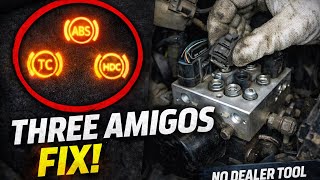
- ABS, Traction Control, and Hill Descent Lights On — On Land Rovers, these 'Three Amigos' illuminate simultaneously because the fault originates in the ABS system. 🎬 See this guide on fixing the Land Rover Three Amigos
- Shifter Locked in Park — On Mitsubishi models, the communication failure prevents the system from verifying brake pedal application, locking the gear selector.
- Harsh or Slipping Gear Shifts — The transmission bangs into gear or fails to shift smoothly due to missing torque reduction data from the ECM.
- No-Start Condition — On Subaru vehicles, a faulty neutral position switch prevents the starter from engaging.
Diagnostic Flowchart
Tap your situation to follow the diagnostic path that matches what you're seeing on this code.
Common Fixes & Costs
- Replace Faulty Relays (Mitsubishi) — Parts: $40-$60, Labor: $0-$60, ~0.2 hr book time (DIY)
- Replace Blown Fuses — Parts: $1-$10, Labor: $0-$50, ~0.1 hr book time (DIY)
- Replace Neutral Position Switch (Subaru) — Parts: $40-$150, Labor: $100-$200, ~1.2 hr book time (Intermediate)
- Replace/Rebuild ABS Control Module (Land Rover) — Parts: $150-$300 (Rebuild) / $1000+ (New), Labor: $150-$250, ~1.5 hr book time (Professional)
- Repair Damaged Wiring or Connectors — Parts: $10-$50, Labor: $150-$500+, ~2.5 hr book time (Professional)
Used vs. New Parts: Buying Guide
When a used part is worth it: For the Land Rover SLABS module, a professionally rebuilt unit saves over $800 compared to a new OEM part. For Mitsubishi relays and fuses, always buy new.
Donor-vehicle mileage cap: roughly under 100000 miles for the part to have meaningful remaining life.
Donor quality checklist:
- Ensure the ABS module part number matches exactly.
- Verify the rebuilt part includes a warranty (typically 1-year).
- Avoid modules from vehicles with flood damage.
Decision logic:
- If The part is a relay or fuse → Always buy new. The cost is negligible and ensures reliability.
- If The part is a Land Rover ABS module → Use a professional rebuild service for your existing module to avoid VIN programming issues and save money.
- If The part is an ECM or TCM → Favor a professional rebuild. If buying used, confirm the shop can reprogram it to your specific VIN.
Warranty tradeoff: Used parts offer 30-90 day warranties. Rebuilt modules often include 1-year warranties. New OEM parts carry a 1-year manufacturer warranty.
Worst-case if a used part fails: 1200. If a used ABS module fails, you pay for the part again plus 1.5 hours of labor to replace and bleed the brakes a second time.
What Happens If You Wait — Timeline
- Immediate: (Land Rover): ABS and Traction Control are disabled. (Mitsubishi): Vehicle enters limp mode with RPM limited to ~3,000 RPM and transmission locked in 2nd or 3rd gear. (MPG impact: 5-20% (in limp mode)% · Added cost: 0)
- 1-4 weeks: (Mitsubishi): Continued driving with harsh, unsynchronized shifts causes accelerated wear on transmission clutch packs and internal mechanical components. (MPG impact: 5-20%% · Added cost: 100)
- 1-6 months: (Mitsubishi): Significant wear on transmission internals. The problem escalates from a simple relay fix to requiring a valve body replacement. (All makes): Driving without ABS increases accident risk. (MPG impact: 5-20%% · Added cost: 1500)
- 6+ months: (Mitsubishi): Catastrophic transmission failure. The initial electrical fault leads to complete mechanical failure, requiring a full rebuild or replacement. (MPG impact: N/A (vehicle undrivable)% · Added cost: 3000-7000)
Cost of Not Fixing It
- Immediate: Land Rover safety systems (ABS/Traction Control) disable, increasing stopping distances. Mitsubishi vehicles enter limp mode with severely reduced power. (Added cost: 0)
- 0-3 months: Mitsubishi transmissions suffer extreme stress from harsh, unsynchronized shifting, causing premature wear on internal clutch packs. (Added cost: 500)
- 3+ months: Complete transmission failure in Mitsubishi vehicles requires a full rebuild. Driving without ABS significantly increases accident risk in adverse weather. (Added cost: 3000-7000)
Diagnosis Steps

- Identify Vehicle Manufacturer
The meaning of P1590 changes entirely based on your vehicle brand. Confirm your make and model before proceeding.
Tools: Owner's Manual (Beginner) - Scan for All Trouble Codes
Use an OBD-II scanner to check for related codes. U0101 on a Mitsubishi confirms a CAN bus communication failure. P1591/P1592 on a Land Rover specifies a short circuit in the ABS signal wire.
Tools: OBD-II Scanner (Beginner) - Inspect Fuses and Relays (Especially Mitsubishi)
Check all related fuses in the engine bay and interior panels. For Mitsubishi, locate the MFI, ETV, CVT, and Starter relays. Replacing these relays per TSB-18-13-003 is the most common fix.
Tools: Fuse Puller, Multimeter (Beginner) - Test Battery and Charging System
Measure battery voltage. A healthy battery reads 12.6V resting and 14.2V-14.7V while running. Low voltage causes modules to drop offline, triggering P1590.
Tools: Multimeter (Beginner) - Unplug Aftermarket Devices
Remove any insurance trackers or aftermarket alarms plugged into the OBD-II port. Clear the codes and drive to see if the network communication restores.
Tools: None (Beginner) - Inspect Wiring and Grounds
Examine the wiring harnesses connecting the ABS module, transmission, and ECM. Look for chafing, melted insulation, or corroded ground straps attached to the chassis.
Tools: Flashlight (Intermediate) - Advanced (Subaru): Test Neutral Position Switch
Disconnect the switch connector. Using a multimeter in continuity mode, verify the switch shows infinite resistance in gear and near-zero resistance in Neutral/Park. Failure to switch states requires replacement.
Tools: Multimeter, Jack Stands (Advanced) - Advanced (Land Rover): Test Rough Road Signal
Backprobe the ECM connector C0637 at terminal 34. With the engine running, use an oscilloscope to measure the PWM signal from the SLABS module. A healthy signal operates at 2.10-2.56 Hz.
Tools: Oscilloscope, Backprobe Pins, Wiring Diagram (Advanced) - Advanced: Test CAN Bus Network
Disconnect the battery. Measure resistance between OBD-II Pin 6 and Pin 14; a healthy network reads 60 Ohms. Reconnect the battery, turn ignition ON, and measure voltage: Pin 6 should read 2.6V and Pin 14 should read 2.4V. Deviations indicate a short or open circuit.
Tools: Multimeter, Wiring Diagram (Advanced)
When This Code Triggers (Freeze-Frame Conditions)
- Vehicle Speed: 0 mph (The code frequently triggers immediately at startup when modules fail their initial communication handshake.)
- Ambient Temperature: < 32°F (0°C) (On Mitsubishi vehicles, freezing temperatures cause the factory relays to stick, directly triggering the code.)
- System Voltage: < 11.8V (Low voltage during engine cranking prevents the CAN bus network from stabilizing, causing communication faults.)
Related Codes
- U0101 — On Mitsubishi, U0101 signifies a total loss of communication with the TCM. Having both U0101 and P1590 strongly suggests a failure in the CAN bus wiring, relays, or fuses.
- P1591 / P1592 — Specific to Land Rover, these specify the electrical fault in the ABS signal circuit. P1591 indicates a short-to-ground, while P1592 indicates a short-to-voltage.
- U0100 — Means 'Lost Communication With ECM/PCM'. Appears alongside P1590 on Mitsubishi models, pointing to a general network failure caused by faulty relays.
- C121C / U1417 — Communication fault codes that appear with P1590 on Mitsubishi vehicles experiencing relay/fuse failures, confirming a widespread network breakdown.
Climate & Environmental Factors
- Cold Weather: Primary trigger for P1590 on Mitsubishi models. Factory relays freeze in extreme cold, severing communication between the TCM and ECM (TSB-18-13-003).
- High Humidity / Salt: Road salt accelerates corrosion on wiring, connector pins, and chassis grounds, leading to intermittent signal loss across all vehicle makes.
How to Talk to a Mechanic About This Code
Say this: "I have a P1590 code. For Mitsubishi: 'Please check the relays per TSB-18-13-003, fuses, and wiring before quoting a new TCM.' For Land Rover: 'The Three Amigos lights are on. I need you to scan the ABS module for the specific fault, not just read the P1590.' For Subaru: 'I have a no-start issue. Please test the neutral position switch circuit.'"
This language shows you understand the common, inexpensive causes for this code on your specific vehicle, preventing the shop from immediately quoting an expensive module replacement.
Avoid saying:
- 'My check engine light is on, can you fix it?'
- 'The car is acting weird, just do whatever it takes.'
- 'I think I need a new transmission.'
Questions to ask before authorizing the repair:
- For Mitsubishi: Did you test the relays and check for the common 7.5A blown fuse?
- For Land Rover: What is the specific fault code from the SLABS (ABS) module?
- For Subaru: Did you confirm the neutral position switch is failing its electrical test?
- If a module is recommended: Can you show me the test results proving the module is bad and not the wiring?
- What is the warranty on this specific repair?
Where to Take It: Dealer vs Independent vs Chain
- Dealer:
Recommended only for newer Land Rovers or complex module programming. For the common Mitsubishi relay or Subaru switch fix, a dealer is unnecessarily expensive.
Best for: Vehicles under warranty., Complex electrical issues on newer Land Rovers requiring proprietary software (Pathfinder/SDD) for module programming.
Downsides: Significantly higher labor rates., Dealers default to replacing entire expensive assemblies (like a $2,000 ABS module) instead of recommending a cost-effective rebuild. (Typical cost: +50% vs. baseline) - Independent Shop:
Best fit for most P1590 scenarios. For Land Rover, seek an independent specialist who focuses on European cars.
Best for: Out-of-warranty vehicles., Known issues like the Mitsubishi relay swap or Subaru neutral switch replacement., Land Rover specialists familiar with the 'Three Amigos' and ABS module rebuilds.
Downsides: Quality varies. You must find a shop with strong electrical diagnostic skills., A general shop may lack the specific scanner needed to diagnose a Land Rover ABS fault. (Typical cost: +0% vs. baseline) - Chain Shop:
AVOID. This code requires diagnostic expertise beyond the scope of a typical chain repair shop.
Best for: Simple maintenance like tires or oil changes.
Downsides: Technicians lack experience with complex electrical or communication diagnostics., High pressure to upsell parts; likely to misdiagnose P1590 as a failed ECM/TCM. (Typical cost: -10% vs. baseline)
When to Walk Away From the Repair
If the estimated repair cost exceeds 50% of the car's private-party value, seriously consider selling or trading in the vehicle.
- Car worth $4000, fix is $80: Fix it. This represents a simple relay or switch replacement.
- Car worth $4000, fix is $1800: Borderline. This represents a Land Rover ABS module replacement. Get a second opinion before proceeding.
- Car worth $3500, fix is $4000: Walk away. This represents a worst-case scenario where a Mitsubishi transmission has failed after ignoring the P1590 code.
What Scan Tool You Need for This Code
Minimum: A scanner that reads manufacturer-specific codes beyond the basic engine module. For Land Rover, it MUST read ABS codes. For Mitsubishi, it MUST read TCM codes.
A $20 generic code reader only shows 'P1590' from the engine module but won't see the critical codes from the ABS or Transmission modules that are the actual source of the problem.
Budget: BlueDriver Pro (~$100) — Reads and clears enhanced codes from modules like ABS, SRS, and Transmission. Sufficient to see the underlying ABS code on a Land Rover or confirm TCM communication codes on a Mitsubishi.
Mid-range: Foxwell NT510 Elite (~$180) — Offers OEM-level diagnostics, including reading proprietary codes and live data from the SLABS module. Crucially for Land Rover, it performs the ABS bleed function after replacing a module.
Professional: Autel MaxiCOM MK808BT (~$550) — Provides OE-level diagnostics for all systems with bidirectional control to test components directly (like solenoids and actuators), which is invaluable for diagnosing intermittent wiring faults.
Rent vs buy: Buy. Auto parts store rental scanners often cannot read manufacturer-specific codes. Buying a budget-level scanner like the BlueDriver pays for itself by preventing a misdiagnosis.
How to Clear the Code After You Fix It
- Repair the underlying mechanical or electrical fault.
- Reconnect the battery if disconnected.
- Use an OBD-II scan tool to erase the DTCs from all modules (ECM, TCM, ABS).
- Perform a complete drive cycle to reset readiness monitors.
Drive cycle (~30 minutes): Start the engine cold and idle for 3 minutes. Drive in stop-and-go traffic for 10 minutes. Accelerate to 55 mph and maintain steady highway speed for 10 minutes. Coast to a stop without braking.
Readiness monitors affected: Comprehensive Component Monitor, Misfire Monitor
Before emissions retest: drive at least 50 miles to fully set monitors.
Watch out for:
- Disconnecting the battery clears the dashboard light but resets readiness monitors to 'Not Ready', causing an automatic emissions failure.
- If you do not fix the root electrical issue, P1590 will return immediately upon the next startup.
Will This Fail Emissions / State Inspection?
Yes — this code typically fails an OBD-II emissions inspection.
- California: An illuminated Check Engine Light is an automatic failure. You must complete a drive cycle to set readiness monitors after repair.
- New York: Vehicles fail the NYVIP3 inspection if the Check Engine Light is on or if more than one readiness monitor is 'Not Ready'.
- Texas: In emissions-testing counties, an active Check Engine Light results in an automatic failure.
Most Commonly Affected Vehicles
- Mitsubishi Outlander (2007-2019) — Highly prone to the 'frozen relay' issue causing communication loss. Covered under TSB-18-13-003.
- Land Rover Discovery II (L318) (1998-2004) — Frequently experiences P1590 due to failures in the ABS 'rough road' signal circuit, triggering the 'Three Amigos' warning lights.
- Mitsubishi Lancer (2008-2017) — Susceptible to the relay failure issue leading to TCM/ECM communication errors.
- Subaru Impreza, Forester, Outback (1999-2008) — P1590 indicates 'Neutral Position Switch Circuit High Input', causing starting and shifting issues.
- Mitsubishi Outlander Sport / RVR (2011-2019) — Affected by the relay problem outlined in the manufacturer's service bulletin.
- Honda Insight, Civic Hybrid (2000-2006) — P1590 indicates 'Motor current U phase signal circuit – low input', related to the IMA hybrid system.
- Volkswagen Jetta, Golf, Passat (1998-2005) — P1590 indicates an 'AC/heater air temperature control switch - open circuit'.
Manufacturer-Specific Notes

- Land Rover: The code is tied to the ABS system's 'rough road detection' feature, which prevents the ECM from misinterpreting wheel vibrations as engine misfires. When this fails, it triggers P1590 and the 'Three Amigos' dashboard lights.
- Mitsubishi: The code almost always relates to a communication failure between the transmission and engine computers. TSB-18-13-003 points to freezing relays as the primary cause, making it a cheap fix.
- Subaru: P1590 points to a 'Neutral Position Switch Circuit High Input', an issue with the transmission range sensor that causes a no-start condition.
Real Owner Stories
2013 Mitsubishi Outlander at 70k miles
While driving, the car suddenly lost power, all dashboard lights illuminated, the shifter locked in Park, and there was a strange smell. Codes U0101 and P1590 were present.
What they tried:
- Visually inspected wiring under the hood, found no obvious damage.
Outcome: The owner discovered the problem was a single blown 7.5A interior fuse (#12) that controls the A/C, CVT control relay, ABS, and SRS systems. Replacing the fuse resolved all symptoms.
Lesson: On Mitsubishi models, a catastrophic-seeming electrical failure with P1590 is often caused by a single, inexpensive fuse. Always check fuses before assuming a major component has failed.
2004 Land Rover Discovery II
The 'Three Amigos' (ABS, TC, HDC) and Check Engine lights were on, with code P1590 stored. The ABS light came on instantly at startup.
What they tried:
- Owner suspected a wheel speed sensor due to squealing brakes.
- Clearing the code with a standard OBD-II scanner did not work; the code and lights returned immediately.
Outcome: The P1590 code is a direct consequence of the ABS fault triggering the Three Amigos. The fix required a specialized scanner to read the specific ABS fault and repair the underlying ABS shuttle valve.
Lesson: For Land Rover's 'Three Amigos,' P1590 is a symptom, not the disease. Focus on diagnosing the specific ABS fault causing the lights rather than chasing the P1590 code.
2005 Subaru Forester (Manual)
Car would crank but not start. Multiple codes were present, including P1590 (Neutral Position Switch Circuit High Input).
What they tried:
- A mechanic suggested replacing the throttle body, which did not solve the issue.
- A dealership misdiagnosed the problem as a timing belt issue, performing an $1800 repair that failed to fix the no-start.
Outcome: The cluster of codes pointed directly to the neutral position switch circuit, which was preventing the car from confirming it was safe to start. Replacing the switch resolved the issue.
Lesson: On a Subaru with a no-start condition, P1590 strongly indicates a fault in the neutral position switch circuit. Diagnose this switch before attempting expensive mechanical repairs.
Mitsubishi Lancer Ralliart
Car was hard to start, would not engage any gear, and showed code P1590. The owner feared the SST transmission had failed.
What they tried:
- Dealer initially suspected a blown transmission.
- Technician found an intercooler pipe rubbing against a wiring harness, breaking the wires.
Outcome: The root cause was physical damage to the CAN bus wiring between the TCM and ECM. The dealer repaired the broken wires and reprogrammed the modules for $810.
Lesson: A P1590 communication error is often caused by physical damage to the wiring harness. Perform a thorough visual inspection of harnesses before replacing expensive modules.
How to Prevent This Code From Triggering
- Periodically clean battery terminals and check ground connections (Every 12 months or during oil change) — Corrosion creates unwanted resistance, leading to low voltage and unstable power for control modules, causing intermittent communication errors.
- Replace specified relays on affected Mitsubishi models proactively (Once, around 60,000-80,000 miles) — Proactively replacing the original relays with upgraded parts (per TSB-18-13-003) prevents being stranded by the 'frozen relay' issue in cold weather.
- Inspect and secure wiring harnesses (During any under-hood maintenance) — Regularly checking that wiring harnesses are secured and not rubbing against engine components prevents chafing that leads to short circuits.
- Avoid deep water and protect against rodents (As needed based on environment) — Water intrusion causes corrosion, and rodents chew on wire insulation, causing difficult-to-diagnose open or short circuits.
Frequently Asked Questions
Can I just clear the code and keep driving?
You can clear it, but it will return immediately. Clearing the code does not fix the disabled safety systems or prevent transmission damage. You must repair the underlying electrical fault.
What are the most common misdiagnosis mistakes for P1590?
The biggest mistake is replacing a $1,000+ Engine or Transmission Control Module when the actual cause is a $20 relay or a weak battery. Always test fuses, relays, and battery voltage before condemning a computer.
My car is stuck in park and other electronics are acting weird. Can this be related to P1590?
Yes, this is a classic Mitsubishi symptom. A blown 7.5A fuse or failing relay disrupts communication, locking the shifter and triggering multiple warning lights. Check your interior fuse box first.
Can cold weather cause a P1590 code?
Yes, especially on Mitsubishi vehicles. Factory relays freeze in extreme cold, causing communication loss between the engine and transmission. Mitsubishi issued TSB-18-13-003 to replace these with upgraded anti-freezing relays.
What are the 'Three Amigos' on a Land Rover?
This refers to the ABS, Traction Control, and Hill Descent Control warning lights illuminating simultaneously on a Land Rover. It signals a fault in the ABS system, which triggers the P1590 code. You need an ABS-capable scanner to find the root cause.
Can a bad battery cause a P1590 code?
Yes. A weak battery drops system voltage below the threshold needed for computers to communicate during startup. This triggers false P1590 communication codes before the engine even cranks.
Will the P1590 code clear itself?
No. P1590 is a hard code tied to critical communication and safety systems. It remains active until you repair the physical fault and manually clear the code with a scanner.
What is TSB-18-13-003 for Mitsubishi?
It is a Mitsubishi service bulletin addressing vehicles that enter limp mode or fail to start in cold weather. It instructs mechanics to replace four specific engine bay relays with upgraded anti-freezing versions. This $40 fix resolves P1590 for most Mitsubishi owners.
Key Takeaways
- P1590 is a manufacturer-specific code: it indicates a frozen relay on a Mitsubishi, an ABS fault on a Land Rover, or a failed neutral switch on a Subaru.
- For Mitsubishi owners, replace the four engine bay relays (part #8627A049 and #8627A050) and check the 7.5A interior fuse before authorizing a $1,000+ transmission repair.
- On Land Rover Discovery II models, P1590 always accompanies the 'Three Amigos' warning lights and requires a specialized ABS scanner to pinpoint the exact wheel speed sensor or SLABS module fault.
- Never replace an Engine Control Module (ECM) for this code without first load-testing the battery, as voltage drops below 12.4V frequently trigger false communication errors.
Helpful Videos


The information in this article is provided for general reference and educational purposes only. Vehicle specifications, procedures, and part compatibility can vary by production date, trim level, and region. Always consult your vehicle's factory service manual and verify part numbers before purchasing or performing repairs. Safety-critical components such as airbags, seat belts, and braking systems should be installed by a qualified professional.
- 🎬 Helpful Videos
- What Does P1590 Mean?
- Can I Drive With P1590?
- Common Causes
- Symptoms
- Diagnostic Flowchart
- Common Fixes & Costs
- Used vs. New Parts: Buying Guide
- What Happens If You Wait — Timeline
- Cost of Not Fixing It
- Diagnosis Steps
- When This Code Triggers (Freeze-Frame Conditions)
- Related Codes
- Climate & Environmental Factors
- How to Talk to a Mechanic About This Code
- Where to Take It: Dealer vs Independent vs Chain
- When to Walk Away From the Repair
- What Scan Tool You Need for This Code
- How to Clear the Code After You Fix It
- Will This Fail Emissions / State Inspection?
- Most Commonly Affected Vehicles
- Manufacturer-Specific Notes
- Real Owner Stories
- 2013 Mitsubishi Outlander at 70k miles
- 2004 Land Rover Discovery II
- 2005 Subaru Forester (Manual)
- Mitsubishi Lancer Ralliart
- How to Prevent This Code From Triggering
- Frequently Asked Questions
- Can I just clear the code and keep driving?
- What are the most common misdiagnosis mistakes for P1590?
- My car is stuck in park and other electronics are acting weird. Can this be related to P1590?
- Can cold weather cause a P1590 code?
- What are the 'Three Amigos' on a Land Rover?
- Can a bad battery cause a P1590 code?
- Will the P1590 code clear itself?
- What is TSB-18-13-003 for Mitsubishi?
- Key Takeaways
- 🎟️ Get 5% Off