

Ultimate P1516 Guide: Causes, Pro-Level Diagnosis & Fixes
The definitive, expert-level resource for diagnosing and fixing OBD-II trouble code P1516.
- P1516 forces the vehicle into 'Reduced Engine Power' mode, capping speeds at 25-40 mph and creating a severe merging hazard.
- Perform a manual 'wiggle test' on the throttle body harness while idling to instantly identify intermittent wiring faults.
- Clean engine grounds G103 and G104 to bare metal, as voltage drops above 0.1V frequently trigger this code on GM trucks.
- Verify the throttle body pigtail and grounds before spending $250-$650 on a full throttle body replacement.
What Does P1516 Mean?

P1516 means the engine computer (ECU) detected a critical failure in the electronic throttle control system. The computer commanded the throttle plate to a specific angle, but the throttle position sensors (TPS) report a different actual position. This mismatch triggers limp mode to prevent unintended acceleration.
Technical definition: Throttle Actuator Control (TAC) Module Throttle Actuator Position Performance. This indicates the Powertrain Control Module (PCM) detected the actual throttle position does not match the commanded throttle position by a specified amount for more than a calibrated period (often 1 second).
Can I Drive With P1516?
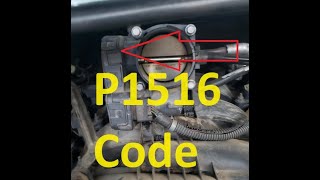
Yes, But With Caution. Yes, but the vehicle enters 'Reduced Engine Power' (limp) mode, capping speeds at 25-40 mph. 🎬 Watch: 5 common causes and fixes for Chevy P1516 codes. This creates a severe safety hazard when merging or climbing hills. Proceed directly to a safe location or repair shop. Prolonged driving risks sudden engine stalls in traffic. While it won't damage the catalytic converter, the safety risks of sudden power loss are too high for normal driving.
Common Causes

- Wiring Harness or Connector Issues (Very Common) — Wires leading to the throttle body endure intense heat and vibration, causing internal breaks within 4 inches of the connector. Poor pin connections or corrosion at the throttle body plug (pigtail) frequently cause this code.
- Faulty Electronic Throttle Body Assembly (Very Common) — The internal electric motor, plastic gears, or integrated throttle position sensors (TPS) fail. Wear on sensor contact points creates 'dead spots' causing erratic signals. The entire assembly requires replacement.
- Poor or Corroded Ground Connections (Common) — Corroded or loose engine, PCM, or TAC module ground straps (specifically G103 and G104 on GM trucks) cause voltage drops. This electrical noise disrupts module communication, triggering the code.
- Dirty or Carbon-Clogged Throttle Body (Common) — Heavy carbon buildup around the throttle plate and bore causes the plate to physically stick or move slowly, preventing it from matching computer commands.
- Frozen PCV System (Cold Climates) (Less Common) — In temperatures below -10°F (-23°C), moisture in the PCV system freezes, creating excessive crankcase pressure. This forces oil vapor into the throttle body, causing it to freeze or stick (GM TSB #PIP4573B).
- Vacuum Leaks (Less Common) — A significant unmetered air leak from a cracked PCV hose or intake manifold gasket forces the PCM to struggle with idle control. This triggers P1516, often alongside lean codes P0171 and P0174.
- Low System Voltage (Less Common) — A weak battery or alternator drops voltage supplied to the PCM and TAC module below required thresholds during cold starts. This triggers performance codes even if the throttle system is mechanically sound.
- Faulty Throttle Actuator Control (TAC) Module (Less Common) — On pre-2007 GM vehicles with a separate TAC module, this component fails. It acts as the middle-man between the gas pedal and throttle body. 🎬 See this breakdown of TAC module performance and repair steps.
- Failing Powertrain Control Module (PCM) (Rare) — The PCM itself fails rarely. Only consider this after exhaustively ruling out wiring, grounds, and the throttle body.
Symptoms

- Reduced Engine Power Light — A dashboard message stating 'Reduced Engine Power' indicates the vehicle entered safety limp mode.
- Poor or No Throttle Response — The gas pedal feels completely unresponsive, or the vehicle accelerates extremely slowly. The engine often only idles.
- Check Engine Light — The Malfunction Indicator Lamp illuminates immediately when P1516 stores.
- Engine Stalling — The engine stalls unexpectedly when stopping or idling, followed by difficult restarts.
- Rough or Unstable Idle — The engine idles erratically, surges, or shakes because the throttle plate fails to control idle airflow.
- Harsh or Erratic Shifting — The Transmission Control Module (TCM) uses throttle position data for shift points; faulty signals cause harsh, delayed, or unpredictable shifting.
Diagnostic Flowchart

Tap your situation to follow the diagnostic path that matches what you're seeing on this code.
Common Fixes & Costs
- Repair Wiring Harness or Connector Pigtail — Parts: $20-$60, Labor: $100-$300, ~1.5 hr book time (Intermediate)
- Clean and Secure Ground Connections — Parts: $0-$10, Labor: $50-$150, ~0.8 hr book time (DIY)
- Replace Throttle Body Assembly — Parts: $150-$400, Labor: $100-$250, ~1.2 hr book time (Intermediate)
- Clean Throttle Body — Parts: $5-$15, Labor: $75-$150, ~0.7 hr book time (DIY)
- Add Redundant Ground Wires — Parts: $10-$20, Labor: $50-$100, ~0.6 hr book time (DIY)
- Replace Throttle Actuator Control (TAC) Module — Parts: $150-$300, Labor: $100-$200, ~1.0 hr book time (Intermediate)
DIY vs Professional
- Clean Throttle Body — Beginner: Yes
Tools: Screwdriver/socket set, throttle body cleaner, rags, toothbrush. - Clean and Secure Ground Connections — Beginner: Yes
Tools: Socket set, wire brush, sandpaper. - Add Redundant Ground Wires — Beginner: Yes
Tools: 10-gauge wire, ring terminals, crimping tool, socket set. - Replace Throttle Body Assembly — Beginner: No (Experienced DIYer)
Tools: Socket set, torque wrench, new gasket. - Repair Wiring Harness or Connector Pigtail — Beginner: No
Tools: Soldering iron or quality butt connectors, heat shrink tubing, wire strippers/cutters.
Used vs. New Parts: Buying Guide
When a used part is worth it: Used throttle bodies hold poor value because internal sensors wear with age. A remanufactured unit offers better reliability for budget-conscious repairs.
Donor-vehicle mileage cap: roughly under 50000 miles for the part to have meaningful remaining life.
Donor quality checklist:
- Match the part number exactly; visual similarities can be deceiving.
- Avoid parts from vehicles with high mileage or from regions with extreme temperatures, which accelerate wear.
- Ask for a clear return policy or a short-term warranty (30-90 days) at a minimum.
Decision logic:
- If The vehicle is a daily driver and reliability is critical. → Buy a new OEM or high-quality new aftermarket part. The higher upfront cost is justified by a longer warranty and reduced risk of repeat failure.
- If The budget is extremely tight and the vehicle's value is low. → A remanufactured part offers a good compromise between cost and reliability. A used part is a last resort.
- If The part is for a pre-2007 vehicle with a separate TAC module. → Ensure you are replacing the correct component. Misdiagnosing a bad throttle body when the TAC module is at fault (or vice-versa) is common.
Warranty tradeoff: Used parts typically offer a 30-90 day warranty, if any. Remanufactured parts often come with a 1-year to limited lifetime warranty. New aftermarket parts usually have a 1-3 year warranty, while new OEM parts offer a 1-year warranty.
Worst-case if a used part fails: $250-500 if a used or cheap part fails shortly after installation, requiring repeat labor costs plus the price of another replacement part.
What Happens If You Wait — Timeline
- First occurrence: The 'Reduced Engine Power' light illuminates, and throttle response is severely limited. The vehicle idles or crawls at 5-10 mph. Restarting the engine temporarily clears the issue. (MPG impact: N/A% · Added cost: $0. The immediate cost is the safety risk and inconvenience.)
- 1 week - 2 months: The fault becomes frequent and unpredictable. It triggers over bumps, while idling, or at specific temperatures. You can no longer trust the vehicle for daily driving. (MPG impact: N/A% · Added cost: $100-$250 for a potential tow when stranded in an unsafe location.)
- 2-6 months: Intermittent open/short circuits worsen. A frayed wire breaks completely, or a corroded ground fails entirely. The vehicle becomes completely undrivable (won't start or immediately enters limp mode). (MPG impact: N/A% · Added cost: $150-$300 in increased diagnostic time at a shop, as intermittent electrical faults become harder-to-trace hard faults.)
- 6+ months: There is no significant risk of cascading mechanical damage to other components. The primary damage is to safety and wallet. The cumulative cost of towing, multiple diagnostic fees, and incorrect parts replacements exceeds the cost of a proper initial diagnosis. (MPG impact: N/A% · Added cost: $500-$1000+ in wasted money on incorrect repairs and repeated diagnostics.)
Cost of Not Fixing It
- Immediate: Sudden entry into limp mode leaves you without acceleration in traffic, creating a high accident risk. (Added cost: Potential for accident-related costs.)
- 0-3 months: Constant stalling leaves you stranded. Limp mode protects the engine, so secondary mechanical damage is unlikely, but the vehicle is unreliable. (Added cost: Towing fees ($100-$250 per incident).)
- 3+ months: Electrical connections degrade further, turning intermittent faults into permanent failures and increasing diagnostic labor costs. (Added cost: Increased diagnostic time at a repair shop ($100-$200).)
Diagnosis Steps
- Perform a 'Wiggle Test' on Throttle Body Wiring
With the engine idling, methodically wiggle the throttle body wiring harness and connector. If the engine stumbles, stalls, or enters limp mode, you confirmed an intermittent wiring or pigtail fault.
Tools: Hands (Beginner) - Inspect and Clean Ground Connections
Remove and clean main engine-to-chassis and battery ground straps (especially G103 and G104 on GM trucks). Sand contact points to shiny bare metal and re-secure tightly.
Tools: Socket set, wire brush/sandpaper (Intermediate) - Read All Trouble Codes & Freeze Frame Data
Read P1516 and related codes (P2135, P2101, U0107, P0171, P0174). Analyze freeze frame data for exact fault conditions. Clear codes to see which return immediately.
Tools: OBD-II Scanner (Beginner) - Check Live Data: Commanded vs. Actual Position
Monitor 'Commanded Throttle Position' and 'Actual Throttle Position' with key on, engine off. Slowly press the gas pedal. Values must track smoothly. If actual position jumps, drops out, or freezes, the throttle body assembly is faulty.
Tools: Advanced OBD-II Scanner with Live Data (Intermediate) - Inspect and Clean the Throttle Body
Remove the air intake tube. Clean heavy carbon buildup with throttle body cleaner and a soft cloth. Do NOT force the plate open manually; use the gas pedal with key on (engine off) to open it.
Tools: Screwdriver/socket set, throttle body cleaner, rags (Intermediate) - Pro Tip: Perform a Voltage Drop Test on Ground Circuits
Set a multimeter to DC Volts. Place the positive lead on the negative battery terminal and negative lead on the engine block while running. Readings above 0.1V indicate a poor ground requiring repair.
Tools: Digital Multimeter (Advanced) - Pro Tip: Graph TPS1 vs. TPS2 with a Scope/Scanner
Plot TPS1 and TPS2 voltages simultaneously. TPS1 sweeps low-to-high (~0.5V to ~4.5V) while TPS2 sweeps high-to-low (~4.5V to ~0.5V). Sudden spikes or dropouts confirm a faulty throttle body.
Tools: Graphing Scanner or Oscilloscope (Advanced) - Advanced: Throttle Body Resistance Test
Test internal circuits with a multimeter (Ohms). For GM 6-pin: Motor (A&B) is 2-15 Ohms. TPS1 (D&E) resistance increases as throttle opens. TPS2 (E&F) resistance decreases. 'OL' means open circuit; zero means short.
Tools: Digital Multimeter, Throttle Body Pinout Diagram (Advanced) - Inspect for Major Vacuum Leaks
Inspect vacuum hoses, especially the PCV tube. Brittle or cracked hoses cause unmetered air leaks triggering throttle codes. Use a smoke machine to find hidden leaks.
Tools: Flashlight, Smoke Machine (optional) (Intermediate)
When This Code Triggers (Freeze-Frame Conditions)
- Engine Coolant Temp: 180-210°F (82-99°C) (Fully warmed up, during normal operation.)
- RPM: 1200-2500 (Occurs at steady throttle or light acceleration, rarely during idle.)
- Engine Load: 20-50% (Associated with maintaining speed on a flat road or slight incline.)
- Vehicle Speed: 25-60 mph (Frequently happens during city or highway cruise conditions, not usually from a stop.)
Related Codes
- P2135 — Indicates a conflict between TPS1 and TPS2 inside the throttle body. If present with P1516, the throttle body assembly requires replacement.
- P2101 — Points to a failing electric motor moving the throttle plate. Strongly suggests internal mechanical failure of the throttle body gears or motor.
- U0107 — Indicates the PCM lost data from the TAC module. Points to a cut wire, failed TAC module, or critical bad ground preventing communication.
- P0120 / P0220 — Indicates a direct electrical circuit fault (open or short) in one of the TPS sensor circuits. P1516 is a performance code comparing commanded vs. actual position.
Climate & Environmental Factors
- Extreme Cold: Temperatures below -10°F (-23°C) freeze PCV moisture, forcing oil into the throttle body (GM TSB #PIP4573B). Extreme cold also degrades battery voltage, triggering the code.
- Humidity / Moisture: High humidity or direct water intrusion accelerates corrosion on the throttle body connector pins and critical chassis/engine ground points. This corrosion creates unwanted resistance, a primary cause of P1516.
- High Altitude: There is no direct link between high altitude and an increased likelihood of P1516. However, any pre-existing issue, such as a dirty throttle body or minor vacuum leak, is exacerbated by the change in air density.
How to Talk to a Mechanic About This Code
Say this: "I have a P1516 code with a 'Reduced Engine Power' light. I'd like a diagnostic, but can you please specifically check the throttle body wiring harness and the main engine grounds before recommending a full throttle body replacement?"
This signals you know the most common and cheapest-to-fix causes for this specific code. It directs the mechanic to perform crucial diagnostic steps (like a 'wiggle test' and ground inspection) instead of immediately defaulting to the most expensive part replacement.
Avoid saying:
- 'My check engine light is on, can you just fix it?'
- 'The car is in limp mode, do whatever you think is best.'
- 'I read online it's the throttle body, can you give me a price to replace it?'
Questions to ask before authorizing the repair:
- Did you perform a 'wiggle test' on the harness and what were the results?
- What was the voltage drop reading on the main engine-to-chassis ground?
- Can you show me the live data graph of 'Commanded' versus 'Actual' throttle position?
- If the throttle body is the issue, does your estimate include the mandatory throttle relearn procedure?
Where to Take It: Dealer vs Independent vs Chain
- Dealer:
Acceptable, but likely the most expensive option. Best if warranty coverage is a possibility.
Best for: Vehicles still under powertrain or a special coverage warranty (e.g., GM #11273B for TPS)., Complex diagnoses that involve PCM replacement and programming.
Downsides: Highest labor rates., Quick to replace the entire throttle body assembly rather than diagnose a simpler wiring or ground fault. (Typical cost: +50% vs. baseline) - Independent Shop:
Best Fit. An experienced independent mechanic has likely seen and fixed P1516 dozens of times and knows to check grounds and wiring first.
Best for: Out-of-warranty vehicles, especially common GM trucks and SUVs., Cost-conscious owners looking for a thorough diagnosis.
Downsides: Quality varies; look for shops specializing in domestic vehicles with good reviews and ASE-certified technicians. (Typical cost: +0% vs. baseline) - Chain Shop:
Use with Caution. Acceptable for a throttle body replacement if you're certain that's the problem, but AVOID for the initial diagnosis of an intermittent P1516.
Best for: Simple, clear-cut parts replacement after a definitive diagnosis has already been made elsewhere.
Downsides: Technician skill varies greatly; lacks the experience for nuanced electrical diagnosis., High pressure to replace parts; recommends a new throttle body without proper diagnosis of cheaper root causes. (Typical cost: -10% vs. baseline)
When to Walk Away From the Repair
If the estimated repair cost exceeds 40-50% of the car's private-party value, seriously consider selling or trading it in instead of repairing it.
- Car worth $4500, fix is $2200: Walk Away. The repair cost is nearly 50% of the car's value. It's not a sound investment.
- Car worth $12000, fix is $750: Fix it. The repair cost is well below the threshold and restores a critical safety function.
- Car worth $2500, fix is $1500: Walk Away. The repair cost is 60% of the vehicle's value, which is a poor financial decision.
What Scan Tool You Need for This Code
Minimum: A scanner that reads and graphs live data, specifically 'Commanded Throttle Position' and 'Actual Throttle Position'.
A basic $20 code reader only tells you the P1516 code is present. It cannot display the live sensor data needed to determine if the throttle body, wiring, or another component is the actual cause.
Budget: Foxwell NT301 / Ancel AD410 (~$70) — Reads and clears the P1516 code and displays basic live data streams for throttle position. Good for initial confirmation but lacks advanced graphing capabilities.
Mid-range: Autel MaxiCOM MK808 / Foxwell NT809 (~$350) — Offers robust live data with graphing to compare commanded vs. actual position. Includes bidirectional controls to command the throttle plate and perform the throttle relearn procedure after replacement.
Professional: Autel MaxiSys MS906BT / Launch X431 Series (~$600-1200) — Provides full bidirectional control, advanced graphing, and OEM-level diagnostics. Performs ECU coding and programming if the PCM is suspected to be the issue.
Rent vs buy: Auto parts store loaner tools are typically basic readers. They confirm the code exists but are insufficient for a proper P1516 diagnosis. For DIY diagnosis of this code, you must buy a scanner with live data graphing capabilities.
How to Clear the Code After You Fix It
- Ensure all repairs are complete and the throttle body is securely connected.
- Reconnect the battery if it was disconnected for the repair.
- Use an OBD-II scan tool to formally erase the P1516 and any other related codes.
- Perform a throttle body relearn procedure as specified by the manufacturer.
- Complete a full GM drive cycle to allow readiness monitors to become 'Ready'.
Drive cycle (~20 minutes): Start with a cold engine. Idle for 3 minutes with A/C and defroster on. Accelerate to 55 mph and hold for 5 minutes. Coast down to 20 mph without braking. Accelerate to 60 mph, hold for 5 minutes, and coast down again.
Readiness monitors affected: Catalyst (CAT) monitor, Oxygen (O2) Sensor monitor, Evaporative (EVAP) System monitor, EGR System monitor
Before emissions retest: drive at least 50 miles to fully set monitors.
Watch out for:
- Clearing the code without a drive cycle leaves readiness monitors 'Not Ready', failing emissions tests.
- The code returns immediately if the underlying electrical or mechanical fault remains unfixed.
- Forgetting the mandatory throttle relearn procedure after cleaning or replacing the throttle body causes idle and performance issues.
Will This Fail Emissions / State Inspection?
Yes — this code typically fails an OBD-II emissions inspection.
- California: Active P1516 causes automatic failure. You must complete a full drive cycle to set readiness monitors before re-testing.
- New York: A vehicle with an illuminated Check Engine Light automatically fails the emissions portion of the NYS inspection. After clearing the code, the vehicle must be driven through a complete drive cycle.
- Texas: In counties requiring emissions testing, an active P1516 code causes an automatic failure. If too many readiness monitors are 'Not Ready' after clearing, the vehicle also fails.
Most Commonly Affected Vehicles
- Chevrolet Silverado, Tahoe, Suburban (2003-2007) — Extremely common on the GMT800 platform. Prone to throttle body failure, pigtail wiring issues, and corroded grounds (G103/G104).
- GMC Sierra, Yukon (2003-2007) — Shares the same GMT800 platform and electronic throttle control system as Chevrolet trucks, making them equally susceptible to wiring, ground, and throttle body issues.
- Chevrolet Trailblazer (2002-2009) — These models experience frequent throttle body failures. Also noted in TSB #PIP4573B for P1516 in extreme cold due to frozen PCV systems. The TPS is integrated and not separately replaceable.
- GMC Envoy (2002-2009) — Shares platform with the Trailblazer and is susceptible to frozen PCV systems in cold climates causing P1516, per TSB #PIP4573B.
- Chevrolet Silverado 1500 (2014-2019) — A well-documented issue on the K2XX platform. GM TSB #PIP5660B addresses potential throttle body issues, and #PIP4578B notes carbon buildup as a cause on high-mileage vehicles.
- Cadillac Escalade (2003-2006) — As part of the GMT800 family, Escalades share the vulnerable TAC system and are frequently mentioned in TSBs for wiring and ground issues.
- Hummer H2, H3 (2003-2009) — The H2 shares its powertrain with GMT800 trucks and suffers the same ground/wiring issues. The H3 with inline engines is noted in TSB #PIP4573B for cold-weather PCV freezing.
- Pontiac GTO, G8 (2005-2009) — These V8-powered GM cars experience P1516 related to the throttle body or its wiring harness.
- Chevrolet Impala, Monte Carlo (2006-2011) — Prone to throttle body issues temporarily resolved by cleaning but often requiring replacement for a permanent fix.
Manufacturer-Specific Notes
- General Motors (Chevrolet, GMC, Cadillac, Hummer, Pontiac): Extremely common on GM vehicles, triggering 'Reduced Engine Power'. TSB #PIP3089B identifies poor wiring crimps at the throttle body. TSB #PIP4573B links P1516 to frozen PCV systems. Grounds G103/G104 are notorious failure points.
- Ford: On Ford vehicles, P1516 is defined as 'Intake Manifold Runner Control Input Error.' This is a completely different problem related to the flaps inside the intake manifold, not the throttle body.
- Jaguar: For Jaguar, P1516 is defined as 'Park/Neutral Position Switch/Gear Change Neutral/Drive.' This relates to the transmission's range sensor, a totally different system.
- Hyundai: On some Hyundai models, P1516 is defined as 'Oil Temp Sensor Low', which is unrelated to the throttle control system.
Real Owner Stories
2006 GMC Sierra 2500HD with intermittent P1516
Truck entered 'Reduced Engine Power' mode only after coming to a stop or idling. It drove fine if kept moving. Occasionally threw P2135 and P0220.
What they tried:
- Cleaned the throttle body and replaced the throttle position sensor on the side of the unit.
- Performed a throttle relearn procedure.
- Visually inspected ground wires, which seemed okay.
Outcome: The problem persisted. The owner eventually replaced the entire throttle body assembly, which permanently fixed the issue and cleared all codes.
Lesson: Even if cleaning provides a temporary fix, an intermittent problem that returns with related codes like P2135 points to an internal electronic failure requiring full throttle body replacement.
2003 Chevy Silverado with persistent P1516 after multiple part replacements
Owner experienced the classic 'Reduced Engine Power' issue. A local dealer replaced the throttle body connector pigtail (three times), the throttle body (twice), and the gas pedal assembly, but the problem returned.
What they tried:
- Multiple expensive part replacements at a dealership failed to solve the root cause.
Outcome: The ultimate fix was a poor ground connection. The owner solved this by adding new, redundant 10-gauge ground wires from the firewall to the engine block and TAC module bracket.
Lesson: If replacing the throttle body and connector doesn't fix P1516, the root cause is a grounding issue. Perform a voltage drop test on grounds or add redundant ground wires before spending more on parts.
2008 Chevy Impala with P1516 and P2101
Vehicle intermittently entered 'Reduced Engine Power' mode. A parts store employee suggested simple maintenance items.
What they tried:
- Cleaned the Mass Air Flow (MAF) sensor.
- Cleaned the throttle body.
- Replaced a very dirty engine air filter.
Outcome: After performing these three simple cleaning tasks, the code did not return after a long test drive.
Lesson: A combination of poor airflow from a clogged filter and a dirty throttle body triggers performance codes. Always start with cheap, simple maintenance before assuming a major component failed.
2005 Yukon Denali bought with known P1516 issue
Owner purchased the vehicle at a discount because it immediately went into limp mode with code P1516.
What they tried:
- Skipped other diagnostics and went straight to replacing the throttle position sensor (TPS), which on this model was part of the throttle body assembly.
Outcome: Replacing the throttle body assembly, which contained the worn TPS, completely resolved the problem.
Lesson: On many GM vehicles of this era, the TPS sensors are integrated into the throttle body and fail due to worn 'dead spots'. If a wiggle test does nothing, the throttle body itself is the most probable culprit.
How to Prevent This Code From Triggering
- Clean the throttle body periodically. (Every 30,000-50,000 miles) — Removes carbon buildup causing the throttle plate to stick or move slowly. A clean throttle body ensures the plate responds to computer commands instantly.
- Inspect and clean major ground connections. (Every 2-3 years or during major service) — Corrosion on engine and chassis grounds creates electrical resistance. This noise disrupts sensitive voltage signals between the PCM, TAC module, and throttle body.
- Apply dielectric grease to the throttle body connector. (Whenever the connector is unplugged for service) — Dielectric grease seals electrical pins from moisture, preventing corrosion that leads to poor connections and intermittent signals.
- Check battery health and charging system annually. (Once per year, especially before winter) — The electronic throttle system requires stable voltage. A weak battery or failing alternator drops voltage during operation, triggering P1516.
Frequently Asked Questions
Can I just clean the throttle body to fix P1516?
Yes, if carbon buildup causes the throttle plate to stick. However, if the code returns quickly after cleaning, the problem is electrical. Expect a failing internal sensor or wiring issue.
I replaced the throttle body and the code came back. What now?
The problem lies in the wiring or grounding. Perform a 'wiggle test' on the connector pigtail and a voltage drop test on engine grounds (especially G103/G104 on GM trucks). Adding redundant ground wires offers a robust, low-cost fix.
Why does the car drive fine after I restart it, but the problem comes back?
This indicates an intermittent electrical fault. Engine vibration and heat cause poor connections in wires or grounds to fail temporarily while driving. Restarting resets the computer until the physical connection fails again.
What is the most common misdiagnosis for P1516?
Mechanics often replace the expensive throttle body without inspecting the wiring pigtail or cleaning main ground straps. Another pitfall is replacing the accelerator pedal sensor, which triggers different codes (like P2138). Always test wiring and grounds first.
Do I need to perform a 'relearn' procedure after replacing the throttle body?
Yes, a throttle relearn procedure is mandatory after replacement or cleaning. It allows the PCM to learn the new closed-throttle position and idle airflow values. Many GM vehicles allow a manual relearn (idle 3 mins, off 60 secs, idle 3 mins), while others require a scan tool.
Can a bad battery cause a P1516 code?
Yes, the throttle control system requires stable voltage. A weak battery provides insufficient voltage during cold cranks to the TAC module or PCM. This triggers P1516 even if the throttle body operates perfectly.
What is the TAC module?
The Throttle Actuator Control (TAC) module acts as the brain for the throttle system on pre-2007 GM vehicles. It processes accelerator pedal signals and commands the throttle body motor. On newer vehicles, the PCM handles this function.
Key Takeaways
- P1516 forces the vehicle into 'Reduced Engine Power' mode, capping speeds at 25-40 mph and creating a severe merging hazard.
- Perform a manual 'wiggle test' on the throttle body harness while idling to instantly identify intermittent wiring faults.
- Clean engine grounds G103 and G104 to bare metal, as voltage drops above 0.1V frequently trigger this code on GM trucks.
- Verify the throttle body pigtail and grounds before spending $250-$650 on a full throttle body replacement.
Helpful Videos


The information in this article is provided for general reference and educational purposes only. Vehicle specifications, procedures, and part compatibility can vary by production date, trim level, and region. Always consult your vehicle's factory service manual and verify part numbers before purchasing or performing repairs. Safety-critical components such as airbags, seat belts, and braking systems should be installed by a qualified professional.
- 🎬 Helpful Videos
- What Does P1516 Mean?
- Can I Drive With P1516?
- Common Causes
- Symptoms
- Diagnostic Flowchart
- Common Fixes & Costs
- DIY vs Professional
- Used vs. New Parts: Buying Guide
- What Happens If You Wait — Timeline
- Cost of Not Fixing It
- Diagnosis Steps
- When This Code Triggers (Freeze-Frame Conditions)
- Related Codes
- Climate & Environmental Factors
- How to Talk to a Mechanic About This Code
- Where to Take It: Dealer vs Independent vs Chain
- When to Walk Away From the Repair
- What Scan Tool You Need for This Code
- How to Clear the Code After You Fix It
- Will This Fail Emissions / State Inspection?
- Most Commonly Affected Vehicles
- Manufacturer-Specific Notes
- Real Owner Stories
- 2006 GMC Sierra 2500HD with intermittent P1516
- 2003 Chevy Silverado with persistent P1516 after multiple part replacements
- 2008 Chevy Impala with P1516 and P2101
- 2005 Yukon Denali bought with known P1516 issue
- How to Prevent This Code From Triggering
- Frequently Asked Questions
- Can I just clean the throttle body to fix P1516?
- I replaced the throttle body and the code came back. What now?
- Why does the car drive fine after I restart it, but the problem comes back?
- What is the most common misdiagnosis for P1516?
- Do I need to perform a 'relearn' procedure after replacing the throttle body?
- Can a bad battery cause a P1516 code?
- What is the TAC module?
- Key Takeaways
- 🎟️ Get 5% Off