

P1500 on 2011-2013 Ford Expedition: Speed Sensor Faults and Fixes
On a 2011-2013 Ford Expedition, code P1500 almost always indicates a failure of the transmission's internal molded leadframe, which contains the output speed sensor. This can cause dangerous, sudden downshifts. The fix is to replace the entire leadframe assembly, which is a complex job costing between $600 and $1,200 at a shop. Ford acknowledged this with recall 19S07 and warranty extension 19N01.
- P1500 on a 2011-2013 Expedition is a critical code pointing directly to the failure of the internal transmission molded leadframe.
- The primary symptom is a dangerous, sudden downshift to first gear, which prompted Ford to issue recall 19S07 and warranty extension 19N01.
- The only correct, permanent repair is to replace the leadframe assembly (part AL3Z-7G276-D), along with the fluid, filter, and pan gasket.
- A software update from the recall does not fix the problem, it only attempts to prevent the most dangerous symptom.
- Check for related codes P0720, P0722, and P0731, which strongly confirm the diagnosis.
What's Unique About the 2011-2013 Ford EXPEDITION

The 2011-2013 Expedition uses a 6R80 transmission where the Output Shaft Speed (OSS) sensor is not a simple, bolt-on external part. Instead, it is integrated into a larger internal component called the 'molded leadframe assembly' (also called a connector plate). This component is a known, widespread failure point that prompted Ford to issue a safety recall (19S07) and an extended warranty program (19N01) because a failure could cause the transmission to suddenly downshift to first gear at speed, creating a significant safety risk.
Diagnostic Flowchart
Tap your situation to follow the diagnostic path that matches what you're seeing on this vehicle.
Symptoms You May Notice
- Sudden, unintended downshift into first gear while driving
- Illuminated Malfunction Indicator Light (Check Engine Light) and/or wrench light
- Erratic or non-functional speedometer (may drop to zero)
- Harsh, erratic, or delayed transmission shifting
- Vehicle entering 'limp mode', sometimes stuck in a single gear
- Flashing Overdrive (O/D) light or gear indicator on the dash may go blank
- Replacing an external Vehicle Speed Sensor (VSS). On this 6R80 transmission, the problematic sensor is internal to the leadframe. There is no separate, external OSS or VSS that can be replaced to fix this issue.
- Unnecessarily replacing the entire transmission. While the symptoms are severe, the issue can typically be resolved by replacing only the molded leadframe assembly, which is much less expensive than a full transmission replacement. One owner on Reddit reported getting a full reimbursement for a transmission replacement they had paid for before the warranty extension was announced.
- Performing only the PCM software update. The software update (from recall 19S07) was a preventative measure to stop the dangerous downshift, not a fix for the failing hardware. 🎬 See how the Ford recall 19S07 PCM reprogramming works. The leadframe itself must be replaced to resolve the codes and symptoms permanently.
Most Likely Causes

- Failed Molded Leadframe Assembly 🔴 High Probability This is a well-documented, widespread failure on the 6R80 transmission. Ford issued Customer Satisfaction Program 19N01 and Safety Recall 19S07 for this exact issue, acknowledging a defect in the component. The internal Output Shaft Speed (OSS) sensor within the leadframe fails intermittently due to cracks in the electrical connections caused by heat and vibration.
How to confirm: Scan the PCM for P1500 and other related transmission codes like P0720, P0722, or P0731. The presence of these specific DTCs together is a strong confirmation, as noted in Ford's own service bulletins which state these codes are required for a warranty claim.
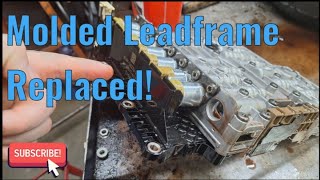
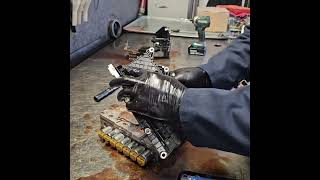
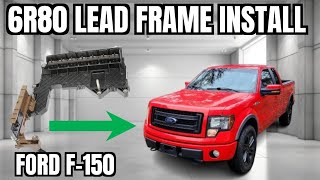
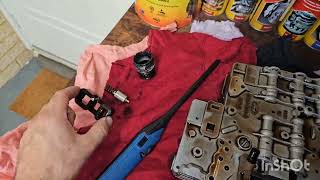
Typical fix: Replace the entire molded leadframe assembly inside the transmission. This requires draining the fluid, dropping the transmission pan, and removing the main control valve body to access the part. 🎬 Watch: A complete walkthrough of the 6R80 leadframe replacement process.
Est. part cost: $150-$350
Rare But Worth Checking
- Wiring Harness Damage: While the leadframe is the most common culprit, it's still possible for the wiring harness leading to the transmission's main connector to be damaged, chafed, or have a corroded pin. This should be inspected before condemning the internal leadframe.
- Powertrain Control Module (PCM) Fault: In very rare cases, the PCM itself could be the source of the error. However, due to the prevalence of the leadframe issue, the PCM should only be considered after the leadframe has been replaced and the problem persists. Ford's recall 19S07 included a PCM software update to prevent the downshift, but this does not fix the root hardware failure.
Diagnosis Steps
- Use an OBD-II scanner to confirm the presence of P1500. Check for other transmission-related codes like P0720, P0722, and P0731, which are the specific codes Ford requires for a warranty claim under program 19N01.
- Enter the vehicle's VIN on the NHTSA or Ford owner website to check its history. See if Safety Recall 19S07 (PCM reprogram) and Customer Satisfaction Program 19N01 (leadframe replacement) are open or were previously performed.
- Even if the software was updated under recall, the hardware can still fail. If the characteristic codes are present, the leadframe is the confirmed culprit.
- Before beginning the internal repair, it is wise to visually inspect the main transmission wiring harness and connector for any obvious external damage, corrosion, or loose pins.
- The definitive repair is to replace the molded leadframe assembly. This involves draining the transmission fluid, removing the transmission pan, and removing the main control (valve body) to access and replace the leadframe.
- During the repair, it is critical to also replace the transmission case connector sleeve, as the old one is often damaged during removal and can cause leaks if reused.
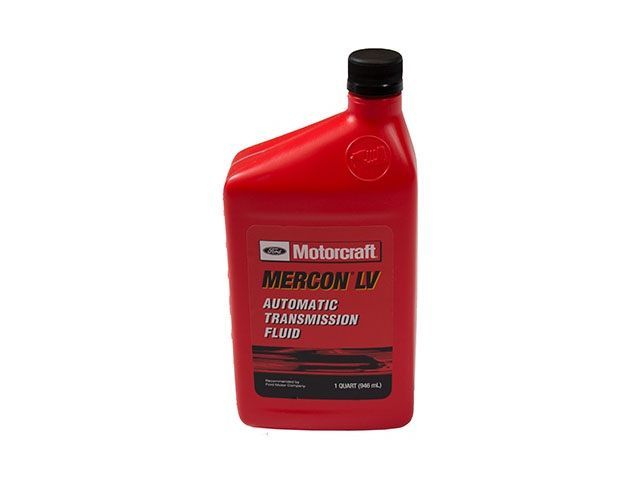
- After replacement, install a new transmission filter, reinstall the pan with a new gasket, and refill with the correct specification of MERCON LV automatic transmission fluid (approx. 8.5 quarts needed for this job).
- Clear all DTCs and perform a transmission adaptive learning drive cycle to allow the PCM to adjust to the new components.
Parts You'll Likely Need

- Transmission Molded Leadframe Assembly
(OEM #AL3Z-7G276-D)— This is the component that houses the failing Output Shaft Speed (OSS) sensor. It is the direct cause of code P1500 and related symptoms. Part number AL3Z-7G276-D is the latest revision, superseding AL3Z-7G276-A and AL3Z-7G276-B.
Trusted brands: Motorcraft, Dorman
OEM price range: $200-$350
Aftermarket price range: $150-$250 - MERCON LV Automatic Transmission Fluid
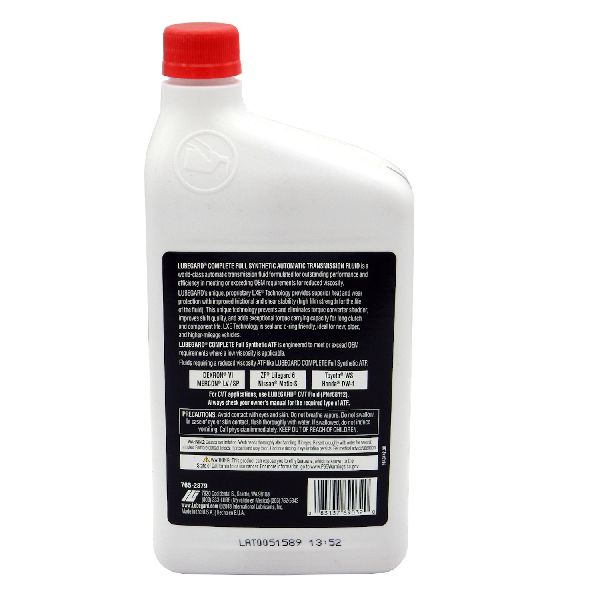
(OEM #XT-10-QLVC)— The transmission fluid must be drained to perform the repair and must be replaced with the correct OEM-specification fluid. The job typically requires around 8.5 quarts.
Trusted brands: Motorcraft, Valvoline, Castrol
OEM price range: $8-$12 per quart
Aftermarket price range: $7-$10 per quart - Transmission Filter Kit
(OEM #BL3Z-7A098-A)— The filter should always be replaced whenever the transmission pan is removed.
Trusted brands: Motorcraft, Wix, ATP
OEM price range: $30-$50
Aftermarket price range: $20-$40 - Transmission Pan Gasket
(OEM #BL3Z-7A191-C)— A new gasket is required to prevent leaks after reinstalling the transmission pan.
Trusted brands: Motorcraft, Fel-Pro
OEM price range: $25-$40
Aftermarket price range: $15-$30
Related Codes That Often Appear With This One
- P0720 — This code indicates a malfunction in the Output Speed Sensor (OSS) circuit. It is explicitly listed alongside P1500 in Ford's TSB 19N01 as a primary indicator of leadframe failure.
- P0722 — This code means 'Output Speed Sensor Circuit No Signal'. It indicates a complete loss of the signal, which can happen intermittently during the failure of the leadframe, triggering P1500 as well. It is also a key code mentioned in TSB 19N01.
- P0731 — This code for 'Gear 1 Incorrect Ratio' can be set when the PCM loses the output speed signal and commands a downshift to first gear as a fail-safe, causing a mismatch between expected and actual gear ratios. This is another code specified in TSB 19N01. 🎬 Watch: Diagnosing OSS faults and incorrect gear ratio codes.
Technical Service Bulletins (TSBs) & Recalls

- 19N01-S3 / 19N01-S4: 'Certain 2011 - 2013 Model Year F-150 and 2012- 2013 Model Year Expedition/Navigator Vehicles Equipped with A 6R80 Transmission Transmission Molded Leadframe Extended Coverage'. This TSB outlines the extended warranty program. It explicitly states that DTCs P0720, P0722, P0731 and/or P1500 must be stored in the PCM for the dealer to replace the leadframe under warranty.
- 19S07 / NHTSA 19V-075: This safety recall addresses the unintended downshift. The remedy was to reprogram the PCM. It notes that if the specified DTCs are present, the vehicle should be repaired under program 19N01.
Platform-Specific Known Issues
- Ford issued Customer Satisfaction Program 19N01, extending the warranty on the molded leadframe to 10 years or 150,000 miles for the 2012-2013 Expedition. This program has likely expired for most vehicles due to age.
- Safety Recall 19S07 was issued for the dangerous sudden downshift condition. The initial fix was a software update to prevent the downshift, but the underlying hardware (the leadframe) would still be faulty.
- Owner experiences confirm the software update is just a band-aid. One owner on a forum noted that after the recall was performed, the transmission no longer slammed into first but would shutter and get confused when the fault occurred.
Mechanic-Grade Diagnostic Values
- Output Shaft Speed (OSS) Sensor Live Data — expected: RPM should be 0 when stopped in Park or Drive (with brakes applied). RPM should increase smoothly and correlate with vehicle speed during acceleration.. Failure: The OSS reading on a scan tool jumps erratically, drops to zero intermittently while the vehicle is moving, or lags significantly behind the Input Speed Sensor (ISS) reading.
- OSS Circuit Voltage at PCM — expected: A specific voltage reading should be present at the PCM pin corresponding to the OSS signal. While the exact voltage varies, a pinpoint test involves checking for expected voltage ranges to rule out opens or shorts.. Failure: Voltage that is out of the expected range (e.g., 0 volts indicating an open, or battery/ground voltage indicating a short) when tested at the PCM connector pin.
Hidden / Shadow Codes Worth Checking
- Mode $06, TID $XX, CID $XX: Mode $06 data can show the results of the PCM's self-tests on components before a failure is bad enough to set a Diagnostic Trouble Code (DTC) and turn on the check engine light. A failing test for the OSS sensor may appear here as a value approaching its failure threshold, acting as an early warning. (see via A professional-grade OBD-II scan tool that supports Mode $06 data is required. The specific Test ID (TID) and Component ID (CID) for the OSS sensor must be looked up in a service manual for the specific vehicle.)
Scan Tool Commands That Help
- Ford IDS (Integrated Diagnostic System): Reset KAM (Keep Alive Memory) — This procedure is critical after replacing the molded leadframe. It is found in the IDS Toolbox under Powertrain -> TCM -> Reset KAM. This fully clears the transmission's adaptive learning tables, which is necessary for the transmission to relearn shift strategies with the new component. Simply clearing DTCs or disconnecting the battery is not sufficient.
- Professional OBD-II Scanners (Snap-on, Autel, etc.): Clear Transmission Adaptive Tables — Used after a transmission repair or lead frame replacement to reset the learned shift pressures and timing. This forces the TCM to start a new learning process.
Wiring & Ground Locations
- C175T, Pin 14 — This is one of the main connectors at the Powertrain Control Module (PCM).. Pin 14 on connector C175T carries the signal from the Output Shaft Speed (OSS) sensor. A technician can back-probe this pin to test for a valid signal, or perform a continuity/short-to-ground test on the DB-YE (Dark Blue with Yellow stripe) wire between the PCM and the transmission, helping to isolate a wiring fault from an internal leadframe failure.
- G104 — Typically located on the engine or chassis near the battery.. This is a primary ground point for the PCM. A poor connection at this ground can cause a wide range of erratic electronic issues, including incorrect sensor readings. While not a direct cause of P1500, checking major PCM grounds is a crucial step if other electrical anomalies are present.
Real Owner Repair Stories
- Ford Expedition Forum user 'Doc94' (2015 Expedition Limited, failure at ~83,000 miles) — Wrench light on dash, vehicle went into limp mode, code P0722 (Output Shaft Speed Sensor Circuit No Signal). Could be temporarily resolved by restarting the engine.
❌ Tried (didn't work) Restarting the vehicle was only a temporary fix.
✅ What actually fixed it The molded lead frame was replaced. The owner noted that at the time of repair, there was a 3-month backorder on the part, with over 17,000 on order nationally, forcing the use of an aftermarket part. The repair cost $1,100. - Reddit user 'Puzzleheaded_Bid9057' (2014 Ford Expedition Limited) — After replacing the lead frame, the transmission would not engage Drive (felt like Neutral). Manual gears 1, 2, and 3 worked correctly.
❌ Tried (didn't work) The initial repair (lead frame, bridge seal, bulkhead sleeve replacement) caused the new issue.
✅ What actually fixed it The problem was suspected by another user to be the manual valve lever inside the transmission not being correctly aligned with the pin on the valve body during reassembly. This is a common mistake that prevents proper gear selection despite the electronic components being new. - Ford Truck Enthusiasts Forums user (2013 F-150 3.5L (shared powertrain)) — Symptoms of lead frame failure persisted even after the lead frame was replaced.
❌ Tried (didn't work) Replacing the molded lead frame did not solve the problem.
✅ What actually fixed it The owner discovered both battery terminals were heavily corroded. Cleaning the terminals and applying anti-corrosion coating resolved the persistent electronic issues that were mimicking a lead frame failure.
When the Usual Fixes Don't Work
- In some documented cases, replacing the molded leadframe—the most common fix—does not resolve the issue. One owner on a Ford forum reported that symptoms persisted after the replacement. The ultimate fix was discovered to be heavily corroded battery terminals. The poor electrical connection was causing voltage fluctuations to the PCM, which in turn misinterpreted sensor signals and created symptoms identical to a failing leadframe. This highlights the importance of checking the basic electrical system (battery, grounds) before or even after a major component replacement.
OEM Part Supersession History
AL3Z-7G276-A, AL3Z-7G276-B→AL3Z-7G276-D— The 'D' revision is the latest updated part from Ford, designed to address the reliability issues of the earlier versions. Forum discussions suggest it has material or design improvements to prevent the sensor failures.
Heads up: The 'A' and 'B' versions should be avoided. Always purchase the latest 'D' revision for the repair to ensure longevity. While they are physically interchangeable, the older parts carry the original design defect.
Model Year Variations Within This Range
- 2012-2013: Ford's Customer Satisfaction Program 19N01, which extended the warranty for the molded leadframe, specifically covers the 2012-2013 Expedition and Navigator. The 2011 Expedition was NOT included in this program, although 2011 F-150s were.
Helpful Videos
We Have This Part in Stock

The information in this article is provided for general reference and educational purposes only. Vehicle specifications, procedures, and part compatibility can vary by production date, trim level, and region. Always consult your vehicle's factory service manual and verify part numbers before purchasing or performing repairs. Safety-critical components such as airbags, seat belts, and braking systems should be installed by a qualified professional.
- Ford EXPEDITION:
- 🎬 Helpful Videos
- 🛍️ Shop This Part
- What's Unique About the 2011-2013 Ford EXPEDITION
- Diagnostic Flowchart
- Symptoms You May Notice
- Most Likely Causes
- Rare But Worth Checking
- Diagnosis Steps
- Parts You'll Likely Need
- Related Codes That Often Appear With This One
- Technical Service Bulletins (TSBs) & Recalls
- Platform-Specific Known Issues
- Mechanic-Grade Diagnostic Values
- Hidden / Shadow Codes Worth Checking
- Scan Tool Commands That Help
- Wiring & Ground Locations
- Real Owner Repair Stories
- When the Usual Fixes Don't Work
- OEM Part Supersession History
- Model Year Variations Within This Range
- 🎟️ Get 5% Off