

OBD-II Code P1478: Particulate Matter Sensor Temperature Circuit High Voltage
The Ultimate Guide to What P1478 Means, Why It Triggers, and How to Fix It for Good
- Code P1478 requires checking GM Emission Recall 17337 or TSB 19-NA-124 first, as a simple ECM software update fixes the issue on 2016-2018 Colorado, Canyon, and Silverado HD models.
- Driving more than 500 miles with an active P1478 code disables DPF regeneration, turning a $300 sensor replacement into a $3,400+ DPF replacement.
- Removing the old Particulate Matter sensor requires soaking it in penetrating oil and using a 15/16-inch flare nut wrench, as extreme exhaust heat permanently seizes the threads.
- Ford Powerstroke owners experience the exact same sensor failure under code P24C6, while BMW and VW owners seeing P1478 actually have an unrelated EVAP system leak.
What Does P1478 Mean?

P1478 indicates the Engine Control Module (ECM) detects an electrical fault in the particulate matter (PM) sensor. Specifically, the voltage from the sensor's internal temperature circuit exceeds the expected range. This high voltage fault typically means an open circuit or a short to a power source, preventing the sensor from accurately measuring exhaust soot.
Technical definition: The SAE/OBD-II definition is "Particulate Matter Sensor Temperature Circuit High Voltage". The sensor's integrated control unit detects an internal high voltage condition on the circuit measuring its own operating temperature, failing its internal self-check.
Can I Drive With P1478?

Yes, But With Caution. Yes, but you must fix it immediately. Driving with this code disables the Diesel Particulate Filter's (DPF) self-cleaning regeneration. Continuing for more than 500 miles irreversibly clogs the DPF with soot, causing severe power loss ('limp mode') and escalating a $300 sensor replacement into a $3,400+ DPF replacement.
Common Causes

- Outdated Engine Control Module (ECM) software (Very Common) — On 2016-2018 GM models, overly sensitive ECM software erroneously sets a P1478 code. General Motors released Technical Service Bulletin (TSB) 19-NA-124 and Emission Recall 17337 to reprogram the ECM and correct this false trigger.
- Internal failure of the Particulate Matter (PM) Sensor (Very Common) — The PM sensor is a complex electronic component constantly exposed to extreme heat cycles and corrosive exhaust gases. The internal electronics fail over time, creating an open circuit that triggers the high voltage code.
- Damaged wiring or connectors (Common) — The sensor's wiring harness runs underneath the vehicle, vulnerable to road debris, moisture, and exhaust heat. Chafed wires or corroded connectors create an open circuit or a short to power.
- Exhaust leaks upstream of the PM sensor (Uncommon) — A leak in the exhaust system before the PM sensor introduces oxygen and alters the exhaust gas temperature. This forces the sensor to generate unexpected readings, triggering a fault code as the system attempts to compensate.
- Extreme heat or chemical damage (Rare) — Intense heat from a forced DPF regeneration or contamination from aggressive, non-approved chemical DPF cleaners destroys the delicate downstream PM sensor, causing permanent electrical failure.
- Internal Fault in Fuse Block (Very Rare) — If P1478 is accompanied by unrelated codes (like P053A for a PCV heater), an internal fault in the vehicle's fuse block is preventing proper voltage from reaching the shared circuit.
Symptoms

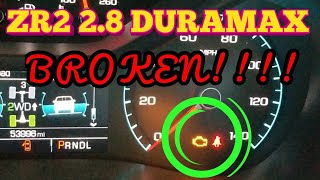
- Check Engine Light is on — The ECM illuminates the malfunction indicator lamp immediately upon detecting the circuit fault.
- Disabled remote start feature — Most modern trucks disable the remote start function as a safety measure when an active emissions-related fault code is present.
- Vehicle enters reduced power "limp mode" — If driven too long without regeneration, the ECM severely limits engine power and speed to prevent catastrophic damage to the clogged emissions system.
- DPF or emissions system warning message — The dashboard displays "Service Emissions System" or illuminates a specific DPF warning light.
- DPF regeneration is disabled (also visible on scanner) — The ECM prohibits automatic DPF regeneration cycles because it cannot verify soot levels with a faulty PM sensor.
Common Fixes & Costs

- Update the Engine Control Module (ECM) Software — Parts: $0, Labor: $150-$200, ~1.0 hr book time (Professional)
- Replace the Particulate Matter (PM) Sensor — Parts: $80-$300, Labor: $150-$250, ~1.5 hr book time (Intermediate)
- Repair Damaged Wiring or Connector — Parts: $10-$50, Labor: $150-$300, ~2.0 hr book time (Intermediate)
- Replace DPF and Seized PM Sensor — Parts: $2000-$3500, Labor: $400-$600, ~3.5 hr book time (Professional)
Used vs. New Parts: Buying Guide
When a used part is worth it: Avoid used Particulate Matter sensors. They are sensitive electronic components with a finite lifespan due to extreme heat exposure. The small cost savings do not justify the high risk of premature failure.
Donor-vehicle mileage cap: roughly under 20000 miles for the part to have meaningful remaining life.
Donor quality checklist:
- Only consider a used sensor from a documented, very low-mileage wrecked vehicle.
- Avoid parts from rust belt vehicles due to corrosion.
- Verify the part number exactly to ensure software compatibility.
Decision logic:
- If The cost of a new OEM or reputable aftermarket sensor is under $300 → Always buy new. The warranty and peace of mind are worth the cost.
- If You are in a critical situation and a new part is unavailable for weeks → A used part from a low-mileage donor is a temporary solution, but plan to replace it with a new one.
Warranty tradeoff: Used sensors offer a 30-day warranty covering only the part. New aftermarket sensors offer 1-year to limited lifetime warranties, while new OEM parts carry a 1-2 year manufacturer warranty.
Worst-case if a used part fails: $300-$500. If a used sensor fails, you pay for the difficult removal labor again plus the cost of another sensor.
Cost of Not Fixing It
- 0-1 month (0-500 miles): DPF regeneration is disabled. Soot accumulates in the DPF, increasing exhaust backpressure. Fuel economy drops slightly. (Added cost: Negligible)
- 1-3 months (500-1,500 miles): DPF becomes significantly clogged. The vehicle enters reduced power 'limp mode'. The DPF requires a forced regeneration at a shop. (Added cost: $200-$400)
- 3+ months (1,500+ miles): The DPF is irreversibly clogged with hardened soot and ash. The filter is scrap and must be replaced along with the faulty sensor. (Added cost: $2,500-$4,000+)
Diagnosis Steps
- Check for Technical Service Bulletins (TSBs) and Recalls
Before touching the vehicle, search your VIN for TSBs and recalls. For 2016-2018 GM trucks, TSB 19-NA-124 or Emission Recall 17337 🎬 See how to fix P1478 on a 2019 Silverado 2500HD. requires a software update that fixes this code without replacing any parts.
Tools: Internet access, Vehicle Identification Number (VIN) (Beginner) - Read All Fault Codes
Use an OBD-II scanner to confirm P1478 is active. Note any other codes. Codes like P1477 or P24B1 point to the same sensor issue, while unrelated codes indicate a broader electrical or fuse block problem.
Tools: OBD-II Scanner (Beginner) - PRO TIP: Analyze Live Sensor Data
View the live data stream for 'Particulate Matter Sensor Temperature'. A normal reading is 32-392°F (0-200°C) with the engine running. A reading stuck at an extreme value (e.g., -40°F) or failing to rise from ambient temperature confirms a dead sensor or open circuit.
Tools: Advanced OBD-II Scanner with Live Data (Intermediate) - Perform a Detailed Visual Inspection
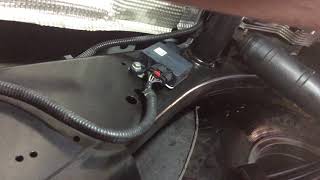
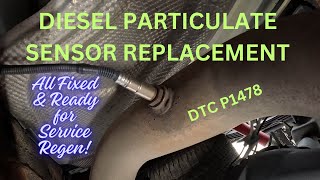
Locate the PM sensor in the exhaust pipe downstream from the DPF. 🎬 Watch: Step-by-step guide on how to replace a particulate matter sensor. Inspect the sensor, connector, and wiring harness for melted plastic, chafed wires rubbing against the frame, or corrosion inside the connector pins.
Tools: Flashlight, safety glasses (Beginner) - PRO TIP: Test the Circuit at the Connector
Disconnect the PM sensor harness. Using a multimeter and wiring diagram, check for 5V/12V reference power and a solid ground on the vehicle-side connector pins. If you have proper voltage and ground, the vehicle wiring is good, and the sensor itself has failed.
Tools: Multimeter, vehicle service manual (Advanced) - Test the Sensor (Swap Test)
Plug a new sensor's electrical connector into the harness without installing it in the exhaust. Clear the codes and start the engine. If P1478 does not return, the old sensor is definitively faulty. If it returns immediately, the problem is in the wiring or ECM.
Tools: New PM sensor, OBD-II Scanner (Intermediate) - Replace the Particulate Matter Sensor
If the sensor is faulty, replace it. The sensor frequently seizes in the exhaust bung. Soak it in penetrating oil and use a 15/16" or 23mm flare nut wrench. If it rounds off, cut the sensor body off with an angle grinder to use a 6-point impact socket.
Tools: Penetrating oil, 15/16" flare nut wrench, socket set, angle grinder (optional) (Advanced)
When This Code Triggers (Freeze-Frame Conditions)
- Engine Coolant Temp: 180-205°F (82-96°C) (The engine is at full operating temperature.)
- Engine RPM: 1500-2500 RPM (The fault is detected during steady-state highway cruising.)
- Vehicle Speed: 45-65 mph (72-105 kph) (Corresponds with highway driving conditions when the DPF system is actively monitored.)
- Ambient Air Temperature: Above 32°F (0°C) (The diagnostic test runs when temperatures are not at freezing extremes.)
Related Codes
- P1477 — The direct counterpart: 'Particulate Matter Sensor Temperature Circuit Low Voltage.' P1478 points to an open circuit or short to power, while P1477 suggests a short to ground.
- P24B1 — A generic code for 'Particulate Matter Sensor Circuit High.' GM's TSB 19-NA-124 groups this with P1478 as being fixed by the same software update.
- P24C6 — Ford's equivalent code for 'Particulate Matter Sensor Temperature Circuit.' The diagnosis and repair steps for P1478 apply directly to Ford trucks with P24C6.
- P1479 — Indicates a 'Particulate Matter Sensor Sensitivity Factor Performance' issue. Triggered as a secondary fault when the temperature circuit (P1478) fails intermittently.
Climate & Environmental Factors
- Extreme Heat Cycles: Diesel exhaust systems subject the sensor to extreme thermal stress during normal operation and forced regenerations. This constant heating and cooling is the primary cause of internal electronic failure.
- Road Salt / Corrosive Environments: Vehicles in the 'Salt Belt' experience accelerated corrosion of the sensor's external body and wiring harness connectors, making removal highly difficult and increasing the risk of electrical shorts.
How to Clear the Code After You Fix It
- Use an OBD-II scan tool to erase the P1478 fault code after the new part is installed.
- Perform a complete drive cycle to allow the vehicle's readiness monitors to reset.
- Disconnecting the battery clears the code but resets all vehicle memory and readiness monitors.
Drive cycle (~30 minutes): A general GM drive cycle includes: 1) Cold start and idle for 2-3 minutes. 2) Drive at a steady 55 mph for 10-15 minutes. 3) Perform stop-and-go city driving. 4) Allow the vehicle to cool completely and repeat.
Readiness monitors affected: Catalyst Monitor, Particulate Matter Monitor, Oxygen Sensor Monitor
Before emissions retest: drive at least 100 miles to fully set monitors.
Watch out for:
- Clearing the code without performing the repair causes it to return immediately.
- Failing to perform a complete drive cycle leaves readiness monitors as 'Not Ready', causing an emissions test failure.
- The code returns if a wiring issue was ignored and only the sensor was replaced.
Will This Fail Emissions / State Inspection?
Yes — this code typically fails an OBD-II emissions inspection.
- California: An active P1478 code results in an automatic smog check failure. A complete drive cycle must be performed to set all readiness monitors before a re-test.
- New York: The NYS inspection includes an OBD-II check. An illuminated Check Engine Light from code P1478 is an automatic failure.
- Texas: In the 17 counties requiring emissions testing, a vehicle with an active P1478 code fails the OBD-II inspection.
Most Commonly Affected Vehicles
- Chevrolet Colorado (2016-2022) — Extremely common on the 2.8L Duramax. TSB 19-NA-124 and Recall 17337 apply to 2016-2018 models for an ECM reprogram.
- GMC Canyon (2016-2022) — Mechanically identical to the Colorado. Suffers from the same software glitches on 2016-2018 models and frequent sensor failures.
- Chevrolet Silverado 2500/3500 HD (2017-2019) — Common on the L5P Duramax engine. Recall 17337 applies to 2017-2018 models to reprogram the ECM for better sensor fault diagnosis.
- GMC Sierra 2500/3500 HD (2017-2019) — Shares the L5P Duramax powertrain with the Silverado. Recall 17337 applies to 2017-2018 models.
- Ford F-Series Super Duty (2015-2022) — On Ford's 6.7L Powerstroke, the identical fault sets code P24C6. Diagnosis and repair involve the exact same PM sensor replacement.
- BMW Various Diesel Models (X3, X5d, 335d) (2010-2018) — On many BMWs, P1478 indicates an EVAP system leak, which is completely unrelated to the diesel exhaust. Verify with BMW-specific software.
- Volkswagen Jetta, Golf, Transporter (TDI models) (2011-2017) — For some VW models, P1478 refers to an EVAP Emission Control System issue. Verify the code definition for your specific engine.
- Vauxhall/Opel Zafira, Insignia (2016-2018) — European GM diesel engines log P1478 for PM sensor faults. Causes and symptoms are identical to US counterparts.
Manufacturer-Specific Notes
- General Motors (Chevrolet/GMC): GM issued Emission Recall 17337 and TSB 19-NA-124 for 2016-2018 diesel trucks. An ECM software update often fixes P1478 without requiring a new sensor. Always check your VIN first.
- Ford: Ford's 6.7L Powerstroke engine uses an identical PM sensor system, but a temperature circuit fault sets code P24C6 instead of P1478.
- BMW & Volkswagen: On many gasoline and some diesel BMW/VW models, P1478 refers to a 'Fuel Evaporation (EVAP) System Leak.' This is entirely unrelated to the exhaust system.
- Dodge/Chrysler/Jeep: On pre-2010 vehicles, P1478 means 'Battery Temperature Sensor Circuit Out-Of-Limits,' referring to a sensor under the battery tray used for charging voltage.
Frequently Asked Questions
Can I clean the Particulate Matter sensor instead of replacing it?
No. The P1478 code signifies an internal electrical failure of the temperature circuit, not a dirty sensor. Cleaning the exterior has no effect on the electrical fault.
What is the most common mistake when diagnosing P1478?
The biggest mistake is replacing the PM sensor without checking for GM Emission Recall 17337 or TSB 19-NA-124. A free dealer software update often fixes the problem on 2016-2018 models.
Is the Particulate Matter sensor the same as a NOx or O2 sensor?
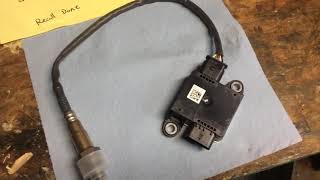
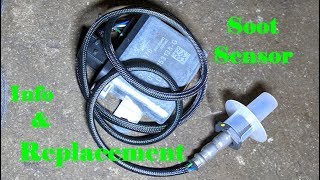
No. An O2 sensor measures oxygen, a NOx sensor measures nitrogen oxides, and a PM sensor measures soot particles. They are not interchangeable despite looking similar.
Will my truck still regenerate its DPF with a P1478 code?
No. The ECM disables all automatic and manual DPF regeneration cycles because it cannot trust the faulty sensor's data.
Why is the PM sensor so difficult to remove?
Thousands of extreme heat cycles cause the metal threads of the sensor and the exhaust pipe to weld together through thread galling. Removal requires penetrating oil, heat, and significant force.
Does a new PM sensor need to be programmed?
No, the sensor is a plug-and-play component. However, you must use an OBD-II scanner to clear the P1478 fault code from the ECM after installation.
Where is the P1478 sensor located?
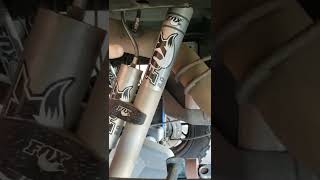
The PM sensor is located in the exhaust system downstream from the Diesel Particulate Filter (DPF). On GM trucks, it is typically on the passenger side near the rear shock absorber.
Can I just delete the PM sensor?
No. Removing factory emissions equipment is illegal for on-road vehicles and causes automatic emissions test failures and engine management issues.
Key Takeaways
- Code P1478 requires checking GM Emission Recall 17337 or TSB 19-NA-124 first, as a simple ECM software update fixes the issue on 2016-2018 Colorado, Canyon, and Silverado HD models.
- Driving more than 500 miles with an active P1478 code disables DPF regeneration, turning a $300 sensor replacement into a $3,400+ DPF replacement.
- Removing the old Particulate Matter sensor requires soaking it in penetrating oil and using a 15/16-inch flare nut wrench, as extreme exhaust heat permanently seizes the threads.
- Ford Powerstroke owners experience the exact same sensor failure under code P24C6, while BMW and VW owners seeing P1478 actually have an unrelated EVAP system leak.
Helpful Videos

The information in this article is provided for general reference and educational purposes only. Vehicle specifications, procedures, and part compatibility can vary by production date, trim level, and region. Always consult your vehicle's factory service manual and verify part numbers before purchasing or performing repairs. Safety-critical components such as airbags, seat belts, and braking systems should be installed by a qualified professional.
- 🎬 Helpful Videos
- What Does P1478 Mean?
- Can I Drive With P1478?
- Common Causes
- Symptoms
- Common Fixes & Costs
- Used vs. New Parts: Buying Guide
- Cost of Not Fixing It
- Diagnosis Steps
- When This Code Triggers (Freeze-Frame Conditions)
- Related Codes
- Climate & Environmental Factors
- How to Clear the Code After You Fix It
- Will This Fail Emissions / State Inspection?
- Most Commonly Affected Vehicles
- Manufacturer-Specific Notes
- Frequently Asked Questions
- Can I clean the Particulate Matter sensor instead of replacing it?
- What is the most common mistake when diagnosing P1478?
- Is the Particulate Matter sensor the same as a NOx or O2 sensor?
- Will my truck still regenerate its DPF with a P1478 code?
- Why is the PM sensor so difficult to remove?
- Does a new PM sensor need to be programmed?
- Where is the P1478 sensor located?
- Can I just delete the PM sensor?
- Key Takeaways
- 🎟️ Get 5% Off