

P1457 on 2001-2004 Acura RL: EVAP Canister System Leak Causes and Fixes
On a 2001-2004 Acura RL, code P1457 almost always points to a leak in the EVAP canister area, not the gas cap. The most common failure is the EVAP Canister Vent Solenoid (CVS) valve, which rusts and fails to seal. A corroded EVAP Bypass Solenoid is the second most likely cause. Replacing the affected solenoid is a common DIY fix, with parts costing between $40 and $120, but be prepared for extremely rusted mounting screws.
- P1457 means there is a leak in the EVAP system near the charcoal canister, not a loose gas cap.
- The most likely cause is a rusted EVAP Canister Vent Solenoid located under the car.
- A smoke test is the best way to accurately diagnose the location of the leak.
- When replacing the solenoid, be prepared to deal with heavily rusted screws.
- Do not overfill your gas tank, as this can ruin the charcoal canister and lead to this code.
What's Unique About the 2001-2004 Acura RL
The first-generation Acura RL, like many Hondas and Acuras from this era, is well-known for triggering the P1457 code. The primary reason is the location of the EVAP canister and its components under the vehicle, where they are exposed to road salt, water, and debris. This exposure causes the metal body and screws of the EVAP Canister Vent Solenoid to corrode. The rust expands and can crack the plastic housing or cause the internal seal to fail, creating the leak that the car's computer detects. Honda acknowledged this issue in TSB 03-001, noting that vehicles in salt-belt regions are much more likely to experience this failure in the EVAP bypass solenoid valve.
Diagnostic Flowchart
Tap your situation to follow the diagnostic path that matches what you're seeing on this vehicle.
Symptoms You May Notice
- Check Engine Light is on
- A faint smell of fuel, particularly around the rear of the vehicle
- Failure to pass an emissions inspection
- Replacing the gas cap. A faulty gas cap will typically cause a P1456 code (fuel tank side leak), not a P1457 (canister side leak).
Most Likely Causes
- Failed EVAP Canister Vent Solenoid (CVS) Valve 🔴 High Probability The valve is mounted on the EVAP canister under the car, where its metal components are highly susceptible to rust from road salt and moisture. The rust expands and can crack the plastic housing or, more commonly, cause the internal O-ring seal to fail.
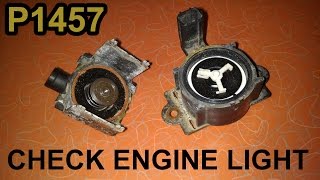
How to confirm: Visually inspect the valve for heavy rust or cracks. A mechanic can use a bi-directional scan tool to command the valve closed and see if it holds a vacuum, or perform a smoke test to see smoke leaking from the valve body. A DIY method involves disassembling the valve to inspect the internal metal plate and o-ring for corrosion and scale.
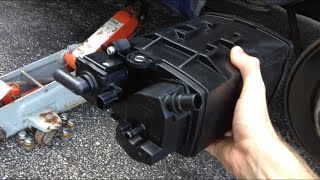
Typical fix: Replace the EVAP Canister Vent Solenoid. The mounting screws are often extremely rusted and may need to be cut or extracted carefully. Some owners have successfully repaired the valve by disassembling it and cleaning the corroded metal sealing surface 🎬 Watch: How to repair and clean the shut valve for free. with a Scotch-Brite pad.
Est. part cost: $40-$120 - Failed EVAP Bypass Solenoid Valve 🟡 Medium Probability Like the vent solenoid, this valve is also located on the canister assembly and is prone to corrosion and internal failure. Honda TSB 03-001 specifically identifies this part failing due to water and road salt intrusion, causing the internal windings to corrode. A short in this valve can damage the Powertrain Control Module (PCM).
How to confirm: A smoke test will show a leak from this valve. It can also be tested with a scan tool or by applying 12V power to see if it actuates. If the valve doesn't click when commanded by a scan tool, and a new valve also doesn't work, the PCM driver may be damaged.
Typical fix: Replace the EVAP bypass solenoid valve. It is often replaced along with the vent solenoid as a preventative measure, especially in salt-belt states.
Est. part cost: $50-$100 - Cracked or Rotted EVAP Hoses ⚪ Low Probability The rubber hoses connected to the EVAP canister can become brittle and crack over time due to age and exposure to the elements.
How to confirm: Visually inspect all rubber hoses connected to the charcoal canister for visible cracks or signs of decay. A smoke test is the most effective way to find small hose leaks.
Typical fix: Replace the specific cracked hose section with a new, correctly sized vacuum hose.
Est. part cost: $10-$30 - Cracked Charcoal Canister ⚪ Low Probability Overfilling the fuel tank can force liquid gasoline into the charcoal canister, saturating the charcoal and potentially damaging the canister itself. Physical damage from road debris can also cause cracks.
How to confirm: A smoke test will show smoke leaking directly from the body of the canister. You may also smell a strong fuel odor coming from the canister. If charcoal particles are found inside the solenoid valves during replacement, the canister is compromised and must be replaced.
Typical fix: Replace the entire charcoal canister assembly.
Est. part cost: $200-$350
Rare But Worth Checking
- Damaged Powertrain Control Module (PCM) Driver: In rare cases, a short-circuited EVAP bypass solenoid can damage the internal circuit in the PCM that controls it. This is confirmed in Honda TSB 03-001. If a new solenoid doesn't click or operate when installed and the wiring is good, the PCM may be the problem. This is an expensive, last-resort diagnosis, and some owners on forums have faced this exact issue after driving with the code for too long.
Diagnosis Steps
- Read the code with an OBD-II scanner to confirm P1457 is the active fault.
- Visually inspect the EVAP canister, vent solenoid, bypass solenoid, and all connected hoses under the rear of the vehicle. Look for obvious signs of extreme rust, cracks, or damage.
- Check the gas cap to ensure it is tight, but do not assume this is the fix for P1457.
- The most effective diagnostic step is to perform a smoke test. This involves injecting pressurized smoke (at a very low pressure, ~1 PSI) into the EVAP system and watching for where it leaks out. 🎬 See a professional smoke test and diagnosis in action. For P1457, the leak will most likely be from the vent solenoid or bypass valve.
- If a bi-directional scanner is available, command the EVAP vent and bypass solenoids to close and check if the system can hold a vacuum. Listen for an audible click from each solenoid as it's activated.
- If a solenoid is suspected, you can test it by applying 12V power and ground to its terminals to see if it clicks open and closed.
- If a solenoid is confirmed bad, replace it. Be prepared for rusted screws. Soak them in penetrating oil for at least an hour, tap them with a hammer to shock the threads, and use locking pliers (vice grips) for removal, as a Phillips screwdriver will likely strip the heads.
Parts You'll Likely Need
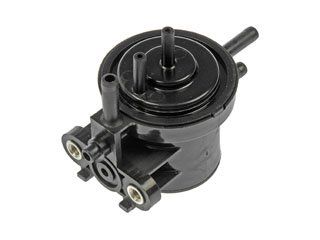
- EVAP Canister Vent Solenoid / Shut Valve
(OEM #17310-SZ3-A51 (Specific to RL), 17310-S5A-L31 (Common Honda/Acura))— This is the most common failure point for a P1457 code due to its susceptibility to corrosion.
Trusted brands: Dorman (911-760), Standard Motor Products (CP421), Acura (OEM)
OEM price range: $80-$115
Aftermarket price range: $40-$85 - EVAP Bypass Solenoid Valve / Two-Way Valve
(OEM #17012-S84-A01 (Commonly used on platform mates))— This valve is the second most likely component to fail from corrosion and cause a P1457 code, as documented in TSB 03-001.
Trusted brands: Acura (OEM), Standard Motor Products
OEM price range: $70-$100
Aftermarket price range: $50-$80 - EVAP Charcoal Canister
(OEM #17011-SZ3-A50 or 17011-SZ3-A30)— Needed if the canister body is cracked or saturated with liquid fuel from overfilling the gas tank.
Trusted brands: Acura (OEM)
OEM price range: $250-$350
Aftermarket price range: $200-$300 - Vent Solenoid Mounting Screws
(OEM #93893-0501008)— The original screws are almost guaranteed to be rusted solid and will likely break or strip during removal. It is highly recommended to have replacements on hand.
Trusted brands: Honda (OEM)
OEM price range: $2-$5 per screw
Technical Service Bulletins (TSBs) & Recalls
- B99-040: Updates the troubleshooting procedures for DTC P1456 and P1457, confirming P1457 relates to the EVAP Canister System.
- 03-001: Details the failure of the EVAP Bypass Solenoid Valve due to corrosion from road salt, causing P1457. It warns that an internal short can damage the PCM and recommends testing and replacing the valve, and the PCM if necessary.
Platform-Specific Known Issues
- The Phillips head screws holding the vent and bypass solenoids to the canister are notorious for rusting solid into their brass inserts. Attempting to remove them often results in the screw heads stripping or breaking. Using penetrating oil liberally (letting it soak for an hour or more), shocking the threads by tapping with a hammer, and using high-quality locking pliers are essential for removal. In severe cases, owners have had to cut the old solenoid body apart with a rotary tool to gain enough access to grip the broken screw shank with locking pliers.
Mechanic-Grade Diagnostic Values
- Fuel Tank Pressure (FTP) Sensor Voltage — expected: 2.45 - 2.55 Volts. Failure: Voltage is fluctuating or outside the specified range with the ignition on and engine off.
- EVAP Canister Purge Valve Resistance — expected: Approximately 33 ohms at room temperature.. Failure: Resistance is significantly higher or lower (open or shorted). A reading of 5.7Ω was noted on a faulty circuit.
Hidden / Shadow Codes Worth Checking
- Mode 6, TID $2E: Represents 'Commanded Evaporative Purge %'. A test value of 0% when a higher percentage is expected indicates a failure in the purge command test run by the PCM. (see via An advanced OBD-II scanner capable of displaying Mode 6 test data.)
Scan Tool Commands That Help
- Honda PGM Tester / HDS: INSPECTION -> EVAP TEST -> SINGLE SOLENOIDS — This dealer-level function allows a technician to individually activate the Canister Vent Shut Valve, Bypass Solenoid Valve, and Purge Control Solenoid Valve to confirm they click and actuate properly.
- Bi-directional Scan Tool: EVAP Vent Solenoid On/Off — Used to command the vent solenoid closed during a smoke test to seal the system, or to simply listen for an audible 'click' to confirm the solenoid is receiving the command and is not seized.
Wiring & Ground Locations
- EVAP Canister Components — Under the left rear of the vehicle, near the rear axle and fuel tank.. This is the physical location of the most common failure points for P1457: the EVAP Canister Vent Solenoid and the EVAP Bypass Solenoid.
- G402 — Behind the right kick panel inside the passenger cabin.. This is a major ground point for multiple systems. A corroded or loose G402 ground can cause erratic behavior in various electronic components, including the PCM and its control over the EVAP system.
- Data Link Connector (DLC) — In the front center console, located behind the ashtray.. This is the port where an OBD-II scanner connects to the vehicle to read codes and perform diagnostic tests.
Real Owner Repair Stories
- Acurazine.com forum user (Acura CL-S (similar platform and EVAP system)) — P1457 Check Engine Light.
❌ Tried (didn't work) Initial diagnosis pointed to a leak in the canister area.
✅ What actually fixed it The user performed a smoke test which revealed a leak from the EVAP bypass solenoid valve. To be thorough, they replaced the charcoal canister, the bypass solenoid valve, and the canister vent shut valve all at once, which resolved the code.
OEM Part Supersession History
17310-SZ3-A51→N/A, but often substituted— This is the specific OEM part number for the RL's EVAP Canister Vent Solenoid.
Heads up: The part number 17310-S5A-L31 is a common vent solenoid for other Hondas/Acuras (like the Civic) and is often listed as a replacement. While it may physically fit, using the vehicle-specific 17310-SZ3-A51 is recommended to ensure correct flow and electrical characteristics.
Helpful Videos
We Have This Part in Stock


The information in this article is provided for general reference and educational purposes only. Vehicle specifications, procedures, and part compatibility can vary by production date, trim level, and region. Always consult your vehicle's factory service manual and verify part numbers before purchasing or performing repairs. Safety-critical components such as airbags, seat belts, and braking systems should be installed by a qualified professional.
- Acura RL:
- 🎬 Helpful Videos
- 🛍️ Shop This Part
- What's Unique About the 2001-2004 Acura RL
- Diagnostic Flowchart
- Symptoms You May Notice
- Most Likely Causes
- Rare But Worth Checking
- Diagnosis Steps
- Parts You'll Likely Need
- Technical Service Bulletins (TSBs) & Recalls
- Platform-Specific Known Issues
- Mechanic-Grade Diagnostic Values
- Hidden / Shadow Codes Worth Checking
- Scan Tool Commands That Help
- Wiring & Ground Locations
- Real Owner Repair Stories
- OEM Part Supersession History
- 🎟️ Get 5% Off