

OBD-II Code P1457: EVAP System Leak (Canister Area)
What P1457 means, why it triggers, and how to fix it
- P1457 is a Honda and Acura-specific OBD-II code indicating a vacuum leak in the charcoal canister area of the EVAP system.
- Do not replace the gas cap to fix P1457; a loose gas cap triggers code P1456, while P1457 requires inspecting under-car canister components.
- The most common fix is replacing the EVAP Canister Vent Solenoid (CVS) valve, which fails due to road salt corrosion and costs $140 to $420 professionally.
- Perform an EVAP smoke test at under 1 PSI to pinpoint the exact leak source before spending $200 or more on a new charcoal canister assembly.
What Does P1457 Mean?

P1457 means the engine computer (ECU) detected a leak in the evaporative (EVAP) emissions system, specifically around the charcoal canister. The EVAP system traps gasoline fumes from the fuel tank and routes them into the engine for combustion. This code triggers when the system fails to hold a vacuum during its automated self-test. For Honda and Acura vehicles, P1457 isolates the leak to the 'canister side' rather than the 'tank side' (which triggers P1456).
Technical definition: Evaporative Emission (EVAP) Control System Leakage Detected (Canister System). This manufacturer-specific code indicates the powertrain control module (PCM) detected a vacuum leak on the canister side of the EVAP system during a self-test. The test fails when the system seals, but the fuel tank pressure (FTP) sensor registers insufficient vacuum drop. Ford models occasionally use P1457 to indicate 'Unable to Pull Vacuum in Tank'.
Can I Drive With P1457?
Yes, But With Caution. Yes, you can drive with a P1457 code without causing immediate engine damage. The vehicle's performance remains unaffected, but it fails emissions tests and emits a noticeable fuel smell. The car releases excess pollutants until repaired. If the leak is large enough to cause a rough idle or stalling, repair it promptly to prevent long-term air-fuel mixture issues. Driving extensively with an active check engine light masks new, potentially severe engine problems.
Common Causes

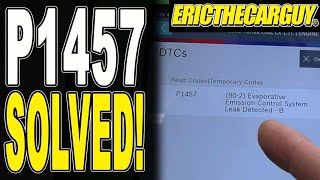
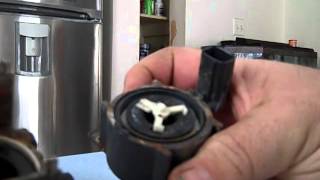
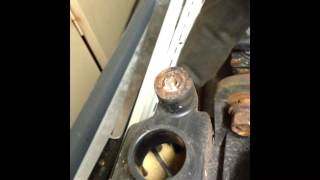
- Faulty EVAP Canister Vent Solenoid (CVS) Valve (Very Common) — This is the primary cause on Honda and Acura vehicles. Located under the car near the charcoal canister, the valve is exposed to road salt and moisture. The metal housing rusts and expands, breaking the plastic valve's seal and creating a vacuum leak. The mounting screws also rust severely, complicating removal. 🎬 See how to replace a rusted vent solenoid valve
- Cracked or Rotted EVAP Hoses (Common) — Rubber hoses connecting the charcoal canister, purge valve, and vent solenoid become brittle with age and crack. Rodents also chew through these lines. A visual inspection reveals large cracks, but pinhole leaks require a smoke test to locate.
- Faulty EVAP Two-Way/Bypass Valve (Common) — This valve helps the system perform self-tests. If it fails or sticks due to corrosion, the test fails and triggers P1457. A failed bypass solenoid occasionally shorts out internally, potentially damaging the PCM.
- Cracked or Saturated Charcoal Canister (Less Common) — The plastic canister body cracks from age or road debris impacts. Habitually overfilling the gas tank (topping off after the pump clicks) forces liquid fuel into the canister, saturating the charcoal and ruining its vapor storage capacity.
- Corroded or Damaged Wiring/Connectors (Less Common) — Wiring to the under-car EVAP solenoids corrodes or frays. This prevents the valves from operating correctly, leading the PCM to register a leak.
- Faulty EVAP Purge Valve/Solenoid (Less Common) — The purge valve in the engine bay sticks open, allowing un-metered air into the system and preventing it from holding a vacuum. This causes P1457 but typically triggers additional codes.
- Faulty Fuel Tank Pressure (FTP) Sensor (Rare) — The sensor monitoring EVAP system pressure fails and sends incorrect readings to the computer, simulating a leak. A healthy sensor reads exactly 2.5 volts with no pressure or vacuum in the system.
- Failed/Damaged Powertrain Control Module (PCM) (Rare) — A shorted EVAP bypass or vent solenoid draws excessive current, destroying the driver circuit within the PCM (noted in Honda TSB 03-001). The code persists after replacing the faulty valve, requiring PCM repair or replacement.
Symptoms

- Failed Emissions Test — The vehicle automatically fails state emissions inspections because the Check Engine Light is active and the EVAP monitor reads 'Not Ready'.
- Fuel Smell — A distinct smell of raw gasoline surrounds the vehicle, particularly near the rear wheels or inside the cabin while idling.
- Decreased Fuel Efficiency — Because the EVAP system recycles fuel vapors, a significant leak causes a minor, measurable decrease in overall gas mileage.
- Rough Idle or Stalling — A massive vacuum leak in the EVAP system alters the engine's air-fuel mixture, causing a rough idle or stalling at stoplights.
- Check Engine Light is On (also visible on scanner) — This is typically the only symptom. The code sets after the system's self-test fails on two consecutive drive cycles.
Diagnostic Flowchart
Tap your situation to follow the diagnostic path that matches what you're seeing on this code.
Common Fixes & Costs
- Replace EVAP Canister Vent Solenoid (CVS) Valve
— Parts: $40-$120, Labor: $100-$300, ~1.5 hr book time
(Intermediate)
1998-2002 Honda Accord: OEM 17310-S0X-A02 (Alt: Dorman 911-761)
1999-2003 Acura TL: OEM 17310-S0X-A02 (Alt: Dorman 911-761)
1998-2001 Honda CR-V: OEM 17310-SV4-L32 (Alt: Dorman 911-760) - Replace Cracked EVAP Hoses — Parts: $10-$50, Labor: $50-$150, ~0.5 hr book time (DIY)
- Replace EVAP Two-Way/Bypass Valve — Parts: $90-$150, Labor: $100-$200, ~1.0 hr book time (Intermediate)
- Replace EVAP Charcoal Canister Assembly
— Parts: $200-$500, Labor: $120-$550, ~1.2 hr book time
(Intermediate)
2001-2005 Honda Civic: OEM 17011-S5A-A30 (Alt: Dorman 911-766)
1998-2001 Honda CR-V: OEM 17300-S10-A01 (Alt: Standard Motor Products CP3066) - Replace EVAP Purge Valve
— Parts: $20-$140, Labor: $50-$150, ~0.8 hr book time
(DIY)
1998-2002 Honda Accord: OEM 36162-PAA-A02 (Alt: N/A)
1999-2001 Honda CR-V: OEM 36162-P2M-A11 (Alt: Genuine W0133-1980270)
DIY vs Professional
- Replace EVAP Canister Vent Solenoid (CVS) Valve — Beginner:
Tools: Jack, jack stands, socket set, Phillips screwdriver, penetrating oil, vice-grips. - Replace EVAP Charcoal Canister Assembly — Beginner:
Tools: Jack, jack stands, socket set, pliers for hose clamps. - Replace EVAP Purge Valve — Beginner:
Tools: Pliers, socket set. - Professional Diagnosis (Smoke Test) — Beginner:
Tools: EVAP-approved smoke machine, bi-directional scan tool.
Used vs. New Parts: Buying Guide
When a used part is worth it: Buying a used EVAP Canister Vent Solenoid is never recommended. The failure stems from corrosion, so a used part from a donor vehicle will fail quickly. Savings do not justify repeat labor.
Donor-vehicle mileage cap: roughly under 50000 miles for the part to have meaningful remaining life.
Donor quality checklist:
- Avoid parts from regions where road salt is used.
- Visually inspect the metal housing for rust or swelling before purchase.
- Match the part number exactly, as variations exist.
Decision logic:
- If The part is the EVAP Canister Vent Solenoid → Buy a new OEM or high-quality aftermarket part. The cost difference is not worth the risk.
- If The part is the entire charcoal canister assembly and the vehicle is old → A used canister from a low-mileage, dry-climate vehicle is cost-effective. Inspect carefully for cracks.
Warranty tradeoff: Used parts carry a 30-90 day warranty. New aftermarket parts offer 1-year to lifetime warranties. New OEM parts have a 1-year/12,000-mile warranty.
Worst-case if a used part fails: $150 - $400 if a used solenoid fails, requiring repeat labor and a new part.
What Happens If You Wait — Timeline
- 0-1 month: Code sets, Check Engine Light illuminates. No drivability symptoms exist. The vehicle automatically fails emissions tests. (MPG impact: 0-1%% · Added cost: $0)
- 1-6 months: A faint fuel smell emerges on hot days or in enclosed garages. A minor drop in fuel economy occurs as vapors escape. The active CEL masks new engine problems. (MPG impact: 1-3%% · Added cost: $20-60 in wasted fuel)
- 6-12 months: If the leak stems from a stuck-open purge valve, it alters the air-fuel mixture, causing a rough idle. Ignoring the CEL risks missing severe DTCs. (MPG impact: 3-5%% · Added cost: $60-150 in wasted fuel)
- 12+ months: A shorted EVAP solenoid draws excessive current over time, destroying the driver circuit in the Powertrain Control Module (PCM), requiring costly PCM replacement. (MPG impact: 3-5%% · Added cost: $800 - $1500+ for PCM repair/replacement.)
Cost of Not Fixing It
- 0-3 months: Failed emissions test, potential fuel smell, and a minor decrease in fuel economy as unburned vapors escape. (Added cost: Negligible, other than the cost of a failed inspection.)
- 3-12 months: Continued check engine light prevents alerts to new, serious problems. A large vacuum leak alters the air-fuel mixture, leading to rough idle. (Added cost: $0 - $50 in wasted fuel.)
- 12+ months: A persistent rich or lean condition stresses the catalytic converter. A shorted solenoid damages the PCM. (Added cost: $1000 - $2500 for catalytic converter replacement or $800+ for PCM replacement.)
Diagnosis Steps

- Check the Gas Cap (and rule it out)
P1457 is not the 'gas cap code' (that is P1456 for Honda/Acura). However, ensure your gas cap clicks at least three times and inspect the rubber seal for cracks. Perform this free check first, but do not buy a new cap expecting it to fix P1457.
Tools: None (Beginner) - Visual Inspection of Hoses and Canister
Safely raise the rear of the vehicle. Locate the black plastic charcoal canister near the fuel tank. Inspect all connected rubber hoses for cracks, breaks, or loose clamps. Check the canister body for impact damage or fuel saturation.
Tools: Jack, Jack Stands, Flashlight (Beginner) - Test the Canister Vent Solenoid (CVS) Valve
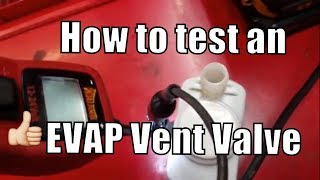
Locate the CVS valve on the charcoal canister. Apply power from a 9-volt or 12-volt battery to its two electrical pins using jumper wires. Listen for a sharp 'click'. If it remains silent, the solenoid is dead and requires replacement. Silence also indicates a potential internal short.
Tools: 9-volt battery, Jumper wires with alligator clips (Intermediate) - Test the Canister Purge Valve (Engine Bay)
Locate the purge valve connected to the intake manifold. With the engine running and the valve unplugged electrically, disconnect the hose coming from the canister. Place your finger over the valve port. If you feel suction, the valve is stuck open and must be replaced.
Tools: Pliers (Intermediate) - Perform an EVAP Smoke Test
This is the definitive diagnostic method. A smoke machine forces low-pressure (under 1 PSI) vapor into the EVAP service port. With the vent valve commanded closed, smoke pours out of any leak, instantly revealing pinhole hose cracks or faulty valve seals.
Tools: EVAP Smoke Machine, Bi-directional OBD-II Scanner (Advanced) - Pro Tip: Test Solenoid and Circuit with a Multimeter
Disconnect the CVS valve connector. Verify battery voltage (approx. 12V) on the power wire with the ignition on. Measure the resistance across the solenoid pins. A healthy Honda vent solenoid reads 20-30 ohms. Infinite resistance (open) or near-zero resistance (short) confirms failure.
Tools: Digital Multimeter (Advanced) - Perform a Bi-Directional Scan Tool Test
Use an advanced scan tool to command the vent and purge solenoids open and closed. Listen for the mechanical click of each component to confirm the PCM's command reaches the valve, isolating mechanical failures from wiring issues.
Tools: Bi-directional OBD-II Scanner (Advanced) - Pro Tip: Check Fuel Tank Pressure (FTP) Sensor Voltage
Monitor the FTP sensor voltage via live data. With the gas cap removed, voltage reads exactly 2.5V. When commanding the system closed and applying vacuum, voltage drops toward 1.5V. A stuck voltage reading indicates a failed sensor or wiring fault.
Tools: OBD-II Scanner with Live Data (Advanced) - Pro Tip: Manually Test EVAP Pump/Solenoid Vacuum
Command the vent solenoid closed and apply vacuum to the system using a hand pump. The system must hold the vacuum steadily. If the gauge needle drops, a mechanical leak exists.
Tools: Handheld Vacuum Pump/Gauge, Jumper Wires (Advanced)
When This Code Triggers (Freeze-Frame Conditions)
- Engine Coolant Temp: Below 122°F (50°C) (The EVAP monitor test requires a cold start, where engine coolant and ambient air temperatures are nearly identical.)
- Fuel Level: 15-85% (The test aborts on a very full or very empty tank. Manufacturers specify a strict range between 1/4 and 3/4 full.)
- Vehicle Speed: 40-60 mph (The drive cycle requires holding a steady highway speed to allow the monitor to execute its vacuum tests.)
- Engine Load: 15-35% (The test runs under part-throttle, steady-state cruise conditions, aborting during hard acceleration or braking.)
Related Codes
- P1456 — The sister code to P1457 for Honda/Acura. P1457 indicates a leak on the canister side, while P1456 points to the fuel tank side. Tightening the gas cap fixes P1456, but never fixes P1457.
- P0455 — Indicates a 'Gross Leak' in the EVAP system. A P1457 fault, such as a vent valve stuck wide open or a severed hose, acts as the root cause for a generic P0455 code.
- P0456 — Indicates a 'Very Small Leak'. This acts as a precursor to P1457 if the leak is intermittent. A smoke test is required to find the tiny leak before it triggers P1457.
- P0442 — Indicates a 'Small Leak'. Honda distinguishes between the tank side (P1456) and canister side (P1457), whereas other manufacturers report a generic P0442 for the exact same leak.
Climate & Environmental Factors
- Road Salt (Rust Belt / Snowbelt Regions): The Canister Vent Solenoid (CVS) sits under the vehicle, directly exposed to road salt and moisture. The metal valve body corrodes, cracking the plastic housing and breaking the seal, triggering P1457.
- Cold Weather: Cold temperatures cause rubber hoses and plastic components to contract. A marginal leak sealed in warm weather opens up when cold, causing intermittent codes on winter mornings.
How to Talk to a Mechanic About This Code
Say this: "I have a check engine light with a P1457 code on my Honda. I'd like to schedule a diagnostic, specifically requesting a smoke test to pinpoint the EVAP leak in the canister area."
This signals you understand the code is specific to the canister side and that a smoke test is the correct procedure. It prevents the shop from starting with unnecessary tests and avoids parts guesswork.
Avoid saying:
- 'My check engine light is on, can you look at it?'
- 'My car smells like gas, just fix it.'
- 'I think I need a new gas cap.'
Questions to ask before authorizing the repair:
- Did the smoke test show the exact location of the leak?
- If you are replacing the vent solenoid, are the mounting bolts corroded and will they need to be replaced as well?
- What is the warranty on the parts and labor for this specific repair?
Where to Take It: Dealer vs Independent vs Chain
- Dealer:
Recommended only if the vehicle is under warranty or if you suspect a rare PCM-related problem that an independent shop couldn't solve.
Best for: Vehicles still under the 2-year/24,000-mile federal emissions warranty., Complex cases where a prior repair at an independent shop failed, suggesting a PCM issue.
Downsides: Significantly higher labor rates, often 1.5-2x more than independent shops., May recommend replacing the entire canister assembly when only a single valve failed. (Typical cost: +50% vs. baseline) - Independent Shop:
Best fit. A reputable independent mechanic specializing in Hondas diagnoses and repairs this efficiently at a much lower cost than a dealer.
Best for: Out-of-warranty Honda/Acura vehicles, as this is a very common and well-understood code., Cost-conscious owners, as labor and parts costs are generally lower.
Downsides: Quality varies, so vet the shop through online reviews and confirm they own an EVAP smoke machine. (Typical cost: +0% vs. baseline) - Chain Shop:
Use with caution. An independent shop specializing in imports is a safer bet for an accurate and cost-effective repair of P1457.
Best for: Simple, unrelated maintenance like oil changes or tires.
Downsides: Technician skill for diagnostics is inconsistent., May lack specific experience with this Honda/Acura issue, leading to misdiagnosis. (Typical cost: -10% vs. baseline)
When to Walk Away From the Repair
If the estimated repair cost exceeds 40-50% of the car's private-party value, it is not economically wise to proceed. This is especially true for the older vehicles commonly affected by P1457.
- Car worth $3500, fix is $1000: Fix it. The repair cost is well below the 50% threshold and restores emissions compliance.
- Car worth $2500, fix is $1200: Borderline. This is 50% of the car's value. Get a second opinion before authorizing, especially if the diagnosis requires replacing the entire canister assembly or the PCM.
- Car worth $1500, fix is $1200: Walk away. The repair cost is a massive percentage of the vehicle's value. It is not worth investing this much into an aging car for an emissions-only issue.
What Scan Tool You Need for This Code
Minimum: A basic OBD-II code reader that reads and clears codes is the absolute minimum. However, for P1457, this is insufficient to avoid guesswork.
A basic reader only confirms the P1457 code. It cannot test individual solenoids or view fuel tank pressure sensor data. Proper diagnosis requires live data and bi-directional component control.
Budget: Autel MS300 or similar basic reader (~$20) — Reads the P1457 code and clears the check engine light after a repair. It offers no advanced diagnostic capability.
Mid-range: Foxwell NT510 Elite or XTOOL A30M (~$150-250) — Offers bi-directional control, allowing you to command the EVAP purge and vent solenoids open and closed. This tests the most common failure parts without removing them. Displays live FTP sensor data.
Professional: Autel MaxiCOM MK808 or Foxwell NT710 (~$450-600) — Provides full bi-directional control for all EVAP components, OE-level Honda/Acura diagnostics, and initiates the complete EVAP system self-test on command.
Rent vs buy: Auto parts stores loan basic OBD-II scanners for free. This is good for reading the code. If diagnosing the issue yourself, buying a mid-range scanner with bi-directional control is a mandatory investment.
How to Clear the Code After You Fix It
- Use an OBD-II scan tool to clear the P1457 code.
- Ensure the fuel tank is between 1/4 and 3/4 full.
- Perform the specific Honda drive cycle to run the EVAP monitor.
Drive cycle (~20 minutes): Start cold (sit 8+ hours). Idle 2.5 minutes with A/C on. Turn A/C off, accelerate to 55 mph at half throttle and hold for 3 minutes. Coast to 20 mph without braking. Accelerate to 55-60 mph and hold for 5 minutes. Coast to a stop.
Readiness monitors affected: EVAP System Monitor, Catalyst Monitor, Oxygen (O2) Sensor Monitor
Before emissions retest: drive at least 50 miles to fully set monitors.
Watch out for:
- Disconnecting the battery clears the code but resets all readiness monitors, guaranteeing an immediate emissions test failure.
- The code returns within three drive cycles if the underlying leak remains unfixed.
- Attempting the drive cycle with fuel outside the 15-85% range prevents the EVAP monitor from running.
Will This Fail Emissions / State Inspection?
Yes — this code typically fails an OBD-II emissions inspection.
- California: P1457 is an automatic smog check failure. After repair, complete the drive cycle to set the EVAP readiness monitor to 'Ready' before re-testing.
- New York: NYS requires an annual emissions inspection. An active P1457 fails the OBD-II portion of the test.
- Texas: In emissions-testing counties, an active P1457 code fails the OBD portion of the annual inspection.
Most Commonly Affected Vehicles

- Honda Accord (1998-2002) — Extremely common due to the canister vent solenoid's exposure to road salt. The OEM part number is 17310-S0X-A02. TSB 99-075 provides updated troubleshooting.
- Honda Civic (1996-2005) — Shares the Accord's EVAP design, making the canister vent solenoid a frequent failure point. TSB 99-075 applies.
- Honda CR-V (1998-2004) — Under-car placement of EVAP components leads to high vent solenoid failure rates in salt-heavy regions. TSB 08-016 addresses restricted EVAP solenoid valves.
- Acura TL (1999-2003) — Suffers from the same corroding canister vent solenoid issue. Repair costs escalate if multiple rusted valves require replacement.
- Acura Integra (1996-2001) — The Canister Vent Solenoid (CVS) is the primary cause due to its exposed location. Acura TSB B99-040 aids diagnosis.
- Honda Odyssey (1999-2004) — The EVAP bypass solenoid valve shorts out due to water intrusion in snowbelt regions. TSB 03-001 addresses this and potential PCM damage.
- Acura RL (1996-2004) — The Canister Vent Shut (CVS) valve is the most common failure point. TSBs B99-040 and 03-001 address misdiagnosis and corrosion.
- Acura RSX (2002-2004) — Prone to sticking EVAP canister shut-off valves. The valve occasionally works intermittently after being tapped.
- Ford Various (e.g., Escape) (1998-2008) — While primarily a Honda/Acura code, P1457 appears on older Fords indicating 'Unable to Pull Vacuum in Tank'. Diagnosis focuses on the purge valve or PCM wiring.
Manufacturer-Specific Notes
- Honda / Acura: This code is almost exclusively Honda/Acura. The #1 cause is the canister vent solenoid rusting. Mounting screws rust solid and snap during removal; buy replacement screws (OEM #93893-05010-08) beforehand.
- Honda / Acura: TSB 03-001 notes a corroded EVAP bypass solenoid shorts out and destroys the PCM. TSB 99-075 provides updated troubleshooting for P1456/P1457.
- Honda / Acura: The EVAP system self-test aborts if the fuel level is below 25% or above 75%. Ensure the tank is half full before verifying a repair.
- Honda / Acura: The Canister Vent Solenoid, Two-Way Valve, and Bypass solenoid cluster together on the charcoal canister. Diagnosing the specific failed part requires testing each individually or performing a smoke test.
- Federal (All Makes): Repairs fall under the 2-year/24,000-mile Federal Emissions Warranty. The longer 8-year/80,000-mile warranty covers only the Catalytic Converter, PCM, and OBD device, excluding canister valves.
Real Owner Stories
1999 Honda Accord with 197k miles
Bought the car with the Check Engine Light on. Found codes P0401 (EGR) and P1457. No major symptoms.
What they tried:
- Replaced the EVAP 2-way valve solenoid, but the code returned in 2 days because an O-ring was forgotten.
- Re-installed with a new O-ring, but testing showed the new valve was also not working correctly.
- Discovered the real issue was a corroded Canister Vent Shut (CVS) valve.
Outcome: The owner learned that jumping straight to replacing parts without full diagnosis wastes time and money. The CVS valve should have been tested first.
Lesson: Test the most common failure component first. For P1457, this is almost always the Canister Vent Solenoid (CVS) valve. Applying 12V power to see if it 'clicks' is a definitive test.
2002 Honda Accord EX
Check Engine Light with code P1457 appeared one month after buying the car. Clearing the code only worked for 3 days.
What they tried:
- Replaced the gas cap with a new factory part, which failed to solve the issue.
- Replaced the Canister Vent Shut valve and the charcoal canister. The code returned.
- Replaced the EVAP Bypass Solenoid Valve.
Outcome: Replacing the Bypass Solenoid Valve fixed the problem permanently.
Lesson: Misdiagnosis is expensive. While the vent valve is the frequent culprit, other canister valves fail and cause P1457. A smoke test prevents the 'parts cannon' approach.
2003 Honda CR-V with 157k miles
Check Engine Light on with code P1457. No drivability symptoms.
What they tried:
- A mechanic performed a smoke test to find the source of the EVAP leak.
- The smoke test revealed a large crack in a rubber hose connected to the charcoal canister.
Outcome: The cracked hose was the sole source of the leak. The owner repaired it using a hose clamp and a zip tie as a temporary fix.
Lesson: A smoke test is the ultimate diagnostic tool. The cause is often a simple, age-related failure like a rotted rubber hose rather than an expensive electronic valve.
1998 Honda Civic EX
P1457 code appeared. Owner replaced the canister vent solenoid module, clearing the code for two weeks.
What they tried:
- Replaced the canister vent solenoid assembly.
- The code returned exclusively on very cold mornings.
- The owner suspected the charcoal canister itself.
Outcome: The code appeared intermittently in cold weather, suggesting a marginal leak that seals in warmth but opens when cold causes components to contract.
Lesson: Track when the code appears. Intermittent cold-weather codes point to temperature-sensitive leaks in seals or hoses that evade detection in a heated garage.
How to Prevent This Code From Triggering
- Avoid overfilling the fuel tank (Every fill-up) — Stopping at the first click of the fuel pump prevents liquid gasoline from flooding the charcoal canister. A saturated canister cannot store vapors and requires replacement.
- Periodically inspect under-car EVAP components (During every oil change) — A visual check of hoses, the canister, and the vent valve for heavy corrosion catches problems before they trigger codes, especially in the Rust Belt.
- Apply anti-corrosion spray to the vent solenoid body (Once per year (before winter)) — Coating the metal body of the canister vent solenoid with a rust inhibitor prevents the corrosion that cracks the plastic housing, stopping the #1 cause of P1457.
- Ensure the gas cap is tightened correctly (Every fill-up) — While a loose cap causes P1456, tightening it to three clicks maintains overall system integrity and prevents the computer from compensating for pressure anomalies.
Frequently Asked Questions
Will replacing my gas cap fix code P1457?
No. P1457 on a Honda or Acura points to a leak in the canister area of the EVAP system. The code for a loose gas cap is P1456.
Is it safe to drive with a P1457 code?
Yes, it is safe to drive. The code indicates an emissions system problem that does not affect engine performance or safety. However, you will fail an emissions test.
I replaced the canister vent valve, but the P1457 code came back. What now?
If the code returns, suspect a secondary leak in a hose or the canister itself requiring a smoke test. Alternatively, the old valve shorted the Powertrain Control Module (PCM) driver circuit (Honda TSB 03-001). A damaged PCM requires professional repair or replacement.
What are common mistakes when diagnosing P1457?
The most common mistake is replacing the gas cap. The second is replacing expensive canister parts without confirming the leak's location. Perform a visual inspection and a smoke test to pinpoint the leak before buying parts.
What is a smoke test and do I need one?
A smoke test fills the EVAP system with harmless vapor under low pressure to visually reveal leaks. It is the fastest, most accurate way to diagnose P1457 and avoid replacing the wrong parts.
Can I fix P1457 myself?
Yes, if you are comfortable working under the car. Replacing the canister vent solenoid is the most common fix. The primary challenge is extracting heavily rusted mounting bolts without breaking the plastic canister.
How much does it cost to fix code P1457?
DIY fixes like replacing a purge valve cost $20-$140 for parts. Professional replacement of the canister vent solenoid ranges from $140 to $420, while a full charcoal canister assembly costs $320 to $1050. Worst-case scenarios involving PCM replacement exceed $1200.
Key Takeaways
- P1457 is a Honda and Acura-specific OBD-II code indicating a vacuum leak in the charcoal canister area of the EVAP system.
- Do not replace the gas cap to fix P1457; a loose gas cap triggers code P1456, while P1457 requires inspecting under-car canister components.
- The most common fix is replacing the EVAP Canister Vent Solenoid (CVS) valve, which fails due to road salt corrosion and costs $140 to $420 professionally.
- Perform an EVAP smoke test at under 1 PSI to pinpoint the exact leak source before spending $200 or more on a new charcoal canister assembly.
Helpful Videos

The information in this article is provided for general reference and educational purposes only. Vehicle specifications, procedures, and part compatibility can vary by production date, trim level, and region. Always consult your vehicle's factory service manual and verify part numbers before purchasing or performing repairs. Safety-critical components such as airbags, seat belts, and braking systems should be installed by a qualified professional.
- 🎬 Helpful Videos
- What Does P1457 Mean?
- Can I Drive With P1457?
- Common Causes
- Symptoms
- Diagnostic Flowchart
- Common Fixes & Costs
- DIY vs Professional
- Used vs. New Parts: Buying Guide
- What Happens If You Wait — Timeline
- Cost of Not Fixing It
- Diagnosis Steps
- When This Code Triggers (Freeze-Frame Conditions)
- Related Codes
- Climate & Environmental Factors
- How to Talk to a Mechanic About This Code
- Where to Take It: Dealer vs Independent vs Chain
- When to Walk Away From the Repair
- What Scan Tool You Need for This Code
- How to Clear the Code After You Fix It
- Will This Fail Emissions / State Inspection?
- Most Commonly Affected Vehicles
- Manufacturer-Specific Notes
- Real Owner Stories
- 1999 Honda Accord with 197k miles
- 2002 Honda Accord EX
- 2003 Honda CR-V with 157k miles
- 1998 Honda Civic EX
- How to Prevent This Code From Triggering
- Frequently Asked Questions
- Will replacing my gas cap fix code P1457?
- Is it safe to drive with a P1457 code?
- I replaced the canister vent valve, but the P1457 code came back. What now?
- What are common mistakes when diagnosing P1457?
- What is a smoke test and do I need one?
- Can I fix P1457 myself?
- How much does it cost to fix code P1457?
- Key Takeaways
- 🎟️ Get 5% Off