

P1450 on 2012-2018 Ford Focus: Causes and Fixes for 'Unable to Bleed Fuel Tank Vacuum'
On a 2012-2018 Ford Focus, code P1450 is almost always caused by a sticking canister purge valve. This is a very common failure, and Ford has a Customer Satisfaction Program (24N07) offering a one-time free replacement for vehicles up to 15 years old with unlimited mileage. The part costs ~$40-$90 and is a straightforward DIY replacement, though many owners recommend replacing the entire hose assembly as the connections can be brittle and difficult to work with.
- P1450 on a 2012-2018 Focus almost certainly means the canister purge valve has failed.
- Before buying any parts, call a Ford dealer with your VIN to see if you are covered under Customer Satisfaction Program 24N07 for a free, one-time replacement.
- The most common symptom is the car stalling or struggling to start right after you get gas.
- If you are not covered by the program, the DIY repair is straightforward and costs under $100. It is highly recommended to replace the entire hose assembly, not just the valve.
- A stuck purge valve can sometimes lead to fuel contaminating the engine oil; an oil change after the repair is a good preventative measure.
What's Unique About the 2012-2018 Ford Focus
The 2012-2018 Ford Focus (Mk3 generation) with both the 1.0L and 2.0L engines is notoriously prone to this issue due to a high failure rate of the canister purge valve. The problem is so widespread that Ford issued Customer Satisfaction Program 24N07, extending the warranty on this specific part to 15 years/unlimited miles for a one-time replacement. This means many owners can get this specific repair done for free at a dealership, which is a unique situation for a non-safety recall item. The program specifically covers the Canister Purge Valve (CPV) and is intended to address drivability concerns like hesitation, rough running, or stalling.
Symptoms You May Notice
- Check Engine Light is on
- Engine stalls or is very difficult to start immediately after refueling.
- Rough or unstable idle, sometimes described as 'shuddering' or 'bogging out'.
- Hesitation or stuttering when accelerating from a stop.
- A 'whoosh' sound of rushing air when opening the gas cap, indicating a vacuum.
- Reduced fuel economy.
- Difficulty filling the fuel tank, with the pump clicking off repeatedly.
- Replacing the gas cap. While a faulty gas cap can cause other EVAP codes (like for a large leak, e.g., P0457), it is not a typical cause for P1450, which is about excessive vacuum, not a leak. The Focus's capless system can have sealing issues, but they typically present as leak codes.
Most Likely Causes
- Sticking Canister Purge Valve 🔴 High Probability This specific part has a very high failure rate on this platform, leading Ford to issue a warranty extension program (Customer Satisfaction Program 24N07). The valve gets stuck open, causing a constant vacuum pull on the fuel tank that the system cannot bleed off.
How to confirm: With the engine running, disconnect the EVAP hose from the purge valve. Place your finger over the port on the valve itself. If you feel any suction (vacuum) at idle, the valve is stuck open and must be replaced. A scan tool can also be used to command the purge valve closed and monitor the fuel tank pressure (FTP) sensor; if vacuum doesn't release, the valve is faulty.
Typical fix: Replace the canister purge valve and the attached hoses as a complete assembly. Before purchasing, check if your vehicle is eligible for the free replacement under Ford's program 24N07 by contacting a dealer with your VIN. Many DIY reports suggest buying the entire hose assembly because the old plastic lines become brittle and the clips are difficult to remove without breaking.
Est. part cost: $40-$90
Rare But Worth Checking
- Blocked Canister Vent Solenoid or Hose: The EVAP system needs a path for fresh air to enter to relieve vacuum. If the vent valve (usually near the charcoal canister by the fuel tank) is stuck closed or its filter is clogged with dirt or debris, it can trap vacuum and cause a P1450 code. This is a less common cause than the purge valve.
- Saturated or Damaged Charcoal Canister: This is often a secondary failure caused by habitually 'topping off' the fuel tank, which forces liquid fuel into the canister designed only for vapor. A failed purge valve can also contribute to its damage. If you find black charcoal pellets in the EVAP lines, the canister has failed and must be replaced along with the purge valve. This can also cause issues with refueling where the pump clicks off constantly.
- Faulty Fuel Tank Pressure (FTP) Sensor: Less commonly, the sensor that measures the tank pressure could be faulty, sending incorrect vacuum readings to the computer. This would cause the code to set even if the pressure is normal. Diagnosis typically requires a scan tool to observe the sensor's voltage and pressure readings at rest and under vacuum.
- Blocked EVAP line: A kinked, pinched, or debris-filled EVAP line between the purge valve, canister, and fuel tank can prevent the system from bleeding vacuum properly. This is uncommon but possible, and a smoke test is often required to identify the location of the blockage.
Diagnosis Steps
- First, check if your vehicle is covered by Ford's Customer Satisfaction Program 24N07 by contacting a Ford dealer with your VIN. If it is, the diagnosis and repair may be free. Be aware that some dealers may charge a diagnostic fee if the fault is found to be unrelated to the purge valve.
- If not covered, perform a physical check of the purge valve. Locate the valve in the engine bay. On the 1.0L EcoBoost, it is near the back of the engine.
- Start the engine and let it idle.
- Disconnect the EVAP line coming from the rear of the car to the purge valve. The clips can be tricky; some users recommend a small flathead screwdriver to help release them.
- Feel the port on the valve for suction. If vacuum is present at idle, the valve is faulty and needs to be replaced.
- If no vacuum is felt, the issue may be more complex. The next steps would involve using a scan tool to monitor the Fuel Tank Pressure (FTP) sensor while commanding the vent and purge solenoids, or using a smoke machine to check for blockages in the vent lines or charcoal canister.
Parts You'll Likely Need
- Vapor Canister Purge Valve Assembly
(OEM #F1FZ-9D289-A)— This is the overwhelmingly common failure point for code P1450 on this vehicle. It sticks open, causing constant, excessive vacuum on the fuel tank. This part number fits 2015-2018 Focus models with the 1.0L engine.
Trusted brands: Motorcraft, Dorman (PV964), Standard Motor Products
OEM price range: $60-$90
Aftermarket price range: $40-$60
Related Codes That Often Appear With This One
- P0456 — Small EVAP Leak Detected. A purge valve that is intermittently sticking can cause the system to fail both the vacuum test (P1450) and the leak test (P0456). This code is mentioned in owner complaints and TSB 17-0016 alongside P1450.
- P144A — EVAP System Purge Vapor Line Restricted/Blocked. This code can also be triggered by a malfunctioning purge valve and is mentioned in the official Ford TSB 17-0016 alongside P1450.
- P0420 — Catalyst System Efficiency Below Threshold. An improper air-fuel mixture caused by the constant vacuum leak from the purge valve can, over time, affect catalyst performance and trigger a P0420 code. This is confirmed in NHTSA owner complaints and TSB 16-0062.
- P219A — Bank 1 Air-Fuel Ratio Imbalance. A stuck purge valve creates a vacuum leak that introduces unmetered fuel vapors, leading to a rich condition and causing the PCM to over-compensate, which can trigger this code. A forum user on FiestaSTForum.com reported fixing both P1450 and P219A by replacing the purge valve assembly.
Technical Service Bulletins (TSBs) & Recalls
- TSB 17-0016: Although for a 2.3L engine, this TSB corroborates that P1450 is caused by an intermittent sticking evaporative emission canister purge valve.
- TSB 16-0062: Mentions that P1450 can be seen with other codes like P0420 due to various system faults on the 2012 Focus.
- Customer Satisfaction Program 24N07: Not a TSB, but an official Ford program that functions like a recall for this specific part and problem, explicitly mentioning P1450 as a related code. The official document confirms a one-time, no-cost replacement for 15 years/unlimited miles.
Platform-Specific Known Issues
- Customer Satisfaction Program 24N07: Ford has acknowledged the high failure rate of the canister purge valve (CPV) and offers a one-time replacement for free for up to 15 years from the warranty start date, regardless of mileage. This covers the 2012-2018 Ford Focus.
- Recurring Failures: Some owners report replacing the purge valve multiple times, suggesting that even replacement parts can fail prematurely. One user on a Fiesta ST forum noted their replacement lasted about a year before symptoms returned.
- DIY Repair Tip: Owners strongly recommend replacing the entire purge valve and hose assembly, not just the valve itself. The plastic lines become brittle with age and heat, and the quick-connect clips are difficult to detach without breaking them.
Mechanic-Grade Diagnostic Values
- Canister Purge Valve Solenoid Resistance — expected: 15 to 30 ohms is a common range for many vehicles. Some sources give a wider range of 12 to 130 ohms.. Failure: A reading that is too high, too low, or infinite (open circuit) indicates a faulty valve. One owner reported a replacement valve failing with a reading of 10.5 ohms.
- Fuel Tank Pressure (FTP) Sensor Voltage (KOEO) — expected: Approximately 2.4-2.5V at atmospheric pressure (neutral).. Failure: A voltage significantly different from the neutral value with the gas cap off indicates a potential sensor fault. Voltage should decrease as vacuum is applied.
Scan Tool Commands That Help
- FORScan or equivalent professional scan tool: EVAP System Test (On-Demand Self-Test) — This function allows the technician to manually initiate the vehicle's internal EVAP leak and flow tests. It can be used to confirm if a repair was successful without waiting for the full drive cycle to complete.
- FORScan or equivalent professional scan tool: Purge Valve Solenoid (EVAPCV) Duty Cycle Command — This bidirectional control allows you to command the purge valve open at various percentages (e.g., 10%, 50%, 100%) while monitoring the FTP sensor. This helps verify if the valve is physically responding to the PCM's commands and if the system pressure changes accordingly.
Real Owner Repair Stories
- Fiesta ST Forum (Ford Fiesta ST (shares similar EVAP components)) — Check engine light with codes P1450 and P219A, 'juttering' during fill-ups, smell of gasoline.
❌ Tried (didn't work) Attempting to replace only the valve without the hoses.
✅ What actually fixed it Replacing the entire purge valve and hose line assembly. The user noted that trying to swap just the valve was 'annoying/impossible' and recommended buying the complete assembly. - Reddit r/FordFocus (2014 Ford Focus SE) — Check engine light with code P1450.
❌ Tried (didn't work) Replacing the canister purge valve.
✅ What actually fixed it The user took the car to a Ford dealership, who found a damaged wiring harness that was rubbing and sending erroneous codes. The fix was repairing the harness, not replacing any of the EVAP components that the code pointed to. - Reddit r/FordFocus (2014 Ford Focus) — Difficulty filling with gas (pump clicks off), followed by CEL with code P1450.
❌ Tried (didn't work) Replacing the purge valve with an aftermarket part from O'Reilly's. The code returned after 100-150 miles.
✅ What actually fixed it The issue was not resolved in the thread, but it serves as a case where a new aftermarket purge valve did not fix the problem, pointing towards either a faulty new part or a different root cause like the vent solenoid or charcoal canister, which are also known to cause refueling issues.
When the Usual Fixes Don't Work
- While the vast majority of P1450 cases are fixed by replacing the canister purge valve, there are documented instances where this does not solve the problem. In one case, the code returned after replacing the valve, and the ultimate cause was found to be a damaged wiring harness rubbing against another component, creating an electrical fault. In another instance, a user replaced the purge valve, but the code and refueling issues persisted, suggesting the actual fault lay elsewhere in the EVAP system, such as the canister vent valve or a blocked charcoal canister.
OEM Part Supersession History
BV6Z-9D289-B→F1FZ-9D289-A— Part revision/update by manufacturer. The -E revision was also noted for the Focus ST.
Heads up: While different revisions may fit, it's crucial to use the part number specified for the vehicle's VIN. Some forum users noted that Ford issued a stop-sale on a previous version, suggesting a design improvement in later revisions.
Model Year Variations Within This Range
- 2015-2018: The specific part number for the purge valve assembly for the 1.0L engine is F1FZ-9D289-A, which is explicitly listed for the 2015-2018 model years. Earlier models or different engines (like the 2.0L) use different part numbers (e.g., BV6Z-9D289-B).
Diagnostic Flowchart
Other Known Issues on This Vehicle
Issues unrelated to this code that are worth knowing about as an owner of this generation:
- Timing Belt (Wet Belt) Degradation 🔴 High — Widespread on 2012-2019 models. Risk increases significantly after 8 years or 80,000-100,000 miles. Belt debris clogs the oil pickup, leading to oil starvation and catastrophic engine failure. (Ref: No recall, but Ford revised service intervals. Specialists recommend proactive replacement far earlier than Ford's 150,000-mile guidance.)
- Coolant System Failures (Hoses, Thermostat) 🔴 High — Common on 2012-2017 models. A specific degas hose from the expansion tank was prone to bursting, causing rapid coolant loss and engine overheating. Plastic thermostat housings can also crack. (Ref: A Field Service Action (recall) was issued in March 2015 for a coolant hose on 2011-2013 models.)
- PowerShift Automatic Transmission Failure 🔴 High — Extremely common on 2012-2018 Focus models equipped with the DPS6 automatic (primarily with the 2.0L engine, but a major platform issue). Symptoms include shuddering, hesitation, and complete failure of clutch packs or the TCM. (Ref: Multiple warranty extensions (14M01, 14M02, 19N08) and a major class-action lawsuit settlement, but not a formal safety recall for the core issue.)
- Faulty Door Latches 🟠 Medium — Common across 2012-2018 models. A spring in the latch mechanism can break, preventing the door from latching securely or causing it to open while driving. (Ref: Yes, this was subject to a safety recall.)
- Oil Pump Belt/Tensioner Failure 🔴 High — Affects 2016-2018 models with the 1.0L EcoBoost. A lawsuit alleges a defect in the oil pump drive belt and/or tensioner can lead to sudden loss of oil pressure and engine failure. (Ref: A recall was issued, but a lawsuit alleges the fix is insufficient.)
Used vs. New Parts: Buying Guide for This Vehicle
When a used part is the smart pick: For this specific repair, a used part from a junkyard is NOT recommended. The canister purge valve is a known high-failure-rate item due to an internal sticking issue. A used part is highly likely to have the same defect or fail in a short amount of time.
What to inspect on the donor part:
- Not applicable, as buying used is not advised.
OEM-only on this vehicle (don't cheap out):
- Vapor Canister Purge Valve Assembly
Aftermarket brands forum-validated for this vehicle:
- Motorcraft (OEM)
Brands owners have reported issues with on this vehicle:
- Dorman: Some owners have reported premature failure of Dorman purge valves, with one user on a Focus ST forum claiming their Dorman valve failed within 5,000 miles. While some find success with Dorman or other store brands like Duralast, the consensus for long-term reliability points towards using the genuine Motorcraft part.
Real Owner Stories
Aggregated from forums and TSBs cited above. Mileages and costs reflect what owners reported in those sources.
2015-2016 Focus 1.0L EcoBoost
Symptoms: Illuminated malfunction indicator lamp (MIL) with diagnostic trouble code (DTC) P1450 (unable to bleed up fuel tank vacuum) present in powertrain control module (PCM) memory.
What fixed it: Replacement of the canister purge valve (CPV) under Ford's service guidelines.
Source hint: NHTSA complaint cited in owner_reports
2015 Ford Focus 1.0L EcoBoost
Symptoms: Stalling after fueling and the check engine light is on.
What fixed it: Purge valve replacement; owner noted awareness of the Ford service program for this fix.
Source hint: reddit.com/r/FordFocus
2013-2019 Ford Fiesta 1.0L EcoBoost
Symptoms: Code P1450; vehicle shares the same engine family and EVAP system design as the Focus.
What fixed it: Canister purge valve replacement.
Source hint: YouTube video cited in platform_mates
Related OBD-II Codes
Frequently Asked Questions
Is there a recall or free repair for P1450 on my 2012-2018 Ford Focus?
Why does my Focus stall or struggle to start only after I fill up the gas tank?
Can I just replace the purge valve itself to save money?
How can I quickly test if the purge valve is the cause of my P1450 code?
Does TSB 17-0016 apply to my 1.0L EcoBoost Focus?
I'm hearing a 'whoosh' sound when I open my gas cap. Is this related to P1450?
Helpful Videos


Used OEM Parts in Stock

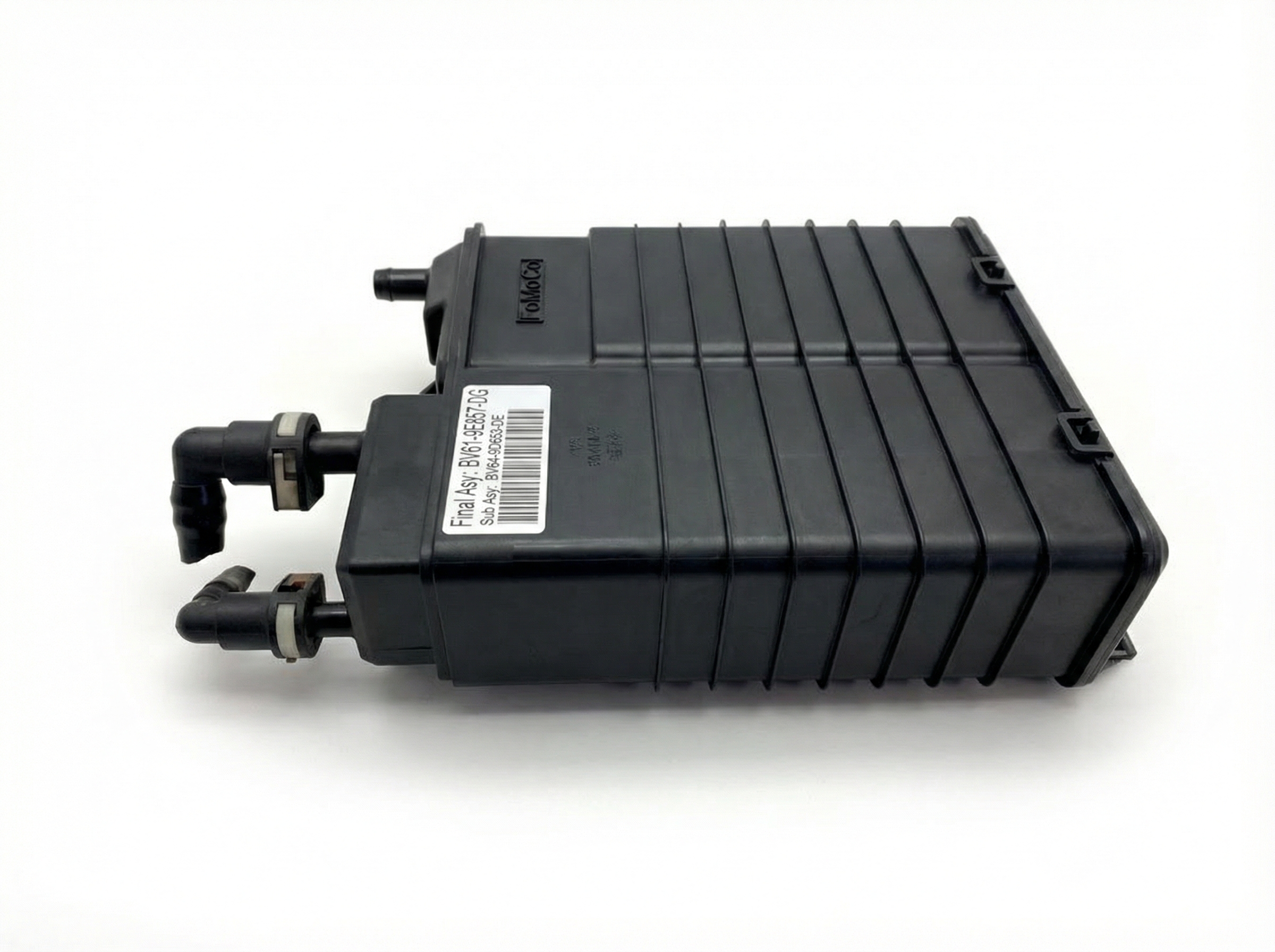
New Aftermarket Parts Available

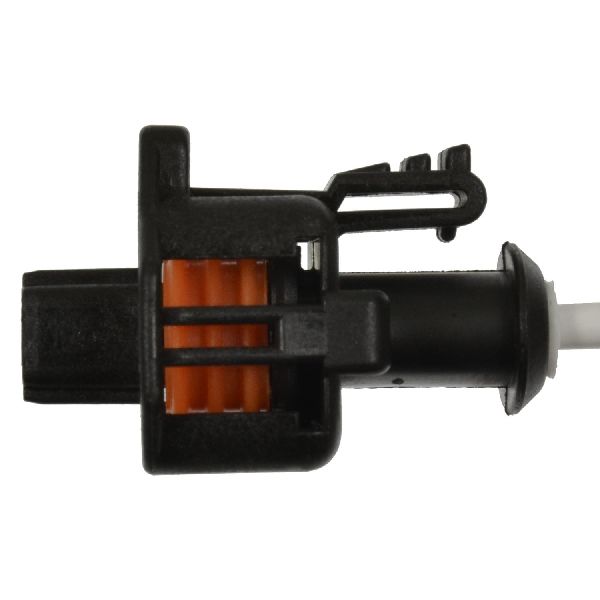
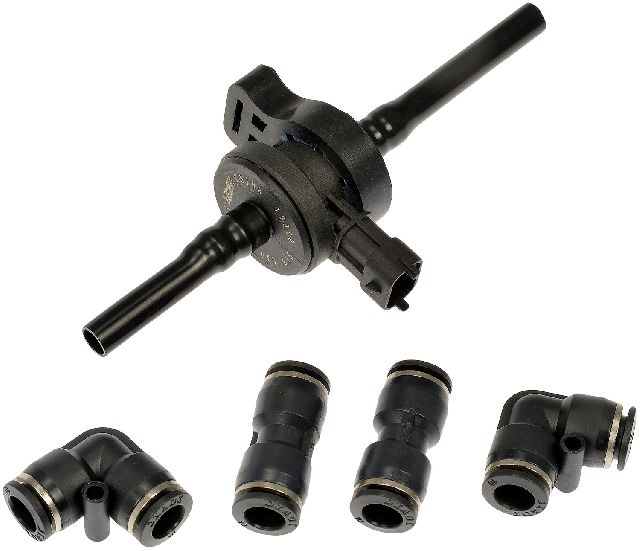

The information in this article is provided for general reference and educational purposes only. Vehicle specifications, procedures, and part compatibility can vary by production date, trim level, and region. Always consult your vehicle's factory service manual and verify part numbers before purchasing or performing repairs. Safety-critical components such as airbags, seat belts, and braking systems should be installed by a qualified professional.
- Ford Focus:
- 🎬 Helpful Videos
- 🛍️ Shop This Part
- What's Unique About the 2012-2018 Ford Focus
- Symptoms You May Notice
- Most Likely Causes
- Rare But Worth Checking
- Diagnosis Steps
- Parts You'll Likely Need
- Related Codes That Often Appear With This One
- Technical Service Bulletins (TSBs) & Recalls
- Platform-Specific Known Issues
- Mechanic-Grade Diagnostic Values
- Scan Tool Commands That Help
- Real Owner Repair Stories
- When the Usual Fixes Don't Work
- OEM Part Supersession History
- Model Year Variations Within This Range
- Diagnostic Flowchart
- Other Known Issues on This Vehicle
- Used vs. New Parts: Buying Guide for This Vehicle
- Real Owner Stories
- 2015-2016 Focus 1.0L EcoBoost
- 2015 Ford Focus 1.0L EcoBoost
- 2013-2019 Ford Fiesta 1.0L EcoBoost
- Related OBD-II Codes
- Frequently Asked Questions
- 🎟️ Get 5% Off