

OBD-II Code P1441: Evaporative System Flow During Non-Purge
The Ultimate Guide to Diagnosing and Fixing P1441
- A stuck-open EVAP purge valve causes 80% of P1441 codes, but you must check the lines for black charcoal pellets before installing a new $50 valve to prevent immediate failure.
- Verify your vehicle's specific P1441 definition before replacing parts; while it means an EVAP flow issue on GM vehicles, it indicates a completely unrelated Secondary Air Injection failure on Toyotas.
- Driving with an active P1441 code drops fuel economy by 5-10% and eventually saturates the charcoal canister, turning a $150 purge valve repair into a $1,000+ canister replacement.
- If a new purge valve does not clear the code, pay a shop $100-$200 for a professional EVAP smoke test to pinpoint hidden vacuum leaks in the hoses.
What Does P1441 Mean?

Your car's computer (PCM) detects fuel vapors flowing from the evaporative emission (EVAP) canister to the engine when they should be sealed off. The EVAP system captures and stores fuel vapors in a charcoal canister until the engine is ready to burn them. This code triggers when the PCM detects vacuum in the system while commanding the purge valve closed, indicating an unwanted flow.
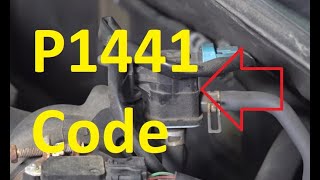
🎬 Watch: Overview of P1441 causes and common fixesTechnical definition: The official SAE/OBD-II definition for P1441 is "Evaporative Emission (EVAP) System Flow During Non-Purge." The Powertrain Control Module (PCM) sets this code when it monitors the Fuel Tank Pressure (FTP) sensor and detects a vacuum developing in the EVAP system while the EVAP purge valve is commanded closed. A developing vacuum proves engine vacuum is drawing vapors from the canister uncommanded.
Can I Drive With P1441?

Yes, But With Caution. Yes, you can drive with a P1441 code, but it is strongly advised against for extended periods. The immediate risk is low, but ignoring it causes a 5-10% decrease in fuel economy, failed emissions tests, and rough idling. Over time, the constant flow of fuel vapors saturates the charcoal canister (a $400-$1500 repair) and stresses the catalytic converter, risking an $800-$2500 replacement. Address the issue within 200 miles to prevent escalating costs.
Common Causes

- Faulty or sticking EVAP purge valve/solenoid (Very Common) — This is the most frequent culprit. The purge valve is a normally-closed solenoid that gets stuck open or leaks internally due to age or contamination. This allows engine vacuum to constantly pull fuel vapors from the charcoal canister, triggering the code.
- Defective or saturated charcoal canister (Common) — The charcoal canister becomes saturated with fuel, often from habitually overfilling the gas tank. Its internal structure breaks down, sending small charcoal granules into the EVAP lines. These particles travel to the purge valve and hold it open, causing a P1441 code even if the valve itself is new.
- Cracked, disconnected, or blocked EVAP hoses (Common) — The network of rubber and plastic vacuum hoses connecting the EVAP components becomes brittle, cracks, or disconnects. This causes a constant vacuum pull on the system, mimicking a stuck-open purge valve.
- Damaged Wiring or Connectors to Purge Valve (Less Common) — The wiring harness or electrical connector for the purge valve solenoid becomes damaged, corroded, or shorted to ground. A short to ground causes the valve to remain energized and stay open when it should be closed, leading to uncommanded vapor flow.
- Faulty fuel tank pressure (FTP) sensor (Less Common) — The sensor that monitors pressure within the EVAP system fails and sends incorrect data to the PCM. It falsely reports a vacuum when there is none, leading the computer to set a P1441 code erroneously.
- Incorrectly routed vacuum hoses (Rare) — After a previous repair, the vacuum source and canister lines at the purge valve are sometimes accidentally swapped. This mistake applies continuous engine vacuum to the EVAP system, directly causing a P1441 code to set.
- Malfunctioning EVAP vent valve (Rare) — The vent valve is normally open to allow air into the canister. If it gets stuck closed, it prevents the system from equalizing pressure. While this more commonly sets other codes, it contributes to the conditions that trigger a P1441 fault.
- Blown Fuse (Rare) — The EVAP system components are on a fused circuit. A blown fuse causes control issues with the valves, leading to this code. Always check the fuse box as part of a thorough diagnosis.
- Faulty Powertrain Control Module (PCM) (Very Rare) — In extremely rare instances, the PCM itself is the problem. A failed internal driver circuit continuously grounds the purge valve, holding it open, or a software glitch misinterprets sensor data. This is the absolute last consideration after exhaustively testing all other possibilities.
Symptoms
- Check Engine Light is on — This is the most common and often the only symptom you notice. The light illuminates after the PCM fails its EVAP monitor test on two consecutive drive cycles.
- Difficulty starting after refueling — After filling the gas tank, the displaced vapors are supposed to be stored in the canister. If the purge valve is stuck open, these vapors are forced directly into the intake manifold, flooding the engine and making the car very difficult to start until the excess vapor clears.
- Rough idle or stalling — A stuck-open purge valve allows unmetered fuel vapors into the engine, creating a rich air-fuel mixture. This causes a fluctuating or rough idle, hesitation, and stalling, particularly at low speeds or when the engine is hot.
- Failed Emissions Test — An active P1441 code causes an automatic failure of any OBD-II emissions inspection or smog check.
- Slight decrease in fuel economy — The engine's computer compensates for the extra fuel vapors entering the intake, but the process is inefficient. This leads to a noticeable drop in fuel economy, often between 5% and 10%.
- Noticeable fuel smell — While more common with large leak codes, a P1441 fault causes a faint smell of raw gasoline around the vehicle as vapors improperly saturate the canister or escape the system.
Diagnostic Flowchart
Tap your situation to follow the diagnostic path that matches what you're seeing on this code.
Common Fixes & Costs
- Replace EVAP Purge Valve/Solenoid
— Parts: $20-$150, Labor: $60-$120, ~0.6 hr book time
(DIY)
Chevrolet/GMC (e.g., Silverado): OEM ACDelco 214-2149 / GM 12690512 (Alt: Dorman 911-082, Standard Motor Products CP648)
Ford (e.g., F-150 EcoBoost): OEM Motorcraft CX-2409 / Ford AU5Z-9C915-B (Alt: Dorman 911-222, Bosch 0280142498)
Honda (e.g., Accord): OEM Honda 36162-R1A-A01 (Varies by exact model) (Alt: Denso 197-6030, Standard Motor Products CP847) - Replace Gas Cap — Parts: $15-$40, Labor: $0, ~0.1 hr book time (DIY)
- Replace Charcoal Canister — Parts: $200-$700, Labor: $100-$500, ~2.5 hr book time (Intermediate)
- Perform EVAP Smoke Test & Repair Hose Leak — Parts: $10-$50, Labor: $100-$200, ~1.2 hr book time (Professional)
- Replace Fuel Tank Pressure Sensor — Parts: $50-$200, Labor: $140-$300, ~2 hr book time (Professional)
DIY vs Professional
- Replace Gas Cap — Beginner:
Tools: None - Replace EVAP Purge Valve/Solenoid — Beginner:
Tools: Basic hand tools (pliers, socket set or screwdriver). - Replace Charcoal Canister — Beginner:
Tools: Jack stands, socket set, hose clamp pliers. May require specialized tools for fuel line disconnection or dropping the fuel tank. - EVAP Smoke Test — Beginner:
Tools: Professional: EVAP-specific smoke machine ($150-$800+). DIY: Homemade smoker using a paint can, solder, and a low-pressure air source. - Replace Fuel Tank Pressure Sensor — Beginner:
Tools: Varies by location. If on top of the fuel tank, requires dropping the tank.
Used vs. New Parts: Buying Guide
When a used part is worth it: For an electronic solenoid like an EVAP purge valve, buying a used part rarely makes sense. The part has internal seals and moving components that wear out. The low cost of a new aftermarket part makes it the recommended choice.
Donor-vehicle mileage cap: roughly under 40000 miles for the part to have meaningful remaining life.
Donor quality checklist:
- Match the part number exactly, as different numbers have different flow rates or connectors.
- Avoid parts from vehicles scrapped due to high mileage or engine failure.
- Visually inspect for cracks in the plastic housing or corrosion on the electrical pins.
Decision logic:
- If The cost of a new OEM or quality aftermarket purge valve is under $100. → Always buy new. The potential labor cost to replace a faulty used part negates any small savings.
- If The vehicle is very old and a new part is unavailable. → A used part is acceptable, but test it with a hand vacuum pump to ensure it seals before installation.
- If The part is a simple mechanical component like a hose or bracket from the same system. → Used is acceptable if it is in good physical condition with no cracks or rust.
Warranty tradeoff: Used parts from a salvage yard typically have a 30-day warranty at best. New aftermarket parts usually carry a 1-year to limited lifetime warranty. New OEM parts have a 1-2 year warranty.
Worst-case if a used part fails: $100-$200 if a used part fails shortly after the warranty period, requiring repeat labor costs plus the cost of another part.
What Happens If You Wait — Timeline
- 0-1 month: Check Engine Light illuminates. Vehicle automatically fails an emissions test. No other symptoms are noticeable. (MPG impact: 0-3%% · Added cost: $0)
- 1-4 months: A slight but noticeable decrease in fuel economy occurs. You experience occasional rough idle or difficulty starting immediately after refueling. (MPG impact: 3-8%% · Added cost: $50-$100 in wasted fuel.)
- 4-12 months: Constant, un-commanded fuel vapor flow saturates the charcoal canister with fuel. The canister loses its ability to store vapors and breaks down internally. (MPG impact: 5-10%% · Added cost: $400-$1500 (cost to replace the charcoal canister and potentially the purge valve again if it's contaminated).)
- 12+ months: The consistently rich fuel mixture overwhelms and overheats the catalytic converter, leading to premature failure. The engine runs rough more frequently. (MPG impact: 10-15%% · Added cost: $1000-$3000+ (cost of catalytic converter replacement plus the original EVAP system repairs).)
Cost of Not Fixing It
- 0-3 months: Failed emissions test, a 5-10% decrease in fuel economy, and rough idling or hard starting after refueling. (Added cost: $50-$150 in wasted fuel and failed test fees.)
- 3-12 months: The charcoal canister becomes saturated with liquid fuel, losing its ability to store vapors and requiring replacement. This is the most common escalating cost. (Added cost: $400-$1500)
- 12+ months: The constant rich fuel mixture from the uncommanded vapors puts extra stress on the catalytic converter, leading to overheating and premature failure. (Added cost: $800-$2500)
Diagnosis Steps

- Verify Code Definition and Check Gas Cap
First, confirm the P1441 definition for your specific vehicle make, as it means different things (e.g., EVAP on GM vs. Secondary Air Injection on Toyota). Then, ensure the gas cap is tight and clicks multiple times. Inspect the cap's O-ring for cracks or damage. A faulty cap is a simple but often overlooked cause of EVAP codes.
Tools: OBD-II Scanner (Beginner) - Test the Purge Valve Mechanically
With the engine off, disconnect the purge valve. Try to blow through it; if air passes through, the valve is stuck open and has failed. For a definitive test, connect a hand vacuum pump to the valve's port that leads to the canister. It must hold vacuum as it is a normally-closed valve. If the vacuum gauge needle drops, the valve leaks internally and requires replacement.
Tools: Pliers, Hand vacuum pump (Intermediate) - Check for Charcoal Contamination
Disconnect the EVAP hose leading from the charcoal canister to the purge valve. Tap the hose and check if any black, sand-like charcoal pellets fall out. If charcoal is present, the canister has ruptured internally. The canister, purge valve, and all contaminated lines must be replaced or thoroughly cleaned with compressed air to prevent the new valve from failing immediately.
Tools: Pliers, Compressed air source (Intermediate) - Visually Inspect EVAP Hoses and Components
Perform a thorough visual inspection of all accessible EVAP system hoses, from the engine bay to the charcoal canister near the fuel tank. Look for obvious cracks, disconnections, kinks, or signs of heat damage. Pay close attention to the lines connected to the purge valve and canister.
Tools: Flashlight (Beginner) - Perform a Bi-Directional Active Test
Using a capable bi-directional scanner, command the EVAP purge valve to open and close while the engine is idling. You should hear an audible click from the valve as it actuates. While commanding it open (e.g., to 50%), watch the live data for Short-Term Fuel Trim (STFT). A functioning system shows STFT values becoming more negative as the engine compensates for the extra fuel vapors. No change in STFT or FTP suggests a blockage or a non-responsive valve.
Tools: Bi-directional OBD-II Scanner (Advanced) - Analyze Live Data with a Bi-Directional Scan Tool
Connect a bi-directional scanner and monitor key PIDs. With the engine idling and the purge valve commanded OFF (0%), the Fuel Tank Pressure (FTP) sensor should read close to 0 inH2O and remain stable. If the FTP value steadily becomes more negative, vacuum is entering the system, confirming a stuck-open purge valve or a leak. Also, watch Short-Term Fuel Trim (STFT). If STFT values are excessively negative (e.g., below -10%) while the purge valve is commanded closed, the PCM is removing fuel to compensate for uncommanded vapors.
Tools: Bi-directional OBD-II Scanner (Advanced) - Test Purge Valve Electrical Circuit with a Multimeter
Disconnect the purge valve's electrical connector. Set a multimeter to Ohms (Ω) and measure the resistance across the two pins on the valve itself. A healthy purge valve typically has a resistance between 15 and 40 Ohms. A reading of infinity (OL) indicates an open coil, while a reading near zero indicates a shorted coil; both mean the valve has failed. Next, set the multimeter to DC Volts. With the key on and engine off, probe the connector terminals. One pin should show battery voltage (approx. 12V), which is the power supply. The other pin is the ground, controlled by the PCM.
Tools: Multimeter (Advanced) - Perform an EVAP Smoke Test
If the purge valve tests good, the next step is finding a hidden leak. An EVAP-specific smoke machine forces low-pressure (typically 0.5 PSI) UV-dyed smoke into the system via the service port. Smoke pours out of any cracks in hoses, a faulty canister, or a bad seal, precisely pinpointing the source of the unwanted vacuum flow. This is the most effective method for finding elusive leaks.
Tools: EVAP smoke machine, UV light (Professional) - Test the Fuel Tank Pressure (FTP) Sensor
Using a scan tool, monitor the FTP sensor reading in live data. With the engine off and gas cap removed, the pressure should be near 0 inches of water (inH2O) or atmospheric pressure (approx. 14.7 PSI at sea level). If the reading is stuck at a high negative value or doesn't change when the cap is loosened, the sensor or its wiring is faulty. You can also back-probe the sensor's signal wire (typically a 3-wire sensor with 5V reference, ground, and signal) to check for a smooth voltage change in response to pressure or vacuum.
Tools: OBD-II Scanner, Multimeter (Professional)
When This Code Triggers (Freeze-Frame Conditions)
- Engine Coolant Temp: 40-95°F (4-35°C) (During the initial 'cold start' phase of the EVAP monitor test.)
- Fuel Tank Level: 15-85% (The EVAP monitor will not run if the tank is too full or too empty.)
- Vehicle Speed: 45-65 mph (72-105 km/h) (During the steady-state cruise portion of the EVAP drive cycle.)
- Engine Load: 20-50% (Steady, part-throttle cruise, not under heavy acceleration or deceleration.)
Related Codes
- P0496 — This is the generic SAE equivalent of P1441. Both codes mean 'EVAP Flow During a Non-Purge Condition.' GM and some other manufacturers use the P1xxx code, while many others use P0496 for the exact same fault. They are diagnosed identically.
- P0442 — Indicates a small leak detected in the EVAP system. P1441 is about *flow* when there should be none (e.g., a stuck valve), while P0442 is about a *leak* detected during a system pressure/vacuum test (e.g., a cracked hose or bad seal). A part causing P1441 eventually leads to a P0442, but they diagnose different failure modes.
- P0443 — This code points specifically to an electrical circuit problem with the purge control valve (e.g., an open or short in the solenoid's wiring or coil). P1441 indicates a mechanical failure (the valve is stuck open) or a flow problem elsewhere. If you have P0443, you test the wiring and coil resistance. If you have P1441, you test if the valve is physically sealing.
- P0455 — Indicates a large leak in the EVAP system, most commonly caused by a loose or missing gas cap. While a bad cap sometimes contributes to a P1441, P0455 is the code that specifically points to a failure to seal the system for a pressure test.
Climate & Environmental Factors
- Cold Weather: Extreme cold makes rubber and plastic EVAP hoses brittle, increasing the likelihood of them cracking and causing leaks that contribute to or mimic P1441 conditions.
- Rust Belt Regions: Areas with heavy road salt use see higher rates of corrosion on under-vehicle components. This damages the charcoal canister, vent valve, and the metal fuel filler neck, leading to various EVAP system failures.
- High Altitude: Changes in barometric pressure at high altitudes affects the sensitivity of the EVAP system's pressure tests. This makes pre-existing, marginal problems more likely to be detected by the PCM.
How to Talk to a Mechanic About This Code
Say this: "I have an active P1441 code and I'd like to schedule a diagnostic. I suspect a stuck purge valve, but I want to confirm it's not a contaminated charcoal canister or a hose leak before replacing parts."
This signals you've done research and understand the common failure points. It directs the mechanic to perform a proper diagnosis (testing the valve, checking for charcoal) rather than just swapping the most common part, which saves you money if the issue is elsewhere.
Avoid saying:
- 'My check engine light is on, can you look at it?'
- 'Just replace the purge valve.'
- 'My car smells like gas and runs rough after I fill it up.'
Questions to ask before authorizing the repair:
- Did you test the purge valve to confirm it's stuck open mechanically?
- Did you check the EVAP lines for charcoal debris from the canister?
- If you are recommending a smoke test, what is the cost for the test itself?
- What is the warranty on the recommended parts and labor?
Where to Take It: Dealer vs Independent vs Chain
- Dealer:
Best for: Vehicles under warranty or with a relevant Technical Service Bulletin (TSB)., Complex manufacturer-specific definitions of P1441 (e.g., on a Toyota or BMW where it's not an EVAP issue)., When previous attempts at an independent shop have failed.
Downsides: Highest labor rates, typically $150-$250+ per hour., May recommend replacing a whole assembly when only one component has failed. (Typical cost: +50% vs. baseline) - Independent Shop:
Best fit for most common P1441 scenarios (stuck purge valve, hose leak) on common domestic and Asian vehicles. Ensure they can perform a smoke test if needed.
Best for: Out-of-warranty vehicles where the code definition is a standard EVAP flow issue (e.g., GM, Ford, Honda)., Cost-effective diagnosis and repair of common failures like purge valves and hose leaks.
Downsides: Quality and diagnostic capabilities vary greatly. Vet the shop through reviews and ask if they have an EVAP smoke machine., May not have access to the latest manufacturer-specific software or TSBs. (Typical cost: +0% vs. baseline) - Chain Shop:
Acceptable for a simple gas cap or purge valve replacement, but AVOID for initial diagnosis. If the problem is anything beyond the purge valve, they are often not equipped to solve it correctly.
Best for: Simple, clear-cut part replacements like a gas cap or an easily accessible purge valve if you've already diagnosed it yourself.
Downsides: Technician skill varies dramatically., High pressure to upsell services; may recommend a costly canister replacement without proper diagnosis., Often lack advanced diagnostic tools like bi-directional scanners or smoke machines for complex EVAP issues. (Typical cost: -10% vs. baseline)
When to Walk Away From the Repair
If the estimated repair cost exceeds 40-50% of your car's private-party value, sell or trade it in instead of repairing it.
- Car worth $4000, fix is $2000: Walk away. A $2,000 repair (e.g., canister, fuel tank drop) is 50% of the car's value and not a sound investment.
- Car worth $12000, fix is $250: Fix it. A $250 purge valve replacement is well below the threshold and restores full function and value.
- Car worth $2500, fix is $1500: Walk away. The repair cost is 60% of the car's value. It's time to move on.
What Scan Tool You Need for This Code
Minimum: A scanner that can read live data for Fuel Tank Pressure (FTP) and Short/Long-Term Fuel Trims. A basic code reader is not enough.
A $20 code reader only confirms the P1441 code exists. It cannot show you the live data (like falling pressure when it should be stable) that proves un-commanded flow is happening, leaving you to guess which part is bad.
Budget: FOXWELL NT301 (~$70) — Reads and clears codes, shows I/M readiness for emissions, and crucially, graphs live data streams like Fuel Tank Pressure and fuel trims to help confirm a flow-when-not-commanded condition.
Mid-range: XTOOL D7 or KINGBOLEN K7 (~$350) — Full bi-directional control. This allows you to actively command the purge valve open and closed from the tool to see if it responds and to watch live data changes. This is the single most effective diagnostic step for P1441.
Professional: Autel MaxiCOM MK808S / MK900BT (~$450-600) — Provides full OEM-level bi-directional control for all systems, including advanced EVAP system tests. It also offers faster processing and wider vehicle coverage, which is critical for correctly interpreting manufacturer-specific P1441 definitions.
Rent vs buy: Most auto parts stores (like AutoZone) offer free code reading, but their tools are basic readers and won't have the necessary live data or bi-directional functions. For P1441, if you plan to DIY, buying a mid-range scanner with bi-directional control is a worthwhile investment.
How to Clear the Code After You Fix It
- Use an OBD-II scan tool to clear the diagnostic trouble code.
- Ensure the fuel tank is between 15% and 85% full.
- Perform the specific EVAP drive cycle for your vehicle.
Drive cycle (~20 minutes): A full EVAP drive cycle requires a 'cold soak' (engine off for 8+ hours). Start the engine and idle for 2-3 minutes. Drive at a steady speed of 45-65 mph for 5-10 minutes, avoiding sharp turns or large hills. Finally, allow the vehicle to coast down to 20 mph without braking. Repeat if necessary.
Readiness monitors affected: EVAP System Monitor, Catalyst Monitor, Oxygen (O2) Sensor Monitor
Before emissions retest: drive at least 50 miles to fully set monitors.
Watch out for:
- Clearing the code with a scanner does not fix the problem; the code returns when the EVAP monitor runs again.
- Disconnecting the battery clears the code but resets all readiness monitors to 'Not Ready', guaranteeing a failed emissions test until a full drive cycle is completed.
- Having the incorrect fuel level (outside 15-85%) prevents the EVAP monitor from running.
Will This Fail Emissions / State Inspection?
Yes — this code typically fails an OBD-II emissions inspection.
- California: An active Check Engine Light for P1441 is an automatic failure. All OBD readiness monitors must be set to 'Ready.' A recently cleared code results in a 'Not Ready' status for the EVAP monitor, also causing a failure.
- New York: The NYS DMV inspection includes an OBD-II scan. An illuminated Check Engine Light from code P1441 results in an automatic emissions test failure.
- Texas: In counties requiring emissions testing (like Harris, Dallas, Tarrant), an active P1441 code and illuminated Check Engine Light is an automatic failure.
Most Commonly Affected Vehicles
- Chevrolet / GMC Silverado / Sierra 1500 (2014-2023) — Frequently caused by a failing EVAP purge valve. GM has issued several Technical Service Bulletins (TSBs), like 18-NA-193, related to EVAP codes. The purge valve is a common replacement part.
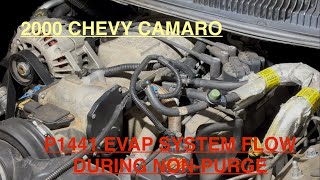
- Chevrolet / Pontiac Camaro / Firebird (1998-2002) — Extremely common on both the 3.8L V6 and 5.7L V8 engines. The purge solenoid, located on the intake manifold, is known to stick open, causing P1441 and sometimes a related warm-stalling issue.
- Ford F-150 (3.5L EcoBoost) (2015-2023) — Often linked to a stuck-open purge valve (part number often ends in 'C' or 'D', e.g., BL3Z-9E928-C). TSB 19-2323 addresses issues with the purge valve on some EcoBoost engines causing various symptoms.
- Honda Accord (2.0T) (2018-2023) — On these turbocharged models, the code is often due to a restricted purge line or a malfunctioning carbon canister vent valve. Check for TSB 21-013 which addresses software updates and potential purge valve replacement for some models.
- Nissan Sentra / Altima (2007-2017) — For Nissan, P1441 often relates to the EVAP Canister Vent Control Valve getting stuck, which is located near the charcoal canister. On some older models, a failing fuel pressure regulator diaphragm causes a vacuum leak that mimics this code.
- Subaru Forester / Outback (2005-2014) — On many Subarus, P1441 is defined as 'Fuel Tank Pressure Control System High Input' and points to a problem with the rusty pressure control solenoid valve near the fuel tank, not the purge valve in the engine bay.
- BMW 3-Series (F30) (2012-2018) — The code definition translates to 'Leakage Diagnostic Pump (LDP) Control Open Circuit,' pointing to an electrical issue with the LDP, not a purge flow problem. However, a standard stuck purge valve is also a common cause on these models. It is critical to verify the code definition with a BMW-specific scanner.
- Toyota Camry (3.5L V6) (2012-2018) — CRITICAL: On many Toyotas, P1441 refers to the 'Secondary Air Injection System Switching Valve No. 2 Stuck Open,' which is completely unrelated to the EVAP system. If your Camry has this code, you must diagnose the air injection pump and valves, typically for water intrusion or corrosion.
Manufacturer-Specific Notes
- General Motors (Chevy, GMC, Cadillac, Buick): The definition is consistently "Evaporative Emission (EVAP) System Flow During Non-Purge." A stuck-open purge valve is the primary culprit. GM has issued Special Coverage Adjustments, like N242441120 for some 2.0L engines, extending the warranty on the EVAP purge pump to 15 years/150,000 miles. It is crucial to check for TSBs and special coverages for your specific VIN.
- Toyota / Lexus: CRITICAL: For many models, P1441 is defined as "Secondary Air Injection System Switching Valve No. 2 Stuck Open." This is an entirely different emissions system used during cold starts. Do NOT diagnose the EVAP system. Check the air injection pump and valves for water damage and corrosion.
- BMW / MINI: P1441 translates to "Leakage Diagnostic Pump (LDP) Control Open Circuit." This points to an electrical fault with the pump that pressurizes the EVAP system for leak testing. This requires a completely different diagnostic path focusing on the LDP circuit, not purge flow. Always use a manufacturer-specific scanner to confirm the definition.
- Volkswagen / Audi: The definition is often "EGR Vacuum Regulator Solenoid Valve Open/Short To Ground." This points to the Exhaust Gas Recirculation (EGR) system, which controls NOx emissions, and is unrelated to the EVAP system.
- Warranty Coverage Note: The Federal Emissions Warranty covers 'specified major emission control components' (ECU, Catalytic Converter, Onboard Diagnostics) for 8 years/80,000 miles. Most EVAP components, including the purge valve, typically fall under the much shorter 2-year/24,000-mile 'Design and Defect' warranty unless a specific extended warranty or recall has been issued by the manufacturer.
Real Owner Stories
2000 Chevy Camaro 3.8L V6
Service Engine Soon light appeared with a P1441 code. The car would sometimes fire up, stumble, and shut off, particularly after sitting for 10-30 minutes after a drive (warm soak).
What they tried:
- The owner suspected a vacuum leak was causing a rich condition. They tested the EVAP purge solenoid by applying vacuum and found it was stuck open, allowing air to pass through when it should have been closed.
Outcome: Replaced the EVAP purge solenoid located on the intake manifold. The new valve correctly remained closed with no power applied. After clearing the codes, the P1441 did not return and the warm-stalling issue was resolved.
Lesson: A stuck-open purge valve causes a hard-to-diagnose warm-stalling or rough-running issue after refueling. A simple mechanical test (blowing through it or using a hand vacuum pump) quickly confirms failure.
1996 Pontiac Firebird LS1 V8
Check Engine Light for P1441 returned immediately after replacing the purge valve solenoid.
What they tried:
- Replaced the purge valve a second time, with no change. Replaced the charcoal canister twice. Blew out the EVAP lines with compressed air. The code persisted.
Outcome: The owner was left suspecting the Fuel Tank Pressure (FTP) sensor, a difficult part to access on top of the fuel tank. The forum thread suggests the next step would be to test the FTP sensor's electrical readings.
Lesson: If replacing the most common part (purge valve) doesn't fix P1441, don't just replace it again. The fault lies with a contaminated system (charcoal), a hidden hose leak, or a faulty sensor providing bad data to the computer.
2001 Nissan Pathfinder, 127k miles
Car had an existing P1441 code. Later, it developed severe drivability issues (would not rev over 2500 RPM, jerking) and threw an additional code, P1491 (Vacuum Cut Valve Bypass Valve).
What they tried:
- The owner planned to replace the purge valve for P1441 but was now faced with a more complex issue. Another owner in a forum noted that on these vehicles, the charcoal canister breaks down and sends charcoal dust into all the vacuum lines, causing multiple, rotating EVAP codes.
Outcome: The recommended fix from forum members was to disconnect all EVAP hoses and use compressed air to blow the charcoal dust out, then replace the charcoal canister and any valves that were clogged.
Lesson: When multiple EVAP codes appear together, suspect a systemic failure like a ruptured charcoal canister contaminating the entire system. Simply replacing one valve will not work, as the new part quickly becomes clogged by the debris.
How to Prevent This Code From Triggering
- Stop fueling at the first click (Every fill-up) — Habitually overfilling the gas tank forces liquid fuel into the charcoal canister, which is only designed for vapor. This saturates and destroys the charcoal, leading to blockage and contamination of the entire EVAP system.
- Use high-quality, top-tier gasoline (Consistently) — Quality fuels contain detergents that keep fuel system components cleaner. While not a direct cause, using different fuel blends (like E85 vs regular) alters the vapor pressure in the tank, which affects the sensitivity of EVAP system tests.
- Inspect and replace the gas cap when its seal is worn (Every 2-3 years or as needed) — The gas cap is a critical sealing point for the EVAP system. A cracked or hardened rubber seal causes leaks, triggering various EVAP codes. It's an inexpensive part to replace to ensure system integrity.
- Periodically inspect visible EVAP hoses (During every oil change) — The rubber and plastic hoses in the engine bay become brittle and crack over time due to heat and age. A quick visual inspection catches obvious damage before it becomes a persistent, hard-to-diagnose leak.
Frequently Asked Questions
I replaced the purge valve, but the P1441 code came back. What's next?
If a new purge valve didn't fix it, check for three common issues. First, inspect for a failed charcoal canister sending debris into the lines and holding the new valve open. Second, perform a smoke test to find a hidden hose leak. Finally, check the purge valve connector for a constant ground signal indicating a wiring short.
What's the difference between a purge valve and a vent valve?
The normally-closed PURGE valve sits in the engine bay and opens to draw fuel vapors into the engine. The normally-open VENT valve sits near the charcoal canister and closes to seal the system for pressure testing. Code P1441 almost always points to a stuck-open purge valve.
Can I clean an EVAP purge valve instead of replacing it?
While some people report temporary success by tapping a stuck valve or attempting to clean it with carburetor cleaner, this is not a reliable long-term solution. The internal seal is likely worn or the solenoid coil is failing. Given the relatively low cost of the part, replacement is the recommended and most effective repair.
What is the most common misdiagnosis for P1441?
The single biggest mistake is not verifying the code's definition for the specific vehicle manufacturer. A technician wastes hours diagnosing the EVAP system on a Toyota when P1441 on that car points to the Secondary Air Injection system. The second mistake is replacing the purge valve without checking for charcoal contamination, leading to the new valve failing shortly after.
How much does it cost to fix code P1441?
The cost varies widely with the cause. A new gas cap is under $40, while the most common fix, a purge valve replacement, typically costs between $140 and $260 at a repair shop. A more complex issue like a charcoal canister replacement ranges from $400 to over $1500, depending on the vehicle and part accessibility.
What's the difference between P1441 and P0496?
Functionally, they mean the exact same thing: the PCM detects EVAP system flow when the purge valve is supposed to be closed. P0496 is the standardized, generic SAE code. P1441 is a manufacturer-specific code used by companies like GM for the same fault.
Does overfilling my gas tank cause this code?
Yes, it is a leading cause of expensive P1441 repairs. Habitually topping off your fuel tank after the pump clicks off forces raw gasoline into the charcoal canister, which is only designed to handle vapor. This saturates the charcoal, causing it to break down and send particles into the EVAP lines, which then holds the purge valve open.
Key Takeaways
- A stuck-open EVAP purge valve causes 80% of P1441 codes, but you must check the lines for black charcoal pellets before installing a new $50 valve to prevent immediate failure.
- Verify your vehicle's specific P1441 definition before replacing parts; while it means an EVAP flow issue on GM vehicles, it indicates a completely unrelated Secondary Air Injection failure on Toyotas.
- Driving with an active P1441 code drops fuel economy by 5-10% and eventually saturates the charcoal canister, turning a $150 purge valve repair into a $1,000+ canister replacement.
- If a new purge valve does not clear the code, pay a shop $100-$200 for a professional EVAP smoke test to pinpoint hidden vacuum leaks in the hoses.
Helpful Videos

The information in this article is provided for general reference and educational purposes only. Vehicle specifications, procedures, and part compatibility can vary by production date, trim level, and region. Always consult your vehicle's factory service manual and verify part numbers before purchasing or performing repairs. Safety-critical components such as airbags, seat belts, and braking systems should be installed by a qualified professional.
- 🎬 Helpful Videos
- What Does P1441 Mean?
- Can I Drive With P1441?
- Common Causes
- Symptoms
- Diagnostic Flowchart
- Common Fixes & Costs
- DIY vs Professional
- Used vs. New Parts: Buying Guide
- What Happens If You Wait — Timeline
- Cost of Not Fixing It
- Diagnosis Steps
- When This Code Triggers (Freeze-Frame Conditions)
- Related Codes
- Climate & Environmental Factors
- How to Talk to a Mechanic About This Code
- Where to Take It: Dealer vs Independent vs Chain
- When to Walk Away From the Repair
- What Scan Tool You Need for This Code
- How to Clear the Code After You Fix It
- Will This Fail Emissions / State Inspection?
- Most Commonly Affected Vehicles
- Manufacturer-Specific Notes
- Real Owner Stories
- 2000 Chevy Camaro 3.8L V6
- 1996 Pontiac Firebird LS1 V8
- 2001 Nissan Pathfinder, 127k miles
- How to Prevent This Code From Triggering
- Frequently Asked Questions
- I replaced the purge valve, but the P1441 code came back. What's next?
- What's the difference between a purge valve and a vent valve?
- Can I clean an EVAP purge valve instead of replacing it?
- What is the most common misdiagnosis for P1441?
- How much does it cost to fix code P1441?
- What's the difference between P1441 and P0496?
- Does overfilling my gas tank cause this code?
- Key Takeaways
- 🎟️ Get 5% Off