

P1437 on 2006-2015 Audi Q7: Air Suspension 'Control Position not Learned' Causes and Fixes
On a 2006-2015 Audi Q7, code P1437 (often displayed as 01437) means the adaptive air suspension's 'Control Position not Learned'. This is almost always caused by an underlying hardware failure like a leaking air spring or a worn-out compressor. The final fix requires a system calibration with a specialized scan tool like VCDS after the faulty hardware is replaced.
- P1437/01437 on a Q7 means the air suspension's position is lost, almost always due to a hardware failure.
- The most common causes are leaking air springs (struts) or a burned-out air compressor.
- Do not just try to recalibrate the system. You must first find and fix the underlying physical problem (e.g., the air leak).
- A specialized scan tool (like VCDS) is required to perform the final, mandatory suspension calibration after parts are replaced.
- Check the 40A compressor fuse and relay before condemning the compressor itself.
What's Unique About the 2006-2015 Audi Q7

The first-generation Audi Q7 (Typ 4L) and its platform mates (VW Touareg 7L, Porsche Cayenne 9PA) rely on a complex air suspension system for ride quality and adjustable height. Unlike many vehicles, this system is prone to age-related failures, particularly air leaks from the rubber air springs and compressor burnout. The 'Control Position not Learned' fault is rarely a software glitch on its own; it's almost always a symptom of a physical problem, like the system being unable to generate or hold air pressure. Resolving it always requires a final calibration step using a VAG-specific tool like VCDS, which is not typical for many other trouble codes.
Symptoms You May Notice
- Suspension malfunction warning light is illuminated on the instrument cluster.
- Vehicle is visibly sagging at one or more corners, or sitting lower than usual.
- Inability to raise or lower the vehicle using the MMI controls.
- A harsh, bouncy, or uncomfortable ride.
- Compressor is heard running constantly or making loud, struggling noises.
- Compressor does not run at all, even when trying to adjust height.
- Simply clearing the code without fixing the underlying hardware issue. The code will return immediately because the system cannot pass its self-check.
- Attempting to perform the suspension calibration before finding and fixing the air leak or failed compressor. The calibration procedure will fail if the system cannot physically reach and hold the required height levels, leading to a persistent 01437 fault.
- Replacing the compressor without replacing the faulty relay. A stuck relay will cause the new compressor to burn out very quickly.
Most Likely Causes

- Leaking Air Spring / Air Strut 🔴 High Probability The rubber bladders of the air springs degrade over time, developing cracks that leak air. This is the most frequent failure point in the system across the Q7, Touareg, and Cayenne platform.
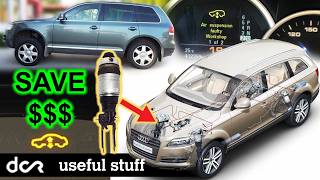
How to confirm: With the system trying to lift, spray the air springs at each corner with soapy water. Bubbles will form at the site of the leak. 🎬 Watch how to find and fix air leaks affordably. The vehicle may also sag at a specific corner after being parked overnight.
Typical fix: Replace the leaking air spring assembly. They are typically replaced in pairs (both fronts or both rears).
Est. part cost: $250-$600 per strut - Failed Air Suspension Compressor 🔴 High Probability Compressors often burn out from constantly running to compensate for air leaks in the system. The original WABCO-manufactured pump can fail due to internal wear or a stuck relay.
How to confirm: If the compressor never runs, check its 40A fuse (often located under the passenger seat) and its relay. If the fuse and relay are good but the compressor is silent, it has likely failed. If it runs constantly but the vehicle doesn't lift, it's too weak to build pressure, likely due to an air leak or internal wear.
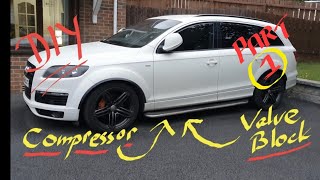
Typical fix: Replace the air suspension compressor and its corresponding relay. 🎬 Watch this step-by-step guide on replacing the compressor and valve block. It is critical to fix any air leaks before or at the same time, otherwise the new compressor will burn out quickly.
Est. part cost: $300-$800 - Faulty Ride Height Level Sensor 🟡 Medium Probability These sensors have plastic arms and linkages that can become brittle and break. They are also exposed to the elements, leading to electrical failure or corrosion.
How to confirm: Visually inspect the sensor at each corner for broken arms or disconnected linkages. A diagnostic scan tool can also read live data from each sensor to see if one is providing an illogical or stuck reading.
Typical fix: Replace the faulty ride height sensor. A calibration is required after replacement.
Est. part cost: $50-$150 - Failed Air Suspension Valve Block ⚪ Low Probability The valve block, often made by RAPA, can fail internally, getting stuck open or closed, or develop leaks over time, though it is less common than strut or compressor failure.
How to confirm: This is difficult to confirm without a scan tool to actuate individual channels. If the compressor runs and the struts are confirmed to be good, but one corner will not raise or lower, the valve block is a likely suspect.
Typical fix: Replace the valve block assembly.
Est. part cost: $150-$300
Rare But Worth Checking
- Water Ingress in ECU/Relay Box: The electronics box in the engine bay plenum can collect water if its drains are clogged. This can corrode fuses, relays (including the compressor relay), and even the Level Control Module itself, causing a variety of suspension faults.
- Stuck or Failed Compressor Relay: The compressor relay can fail in two ways: stuck open (compressor never runs) or stuck closed (compressor runs continuously until it burns out or the battery dies). It is often recommended to replace the relay whenever the compressor is replaced. The relay is often a '645' relay with part number 4H0951253A.
Diagnosis Steps
- Scan the Level Control Module (Address 34) with a VAG-compatible scan tool (like VCDS) and record all fault codes.
- Check the primary 40A fuse for the suspension compressor, often located in the fuse panel under the front passenger seat near the battery.
- Check the compressor relay. On the Q7, this is often in the engine bay relay panel, not under the dash. A stuck relay can burn out the compressor.
- Visually inspect the vehicle. Is one corner or axle lower than the others?
- Start the engine and attempt to raise the vehicle to 'Lift' mode. Listen for the compressor running. It is located under the vehicle, typically on the passenger side.
- If the compressor runs, use a spray bottle with soapy water to check for leaks at all four air springs and the air lines connected to them. Bubbles indicate a leak.
- Inspect the ride height sensors at each corner. Ensure their plastic arms and linkages are intact and connected.
- If a hardware fault (leak, bad compressor, broken sensor) is found, replace the component.
- After repairs, clear all fault codes. Perform the 'Suspension Level Control Calibration' using a scan tool. This involves entering Security Access (code 31564), then going to Adaptation. You will then input the measured height (from wheel center to fender lip, in mm) for all four corners into channels 01, 02, 03, and 04, and finally save a '1' to channel 05 to confirm.
Parts You'll Likely Need

- Air Suspension Compressor
(OEM #4L0698007C (supersedes 4L0698007A, 4L0698007B). Also see platform-shared numbers like 7L8616006A, 7L8616007A.)— This part is often the victim of an air leak, burning out from overwork. If it's weak or dead, the system cannot lift the vehicle, triggering the code.
Trusted brands: WABCO (OEM), Arnott, Aerosus
OEM price range: $900-$1200
Aftermarket price range: $300-$800 - Front Air Spring/Strut
(OEM #Right: 7L8616040D. Left: 7L8616039D. Many revisions exist.)— This is the most common failure point. The rubber bladder cracks with age, causing air leaks that the compressor cannot overcome.
Trusted brands: Arnott, Bilstein, Suncore
OEM price range: $800-$1100
Aftermarket price range: $250-$600 - Air Suspension Compressor Relay
(OEM #4H0951253A (often marked '645'). Also 8D0951253A.)— A cheap but critical part. If it sticks 'on', it will destroy a new compressor. If it fails 'open', the compressor won't run. Always replace with the compressor.
Trusted brands: Genuine VW/Audi, Bosch
OEM price range: $20-$40
Aftermarket price range: $10-$25 - Air Suspension Valve Block
(OEM #7L0698014.)— Less common to fail, but can cause issues where one or more corners won't raise or lower, or can cause leaks that trigger the P1437 code.
Related Codes That Often Appear With This One
- 01400 — This code means 'Suspension Level Control - Control Limit Not Reached'. It often appears with 01437 as it indicates the system tried to adjust but failed to reach its target height, which is the direct cause for the 'Control Position not Learned' fault.
- 02250 — 'Function Deactivation; Valve Duty Cycle'. This indicates the control module has shut down the system to protect the compressor from overheating after it has been running for too long (usually due to a leak), which directly leads to the 01437 fault.
- 01772 — 'Signal from Level Control Pressure Sensor; Implausible Signal'. This points towards a problem with the pressure sensor, often located on the valve block, which can also prevent the system from knowing its status and trigger the 01437 code.
Technical Service Bulletins (TSBs) & Recalls
- TSB #TSB-43-12-11: Describes a scenario where the control module, as a safeguard, lowers the vehicle to its lowest position and illuminates a warning light due to compressor failure or poor performance, making the vehicle unable to adjust. This condition directly leads to a 01437 fault.
Mechanic-Grade Diagnostic Values
- VCDS Measuring Blocks, Address 34 (Level Control), Group 006, Field 1 — expected: Ambient Temperature (e.g., 15-30°C). Failure: An illogical reading, such as a constant 80°C, points to a faulty temperature sensor, which can prevent system operation.
- VCDS Measuring Blocks, Address 34 (Level Control), Group 006, Field 2 — expected: Compressor Temperature (e.g., slightly above ambient when running). Failure: A reading of -40°C indicates the compressor temperature sensor (G290) is unplugged or has failed open circuit.
- VCDS Measuring Blocks, Address 34, Pressure Reservoir Test — expected: Pressure should rise to specified level (typically well above 10 bar).. Failure: If the pressure test fails to rise above a low value like 5.5 bar, it indicates either a very weak compressor or a significant leak in the system, preventing calibration.
Scan Tool Commands That Help

- VCDS (VAG-COM): Adaptation - Channel 05 — This is the final, critical step of the suspension calibration. After entering the measured heights in channels 1-4, you MUST save a value of '1' to channel 05 to confirm and save the new calibration. Forgetting this step is a common reason the 01437 fault immediately returns.
- VCDS (VAG-COM): Security Access - Code 31564 — This security code must be entered in the Level Control Module (Address 34) before you are allowed to perform the Adaptation/Calibration procedure.
- VCDS (VAG-COM): Output Tests — Before attempting calibration, running the output tests allows you to individually command each corner's valve to open or close and run the compressor. This can help isolate a non-responsive corner or confirm the compressor is functional before starting the lengthy adaptation process.
Wiring & Ground Locations
- J197 - Level Control Module — In the luggage compartment, on the right side, underneath the trim/floor cover, often near the spare wheel well.. This is the brain of the air suspension system. All sensor inputs and commands to the compressor and valve block originate here. A bad connection or water damage to this module can cause the 01437 fault.
- J403 - Air Suspension Compressor Relay — Location varies. Some sources state it is in the driver's side footwell, behind paneling near the steering column. Other sources state it is in the electronics box in the engine bay plenum chamber (under the windshield cowl), on the right (passenger) side. It is critical to verify the location for your specific model year.. A failed relay will either prevent the compressor from running (stuck open) or cause it to run continuously until it burns out (stuck closed), both of which lead to the system being unable to achieve its target height.
- Ground Connection (35) — Below the front passenger's seat, near the battery.. This is a key ground point. The main 40A fuse for the compressor is also located under the passenger seat. A poor ground connection can cause intermittent power issues for the compressor and control module.
- Ground Connection (609) — In the plenum chamber on the right side of the engine bay.. This ground serves the electronics box that can house the compressor relay and other critical components. Corrosion here due to water ingress is a known issue.
Real Owner Repair Stories
- AudiWorld Forums user 'CtrlAltDel' (2012 Audi Q7) — Suspension malfunction light (MIL) on, fault code 01437 - Control Position not Learned.
❌ Tried (didn't work) Running the VCDS suspension calibration steps multiple times., Manually clearing the error code, which kept returning.
✅ What actually fixed it The user realized they had missed the final step of the VCDS calibration procedure. After correctly saving a value of '1' to Adaptation Channel 05 to confirm the new settings, the procedure completed successfully and the fault code was resolved. - AudiWorld Forums user 'vtraudt' (Audi A6 Allroad (similar system to Q7)) — Fault code 01437, rear of the car was all the way down. Inability to run adaptation.
❌ Tried (didn't work) Standard VAG-COM procedure (clear codes, output test, security login, adaptation)., Cleaning connectors at compressor and valve block.
✅ What actually fixed it The user discovered standing water and corrosion in the ECU box located in the passenger side engine bay plenum. Cleaning the contacts and replacing the corroded fuses and relay in this box restored system functionality. - Ross-Tech Forums user 'Pro-Race' (2008 Audi Q7) — Vehicle sitting lopsided (high on right rear), dropping on one corner when parked, eventually burned out the compressor. After replacing compressor and valve block, the car remained lopsided and calibration would not fix it.
❌ Tried (didn't work) Replacing the leaking air strut., Replacing the compressor and valve block., Attempting level calibration multiple times with VCDS., Swapping the original valve block back on.
✅ What actually fixed it The user suspected a failed Level Control Module (J197), believing an output to the right rear solenoid was stuck on. While the final post doesn't confirm the module replacement, it points to a scenario where multiple hardware replacements fail to solve the issue, making the control module itself the next logical point of failure.
Model Year Variations Within This Range
- 2010-2015 (Facelift): The 2010 model year introduced a facelift for the Q7, which included updated exterior styling with LED headlights and taillights, as well as improved interior MMI units and trim. While the core air suspension system components remained largely the same, wiring and module software may have minor revisions.
- 2006-2015: The location of the J403 compressor relay is a point of confusion. Some owner reports and diagrams for earlier models place it under the driver's side dash/footwell. Other sources, particularly for later models, place it in the electronics box in the plenum chamber on the passenger side of the engine bay. It is crucial to verify the location before attempting replacement.
Diagnostic Flowchart
Used vs. New Parts: Buying Guide for This Vehicle
When a used part is the smart pick: Used parts are generally not recommended for the primary failure items (air springs, compressor) due to their nature as wear-and-tear components. A used part may have limited life remaining. However, a used Level Control Module (J197) from a reputable salvage yard can be a cost-effective option if the original has failed, but it will require professional programming to the vehicle.
Donor-vehicle mileage cap: roughly under 60000 miles for the part to have meaningful remaining life.
What to inspect on the donor part:
- For an air spring: Check the rubber for any visible cracking, perishing, or abrasion. Ensure the top mount and piston are in good condition.
- For a compressor: Ask for the mileage of the donor vehicle. Visually inspect for corrosion or damage to the housing and electrical connector.
- For a control module: Ensure no signs of water damage or corrosion on the casing or pins. Verify the part number matches exactly.
OEM-only on this vehicle (don't cheap out):
- Level Control Module (J197): While used OEM is an option, aftermarket modules are not available. The module must be coded to the car's specific VIN and options, which requires dealer-level tools.
- Compressor Relay: This is an inexpensive but critical part. Given the low cost, always buy a new OEM or high-quality OE-supplier (e.g., Bosch) relay rather than a used one.
Aftermarket brands forum-validated for this vehicle:
- Arnott: Widely regarded in forums as a high-quality aftermarket supplier for both complete air struts and compressors. They often re-engineer parts to address common OEM failure points.
- WABCO: The Original Equipment Manufacturer (OEM) for the compressor. Buying a WABCO-branded compressor from an aftermarket supplier is equivalent to getting the dealer part without the Audi box.
Brands owners have reported issues with on this vehicle:
- Unbranded/generic parts from online marketplaces: While significantly cheaper, these parts have a very high failure rate. Forum discussions frequently mention users who replaced a cheap compressor or air spring only for it to fail within months, forcing them to do the job again with a quality part.
Real Owner Stories
Aggregated from forums and TSBs cited above. Mileages and costs reflect what owners reported in those sources.
2003-2010 Porsche Cayenne
Symptoms: An owner reported getting a '1437 control position not learned' fault after an attempt to calibrate the air suspension failed, highlighting the shared problem on this platform.
What fixed it: The code was triggered by an unsuccessful calibration attempt. The resolution is to successfully perform the 'Suspension Level Control Calibration' using a compatible scan tool and the correct procedure.
Source hint: rennlist.com/forums/cayenne-955-957-2003-2010/1155101-icarscan-air-suspension-calibration-problem.html
Frequently Asked Questions
My 2009 Q7 is sagging at one corner after being parked overnight. Is this related to the P1437 code?
I replaced the air compressor on my Q7, but the suspension warning light and P1437 code came back. What did I do wrong?
After replacing a broken ride height sensor on my Q7, is any special procedure required?
Can I use suspension parts from a Volkswagen Touareg or Porsche Cayenne to repair my Audi Q7?
What aftermarket brands are considered reliable for Q7 air suspension components?
Is it a good idea to buy a used air spring or compressor for my Q7 to save money?
My mechanic says the control module intentionally lowered my Q7 and set a fault. Is this a known issue?
Helpful Videos
We Have This Part in Stock



The information in this article is provided for general reference and educational purposes only. Vehicle specifications, procedures, and part compatibility can vary by production date, trim level, and region. Always consult your vehicle's factory service manual and verify part numbers before purchasing or performing repairs. Safety-critical components such as airbags, seat belts, and braking systems should be installed by a qualified professional.
- Audi Q7:
- 🎬 Helpful Videos
- 🛍️ Shop This Part
- What's Unique About the 2006-2015 Audi Q7
- Symptoms You May Notice
- Most Likely Causes
- Rare But Worth Checking
- Diagnosis Steps
- Parts You'll Likely Need
- Related Codes That Often Appear With This One
- Technical Service Bulletins (TSBs) & Recalls
- Mechanic-Grade Diagnostic Values
- Scan Tool Commands That Help
- Wiring & Ground Locations
- Real Owner Repair Stories
- Model Year Variations Within This Range
- Diagnostic Flowchart
- Used vs. New Parts: Buying Guide for This Vehicle
- Real Owner Stories
- 2003-2010 Porsche Cayenne
- Frequently Asked Questions
- 🎟️ Get 5% Off