

Ultimate Guide to OBD-II Code P1413: Secondary Air Injection System Fault
The Most Comprehensive P1413 Resource: Causes, Pro-Level Diagnosis, and Real-World Fixes
- P1413 is a manufacturer-specific emissions code indicating a Secondary Air Injection (SAI) system fault, guaranteeing an automatic failure on state OBD-II emissions tests.
- P1413 definitions vary by brand: Ford and BMW typically indicate an electrical circuit fault, while Subaru and GM point to physical airflow blockages.
- A stuck-open check valve is the root cause of 80% of SAI pump failures, allowing corrosive exhaust moisture to destroy the $300+ electric pump.
- Always check the 40-60A SAI fuse and swap the $20 pump relay before replacing the expensive pump assembly.
- Driving with an active P1413 code is safe for up to 12 months, but ignoring it longer risks premature catalytic converter failure costing $800 to $2,500.
What Does P1413 Mean?

P1413 is a manufacturer-specific Diagnostic Trouble Code (DTC) indicating the Powertrain Control Module (PCM) detected a fault in the Secondary Air Injection (SAI) system. This emissions system pumps fresh air into the exhaust manifold for 30-90 seconds after a cold start. This extra oxygen burns off unburned fuel in the hot exhaust, reducing harmful emissions and heating the catalytic converter to operating temperature faster. Code P1413 typically signifies an electrical problem in the pump's control circuit (like a low voltage signal) or a failure to detect the expected change in airflow when activated.
Technical definition: P1413 is a manufacturer-specific code with varying definitions. For Ford, Lincoln, and Mercury, it means 'Secondary Air Injection System Monitor Circuit Low Input'. For BMW, it translates to 'Secondary Air Injection Pump Relay Control Circuit Signal Low'. For General Motors, it indicates a general fault on 'Secondary Air Injection System Bank 1'. For some Honda/Acura models, P1413 refers to an 'EGR Differential Pressure Sensor Signal Too Low', which involves a completely different emissions system.
Can I Drive With P1413?
Yes, But With Caution. Yes, the vehicle is safe to drive. The Secondary Air Injection (SAI) system only affects emissions during the first 30-90 seconds of a cold start. However, you will automatically fail an emissions test. Ignoring the problem for over a year contributes to premature catalytic converter damage due to consistently incorrect air/fuel mixtures during warm-up, a repair costing $800-$2,500.
Common Causes

- Failed Secondary Air Injection (SAI) Check Valve (Very Common) — This one-way valve prevents hot exhaust gases from flowing back into the SAI pump. Carbon buildup or corrosion forces it stuck open. When stuck open, moisture-laden exhaust travels backward, condenses inside the pump, and causes catastrophic internal corrosion.
- Clogged Secondary Air Injection Passages (Very Common) — Extremely common on direct-injection engines (Volkswagen/Audi). Carbon deposits build up inside the small air passages within the cylinder head. This acts as a complete blockage, preventing air from reaching the exhaust stream and triggering a flow-related fault, even if the pump and valves work perfectly.
- Failed Secondary Air Injection (SAI) Pump (Common) — This high-speed electric air blower fails primarily from water ingress caused by a faulty check valve, or internal condensation freezing in cold climates. A seized pump motor draws excess current and blows the system's main fuse.
- Blown SAI Pump Fuse (Common) — The SAI pump motor requires significant amperage and uses a dedicated 40-60A fuse. A pump motor seizing due to water damage or age draws excess current and instantly blows this fuse.
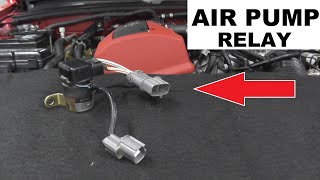
- Faulty Secondary Air Injection Pump Relay (Common) — This high-current electro-mechanical switch provides power to the SAI pump. The high amperage draw of the pump motor burns out or sticks the relay's internal contacts over time, creating an open or short circuit. 🎬 Watch: How to test and replace your air pump relay
- Vacuum System Leaks or Failed Solenoids (Less Common) — Many systems (Land Rover, older BMWs) use a vacuum-operated solenoid to control the check valves. If this solenoid fails, or the brittle plastic vacuum lines crack, the check valves cannot open, preventing airflow.
- Damaged Wiring or Connectors (Rare) — Electrical wiring and connectors for the pump, relay, and solenoids endure harsh engine bay heat and vibration. Chafing or loose pins cause an intermittent or permanent 'circuit low' fault.
- Faulty Powertrain Control Module (PCM) (Very Rare) — The driver circuit within the PCM that controls the SAI relay rarely fails. Consider this only after exhaustively testing all other components and wiring.
Symptoms
- Check Engine Light On — The PCM logs the P1413 fault and illuminates the Malfunction Indicator Lamp (MIL). This is often the only noticeable symptom.
- No Pump Noise on Cold Start — If the system is supposed to run but you hear nothing, it confirms an electrical failure: a blown fuse, bad relay, dead pump motor, or wiring issue.
- Loud Vacuum Cleaner or Grinding Noise on Cold Start — A failing SAI pump produces a loud whirring or grinding noise lasting 30-90 seconds after a cold start. It sounds like a small vacuum cleaner under the hood and stops abruptly.
- Failed Emissions Test — An active P1413 code results in an automatic failure of the OBD-II portion of any state emissions inspection.
- Brief Hesitation on Cold Start — A malfunctioning SAI system causes a slight stumble immediately after a cold start, as the PCM's fueling strategy expects a change in exhaust oxygen content that never occurs.
Diagnostic Flowchart
Tap your situation to follow the diagnostic path that matches what you're seeing on this code.
Common Fixes & Costs

- Replace Secondary Air Injection Pump Relay — Parts: $15-$80, Labor: $0-$50, ~0.2 hr book time (DIY)
- Replace Blown SAI Fuse — Parts: $5-$20, Labor: $0, ~0.1 hr book time (DIY)
- Replace Secondary Air Injection Check Valve(s) — Parts: $50-$450, Labor: $100-$300, ~1.5 hr book time (Intermediate)
- Replace Secondary Air Injection Pump — Parts: $200-$700, Labor: $150-$400, ~2 hr book time (Intermediate)
- Clean Carbon from Cylinder Head Air Passages — Parts: $30-$100, Labor: $400-$1200, ~8 hr book time (Professional)
DIY vs Professional
- Replace SAI Fuse or Relay — Beginner:
Tools: Fuse puller, owner's manual. - Replace SAI Pump — Beginner:
Tools: Socket set (10mm, 13mm), screwdrivers, hose clamp pliers. - Replace SAI Check Valve — Beginner:
Tools: Socket set with extensions and universal joints, gasket scraper, torque wrench. - Clean Carbon from Cylinder Head Air Passages — Beginner:
Tools: Extensive toolset, specialized cleaning tools (media blaster, picks), borescope camera.
Used vs. New Parts: Buying Guide
When a used part is worth it: Used parts make sense for simple, non-wear components like relays, hoses, or mounting brackets. A used SAI pump is a massive gamble, as they fail due to moisture, and a used part likely has the same issue.
Donor-vehicle mileage cap: roughly under 60000 miles for the part to have meaningful remaining life.
Donor quality checklist:
- Avoid pumps or valves from regions with heavy road salt use or high humidity.
- Verify the part number exactly; visual matches have different internal calibrations.
- Demand a 30-90 day warranty to protect against receiving a dead-on-arrival part.
Decision logic:
- If The failed part is a relay or fuse → Buy new; the cost is low and it eliminates any uncertainty.
- If The failed part is the SAI pump or check valve → Strongly favor new. The labor to replace these parts is significant, and a failed used part means doing the job twice.
- If Vehicle is over 150K miles and budget is the primary concern → A used pump is a high-risk option but acceptable if it comes from a low-mileage donor and has a functional warranty.
Warranty tradeoff: Used parts typically have a 30-90 day warranty on the part only. New aftermarket parts carry a 1-year to limited lifetime warranty. The cost difference buys peace of mind against repeat labor costs.
Worst-case if a used part fails: $300-$600 if a used pump or valve fails after installation, representing the cost of repeating the labor.
What Happens If You Wait — Timeline
- 0-1 month: Check Engine Light illuminates. The SAI system does not activate on cold starts. No drivability symptoms exist, but the car automatically fails emissions tests. (MPG impact: 0%% · Added cost: $0)
- 1-12 months: The Check Engine Light remains on, masking new, potentially serious DTCs. The catalytic converter endures longer warm-up times with a rich fuel mixture. (MPG impact: 0%% · Added cost: $0)
- 1-3 years: Cumulative slow warm-ups reduce catalytic converter efficiency. Catalyst materials degrade, though it may not yet trigger a P0420 (catalyst inefficiency) code. (MPG impact: 0%% · Added cost: $0)
- 3+ years: Prolonged exposure to unburned fuel during cold starts causes the catalyst substrate to fail, triggering a P0420 code and requiring costly replacement. (MPG impact: 0-5%% · Added cost: $800 - $2,500+)
Cost of Not Fixing It
- Immediate: Guaranteed failure of any state OBD-II emissions inspection. Potential fines for expired inspection. (Added cost: Varies by state (re-test fees, fines))
- 1-12 months: No significant mechanical risk. The primary issue is failing to address the Check Engine Light, which masks new, more serious problems. (Added cost: Negligible)
- 12+ months: Premature catalytic converter degradation. Without the SAI system, the converter is subjected to unburned fuel during cold starts for longer periods, reducing its lifespan. (Added cost: $800 - $2,500+)
Diagnosis Steps

- Perform an 'Ear Test' on a Cold Start
Ensure the engine is completely cold (left overnight). Have an assistant start the car while you listen in the engine bay. A healthy system produces a distinct 'vacuum cleaner' sound for 30-90 seconds. A loud grinding indicates a failing pump; no sound indicates an electrical issue.
Tools: Assistant (Beginner) - Scan and Document Codes
Use an OBD-II scanner to confirm P1413 is active. Check for related codes like P0410, P0411, P1414, or P0418 to pinpoint the problem area. Document the freeze frame data.
Tools: OBD-II Scan Tool (Beginner) - Check the SAI Fuses
Locate the large-amperage fuse (40A to 60A) for the 'Secondary Air Injection' or 'AIR' pump in the engine bay fuse box. Visually inspect and test the fuse for continuity with a multimeter. A blown fuse guarantees a seized pump.
Tools: Owner's manual, fuse puller, multimeter (Beginner) - Test the SAI Pump Relay
Locate the SAI relay in the engine compartment fuse box. Swap it with an identical relay from a non-critical system (e.g., the horn). If the pump runs on the next cold start, the relay is faulty.
Tools: Owner's manual (Intermediate) - Inspect Hoses and Wiring
Perform a visual inspection of all components. Look for cracked, disconnected, or melted vacuum lines and air hoses. Check the electrical connector at the SAI pump for corrosion or melted pins.
Tools: Flashlight (Beginner) - Test the SAI Check Valve(s)
Disconnect the large hose running from the pump to the check valve. With the engine running, feel for exhaust pressure coming out of the valve's inlet; there should be none. After the engine is off, remove the valve. You should be able to blow air through the inlet side, but the outlet side must block air completely.
Tools: Pliers, screwdrivers, basic wrenches (Intermediate) - Pro Tip: Scan Tool Actuator Test & O2 Sensor Monitoring
Using a bidirectional scan tool, command the SAI pump 'ON'. Monitor the live data for the upstream O2 sensor (Bank 1 Sensor 1). A functioning system drops the O2 sensor voltage lean (below 200mV). If the pump runs but voltage doesn't drop, you have a physical blockage.
Tools: Bidirectional Scan Tool (Advanced) - Pro Tip: Test Pump Circuit with a Multimeter
Disconnect the SAI pump connector. Have an assistant start the car cold. For the first 30-90 seconds, measure battery voltage (12-14V) across the harness-side connector terminals. If you have voltage but the pump doesn't run, the pump is dead. If you have no voltage, the problem is upstream.
Tools: Multimeter (Advanced) - Pro Tip: Measure Pump Current Draw
Use a DC clamp-on ammeter around the pump's main power wire. When activated, a healthy pump draws 15A-30A. A draw over 40A proves a seized motor. A reading of 0A confirms an open circuit.
Tools: DC Clamp-on Ammeter (Advanced) - Pro Tip: Measure Air Pump Discharge Pressure
Disconnect the air hose from the check valve and attach a low-pressure gauge. Activate the pump. A healthy pump produces at least 1.5 to 2.0 psi. Zero pressure indicates a sheared internal impeller, even if the motor spins.
Tools: Low-Pressure Gauge (0-15 PSI range) (Advanced)
When This Code Triggers (Freeze-Frame Conditions)
- Engine State: First 30-120 seconds after cold start (The SAI system monitor runs only once per drive cycle, immediately after a cold soak.)
- Engine Coolant Temp (at startup): Below 122°F (50°C) (The system requires a 'cold' engine to activate; the fault is logged during the warm-up phase.)
- RPM: 800-1500 RPM (The fault is logged while the engine is at idle or just above idle, before being driven.)
- Time Since Engine Start: < 2 minutes (The pump and its self-test are only active for a very short window after starting the engine.)
Related Codes
- P0410 — A generic code for 'Secondary Air Injection System Malfunction.' P1413 is the manufacturer-specific version providing more detail, such as pointing to a specific circuit.
- P0411 — Indicates 'Incorrect Flow Detected.' The PCM sets this when the pump runs, but O2 sensors don't detect extra oxygen. This points to a physical blockage rather than an electrical fault.
- P1414 — The equivalent of P1413 but for the opposite engine bank (Bank 2). If both are present, the fault lies with a shared component like the pump, relay, or fuse.
- P0418 — Means 'Relay A Circuit Malfunction.' It specifically points to an electrical fault with the relay or its control circuit, making the relay the primary suspect.
- P2441 — Means 'Switching Valve Stuck Closed.' Very common on Subaru models where valves corrode and seize, preventing airflow even if the pump works.
Climate & Environmental Factors
- Cold Climates / Freezing Temperatures: Moisture from exhaust gas enters the system via a leaking check valve and collects in the pump. In freezing weather, this water turns to ice, seizing the pump's impeller. When commanded on, the seized motor draws massive current and blows the main fuse.
- High Humidity: Humid environments increase water vapor in the exhaust and ambient air. This accelerates condensation and internal corrosion of the check valve and pump, causing failure even in non-freezing climates.
- Short Trip Driving: Vehicles driven primarily for short trips never heat the exhaust enough to evaporate collected condensation. Moisture pools in the SAI system, guaranteeing eventual corrosion.
How to Talk to a Mechanic About This Code
Say this: "I have a P1413 code for the secondary air injection system. I'd like to book a diagnostic appointment. Please start by testing the system's fuse and relay before condemning the pump, as I understand those are common failure points."
This signals you've done your research and guides the technician toward a logical, cost-effective diagnostic path. It prevents them from immediately quoting the most expensive part.
Avoid saying:
- 'Just fix whatever's wrong'
- 'My check engine light is on, can you look at it?'
- 'My friend said it's the air pump, can you replace it?'
Questions to ask before authorizing the repair:
- Did you test the fuse and relay first? What were the results?
- If the pump failed, did you confirm it's receiving power and ground during a cold start?
- If the pump needs replacement, have you inspected the check valve? I want to replace it simultaneously to prevent the new pump from failing.
- (For Audi/VW) Have you ruled out clogged air passages in the cylinder head as the cause of the flow issue?
- What is the warranty on the parts and labor for this repair?
Where to Take It: Dealer vs Independent vs Chain
- Dealer:
Best for: Vehicles under warranty or with a known Customer Support Program (Toyota Tundra/Sequoia)., Complex, brand-specific issues like Audi/VW carbon-clogged passages requiring special tools.
Downsides: Highest labor rates, often 1.5-2x more than an independent shop., May recommend replacing an entire assembly when only one component failed. (Typical cost: +50% vs. baseline) - Independent Shop:
Best fit for most P1413 scenarios, especially if you find a shop specializing in your vehicle's brand. They offer the best balance of expertise and value.
Best for: Out-of-warranty vehicles where cost is a factor., Common P1413 causes like a failed relay, fuse, or standard pump/check valve replacement., A brand-specialist indie is ideal for BMW, Audi, or VW.
Downsides: Quality and experience vary widely; check reviews and ASE certifications., May lack access to the latest manufacturer TSBs. (Typical cost: +0% vs. baseline) - Chain Shop:
AVOID for P1413 diagnosis. The risk of an incorrect diagnosis or an incomplete repair (replacing the pump but not the faulty check valve) is very high.
Best for: Simple jobs like tire changes or oil services.
Downsides: Technician skill with emissions systems like SAI is highly inconsistent., High pressure to sell parts leads to misdiagnosis, like replacing an expensive pump when the relay was the only issue. (Typical cost: -10% vs. baseline)
When to Walk Away From the Repair
If the estimated repair cost exceeds 40-50% of the car's private-party value, seriously consider selling the car as-is or trading it in.
- Car worth $4000, fix is $2200: Walk away. A $2,200 repair on a $4,000 Subaru WRX for SAI valves and a pump is over the threshold.
- Car worth $12000, fix is $900: Fix it. A $900 carbon cleaning service on a $12,000 Audi A4 is well below the threshold and restores proper function.
- Car worth $3000, fix is $1500: Borderline. This is exactly 50% of the car's value. Get a second opinion. If confirmed, sell the car as a 'mechanic's special'.
What Scan Tool You Need for This Code
Minimum: A bidirectional scan tool capable of performing 'Active Tests' or 'Actuator Tests' on the Secondary Air Injection system components.
A basic $30 code reader only shows the P1413 code. It cannot command the pump to turn on for testing, which is critical to determine if the fault is electrical or a physical blockage.
Budget: XTOOL A30M (~$120) — A wireless Bluetooth dongle offering basic bidirectional controls, which includes activating the SAI pump on many models for functional testing.
Mid-range: Foxwell NT510 Elite (~$180) — A powerful handheld tool. With vehicle-specific software, it runs bidirectional tests on the SAI pump and views live O2 sensor data to confirm airflow.
Professional: Autel MaxiCOM MK808S (~$480) — Full bidirectional control to activate the SAI pump and valves on demand. Provides robust live data graphing to monitor O2 sensors during the test.
Rent vs buy: For a one-time fix, use an auto parts store Loan-A-Tool program. However, loaner tools rarely have bidirectional capability. If you plan to do your own maintenance regularly, buying a midrange tool like the Foxwell is a worthwhile investment.
How to Clear the Code After You Fix It
- Use an OBD-II scan tool to clear the P1413 code and any related faults.
- Ensure the engine is completely cold (allow vehicle to sit for 8+ hours).
- Perform a cold start and allow the engine to idle for 2-3 minutes without touching the throttle.
Drive cycle (~20 minutes): To set the SAI readiness monitor, a cold start is mandatory. Start the engine after it has been off overnight. Let it idle for 2-3 minutes; this is when the SAI monitor runs. Follow with 10-15 minutes of mixed driving for other monitors.
Readiness monitors affected: Secondary Air (AIR), Catalyst monitor, O2 sensor monitor
Before emissions retest: drive at least 50 miles to fully set monitors.
Watch out for:
- Attempting the drive cycle with a warm engine will never set the SAI monitor.
- Simply clearing the code will not pass an emissions test; the readiness monitor must show 'Ready'.
- Disconnecting the battery clears the code but resets all readiness monitors to 'Not Ready'.
Will This Fail Emissions / State Inspection?
Yes — this code typically fails an OBD-II emissions inspection.
- California: An illuminated Check Engine Light is an automatic failure. After repairs, all readiness monitors must be 'Ready'. A 'Not Ready' SAI monitor blocks the test.
- New York: An active P1413 code or illuminated MIL causes an immediate failure. For vehicles model year 2001 and newer, only one readiness monitor is allowed to be incomplete.
- Texas: In the 17 counties requiring emissions testing, an active P1413 code fails the OBD inspection. The vehicle is allowed two 'Not Ready' monitors to pass.
Most Commonly Affected Vehicles
- Audi / Volkswagen GTI, Jetta, A4, Q5 (2.0T, 3.0T, 3.2L engines) (2008-2017) — Extremely susceptible to carbon buildup completely blocking cylinder head air passages. Audi issued multiple TSBs (e.g., 2014753/12) and a 10-year/110,000-mile warranty extension for this specific cleaning.
- BMW 3-Series (E46), 5-Series (E39), X3, X5, Z4 (1999-2006) — Common failures include the pump relay, the pump itself (from moisture), and brittle plastic vacuum lines. The P1413 code often points specifically to the relay circuit.
- Subaru WRX, STI, Forester XT, Legacy GT (2006-2014) — Notorious for SAI valves seizing closed due to internal corrosion. This triggers P2441 along with P1413. Repair is expensive and difficult due to component location.
- Chevrolet / GMC Corvette (C5), Silverado, Tahoe, Camaro (1999-2007) — The primary failure point is the check valve getting stuck open, allowing exhaust moisture to destroy the pump. Always replace the check valves when replacing the pump.
- Ford Mustang, F-150, Explorer (1998-2008) — The 'Monitor Circuit Low Input' definition points directly to a failed pump motor creating an open circuit, a faulty relay, or a corroded connector.
- Land Rover Discovery II, Range Rover (P38) (1999-2004) — Failures frequently trace to the pump relay, a failed vacuum solenoid, or cracked vacuum lines. The orientation of the vacuum reservoir is critical for proper operation.
- Toyota Tundra, Sequoia (2007-2014) — Known for a catastrophic failure where the foam filter inside the air pump housing disintegrates, clogging the air switching valves. Toyota issued Customer Support Programs (ZG6, ZHA) extending the warranty to 10 years/150,000 miles.
- Honda / Acura Pilot, Odyssey, MDX (V6 Models) (2005-2008) — On some V6 models, P1413 indicates a fault related to the Exhaust Gas Recirculation (EGR) system's differential pressure sensor, not the Secondary Air Injection system.
Manufacturer-Specific Notes

- Audi / Volkswagen: Carbon buildup in the cylinder head is the #1 cause of flow-related SAI codes. Shops mistakenly replace the pump first. Check for TSBs and warranty extensions for this specific cleaning.
- General Motors: A failed check valve is the root cause of nearly all SAI pump failures. Replacing the pump without replacing the check valve guarantees the new pump will fail from moisture damage.
- Subaru: Due to the $2,000+ cost of replacing seized SAI valves and pumps, a common off-road modification is installing block-off plates and using ECU tuning software to disable the system.
- BMW: The 'Pump Relay Control Circuit Signal Low' definition is literal. Diagnosis must begin at the lime green relay and its wiring. Brittle plastic vacuum lines are also major failure points.
- Toyota: The foam filter disintegration issue is unique to Tundra/Sequoia V8s. Replacing the pump alone fails; the entire system must be cleared of foam debris. Check VIN for warranty extensions.
Real Owner Stories
2003 BMW E46 325i at 130K miles - The Easy Fix
Check Engine Light appeared with code P1413 ('SAI Pump Relay Control Circuit Signal Low'). The pump made no noise on cold starts.
What they tried:
- Checked the 40A system fuse, which was intact.
- Located the lime green SAI relay in the engine bay fuse box.
- Swapped the suspect relay with the identical horn relay.
Outcome: The SAI pump ran perfectly on the next cold start. The owner bought a new relay (part # 61368373700) for $20, permanently resolving the code.
Lesson: For BMWs, the 'Relay Circuit' definition is literal. Always test the fuse and relay first; it is the cheapest, easiest fix.
2008 Subaru WRX at 115K miles - Misdiagnosis and Repeat Failure
Car threw P1413 and P2441 (Valve Stuck Closed). A general repair shop replaced the SAI pump for $900.
What they tried:
- Two months later, the exact same codes returned.
- The owner researched Subaru forums and learned seized check valves are the actual root cause.
Outcome: The new pump failed due to moisture backflow from the original, seized-shut check valves. Proper repair required replacing the pump AND both expensive check valves, costing over $1,500.
Lesson: On Subarus, valves are the primary culprits. Replacing only the pump without addressing faulty valves guarantees rapid repeat failure.
2012 Audi A4 2.0T at 85K miles - The Clogged Passage Problem
Owner had flow-related SAI codes. The pump ran audibly, the fuse and relay were good, and the check valve operated normally.
What they tried:
- A shop quoted $1,200 for a new pump and check valve.
- Owner found Technical Service Bulletins (TSBs) regarding carbon-clogged SAI ports.
Outcome: An independent Audi specialist confirmed the components worked but the cylinder head air passages were completely blocked with carbon. An $800 labor-intensive cleaning process resolved the issue permanently.
Lesson: On VW/Audi direct-injection engines, if the pump runs but a flow code exists, suspect clogged cylinder head ports before replacing expensive parts.
2007 Toyota Tundra at 140K miles - The Disintegrating Foam Filter
Check Engine Light on with multiple SAI codes. The truck entered 'limp mode' with reduced power.
What they tried:
- Dealer diagnosed a failed air injection pump and quoted $2,500.
- Owner discovered Toyota's Customer Support Program (CSP) for this specific defect.
Outcome: The foam filter inside the pump housing disintegrated, sending debris into the air switching valves. Because Toyota extended the warranty to 10 years/150,000 miles, the dealer performed the entire repair for free.
Lesson: For Toyota Tundra/Sequoia, always check your VIN for warranty extensions related to the SAI system before paying out of pocket.
How to Prevent This Code From Triggering
- Proactively Replace the SAI Check Valve (Every 80,000-100,000 miles) — The check valve is the root cause of most pump failures. Replacing it proactively prevents it from sticking open and allowing corrosive moisture to destroy the $300+ pump.
- Ensure Engine Reaches Full Operating Temperature Regularly (At least once a week) — Consistent short-trip driving prevents the exhaust system from evaporating condensation. A weekly drive of 20+ minutes burns off accumulated moisture, preventing internal freezing and rust.
- Periodically Inspect SAI Hoses (During regular oil changes) — Rubber and plastic hoses become brittle from engine heat. Catching a cracked vacuum line early prevents the check valves from failing to open.
Frequently Asked Questions
What does the secondary air injection system actually do?
It injects fresh air into the hot exhaust stream for 30 to 90 seconds after a cold engine start. This burns excess hydrocarbons and heats the catalytic converter to operating temperature much faster.
Can a bad O2 sensor cause a P1413 code?
It is highly unlikely. The PCM uses O2 sensors to monitor the SAI system, but P1413 specifically points to an electrical issue with the pump or relay circuit, not a sensor failure.
What's the biggest mistake when fixing a P1413 code?
The most costly mistake is immediately replacing the expensive SAI pump without diagnosis. The root cause is usually a $20 relay, a $5 fuse, or a stuck check valve that will destroy the new pump.
Will fixing P1413 improve my gas mileage or performance?
No. The system only runs for a brief period at startup and is completely inactive during normal driving. Fixing it has zero effect on fuel economy or engine power.
Can I just remove or bypass the secondary air injection system?
While physically possible to install block-off plates, doing so on a street-legal vehicle is illegal. It causes a permanent Check Engine Light and guarantees a failed emissions test.
Can a vacuum leak cause a P1413 code?
Yes. On systems using vacuum-controlled check valves (older BMWs and Land Rovers), a cracked vacuum line prevents the valves from opening, triggering a flow fault.
Will the P1413 code clear itself?
If the fault was intermittent, the PCM clears the code after several successful drive cycles. For hard faults like a dead pump or blown fuse, the code remains until repaired and manually cleared.
Why is this repair so expensive on my Subaru/Audi/Toyota?
OEM parts are expensive, and components are often buried in difficult-to-access locations. Furthermore, the failure mode often requires replacing multiple parts at once or performing labor-intensive carbon cleaning.
Key Takeaways
- P1413 is a manufacturer-specific emissions code indicating a Secondary Air Injection (SAI) system fault, guaranteeing an automatic failure on state OBD-II emissions tests.
- P1413 definitions vary by brand: Ford and BMW typically indicate an electrical circuit fault, while Subaru and GM point to physical airflow blockages.
- A stuck-open check valve is the root cause of 80% of SAI pump failures, allowing corrosive exhaust moisture to destroy the $300+ electric pump.
- Always check the 40-60A SAI fuse and swap the $20 pump relay before replacing the expensive pump assembly.
- Driving with an active P1413 code is safe for up to 12 months, but ignoring it longer risks premature catalytic converter failure costing $800 to $2,500.
Helpful Videos


The information in this article is provided for general reference and educational purposes only. Vehicle specifications, procedures, and part compatibility can vary by production date, trim level, and region. Always consult your vehicle's factory service manual and verify part numbers before purchasing or performing repairs. Safety-critical components such as airbags, seat belts, and braking systems should be installed by a qualified professional.
- 🎬 Helpful Videos
- What Does P1413 Mean?
- Can I Drive With P1413?
- Common Causes
- Symptoms
- Diagnostic Flowchart
- Common Fixes & Costs
- DIY vs Professional
- Used vs. New Parts: Buying Guide
- What Happens If You Wait — Timeline
- Cost of Not Fixing It
- Diagnosis Steps
- When This Code Triggers (Freeze-Frame Conditions)
- Related Codes
- Climate & Environmental Factors
- How to Talk to a Mechanic About This Code
- Where to Take It: Dealer vs Independent vs Chain
- When to Walk Away From the Repair
- What Scan Tool You Need for This Code
- How to Clear the Code After You Fix It
- Will This Fail Emissions / State Inspection?
- Most Commonly Affected Vehicles
- Manufacturer-Specific Notes
- Real Owner Stories
- 2003 BMW E46 325i at 130K miles - The Easy Fix
- 2008 Subaru WRX at 115K miles - Misdiagnosis and Repeat Failure
- 2012 Audi A4 2.0T at 85K miles - The Clogged Passage Problem
- 2007 Toyota Tundra at 140K miles - The Disintegrating Foam Filter
- How to Prevent This Code From Triggering
- Frequently Asked Questions
- What does the secondary air injection system actually do?
- Can a bad O2 sensor cause a P1413 code?
- What's the biggest mistake when fixing a P1413 code?
- Will fixing P1413 improve my gas mileage or performance?
- Can I just remove or bypass the secondary air injection system?
- Can a vacuum leak cause a P1413 code?
- Will the P1413 code clear itself?
- Why is this repair so expensive on my Subaru/Audi/Toyota?
- Key Takeaways
- 🎟️ Get 5% Off