

OBD-II Code P1406: EGR System Performance/Pintle Position Error
The Ultimate Guide to Understanding, Diagnosing, and Fixing P1406
- P1406 triggers when the EGR valve's actual position deviates from the PCM's commanded position by more than 10%, usually due to physical binding.
- Carbon buildup blocking the EGR pintle or intake passages causes 80% of P1406 codes on GM vehicles, requiring a $15 gasket and thorough cleaning rather than a new valve.
- On 1997-2003 Ford F-150s and Rangers, immediately inspect the two rubber DPFE sensor hoses; replacing cracked or carbon-clogged hoses fixes the code for under $40.
- Ignoring P1406 for more than 6 months forces the engine to run lean or hot, risking a melted catalytic converter that costs $1,200 to $2,800 to replace.
What Does P1406 Mean?

Code P1406 means the Powertrain Control Module (PCM) detects a performance problem in the Exhaust Gas Recirculation (EGR) system. The EGR system reduces NOx emissions by recirculating exhaust gas into the engine cylinders. This code specifically triggers when the EGR valve's position sensor reports a position that does not match the PCM's commanded position. The discrepancy stems from a stuck valve, slow movement, or an electrical fault in the sensor circuit.
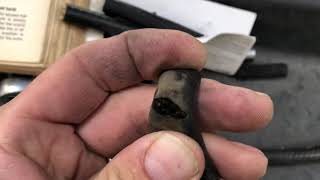
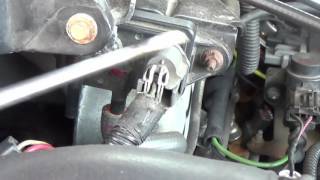
Technical definition: The official definition of P1406 varies by manufacturer. For General Motors (GM), it is 'EGR Valve Pintle Position Performance 🎬 See this GM case study on testing electronic EGR valves,' triggered when the actual pintle position deviates from the commanded position by more than 10%. For Ford, Lincoln, and Mercury, it is 'DPFE Downstream Hose Off or Plugged 🎬 Watch: How to fix a disconnected DPFE hose on a Ford,' pointing to a fault in the sensor's plumbing. Always confirm the definition for your specific vehicle, as some Dodge models use it for 'Intermittent Loss Of Camshaft Position Sensor,' and certain Hyundai diesels define it as 'Exhaust Gas Temperature Not Plausible.'
Can I Drive With P1406?
Yes, But With Caution. You can drive for 50-100 miles, but extended trips risk severe catalytic converter damage. Ignoring this code causes rough idling, poor fuel economy, stalling, and guaranteed emissions test failure. The most significant risk is long-term damage to the catalytic converter from an overly rich or lean fuel mixture, a repair costing $1,200 to $2,800.
Common Causes


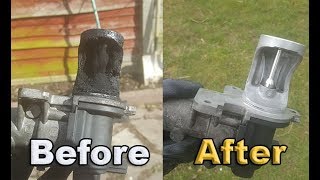
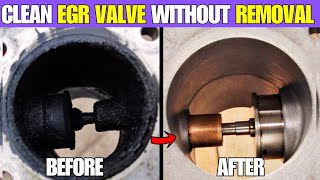
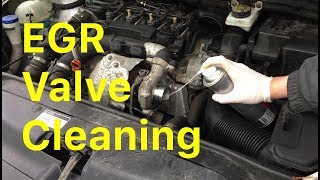
- Carbon buildup in the EGR valve or passages (Very Common) — Soot and carbon from exhaust gases accumulate over time, causing the EGR valve's internal pintle to stick or completely blocking the passages. 🎬 Watch: A step-by-step guide to cleaning your EGR valve
- Cracked, disconnected, or clogged DPFE hoses (Ford) (Common) — On Ford vehicles, the two rubber hoses connected to the DPFE sensor become brittle, crack, clog with carbon, or blow off their fittings from backpressure.
- Faulty EGR Position Sensor or DPFE Sensor (Common) — The sensor measuring the EGR valve's position (GM) or pressure differential (Ford) fails, sending incorrect voltage signals to the PCM.
- Damaged wiring or corroded electrical connectors (Less Common) — Wires leading to the EGR valve melt from exhaust heat or short out. Corroded connector pins disrupt the 5-volt reference signal.
- Faulty EGR Valve (Less Common) — The valve fails mechanically (broken spring) or electronically (burned-out internal motor), rendering it inoperable.
- Faulty EGR vacuum solenoid (Less Common) — In vacuum-operated systems, the electronic solenoid controlling the vacuum supply fails, preventing the valve from opening.
- Moisture freezing in the EGR system (Rare) — In climates below 32°F (0°C), moisture inside the DPFE hoses or valve freezes, causing a temporary blockage. The code clears once the engine warms up.
- Vacuum leaks (Rare) — A leak in any vacuum line connected to the EGR system prevents the valve from opening to the correct position.
- Failing Powertrain Control Module (PCM) (Very Rare) — The PCM itself fails. Only consider this after exhaustively testing all wiring and components.
Symptoms

- Check Engine Light is on — This is the most common, and sometimes the only, initial symptom.
- Rough idle or stalling — A stuck-open EGR valve creates a massive vacuum leak at idle, causing the engine to shake, surge, or stall.
- Reduced engine power and poor acceleration — The vehicle hesitates or hits a wall at higher RPMs.
- Decreased fuel economy — Inefficient combustion causes a 5-15% drop in MPG.
- Failed emissions test — NOx levels spike, resulting in an automatic smog check failure.
- Engine knocking or pinging — A stuck-closed EGR valve raises combustion chamber temperatures, causing detonation under load.
- Strong exhaust or fuel smell — Disrupted air/fuel mixtures push unburnt fuel into the exhaust.
- RPM jumps or fluctuations — Engine speed fluctuates randomly as the computer tries to compensate for the EGR fault.
Diagnostic Flowchart
Tap your situation to follow the diagnostic path that matches what you're seeing on this code.
Common Fixes & Costs
- Cleaning the EGR valve and passages — Parts: $5-$20, Labor: $150-$275, ~1.5 hr book time (DIY)
- Replacing the DPFE sensor hoses (Ford/Lincoln/Mercury) — Parts: $15-$40, Labor: $65-$100, ~0.5 hr book time (DIY)
- Replacing the EGR Position Sensor or DPFE Sensor — Parts: $50-$120, Labor: $100-$175, ~0.8 hr book time (Intermediate)
- Replacing the entire EGR valve assembly — Parts: $150-$400, Labor: $130-$250, ~1.2 hr book time (Intermediate)
- Repairing damaged wiring or connectors — Parts: $10-$50, Labor: $130-$300, ~1.5 hr book time (Advanced)
DIY vs Professional
- Cleaning the EGR valve and passages — Beginner: Yes, with caution.
Tools: Socket set, wrenches, gasket scraper, wire brushes, and a dedicated EGR/intake cleaner spray. - Replacing the DPFE sensor hoses — Beginner: Yes, this is a great beginner task.
Tools: Pliers to remove hose clamps, and a small pick or flathead screwdriver. - Replacing the EGR Valve or DPFE Sensor — Beginner: Yes, it's typically straightforward.
Tools: Socket set, wrenches, torque wrench, and a gasket scraper. - Repairing damaged wiring or connectors — Beginner: No, this is for advanced DIYers.
Tools: Multimeter, wire strippers, crimpers, heat gun, soldering iron, and vehicle-specific wiring diagrams.
Used vs. New Parts: Buying Guide
When a used part is worth it: For a simple, externally mounted electronic EGR valve or DPFE sensor, a used part from a low-mileage donor vehicle is a budget-friendly option. It is not recommended for complex, integrated EGR systems.
Donor-vehicle mileage cap: roughly under 80000 miles for the part to have meaningful remaining life.
Donor quality checklist:
- Verify the donor vehicle was not scrapped due to an engine or emissions-related failure.
- Inspect the part for excessive corrosion, physical damage, or clogged ports.
- Match the part number exactly, as manufacturers make small revisions that are not interchangeable.
Decision logic:
- If The part is a simple Ford DPFE sensor or external GM EGR valve and the new part is under $100 → Buy new. The small savings are not worth the risk of a premature failure.
- If Vehicle is over 150,000 miles, the part is easy to access, and budget is the primary concern → A used part is a reasonable gamble, but do not expect it to last the remaining life of the vehicle.
- If The part has a known high failure rate due to carbon buildup → Strongly favor a new part, as a used one likely has significant internal wear and deposits already.
Warranty tradeoff: Used parts from salvage yards typically offer a 30-90 day warranty covering only the part. New aftermarket parts often come with a 1-year to limited lifetime warranty.
Worst-case if a used part fails: 200-500. If the used part fails, you pay for the part again plus repeat labor.
What Happens If You Wait — Timeline
- 0-2 weeks: Check Engine Light illuminates. EGR valve sticks intermittently with no noticeable symptoms. (MPG impact: 0-3%% · Added cost: $0-20 in wasted fuel)
- 2 weeks - 3 months: Carbon buildup worsens. MPG drops 3-8%, and the engine develops a rough idle or hesitates. (MPG impact: 3-8%% · Added cost: $50-150 in wasted fuel)
- 3-8 months: Engine knocks if valve is stuck closed, or misfires (P0300) if stuck open. Incorrect air/fuel ratio stresses the catalytic converter. (MPG impact: 8-15%% · Added cost: $200-400 in wasted fuel and potential O2 sensor damage)
- 8+ months: Catastrophic catalytic converter failure occurs. The substrate melts, causing severe exhaust restriction and power loss. (MPG impact: 15-25%% · Added cost: $1200-2800+ for catalytic converter replacement)
Cost of Not Fixing It
- 0-1 month: Reduced fuel economy (5-10% drop), rough idle, and hesitation. Guaranteed failure of any emissions test. (Added cost: 10-50)
- 1-6 months: Increased engine knocking (detonation) due to higher combustion temperatures. Worsening fuel economy and potential for damage to oxygen sensors. (Added cost: 200-600)
- 6+ months: Severe risk of catalytic converter damage from prolonged exposure to incorrect exhaust gas temperatures and unburnt fuel. (Added cost: 1200-2800)
Diagnosis Steps

- Read Codes and Freeze Frame Data
Confirm P1406 and check for related codes (P0401, P0300). Analyze freeze frame data for exact engine conditions (RPM, speed, temperature) when the fault triggered.
Tools: OBD-II Scanner (Beginner) - Thorough Visual Inspection
Inspect the EGR system for disconnected or cracked vacuum lines and wiring. On Fords, scrutinize the two rubber hoses on the DPFE sensor.
Tools: Flashlight, Inspection mirror (Beginner) - Check for Clogged Passages and Hoses
Remove the EGR valve. Inspect ports and mounting passages for heavy carbon. On Fords, remove DPFE hoses and blow through them.
Tools: Wrench/socket set, Gasket scraper, Carb cleaner, Pipe cleaners or thin wire (Intermediate) - Test EGR Valve Operation with a Scan Tool
Command the EGR valve open in 25% increments at idle using a bidirectional scanner. The engine should run rough or stall, confirming clear passages.
Tools: Bidirectional OBD-II Scanner (Advanced) - Monitor Live Data PIDs
Compare 'Commanded EGR' and 'Actual EGR Position'. A difference over 10% triggers P1406, differentiating a sensor problem from a mechanical one.
Tools: OBD-II Scanner with Live Data (Advanced) - Test the 5-Volt Reference Circuit
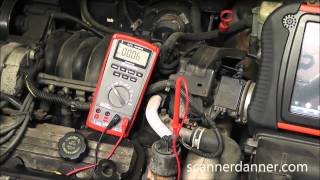
Unplug the EGR sensor. With key on, engine off (KOEO), test the reference wire for a steady 5 volts. 0 volts indicates a wiring or PCM issue.
Tools: Multimeter, Back-probe pins, Vehicle-specific wiring diagram (Advanced) - Test the Sensor's Signal Voltage
Back-probe the signal wire with KOEO. Closed valve voltage should be 0.5-1.0V. Stuck at 0V or 5V means a bad sensor.
Tools: Multimeter, Back-probe pins (Intermediate) - Manually Test the DPFE Sensor (Ford)
Apply vacuum to the upstream DPFE port. Voltage should smoothly increase from ~1.0V to 4.5V. Erratic jumps mean a faulty sensor.
Tools: Multimeter, Hand-operated vacuum pump or hose (Advanced) - Test EGR Solenoid and Sensor Resistance (GM)
Test GM EGR solenoid coils (20-25 ohms) and pintle sensor resistance (sweeps 700-4000 ohms).
Tools: Multimeter, Vehicle-specific wiring diagram (Advanced) - Perform a PCM Relearn Procedure
On older GM models, force the PCM to relearn the valve's closed position after cleaning or replacement.
Tools: OBD-II Scanner (Intermediate)
When This Code Triggers (Freeze-Frame Conditions)
- Engine Coolant Temp: 180-210°F (82-99°C) (Fully warmed up, in closed loop operation.)
- RPM: 1500-2500 (Steady cruise or light acceleration, not at idle.)
- Engine Load: 20-60% (Light to moderate load, not during heavy acceleration or deceleration.)
- Vehicle Speed: 35-55 mph (56-88 km/h) (Steady state highway or city cruising speed.)
Related Codes
- P0401 — EGR Flow Insufficient. P1406 is the electronic feedback cause; P0401 is the measured lack of gas flow result.
- P0404 — EGR Circuit Range/Performance. Diagnosed identically to P1406 but triggers based on erratic movement over time rather than a fixed percentage error.
- P0300 — Random Misfire. A stuck-open EGR valve leans out the air-fuel mixture at idle, causing misfires.
- P0171 / P0174 — System Too Lean. A stuck-open EGR valve acts as a vacuum leak. Fix P1406 first.
Climate & Environmental Factors
- Cold Weather: Moisture freezes inside the EGR valve or DPFE hoses below 32°F (0°C), causing a temporary blockage.
- Humidity: High humidity increases exhaust moisture, corroding internal DPFE sensor electronics over time.
- High Altitude: Slow system response to barometric pressure changes creates a mismatch between commanded and actual EGR flow.
- Driving Habits: Frequent short trips prevent the engine from burning off carbon deposits.
How to Talk to a Mechanic About This Code
Say this: "I have an active P1406 code and I'd like to schedule a diagnostic. I want to confirm if the cause is carbon buildup, a faulty sensor, or a wiring issue before replacing the whole EGR valve. Can you please check the EGR passages and test the sensor circuit as part of the diagnosis?"
This signals that you understand the common causes of P1406 and prevents a shop from simply replacing the most expensive part without proper diagnosis. It directs them to check for cheaper fixes like cleaning or a bad wire first.
Avoid saying:
- 'My check engine light is on, can you look at it?' (This is too vague and invites a broad, expensive diagnostic process.)
- 'Just fix whatever is wrong.'
- 'I think I need a new EGR valve.' (Don't suggest a specific repair; ask for a specific diagnosis.)
Questions to ask before authorizing the repair:
- Did you confirm the EGR passages are clear, both in the valve and the intake manifold?
- If you are recommending a new valve, did you test the position sensor's 5-volt reference and ground circuits first to rule out a wiring problem?
- For my Ford, did you inspect the DPFE hoses for internal clogs, not just external cracks?
- Does your estimate include new gaskets and cleaning of the mounting surfaces?
- What is the warranty on the parts and labor for this repair?
Where to Take It: Dealer vs Independent vs Chain
- Dealer:
Best for: Vehicles under an emissions or powertrain warranty., Complex cases where a manufacturer-specific PCM software update is required., Diagnosing manufacturer-specific definitions of P1406 (e.g., Dodge or Hyundai).
Downsides: Highest labor rates, often 1.5x to 2x more than an independent shop., Defaults to replacing the entire EGR assembly rather than attempting a less expensive cleaning. (Typical cost: +50% vs. baseline) - Independent Shop:
Best fit for most situations. P1406 is a bread-and-butter code for competent independent mechanics, who are more likely to attempt a cleaning before a full replacement.
Best for: Most out-of-warranty vehicles., Common P1406 failures like carbon cleaning, Ford DPFE hose replacement, or standard EGR valve replacement., Getting a second opinion on a dealer's expensive quote.
Downsides: Shop quality and diagnostic skill vary widely. Vet the shop by checking for ASE certifications., Lacks access to the latest manufacturer TSBs or software updates. (Typical cost: +0% vs. baseline) - Chain Shop:
Use with caution. Acceptable for a straightforward EGR valve or sensor swap if you are certain of the diagnosis, but AVOID for initial diagnosis of the P1406 code.
Best for: Simple, clear-cut parts replacement where the diagnosis is already certain., Tire changes and oil services, not complex diagnostics.
Downsides: Technician skill varies dramatically from location to location., High pressure to upsell; recommends unnecessary services or replaces parts without a thorough diagnosis., Lacks the advanced diagnostic tools to differentiate between a bad sensor, clogged passage, or wiring fault. (Typical cost: -10% vs. baseline)
When to Walk Away From the Repair
If the total estimated repair cost for the P1406 fault exceeds 40-50% of your car's current private-party value, seriously consider selling the car as-is or trading it in rather than repairing it.
- Car worth $4000, fix is $650: Fix it. The repair cost is only about 16% of the vehicle's value, which is well below the threshold.
- Car worth $2500, fix is $650: Borderline. At 26% of the car's value, the repair is reasonable, but consider the car's overall condition and any other needed maintenance before proceeding.
- Car worth $3000, fix is $1400: Walk away. The repair cost is nearly 47% of the car's value. It's not economically sound to invest this much unless the car is in otherwise perfect condition.
What Scan Tool You Need for This Code
Minimum: A scanner that reads and graphs live data PIDs, specifically 'Commanded EGR' and 'Actual EGR Position'.
A basic $20 code reader only gives you the 'P1406' code, leaving you to guess between a dozen possible causes. To diagnose effectively, you need to see if the computer is commanding the valve to open and if the position sensor is reporting that movement accurately.
Budget: BlueDriver Pro (~$100) — Connects to your smartphone via Bluetooth. It reads the code, provides freeze frame data, and displays live data for the EGR commanded vs. actual position PIDs to determine if the valve is physically stuck.
Mid-range: Innova 5610 / Foxwell NT510 Elite (~$180) — Offers bidirectional control. This allows you to command the EGR valve to open and close from the tool itself while the engine is running, proving the valve works and the passages are clear.
Professional: Autel MaxiCOM MK808 / MK906BT (~$500-1200) — Provides full, OEM-level bidirectional control and diagnostics. Performs specific manufacturer relearn procedures required after replacing an EGR valve on GM vehicles.
Rent vs buy: For a one-time diagnosis, auto parts stores have a loaner tool program where you borrow a scanner for free with a refundable deposit. If you plan to do your own car repairs more than once a year, buying a budget or mid-range scanner is a wise investment.
How to Clear the Code After You Fix It
- Use an OBD-II scan tool to clear the diagnostic trouble codes (DTCs).
- Perform a complete OBD-II drive cycle to allow all readiness monitors to run.
- Check for pending or current codes after the drive cycle to confirm the fix.
Drive cycle (~30 minutes): Cold start (sit for 8+ hours). Idle for 2-3 minutes. Drive for 15-20 minutes with mixed city (stop-and-go) and highway (steady 55 mph for 5-10 minutes) conditions. Allow vehicle to cool down.
Readiness monitors affected: EGR System Monitor, Catalyst Monitor, O2 Sensor Monitor, EVAP System Monitor
Before emissions retest: drive at least 50-100 miles to fully set monitors.
Watch out for:
- Disconnecting the battery clears the code but resets all readiness monitors to 'Not Ready', guaranteeing an emissions test failure.
- The code returns immediately if the root cause (e.g., clogged passages, bad sensor) was not correctly identified and fixed.
- Not driving long enough or under the right conditions to complete the drive cycle and set the readiness monitors.
Will This Fail Emissions / State Inspection?
Yes — this code typically fails an OBD-II emissions inspection.
- California: An active P1406 code is an automatic failure. All OBD-II readiness monitors must be 'Ready' to take the test. You need to complete a full drive cycle after repairs.
- New York: A P1406 code results in an automatic failure. The EGR readiness monitor must be set to 'Ready' for the inspection to be completed.
- Texas: An illuminated Check Engine Light from a P1406 code is an automatic failure. After repair, you can pass with at most one non-continuous monitor not ready on 2001 and newer vehicles.
Most Commonly Affected Vehicles
- Ford F-150 (1997-2003) — Code almost always points to clogged or deteriorated rubber DPFE sensor hoses.
- Chevrolet Silverado / C1500 (1996-2002) — Heavy carbon buildup causes the EGR valve pintle to stick.
- Chevrolet Blazer (1995-2005) — The 4.3L V6 is highly susceptible to carbon buildup in EGR passages.
- GMC Sierra / Suburban (1996-2002) — Mechanically identical to Chevrolet counterparts, suffering from the same carbon buildup issues.
- Ford Ranger (1995-2008) — P1406 relates to the DPFE sensor. Check hoses first.
- Volkswagen Jetta / Golf (1999-2010) — Faulty EGR position sensor or heavy carbon buildup in the intake manifold.
- Honda Accord / Civic (1998-2005) — Clogged EGR distribution ports inside the intake manifold trigger the code.
- Audi A4 (2002-2008) — Commonly traced to a failed EGR position sensor or a wiring fault in the harness near the valve.
Manufacturer-Specific Notes
- Ford, Lincoln, Mercury: Definition is 'DPFE Downstream Hose Off or Plugged.' Inspect and replace the two rubber hoses connected to the DPFE sensor.
- General Motors (Chevrolet, GMC): Caused by the EGR valve pintle sticking from carbon. Requires a PCM relearn procedure after replacement.
- Dodge: Can mean 'Intermittent Loss Of Camshaft Position Sensor.' Verify the definition for your specific vehicle.
- Audi / Volkswagen: Prone to electrical failures in the EGR position sensor itself or chafing in the wiring harness near the valve.
- Hyundai / Kia: On diesels, means 'Exhaust Gas Temperature Not Plausible,' pointing to the DPF system, not the EGR.
Real Owner Stories
2000 Ford F-150 5.4L with 98K miles
Check Engine Light came on. Code reader showed P1406, 'DPFE downstream hose off or plugged'.
Outcome: Replaced both hoses with a new set from an auto parts store for $10. Cleared the code, and it did not return.
Lesson: On Ford trucks, inspect the DPFE hoses first. Remove them to check for internal blockages, as a visual check is not enough.
1996 Chevrolet Blazer 4.3L with 107K miles
Intermittent P1406 code accompanied by a very rough, erratic idle.
Outcome: The root cause was the EGR supply tube and intake passages, which were still clogged with carbon. After thoroughly cleaning the passages, the code was resolved.
Lesson: If replacing the EGR valve doesn't fix P1406 on a GM, the intake passages are clogged. Clean the mounting surface and perform a PCM relearn.
2000 Ford Mustang GT 4.6L
Vehicle felt sluggish and hit a wall at 5,000 RPM. Check Engine Light came on with code P1406.
Outcome: The issue was intermittent and related to cold weather. Moisture froze in the DPFE sensor lines, causing a temporary blockage.
Lesson: If P1406 appears only in freezing temperatures and disappears when warm, suspect ice in the EGR system.
How to Prevent This Code From Triggering
- Perform an 'Italian tune-up' periodically (Once a month) — Sustained highway driving at higher RPMs increases exhaust temperature, burning off soft carbon deposits from the EGR valve and passages.
- Avoid frequent short trips and excessive idling (Daily habit) — Short trips prevent the engine from reaching operating temperature, allowing moisture and carbon to form sludge.
- Use high-quality, top-tier gasoline or diesel fuel (Every fill-up) — Detergent additives clean intake components, reducing soot production and EGR load.
- Perform preventative cleaning of EGR passages (Every 30,000-40,000 miles) — Cleaning the EGR valve and passages removes carbon before it causes the valve to stick.
- Use the correct specification of engine oil (Every oil change) — Low-SAPS oils reduce deposits that contaminate the EGR system.
Frequently Asked Questions
Can I fix P1406 myself?
Yes, for many common causes. Cleaning a carbon-clogged EGR valve or replacing Ford DPFE hoses are manageable DIY tasks requiring basic hand tools and carb cleaner.
What happens if I ignore code P1406?
Ignoring the code causes poor engine performance, terrible gas mileage, and a failed emissions test. Over time, the incorrect air/fuel mixture overheats and destroys your catalytic converter, costing thousands of dollars.
I replaced the EGR valve, but the P1406 code came back. What now?
If a new valve didn't fix it, the problem is elsewhere. The top culprits are clogged EGR passages in the intake manifold, a wiring problem, or a missing PCM relearn procedure on GM vehicles.
How can I prevent P1406 from happening?
Use high-quality fuel to minimize carbon deposits. Avoid excessive short trips where the engine doesn't fully warm up. Periodically drive at sustained highway speeds to help burn off carbon.
Does a bad EGR valve cause a rough idle?
Yes. If the EGR valve is stuck open, it allows exhaust into the engine at idle. This disrupts the air-fuel ratio, causing a rough, unstable idle or stalling.
Is cleaning the EGR valve a permanent fix?
Cleaning is highly effective, but carbon eventually builds up again. If the code returns quickly, the valve's internal electronic sensor is failing and requires a full replacement.
My Ford scanner says 'DPFE downstream hose off,' but it looks fine. What's wrong?
The hose may look fine externally but be clogged internally with carbon. Backpressure from a clog inside the sensor itself also blows the hose off the fitting. Remove the hoses and sensor to properly inspect for blockages.
What does it mean when the check engine light flashes?
A flashing check engine light indicates a severe engine misfire dumping unburnt fuel into the exhaust. This destroys your catalytic converter in minutes. Pull over immediately and tow the vehicle.
Key Takeaways
- P1406 triggers when the EGR valve's actual position deviates from the PCM's commanded position by more than 10%, usually due to physical binding.
- Carbon buildup blocking the EGR pintle or intake passages causes 80% of P1406 codes on GM vehicles, requiring a $15 gasket and thorough cleaning rather than a new valve.
- On 1997-2003 Ford F-150s and Rangers, immediately inspect the two rubber DPFE sensor hoses; replacing cracked or carbon-clogged hoses fixes the code for under $40.
- Ignoring P1406 for more than 6 months forces the engine to run lean or hot, risking a melted catalytic converter that costs $1,200 to $2,800 to replace.
Helpful Videos

The information in this article is provided for general reference and educational purposes only. Vehicle specifications, procedures, and part compatibility can vary by production date, trim level, and region. Always consult your vehicle's factory service manual and verify part numbers before purchasing or performing repairs. Safety-critical components such as airbags, seat belts, and braking systems should be installed by a qualified professional.
- 🎬 Helpful Videos
- What Does P1406 Mean?
- Can I Drive With P1406?
- Common Causes
- Symptoms
- Diagnostic Flowchart
- Common Fixes & Costs
- DIY vs Professional
- Used vs. New Parts: Buying Guide
- What Happens If You Wait — Timeline
- Cost of Not Fixing It
- Diagnosis Steps
- When This Code Triggers (Freeze-Frame Conditions)
- Related Codes
- Climate & Environmental Factors
- How to Talk to a Mechanic About This Code
- Where to Take It: Dealer vs Independent vs Chain
- When to Walk Away From the Repair
- What Scan Tool You Need for This Code
- How to Clear the Code After You Fix It
- Will This Fail Emissions / State Inspection?
- Most Commonly Affected Vehicles
- Manufacturer-Specific Notes
- Real Owner Stories
- 2000 Ford F-150 5.4L with 98K miles
- 1996 Chevrolet Blazer 4.3L with 107K miles
- 2000 Ford Mustang GT 4.6L
- How to Prevent This Code From Triggering
- Frequently Asked Questions
- Can I fix P1406 myself?
- What happens if I ignore code P1406?
- I replaced the EGR valve, but the P1406 code came back. What now?
- How can I prevent P1406 from happening?
- Does a bad EGR valve cause a rough idle?
- Is cleaning the EGR valve a permanent fix?
- My Ford scanner says 'DPFE downstream hose off,' but it looks fine. What's wrong?
- What does it mean when the check engine light flashes?
- Key Takeaways
- 🎟️ Get 5% Off