

OBD-II Code P1388: Variable Cam Timing Over-Retarded (Bank 2)
What P1388 means, why it triggers, and how to fix it
- Check your oil first; over 50% of P1388 codes trigger because low or dirty oil starves the hydraulic Variable Cam Timing (VCT) system of necessary pressure.
- Verify your manufacturer's specific code definition, as P1388 means a Bank 2 cam timing issue for Ford and BMW, but indicates a critical Auto Shutdown (ASD) Relay failure on Dodge and Jeep vehicles.
- Swap the Bank 1 and Bank 2 VCT solenoids to isolate the fault; if the code moves to Bank 1 (P1383), replacing the $50-$150 solenoid will permanently fix the issue.
- Do not drive extensively with an active P1388 code, as the over-retarded timing dumps unburnt fuel into the exhaust, destroying a $1,500 catalytic converter within a few months.
What Does P1388 Mean?

The P1388 code means your Powertrain Control Module (PCM) detects the Bank 2 camshaft is more 'retarded' (delayed) than commanded. This occurs when the oil-pressure-dependent Variable Cam Timing (VCT) system fails to adjust the camshaft's rotation relative to the crankshaft. This failure tanks engine performance, fuel efficiency, and emissions.
Technical definition: The official SAE/OBD-II definition is "Variable Cam Timing Overretarded (Bank 2)". This indicates the PCM determined the actual camshaft position for Bank 2, measured by the camshaft position sensor, is more retarded than the desired position commanded by the PCM for a specific duration.
Can I Drive With P1388?
Yes, But With Caution. You can drive short distances, but expect rough idling, poor acceleration, and reduced power. The engine suffers poor fuel economy and higher emissions. Driving for an extended period causes unburnt fuel to overheat and destroy the catalytic converter, an $800 to $2,500 repair. It also leads to catastrophic engine damage, such as timing chain failure, so diagnose it immediately.
Common Causes

- Low, dirty, or incorrect viscosity engine oil (Very Common) — The VCT system is hydraulic and uses oil pressure to actuate the cam phasers. If the oil is low, contaminated with fuel, full of sludge, or the wrong weight, the VCT solenoid cannot supply adequate pressure to the phaser.
- Failed Variable Cam Timing (VCT) Solenoid (Very Common) — This electronic valve directs oil flow to the cam phaser. It gets clogged with sludge, its internal screens break, or it fails electrically, causing it to stick open or closed.
- Clogged Oil Passages (Common) — Severe engine sludge breaks off and clogs the narrow oil passages feeding the VCT solenoids and cam phasers. Even with a new solenoid and clean oil, blocked cylinder head passages prevent the system from functioning.
- Faulty Camshaft Phaser (Common) — The cam phaser is a mechanical gear on the camshaft that performs the actual rotation. Internal components, like the locking pin or vane seals, wear out or break, preventing it from holding a commanded position and causing a distinct rattle.
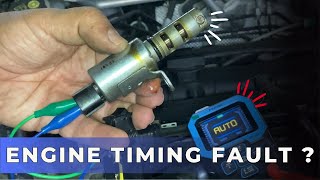
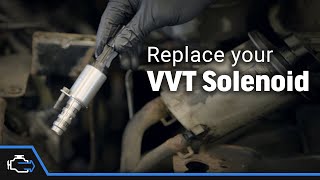
- Low Oil Pressure from a Failing Oil Pump (Less Common) — On high-mileage engines, the oil pump wears out and fails to produce sufficient pressure to operate the VCT system, even if the oil level is full. This is a known defect on engines like the Ford 5.4L 3V. 🎬 See this step-by-step walkthrough for replacing the VCT solenoid.
- Stretched Timing Chain (Less Common) — If the timing chain stretches or skips a tooth on the gear, the base timing between the crankshaft and camshaft is incorrect. The PCM detects this discrepancy when attempting to adjust timing.
- Wiring or Connector Issues (Rare) — Damaged wires or a corroded electrical connector for the VCT solenoid interrupt the signal. On some Jaguars, the plastic connector clip becomes brittle and breaks, allowing the connector to vibrate loose.
- Faulty Camshaft Position Sensor (Rare) — The sensor reading the camshaft's position sends incorrect data to the PCM. It is far less common for the sensor to fail than it is for the solenoid, oil, or mechanical phaser to be the root cause.
Symptoms

- Check Engine Light is on — The Malfunction Indicator Lamp (MIL) illuminates on your dashboard.
- Reduced Engine Power and Poor Acceleration — The car feels sluggish and accelerates poorly because the valve timing is not optimized for the current engine load and speed.
- Rattling or Knocking Noise from Engine — A distinct rattling, ticking, or diesel-like knocking noise comes from the front of the engine on startup or at hot idle. This points directly to a failing cam phaser or timing chain tensioner.
- Decreased Fuel Economy — Incorrect valve timing makes the engine's combustion process inefficient, causing a noticeable drop in gas mileage.
- Rough Idle and Stalling (also visible on scanner) — The engine runs poorly, shakes at idle, or stalls entirely, especially at low RPMs when oil pressure is lowest.
Diagnostic Flowchart
Tap your situation to follow the diagnostic path that matches what you're seeing on this code.
Common Fixes & Costs
- Engine Oil and Filter Change — Parts: $30-$80, Labor: $20-$60, ~0.5 hr book time (DIY)
- Replace Variable Cam Timing (VCT) Solenoid
— Parts: $40-$200, Labor: $75-$300, ~1.5 hr book time
(Intermediate)
Ford F-150 (5.4L 3V): OEM 8L3Z-6M280-B (Alt: Dorman 917-200, Standard Motor Products VVT290)
Jaguar S-Type (4.2L): OEM AJ810570 (Alt: Dorman 918-158, Walker 590-1123)
BMW 3-Series (N52): OEM 11367585425 (Alt: Febi Bilstein 45244, Pierburg 7.06117.24.0) - Engine Sludge Flush — Parts: $20-$40, Labor: $100-$150, ~1 hr book time (Professional)
- Replace Camshaft Phaser
— Parts: $200-$500, Labor: $800-$1800, ~7 hr book time
(Professional)
Ford F-150 (5.4L 3V): OEM 3R2Z-6A257-DA (Alt: Dorman 917-250, Cloyes 9-VVT420)
BMW 3-Series (N52): OEM 11367583207 (Intake) (Alt: INA F-347711.03) - Replace Timing Chain and Related Components
— Parts: $400-$1200, Labor: $1500-$3500, ~11.5 hr book time
(Professional)
Ford F-150 (5.4L 3V): OEM 5L3Z-6268-A (Chain) (Alt: Cloyes 9-0391S, Melling 3-391S)
DIY vs Professional
- Engine Oil and Filter Change — Beginner: Yes
Tools: Socket/wrench for drain plug, oil filter wrench, drain pan, funnel. - Replace Variable Cam Timing (VCT) Solenoid — Beginner: Maybe. Depends on accessibility.
Tools: Basic socket set, torque wrench, rags. On some vehicles, it is easily accessible on the front of the valve cover. On others, it requires removing other components. - Replace Camshaft Phaser — Beginner: No.
Tools: Extensive tool set, including timing chain holding tools, valve cover gasket tools, torque wrenches, and a deep understanding of engine timing. - Replace Timing Chain and Related Components — Beginner: No.
Tools: Professional-grade tools. Requires removal of the engine's front cover, radiator, belts, and accessories. Special tools are needed to align the crankshaft and camshafts.
Used vs. New Parts: Buying Guide
When a used part is worth it: For a VCT/VANOS solenoid, a used OEM part from a low-mileage, accident-totaled vehicle is a cost-effective alternative to a new aftermarket part, offering better fitment.
Donor-vehicle mileage cap: roughly under 60000 miles for the part to have meaningful remaining life.
Donor quality checklist:
- Verify the donor vehicle was not scrapped due to engine failure or sludge issues.
- Match the part number exactly, as solenoids look identical but have different internal calibrations.
- Inspect the mesh screens on the used solenoid for tears or embedded metallic debris.
Decision logic:
- If The new OEM or high-quality aftermarket solenoid costs less than $100 → buy new. The savings from a used part are not worth the risk and lack of warranty.
- If The vehicle is high mileage (>150k miles) and you are on a tight budget → a tested, used part is an acceptable risk, but understand it will not last as long as a new component.
- If The part is for a high-performance or newer model vehicle (e.g., BMW M-series) → favor new OEM parts to ensure correct performance and avoid engine damage from incorrect timing control.
Warranty tradeoff: Used parts from salvage yards typically come with a 30-90 day warranty. New aftermarket parts offer a 1-year to limited lifetime warranty. New OEM parts carry a 1-2 year warranty.
Worst-case if a used part fails: $200-$600 if a used solenoid fails shortly after installation, requiring repeat labor costs.
What Happens If You Wait — Timeline
- 0-1 month: Check Engine Light is on. You notice a slightly rough idle when the engine is warm or a minor hesitation, but often there are no other perceivable symptoms. (MPG impact: 1-5%% · Added cost: $0-$25 in wasted fuel)
- 1-4 months: Symptoms become consistent: noticeable rough idle, poor acceleration from a stop, and a distinct drop in fuel economy. The over-retarded timing causes inefficient combustion, leading to unburnt fuel entering the exhaust. (MPG impact: 5-15%% · Added cost: $50-$150 in wasted fuel and early stress on the catalytic converter)
- 4-8 months: The catalytic converter begins to sustain damage from being constantly overheated by raw fuel. If the cause is mechanical, a rattling or knocking noise becomes prominent. Failed emissions test is guaranteed. (MPG impact: 10-20%% · Added cost: $800-$2500 for a now-necessary catalytic converter replacement)
- 8+ months: If the underlying cause is a worn timing chain or guide, the risk of the chain skipping a tooth or breaking becomes critical. This is a catastrophic event for an interference engine, causing pistons to collide with valves and destroying the engine. (MPG impact: 15-25%% · Added cost: $5000-$10000+ for a complete engine replacement)
Cost of Not Fixing It
- 0-1 month: Noticeable drop in fuel economy (5-15%), rough idle, and poor acceleration. Guaranteed emissions test failure. (Added cost: Negligible, besides increased fuel costs.)
- 1-6 months: Over-retarded timing forces unburnt fuel into the exhaust, overheating and melting the catalytic converter internals. (Added cost: $1200-$2800)
- 6+ months: A stretching timing chain eventually skips a tooth or breaks entirely. In interference engines, this causes pistons to smash into valves, destroying the engine. (Added cost: $5000-$10000)
Diagnosis Steps
- Check Engine Oil Level and Condition
The VCT system depends entirely on clean oil at the correct level and viscosity. Pull the dipstick. If the oil is very dark, gritty, or milky, change it before performing any further diagnosis.
Tools: Rag or paper towel (Beginner) - Scan for Codes and View Live Data
Use an OBD-II scanner to read all stored codes. Codes related to the VCT solenoid circuit (P1385) or camshaft position sensor (P0345) pinpoint the problem. Use the scanner's live data function to monitor the 'CAM_ERR' or 'VCT_ADV_ERR' PID for Bank 2. A large negative value confirms the over-retarded condition.
Tools: OBD-II Scanner with Live Data capability (Beginner) - Inspect VCT Solenoid Wiring
Locate the VCT solenoid for Bank 2. Visually inspect the electrical connector and wiring for damage, corrosion, or loose connections. Ensure the connector is fully seated and the locking tab is engaged.
Tools: Flashlight (Beginner) - Swap VCT Solenoids
If your engine has identical and accessible VCT solenoids for Bank 1 and Bank 2, swap them. Clear the codes and drive the vehicle. If the code changes to P1383 (Over-retarded Bank 1), the solenoid you moved is definitively faulty.
Tools: Basic hand tools (socket set, wrenches) (Intermediate) - Test VCT Solenoid Electrically
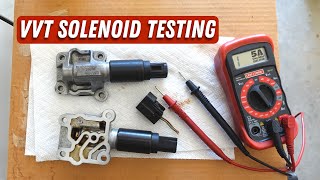
Unplug the suspect solenoid and use a multimeter set to Ohms (Ω) to measure resistance across its pins (typically 5-15 Ohms). A reading of infinity (OL) or zero means the solenoid failed. Next, switch to DC Volts and probe the harness with the key 'On' (engine off) to verify the PCM is supplying battery voltage (approx. 12.6V).
Tools: Multimeter, repair manual for specifications (Intermediate) - Test the VCT Solenoid Mechanically
Remove the solenoid and inspect its small oil screens for clogs or tears. Test its function by applying 12V power to its terminals; you should hear and feel a distinct click as the internal plunger moves. A sluggish or absent click indicates an internal mechanical failure.
Tools: Socket set, 12V power source (e.g., car battery and jumper wires) (Intermediate) - Measure Engine Oil Pressure
Low oil pressure is a primary cause of VCT faults. Use a mechanical oil pressure gauge to test the actual pressure. For a Ford 5.4L 3V, pressure must be at least 15 PSI at hot idle (ideally 20-25 PSI). If pressure is below this, the oil pump is failing or the pickup tube is clogged.
Tools: Mechanical oil pressure gauge kit, teflon tape, basic hand tools (Advanced) - Check Mechanical Timing with an Oscilloscope
Connect an oscilloscope to the Crankshaft Position Sensor (CKP) and the Bank 2 Camshaft Position Sensor (CMP) to view their waveforms simultaneously. If your pattern is shifted relative to a known-good database waveform, it definitively indicates a stretched timing chain without requiring engine disassembly.
Tools: Dual-channel automotive oscilloscope, sensor back-probes, known-good waveform database (Advanced) - Inspect Mechanical Timing Components
This invasive final step involves removing the valve cover and timing cover to physically inspect the timing chain for slack, check timing marks for alignment, and examine guides and phasers for wear. Do this only after exhausting all other possibilities.
Tools: Advanced mechanical tools, repair manual (Advanced)
When This Code Triggers (Freeze-Frame Conditions)
- Engine Coolant Temp: 180-210°F (The engine must be at full operating temperature. The code rarely sets on a cold engine.)
- Engine RPM: 1500-3000 RPM (The fault is detected under steady-state cruising or light acceleration, not typically at idle or full throttle.)
- Engine Load: 20-60% (The PCM actively commands VCT adjustments under moderate load conditions, flagging the discrepancy between desired and actual cam position.)
- Oil Temperature: 170-220°F (The oil must be warm and at its normal operating viscosity for the VCT system to be commanded and faults accurately detected.)
Related Codes
- P1383 — This is the same fault (Over-Retarded) but for Bank 1. If you swap the VCT solenoids between banks and this code appears, you confirmed the solenoid is the faulty component.
- P0022 — 'A' Camshaft Position - Timing Over-Retarded (Bank 2). This is the generic SAE equivalent of P1388. They mean the exact same thing and the diagnostic procedure is identical.
- P1385 — VVT Solenoid B Circuit Malfunction (Bank 2). This code points specifically to an ELECTRICAL problem with the solenoid. P1388 points to a MECHANICAL/HYDRAULIC problem. If you have P1385, test the solenoid's resistance first.
- P0345 / P0349 — These codes indicate a fault with the camshaft position sensor CIRCUIT for Bank 2. P1388 is set when the PCM gets a GOOD signal from the sensor, but the timing position it reports is incorrect.
Climate & Environmental Factors
- Cold Weather: Extremely cold temperatures cause engine oil to thicken. On a cold start, this thick oil is slow to reach the VCT system, causing a delay in cam phaser actuation and triggering P1388. This is often temporary and resolves as the engine warms up.
- Short Trip Driving: Frequent short trips prevent the engine oil from reaching a high enough temperature to burn off condensation and fuel contaminants. This moisture mixes with oil to form sludge, a primary cause of clogged VCT solenoids.
- Hot Climates / Heavy Load: Sustained high engine temperatures accelerate oil oxidation, leading to the formation of hard, black sludge. This sludge clogs the fine mesh screens on VCT solenoids and blocks narrow oil galleries.
How to Talk to a Mechanic About This Code
Say this: "I have a P1388 code and I'd like to schedule a diagnostic. I've already confirmed the oil level and condition are good. Could you please focus on testing the Bank 2 VCT solenoid and verifying oil pressure before quoting a full timing job?"
This signals you've done your research and guides the technician toward the most likely, and cheapest, repairs first. It prevents them from immediately jumping to the most expensive conclusion (a full timing chain replacement) and establishes you as an informed consumer.
Avoid saying:
- 'Just fix whatever's wrong'
- 'My check engine light is on, can you look at it?'
- 'Whatever you recommend'
Questions to ask before authorizing the repair:
- What was the result of the VCT solenoid electrical test and mechanical inspection?
- What was the engine's oil pressure reading at hot idle?
- If you are recommending a timing chain replacement, what is the specific evidence of failure (e.g., measured chain slack, CKP/CMP correlation data)?
- Will you provide a printout of the freeze-frame data that was stored with the code?
- What is the warranty on this specific repair, covering both parts and labor?
Where to Take It: Dealer vs Independent vs Chain
- Dealer:
Recommended only if the vehicle is under warranty or has a known manufacturer-specific issue covered by a TSB or recall that an independent shop might miss.
Best for: Vehicles still under powertrain warranty, Complex manufacturer-specific issues (e.g., BMW VANOS faults covered by a warranty extension or recall), When you want OEM parts used exclusively
Downsides: Significantly higher labor rates (1.5-2x) than independent shops., Quick to recommend a complete, expensive assembly replacement (e.g., full timing kit) rather than diagnosing a single failed component. (Typical cost: +50% vs. baseline) - Independent Shop:
Best fit for most situations. An experienced independent technician has diagnosed P1388 many times and will follow a logical, cost-effective diagnostic path from oil and solenoids to more complex mechanical issues.
Best for: Out-of-warranty vehicles where cost is a major factor., Common problems like P1388 on high-volume vehicles (e.g., Ford F-150)., Building a long-term relationship with a trusted mechanic.
Downsides: Quality and expertise vary widely; vetting the shop's reputation and certifications (like ASE) is crucial., May not have immediate access to the very latest manufacturer-specific software or tools. (Typical cost: +0% vs. baseline) - Chain Shop:
Acceptable for an initial oil and filter change. AVOID for the actual diagnosis of P1388, as the risk of an incorrect diagnosis or being oversold on a major repair is high.
Best for: Simple, clear-cut jobs like an oil change, which is the first step in diagnosing P1388.
Downsides: Technician skill is inconsistent., A high-pressure sales environment leads to upselling unnecessary services or misdiagnosing a complex issue like P1388 as something simpler they can sell easily., Lacks the advanced diagnostic equipment to differentiate between a solenoid, phaser, or oil pressure problem. (Typical cost: -10% vs. baseline)
When to Walk Away From the Repair
If the estimated repair cost exceeds 50% of the car's private-party value from Kelley Blue Book, sell or trade in the vehicle.
- Car worth $4000, fix is $2500: Walk away. A $2,500 timing job on a $4,000 truck is a poor investment.
- Car worth $15000, fix is $3000: Fix it. The repair cost is only 20% of the vehicle's value and is a worthwhile investment.
- Car worth $3000, fix is $800: Borderline. The repair (e.g., phaser and solenoid) is about 27% of the car's value. Get a second opinion and consider the car's overall condition before proceeding.
What Scan Tool You Need for This Code
Minimum: A scanner that can read and graph live data, specifically the manufacturer-specific PIDs for commanded vs. actual camshaft position (e.g., VCT_ADV and VCT_ADV_ERR on a Ford).
A basic $20 code reader only gives you the P1388 code. It cannot show you the live data that proves the timing is actually incorrect, nor can it help you differentiate between a sensor, solenoid, or mechanical fault. You will be guessing and likely replacing the wrong parts.
Budget: BlueDriver Pro or XTool A30D (~$90-120) — These Bluetooth scanners connect to your smartphone and read codes from all vehicle systems. Crucially, they display and graph the live data PIDs needed to watch the VCT system's performance in real-time.
Mid-range: Foxwell NT510 Elite or Innova 5610 (~$180-350) — These scanners offer bidirectional control. This allows you to command the VCT solenoid on and off directly from the tool, providing a definitive test of its mechanical function without removing it from the engine.
Professional: Autel MaxiCOM MK808S or XTOOL D7 (~$450-600) — These tablet-based tools offer full bidirectional control, extensive service functions, and comprehensive diagnostic capabilities close to dealer-level. They are ideal for serious DIYers or those who work on multiple vehicles.
Rent vs buy: For a one-time diagnosis, auto parts stores (like AutoZone or O'Reilly) have a free loaner tool program where you borrow a capable scanner with a refundable deposit. If you plan to do your own maintenance regularly, buying a scanner in the $100-$400 range offers the best long-term value.
How to Clear the Code After You Fix It
- Use an OBD-II scan tool to erase the diagnostic trouble codes.
- Reconnect the battery if it was disconnected for the repair.
- Perform a complete OBD-II drive cycle to allow readiness monitors to run.
Drive cycle (~30 minutes): A generic drive cycle includes a cold start (engine temp below 122°F), a 2-3 minute idle, 5-10 minutes of city driving (stop-and-go), and 15 minutes of steady highway driving (55-60 mph). The vehicle must then cool completely.
Readiness monitors affected: Catalyst Monitor, Oxygen (O2) Sensor Monitor, EGR System Monitor
Before emissions retest: drive at least 100 miles to fully set monitors.
Watch out for:
- Clearing the code with a scanner without performing a drive cycle leaves readiness monitors as 'Not Ready', resulting in an automatic emissions test failure.
- The code returns immediately or within a few drive cycles if the underlying mechanical or hydraulic issue is not fixed.
- Some monitors, like the EVAP monitor, require the fuel level to be between 1/4 and 3/4 full to run.
Will This Fail Emissions / State Inspection?
Yes — this code typically fails an OBD-II emissions inspection.
- California: An illuminated Check Engine Light is an automatic failure for a smog check. After repair, a full drive cycle must be completed to set all readiness monitors before a re-test.
- New York: A vehicle fails the NYS OBD-II inspection if the Malfunction Indicator Light is on for any emissions-related fault code like P1388.
- Texas: An active P1388 code causes an automatic failure. For model year 2001 and newer vehicles, you can only have one readiness monitor 'Not Ready' to pass; clearing the code right before the test results in a failure.
Most Commonly Affected Vehicles

- Ford F-150, Expedition (2004-2010) — The 5.4L 3V Triton engine is widely known for issues with cam phasers, VCT solenoids, and low oil pressure causing this code. TSB 06-19-8 addresses related engine noises.
- Ford Mustang GT, Explorer (2005-2010) — Equipped with the 4.6L 3V engine, which shares the same VCT system design as the 5.4L Triton and is prone to identical failures.
- Jaguar S-Type, X-Type, XJ, XK (2000-2008) — These models frequently log P1388 caused by failing VVT solenoids or sludge. The plastic connector clip for the solenoid is a known failure point, becoming brittle and breaking.
- BMW 3-Series, 5-Series, X3, X5 (2006-2013) — Common on models with the N52 and N54 inline-6 engines. Early E90/E60 models were highly susceptible to oil sludge issues; BMW released updated software with a solenoid cleaning cycle to address this.
- Lincoln Navigator, Mark LT (2005-2014) — Uses the same 5.4L 3V engine as the F-150 and experiences the exact same VCT system problems.
- Land Rover LR3, Range Rover Sport (2005-2009) — Models equipped with the Jaguar-derived 4.4L AJ-V8 engine are susceptible to the same VVT solenoid and timing chain guide failures as their Jaguar counterparts.
- Hyundai / Kia Sonata, Optima, Santa Fe, Sorento (2011-2019) — Models with the 2.0L and 2.4L Theta II GDI engines are known for VVT system failures, often resulting in generic codes like P0011, P0014, or P0022, pointing to faulty solenoids or sludge.
- Mazda 3, 6, CX-7 (2007-2013) — Common on models with the 2.3L and 2.5L engines. These vehicles log P1388 or P0022 due to a failing VVT solenoid or a stretched timing chain.
Manufacturer-Specific Notes
- Chrysler / Dodge / Jeep: On these vehicles, P1388 means "Auto Shutdown (ASD) Relay Control Circuit". This is a completely different electrical issue related to a relay that controls power to the fuel pump and ignition system, causing a no-start condition.
- Volkswagen / Audi: For VW and Audi, P1388 translates to "Internal Control Module Drive By Wire Error". This points to a problem with the electronic throttle body or the Engine Control Module (ECM) itself, not the cam timing.
- Ford: On 4.6L and 5.4L 3V engines, this code is often accompanied by a ticking noise. Ford issued TSB 06-19-8 to help technicians diagnose these noises, advising them to check oil temperature and validate the noise source before replacing parts.
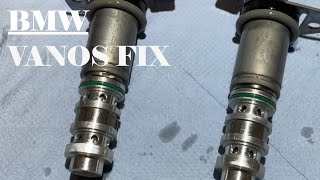
- BMW: BMW issued a limited warranty extension for the Camshaft Adjustment Units (VANOS) to 10 years/unlimited miles for certain non-turbo 6-cylinder engines (like the N52) due to high failure rates. Recalls 14V-176 and 23V-707 address VANOS housing bolts that loosen or break.
Real Owner Stories
2007 Ford F-150 with 5.4L 3V at 135k miles
Check engine light on with code P0022 (generic for P1388). Engine developed a loud knock/rattle after abrupt, low-RPM acceleration, but drove fine otherwise.
What they tried:
- Initially ignored the issue as it was intermittent.
- An oil change was performed as the first diagnostic step.
- A mechanic diagnosed the issue as failing camshaft phasers, a very common problem on this engine.
Outcome: The owner faced a multi-thousand dollar repair to replace the timing chain, guides, and phasers. The case highlights how a seemingly minor, intermittent issue points to a major mechanical failure.
Lesson: A rattling or knocking noise accompanying a VCT-related code is a strong indicator of mechanical wear in the timing system (phasers, guides, tensioners), not just a simple solenoid or oil issue. Do not ignore engine noises.
2001 Jaguar S-Type 3.0L V6 with 90k miles
Car sat for a year, then threw codes P1383 and P1388 (over-retarded on both banks) after being put back into service.
What they tried:
- The owner's first instinct was to perform an engine flush and oil change, suspecting sludge from sitting.
- Forum members advised against a harsh chemical flush on a high-mileage engine, warning it dislodges debris and causes more harm.
- The recommended first step was a simple oil and filter change with the correct viscosity oil.
Outcome: For many Jaguar owners with these codes, a fresh oil change alone resolves the problem, especially on high-mileage engines where oil viscosity breaks down.
Lesson: On engines known for sludge issues, especially after a period of sitting, always start with the simplest and safest solution: an oil and filter change. Avoid aggressive chemical flushes.
2012 BMW 320i with 104k miles
Vehicle suddenly displayed a 'drivetrain fault,' shut off, and would crank but not start. The only code stored was P1388.
What they tried:
- The owner suspected and ordered a new camshaft position sensor based on the code description.
- A mechanic advised that the sensor was likely not the problem, as a sensor fault typically sets a different code (like P0345/P0349).
Outcome: The actual issue was a stuck VANOS (BMW's VVT) solenoid or a failure in the mechanical VANOS actuator, which caused the timing to be so retarded that the engine could not run.
Lesson: Do not automatically replace the camshaft position sensor for a P1388 code. The code means the sensor is working and reporting a timing problem. The fault almost always lies with the oil, the solenoid, or the mechanical timing components.
2002 Dodge Neon with no-start condition
Vehicle would crank but not start, throwing code P1388.
What they tried:
- The owner replaced many parts based on guessing, including the crank and cam sensors, ignition coil, and IAC valve, with no success.
Outcome: The owner learned that on a Dodge, P1388 does not relate to cam timing. It indicates a fault in the Auto Shutdown (ASD) Relay circuit. The problem was a bad ASD relay.
Lesson: Always verify the definition of a P-code for your specific vehicle manufacturer. P1388 means cam timing for Ford/Jaguar/BMW but points to a completely different electrical issue on Chrysler/Dodge/Jeep and VW/Audi vehicles.
How to Prevent This Code From Triggering
- Perform regular oil and filter changes. (Per manufacturer's 'severe service' schedule (typically 3,000-5,000 miles).) — This is the single most effective preventative measure. It removes contaminants before they turn into the sludge that clogs VCT solenoids and oil passages.
- Use high-quality full synthetic oil. (Every oil change.) — Synthetic oils are more resistant to thermal breakdown and oxidation at high temperatures, significantly reducing the rate of sludge formation compared to conventional oils.
- Ensure you use the correct oil viscosity. (Every oil change.) — The VCT system is calibrated to operate with a specific oil viscosity. Using oil that is too thick or too thin impairs the system's ability to adjust cam timing correctly.
- Avoid frequent short trips and excessive idling. (Daily habit.) — Short trips prevent the engine oil from reaching its full operating temperature, which is necessary to burn off moisture and fuel contaminants. Condensation is a key ingredient in sludge formation.
- Address engine overheating issues immediately. (As needed.) — Excessive heat rapidly degrades engine oil, accelerating oxidation and sludge creation. Maintaining a healthy cooling system directly protects the oil and the VCT system.
Frequently Asked Questions
What is 'Bank 2'?
Bank 2 is the side of the engine that does not contain the number one cylinder. For V-shaped engines (V6, V8), find cylinder #1 to determine which side is Bank 1. For inline-6 engines like BMW's, Bank 2 refers to cylinders 4-6.
I replaced the Camshaft Position Sensor but the code came back. What now?
The P1388 code rarely indicates a bad sensor, as the sensor is usually correctly reporting that the camshaft's timing is wrong. Stop replacing sensors and diagnose the VCT system itself. The root cause almost always lies with the VCT solenoid, the cam phaser, or the oil pressure.
My mechanic says the whole timing job costs thousands, but the solenoid is cheap. Why?
Replacing the VCT solenoid is a simple, externally accessible job. However, replacing cam phasers and timing chains requires draining fluids and removing the radiator, valve covers, and front engine cover. This 12+ hour labor requirement drives the repair cost into the thousands.
Will using thicker oil fix this code?
Some owners report temporary success using a slightly thicker oil (e.g., 5W-30 instead of 5W-20) to increase oil pressure to a worn VCT system. However, this is a temporary band-aid that does not address the underlying failing part or clogged oil passages.
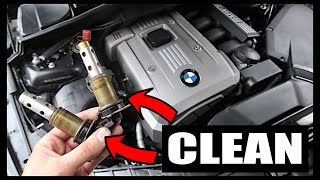
Can I just clean the VCT / VANOS solenoid instead of replacing it?
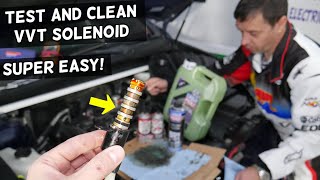
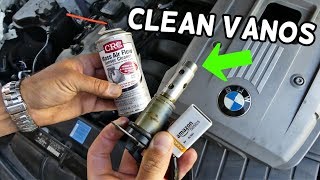
Cleaning a clogged VCT or VANOS solenoid sometimes restores its function and clears the code, especially if the issue is minor sludge buildup. However, if the solenoid has internal wear or a failing electrical coil, cleaning will not solve the problem long-term.
What does a P1388 engine noise sound like?
The most commonly described noise is a diesel-like rattling or a distinct 'ticking' or 'clacking' sound. It is most prominent at idle after the engine warms up, coming from the upper front portion of the engine.
How can I prevent P1388 from happening?
The single best prevention is performing regular oil changes with high-quality, manufacturer-recommended oil and a quality filter. This prevents the sludge buildup that clogs VCT solenoids and damages cam phasers.
My car is a Dodge and I got P1388, but it won't start. Is this guide wrong?
No, your vehicle has a manufacturer-specific definition for this code. For Dodge, Chrysler, and Jeep, P1388 points to the Auto Shutdown (ASD) Relay circuit, meaning your problem is a bad ASD relay, a blown fuse, or a wiring issue.
Key Takeaways
- Check your oil first; over 50% of P1388 codes trigger because low or dirty oil starves the hydraulic Variable Cam Timing (VCT) system of necessary pressure.
- Verify your manufacturer's specific code definition, as P1388 means a Bank 2 cam timing issue for Ford and BMW, but indicates a critical Auto Shutdown (ASD) Relay failure on Dodge and Jeep vehicles.
- Swap the Bank 1 and Bank 2 VCT solenoids to isolate the fault; if the code moves to Bank 1 (P1383), replacing the $50-$150 solenoid will permanently fix the issue.
- Do not drive extensively with an active P1388 code, as the over-retarded timing dumps unburnt fuel into the exhaust, destroying a $1,500 catalytic converter within a few months.
Helpful Videos



The information in this article is provided for general reference and educational purposes only. Vehicle specifications, procedures, and part compatibility can vary by production date, trim level, and region. Always consult your vehicle's factory service manual and verify part numbers before purchasing or performing repairs. Safety-critical components such as airbags, seat belts, and braking systems should be installed by a qualified professional.
- 🎬 Helpful Videos
- What Does P1388 Mean?
- Can I Drive With P1388?
- Common Causes
- Symptoms
- Diagnostic Flowchart
- Common Fixes & Costs
- DIY vs Professional
- Used vs. New Parts: Buying Guide
- What Happens If You Wait — Timeline
- Cost of Not Fixing It
- Diagnosis Steps
- When This Code Triggers (Freeze-Frame Conditions)
- Related Codes
- Climate & Environmental Factors
- How to Talk to a Mechanic About This Code
- Where to Take It: Dealer vs Independent vs Chain
- When to Walk Away From the Repair
- What Scan Tool You Need for This Code
- How to Clear the Code After You Fix It
- Will This Fail Emissions / State Inspection?
- Most Commonly Affected Vehicles
- Manufacturer-Specific Notes
- Real Owner Stories
- 2007 Ford F-150 with 5.4L 3V at 135k miles
- 2001 Jaguar S-Type 3.0L V6 with 90k miles
- 2012 BMW 320i with 104k miles
- 2002 Dodge Neon with no-start condition
- How to Prevent This Code From Triggering
- Frequently Asked Questions
- What is 'Bank 2'?
- I replaced the Camshaft Position Sensor but the code came back. What now?
- My mechanic says the whole timing job costs thousands, but the solenoid is cheap. Why?
- Will using thicker oil fix this code?
- Can I just clean the VCT / VANOS solenoid instead of replacing it?
- What does a P1388 engine noise sound like?
- How can I prevent P1388 from happening?
- My car is a Dodge and I got P1388, but it won't start. Is this guide wrong?
- Key Takeaways
- 🎟️ Get 5% Off