

OBD-II Code P1386: Variable Camshaft Timing Over-Advanced (Bank 2)
What P1386 means, why it triggers, and how to fix it
- P1386 indicates the Bank 2 camshaft is stuck over-advanced, though definitions vary strictly by manufacturer (e.g., Ford VCT vs. Honda CYP sensor).
- Check your engine oil level and viscosity first, as low or dirty oil causes 80% of VCT-related P1386 codes on Ford and Jaguar engines.
- Expect a 5-15% drop in fuel economy, rough idling, and a persistent check engine light until the timing issue is resolved.
- Limit driving to under 100 miles to prevent unburnt fuel from destroying your catalytic converter, a secondary repair costing upwards of $2,000.
- Verify mechanical oil pressure exceeds 15 PSI at hot idle before spending $3,000+ on new cam phasers, as a failing oil pump mimics phaser failure.
What Does P1386 Mean?

P1386 means the Engine Control Unit (ECU) detects the Bank 2 camshaft is turned too far forward (over-advanced). Camshafts open and close the engine's valves, and Variable Camshaft Timing (VCT) adjusts their position to optimize performance. When this timing advances beyond the commanded angle, the engine loses efficiency and power.
Technical definition: Variable Camshaft Timing Over-Advanced Bank 2. This manufacturer-specific code primarily indicates the Bank 2 camshaft timing exceeds the ECU's commanded position (common in Ford, Jaguar, and Lincoln). In other makes (Honda, BMW, VW), this code points to entirely different systems, such as knock sensors or cylinder position sensors.
Can I Drive With P1386?
Yes, But With Caution. Yes, but do not exceed 50-100 miles. The engine runs poorly, stalls, and gets bad gas mileage. Prolonged driving with an over-advanced camshaft causes engine knock (detonation), placing severe stress on pistons and bearings. It also dumps unburnt fuel into the exhaust, destroying the catalytic converter—a secondary repair costing $1,200 to $2,800. Some vehicles enter 'limp mode,' significantly limiting power to prevent further damage.
Common Causes

- Low, old, or incorrect viscosity engine oil (Very Common) — The hydraulic VCT system relies on precise oil pressure. Low fluid, heavy sludge, or the wrong viscosity (e.g., 5W-30 instead of 5W-20) prevents the system from generating enough pressure to operate the cam phasers.
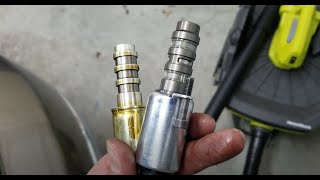
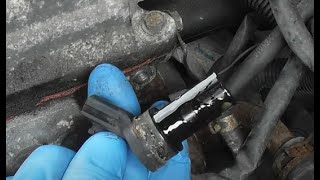
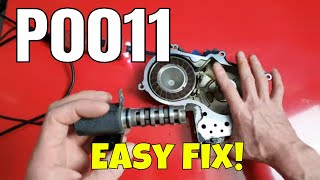
- Faulty VCT Solenoid (Oil Control Valve) (Common) — This electronic valve directs oil flow to the cam phaser. It fails when clogged with dirty oil, blocked by debris from a previous repair, or when its internal electrical coil shorts out. 🎬 Watch: Step-by-step VCT solenoid replacement and tips.
- Faulty Camshaft Position Sensor (Common) — This sensor reports the exact camshaft position to the ECU. A failing sensor sends erratic signals, tricking the ECU into reading an over-advanced timing condition that isn't actually happening.
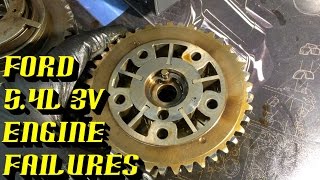
- Failing Cam Phaser (Less Common) — The mechanical gear on the camshaft physically rotates to adjust timing. Internal failure, a broken locking pin, or severe sludge causes it to stick in the advanced position, requiring an expensive mechanical repair.
- Damaged wiring or connectors (Less Common) — Frayed wires or oil-soaked connectors interrupt the signal between the VCT solenoid, cam sensor, and the ECU.
- Clogged Oil Passages (Rare) — Engine sludge blocks the microscopic oil passages in the cylinder head feeding the VCT system. Even a brand-new solenoid fails to function without adequate oil flow.
- Stretched timing chain or worn guides (Rare) — A stretched main timing chain alters the base mechanical timing between the crankshaft and camshafts, pushing the cam outside its normal operating range.
- Engine Control Unit (ECU) Fault (Very Rare) — The ECU suffers an internal driver circuit failure, preventing it from properly commanding the VCT solenoid. Rule out all other causes before replacing the ECU.
Symptoms

- Check Engine Light is on — The ECU illuminates the Malfunction Indicator Lamp (MIL) immediately when this code is stored.
- Rough idle or stalling — The engine shakes, idles unevenly, or shuts off when stopped because the valve timing is incorrect at low speeds.
- Poor engine performance and hesitation — The vehicle lacks power at specific RPMs. Throttle response feels unusually sharp right before a noticeable power loss.
- Rattling or ticking engine noise — A failing cam phaser or loose timing chain makes a distinct rattling or diesel-like ticking sound, especially at startup or idle. 🎬 Listen: What a failing cam phaser sounds like.
- Worse fuel economy (also visible on scanner) — An inefficiently running engine burns 5-15% more fuel than usual.
Diagnostic Flowchart
Tap your situation to follow the diagnostic path that matches what you're seeing on this code.
Common Fixes & Costs
- Engine Oil and Filter Change — Parts: $30-$80, Labor: $50-$100, ~0.5 hr book time (DIY)
- Replace VCT Solenoid (Oil Control Valve)
— Parts: $40-$700, Labor: $75-$300, ~1.5 hr book time
(DIY)
Ford F-150 (5.4L 3V) / Mustang GT (4.6L 3V): OEM 8L3Z-6M280-B (Motorcraft) (Alt: Dorman 917-200, Standard Motor Products VCT400)
Jaguar S-Type / XF (3.0L V6 / 5.0L V8): OEM VIN Specific (e.g., C2C39525, AJ813328) (Alt: Limited availability, verify by OEM number) - Replace Camshaft Position Sensor
— Parts: $50-$175, Labor: $80-$200, ~0.8 hr book time
(DIY)
Ford F-150 (5.4L 3V): OEM 1W7Z-6B288-AB (Motorcraft DU70) (Alt: Bosch 0232103052, Standard Motor Products PC643) - Replace Cam Phasers and Timing Chain Kit
— Parts: $750-$1200, Labor: $1300-$4600, ~11.5 hr book time
(Professional)
Ford F-150 (5.4L 3V): OEM 3R2Z-6A257-DA (Phaser) (Alt: Cloyes 9-0391SBVVT (Full Kit)) - Perform ECU Reflash/Update — Parts: $0, Labor: $100-$250, ~1 hr book time (Professional)
DIY vs Professional
- Engine Oil and Filter Change — Beginner:
Tools: Wrench for drain plug, oil filter wrench, drain pan, funnel. - Replace Camshaft Position Sensor — Beginner:
Tools: Basic socket/wrench set. - Replace VCT Solenoid — Beginner:
Tools: Socket set, Torx bit socket (T27 for Ford), screwdriver, hammer/mallet. - Replace Cam Phasers and Timing Chain Kit — Beginner:
Tools: Extensive tool set, engine-specific timing tools (cam locks, crank holding tool), torque wrenches, service manual.
Used vs. New Parts: Buying Guide
When a used part is worth it: For VCT solenoids and camshaft position sensors, a tested part from a low-mileage (under 80k miles) vehicle is a cost-effective option. Avoid used parts for timing chains and cam phasers due to their high labor cost and wear-and-tear nature.
Donor-vehicle mileage cap: roughly under 80000 miles for the part to have meaningful remaining life.
Donor quality checklist:
- Verify the donor vehicle wasn't scrapped for a related engine failure.
- Match the part number exactly; visual similarities do not guarantee compatibility.
- For electronic parts, avoid donors from flood-damaged vehicles.
Decision logic:
- If The part is a sensor or solenoid and the new OEM part costs over $200 → A used part from a reputable salvage yard with a warranty is a reasonable choice.
- If The vehicle is over 150,000 miles and the repair is not critical to safety → A used part is acceptable to keep the vehicle operational on a budget.
- If The part is internal to the engine (e.g., cam phaser, timing chain) → Always buy new. The labor cost to replace it a second time far outweighs any savings on a used part.
Warranty tradeoff: Used parts typically come with a 30-90 day warranty covering the part only. New aftermarket parts offer 1-year to lifetime warranties, while new OEM parts carry a 1-2 year warranty.
Worst-case if a used part fails: $400-$1500 if a used internal engine part fails, requiring repeated expensive labor.
What Happens If You Wait — Timeline
- 0-1 month: Check Engine Light appears. You notice a slightly rough idle when the engine is warm, or a brief hesitation when accelerating. (MPG impact: 0-5%% · Added cost: $0)
- 1-3 months: Rough idle becomes consistent. Stalling at stoplights is possible. A faint ticking or rattling noise begins to appear. (MPG impact: 5-15%% · Added cost: $50-$150 in wasted fuel)
- 3-6 months: Engine runs poorly constantly. Over-advanced timing dumps unburnt fuel into the exhaust, overheating the catalytic converter. Rattling noise becomes pronounced. (MPG impact: 15-25%% · Added cost: $1,200-$2,800 for catalytic converter replacement.)
- 6+ months: Catastrophic failure risk increases. A completely failed cam phaser or stretched timing chain jumps teeth, causing piston-to-valve contact and destroying the engine. (MPG impact: 25%+% · Added cost: $5,000-$10,000+ for a replacement engine.)
Cost of Not Fixing It
- 0-1 month: Noticeable drop in fuel economy (5-15%), rough idle, and potential stalling. (Added cost: $50-$150 in wasted fuel.)
- 1-6 months: Over-advanced timing dumps unburnt fuel into the exhaust, overheating and damaging the catalytic converter substrate. (Added cost: $1,200-$2,800 for catalytic converter replacement.)
- 6+ months: Prolonged operation with incorrect timing causes a timing chain failure, leading to catastrophic piston-to-valve contact in an interference engine. (Added cost: $5,000-$10,000+ for a replacement engine.)
Diagnosis Steps
- Check the Engine Oil
Check the dipstick to ensure the oil level is correct and the fluid is clean. If the oil is dark, thick, or past its change interval, replace it using the exact manufacturer-specified viscosity and a high-quality filter.
Tools: Rag or paper towel (Beginner) - Scan for Codes and Check TSBs
Use an OBD-II scanner to read all stored codes. Check for Technical Service Bulletins (TSBs), as manufacturers frequently release software updates to resolve false P1386 triggers.
Tools: OBD-II Scanner (Beginner) - Inspect VCT Solenoid and Cam Sensor Wiring
Locate the VCT solenoid and Camshaft Position Sensor on Bank 2. Unplug them and inspect for frayed wires, corrosion, or oil intrusion inside the connectors.
Tools: Flashlight (Beginner) - Test the VCT Solenoid
Unplug the solenoid and measure resistance across its pins with a multimeter (typically 5-15 ohms). Apply 12V power briefly; a lack of an audible 'click' confirms the valve is mechanically stuck.
Tools: Multimeter, 12V power source (Intermediate) - Monitor Live Data (PIDs)
Using an advanced scan tool, monitor the commanded vs. actual camshaft angle for Bank 2. If the ECU commands 0 degrees but the actual angle reads 10 degrees, you have a definitive hydraulic or mechanical failure.
Tools: Advanced OBD-II Scan Tool (Advanced) - Test the Camshaft Position Sensor
Verify the sensor receives a 5V reference voltage and a solid ground. Use a multimeter to check for a fluctuating signal voltage while the engine runs, confirming the sensor accurately reads the camshaft.
Tools: Multimeter (Intermediate) - Check Mechanical Engine Oil Pressure
Connect a mechanical oil pressure gauge to the engine block. For a Ford 5.4L 3V, hot idle pressure must exceed 15 PSI. If pressure falls below spec, repair the oil pump or pickup tube before replacing VCT parts.
Tools: Mechanical oil pressure gauge set, Socket set, Service manual (Advanced) - Check Mechanical Timing
Remove the valve covers to physically verify base engine timing. Align the timing marks on the crankshaft, cam phasers, and chains. Any deviation confirms a jumped tooth or stretched chain.
Tools: Full socket set, Torque wrench, Service manual, Timing chain tools (Professional)
When This Code Triggers (Freeze-Frame Conditions)
- Engine Coolant Temp: 180-200°F (The engine is fully warmed up to normal operating temperature.)
- RPM: 1500-2500 (The code sets during steady-state cruise or light acceleration, rarely at idle or heavy throttle.)
- Engine Load: 20-50% (Occurs under moderate load conditions, consistent with highway cruising or maintaining speed on an incline.)
- Vehicle Speed: 45-65 mph (Triggers during steady highway driving when the VCT system actively adjusts timing for fuel economy.)
Related Codes
- P1388 — The direct opposite of P1386: 'Variable Cam Timing Over-Retarded (Bank 2)'. Seeing both codes together strongly suggests a complete loss of control over the cam position, often due to a stuck VCT solenoid or major oil passage blockage.
- P0021 — The generic OBD-II code for 'Intake Camshaft Position Timing - Over-Advanced (Bank 2)'. P1386 is the manufacturer-specific equivalent. Both point to the exact same fundamental problem.
- P0345 — Means 'Camshaft Position Sensor A Circuit (Bank 2)'. P0345 points to an electrical fault (no signal), while P1386 means the ECU gets a reading but it is out of range. Fix P0345 first if present.
- P0016 — Indicates a 'Crankshaft Position - Camshaft Position Correlation' issue. P0016 points to a fundamental mechanical mismatch (stretched chain), whereas P1386 flags a dynamic VCT performance problem.
Climate & Environmental Factors
- Cold Weather: Cold temperatures increase engine oil's viscosity. Incorrect, higher viscosity oil (e.g., 10W-30 instead of 5W-20) is too thick on a cold start to flow through the VCT system, starving the phasers of pressure and triggering P1386.
- Extreme Heat: High temperatures decrease oil viscosity. If the engine has existing wear causing borderline low oil pressure, extreme heat lowers the pressure below the minimum threshold required for the VCT system to operate.
How to Talk to a Mechanic About This Code
Say this: "I have a P1386 code on my [Vehicle Make/Model]. Please start the diagnostic by verifying the mechanical oil pressure at hot idle and testing the Bank 2 VCT solenoid before quoting any internal engine repairs."
This directs the technician to follow a logical, cost-effective diagnostic path, starting with the most common causes. It prevents them from immediately quoting an expensive mechanical repair like cam phasers without ruling out simpler hydraulic or electrical issues.
Avoid saying:
- 'Just fix my check engine light.'
- 'I think I need new cam phasers.'
- 'My car is running rough, can you look at it?'
Questions to ask before authorizing the repair:
- What was the engine's oil pressure reading with a mechanical gauge at hot idle?
- Did you test the VCT solenoid's resistance and command it on and off with a scan tool?
- Can you show me the live data from the scan tool, specifically the commanded vs. actual camshaft angle for Bank 2?
- If you recommend a timing chain and phaser replacement, what specific tests confirmed this is a mechanical failure?
- What is the warranty on the parts and labor for this repair?
Where to Take It: Dealer vs Independent vs Chain
- Dealer:
Best for: Vehicles still under powertrain or emissions warranty., Complex manufacturer-specific issues (e.g., P1386 on a BMW or VW pointing to an ECU fault)., Repairs requiring a PCM/ECU software update (TSB).
Downsides: Highest labor rates, often 1.5-2x more than an independent shop., May recommend a complete, expensive assembly replacement when only one component has failed. (Typical cost: +50% vs. baseline) - Independent Shop:
Best fit for most common vehicles (Ford, Jaguar, Honda). An independent shop with good experience on your specific brand offers the best value for diagnosing and fixing the likely causes.
Best for: Out-of-warranty vehicles, especially common ones like Ford or Honda., Diagnosing and repairing well-known issues (e.g., Ford 5.4L VCT problems, Honda CYP sensor)., Owners looking for the best balance of expertise and value.
Downsides: Quality and experience vary widely; look for ASE certifications related to engine work., May lack the expensive, specialized tools required for certain German or luxury brands. (Typical cost: +0% vs. baseline) - Chain Shop:
AVOID for the full diagnosis. They are less likely to perform the in-depth electrical and mechanical pressure tests required to accurately pinpoint the fault.
Best for: An initial, basic code scan., Simple, unambiguous repairs like an oil change.
Downsides: Technician skill is inconsistent., High pressure to upsell services; may recommend expensive, unnecessary repairs without proper diagnosis. (Typical cost: -10% vs. baseline)
When to Walk Away From the Repair
If the estimated repair cost exceeds 40-50% of the car's private-party value, seriously consider selling or trading in the vehicle instead of repairing it.
- Car worth $4500, fix is $3500: Walk away. A $3,500 timing chain job on a $4,500 Ford F-150 is not a good investment. The repair cost is over 75% of the truck's value.
- Car worth $12000, fix is $600: Fix it. A $600 repair for a VCT solenoid is well below the 50% threshold and makes economic sense.
- Car worth $2000, fix is $1200: Walk away. The repair cost is over 50% of the car's value. Unless the car is otherwise in excellent condition, this money is better put toward a replacement vehicle.
What Scan Tool You Need for This Code
Minimum: A scanner that reads manufacturer-specific codes and displays live data PIDs for the VCT system.
A basic $20 code reader only shows the P1386 code. It cannot show critical live data, such as the ECU's commanded cam angle versus the actual reported angle, leading to guesswork and wasted money.
Budget: BlueDriver Pro Scan Tool (~$119) — Connects to your smartphone to read manufacturer-specific codes and display live data graphing for relevant PIDs (e.g., VCT Advance, VCT Error) to determine if the problem is hydraulic, mechanical, or electrical.
Mid-range: Innova 5610 (~$330) — Provides bidirectional control, allowing you to command the VCT solenoid on and off directly from the tool to test its mechanical function, dramatically speeding up diagnosis.
Professional: Autel MaxiCOM MK808S / XTOOL D7 (~$450-600) — Offers robust bidirectional controls, access to all vehicle modules, and advanced data graphing. Essential for definitively testing solenoids, sensors, and wiring before committing to an expensive mechanical repair.
Rent vs buy: For a one-time, in-depth diagnosis of P1386, paying a shop's diagnostic fee ($120-$200) is more effective than buying a high-end scanner. Buy a scanner if you plan to do your own vehicle maintenance regularly.
How to Clear the Code After You Fix It
- Use an OBD-II scan tool to clear Diagnostic Trouble Codes (DTCs).
- Ensure the fuel tank is between 30% and 85% full.
- Perform a complete drive cycle to allow readiness monitors to run.
Drive cycle (~30 minutes): A universal drive cycle includes a cold start (engine off for 8+ hours), a 2-3 minute idle, mixed city driving (stop-and-go), and 5-10 minutes of steady highway speed (55-60 mph).
Readiness monitors affected: Catalyst Monitor, Oxygen (O2) Sensor Monitor, EGR System Monitor, Evaporative (EVAP) System Monitor
Before emissions retest: drive at least 100 miles to fully set monitors.
Watch out for:
- Disconnecting the battery clears the code but resets all readiness monitors to 'Not Ready', guaranteeing an emissions test failure.
- The code returns immediately if the underlying mechanical or electrical fault is not fixed.
- Driving at a constant highway speed for 100 miles is insufficient; mixed driving conditions are required to set all monitors.
Will This Fail Emissions / State Inspection?
Yes — this code typically fails an OBD-II emissions inspection.
- California: An active or permanent P1386 code causes an automatic smog check failure. After repair, all readiness monitors must be 'Ready' before passing.
- New York: An illuminated Check Engine Light for a code like P1386 is an automatic failure during the OBD-II scan.
- Texas: An illuminated Check Engine Light results in an automatic failure. After clearing the code, you can have at most one monitor 'Not Ready' to pass.
Most Commonly Affected Vehicles
- Ford F-150 (2004-2010) — The 5.4L 3V Triton engine is famous for VCT solenoid and cam phaser failures. Using the correct 5W-20 oil and a high-quality filter is critical.
- Jaguar S-Type, X-Type, XF, F-Type (1999-2017) — The 3.0L V6 and 5.0L V8 engines frequently report P1386 due to sludged oil passages or failing VCT solenoids. Always verify the correct part number by VIN.
- Ford Mustang GT (2005-2010) — The 4.6L 3V V8 engine shares the same VCT system design as the F-150 and is prone to similar failures.
- Ford Explorer / Mountaineer (2006-2010) — Vehicles with the 4.6L 3V V8 engine experience this code for the same reasons as the Mustang and F-150.
- Lincoln Navigator (2005-2014) — Uses the same 5.4L 3V engine as the F-150 and suffers from identical VCT system problems.
- Honda Accord, Civic, CR-V (1996-2002) — On older Hondas, P1386 means 'CYP Sensor B Intermittent Interruption'. The CYP sensor is inside the distributor, often requiring full distributor replacement.
- BMW Various (1998-2008) — For many BMW models, P1386 indicates 'Control Module Self-test, Knock Control Baseline Test Bank 1', pointing to an internal ECU fault or knock sensor circuit issue.
- Volkswagen / Audi Various (2000-2010) — P1386 translates to 'Internal Control Module Knock Control Error', pointing to a failure in the ECU's knock monitoring circuit or the knock sensor itself.
Manufacturer-Specific Notes

- Ford / Jaguar / Lincoln: This is the most common definition, relating to the VCT system being over-advanced on Bank 2. Jaguar issued TSBs requiring a PCM reflash to fix false codes. Ford VCT phasers are sometimes covered under the 8-year/80,000-mile federal emissions warranty.
- Honda / Acura: P1386 typically means 'CYP Sensor B Intermittent Interruption', pointing to a fault with the Cylinder Position Sensor integrated into the distributor assembly.
- Toyota (Diesel): On Toyota diesel engines (D-4D, D-CAT), P1386 refers to a problem with the 'Injector for Exhaust Fuel Addition' in the DPF system, completely unrelated to camshaft timing.
- Audi / Volkswagen: P1386 indicates an 'Internal Control Module, Knock Control Circuit Error', a fault within the ECU's ability to monitor for engine knock.
- BMW: P1386 is 'Control Module Self-test Knock Control Baseline Test Bank 1', indicating the ECU detected a failure in its knock control circuitry.
Real Owner Stories
2004 Ford F-150 5.4L with 240K miles
Truck ran great on cold start, but stalled at low RPMs and bogged down from a stop once warmed up.
What they tried:
- Replaced Cam Position Sensors - no change.
- Replaced VCT solenoids - problem got slightly worse.
- Unplugged the VCT solenoids from the harness to run the truck without variable timing.
Outcome: Unplugging the solenoids temporarily stopped the stalling, proving the VCT system was at fault. The owner ultimately required a $3,500 full timing job to fix the worn phasers and stretched chains.
Lesson: Replacing sensors and solenoids often doesn't fix VCT issues on high-mileage engines. The root cause is frequently low oil pressure from worn components, requiring a major mechanical repair. Unplugging solenoids is a temporary diagnostic step, not a fix.
1999 Jaguar S-Type 3.0L
Check engine light on with codes P1386 and P1388 (over-advanced and over-retarded). Engine surged when cold but smoothed out when warm.
What they tried:
- Changed all breather hoses.
- Performed an engine flush and changed the oil and filter.
Outcome: An oil flush failed to resolve the surging. Electrical testing revealed a dead VCT solenoid coil, requiring a $600 replacement to restore proper timing control.
Lesson: When both over-advanced and over-retarded codes appear together, it points to a complete loss of VCT control. While an oil flush is a good first step, the problem is often electrical, requiring targeted multimeter testing.
1996 Honda Accord F22B2
Intermittent P1381 code became a constant P1382 and P1386 (CYP Sensor Intermittent Interruption). The car ran terribly.
What they tried:
- Replaced the distributor with a remanufactured unit, but the Check Engine Light returned instantly.
- Tested wiring and found a dead short at the CYP sensor.
Outcome: The owner discovered a severe oil leak had dissolved the wiring harness. Running new shielded wires directly from the distributor to the ECU permanently resolved the P1386 code.
Lesson: For the Honda-specific P1386, the problem is often the wiring between the distributor and the ECU, not the sensor itself. Always inspect the wiring harness for continuity and physical damage before replacing the distributor.
How to Prevent This Code From Triggering
- Use the exact manufacturer-specified viscosity engine oil and a high-quality oil filter. (Every oil change (3,000-5,000 miles for conventional, 7,500-10,000 for full synthetic)) — Incorrect viscosity oil or a cheap filter with a poor anti-drainback valve starves the VCT system of pressure, causing wear and triggering codes.
- Perform a preventative engine flush with a gentle, solvent-free cleaner. (Every 30,000-50,000 miles.) — Gently dissolves sludge buildup in the narrow oil passages that feed the VCT solenoids and phasers without dislodging large chunks.
- Change engine oil more frequently than the maximum recommended interval. (Reduce interval by 25-40% (e.g., change 10,000-mile synthetic oil at 6,000-7,500 miles).) — Keeps the oil cleaner and detergent additives effective, preventing the formation of sludge that clogs VCT components.
- Allow the engine to warm up for 30-60 seconds before driving. (Daily habit) — Gives the oil pump time to circulate oil and build pressure, ensuring the VCT system is lubricated from the moment you start driving.
Frequently Asked Questions
Can I fix P1386 myself?
Yes, if the cause is low oil, a dirty VCT solenoid, or a bad sensor, it is a straightforward DIY repair. Stop DIY and take the vehicle to a qualified shop if you suspect a bad cam phaser or timing chain. These require specialized tools and absolute precision to prevent engine destruction.
What are common misdiagnosis mistakes for P1386?
A common mistake is replacing expensive cam phasers without ruling out low oil pressure or a clogged VCT solenoid. Always verify oil pressure with a mechanical gauge first. Failing to remove broken pieces of an old solenoid also causes immediate failure of the new part.
I changed the VCT solenoid and the code came back. What now?
If a new solenoid fails to clear the code, the problem is hydraulic or mechanical. Verify hot idle oil pressure exceeds 15 PSI and inspect the valve cover for heavy sludge. If pressure is good and passages are clear, prepare for a cam phaser replacement.
What is 'Bank 2'?
On a V-shaped engine, Bank 1 is the side containing cylinder #1. Bank 2 is the opposite side. Inline engines only have one bank, so they rarely trigger this specific code.
Can I just clean my VCT solenoid?
Yes, cleaning the oil screens with brake cleaner sometimes works if the valve is merely stuck. However, if the internal coil has failed electrically, cleaning provides no benefit. Always test the solenoid with a multimeter and 12V power after cleaning to confirm functionality.
What does a bad VCT solenoid or cam phaser sound like?
A failing VCT system produces a distinct ticking or diesel-like rattling noise from the top of the engine. This noise is especially prominent at idle or during a cold start. If you hear this rattle, mechanical wear is highly likely.
How much does it cost to diagnose a P1386 code?
Shops typically charge a diagnostic fee between $120 and $200. This covers reading live data, testing electrical components, and verifying oil pressure. This fee is often applied toward the final repair cost if you authorize the work.
Is a P1386 an expensive repair?
Repair costs range from a $50 oil change to a $3,000+ timing chain and phaser replacement. The final bill depends entirely on whether the root cause is hydraulic, electrical, or mechanical. Proper diagnosis prevents wasting money on unnecessary parts.
Key Takeaways
- P1386 indicates the Bank 2 camshaft is stuck over-advanced, though definitions vary strictly by manufacturer (e.g., Ford VCT vs. Honda CYP sensor).
- Check your engine oil level and viscosity first, as low or dirty oil causes 80% of VCT-related P1386 codes on Ford and Jaguar engines.
- Expect a 5-15% drop in fuel economy, rough idling, and a persistent check engine light until the timing issue is resolved.
- Limit driving to under 100 miles to prevent unburnt fuel from destroying your catalytic converter, a secondary repair costing upwards of $2,000.
- Verify mechanical oil pressure exceeds 15 PSI at hot idle before spending $3,000+ on new cam phasers, as a failing oil pump mimics phaser failure.
Helpful Videos

The information in this article is provided for general reference and educational purposes only. Vehicle specifications, procedures, and part compatibility can vary by production date, trim level, and region. Always consult your vehicle's factory service manual and verify part numbers before purchasing or performing repairs. Safety-critical components such as airbags, seat belts, and braking systems should be installed by a qualified professional.
- 🎬 Helpful Videos
- What Does P1386 Mean?
- Can I Drive With P1386?
- Common Causes
- Symptoms
- Diagnostic Flowchart
- Common Fixes & Costs
- DIY vs Professional
- Used vs. New Parts: Buying Guide
- What Happens If You Wait — Timeline
- Cost of Not Fixing It
- Diagnosis Steps
- When This Code Triggers (Freeze-Frame Conditions)
- Related Codes
- Climate & Environmental Factors
- How to Talk to a Mechanic About This Code
- Where to Take It: Dealer vs Independent vs Chain
- When to Walk Away From the Repair
- What Scan Tool You Need for This Code
- How to Clear the Code After You Fix It
- Will This Fail Emissions / State Inspection?
- Most Commonly Affected Vehicles
- Manufacturer-Specific Notes
- Real Owner Stories
- 2004 Ford F-150 5.4L with 240K miles
- 1999 Jaguar S-Type 3.0L
- 1996 Honda Accord F22B2
- How to Prevent This Code From Triggering
- Frequently Asked Questions
- Can I fix P1386 myself?
- What are common misdiagnosis mistakes for P1386?
- I changed the VCT solenoid and the code came back. What now?
- What is 'Bank 2'?
- Can I just clean my VCT solenoid?
- What does a bad VCT solenoid or cam phaser sound like?
- How much does it cost to diagnose a P1386 code?
- Is a P1386 an expensive repair?
- Key Takeaways
- 🎟️ Get 5% Off