

OBD-II Code P1383: Variable Cam Timing Over-Retarded (Bank 1)
The Ultimate 2026 Guide to Diagnosing and Fixing P1383
- Check your oil first; low or dirty oil causes 80% of P1383 codes, especially on Ford 5.4L 3V engines.
- Verify the code definition for your specific vehicle, as P1383 means 'Ignition Coil Malfunction' on BMWs and 'Alternator Belt Service' on Peugeot diesels.
- Return to the shop immediately if P1383 appears after a timing belt replacement; the mechanic likely misaligned the timing marks by at least one tooth.
- Test the VCT solenoid electrically (expecting 5-14 Ohms) before replacing it, as replacing the camshaft position sensor will not fix this mechanical fault.
- Budget $100 for an oil change or up to $4,500 for a full timing chain replacement if you ignore the hot idle rattling noise.
What Does P1383 Mean?

P1383 means the Engine Control Unit (ECU) detects the intake camshaft for engine bank 1 is lagging behind its commanded position. The camshaft opens and closes the engine's valves at the perfect moment. When its timing is off, it severely impacts engine performance, fuel efficiency, and emissions.
Technical definition: The official SAE definition is "Variable Cam Timing Over-Retarded (Bank 1)". This indicates the powertrain control module (PCM) has determined that the timing for the intake camshaft on bank 1 is retarded beyond a calibrated threshold compared to the crankshaft's position. The Comprehensive Component Monitor (CCM) continuously tracks the Variable Cam Timing (VCT) position and sets DTC P1383 if the actual cam position lags behind the desired position for a specific duration.
Can I Drive With P1383?
Yes, But With Caution. You can drive the vehicle, but diagnose and repair it immediately. Expect poor acceleration, rough idling, and lower fuel economy. If the Check Engine Light is solid, limit driving to essential trips. If the light is flashing, do not drive the vehicle. A flashing light indicates a severe misfire that destroys the catalytic converter, adding $800-$2,500 to the repair cost. Ignoring the code risks the timing chain breaking, which causes catastrophic engine damage.
Common Causes

- Low, Dirty, or Incorrect Engine Oil (Very Common) — The VCT system is hydraulic and uses pressurized engine oil to phase the camshaft. Low oil fails to supply adequate pressure. Old, dirty, or sludgy oil clogs the tiny passages and screens for the VCT solenoid and phaser. Using the wrong oil viscosity (e.g., 5W-30 instead of 5W-20) prevents the system from operating at the correct speed.
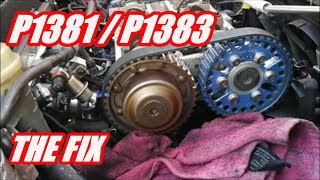
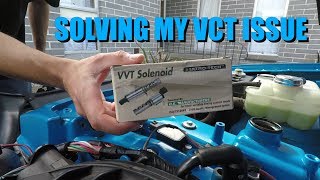
- Faulty VCT Solenoid / Oil Control Valve (OCV) (Very Common) — This electronically controlled valve directs oil flow to the cam phaser. It clogs with sludge, its internal screen blocks, or it fails electrically. A stuck-open solenoid causes 🎬 See this walkthrough on fixing cam timing codes the phaser to remain in a retarded state.
- Incorrect Mechanical Timing (Post-Service Error) (Common) — This code frequently appears immediately after a timing belt or chain replacement. This happens if the base timing marks are misaligned by even one tooth, or if a special procedure for 'clocking' the VCT phaser is missed on engines like the Ford 2.0L Zetec.
- Worn or Failed Cam Phaser (Common) — The cam phaser is the mechanical gear that rotates the camshaft. On engines like the Ford 5.4L 3V, the internal locking pins fail, or the chambers clog with sludge, causing it to stick or produce a loud rattling noise.
- Stretched Timing Chain or Worn Guides (Common) — Timing chains stretch over time. This increases slack in the valvetrain, altering the base timing relationship between the crank and the cams, leading directly to a retarded timing code.
- Low Engine Oil Pressure (Less Common) — A worn oil pump, failing timing chain tensioners (which are oil-pressurized), or worn engine bearings cause system-wide low oil pressure, starving the VCT system entirely.
- Damaged Wiring or Connectors (Less Common) — The wiring for the VCT solenoid or camshaft position sensor becomes brittle and breaks from engine heat. Oil contamination in the connectors disrupts the electrical signal.
- Faulty Camshaft Position (CMP) Sensor (Rare) — A failing CMP sensor sends a slow or erratic signal to the PCM, misinterpreted as retarded timing. However, a bad sensor usually triggers its own specific codes, like P0340, rather than P1383.
Symptoms

- Check Engine Light On — The PCM illuminates the Malfunction Indicator Lamp (MIL) as soon as the fault is verified, happening immediately or after a short drive.
- Rough Idle or Stalling — With the cam timing retarded, the engine runs inefficiently at low RPMs, causing a shaky or vibrating idle and stalling when coming to a stop.
- Lack of Power and Sluggish Acceleration — The car feels noticeably weak, especially when trying to accelerate from a stop or pass another vehicle. The engine cannot produce its designed power.
- Poor Fuel Economy — An inefficiently running engine burns more fuel to do the same amount of work, leading to a noticeable drop in average MPG.
- Engine Rattle or Ticking Noise — A distinct rattling, ticking, or diesel-like clatter, especially at hot idle, is the classic symptom of failing cam phasers on engines like the Ford 5.4L 3V.
- Difficulty Starting / Long Crank Time — If the base timing is significantly off, the engine takes longer than usual to start, or cranks but does not start at all.
Diagnostic Flowchart
Tap your situation to follow the diagnostic path that matches what you're seeing on this code.
Common Fixes & Costs
- Engine Oil and Filter Change — Parts: $40-$80, Labor: $50-$100, ~0.5 hr book time (DIY)
- Replace VCT Solenoid (Oil Control Valve)
— Parts: $50-$220, Labor: $75-$300, ~1.5 hr book time
(Intermediate)
Ford F-150 (2004-2010, 5.4L 3V): OEM Ford / Motorcraft: 8L3Z-6M280-B (Alt: Dorman 917-200, NTK VV0010, Cloyes VTS100)
Ford Contour (1998-2000, 2.0L Zetec): OEM Ford: F8CZ-6L713-AA (Alt: Dorman 918-054, Standard Motor Products VVT288)
Ford Focus (2002-2004, 2.0L Zetec SVT): OEM Ford: F8CZ-6L713-AA (Alt: Dorman 918-054, Walker 250-24896) - Correct Mechanical Timing / Re-do Timing Belt Service — Parts: $0-$50, Labor: $600-$1500, ~8 hr book time (Professional)
- Replace Cam Phaser(s)
— Parts: $200-$600, Labor: $1000-$2800, ~11.5 hr book time
(Professional)
Ford F-150 (2004-2010, 5.4L 3V): OEM Ford / Motorcraft: 3R2Z-6A257-DA (Alt: Dorman 917-250, Cloyes 9-175) - Replace Timing Chain, Guides, and Tensioners
— Parts: $300-$1000, Labor: $1500-$4500, ~14 hr book time
(Professional)
Ford F-150 (2004-2010, 5.4L 3V): OEM Ford / Motorcraft Timing Kit (Alt: Cloyes 9-0391ST, Melling 3-391S)
DIY vs Professional
- Engine Oil and Filter Change — Beginner: Yes
Tools: Wrench for drain plug, oil filter wrench, drain pan, funnel. - Replace VCT Solenoid — Beginner: Yes, on some models.
Tools: Socket set (8mm, 10mm), Torx driver (T27), screwdriver, hammer/mallet, pick tool, torque wrench. - Replace Cam Phaser(s) — Beginner: No.
Tools: Full professional tool set, torque wrenches, valve spring compressor, timing chain wedge tool, harmonic balancer puller, vehicle-specific cam holding tools. - Replace Timing Chain, Guides, and Tensioners — Beginner: No.
Tools: Same as cam phaser replacement, plus front cover alignment tools and seal installers.
Used vs. New Parts: Buying Guide
When a used part is worth it: Never buy used VCT solenoids; new aftermarket parts are cheap, and labor is high. Buy new OEM or high-quality aftermarket cam phasers and timing chains, as these are critical wear items. A used part carries the exact same risk of failure as the part you are replacing.
Donor-vehicle mileage cap: roughly under 50000 miles for the part to have meaningful remaining life.
Donor quality checklist:
- Verify the exact OEM part number matches; superseded parts are often incompatible.
- For solenoids, ensure the electrical connector is free of corrosion or oil contamination.
- Avoid parts from engines known to have sludge or oil pressure issues.
Decision logic:
- If The part is a VCT solenoid. → Buy new. The cost savings of a used part are negligible compared to the labor cost to replace it again if it fails.
- If The part is a cam phaser or timing chain component. → Buy new OEM or high-quality aftermarket. These are critical wear items with an unknown history and limited remaining life.
- If The vehicle is very old and has low value. → A used part is a budget-conscious choice, but accept the risk of premature failure and repeated labor costs.
Warranty tradeoff: Used parts from a salvage yard typically have a 30-90 day warranty on the part only, not labor. New aftermarket parts carry a 1-year to limited lifetime warranty. New OEM parts have a 1-2 year warranty.
Worst-case if a used part fails: $500-$2000 if a used phaser or solenoid fails after installation, requiring a full repeat of the labor-intensive repair.
What Happens If You Wait — Timeline
- 0-1 month: Check Engine Light illuminates. A slight rough idle is noticeable on cold starts. No other major symptoms perceived by most drivers. (MPG impact: 0-5%% · Added cost: $0-$50 in wasted fuel.)
- 1-4 months: Engine performance becomes noticeably sluggish. Rough idle is more persistent, and stalling at stops occurs. A faint ticking or rattling noise begins when the engine is hot. (MPG impact: 5-10%% · Added cost: $50-$200 in wasted fuel. Increased stress on valvetrain components begins.)
- 4-9 months: The timing chain stretches further, and plastic guides start breaking. Metal shavings appear in the engine oil. The rattling noise at hot idle becomes a prominent 'diesel-like' clatter. Misfires become frequent. (MPG impact: 10-20%% · Added cost: $1500-$4500. The problem progresses from a single solenoid to requiring a full timing chain and phaser replacement.)
- 9+ months: Catastrophic failure becomes imminent. The severely stretched timing chain jumps a tooth, causing pistons to hit valves. Alternatively, the chain snaps entirely, causing the engine to stop instantly and destructively. (MPG impact: 20%+% · Added cost: $5000-$10000. The engine is destroyed, requiring a complete replacement. The cost of the repair now exceeds the value of many affected vehicles.)
Cost of Not Fixing It
- 0-1 month: Noticeable drop in fuel economy (5-15%), rough idle, and poor acceleration. Increased stress on valvetrain components. (Added cost: $50-$150 in wasted fuel.)
- 1-6 months: Incorrect timing allows unburnt fuel into the exhaust, overheating and destroying the catalytic converter. Increased wear on timing chain guides and phasers. (Added cost: $1200-$2800 for catalytic converter replacement.)
- 6+ months: A stretched timing chain skips teeth or breaks entirely. Pistons collide with valves, resulting in catastrophic engine failure. (Added cost: $5000-$10000 for a used or rebuilt engine replacement.)
Diagnosis Steps

- Verify Oil Level and Condition
Check the dipstick. If the oil is low, black, or sludgy, this is your primary suspect. An oil and filter change using the manufacturer-specified viscosity oil is a necessary first step regardless of the ultimate cause.
Tools: Rag or paper towel (Beginner) - Scan for Other DTCs
Use an OBD-II scanner to check for other codes. P1388 (Bank 2 Over-Retarded) points to a systemic issue like oil pressure. P1381 (Over-Advanced) suggests a different failure mode. P0340 (Cam Sensor Circuit) points to the sensor itself.
Tools: OBD-II Scanner (Beginner) - Inspect VCT Solenoid Wiring
Locate the VCT solenoid on Bank 1. Visually inspect the electrical connector for oil contamination, corrosion, or loose pins. Trace the wiring harness back as far as possible, looking for brittle, frayed, or melted sections.
Tools: Flashlight (Beginner) - [PRO TIP] Test VCT Solenoid Electrically
Disconnect the VCT solenoid. Use a multimeter set to Ohms (Ω) to measure the resistance across the two pins on the solenoid itself. A healthy Ford VCT solenoid typically reads between 5 and 14 Ohms. An open circuit (infinite resistance) or short circuit (near-zero resistance) indicates a failed solenoid.
Tools: Multimeter (Intermediate) - [PRO TIP] Test VCT Solenoid Mechanically
Remove the solenoid from the engine. Use jumper wires to briefly apply 12V and ground to the solenoid's pins. You should hear a sharp, audible 'click' as the internal plunger moves. If there is no click, the solenoid is mechanically seized and must be replaced.
Tools: Basic hand tools, jumper wires, 12V power source (car battery) (Intermediate) - [PRO TIP] Analyze Live Data with a Scan Tool
Using an advanced scan tool, monitor the Parameter IDs (PIDs) for Desired Cam Position vs. Actual Cam Position for Bank 1 and the cam error (CAMERR). At hot idle, the desired and actual angles should be near 0 degrees, and the CAMERR PID should be less than +/- 5 degrees. If the actual angle doesn't follow or the CAMERR exceeds 5-10 degrees for several seconds, it confirms a VCT system fault.
Tools: Advanced bidirectional scan tool (Advanced) - Check Engine Oil Pressure
If both banks have codes (P1383 & P1388) or the VCT system is sluggish, check the engine's base oil pressure. Use a mechanical oil pressure gauge connected to the engine block. For a Ford 5.4L 3V, the minimum specification at hot idle is 15 PSI. Low pressure at idle points to worn internal components like timing chain guides or main bearings.
Tools: Mechanical oil pressure gauge kit, basic hand tools (Advanced) - Verify Mechanical Engine Timing
This requires removing the valve cover(s) and timing cover to physically inspect the timing marks on the crankshaft, camshafts, and phasers. This is essential if the code appeared after a recent service to confirm a jumped tooth or incorrect phaser clocking.
Tools: Advanced mechanic's tool set, vehicle-specific timing tools (Professional)
When This Code Triggers (Freeze-Frame Conditions)
- Engine Coolant Temp: 180-210°F (Fully warmed up, in closed loop operation.)
- Engine RPM: 1500-3000 RPM (During light acceleration or steady-state cruise when the PCM commands a change in cam phasing.)
- Engine Load: 20-50% (Moderate engine load, not at idle or full throttle.)
- Vehicle Speed: 40-65 mph (Occurs during highway or expressway driving speeds.)
Related Codes
- P0012 — This is the generic SAE equivalent of P1383. They both mean 'Intake Camshaft Position Timing - Over-Retarded Bank 1'. Diagnostically, they are identical.
- P1381 — This is the direct opposite of P1383, indicating the cam timing is 'Over-Advanced' on Bank 1. P1383 means the phaser is stuck near its base, retarded position. P1381 means it is stuck in the advanced position.
- P1388 — This is the identical 'Over-Retarded' fault, but for Bank 2. If you see P1383 and P1388 together, the cause is a global issue like low oil level, incorrect oil viscosity, or low oil pressure from a failing pump.
- P0340 — This code means the Camshaft Position Sensor circuit for Bank 1 is malfunctioning. P1383 means the sensor's signal is being received and is plausible, but the timing value it reports is incorrect.
Climate & Environmental Factors
- Cold Weather: Cold weather thickens engine oil, slowing the hydraulic response of the VCT system at startup. If the oil is old, dirty, or of the wrong viscosity, it prevents the phasers from moving as commanded until the engine warms up, triggering P1383.
- High Temperatures / Severe Use: Sustained high temperatures and heavy loads accelerate oil breakdown. This loss of viscosity and lubricity leads to lower oil pressure, starving the VCT system and contributing to wear on timing components.
- Altitude: Altitude does not affect P1383. The code is based on the mechanical relationship between the crank and cams, which is not affected by air density.
How to Talk to a Mechanic About This Code
Say this: "I have an OBD-II code P1383 for variable cam timing over-retarded. I've already confirmed the oil level and condition are good. I'd like to book a diagnostic appointment. Can you please start by checking the cam timing error PIDs with a scan tool and electrically testing the VCT solenoid before quoting a full timing job?"
This signals you've done your research and know the difference between common, inexpensive failures (like a VCT solenoid) and a major, costly repair (like a timing chain). It directs the technician to perform specific, logical diagnostic steps first, preventing them from jumping to the most expensive conclusion.
Avoid saying:
- 'My check engine light is on, can you just fix it?'
- 'I think I need a new timing chain.'
- 'Just do whatever you think is best.'
Questions to ask before authorizing the repair:
- If you are recommending a timing chain and phaser replacement, what was the measured hot idle oil pressure, and what was the cam error angle shown on the scan tool?
- If you are recommending a VCT solenoid, did you confirm the old one failed its electrical resistance test or was mechanically stuck?
- If the code appeared after a timing belt change, can you confirm you are using the manufacturer's specific 'clocking' procedure for the VCT pulley?
- What is the warranty on the parts and labor for this specific repair?
Where to Take It: Dealer vs Independent vs Chain
- Dealer:
Necessary for warranty work or known software/quirk-related issues. For common out-of-warranty failures (like on a Ford F-150), an independent specialist is often more cost-effective.
Best for: Vehicles under warranty., Vehicles with manufacturer-specific quirks, like a Jaguar needing a PCM reflash or a BMW/Peugeot where P1383 has a unique meaning.
Downsides: Significantly higher labor rates and parts costs., May recommend a complete (and very expensive) timing job when a smaller repair would suffice. (Typical cost: +50% vs. baseline) - Independent Shop:
Best overall choice for most common, out-of-warranty P1383 repairs, offering a balance of expertise and value. Ensure the shop has experience with VCT and timing systems.
Best for: Out-of-warranty vehicles with common P1383 causes (e.g., Ford, Mazda)., Shops that specialize in your vehicle's brand (e.g., a domestic truck specialist for an F-150).
Downsides: Quality and expertise vary greatly; vet shops carefully., May lack the specific tools or software for rare models or ECU-level fixes. (Typical cost: +0% vs. baseline) - Chain Shop:
ACCEPTABLE for an oil change only. AVOID for diagnosis or any repair beyond that. The risk of an incorrect and expensive recommendation is very high.
Best for: An oil and filter change, which is the first and simplest diagnostic step for P1383.
Downsides: Technician skill is highly variable., High risk of misdiagnosis; may replace an easy-to-access sensor instead of diagnosing the true mechanical or hydraulic fault., Generally not equipped for complex timing chain or phaser repairs. (Typical cost: -10% vs. baseline)
When to Walk Away From the Repair
If the estimated repair cost exceeds 50% of the vehicle's private-party market value, you should seriously consider selling the car as-is or trading it in rather than repairing it.
- Car worth $7000, fix is $3500: Borderline. This is a 50% ratio. Get a second opinion on the repair cost before proceeding. Explore trade-in offers.
- Car worth $15000, fix is $4000: Fix it. The repair cost is ~27% of the vehicle's value, which is well below the threshold.
- Car worth $4000, fix is $3000: Walk away. The repair cost is 75% of the car's value. It is not economical to repair.
What Scan Tool You Need for This Code
Minimum: A scanner that can read and graph live data PIDs, specifically for 'Desired Camshaft Position' and 'Actual Camshaft Position'.
A basic $20 code reader only tells you the P1383 code exists. It cannot show you the live timing error data, which is essential to determine if the problem is a cheap solenoid or expensive mechanical components like phasers or chains. You will be guessing without live data.
Budget: BlueDriver Pro (~$100) — Connects to your smartphone and can read and clear the code, view freeze-frame data, and graph live data for the camshaft timing PIDs to help diagnose the fault.
Mid-range: Foxwell NT510 Elite (~$180) — Offers everything the budget pick does, plus bidirectional controls. This allows you to actively command the VCT solenoid on and off to test its mechanical function directly, which is a powerful diagnostic step.
Professional: Autel MaxiCOM MK808S / MK808BT (~$400-600) — Provides full bidirectional control, all-system diagnostics, and advanced service functions. These professional-level tools offer faster processing and more comprehensive data, including manufacturer-specific PIDs, making diagnosis quicker and more accurate.
Rent vs buy: For a one-time check, many auto parts stores like AutoZone offer free loaner tools. However, these are often basic readers that lack the critical live data function. If you plan to diagnose issues yourself more than once, buying a tool with live data capability (like the BlueDriver) is a worthwhile investment.
How to Clear the Code After You Fix It
- Use an OBD-II scan tool to clear the diagnostic trouble code.
- Ensure the fuel tank is between 30% and 70% full.
- Perform a complete OBD-II drive cycle to allow readiness monitors to run.
Drive cycle (~30 minutes): A general drive cycle involves: a cold start (engine off for 8+ hours), 2-3 minutes of idling, several minutes of steady-speed highway driving (around 55 mph), followed by stop-and-go city driving. The goal is to operate the vehicle under various conditions to allow all system self-tests to complete.
Readiness monitors affected: Comprehensive Component Monitor, Catalyst Monitor, Misfire Monitor
Before emissions retest: drive at least 50 miles to fully set monitors.
Watch out for:
- Disconnecting the battery clears the code but resets all readiness monitors to 'Not Ready', causing an automatic emissions test failure.
- The code returns immediately or within a few drive cycles if the underlying mechanical or hydraulic fault remains unfixed.
Will This Fail Emissions / State Inspection?
Yes — this code typically fails an OBD-II emissions inspection.
- California: An illuminated Check Engine Light is an automatic failure for the smog check. After repairs, a drive cycle must be completed to set the readiness monitors before a retest is possible.
- New York: A vehicle automatically fails the emissions portion of the NYS inspection if the Check Engine Light is on. The OBD-II system is scanned directly by the DMV's computers.
- Texas: In counties requiring an emissions test, an illuminated Check Engine Light is an automatic failure. After clearing the code, you can only have one or two 'Not Ready' monitors, depending on the vehicle year, to pass.
Most Commonly Affected Vehicles

- Ford F-150 (2004-2010) — The 5.4L 3V Triton engine is infamous for this code, almost always caused by failing cam phasers, worn timing chain guides, and low oil pressure at idle when hot. The fix is often a full timing job.
- Ford Contour (1998-2000) — Common on the 2.0L Zetec engine. The code almost always appears after a timing belt replacement where the VCT phaser was not correctly 'clocked' (pre-loaded) before tensioning the belt.
- Ford Focus (2002-2004) — Affects the SVT and ST170 models with the 2.0L Zetec VCT engine. Causes are identical to the Contour: incorrect timing procedure or a failed VCT solenoid.
- Jaguar S-Type (2000-2002) — Affects the 3.0L V6. Can be caused by a bad VCT solenoid, but a known issue covered by TSB S303-09 points to a software glitch that falsely triggers P1383/P1388. The official fix is a PCM reflash.
- Ford Escape (2001-2008) — The 3.0L Duratec V6 triggers this code due to sludged-up VCT solenoids or failing phasers. These engines are shared with the Mazda Tribute and Mercury Mariner.
- BMW / Mini Various Models (2002-2008) — CRITICAL: On many BMWs and Minis, P1383 is NOT a cam timing code. It means 'Ignition Coil Circuit Malfunction' or a fault in the electronic throttle control system. Always verify the code definition for the specific model.
- Citroen / Peugeot Various Diesel Models (2014-2022) — CRITICAL: On models with 2.0L BlueHDi engines, P1383 is a calculated service reminder indicating the ancillary (alternator) belt is due for replacement. It is not a VVT fault. The counter must be reset with a diagnostic tool.
- Hyundai / Kia Starex / Grand Starex (Diesel) (2007-2015) — On these diesel models, P1383 indicates a problem with the Variable Geometry Turbocharger (VGT) actuator or its position sensor, not the camshaft timing system.
Manufacturer-Specific Notes
- Ford: On the 5.4L 3V Triton engine, a hot idle rattle that sounds like a diesel is the classic sign of worn cam phasers. Using a slightly thicker oil (e.g., 5W-30 instead of 5W-20) is a common, but temporary, diagnostic trick to see if the noise lessens, confirming an oil pressure issue.
- Jaguar: For 2000-2002 S-Type 3.0L models, always check for TSB S303-09 before replacing parts for P1383 or P1388. The problem is often in the PCM software, and a simple reflash by a dealer is the only fix required.
- BMW: Do not diagnose P1383 as a timing issue on a BMW without verifying the code definition with a BMW-specific scan tool. It commonly points to an ignition coil primary/secondary circuit fault or an electronic throttle body problem.
- Citroen / Peugeot: On 2.0L BlueHDi engines, P1383 is a 'calculated' code and does not correspond to a physical sensor reading. The ECU logs engine runtime and triggers this code as a service interval reminder for the alternator belt.
- Ford: Ford issued Customer Satisfaction Program 21N03 for certain 2017-2020 F-150, Expedition, and Navigator models with the 3.5L EcoBoost engine for a cam phaser rattle. This program extended warranty coverage for phaser replacement due to noise.
Real Owner Stories
1999 Ford Contour 2.0L with 220,000 miles
Check Engine Light came on intermittently, then stayed on with code P1383. Car had reduced power but was driveable.
What they tried:
- A mechanic replaced the timing belt, but did so incorrectly, and the code returned immediately.
- A second, more experienced mechanic redid the job, replacing the cam gears, tensioner, and belt using proper procedure.
Outcome: After the second, correct timing belt job, the code was resolved. The first attempt was a waste of money.
Lesson: On engines like the Ford 2.0L Zetec, P1383 after a timing belt change almost always means the VCT pulley was not 'clocked' correctly. The job must be done by a technician familiar with the specific VCT procedure.
2007 Ford F-150 5.4L 3V with ~170,000 miles
Engine ran extremely rough and sounded like a 'bucket of bolts' at hot idle. P1383 was present along with other timing codes.
What they tried:
- Owner tried changing oil to a thicker viscosity (15W-40, then 15W-50) as a temporary measure.
- The thicker oil quieted the noise and improved idle, confirming a severe loss of oil pressure to the top end when hot.
Outcome: The owner used thick oil as a 'crutch' to keep the truck running daily. The true fix is a full timing job (phasers, chains, guides, tensioners) and a new high-volume oil pump, costing $2,000-$4,000+.
Lesson: A diesel-like rattle at hot idle on a Ford 5.4L is a classic sign of worn phasers and low oil pressure. Using thicker oil is a diagnostic trick, not a solution. The noise is a serious warning of progressing mechanical failure.
2001 Jaguar S-Type 3.0L V6
Check Engine Light on with codes P1383 and P1388 (over-retarded on both banks).
What they tried:
- Owner checked with a Jaguar dealer and found a Technical Service Bulletin (TSB S303-09) existed for this exact issue.
- The TSB states that on some 2000-2002 models, the codes are 'falsely flagged' by the PCM software.
Outcome: The recommended fix was not to replace any parts, but to have the Powertrain Control Module (PCM) reprogrammed (reflashed) with updated software from Jaguar.
Lesson: Always check for manufacturer TSBs before starting expensive repairs. For certain Jaguar S-Types, a software update is the official fix for P1383/P1388, potentially saving thousands in unnecessary parts replacement.
2005 BMW 3-series (E46)
Owner scanned a P1383 code but had no typical timing symptoms like rough idle or power loss.
What they tried:
- Initial online research suggested VVT system issues.
- Further research specific to BMW revealed that P1383 on this platform means 'Ignition Coil Primary/Secondary Circuit Malfunction' for a specific cylinder.
Outcome: The owner avoided a costly and incorrect VVT diagnosis and instead focused on the ignition system, which is a completely different and cheaper repair path.
Lesson: The definition of P1383 is NOT universal. Always verify the code's meaning for your specific make and model using a reliable source. Misinterpreting the code is a common and expensive misdiagnosis.
How to Prevent This Code From Triggering
- Perform regular oil changes with high-quality synthetic oil. (Every 5,000-7,500 miles, or per manufacturer's 'severe' schedule.) — Clean synthetic oil resists thermal breakdown, prevents sludge formation that clogs VCT solenoids, and provides superior lubrication to timing chain components.
- Use the exact OEM-specified oil viscosity. (Every oil change.) — The VCT system is hydraulically actuated and calibrated for a specific oil viscosity. Using oil that is too thick or too thin prevents phaser movement, directly causing timing errors.
- Use a high-quality oil filter. (Every oil change.) — A quality filter effectively removes the abrasive particles and sludge that wear down timing chain components and clog the fine mesh screens on VCT solenoids.
- Avoid excessive short trips and long idling. (Daily habit.) — Short trips prevent the engine oil from reaching full operating temperature, which is necessary to burn off moisture and fuel contaminants that lead to sludge formation.
- Consider a preventative engine flush before an oil change on high-mileage vehicles. (Once, or every 50,000 miles if at risk for sludge.) — On an engine with unknown history or signs of sludge, a quality engine flush product dissolves deposits in oil passages, VCT solenoids, and phasers, restoring proper oil flow.
Frequently Asked Questions
My timing belt was just changed and now I have code P1383. What happened?
The service was done incorrectly. The technician likely failed to 'clock' the VCT pulley correctly or misaligned the timing marks by a tooth. The job must be redone by a qualified technician.
Can I just replace the camshaft position sensor to fix P1383?
No, replacing the sensor rarely fixes P1383. The code indicates the sensor is working properly but reporting incorrect mechanical timing. You must fix the underlying hydraulic or mechanical issue.
Why is an oil change the first recommendation?
The Variable Cam Timing (VCT) system relies entirely on clean oil at the correct pressure to function. Dirty or low oil is the most common cause of VCT failures. An oil change is the cheapest and most effective first diagnostic step.
What is a common misdiagnosis for P1383?
The most common misdiagnosis is assuming the code means a timing issue on all vehicles. For example, on BMWs it indicates an ignition coil fault, and on Peugeot diesels, it is a belt service reminder. Always verify the code definition for your specific make and model.
Can I clean a VCT solenoid?
Yes, you can sometimes clean a VCT solenoid with brake cleaner to remove sludge from its screens. This restores function temporarily if it was merely clogged. However, if the solenoid has failed electrically or seized mechanically, it requires replacement.
What is 'Bank 1'?
Bank 1 is the side of a V-shaped engine (V6, V8) that contains cylinder number one. On an inline engine (I4, I6), there is only one bank. Identifying Bank 1 correctly ensures you diagnose the right components.
What happens if I ignore code P1383?
Ignoring P1383 causes poor performance, reduced fuel economy, and a rough idle. If a failing timing chain causes the code, the chain eventually breaks or skips. This results in catastrophic engine failure costing upwards of $5,000.
Key Takeaways
- Check your oil first; low or dirty oil causes 80% of P1383 codes, especially on Ford 5.4L 3V engines.
- Verify the code definition for your specific vehicle, as P1383 means 'Ignition Coil Malfunction' on BMWs and 'Alternator Belt Service' on Peugeot diesels.
- Return to the shop immediately if P1383 appears after a timing belt replacement; the mechanic likely misaligned the timing marks by at least one tooth.
- Test the VCT solenoid electrically (expecting 5-14 Ohms) before replacing it, as replacing the camshaft position sensor will not fix this mechanical fault.
- Budget $100 for an oil change or up to $4,500 for a full timing chain replacement if you ignore the hot idle rattling noise.
Helpful Videos

The information in this article is provided for general reference and educational purposes only. Vehicle specifications, procedures, and part compatibility can vary by production date, trim level, and region. Always consult your vehicle's factory service manual and verify part numbers before purchasing or performing repairs. Safety-critical components such as airbags, seat belts, and braking systems should be installed by a qualified professional.
- 🎬 Helpful Videos
- What Does P1383 Mean?
- Can I Drive With P1383?
- Common Causes
- Symptoms
- Diagnostic Flowchart
- Common Fixes & Costs
- DIY vs Professional
- Used vs. New Parts: Buying Guide
- What Happens If You Wait — Timeline
- Cost of Not Fixing It
- Diagnosis Steps
- When This Code Triggers (Freeze-Frame Conditions)
- Related Codes
- Climate & Environmental Factors
- How to Talk to a Mechanic About This Code
- Where to Take It: Dealer vs Independent vs Chain
- When to Walk Away From the Repair
- What Scan Tool You Need for This Code
- How to Clear the Code After You Fix It
- Will This Fail Emissions / State Inspection?
- Most Commonly Affected Vehicles
- Manufacturer-Specific Notes
- Real Owner Stories
- 1999 Ford Contour 2.0L with 220,000 miles
- 2007 Ford F-150 5.4L 3V with ~170,000 miles
- 2001 Jaguar S-Type 3.0L V6
- 2005 BMW 3-series (E46)
- How to Prevent This Code From Triggering
- Frequently Asked Questions
- My timing belt was just changed and now I have code P1383. What happened?
- Can I just replace the camshaft position sensor to fix P1383?
- Why is an oil change the first recommendation?
- What is a common misdiagnosis for P1383?
- Can I clean a VCT solenoid?
- What is 'Bank 1'?
- What happens if I ignore code P1383?
- Key Takeaways
- 🎟️ Get 5% Off