

OBD-II Code P1378: Fuel Injection Control Module (FICM) System Voltage Low
The Ultimate Guide to What P1378 Means, Why It Triggers, and How to Fix It for Good
- Code P1378 indicates a low voltage supply to the Fuel Injection Control Module (FICM), not necessarily a failed module.
- Test both batteries and the alternator under load before replacing the FICM, as weak batteries are the number one cause of this code.
- Monitor FICM Main Power (MPWR) with a scan tool during engine cranking; it must remain above 45 volts to ensure proper injector operation.
- Fix P1378 immediately, as driving with chronic low voltage permanently destroys the FICM's internal power board, turning a $200 repair into a $1,000+ replacement.
What Does P1378 Mean?

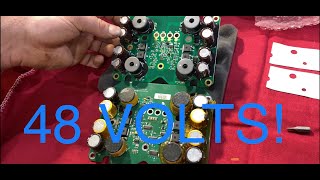
Code P1378 means the Powertrain Control Module (PCM) detects low voltage from the Fuel Injection Control Module (FICM). The FICM, critical in diesel engines like the Ford 6.0L Power Stroke, boosts 12-volt battery power to 48 volts to operate fuel injectors. When input voltage drops, injectors fail to fire properly, causing severe engine performance issues.
Technical definition: The SAE definition for P1378 is "Fuel Injector Control Module (FICM) System Voltage Low." This indicates the voltage supplied to the FICM's logic circuit (FICM_LPWR) dropped below a specified threshold (typically 10.5 volts, sometimes as low as 7 volts) for a set period.
Can I Drive With P1378?
Yes, But With Caution. You can drive, but it is a significant gamble. Expect hard starting, rough running, and stalling, creating a major safety hazard in traffic. Driving with low voltage permanently damages the Fuel Injection Control Module (FICM), turning a $400 alternator repair into a $1,200+ FICM replacement. Diagnose and repair promptly to avoid being stranded.
Common Causes

- Weak or Failing Batteries (Very Common) — This is the primary cause. The FICM requires stable voltage, especially during high-demand cranking. Weak batteries fail to provide this logic board power, triggering the code.
- Corroded or Loose Battery Terminals/Cables (Very Common) — Corrosion or loose connections at battery posts or grounds create resistance. This causes a massive voltage drop before power reaches the FICM.
- Failing Alternator (Common) — A failing alternator cannot charge batteries or supply sufficient running voltage. Output below 13.3 volts at idle drains batteries and triggers P1378.
- Defective FICM Power Relay (Common) — The FICM relay powers the module. Worn internal contacts create intermittent connections, causing sudden voltage drops.
- Poor Main Engine/Chassis Ground (Common) — A corroded or broken ground strap between the engine block and chassis prevents the FICM from getting a stable voltage reference.
- Failing Fuel Injection Control Module (FICM) (Less Common) — The FICM's internal power supply board is a known weak point on Ford 6.0L engines due to heat and vibration. Chronic low input voltage also destroys the logic side.
- Blown Fuse (Shared Circuit) (Rare) — On some diesels, the fuel heater shares a fuse with the FICM relay. A shorted fuel heater blows the fuse, instantly cutting FICM power.
- Chafed or Damaged Wiring Harness (Rare) — Engine vibration rubs the FICM wiring harness against brackets, wearing through insulation and causing a short to ground.
- Aftermarket Engine Calibrations/Tuners (Rare) — Aggressive aftermarket tuners altering engine software sometimes generate false P1378 codes.
Symptoms

- Hard Starting or No-Start (Cold) — The engine cranks extensively before starting, or fails to start. This is severe when cold because glow plugs and injectors demand maximum voltage.
- Rough Idle or Engine Stalling — The engine runs unevenly, shakes, or shuts off unexpectedly at low speeds or when stopping.
- Lack of Power and Poor Acceleration — The vehicle hesitates and accelerates poorly because injectors lack the 48-volt signal needed to deliver fuel.
- White or Gray Exhaust Smoke — Unburned fuel exits as white or gray smoke during startup because weak electrical signals prevent proper fuel atomization.
- Check Engine Light is On (also visible on scanner) — The PCM detects the fault and illuminates the Malfunction Indicator Lamp (MIL).
Diagnostic Flowchart
Tap your situation to follow the diagnostic path that matches what you're seeing on this code.
Common Fixes & Costs
- Clean or Replace Battery Terminals and Cables — Parts: $10-$75, Labor: $50-$125, ~0.8 hr book time (DIY)
- Replace Both Batteries — Parts: $300-$500, Labor: $50-$100, ~0.7 hr book time (DIY)
- Replace Alternator — Parts: $200-$450, Labor: $150-$250, ~1.5 hr book time (Intermediate)
- Replace FICM Power Relay — Parts: $20-$40, Labor: $0, ~0.1 hr book time (DIY)
- Repair or Replace FICM — Parts: $200-$350 (Repair) / $500-$1000 (New/Reman), Labor: $150-$250, ~2.0 hr book time (Professional)
Used vs. New Parts: Buying Guide
When a used part is worth it: A used OEM FICM from a low-mileage donor vehicle is a budget option, but given the high failure rate of this part, it is a significant gamble.
Donor-vehicle mileage cap: roughly under 60000 miles for the part to have meaningful remaining life.
Donor quality checklist:
- Verify the exact part number (4-pin vs 7-pin for Ford 6.0L are not interchangeable).
- Check the donor vehicle's VIN history.
- Avoid units with physical damage, corrosion, or broken seals.
Decision logic:
- If Budget is the primary concern and you accept the risk of a shorter lifespan → A used FICM works, but a professional mail-in repair service is a better value.
- If Reliability and warranty are important → Use a reputable mail-in repair service that upgrades internal components.
- If The vehicle is heavily relied upon for work or long trips → Buy a new or professionally rebuilt unit with an upgraded power supply and a long warranty.
Warranty tradeoff: Used parts offer 30-90 day warranties. New aftermarket units offer 1-year warranties. Reputable repair services provide 1 to 5-year warranties.
Worst-case if a used part fails: $300-600 if a used FICM fails shortly after installation, requiring repeat labor and another replacement.
What Happens If You Wait — Timeline
- 0-1 month: Intermittent P1378 code after cold starts. Check engine light toggles. No noticeable driving symptoms, or slightly longer crank times. (MPG impact: 0-2%% · Added cost: $0)
- 1-3 months: Code sets consistently on cold starts. Noticeable hard starting, rough idle, and hesitation. Constant low-voltage cycles stress the FICM. (MPG impact: 3-8%% · Added cost: $50-150 in wasted fuel and accelerated battery wear.)
- 3-6 months: FICM internal power board is damaged. Output voltage drops below 45V during cranking. Truck stalls intermittently and lacks power. (MPG impact: 10-15%% · Added cost: $800-$1700 (Original problem plus required FICM replacement).)
- 6+ months: Complete failure. FICM power supply dies, causing a crank-no-start condition. Erratic voltage damages fuel injectors. (MPG impact: N/A (Vehicle is not drivable)% · Added cost: $1500-$3000+ (Tow, batteries, alternator, FICM, and fuel injectors).)
Cost of Not Fixing It
- 0-1 month: Intermittent hard starting, rough idle, and occasional stalling. Reduced fuel economy due to inefficient injection. (Added cost: Negligible, but high risk of being stranded.)
- 1-6 months: Chronically low voltage permanently damages the FICM internal power board. A simple battery fix now requires a FICM replacement. (Added cost: $600-$1500)
- 6+ months: Complete FICM failure causes a no-start condition. Inconsistent voltage destroys fuel injectors, cascading into massive repair bills. (Added cost: $1500-$3000+)
Diagnosis Steps

- Inspect the Electrical Foundation
Visually inspect batteries, power cables, and grounds. Clean battery terminals with a wire brush and tighten all connections. A poor connection is the most common, easiest fix.
Tools: Safety glasses, gloves, wire brush, socket set/wrenches (Beginner) - Test Batteries Under Load
Check battery voltage with the engine off (minimum 12.6V). Have a helper crank the engine; if voltage drops below 10.0V, replace the batteries. Auto parts stores offer free load testing.
Tools: Digital multimeter (Beginner) - Test Alternator Output
Start the engine and idle. Connect a multimeter across battery terminals. Reading must be 13.3-14.5V. If below 13.3V, the alternator is failing.
Tools: Digital multimeter (Beginner) - Monitor FICM Voltage with Scan Tool
Connect an OBD-II scanner. Monitor FICM Logic Power (FICM_LPWR), Vehicle Power (FICM_VPWR), and Main Power (FICM_MPWR). While cranking, LPWR and VPWR must stay above 10.0V, and MPWR must stay above 45V. A drop below 45V indicates a failing FICM power board.
Tools: Advanced OBD-II scan tool (Intermediate) - Check FICM Power Relay
Locate the FICM power relay in the under-hood fuse box. Swap it with an identical non-critical relay (like the horn). If the vehicle starts normally, replace the relay.
Tools: Owner's manual (for fuse box diagram) (Beginner) - Inspect Fuses for Shared Circuits
Check if the FICM relay fuse also powers other components, like the Ford fuel bowl heater. If blown, unplug the secondary component and replace the fuse. If it holds, the secondary component is shorted.
Tools: Owner's manual, fuse puller (Intermediate) - Perform Voltage Drop Test
Set multimeter to DC Volts. Place black probe on negative battery terminal and red probe on FICM chassis. A reading above 0.2V indicates a poor ground. For power, place red probe on positive terminal and black on FICM power input. Above 0.3V indicates excessive resistance.
Tools: Digital multimeter, wiring diagram (Advanced) - Direct FICM Output Voltage Test
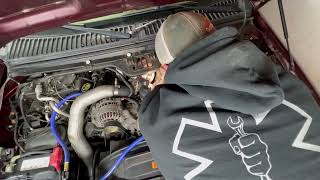
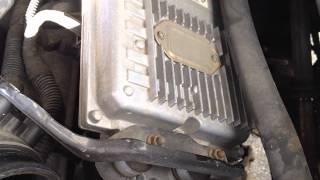
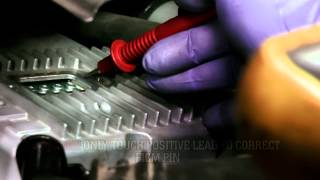
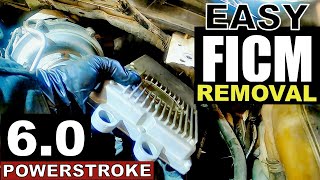
Remove the FICM cover (two T20 Torx screws). With key on, touch multimeter positive probe to the test screw (closest to driver's side for 4-pin, engine for 7-pin) and negative to ground. Do not touch the case. Voltage must be 47-49V. While cranking, it must stay above 45V.
Tools: Digital multimeter, T20 Torx driver, safety glasses (Advanced) - Conduct Wiggle Test
With the engine running or key on, monitor FICM voltages on a scan tool while wiggling the wiring harness. Voltage fluctuations indicate an intermittent open or short in the wiring.
Tools: Advanced OBD-II scan tool, gloves (Intermediate)
When This Code Triggers (Freeze-Frame Conditions)
- Engine State: During Crank/Startup (The code sets when the starter motor engages, causing a massive voltage drop across the electrical system.)
- Ambient Temperature: < 40°F (5°C) (Cold weather weakens batteries and thickens engine oil, demanding maximum cranking power and exposing electrical flaws.)
- Battery Voltage (System): < 11.0V (The PCM logs the fault when the FICM reports its logic power dropped below the critical threshold during startup.)
- Engine RPM: 0-300 RPM (The fault is captured while the engine cranks but fails to start quickly, or immediately after it fires.)
Related Codes
- P0611 — P0611 means 'FICM Performance'. P1378 is the cause (low input voltage) and P0611 is the effect (FICM processor malfunctioning). Fix the P1378 voltage supply issue first.
- P1379 — The opposite of P1378, indicating 'FICM System Voltage High'. Points exclusively to a faulty alternator overcharging the system.
- P0562 — Generic code for 'System Voltage Low'. Seeing both confirms the root cause is systemic (batteries, alternator, main cables) rather than isolated FICM wiring.
- P0261-P0284 (Injector Circuit Low) — Indicates low voltage for individual injectors. If the FICM lacks 12V power, it cannot supply 48V to injectors. Resolve P1378 first, and injector codes disappear.
Climate & Environmental Factors
- Cold Weather: Cold weather is the primary environmental trigger. Low temperatures reduce battery output and thicken engine oil, demanding massive starter power. This creates a severe voltage drop during cranking, exposing weak batteries or alternators.
- High Humidity: Sustained humidity accelerates corrosion on battery terminals, ground straps, and fuse box contacts. This builds resistance, impeding current flow and starving the FICM.
- High-Heat Environments: Prolonged exposure to high engine bay temperatures degrades the internal electronic components of the FICM's power supply, making it susceptible to failure during low voltage events.
How to Talk to a Mechanic About This Code
Say this: "I have a P1378 code. Please start by load testing both batteries, checking alternator output at idle, and inspecting main power and ground connections before quoting a FICM replacement."
Directs the mechanic to diagnose common, inexpensive root causes first, preventing immediate upselling to a costly FICM replacement.
Avoid saying:
- 'My truck won't start, just fix it.'
- 'My check engine light is on, can you look at it?'
- 'I think I need a new FICM.'
Questions to ask before authorizing the repair:
- What were the battery load test results? What was the voltage during cranking?
- What was the alternator's voltage output at idle?
- If recommending a FICM replacement, what was the FICM Main Power (MPWR) reading while cranking?
- Can you show me the corroded cable or failing part?
- What is the warranty on parts and labor?
Where to Take It: Dealer vs Independent vs Chain
- Dealer:
Good, but expensive. Choose if money is no object or a Ford-specific PCM reflash is required.
Best for: Vehicles under powertrain warranty., Repairs requiring specific manufacturer software updates (Ford TSB).
Downsides: Highest labor rates., Defaults to replacing the entire FICM module rather than recommending affordable mail-in repairs. (Typical cost: +50% vs. baseline) - Independent Shop:
Best fit. A good independent diesel mechanic correctly diagnoses P1378 and follows proper procedures.
Best for: Out-of-warranty diesel trucks., Cost-effective diagnosis of batteries and alternators.
Downsides: Diesel expertise varies. Look for ASE certifications and positive reviews mentioning Power Stroke or Duramax. (Typical cost: +0% vs. baseline) - Chain Shop:
Acceptable for free battery testing, but avoid for full diagnosis and repair.
Best for: Free battery and alternator testing.
Downsides: Technicians lack specific knowledge for FICM diagnostics., High pressure to sell parts; misdiagnoses the FICM when the issue is a relay. (Typical cost: -10% vs. baseline)
When to Walk Away From the Repair
If the total estimated repair cost exceeds 40-50% of the truck's current private-party value, consider selling or trading it in.
- Car worth $12000, fix is $2500: Fix it. The repair cost is 21% of the vehicle's value. These trucks have a long service life once the electrical system is sorted.
- Car worth $5000, fix is $2500: Borderline. At 50% of the vehicle's value, get a second opinion. If the truck is otherwise excellent, repair it. If it has other issues, walk away.
- Car worth $3500, fix is $2500: Walk away. The repair cost is over 70% of the truck's value. It is not economically viable.
What Scan Tool You Need for This Code

Minimum: A scanner that reads manufacturer-specific live data PIDs.
A basic $20 code reader only shows the P1378 code. It cannot display critical live data (FICM Logic Power, Vehicle Power, Main Power) essential to watch during cranking.
Budget: BlueDriver Pro / BAFX Bluetooth Adapter with FORScan (~$100) — Connects to a smartphone to access and graph Ford-specific PIDs (FICM_LPWR, FICM_VPWR, FICM_MPWR) to diagnose voltage drops during cranking.
Mid-range: ANCEL FD500 or iCarsoft CR MAX (~$150) — Dedicated handheld unit reading all Ford-specific codes and live data streams, including FICM voltages.
Professional: Autel MaxiCOM MK808S (~$500) — Professional tablet scanner offering full-system diagnostics, live data graphing, and bidirectional controls. Monitors all FICM PIDs and performs system tests.
How to Clear the Code After You Fix It
- Fix the underlying voltage supply issue (batteries, alternator, cables).
- Reconnect batteries if disconnected.
- Use an OBD-II scan tool to clear DTCs.
- Perform a complete drive cycle to reset readiness monitors.
Drive cycle (~30 minutes): Cold start and idle for 3 minutes. Drive 15 minutes with stop-and-go city driving and steady speeds between 40-55 mph. Perform several slow accelerations. Finish with 10 minutes of steady highway driving (55-60 mph). Cool down completely and repeat if necessary.
Readiness monitors affected: Comprehensive Component Monitor, Misfire Monitor, EGR System Monitor
Before emissions retest: drive at least 50 miles to fully set monitors.
Watch out for:
- Disconnecting batteries clears the code but resets emissions monitors, causing an automatic smog test failure.
- The code returns immediately if the root cause (bad batteries, weak alternator) is ignored.
Will This Fail Emissions / State Inspection?
Yes — this code typically fails an OBD-II emissions inspection.
- California: An active P1378 code is an automatic failure. After repair, complete a full drive cycle to set readiness monitors. Clearing the code by disconnecting the battery results in a 'Not Ready' failure.
- New York: A Check Engine Light with code P1378 causes an automatic failure during the OBD-II emissions inspection.
- Texas: In emissions-testing counties, an illuminated Check Engine Light for P1378 results in an automatic failure. Readiness monitors must be 'Ready'.
Most Commonly Affected Vehicles
- Ford F-250/F-350/F-450/F-550 Super Duty (2003-2007) — Extremely common on 6.0L Power Stroke engines. The FICM's location on the engine exposes it to intense heat and vibration. TSB 09-24-3 included a PCM calibration update to mitigate this.
- Ford Excursion (2003-2005) — Shares the 6.0L Power Stroke engine and electrical architecture with Super Duty trucks.
- Ford E-Series Van (E-350/E-450) (2004-2010) — Uses the 6.0L Power Stroke engine and is prone to identical FICM voltage issues.
- GMC/Chevrolet Silverado/Sierra with 6.6L Duramax Diesel (2001-2010) — P1378 appears on LB7, LLY, and LBZ Duramax engines, indicating low voltage to the FICM. Diagnostic principles are identical to Ford.
- International VT365 (2003-2009) — The base engine for the Ford 6.0L Power Stroke; experiences identical FICM voltage problems.
- BMW N52/N55 engines (3-series, 5-series, X3, X5) (2006-2015) — Unrelated to fuel injection. Points to a failing eccentric shaft sensor in the Valvetronic system, often contaminated by oil.
- Toyota/Lexus NX200t, GS200t, IS200t, RC200t (2015-2017) — Indicates 'Pre-ignition Detected'. Resolved by an ECM software update (TSB L-SB-0159-17), not hardware replacement.
- Subaru Outback, Legacy, Forester (2003-2021+) — Indicates 'Pre-ignition Detected' related to low-speed pre-ignition (LSPI) in turbocharged direct-injection engines.
Manufacturer-Specific Notes
- Ford: The quintessential code for the 6.0L Power Stroke. Ford issued TSB 09-24-3 with a PCM calibration update to improve FICM low voltage detection and cold start performance.
- Chevrolet/GMC: On Duramax engines, pay close attention to main ground connections. Early LB7 models had a fuel-cooling FICM design where debris trapped inside causes fuel restriction issues.
- Audi/Volkswagen: On older models, P1378 means 'Cylinder 8, Ignition Circuit Short to Ground', unrelated to diesel injection modules.
- Toyota/Lexus: On 2.0L turbo models, do not replace hardware. P1378 is resolved by a dealer ECM software update (TSB L-SB-0159-17).
Real Owner Stories
2005 Ford F-350 6.0L - The Simple Fix
Truck failed to start on cold mornings, throwing only a P1378 code. FICM output was a solid 48V during cranking.
What they tried:
- Verified FICM output voltage was good.
- Tested batteries, reading 12.6V with the engine off.
- Swapped the FICM power relay with an identical one from the fuse box.
Outcome: Swapping the FICM relay resolved the no-start. The original relay's internal contacts were pitted, causing an intermittent voltage drop during cold starts. The fix was a new $30 relay.
Lesson: Check inexpensive parts first. A faulty FICM power relay perfectly mimics a major electrical problem. Swapping it with a known-good relay is a free diagnostic step.
2006 Ford F-250 6.0L - The Misdiagnosis Story
Intermittent P1378 code appeared after driving, with no noticeable running issues.
What they tried:
- Replaced the FICM relay.
- Replaced the batteries.
- Swapped the original FICM with an expensive aftermarket unit.
Outcome: The owner discovered an aftermarket tuner setting caused false P1378 codes. After adjusting the tune, the code stopped. The issue was software, not hardware.
Lesson: Aftermarket tuners generate false codes. Return the vehicle to the stock tune before replacing expensive hardware to eliminate the tuner as a variable.
Ford 6.0L - The Hidden Cause
Truck towed to a shop with a no-start and P1378 code. The fuse for the fuel heater circuit repeatedly blew.
What they tried:
- Replaced the blown fuse, which blew again immediately.
- Consulted a wiring diagram, revealing the fuse powered both the FICM relay and fuel bowl heater.
- Unplugged the fuel bowl heater.
Outcome: With the heater disconnected, the truck started normally. The heater element shorted internally, blowing the shared fuse and cutting power to the FICM. The fix was leaving the heater unplugged.
Lesson: If P1378 pairs with a blown fuse, check wiring diagrams for shared circuits. A short in a secondary part cuts power to the FICM.
2005 Ford 6.0L - The Cascading Failure
After replacing a failed alternator, the truck started but had a terrible miss and set injector contribution codes.
What they tried:
- Replaced the alternator.
- Diagnosed the misfire with a scan tool.
- Replaced the entire bank of injectors on the driver's side.
Outcome: Replacing the injectors cured the miss. Prolonged low voltage from the failing alternator damaged the sensitive electronic solenoids inside the fuel injectors.
Lesson: Low system voltage cascades. A failing alternator starves the FICM and sends insufficient power to injectors, causing permanent damage. Fix voltage problems immediately.
How to Prevent This Code From Triggering
- Test Batteries and Clean Terminals (Every 6 months) — Weak batteries are the #1 cause of P1378. Load testing catches failing batteries before they damage the FICM. Cleaning terminals prevents resistance buildup.
- Use a Battery Maintainer (If the truck sits for more than a week) — Keeps batteries at an optimal charge level, preventing deep voltage drops during startup that strain the FICM.
- Upgrade Battery and Ground Cables (Once, especially on high-mileage 6.0L Fords) — Factory ground straps corrode internally. Upgrading to larger gauge cables (2/0 AWG) ensures balanced power draw and a solid ground path.
- Check Alternator Health (Annually) — A weak alternator undercharges batteries. Verify output is above 13.3V at idle and inspect the plug for melting.
- Switch to Lower Viscosity Oil in Winter (Seasonally (for cold climates)) — Thick 15W-40 oil requires massive cranking energy. Switching to 5W-40 synthetic reduces electrical strain, preventing voltage dips.
Frequently Asked Questions
Can I just replace the FICM to fix P1378?
You can, but it is a costly gamble. P1378 indicates low voltage *to* the FICM, meaning a weak battery or alternator will quickly destroy the new module. Always test the complete charging system first.
My FICM voltage reads 48 volts with the key on, so why do I get this code?
A static key-on test is insufficient because voltage drops significantly when the starter engages. You must test FICM voltage *during* startup. A healthy FICM holds at least 45 volts while cranking, whereas a failing one drops under load.
What’s the difference between FICM Logic Power and Main Power?
FICM Logic Power (FICM_LPWR) is the 12-volt input from the vehicle's electrical system that powers the module's logic board. FICM Main Power (FICM_MPWR) is the 48-volt output created internally to fire the injectors. Code P1378 specifically flags a problem with the 12-volt Logic Power input.
My truck runs fine but the P1378 code keeps appearing. What should I do?
This occurs in the early stages of failure when voltage drops briefly during a cold start. Do not ignore it, as it is an early warning of failing batteries or alternator. Address it immediately to prevent permanent FICM damage.
Can a bad ground cause P1378?
Yes. A poor ground connection between the battery and chassis increases electrical resistance. This resistance causes a voltage drop that starves the highly sensitive FICM, triggering the code.
What is the most common misdiagnosis with P1378?
The most common mistake is replacing the expensive FICM without testing the batteries and alternator under load. Diagnosing the charging system first saves time and prevents destroying the new module.
Is it better to repair my FICM or buy a new one?
Reputable mail-in repair services are often cheaper and more robust than buying a remanufactured unit because they upgrade known weak components. A repair service costs $200-$350, while a replacement unit exceeds $1,000.
Why does my truck only have problems starting when it's cold?
Cold weather slows battery chemical reactions, thickens engine oil, and demands massive current for glow plugs. This combined load creates a severe voltage drop during cranking. It exposes weak electrical components that function fine in warm weather.
Key Takeaways
- Code P1378 indicates a low voltage supply to the Fuel Injection Control Module (FICM), not necessarily a failed module.
- Test both batteries and the alternator under load before replacing the FICM, as weak batteries are the number one cause of this code.
- Monitor FICM Main Power (MPWR) with a scan tool during engine cranking; it must remain above 45 volts to ensure proper injector operation.
- Fix P1378 immediately, as driving with chronic low voltage permanently destroys the FICM's internal power board, turning a $200 repair into a $1,000+ replacement.
Helpful Videos

The information in this article is provided for general reference and educational purposes only. Vehicle specifications, procedures, and part compatibility can vary by production date, trim level, and region. Always consult your vehicle's factory service manual and verify part numbers before purchasing or performing repairs. Safety-critical components such as airbags, seat belts, and braking systems should be installed by a qualified professional.
- 🎬 Helpful Videos
- What Does P1378 Mean?
- Can I Drive With P1378?
- Common Causes
- Symptoms
- Diagnostic Flowchart
- Common Fixes & Costs
- Used vs. New Parts: Buying Guide
- What Happens If You Wait — Timeline
- Cost of Not Fixing It
- Diagnosis Steps
- When This Code Triggers (Freeze-Frame Conditions)
- Related Codes
- Climate & Environmental Factors
- How to Talk to a Mechanic About This Code
- Where to Take It: Dealer vs Independent vs Chain
- When to Walk Away From the Repair
- What Scan Tool You Need for This Code
- How to Clear the Code After You Fix It
- Will This Fail Emissions / State Inspection?
- Most Commonly Affected Vehicles
- Manufacturer-Specific Notes
- Real Owner Stories
- 2005 Ford F-350 6.0L - The Simple Fix
- 2006 Ford F-250 6.0L - The Misdiagnosis Story
- Ford 6.0L - The Hidden Cause
- 2005 Ford 6.0L - The Cascading Failure
- How to Prevent This Code From Triggering
- Frequently Asked Questions
- Can I just replace the FICM to fix P1378?
- My FICM voltage reads 48 volts with the key on, so why do I get this code?
- What’s the difference between FICM Logic Power and Main Power?
- My truck runs fine but the P1378 code keeps appearing. What should I do?
- Can a bad ground cause P1378?
- What is the most common misdiagnosis with P1378?
- Is it better to repair my FICM or buy a new one?
- Why does my truck only have problems starting when it's cold?
- Key Takeaways
- 🎟️ Get 5% Off