

OBD-II Code P1361: Ignition/Camshaft Sensor Circuit Fault
What P1361 means, why it triggers, and how to fix it
- P1361 is a manufacturer-specific code indicating an intermittent Camshaft Position Sensor fault on Hondas/Acuras, or a low voltage Ignition Control circuit fault on Fords/GMs.
- Driving with P1361 is dangerous because the engine stalls unpredictably in traffic, and unburned fuel destroys the catalytic converter, adding up to $2,500 in repair costs.
- On Honda and Acura vehicles, replacing a heat-damaged Camshaft Position Sensor (OEM part 37840-RJH-006 or 37840-P8A-305) fixes the issue in the majority of cases.
- For GM and Ford vehicles, do not replace the camshaft sensor; test the battery and alternator first, as cranking voltage dropping below 9.5V triggers this code.
What Does P1361 Mean?

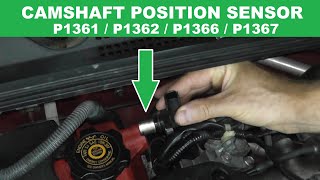
P1361 is a manufacturer-specific code. On Hondas and Acuras, it signals an intermittent interruption in the Top Dead Center (TDC) or Camshaft Position Sensor (CMP) circuit. On Ford, Chevrolet, and GM vehicles, it indicates low voltage in the Ignition Control (IC) circuit. The engine's computer (PCM) detects a brief loss of the critical signal required to control ignition timing and spark delivery.
Technical definition: The SAE/OBD-II definition varies by manufacturer. Honda/Acura defines it as 'Camshaft Position (CMP) Sensor A Intermittent Interruption.' Ford/GM/Saturn defines it as 'Ignition Control (IC) Circuit Low Voltage.' The Powertrain Control Module (PCM) triggers P1361 when the voltage signal from the affected circuit is irregular, interrupted, or falls outside the expected range. On GM vehicles, this sets if the IC voltage drops below 0.04 volts.
Can I Drive With P1361?
no_recommended. Driving is not recommended. The engine stalls without warning, creating a significant safety hazard in traffic. Continuing to drive with a faulty timing signal forces unburned fuel into the exhaust, destroying the catalytic converter and adding $800 to $2,500 to your repair bill.
Common Causes

- Faulty Camshaft Position (CMP) / Top Dead Center (TDC) Sensor (Very Common) — This is the most frequent cause on Honda and Acura vehicles. The sensor fails internally due to heat and age, sending an erratic or intermittent signal to the PCM.
- Damaged, Corroded, or Oil-Soaked Wiring and Connectors (Common) — The wiring harness or connector fails due to frayed wires, loose pins, water intrusion from engine washing, or oil saturation from a leaking valve cover gasket.
- Low Battery Voltage or Charging System Fault (Common) — On GM and Ford vehicles, a weak battery, failing alternator, or corroded ground strap drops system voltage below the required threshold, triggering the ignition circuit fault.
- Faulty Crankshaft Position (CKP) Sensor (Less Common) — A failing crankshaft position sensor triggers P1361 if the PCM detects a correlation error between the cam and crank signals.
- Slipped or Incorrectly Installed Timing Belt/Chain (Rare) — If the timing belt or chain jumps a tooth, the physical correlation between the camshaft and crankshaft is incorrect. The PCM detects this timing discrepancy and triggers the code.
- Faulty Electronic Load Detector (ELD) (Rare) — On Honda models, a faulty ELD in the under-hood fuse box causes erratic electrical behavior, triggering P1361 alongside code P1298.
- Failed Powertrain Control Module (PCM) (Very Rare) — The engine computer itself fails, with a faulty driver circuit unable to process the sensor signal. This is the absolute last item to consider.
Symptoms

- Engine Stalls or Dies While Driving — The car suddenly loses power and shuts off, often after reaching operating temperature or under load (like running the A/C).
- Engine Will Not Start or is Hard to Start — The engine cranks but refuses to start, either intermittently or completely, regardless of engine temperature.
- Check Engine Light is On — The Malfunction Indicator Lamp (MIL) illuminates. On Acuras, the TCS light also illuminates.
- Rough Idle and Poor Performance — The engine runs erratically, shakes at a stop, feels sluggish, and exhibits poor acceleration.
- Engine Won't Rev Past a Certain RPM — The computer engages 'limp mode' to prevent damage, limiting engine speed to 3,000-5,500 RPM.
Diagnostic Flowchart

Tap your situation to follow the diagnostic path that matches what you're seeing on this code.
Common Fixes & Costs
- Replace Camshaft Position Sensor (TDC Sensor) — Parts: $40-$150, Labor: $130-$225, ~1.1 hr book time (DIY)
- Repair Wiring or Replace Connector Pigtail — Parts: $15-$50, Labor: $130-$300, ~1.5 hr book time (Intermediate)
- Replace Crankshaft Position Sensor — Parts: $40-$130, Labor: $150-$250, ~1.2 hr book time (Intermediate)
- Replace Timing Belt and Associated Components — Parts: $150-$400, Labor: $500-$900, ~5.0 hr book time (Professional)
- Replace Electronic Load Detector (ELD) — Parts: $30-$70, Labor: $50-$100, ~0.5 hr book time (DIY)
DIY vs Professional
- Replace Camshaft Position Sensor — Beginner:
- Repair Wiring or Replace Connector Pigtail — Beginner:
- Replace Timing Belt — Beginner:
- Replace ELD — Beginner:
Used vs. New Parts: Buying Guide
When a used part is worth it: Buying a used camshaft position sensor is never recommended. The part is inexpensive new, and failure rates for used sensors are extremely high.
Donor-vehicle mileage cap: roughly under 40000 miles for the part to have meaningful remaining life.
Donor quality checklist:
- Verify the part is genuine OEM (e.g., Denso) and not a generic aftermarket replacement.
- Ensure the part number exactly matches the original.
- Avoid parts with physical damage, corrosion, or oil contamination.
Decision logic:
- If The part is an electronic sensor like a CMP or CKP sensor. → Buy a new OEM or high-quality OE-supplier (Denso, NTK, Delphi) part. The risk of premature failure is too high.
- If Vehicle has over 150,000 miles and budget is the absolute primary concern. → A used sensor is a gamble. The labor to replace it a second time negates initial savings.
- If The required part is a larger mechanical assembly like a cylinder head. → A used assembly from a low-mileage, documented donor vehicle is a cost-effective option.
Warranty tradeoff: Used parts carry a 30-90 day warranty covering only the part. New aftermarket parts offer 1-year warranties. New OEM parts carry the manufacturer's standard warranty.
Worst-case if a used part fails: $200-400 if a used sensor fails, requiring repeat labor costs plus a new part.
What Happens If You Wait — Timeline
- 0-1 month: Code appears. The engine stalls intermittently when hot or under load. The car restarts and drives normally for days. (MPG impact: 0-2%% · Added cost: $0)
- 1-3 months: Stalling becomes frequent. Hard-starting occurs when warm. A rough idle and hesitation during acceleration begin. (MPG impact: 3-8%% · Added cost: $20-75 in wasted fuel)
- 3-6 months: The car stalls unpredictably in traffic. Inefficient combustion overheats the catalytic converter, reducing efficiency. (MPG impact: 10-15%% · Added cost: $500-1500)
- 6+ months: Complete failure of the catalytic converter occurs as the substrate melts. Continued driving with a jumped timing belt destroys engine valves. (MPG impact: 15-25%% · Added cost: $1500-4000+)
Cost of Not Fixing It
- Immediate: Unpredictable stalling in traffic creates a significant safety hazard. Hard-starting leaves you stranded. (Added cost: 0)
- 1-3 months: Continued poor engine performance forces unburned fuel into the exhaust, overheating and damaging the catalytic converter. (Added cost: $1200-2800)
- 3+ months: Catastrophic failure of the catalytic converter occurs. If caused by a jumped timing belt, continued operation destroys the engine valves. (Added cost: $2000-4500+)
Diagnosis Steps
- Read Codes and Freeze Frame Data
Use an OBD-II scanner to confirm P1361 is active. Note freeze-frame data and companion codes (P1362, P0335, P1298). For GM/Ford, check the battery voltage reading in the freeze-frame data.
Tools: OBD-II Scanner (Beginner) - Perform a Thorough Visual Inspection
Inspect the camshaft position sensor's wiring harness for burns, chafing, or breaks. Check the connector for corrosion, bent pins, or oil saturation. On GM/Ford, inspect the ignition control module and coil pack wiring.
Tools: Flashlight (Beginner) - Test System Voltage (GM/Ford)
Check battery voltage Key On, Engine Off (KOEO), which must be 12.4-12.8V. Measure voltage while cranking; it must not drop below 9.5V. A drop indicates a weak battery or bad connection, the primary cause for the IC low voltage code.
Tools: Multimeter (Intermediate) - Check for Power and Ground at the Connector
Turn the ignition ON (engine off). Disconnect the sensor and test the harness-side connector. For a 3-wire Honda sensor: one wire has battery voltage (~12V), one is ground (~0V), and the third is the signal wire. No power or ground points to a wiring or fuse issue.
Tools: Multimeter, Vehicle-specific Wiring Diagram (Intermediate) - Test Sensor Resistance (Honda/Acura)
Disconnect the sensor and measure resistance between the two outer terminals. A good Honda sensor reads 1,800-2,500 Ohms when cold. A reading of infinity (OL) or zero confirms a failed sensor.
Tools: Multimeter (Intermediate) - Check Signal Wire Voltage (Honda/Acura)
With the connector plugged in, back-probe the signal wire. While cranking the engine, voltage fluctuates between 0.5V and 4.5V. Static or zero voltage indicates a failed sensor.
Tools: Multimeter with Back-probe Pins (Advanced) - Inspect Mechanical Timing
If electrical tests pass, remove the upper timing cover to inspect the timing belt or chain. Check for proper tension, alignment of timing marks, and signs of a jumped tooth.
Tools: Socket Set, Wrenches, Vehicle Service Manual (Advanced) - Analyze the Signal with an Oscilloscope
Connect to the signal wire and ground. Start the engine and observe the square wave pattern. P1361 causes 'dropouts' where the signal momentarily disappears. Wiggle the harness to induce the fault.
Tools: Oscilloscope (Advanced) - Test the Powertrain Control Module (PCM)
If the sensor, wiring, and mechanical timing are good, the PCM's internal driver failed. This requires professional diagnosis with specialized equipment.
Tools: Advanced Scan Tool, Breakout Box (Professional)
When This Code Triggers (Freeze-Frame Conditions)
- Engine Coolant Temp: 175-205°F (80-96°C) (The fault occurs when the engine is fully warmed up, as heat exacerbates internal sensor failures.)
- RPM: 700-1200 or 2000-3000 (The interruption happens at idle (causing a stall) or during steady-state cruising.)
- Engine Load: 20-40% (The code sets under light to moderate engine load, not necessarily during heavy acceleration.)
- Vehicle Speed: 0 mph (stalling) or 35-60 mph (The fault manifests as a stall from idle or a hesitation at highway cruising speeds.)
Related Codes
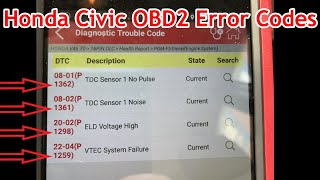
- P1362 — The companion code to P1361. P1361 signifies an 'intermittent' signal interruption, while P1362 indicates 'no signal' at all. Seeing both confirms a hard failure in the TDC/CMP sensor circuit.
- P0335 — Generic code for 'Crankshaft Position Sensor A Circuit Malfunction.' If present with P1361, the PCM sees a conflict between the timing sensors, strongly suggesting a slipped timing belt.
- P0340 — Generic equivalent for a 'Camshaft Position Sensor A Circuit' fault. Seeing both confirms a fault in the CMP sensor circuit.
- P1298 — Specific to Honda/Acura, indicating 'Electronic Load Detector (ELD) Circuit High Voltage.' A failing ELD causes voltage fluctuations that incorrectly trigger P1361.
Climate & Environmental Factors
- Temperature Fluctuations: Extreme heat and cold cause materials to expand and contract, stressing old wiring and connectors, leading to intermittent open circuits or shorts.
- Moisture and Humidity: Direct water intrusion from engine washing or deep puddles forces moisture inside sensor connectors, short-circuiting the electrical pins and causing long-term corrosion.
How to Talk to a Mechanic About This Code
Say this: "I have a P1361 code on my [Make/Model] causing intermittent stalling. I suspect the cam sensor or wiring, but I want the circuit tested before replacing parts. For GM/Ford: I have a P1361 Ignition Control Low Voltage code; please check the battery, grounds, and wiring."
This signals you understand the code is specific and expect proper diagnosis. It directs the technician to the correct culprits (sensor/wiring for Honda, voltage for GM/Ford).
Avoid saying:
- 'Just fix whatever's wrong'
- 'My check engine light is on, can you look at it?'
- 'I think it's the cam sensor, replace it.' (Do not lead them down the wrong path for GM/Ford)
Questions to ask before authorizing the repair:
- Did you test for power, ground, and signal at the connector before condemning the sensor?
- If it's a wiring issue, can you show me the damage?
- For GM/Ford: What was the battery voltage during cranking?
- What is the warranty on parts and labor?
Where to Take It: Dealer vs Independent vs Chain
- Dealer:
Use for difficult intermittent faults or TSBs, but it is the most expensive choice for a straightforward sensor replacement.
Best for: Vehicles under powertrain warranty, Complex electrical issues requiring factory-trained technicians, Cases where a TSB applies (e.g., Honda Civic camshaft end-play)
Downsides: Highest labor rates., May recommend replacing a larger assembly when a smaller component suffices. (Typical cost: +50% vs. baseline) - Independent Shop:
Best fit for most P1361 situations. A good independent mechanic knows the likely causes on Hondas, providing the best balance of expertise and cost.
Best for: Out-of-warranty vehicles., Straightforward diagnosis and part replacement.
Downsides: Diagnostic skill varies. Vet the shop through reviews and ASE certifications. (Typical cost: +0% vs. baseline) - Chain Shop:
AVOID for diagnosis. Use them to read the code, then go to an independent shop.
Best for: Reading the initial code for free.
Downsides: Technicians lack equipment for proper electrical diagnosis., High pressure to replace the sensor without diagnosing underlying wiring issues. (Typical cost: -10% vs. baseline)
When to Walk Away From the Repair
If the estimated repair cost exceeds 50% of the car's private-party value, sell or trade it in.
- Car worth $3500, fix is $900: Fix it. The timing belt and sensor job is a worthwhile investment below the threshold.
- Car worth $2500, fix is $1500: Walk away. The rare ECU failure repair cost is over 50% of the car's value.
- Car worth $4000, fix is $2200: Walk away. The cylinder head issue exceeds the 50% threshold. Get a second opinion first.
What Scan Tool You Need for This Code
Minimum: An OBD-II scanner that reads codes and displays live data streams.
A $20 reader only gives the code. Live data is required to watch the camshaft sensor signal drop out or the system voltage drop during cranking.
Budget: Autel AutoLink AL519 / Basic BlueDriver (~$60) — Reads codes, shows freeze frame data, and displays live data streams to watch sensor status or system voltage.
Mid-range: Foxwell NT510 Elite / Innova 5610 (~$180) — Offers manufacturer-specific diagnostics, detailed live data graphing, and bi-directional controls to test components.
Professional: Autel MaxiCOM MK808 (~$500) — Provides full professional diagnostics, extensive live data graphing, and special functions like crankshaft sensor relearn procedures.
Rent vs buy: AutoZone or Advance Auto Parts read codes for free. Use their 'Loan-A-Tool' program to borrow a scanner for a one-time diagnosis.
How to Clear the Code After You Fix It
- Reconnect the battery if disconnected.
- Use an OBD-II scan tool to issue the 'Clear Codes' command to erase the active DTC and freeze frame data.
- Perform a complete drive cycle to allow the vehicle's readiness monitors to run and set to 'Ready'.
Drive cycle (~30 minutes): A Honda drive cycle involves: a cold start (engine off for 6+ hours), 3 minutes of idling, 15-20 minutes of steady highway driving at 50-60 mph, coasting for 90 seconds, and 10 minutes of city driving.
Readiness monitors affected: Catalyst (CAT) monitor, Evaporative System (EVAP) monitor, Oxygen (O2) Sensor monitor, EGR System monitor
Before emissions retest: drive at least 100 miles to fully set monitors.
Watch out for:
- Disconnecting the battery clears the code but resets all readiness monitors to 'Not Ready,' causing an automatic emissions failure.
- The code returns immediately if the root cause (bad wiring, faulty sensor) is not fixed.
- Failing to drive through specific phases (idle, steady cruise, deceleration) prevents monitors from setting.
Will This Fail Emissions / State Inspection?
Yes — this code typically fails an OBD-II emissions inspection.
- California: An active Check Engine Light is an automatic failure. After repairs, a full drive cycle must be completed to set all readiness monitors to 'Ready'.
- New York: The NYS DMV emissions inspection includes an OBD-II scan. An illuminated MIL for P1361 is an automatic failure.
- Texas: An illuminated Check Engine Light is an automatic failure. After clearing the code, drive 50-100 miles to reset readiness monitors before inspection.
Most Commonly Affected Vehicles

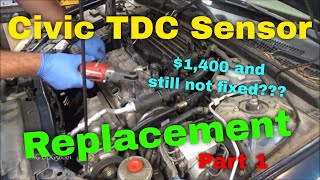
- Honda Civic (2001-2005) — Extremely common for the 7th generation (D17 engine). The TDC/Camshaft sensor is located behind the upper timing belt cover. The OEM part number is 37840-RJH-006.
- Honda Accord (1998-2002) — Frequently reported for 4-cylinder (F23A) and V6 (J30A1) models. The V6 OEM part number is 37840-P8A-305.
- Acura TL (1999-2003) — Shares powertrain components with the Honda Accord V6. Triggered by a faulty TDC sensor (OEM Part 37840-P8A-305) or water intrusion into connectors.
- Acura CL (2001-2003) — Prone to TDC sensor failures. A leaking power steering pump drips fluid onto the sensor and wiring, causing contamination and failure.
- Honda CR-V (2002-2006) — Experiences intermittent stalling and no-start conditions caused by a P1361 code related to the TDC sensor on the cylinder head.
- Chevrolet Cavalier / Malibu / Express Van (1999-2005) — The code means 'Ignition Control (IC) Circuit Low Voltage.' Diagnosis focuses on the ignition module, wiring, and system voltage, not cam/crank sensors.
- Saturn Ion / L-Series (2000-2007) — P1361 points to 'IC Circuit Low Voltage.' A weak battery or failing alternator are the primary causes.
- Ford Focus (1998-2010) — Points to an 'Ignition Control Circuit Low Voltage' issue related to the ignition coil, wiring, or a faulty PCM.
Manufacturer-Specific Notes
- Honda/Acura: The terms Top Dead Center (TDC) Sensor and Camshaft Position (CMP) Sensor are used interchangeably. On D17 and F23 engines, the sensor sits behind the upper timing belt cover.
- Ford/GM: P1361 is not related to a cam/crank sensor. It points to a low voltage issue in the Ignition Control (IC) circuit. Diagnosis must focus on the battery, alternator, and ignition coil wiring.
- Aftermarket Parts: Using cheap, non-OEM camshaft sensors guarantees repeat failures. Use OEM or reputable OE-supplier brands (like Denso for Honda) for these critical components.
Real Owner Stories
2001 Honda Civic LX with 1.7L Engine
Car lost power and stalled. It restarted after 20 minutes, but the Check Engine Light showed P1361. Stalling became frequent when hot.
What they tried:
- A dealership diagnosed the issue and quoted an expensive cylinder head replacement.
Outcome: The owner replaced the Top Dead Center (TDC) sensor instead, resolving the problem completely.
Lesson: A faulty TDC sensor is the most common cause on Hondas. Investigate the cheapest culprit before agreeing to major repairs.
2002 Honda Civic EX (~120K miles)
Immediately after a DIY timing belt replacement, the car threw P1361 and lost power on the highway with the A/C on.
What they tried:
- The owner restarted the car, but the problem repeated when A/C and cruise control were active.
Outcome: The TDC sensor connector was loose and not fully seated during the timing belt job.
Lesson: If P1361 appears right after a timing belt service, re-inspect the TDC sensor connector and wiring.
2002 Honda Civic Type-R (EP3)
Car died at idle, throwing P1361. It progressively worsened, stalling while driving and throwing a P1362 code.
What they tried:
- Replaced timing chain, TDC sensor, and crankshaft sensor.
- Swapped the ECU and camshaft sensors from a known-good car.
- Ran a new signal wire directly from the sensor to the ECU.
- Replaced a visibly corroded engine ground cable.
Outcome: Replacing the ECU was the final fix. The bad engine ground cable sent voltage spikes that damaged the original ECU.
Lesson: Check all engine and chassis ground straps for corrosion before replacing an expensive ECU.
How to Prevent This Code From Triggering
- Use OEM or High-Quality OE-Supplier Sensors (During any replacement) — Aftermarket camshaft sensors have a high failure rate. OEM parts ensure temperature tolerance and signal accuracy, preventing repeat repairs.
- Replace Sensor During Timing Belt Service (Every 90k-105k miles (or 7 years)) — On Hondas, the TDC sensor sits behind the timing cover. Replacing the $60 sensor during a $700 timing belt job requires no extra labor.
- Fix Oil Leaks Promptly (As needed) — A leaking valve cover gasket drips oil onto the sensor's wiring, degrading insulation and interfering with the electrical connection.
- Maintain Battery and Ground Connections (Annual inspection) — Corroded battery terminals or weak grounds cause low system voltage, the direct trigger for P1361 on GM and Ford vehicles.
Frequently Asked Questions
What are the most common mistakes when diagnosing a P1361?
The biggest mistake is immediately replacing the camshaft sensor without testing the wiring or checking for oil contamination. On GM/Ford vehicles, the mistake is diagnosing the cam sensor at all, since the code points to the ignition control circuit.
Can I fix a P1361 code myself?
Replacing an accessible camshaft position sensor is a straightforward DIY repair requiring basic hand tools. Stop and take the vehicle to a shop if the sensor is located behind the timing cover or if the issue involves complex wiring faults.
Why did the code come back after I replaced the sensor?
The replacement sensor was likely a low-quality aftermarket part that failed prematurely. Alternatively, the root cause is a damaged wiring harness, a loose connector, or an active oil leak contaminating the new sensor.
Can a weak battery cause a P1361 code?
Yes, specifically on Ford and GM vehicles where P1361 means 'Ignition Control Circuit Low Voltage.' The ignition system requires stable voltage to operate. If cranking voltage drops below 9.5V due to a weak battery or bad alternator, the PCM triggers this code.
My mechanic says the timing belt needs to be replaced. How is that related to code P1361?
On many Hondas, the camshaft sensor sits behind the timing belt cover, making it cost-effective to replace both simultaneously. Additionally, a stretched or slipped timing belt throws the cam and crank signals out of sync, directly triggering the code.
What happens if I just unplug the camshaft sensor?
The engine runs in a low-performance 'limp mode' without the camshaft sensor signal. It relies solely on the crankshaft sensor, resulting in reduced power, poor fuel economy, and hard starting. This is not a viable long-term solution.
Can a bad TDC sensor cause my car to overheat?
The sensor itself does not cause the engine coolant to overheat. However, severe misfires from poor timing force unburned fuel into the catalytic converter, causing the exhaust to glow red-hot. If your radiator is overheating, you have a separate cooling system failure.
Key Takeaways
- P1361 is a manufacturer-specific code indicating an intermittent Camshaft Position Sensor fault on Hondas/Acuras, or a low voltage Ignition Control circuit fault on Fords/GMs.
- Driving with P1361 is dangerous because the engine stalls unpredictably in traffic, and unburned fuel destroys the catalytic converter, adding up to $2,500 in repair costs.
- On Honda and Acura vehicles, replacing a heat-damaged Camshaft Position Sensor (OEM part 37840-RJH-006 or 37840-P8A-305) fixes the issue in the majority of cases.
- For GM and Ford vehicles, do not replace the camshaft sensor; test the battery and alternator first, as cranking voltage dropping below 9.5V triggers this code.
Helpful Videos


The information in this article is provided for general reference and educational purposes only. Vehicle specifications, procedures, and part compatibility can vary by production date, trim level, and region. Always consult your vehicle's factory service manual and verify part numbers before purchasing or performing repairs. Safety-critical components such as airbags, seat belts, and braking systems should be installed by a qualified professional.
- 🎬 Helpful Videos
- What Does P1361 Mean?
- Can I Drive With P1361?
- Common Causes
- Symptoms
- Diagnostic Flowchart
- Common Fixes & Costs
- DIY vs Professional
- Used vs. New Parts: Buying Guide
- What Happens If You Wait — Timeline
- Cost of Not Fixing It
- Diagnosis Steps
- When This Code Triggers (Freeze-Frame Conditions)
- Related Codes
- Climate & Environmental Factors
- How to Talk to a Mechanic About This Code
- Where to Take It: Dealer vs Independent vs Chain
- When to Walk Away From the Repair
- What Scan Tool You Need for This Code
- How to Clear the Code After You Fix It
- Will This Fail Emissions / State Inspection?
- Most Commonly Affected Vehicles
- Manufacturer-Specific Notes
- Real Owner Stories
- 2001 Honda Civic LX with 1.7L Engine
- 2002 Honda Civic EX (~120K miles)
- 2002 Honda Civic Type-R (EP3)
- How to Prevent This Code From Triggering
- Frequently Asked Questions
- What are the most common mistakes when diagnosing a P1361?
- Can I fix a P1361 code myself?
- Why did the code come back after I replaced the sensor?
- Can a weak battery cause a P1361 code?
- My mechanic says the timing belt needs to be replaced. How is that related to code P1361?
- What happens if I just unplug the camshaft sensor?
- Can a bad TDC sensor cause my car to overheat?
- Key Takeaways
- 🎟️ Get 5% Off