

OBD-II Code P1346: Camshaft Position Sensor Performance
What P1346 means, why it triggers, and how to fix it
- Check your engine oil level and condition first, as dirty or low oil causes over 40% of P1346 variable valve timing (VVT) faults.
- Verify your specific vehicle's code definition before buying parts; on 1998-2006 BMWs, P1346 indicates a cylinder 3 misfire, not a timing issue.
- Test the VVT solenoid's electrical resistance with a multimeter (typically 6.9-7.9 Ohms for Toyotas) before replacing the $150 camshaft position sensor.
- Stop driving and tow the vehicle to a shop if you hear a loud rattling noise on startup, as this indicates a stretched timing chain that can cause $3,000+ in engine damage.
What Does P1346 Mean?

The P1346 code means your car's powertrain control module (PCM) detects a performance issue with the camshaft position sensor system. This sensor monitors the exact rotational position of the camshaft, dictating engine timing, fuel injection, and variable valve timing (VVT). The code triggers when the camshaft signal falls outside the expected range or fails to correlate with the crankshaft position sensor.
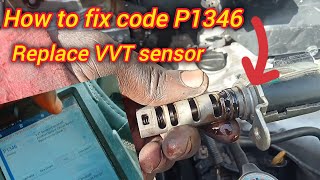
Technical definition: The SAE/OBD-II definition is "Intake Camshaft Position System Performance" or a manufacturer-specific variation like "VVT Sensor Range/Performance Problem Bank 1 🎬 Watch: How to fix P1346 on Toyota 2AZ engines". The PCM sets this code when the intake camshaft position sensor signal on bank 1 deviates from expected parameters or misaligns with the crankshaft position sensor by a specific number of degrees over two consecutive drive cycles.
Can I Drive With P1346?
Yes, But With Caution. You can drive short distances, but diagnose it immediately. The engine will run rough, lose power, and consume more fuel. Continued driving risks severe damage: a faulty VVT system dumps unburnt fuel that destroys the catalytic converter ($800-$2,500), while a stretched timing chain can jump a tooth and destroy the engine (bent valves, damaged pistons), costing upwards of $3,000.
Common Causes

- Low, dirty, or incorrect viscosity engine oil (Very Common) — The variable valve timing (VVT) system operates hydraulically via engine oil pressure. Low, dirty, or incorrect viscosity oil clogs passages and the VVT solenoid's filter screen, preventing the cam phasers from adjusting camshaft timing.
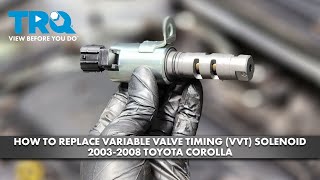
- Faulty VVT solenoid (Oil Control Valve) (Common) — This solenoid controls oil flow to the VVT system. If it clogs with sludge, sticks internally, or fails electrically, the camshaft timing remains static despite PCM commands.
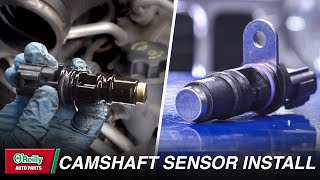
- Faulty camshaft position sensor (Common) — The sensor itself fails, weakens, or accumulates metallic debris, sending an incorrect, intermittent, or dead signal to the computer. 🎬 Watch: Step-by-step guide to replacing a camshaft position sensor
- Stretched or jumped timing chain/belt (Less Common) — If the timing chain or belt stretches or skips a tooth, the physical correlation between the camshaft and crankshaft misaligns. This is a severe mechanical failure.
- Damaged or chafed wiring harness (Uncommon) — Wiring to the camshaft position sensor or VVT solenoid frays, corrodes, or chafes against hot engine components, causing a short or open circuit.
- Failing VVT Actuator (Cam Phaser) (Uncommon) — The mechanical VVT actuator on the end of the camshaft sticks, fails internally, or breaks its locking pins, preventing timing adjustments even with a perfect VVT solenoid.
- Damaged Camshaft Reluctor Wheel (Rare) — The reluctor wheel (tone ring) on the camshaft breaks teeth or accumulates metallic debris, causing an erratic magnetic signal to the sensor.
Symptoms

- Rough idle and poor engine performance — The engine vibrates, hesitates, misfires, or stumbles during acceleration. Idle RPM fluctuates abnormally.
- Hard starting or stalling — The engine requires extended cranking before starting, or stalls unexpectedly at idle and stoplights.
- Rattling noise from engine — A stretched timing chain or failing VVT component produces a distinct rattling or ticking sound from the front of the engine, peaking on cold starts.
- Reduced fuel economy — Incorrect valve timing plummets engine efficiency, requiring more frequent refueling.
- Check Engine Light is on (also visible on scanner) — The Malfunction Indicator Lamp (MIL) illuminates on your dashboard.
Diagnostic Flowchart

Tap your situation to follow the diagnostic path that matches what you're seeing on this code.
Common Fixes & Costs
- Changing the engine oil and filter — Parts: $30-$70, Labor: $20-$50, ~0.5 hr book time (DIY)
- Replacing the VVT solenoid (Oil Control Valve)
— Parts: $50-$150, Labor: $75-$150, ~1 hr book time
(Intermediate)
Toyota Corolla (1.8L 1ZZ-FE): OEM 15330-22030 (Alt: Denso, Aisin (VVT-023), Standard Motor Products (VVT171))
Lexus RX300 (3.0L 1MZ-FE): OEM 15330-0A010 (Right), 15340-0A010 (Left) (Alt: Denso, Standard Motor Products, Dorman) - Replacing the camshaft position sensor
— Parts: $40-$120, Labor: $50-$100, ~0.9 hr book time
(DIY)
Toyota Corolla (1.8L 1ZZ-FE): OEM 90919-05043 (Alt: Denso (196-2010), NTK)
Lexus IS300 (3.0L 2JZ-GE): OEM 90919-05054 (Alt: Denso, Beck/Arnley) - Repairing damaged wiring harness — Parts: $10-$30, Labor: $100-$350, ~2.5 hr book time (Intermediate)
- Replacing the timing chain/belt and related components — Parts: $200-$600, Labor: $800-$1500, ~8 hr book time (Professional)
DIY vs Professional
- Changing the engine oil and filter — Beginner:
Tools: Wrench for drain plug, oil filter wrench, drain pan, funnel. - Replacing the VVT solenoid or Camshaft Position Sensor — Beginner:
Tools: Basic socket set (10mm), flashlight. - Repairing damaged wiring harness — Beginner:
Tools: Multimeter, wire strippers, soldering iron, heat shrink tubing. - Replacing the timing chain/belt — Beginner:
Tools: Extensive socket set, torque wrench, engine-specific timing tools, harmonic balancer puller.
Used vs. New Parts: Buying Guide
When a used part is worth it: Never buy used electronic parts like VVT solenoids and camshaft sensors. A used part likely suffers from the same internal wear or electrical fault as your broken one. Purchase new aftermarket parts from reputable brands (Denso, Aisin, NTK).
Donor-vehicle mileage cap: roughly under 50000 miles for the part to have meaningful remaining life.
Donor quality checklist:
- Require the VIN and mileage of the donor vehicle.
- Verify the exact OEM part number matches; superseded numbers contain different internal calibrations.
- Reject parts from rust-belt states to avoid hidden connector corrosion.
Decision logic:
- If The part is a sensor or solenoid (VVT, Cam Sensor) → Buy new from an OEM or reputable aftermarket supplier. Used parts guarantee premature failure and repeat labor costs.
- If The part is a major mechanical component like a timing cover and the budget is extremely tight → A used part from a low-mileage, accident-damaged vehicle is acceptable. Never install a used timing chain, belt, or tensioner.
Warranty tradeoff: Used parts carry a 30-90 day warranty that excludes labor. New aftermarket parts include a 1-year to limited lifetime warranty. New OEM parts carry a 1-year warranty.
Worst-case if a used part fails: $200-$500 if a used sensor/solenoid fails shortly after installation, requiring repeat diagnosis and labor.
What Happens If You Wait — Timeline
- 0-2 weeks: Code P1346 sets and the Check Engine Light illuminates. The driver experiences slight hesitation or a rough idle on cold starts. (MPG impact: 0-5%% · Added cost: $0)
- 2 weeks - 3 months: Symptoms escalate. Fuel economy drops noticeably. The engine idles roughly, hesitates during acceleration, and feels sluggish. A startup rattle becomes audible if the chain is stretched. (MPG impact: 5-15%% · Added cost: $50-$150 in wasted fuel.)
- 3-8 months: The engine runs consistently rich, overheating the catalytic converter. The timing chain tensioner reaches its limit, maximizing the risk of the chain skipping a tooth. (MPG impact: 15-25%% · Added cost: $1,200-$2,800 (Catalytic converter replacement).)
- 8+ months: Catastrophic failure occurs. A stretched timing chain jumps teeth, causing pistons to smash into valves. A failed VVT system causes constant stalling and a no-start condition. (MPG impact: >25%% · Added cost: $3,000-$8,000+ (Full engine replacement).)
Cost of Not Fixing It
- 0-1 month: Reduced fuel economy (5-15% drop), rough idle, and hesitation. Increased emissions. (Added cost: Negligible, other than increased fuel consumption.)
- 1-6 months: A malfunctioning VVT system forces the engine to run rich, overheating and destroying the catalytic converter. (Added cost: $1,200-$2,800)
- 6+ months: A stretched timing chain skips a tooth or breaks entirely, causing pistons to smash into valves, destroying the engine. (Added cost: $3,000-$8,000+ (Engine replacement))
Diagnosis Steps
- Check engine oil level and condition
Pull the dipstick to verify the oil level is full and the oil is clean. Dark, sludgy, or low oil is the primary trigger for VVT performance codes.
Tools: Shop towel or rag (Beginner) - Read the trouble codes and freeze frame data
Connect an OBD-II scanner to confirm P1346 and check for related codes (like P0016 or P0340). Analyze freeze frame data to identify the exact RPM and engine load when the fault occurred.
Tools: OBD-II scanner (Beginner) - Pro Tip: Test the VVT solenoid with a bidirectional scan tool
Command the VVT solenoid on and off while the engine idles using a bidirectional scanner. You must hear a click and see the engine RPM stumble or stall. No change means the solenoid is stuck, clogged, or electrically dead.
Tools: Bidirectional scan tool (Intermediate) - Test the VVT solenoid's electrical integrity
Disconnect the VVT solenoid and measure internal resistance with a multimeter. A healthy solenoid reads between 5-25 Ohms (Toyota 1ZZ-FE spec is 6.9-7.9 Ohms). Infinite resistance (open) or near-zero (short) requires immediate replacement.
Tools: Multimeter, repair manual (Intermediate) - Inspect wiring and connectors
Visually trace the wiring harness for the camshaft position sensor and VVT solenoid. Look for melted insulation, chafing against metal brackets, or corroded connector pins.
Tools: Flashlight (Beginner) - Test the camshaft position sensor with a multimeter
Backprobe the 3-wire Hall-effect sensor connector with the key on. Verify 5V power and solid ground. Pass a wrench past the sensor tip; the signal wire must toggle between 5V and 0V. No toggle means a dead sensor.
Tools: Multimeter, backprobe kit (Intermediate) - Advanced: Analyze VVT Live Data PIDs
Monitor 'VVT Desired Angle' and 'VVT Actual Angle' while driving. The actual angle must track the desired angle within +/- 5 degrees. A lagging actual angle confirms a sticky VVT actuator, low oil pressure, or a clogged solenoid.
Tools: Advanced bidirectional scan tool (Advanced) - Pro Tip: Analyze Cam/Crank correlation with an oscilloscope
Connect an oscilloscope to the camshaft and crankshaft sensor signal wires. Compare the live waveform to a known-good pattern in the repair manual. A drifting or offset cam signal definitively proves a stretched timing chain or jumped tooth.
Tools: 2-channel oscilloscope, repair manual (Advanced) - Check mechanical timing
Remove the valve cover and timing cover to visually inspect the timing marks on the camshaft and crankshaft sprockets. If they misalign by even one tooth, the timing chain/belt requires replacement and realignment.
Tools: Socket set, wrenches, repair manual (Advanced)
When This Code Triggers (Freeze-Frame Conditions)
- Engine Coolant Temp: 176-210°F (80-99°C) (The engine must reach full operating temperature for the PCM to command the VVT system through its full range.)
- Engine RPM: 1500-3000 RPM (The fault triggers during steady-state cruising or light acceleration, rarely at idle or wide-open throttle.)
- Engine Load: 20-70% (The PCM actively commands VVT changes under moderate load conditions to optimize performance.)
- Vehicle Speed: 40-60 mph (64-97 km/h) (The code sets during highway driving when the engine operates at a consistent speed and load.)
Related Codes
- P0016 — P0016 ('Crankshaft Position - Camshaft Position Correlation Bank 1 Sensor A') confirms a base mechanical timing misalignment. If paired with P1346, a stretched timing chain or jumped belt is the definitive cause.
- P0340 — P0340 ('Camshaft Position Sensor 'A' Circuit') indicates a complete electrical circuit failure. P1346 shows the performance consequence. Diagnose the P0340 electrical fault first.
- P0011 — P0011 ('Camshaft Position 'A' - Timing Over-Advanced') specifies the camshaft timing is stuck advanced. This points directly to a VVT solenoid stuck open or a failed cam phaser.
- P0012 — P0012 ('Camshaft Position 'A' - Timing Over-Retarded') specifies the camshaft timing is stuck retarded. This points directly to a clogged VVT solenoid, low oil pressure, or a stretched timing chain.
Climate & Environmental Factors
- Cold Weather: Freezing temperatures thicken engine oil, slowing the hydraulic response of the VVT system. If the cam phaser fails to reach its commanded position within the PCM's time limit during a cold start, it triggers P1346. Using the exact manufacturer-recommended winter oil viscosity is mandatory.
- High Temperatures / Severe Service: Sustained high temperatures and stop-and-go traffic accelerate oil degradation, baking it into sludge. This sludge permanently clogs the fine mesh screens inside the VVT solenoids.
How to Talk to a Mechanic About This Code
Say this: "I have a P1346 code and need a diagnostic. Based on my research, the most common causes are oil-related or a faulty VVT solenoid. Please start by checking the oil level and condition, then test the VVT solenoid's function and wiring before quoting complex mechanical issues like a timing chain."
This signals you are an informed customer. It forces the mechanic to follow a logical, cost-effective diagnostic path, preventing them from immediately quoting a $2,000 timing chain replacement without proper evidence.
Avoid saying:
- 'My check engine light is on, can you look at it?'
- 'The car is running weird, just fix it.'
- 'I think I need a new timing chain.'
Questions to ask before authorizing the repair:
- Can you show me the old part and explain exactly how it failed?
- If you recommend a timing chain: How did you confirm the timing correlation error? Can I see the oscilloscope waveform or a picture of the misaligned timing marks?
- If you recommend a VVT solenoid: What was the resistance reading of the old solenoid, and did you check its filter for sludge?
- Is this repair necessary for safety right now, or can it wait?
- What is the warranty on the parts and the labor for this specific repair?
Where to Take It: Dealer vs Independent vs Chain
- Dealer:
Best for: Vehicles still under powertrain warranty., Complex manufacturer-specific quirks (e.g., the BMW misfire definition for P1346)., When a definitive, manufacturer-backed diagnosis is required after other shops fail.
Downsides: Highest labor rates, often 1.5-2x more than independent shops., Dealers frequently recommend replacing entire assemblies when only one component failed. (Typical cost: +50% vs. baseline) - Independent Shop:
Best fit for most vehicles. A reputable independent shop handles everything from oil issues and VVT solenoid replacement to a full timing chain job at a reasonable cost.
Best for: Out-of-warranty vehicles where cost is a major factor., Common codes like P1346 on well-known platforms (e.g., Toyota/Lexus VVT-i issues)., Building a long-term relationship with a trusted mechanic.
Downsides: Quality and expertise vary widely; vetting the shop's ASE certifications is crucial., May lack the latest manufacturer-specific diagnostic software for brand-new models. (Typical cost: +0% vs. baseline) - Chain Shop:
AVOID for diagnosis. Only use for a simple oil change. Do not trust them to diagnose a VVT system or a potential timing chain issue.
Best for: Performing a basic oil and filter change if you suspect dirty oil is the sole cause.
Downsides: Technician skill is highly variable., Ill-equipped for the in-depth electrical or mechanical diagnostics required for P1346., High pressure to upsell services; frequently misdiagnoses complex timing issues. (Typical cost: -10% vs. baseline)
When to Walk Away From the Repair
If the estimated repair cost exceeds 40-50% of the car's private-party value, sell or trade it in.
- Car worth $4000, fix is $1800: Walk away. The repair cost is 45% of the car's value. For a major mechanical job like a timing chain, other age-related failures will follow.
- Car worth $12000, fix is $1800: Fix it. The repair is 15% of the vehicle's value and is a worthwhile investment to keep a valuable car running.
- Car worth $3000, fix is $350: Fix it. If the diagnosis points to a simple VVT solenoid or sensor, this inexpensive repair falls well under the threshold.
What Scan Tool You Need for This Code
Minimum: A scanner that reads live data, specifically the VVT 'desired' vs 'actual' angle PIDs. A basic code reader is useless for this diagnosis.
A $20 code reader only confirms the P1346 code exists. It cannot determine if the cause is a slow VVT solenoid, a wiring issue, or a stretched timing chain. You need live data to view real-time system performance.
Budget: BlueDriver Pro (~$90) — Connects to your smartphone to display live data, including graphing VVT angles. It provides freeze-frame data and generates repair reports based on verified fixes.
Mid-range: Innova 5610 or Foxwell NT510 Elite (~$320) — Handheld units with bidirectional control. This allows you to actively command the VVT solenoid on and off to test its mechanical function, a critical diagnostic step for P1346.
Professional: Autel MaxiCOM MK808S (~$500) — A full-featured diagnostic tablet with robust bidirectional controls, extensive live data graphing, and access to manufacturer-specific codes. It is the closest a DIYer can get to a professional shop tool.
How to Clear the Code After You Fix It
- Use an OBD-II scan tool to clear the diagnostic trouble codes.
- Perform a cold soak by letting the vehicle sit for at least 8 hours.
- Complete the manufacturer-specific drive cycle to allow readiness monitors to run.
Drive cycle (~20 minutes): After a cold start, idle for 5 minutes. Drive at a steady speed between 40-55 mph for 3-5 minutes. Drive with varied throttle input in city conditions for 10 minutes. Allow the engine to idle for 3 minutes before shutting it off.
Readiness monitors affected: Catalyst (CAT) monitor, Evaporative System (EVAP) monitor, Oxygen (O2) Sensor monitor
Before emissions retest: drive at least 50 miles to fully set monitors.
Watch out for:
- Disconnecting the battery clears the code but resets all readiness monitors to 'Not Ready', guaranteeing an emissions test failure.
- The code returns immediately if the underlying mechanical timing fault remains unaddressed.
- Failing to perform a full drive cycle leaves monitors incomplete, resulting in an automatic emissions failure.
Will This Fail Emissions / State Inspection?
Yes — this code typically fails an OBD-II emissions inspection.
- California: An active P1346 code is an automatic smog check failure. All OBD-II readiness monitors must read 'Ready' (except the EVAP monitor on specific older models) to pass.
- New York: The NYS vehicle inspection includes an OBD-II scan. An illuminated Check Engine Light and stored P1346 code trigger an automatic failure.
- Texas: In the 17 counties requiring emissions testing, an illuminated Check Engine Light causes an automatic failure. After repair, readiness monitors must be set to 'Ready' to pass.
Most Commonly Affected Vehicles
- Toyota Corolla (2003-2008) — Frequently caused by a stretched timing chain on the 1.8L (1ZZ-FE) engine or a failed VVT solenoid (OCV).
- Lexus RX300 (1999-2003) — Plagued by sludge buildup clogging the two VVT solenoids on the 3.0L 1MZ-FE V6. If the code appears immediately after a timing belt change, the belt is off by a tooth.
- Lexus IS300 (2001-2005) — Directly linked to the VVT-i system on the 2JZ-GE engine. Prioritize testing the oil control valve (OCV) and cleaning its filter screen.
- Toyota Camry (2002-2009) — The 2.4L (2AZ-FE) engine triggers this code due to faulty VVT solenoids and oil consumption issues.
- General Motors (GM) Various models with VVT (2000-2015) — Indicates an intake camshaft position performance problem. Follow standard diagnostic paths for oil, sensors, and solenoids.
- Chevrolet Silverado (2019-2020) — Triggers a similar code (U1346) due to a factory wiring harness that is too short, causing chafing and electrical faults. Check for active TSBs.
- BMW 3-Series (E46), 5-Series (E39) (1998-2006) — CRITICAL: On BMWs, P1346 means 'Misfire During Start Cylinder 3'. It is NOT a VVT or timing code. Diagnose the ignition coil, spark plug, or fuel injector for cylinder 3.
- Toyota Echo / Vitz (2000-2005) — Triggered by a stretched timing chain or incorrect mechanical timing after a chain replacement on the 1.5L (1NZ-FE) engine.
Manufacturer-Specific Notes
- Toyota/Lexus: This code almost exclusively relates to the VVT-i system. Always diagnose the Oil Control Valve (OCV) solenoid and its filter screen before suspecting base mechanical timing.
- BMW: CRITICAL: P1346 means 'Misfire During Start Cylinder 3'. It has zero relation to camshaft timing. Diagnosing it as a timing issue guarantees wasted money.
- General Motors (GM): Certain GM models have Technical Service Bulletins (TSBs) for chafed wiring harnesses causing this fault. Always check your VIN against GM TSB databases.
- Ford: P1346 translates to 'Lost Communication With Hybrid Powertrain Control Module on Bus B' on specific hybrid models. Verify the code definition for your exact year and model.
- Hyundai/Kia: Scanners often misread B1346 as P1346. B1346 is 'Driver Airbag Resistance Too High', an SRS/airbag system fault completely unrelated to the engine.
Real Owner Stories
2000 Lexus RX300 with 98K miles - A Misdiagnosis Story
Check Engine Light (P1346) appeared shortly after a shop replaced the timing belt and water pump. The car ran fine.
What they tried:
- The shop misdiagnosed the issue as a bad O2 sensor and replaced it, but the light returned.
- The owner researched the code and discovered it indicated a timing correlation problem.
Outcome: The owner informed the mechanic that P1346 after a timing belt job guarantees the timing is off by a tooth. The mechanic re-did the job, correctly aligning the timing marks, permanently fixing the code.
Lesson: If P1346 appears immediately after a timing belt or chain replacement, the mechanical timing is incorrect. Refuse other parts replacements until the shop verifies physical timing alignment.
2001 Lexus IS300 at 215K miles - The Long-Ignored Light
The car drove with a P1346 light for over 55,000 miles following a timing belt change. The car exhibited no noticeable performance issues or rough idle.
What they tried:
- The owner cleaned the VVT solenoid's oil filter, which failed to resolve the code.
Outcome: The issue remained unresolved. The engine ran inefficiently for years, risking severe damage due to a minor timing misalignment.
Lesson: A lack of symptoms does not mean the engine is healthy. The root cause—incorrect timing from the belt job—was never addressed, leaving the engine vulnerable to catastrophic failure.
1999 Lexus RX300 - The Sludge Fix
The car triggered P1346 and failed a smog test. The owner experienced poor low-end torque in cold weather prior to the light illuminating.
What they tried:
- Shop A misdiagnosed and replaced the camshaft position sensor.
- Shop B identified a sticking Bank 1 Oil Control Valve (OCV) and cleaned it, but the problem persisted.
- The owner decided to DIY the repair.
Outcome: The owner replaced both Bank 1 and Bank 2 OCVs (VVT solenoids), replaced their respective mesh filters, and performed an oil change. This resolved the code permanently.
Lesson: P1346 on high-mileage Toyotas/Lexus is almost always a sludge-clogged VVT solenoid. Replacing the solenoid and its tiny filter screen is the definitive fix.
2004 BMW 3-Series (E46) - The *Critical* Exception
The owner pulled a P1346 code while the car misfired and ran rough.
What they tried:
- Swapped the ignition coil from cylinder 3 to cylinder 1.
- Cleared the codes. The misfire moved, triggering a new P1343 (Misfire Cylinder 1) code.
Outcome: The problem was a single bad spark plug in cylinder 3. Replacing the spark plug completely resolved the issue.
Lesson: On a BMW, P1346 means 'Misfire During Start Cylinder 3'. It has zero relation to timing chains or VVT solenoids. Always verify the code definition for your specific vehicle.
How to Prevent This Code From Triggering
- Perform regular oil changes with high-quality synthetic oil (Every 5,000 miles) — Clean, correct-viscosity oil prevents sludge formation that clogs VVT solenoid filters and oil passages, ensuring the hydraulic system functions flawlessly.
- Use an engine flush product before an oil change on high-mileage engines (Once when acquiring a used vehicle, or every 40k miles for short-trip drivers.) — Engine flushes dissolve existing sludge and deposits that regular oil changes miss, clearing the microscopic passages critical to the VVT system.
- Replace the VVT solenoid (OCV) filter screen (Whenever replacing the VVT solenoid or performing a valve cover gasket job.) — This tiny filter is the last line of defense for the VVT solenoid. It clogs with debris, starving the solenoid of oil pressure.
- Avoid frequent short trips and allow the engine to fully warm up (Daily habit) — Short trips prevent engine oil from reaching optimal temperature, allowing moisture and fuel to accumulate and accelerate sludge formation.
- Adhere to the timing belt/chain replacement interval (Per manufacturer's specification (typically 90k-120k miles)) — Replacing timing components preventively avoids stretching or breaking, which triggers P1346 and causes catastrophic engine failure.
Frequently Asked Questions
What are the most common misdiagnosis mistakes for P1346?
The top mistake is replacing the camshaft position sensor without checking the engine oil level and condition first. Another error is ignoring mechanical timing alignment after a recent timing chain or belt replacement. Finally, failing to check manufacturer-specific definitions (like BMW's misfire code) leads to completely wrong repairs.
I just replaced my timing chain/belt and now I have a P1346 code. What happened?
The mechanical timing was set incorrectly during installation. The camshaft and crankshaft sprockets are misaligned by at least one tooth. The engine requires disassembly to correctly align all timing marks according to the service manual.
Can I clean a VVT solenoid?
Yes, if the solenoid is clogged with oil sludge, cleaning it and its mesh filter screen restores function. However, if the solenoid fails an electrical resistance test or sticks internally, cleaning fails and replacement is mandatory.
My car seems to run fine, but the P1346 code is on. Can I ignore it?
Do not ignore it. The code indicates an engine timing error that reduces fuel efficiency and increases emissions. Ignoring it allows a minor issue, like a failing chain tensioner, to escalate into catastrophic engine failure.
What does a bad VVT solenoid sound like?
A failing VVT solenoid causes a distinct rattling or ticking noise from the top of the engine. This sound peaks at idle or during a cold start as the system struggles with incorrect oil pressure.
How much does it cost to fix a P1346 code?
An oil change costs under $100, while replacing a VVT solenoid ranges from $150 to $400. Wiring repairs cost $100 to $350. Replacing a stretched timing chain is a major job costing $1,000 to $2,100.
Will a P1346 code clear itself?
A P1346 code will not clear itself. The PCM verified a persistent performance or correlation fault over two separate drive cycles. You must diagnose and repair the underlying mechanical or electrical problem to resolve the code permanently.
Can a bad VVT solenoid cause a no-start condition?
A bad VVT solenoid rarely causes a complete no-start. It directly causes extended cranking times, hard starting, and frequent stalling, especially when the engine reaches operating temperature.
Key Takeaways
- Check your engine oil level and condition first, as dirty or low oil causes over 40% of P1346 variable valve timing (VVT) faults.
- Verify your specific vehicle's code definition before buying parts; on 1998-2006 BMWs, P1346 indicates a cylinder 3 misfire, not a timing issue.
- Test the VVT solenoid's electrical resistance with a multimeter (typically 6.9-7.9 Ohms for Toyotas) before replacing the $150 camshaft position sensor.
- Stop driving and tow the vehicle to a shop if you hear a loud rattling noise on startup, as this indicates a stretched timing chain that can cause $3,000+ in engine damage.
Helpful Videos


The information in this article is provided for general reference and educational purposes only. Vehicle specifications, procedures, and part compatibility can vary by production date, trim level, and region. Always consult your vehicle's factory service manual and verify part numbers before purchasing or performing repairs. Safety-critical components such as airbags, seat belts, and braking systems should be installed by a qualified professional.
- 🎬 Helpful Videos
- What Does P1346 Mean?
- Can I Drive With P1346?
- Common Causes
- Symptoms
- Diagnostic Flowchart
- Common Fixes & Costs
- DIY vs Professional
- Used vs. New Parts: Buying Guide
- What Happens If You Wait — Timeline
- Cost of Not Fixing It
- Diagnosis Steps
- When This Code Triggers (Freeze-Frame Conditions)
- Related Codes
- Climate & Environmental Factors
- How to Talk to a Mechanic About This Code
- Where to Take It: Dealer vs Independent vs Chain
- When to Walk Away From the Repair
- What Scan Tool You Need for This Code
- How to Clear the Code After You Fix It
- Will This Fail Emissions / State Inspection?
- Most Commonly Affected Vehicles
- Manufacturer-Specific Notes
- Real Owner Stories
- 2000 Lexus RX300 with 98K miles - A Misdiagnosis Story
- 2001 Lexus IS300 at 215K miles - The Long-Ignored Light
- 1999 Lexus RX300 - The Sludge Fix
- 2004 BMW 3-Series (E46) - The *Critical* Exception
- How to Prevent This Code From Triggering
- Frequently Asked Questions
- What are the most common misdiagnosis mistakes for P1346?
- I just replaced my timing chain/belt and now I have a P1346 code. What happened?
- Can I clean a VVT solenoid?
- My car seems to run fine, but the P1346 code is on. Can I ignore it?
- What does a bad VVT solenoid sound like?
- How much does it cost to fix a P1346 code?
- Will a P1346 code clear itself?
- Can a bad VVT solenoid cause a no-start condition?
- Key Takeaways
- 🎟️ Get 5% Off