

OBD-II Code P1335: EGR Position Sensor or Crankshaft Position Sensor Fault
What P1335 means, why it triggers, and how to fix it
- P1335 indicates a Crankshaft Position Sensor failure on Nissan, GM, and Toyota vehicles, a stuck EGR valve on Fords, or a vacuum leak on VW and Audi models.
- Ford 6.0L and 6.4L Power Stroke engines trigger P1335 when carbon buildup jams the EGR valve, often requiring a $300 to $800 valve replacement.
- Nissan and Infiniti vehicles require an OEM Hitachi crankshaft position sensor to permanently clear P1335, as aftermarket sensors fail at a high rate.
- Volkswagen and Audi owners must perform a smoke test to find vacuum leaks, as P1335 indicates an 'Engine Torque Monitoring' fault rather than a sensor failure.
- Driving with an active P1335 code risks sudden engine stalling in traffic and causes unburned fuel to destroy the catalytic converter within 1 to 3 months.
What Does P1335 Mean?

P1335 is a manufacturer-specific code with entirely different definitions depending on your vehicle. On Ford models, it indicates a fault with the Exhaust Gas Recirculation (EGR) valve's position sensor. On Nissan, GM, and Toyota vehicles, it points to a Crankshaft Position Sensor (CKP) circuit failure. On Volkswagen and Audi, it signifies an 'Engine Torque Monitoring' issue caused by unmetered air entering the engine, not a specific part failure.
Technical definition: There is no single official SAE/ISO definition for P1335. Common definitions include: Ford: 'EGR Position Sensor Minimum/Maximum Stop Performance'; Nissan/Infiniti: 'Crankshaft Position Sensor (REF) Circuit Malfunction'; Toyota: 'Crankshaft Position Sensor Circuit Fault During Running'; GM: 'Crankshaft Position Sensor (CKP) Circuit'; VW/Audi: 'Engine Torque Monitoring 2 Control Limit Exceeded'; Honda: 'A misfire causes an unexpected change in the crankshaft speed.'
Can I Drive With P1335?
Yes, But With Caution. You can drive the vehicle, but do not exceed a few miles. Depending on the cause, the engine stalls suddenly, struggles to start, or runs with significantly reduced power, creating a safety risk in traffic. If a misfire or stuck-open EGR valve causes the code, continuing to drive dumps unburned fuel into the exhaust, destroying the catalytic converter and turning a $200 sensor repair into a $2,500 replacement.
Common Causes

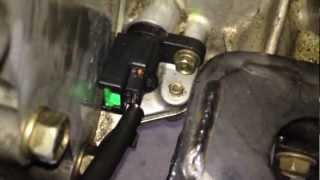
- Failed Crankshaft Position Sensor (CKP) (Nissan, GM, Toyota, Hyundai) (Very Common) — The sensor fails internally due to heat and age, sending an incorrect or no signal to the engine computer. This is the primary cause for CKP-related P1335 codes.
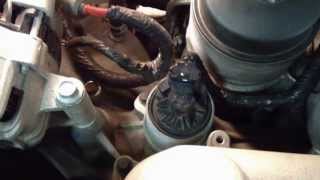
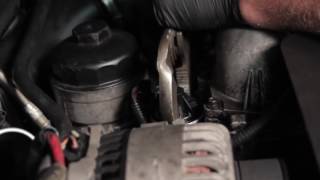
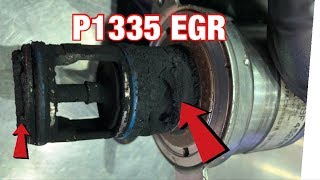
- Faulty or Sticking EGR Valve (Ford) (Very Common) — Heavy carbon buildup from exhaust gases causes the EGR valve's pintle to stick, preventing it from closing or opening properly. 🎬 Watch: How to remove and clean a stuck Ford EGR valve. The position sensor reports a voltage outside the expected range, triggering the code.
- Vacuum Leaks (VW/Audi) (Common) — Unmetered air entering the engine after the Mass Airflow (MAF) sensor from a cracked hose, faulty PCV valve, or bad intake manifold gasket causes the PCM's calculated engine torque to differ from the actual torque, triggering a P1335 'Torque Monitoring' fault.
- Failing EGR Cooler (Ford Power Stroke) (Common) — On Ford 6.0L and 6.4L engines, the EGR cooler becomes restricted or leaks internally. Excessively hot exhaust gases reach the EGR valve, causing it to fail prematurely or stick. A failing cooler is the root cause of recurring P1335 codes.
- Damaged Wiring or Corroded Connector (Common) — The wiring harness for the EGR valve or CKP sensor sustains damage from engine heat, vibration, or abrasion. Pins in the electrical connector corrode or push out, leading to a poor or intermittent signal.
- Oil or Debris Contamination on Sensor (Less Common) — An engine oil leak from a nearby seal contaminates the crankshaft position sensor and its connector. This oil interferes with the electrical signal, causing intermittent faults.
- Aggressive Aftermarket Tune (VW/Audi) (Less Common) — An aftermarket engine tune that significantly increases torque causes the actual engine output to exceed the limits expected by the PCM's monitoring software, triggering a P1335 code. 🎬 See this quick explanation of Audi and VW torque monitoring faults.
- Damaged Crankshaft Reluctor Ring (Rare) — The CKP sensor reads teeth on a metal ring (reluctor) to determine crankshaft speed. If this ring is damaged, has broken teeth, or is misaligned, it causes an erratic signal the PCM cannot interpret.
- Failed Powertrain Control Module (PCM) (Rare) — The engine's computer (PCM) fails and cannot correctly interpret the signal from the sensor, setting the code falsely. This is the last item to suspect after ruling out all other possibilities.
Symptoms

- Check Engine Light is On — The Malfunction Indicator Lamp (MIL) illuminates on the dashboard. On VW/Audi vehicles, the EPC (Electronic Power Control) light also illuminates.
- Engine is Hard to Start or Cranks Excessively — Common with a CKP sensor issue on Nissan vehicles, the engine turns over for several seconds before starting, or fails to start entirely.
- Rough Idle or Stalling — The engine runs erratically, shakes at a stop, or shuts off unexpectedly. This happens with a stuck EGR valve or a failing CKP sensor.
- Reduced Engine Power and Poor Acceleration — The vehicle feels sluggish and unresponsive. Ford trucks display a 'Reduced Power' message, while VW/Audi models enter 'limp mode'.
- Black or White Smoke from Exhaust (Ford) — A stuck-open EGR valve causes an overly rich fuel condition, resulting in black smoke. A failed EGR cooler leaking coolant into the exhaust produces clouds of white smoke.
- Poor Fuel Economy — Incorrect ignition timing or an improper air-fuel mixture decreases fuel efficiency by 5-15%.
Diagnostic Flowchart
Tap your situation to follow the diagnostic path that matches what you're seeing on this code.
Common Fixes & Costs
- Replace the Crankshaft Position Sensor (Nissan, GM, Toyota, Hyundai) — Parts: $40-$150, Labor: $100-$250, ~1.8 hr book time (DIY)
- Clean or Replace the EGR Valve (Ford) — Parts: $150-$450, Labor: $150-$350, ~1.5 hr book time (Intermediate)
- Repair Vacuum Leak (VW/Audi) — Parts: $20-$150, Labor: $150-$300, ~2 hr book time (DIY)
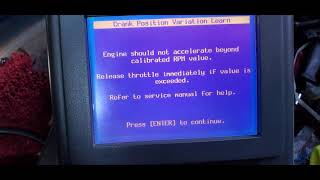
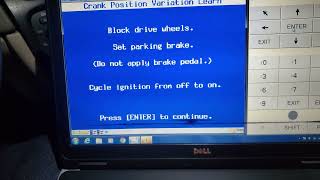
- Perform Crankshaft Variation Relearn Procedure (GM) — Parts: $0, Labor: $100-$180, ~0.8 hr book time (Professional)
- Repair Damaged Wiring or Connector — Parts: $10-$50, Labor: $100-$250, ~2 hr book time (Intermediate)
- Replace the EGR Cooler (Ford 6.0L/6.4L Power Stroke) — Parts: $250-$700, Labor: $400-$800+, ~8 hr book time (Advanced)
Used vs. New Parts: Buying Guide
When a used part is worth it: For electronic parts like Crankshaft Sensors and EGR valves, buying used guarantees premature failure. The labor cost to install the part exceeds the part cost, making a used part a costly gamble. Only consider used parts for a low-budget, temporary repair where the part is easily accessible.
Donor-vehicle mileage cap: roughly under 50000 miles for the part to have meaningful remaining life.
Donor quality checklist:
- For EGR valves, a used part is as clogged with carbon as the part it replaces.
- For Crankshaft sensors, heat and age cause internal failure; a used sensor has unknown remaining life.
- Verify the exact part number matches; manufacturer revisions are common and do not interchange.
Decision logic:
- If The part is a Crankshaft Position Sensor → Buy new from an OEM or reputable aftermarket brand. For Nissan/Infiniti, OEM (Hitachi) is mandatory as aftermarket versions have a high failure rate.
- If The part is an EGR valve → Buy a new assembly. Cleaning is a temporary fix, and a used valve from a salvage yard is a significant risk.
- If You are a DIYer on a tight budget and the part is easy to access → A used part is a viable short-term option, but accept the high risk of immediate failure.
Warranty tradeoff: Used parts from a salvage yard carry a 30-90 day warranty on the part only, not the labor. A new aftermarket part carries a 1-year to limited lifetime warranty. An OEM part provides the best quality assurance.
Worst-case if a used part fails: $250-$500 if a used part fails shortly after installation, requiring repeat labor costs plus the cost of another part.
What Happens If You Wait — Timeline
- 0-1 month: Check Engine Light illuminates. Vehicle has a slightly rough idle or intermittent hesitation, but is drivable. The fault is logged in the PCM. (MPG impact: 0-5%% · Added cost: $0)
- 1-3 months: Symptoms become frequent, including stalling at idle, long crank times, or noticeable power loss. Unburned fuel from an incorrect mixture consistently overheats the catalytic converter. (MPG impact: 5-15%% · Added cost: $50-$200 in wasted fuel)
- 3-6 months: The catalytic converter's internal ceramic substrate cracks or melts from sustained high temperatures. Power loss is significant, and the exhaust glows red after a long drive. (MPG impact: 15-25%% · Added cost: $1,500 - $2,500 (Catalytic converter replacement is unavoidable))
- 6+ months: Total catalytic converter meltdown completely blocks the exhaust path. The engine has no power and fails to run. In Ford 6.0L cases, a failed EGR cooler leads to coolant ingestion and catastrophic engine damage. (MPG impact: 25-50%+% · Added cost: $1,800 - $4,000+ (Includes converter, O2 sensors, and engine diagnostic work))
Cost of Not Fixing It
- Immediate: Unexpected stalling, no-start condition, or significantly reduced engine power, creating a serious safety hazard in traffic. Fuel economy drops by 5-15%. (Added cost: $0)
- 1-6 Months: Unburned fuel continuously enters the exhaust, overheating the catalytic converter and causing irreversible damage to its internal ceramic structure. (Added cost: $1,500-$3,500)
- 6+ Months: Guaranteed catalytic converter failure, leading to an automatic emissions test fail and a completely clogged exhaust that prevents the engine from running. (Added cost: $1,800-$4,000+)
Diagnosis Steps

- Identify Your Vehicle's Definition for P1335
Determine what P1335 means for your specific make and model. Search '[Your Car Make] P1335' to confirm if you are diagnosing an EGR, Crankshaft Position Sensor, or Torque Monitoring issue.
Tools: OBD-II Scanner, Internet Access (Beginner) - Analyze Freeze Frame Data
Use an OBD-II scanner to view freeze frame data. This snapshot shows engine conditions (RPM, temperature, speed) at the moment the code set, providing clues if the code triggers at a specific RPM or temperature.
Tools: OBD-II Scanner (Beginner) - Visual Inspection
Inspect the EGR valve or CKP sensor. Check the wiring harness for melting, chafing, or breaks. Ensure the electrical connector is securely plugged in and check for corrosion or oil contamination on the pins.
Tools: Flashlight (Beginner) - Check Sensor Voltage/Resistance (DIY)
For a Ford EGR, back-probe the position sensor wire with a multimeter. With key on/engine off, a closed valve reads 0.8V-1.2V. A reading above 3.0V indicates a stuck-open valve. For a Nissan CKP sensor, measure resistance between terminals (typically 470-570 Ohms). Infinite resistance means the sensor is dead.
Tools: Digital Multimeter, Vehicle-specific wiring diagram (Intermediate) - Check for Carbon Buildup (EGR Systems)
Remove the Ford EGR valve. Inspect it and the intake manifold port for thick, black soot. A heavily carboned-up valve is the primary culprit. If the valve is clean but the code returns, suspect a failing EGR cooler.
Tools: Socket set, Gasket scraper, Carb cleaner (Intermediate) - Check Live Data PIDs
Monitor the live data PID for the relevant sensor. For Ford, monitor 'EGR_VPWR'. At warm idle, commanded percentage is 0% and voltage is 0.8V-1.2V. For a CKP code, monitor engine RPM while cranking. An RPM reading of 0 confirms a failed CKP sensor or circuit.
Tools: Advanced OBD-II Scan Tool (Advanced) - Perform a Crankshaft Position Sensor Relearn (GM)
On GM vehicles, replacing the crankshaft sensor requires a 'CASE relearn' procedure to calibrate the new sensor to the PCM. Skipping this step guarantees the P1335 code persists.
Tools: Bidirectional Scan Tool (Advanced) - Analyze the Waveform with an Oscilloscope
View the CKP sensor output on an oscilloscope. A good Hall-effect sensor shows a clean 0V-5V square wave. A Variable Reluctance sensor produces a consistent AC sine wave. Gaps or noise point directly to a bad sensor, wiring issue, or damaged reluctor ring.
Tools: Digital Oscilloscope, Back-probe pins (Advanced) - Use a Manufacturer-Specific Scan Tool (Ford)
For Ford Power Stroke engines, use a high-end scan tool to run an 'EGR System Test'. This commands the EGR valve to open and close, graphing its position sensor feedback to definitively confirm if the valve is sticking.
Tools: Ford IDS or equivalent bidirectional scan tool (Advanced)
When This Code Triggers (Freeze-Frame Conditions)
- Engine Coolant Temp: 175-210°F (The engine reaches full operating temperature, allowing the PCM to run diagnostic monitors.)
- Engine RPM: 1200-3000 RPM (The code sets during light-load, steady-state driving when the EGR or CKP self-tests are performed.)
- Vehicle Speed: 30-65 mph (Occurs during city or highway cruise conditions where engine parameters are stable enough for the PCM to detect inconsistencies.)
- Engine Load: 20-50% (The fault is detected under moderate engine load, the typical condition for EGR valve operation or torque monitoring calculations.)
Related Codes
- P0335 — This is the generic code for 'Crankshaft Position Sensor 'A' Circuit Malfunction.' On a Toyota, P1335 triggers if the fault occurs while the engine runs above 1,000 RPM, whereas P0335 sets during cranking. On a Nissan, P1335 points to the REF sensor, while P0335 points to the POS sensor.
- P0404 — 'EGR Control Circuit Range/Performance.' On a Ford, P0404 means the PCM commanded the EGR valve to a position, but the sensor reports it is elsewhere. P1335 means the sensor reports a physically impossible value, indicating a mechanical jam.
- P0401 — 'EGR Flow Insufficient Detected.' On a Ford with P1335, this code appears if the EGR valve is stuck closed or passages are clogged. P1335 points to the valve's position being wrong, and P0401 points to the result (insufficient flow).
- P1336 — On Nissan vehicles, P1336 means the PCM detects chipped or damaged teeth on the flywheel or signal plate. Visually inspecting the flywheel teeth is necessary when P1336 is present alongside P1335.
Climate & Environmental Factors
- Extreme Heat: High engine bay temperatures cause the internal electronics of a crankshaft position sensor to fail or 'drift', sending inaccurate signals as it heats up. It also makes wiring insulation brittle and prone to cracking.
- Extreme Cold: Very low temperatures freeze moisture inside a sensor or connector, leading to a poor connection. It makes sensor housings brittle and increases electrical resistance in the wiring, causing a no-start condition.
- High Humidity / Moisture: Moisture penetrates non-sealed connectors or cracks in the sensor housing, corroding the electrical pins. This corrosion increases resistance and causes an intermittent or lost signal.
How to Talk to a Mechanic About This Code
Say this: "I have a P1335 code on my [Ford/Nissan/VW]. I'd like to schedule a diagnostic. Based on the make, I suspect it's the [EGR valve/crankshaft sensor/a vacuum leak], so please start by checking that."
This signals you've done your research. It directs the technician's focus, saving diagnostic time and preventing them from starting with broad, unnecessary checks. It sets a collaborative tone and reduces upsells.
Avoid saying:
- 'Just fix whatever's wrong'
- 'My check engine light is on, can you look at it?'
- 'My buddy says it's the...'
Questions to ask before authorizing the repair:
- For a Ford: Did you check the EGR position sensor voltage with the key on, engine off? What was the reading?
- For a Nissan: Are you recommending an OEM Hitachi sensor? I've read aftermarket sensors are unreliable for this part.
- For a GM: Does your estimate include the CASE relearn procedure required after replacing the crank sensor?
- For a VW/Audi: Did you perform a smoke test to check for vacuum leaks before recommending any parts?
- Can you provide a written estimate that breaks down parts and labor costs?
Where to Take It: Dealer vs Independent vs Chain
- Dealer:
Best for: Vehicles still under a powertrain or emissions warranty., Complex manufacturer-specific quirks, like a VW/Audi 'Torque Monitoring' fault., Performing required procedures like a GM CASE relearn if a trusted independent shop isn't available.
Downsides: Significantly higher labor rates, often 1.5x to 2x more than independent shops., Defaults to replacing entire assemblies instead of smaller failed components. (Typical cost: +50% vs. baseline) - Independent Shop:
Best overall fit. A reputable independent shop handles the most common causes of P1335 across all makes and offers the best balance of expertise and value.
Best for: Out-of-warranty vehicles where cost is a factor., Common, well-documented P1335 fixes like a Ford EGR valve or a Nissan/Toyota crank sensor., Finding a mechanic who performs the GM CASE relearn for a reasonable fee ($35-$55) after a DIY repair.
Downsides: Quality and diagnostic capabilities vary widely; check reviews and ASE certifications., Lacks the latest manufacturer-specific tools for very new models. (Typical cost: +0% vs. baseline) - Chain Shop:
High risk for misdiagnosis. Only consider for a simple crank sensor replacement if you are certain that is the problem. AVOID for diagnosing a VW/Audi P1335 or a recurring Ford EGR issue.
Best for: Simple, straightforward part replacements where the diagnosis is already certain.
Downsides: Technician skill varies dramatically., High pressure to upsell services like fluid flushes., Unfamiliar with manufacturer-specific quirks (e.g., VW vacuum leaks, Nissan OEM sensor needs, GM relearn procedures). (Typical cost: -10% vs. baseline)
When to Walk Away From the Repair
If the estimated repair cost exceeds 40-50% of the car's Kelley Blue Book (KBB) private-party value, seriously consider selling or trading in the vehicle rather than repairing it.
- Car worth $8000, fix is $750: Fix it. A typical crank sensor or EGR valve replacement is well below the threshold and is a standard repair for a vehicle of this value.
- Car worth $4500, fix is $1800: Borderline. This repair cost (typical for a Ford 6.0L EGR cooler replacement) is approaching 40% of the vehicle's value. Get a second opinion before authorizing the repair.
- Car worth $2000, fix is $1500: Walk away. The repair cost is a huge percentage of the car's value. It is not economically sensible to proceed.
What Scan Tool You Need for This Code
Minimum: A scanner that reads manufacturer-specific codes and displays live data PIDs (Parameter IDs).
A basic $20 code reader only gives the 'P1335' number, which is useless without knowing your car's make. You need live data like 'Engine RPM' during cranking or 'EGR Position' voltage to properly diagnose the fault.
Budget: BlueDriver Pro (~$100) — Connects to your smartphone and reads enhanced codes while graphing live data, essential for monitoring sensor outputs in real-time to see if they function correctly.
Mid-range: Foxwell NT510 Elite / XTool A30M (~$150) — Offers bidirectional controls, critical for GM owners to command the mandatory 'CASE relearn' procedure after a crank sensor replacement. Provides deeper access to manufacturer-specific systems.
Professional: Autel MaxiCOM MK808 (~$500) — Provides full bidirectional control, all service functions including the GM CASE relearn, and access to all vehicle modules. Definitively diagnoses P1335 on any make by running active tests.
Rent vs buy: For a one-time diagnosis, auto parts stores scan codes for free, but their tools lack live data or special functions. If you have a GM vehicle and need a CASE relearn, buying a mid-range scanner is cheaper than paying a dealership's 1-hour minimum labor charge.
How to Clear the Code After You Fix It
- Use an OBD-II scan tool to clear stored Diagnostic Trouble Codes (DTCs).
- Ensure the fuel tank is between 15% and 85% full.
- Perform a complete OBD-II drive cycle to allow the vehicle's readiness monitors to run and complete their self-tests.
Drive cycle (~30 minutes): A generic drive cycle includes: 1) Cold start after an 8+ hour soak. 2) Idle for 2-3 minutes. 3) Drive at a steady 25-45 mph for 5-10 minutes. 4) Accelerate to and maintain a steady highway speed (55-65 mph) for 10-15 minutes. 5) Coast down to a lower speed without braking. 6) Idle for another 2 minutes before shutting down.
Readiness monitors affected: EGR System, Catalyst (CAT), Oxygen (O2) Sensor, Comprehensive Component Monitor (CCM)
Before emissions retest: drive at least 100 miles to fully set monitors.
Watch out for:
- Simply disconnecting the battery clears the code but resets all readiness monitors to 'incomplete', guaranteeing an emissions test failure.
- The code returns immediately if the root cause (e.g., bad wiring, clogged EGR cooler) was not fixed.
- The EVAP system monitor is the last and most difficult to set, but most states allow a vehicle to pass with one monitor 'not ready'.
Will This Fail Emissions / State Inspection?
Yes — this code typically fails an OBD-II emissions inspection.
- California: An active P1335 code results in an automatic smog check failure. After repair, a complete drive cycle must be performed to set the readiness monitors before a retest is possible.
- New York: The NYS vehicle inspection includes an OBD-II check. The illuminated Check Engine Light from a P1335 code causes the vehicle to fail the inspection.
- Texas: In the 17 counties requiring emissions testing, a vehicle with an active P1335 code fails the OBD-II portion of the annual inspection.
Manufacturer-Specific Notes
- Ford: P1335 is related to the EGR valve sticking due to carbon. A key-on, engine-off voltage reading above 1.2V points to a stuck valve. Cleaning is a temporary fix; the issue returns if the root cause (a failing EGR cooler) isn't addressed.
- Nissan / Infiniti: These vehicles have two crankshaft position sensors: REF and POS. P1335 specifically points to the REF sensor. Using OEM (Hitachi) sensors is critical, as aftermarket sensors have a high failure rate. A recall (NHTSA 03V455000) was issued because internal solder joints failed from heat.
- General Motors (GM): After replacing the crankshaft position sensor, the PCM requires a 'Crankshaft Position System Variation Learning Procedure' using a bidirectional scan tool. Failure to perform this relearn causes the code to remain.
- Audi / Volkswagen: P1335 means 'Engine Torque Monitoring 2 Control Limit Exceeded,' an internal PCM check. It is not a crankshaft sensor fault. The causes are unmetered air from a vacuum leak, a faulty MAF sensor, or an aggressive aftermarket tune.
Real Owner Stories
2006 Ford F-250 6.0L Power Stroke at 130K miles
Check Engine Light came on with code P1335. A few days later, the engine would not restart after being driven for 30 minutes (a 'hot no-start'). After cooling for 3 hours, it started normally.
What they tried:
- Initially suspected a major High Pressure Oil Pump (HPOP) leak.
- Tapped on the side of the EGR valve with a wrench while waiting for a tow truck.
- After getting home, the truck started, leading the owner to believe the HPOP was not the issue.
Outcome: The owner deduced the P1335 code was the real problem. A stuck-open EGR valve flooded the intake with exhaust gas, preventing a hot restart. Replacing the EGR valve fixed both the code and the no-start condition.
Lesson: On a 6.0L Ford, a P1335 with a hot no-start is a stuck EGR valve, not a multi-thousand dollar HPOP system failure.
2005 Chevy Silverado 5.3L at 165K miles
Vehicle was running fine but threw a P1335 code. Decided to proactively replace the original crankshaft position sensor.
What they tried:
- Replaced the crankshaft position sensor with a new ACDelco part.
- After reassembly, the truck cranked and sputtered but would not start.
Outcome: The owner discovered GM vehicles require a 'CASE Relearn' procedure after a CKP sensor replacement. They bought a bidirectional scan tool (CGSULIT SC530) for $100. After running the CASE relearn, the truck started immediately.
Lesson: For GM vehicles, the CASE relearn is mandatory. If you DIY a CKP sensor, you must have a bidirectional scan tool to perform the relearn.
2013 VW GTI at 85K miles
Check Engine Light and EPC light came on, with code P1335. Car felt slightly sluggish but was drivable.
What they tried:
- Based on a generic definition, the owner replaced the crankshaft position sensor. The code returned within a day.
- Searched VW-specific forums and learned P1335 means 'Engine Torque Monitoring' and is usually a vacuum leak.
Outcome: The owner performed a smoke test and found a small crack in a plastic vacuum line near the PCV valve. Replacing the $30 hose permanently fixed the issue.
Lesson: Vehicle-specific definitions are critical. On a VW/Audi, P1335 is almost never the crankshaft sensor. Always start by diagnosing for vacuum leaks.
2001 Nissan Maxima at 180K miles
Car developed a 'long crank' issue, turning over for 5-10 seconds before starting. It threw codes P1335 and P1336.
What they tried:
- Bought two new aftermarket crankshaft sensors and replaced the REF sensor. No change in symptoms.
- Dealership quoted $9,000 for a series of 'process of elimination' repairs.
Outcome: The owner researched Maxima forums and learned these cars are sensitive to aftermarket sensors. They purchased an OEM Hitachi sensor. Installing the OEM sensor fixed the long crank and cleared the codes.
Lesson: On Nissan/Infiniti VQ engines, cheap aftermarket crankshaft sensors fail to fix the problem. Always use an OEM/Hitachi sensor for a reliable repair.
How to Prevent This Code From Triggering
- For Ford 6.0L: Use correct ELC coolant and perform regular flushes (Every 2-3 years or 50,000 miles) — Factory Ford Gold coolant breaks down and forms silicate deposits that clog the oil cooler. This starves the EGR cooler of coolant, causing it to overheat and fail. Using Extended Life Coolant (ELC) prevents this buildup.
- For Ford 6.0L: Install a coolant filtration system (One-time installation) — A coolant filter continuously filters small amounts of coolant, trapping casting sand and rust before it accumulates in the oil cooler, extending the life of the oil and EGR coolers.
- For direct-injection and diesel engines: Avoid excessive idling (Daily habit) — Long periods of idling prevent the exhaust system from getting hot enough to burn off soot. This leads to rapid carbon buildup in EGR valves, intake ports, and turbocharger vanes.
- For VW/Audi (Torque Monitoring): Periodically inspect vacuum lines (Every oil change) — Plastic and rubber hoses in the PCV and vacuum systems become brittle from heat and age. Visual inspection catches a potential leak before it triggers a P1335 code.
- For all vehicles: Keep the engine clean of oil leaks (Ongoing) — Engine oil is corrosive to electrical wiring insulation. A leaking valve cover gasket dripping oil onto a crankshaft position sensor connector degrades the wiring, causing intermittent signals.
Frequently Asked Questions
Can a bad battery cause a P1335 code?
Yes, a weak battery causes low voltage in the electrical system, leading to erratic sensor readings and triggering a P1335 code during cranking.
What is the difference between P1335 and P0335?
P0335 is a generic code for a crankshaft sensor circuit malfunction, while P1335 is manufacturer-specific. On Nissan, P1335 points to the REF sensor and P0335 points to the POS sensor. On Ford, P1335 indicates an EGR valve issue, completely unrelated to the crankshaft.
I replaced the sensor but the P1335 code came back. What now?
If you have a GM vehicle, you must perform the crankshaft relearn procedure. For a Ford EGR valve, the passages are clogged or the EGR cooler is failing, causing the new valve to stick. For a Nissan, ensure you used an OEM (Hitachi) sensor, as aftermarket parts fail immediately.
Is it better to clean or replace a Ford EGR valve?
Cleaning is cheaper and works as a temporary fix. However, if the valve's internal electronics fail or the carbon buildup is severe, replacement is the only reliable long-term solution. For Ford Power Stroke engines, replacement is strongly recommended.
What are the most common misdiagnoses for P1335?
For VW/Audi, mechanics mistakenly replace the crankshaft sensor when the code is actually for 'Torque Monitoring' caused by a vacuum leak. For Nissans, mechanics replace the wrong sensor (POS instead of REF) or use a cheap aftermarket part. For Fords, replacing a stuck EGR valve without checking the EGR cooler leads to the code returning.
Can a vacuum leak cause a P1335 code?
On most vehicles, no. However, on Volkswagen and Audi models, where P1335 means 'Engine Torque Monitoring Limit Exceeded', a vacuum leak is the primary cause. The unmetered air throws off the engine's torque calculation, triggering the code.
Can P1335 appear after a timing belt change?
Yes. If the timing is not set perfectly or if the crankshaft reluctor ring was damaged during the service, it causes an erratic signal from the CKP sensor and triggers a P1335 code.
Key Takeaways
- P1335 indicates a Crankshaft Position Sensor failure on Nissan, GM, and Toyota vehicles, a stuck EGR valve on Fords, or a vacuum leak on VW and Audi models.
- Ford 6.0L and 6.4L Power Stroke engines trigger P1335 when carbon buildup jams the EGR valve, often requiring a $300 to $800 valve replacement.
- Nissan and Infiniti vehicles require an OEM Hitachi crankshaft position sensor to permanently clear P1335, as aftermarket sensors fail at a high rate.
- Volkswagen and Audi owners must perform a smoke test to find vacuum leaks, as P1335 indicates an 'Engine Torque Monitoring' fault rather than a sensor failure.
- Driving with an active P1335 code risks sudden engine stalling in traffic and causes unburned fuel to destroy the catalytic converter within 1 to 3 months.
Helpful Videos





The information in this article is provided for general reference and educational purposes only. Vehicle specifications, procedures, and part compatibility can vary by production date, trim level, and region. Always consult your vehicle's factory service manual and verify part numbers before purchasing or performing repairs. Safety-critical components such as airbags, seat belts, and braking systems should be installed by a qualified professional.
- 🎬 Helpful Videos
- What Does P1335 Mean?
- Can I Drive With P1335?
- Common Causes
- Symptoms
- Diagnostic Flowchart
- Common Fixes & Costs
- Used vs. New Parts: Buying Guide
- What Happens If You Wait — Timeline
- Cost of Not Fixing It
- Diagnosis Steps
- When This Code Triggers (Freeze-Frame Conditions)
- Related Codes
- Climate & Environmental Factors
- How to Talk to a Mechanic About This Code
- Where to Take It: Dealer vs Independent vs Chain
- When to Walk Away From the Repair
- What Scan Tool You Need for This Code
- How to Clear the Code After You Fix It
- Will This Fail Emissions / State Inspection?
- Manufacturer-Specific Notes
- Real Owner Stories
- 2006 Ford F-250 6.0L Power Stroke at 130K miles
- 2005 Chevy Silverado 5.3L at 165K miles
- 2013 VW GTI at 85K miles
- 2001 Nissan Maxima at 180K miles
- How to Prevent This Code From Triggering
- Frequently Asked Questions
- Can a bad battery cause a P1335 code?
- What is the difference between P1335 and P0335?
- I replaced the sensor but the P1335 code came back. What now?
- Is it better to clean or replace a Ford EGR valve?
- What are the most common misdiagnoses for P1335?
- Can a vacuum leak cause a P1335 code?
- Can P1335 appear after a timing belt change?
- Key Takeaways
- 🎟️ Get 5% Off