

OBD-II Code P1320: Ignition Signal Fault
The Ultimate Guide to Diagnosing and Fixing P1320
- Code P1320 on Nissan and Infiniti vehicles almost always indicates a failing ignition coil, requiring a $75-$150 OEM replacement part to fix.
- Stop driving immediately if your check engine light flashes, as this indicates a severe misfire that will destroy a $1,500+ catalytic converter within minutes.
- Always diagnose and repair related sensor codes like P0335 (Crankshaft Position Sensor) first, because a faulty $50 sensor frequently triggers a false P1320 code.
- Inspect spark plug tubes for oil before replacing coils; leaking valve cover gaskets are the root cause of 40% of coil failures on V6 engines and must be fixed simultaneously.
- Never use cheap aftermarket ignition coils to fix a P1320 code, as the sensitive PCM detects minute resistance differences and will immediately trigger the code again.
What Does P1320 Mean?

The P1320 code indicates the Powertrain Control Module (PCM) detects a fault in the ignition system's low-voltage primary circuit. This circuit triggers the ignition coils to create a spark. The PCM is receiving a weak, inconsistent, or missing signal. While often accompanied by a misfire, this code can appear before noticeable performance issues arise.
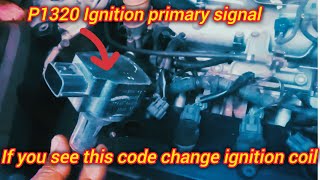
Technical definition: For manufacturers like Nissan, P1320 is defined as "Ignition Signal Primary – circuit malfunction." 🎬 Watch: A breakdown of common causes and fixes for P1320. The PCM uses crankshaft and camshaft position sensors to monitor spark timing and expects a confirmation signal from the power transistor inside each ignition coil. When this signal is missing, the PCM sets the P1320 code.
Can I Drive With P1320?
Yes, But With Caution. Do not drive if the check engine light is flashing. A flashing light indicates a severe misfire dumping unburned fuel into the exhaust, which destroys the catalytic converter within minutes. Catalytic converter replacement costs $900 to $2,500+. If the light is steady and the car runs smoothly, you can drive a short distance to a repair shop.
Common Causes

- Defective Ignition Coil(s) (Very Common) — An ignition coil, or the power transistor built into it, fails internally, sending a bad signal back to the computer even if it still produces a spark.
- Leaking Valve Cover Gaskets (Common) — On many V6 engines (like the Nissan VQ35DE), failing valve cover gaskets leak oil into the spark plug tubes. This oil saturates and destroys the ignition coil boots, causing a misfire and triggering P1320.
- Worn, Fouled, or Incorrect Spark Plugs (Common) — A spark plug with a massive gap or heavy carbon fouling increases resistance in the ignition circuit. This forces the coil to work harder, overheat, and fail.
- Damaged Wiring or Connectors (Common) — The wiring harness connecting the ignition coils becomes brittle and cracks from engine heat. Corroded pins, loose connections, or rodent damage disrupt the primary signal.
- Faulty Crankshaft Position Sensor (CKP) (Less Common) — The crankshaft sensor dictates engine speed and position for ignition timing. A failing sensor sends an erratic signal that the computer misinterprets as an ignition fault.
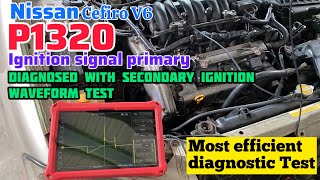
- Failed Ignition Condenser (Less Common) — This small capacitor stabilizes voltage in the ignition circuit. When it fails, it introduces electrical noise and weakens the spark. 🎬 Watch: How to perform a professional secondary ignition waveform test.
- Poor Ground Connections (Uncommon) — Corroded or loose engine ground straps cause erratic electrical behavior. Cleaning and tightening main ground points resolves intermittent P1320 codes.
- Blown Fuse or Fusible Link (Uncommon) — A shorted ignition coil blows the fuse supplying power to the ignition system. Always check the ignition fuse box before replacing expensive parts.
- Faulty Powertrain Control Module (PCM) (Rare) — A faulty driver circuit within the PCM fails to send or receive the ignition signal. This is extremely rare and requires professional diagnosis.
Symptoms

- Engine Misfires, Runs Rough, or Shakes — The engine stumbles, vibrates, or shakes violently, especially at idle or under heavy acceleration.
- Difficulty Starting, Stalling, or No-Start — The engine cranks longer than usual, stalls unexpectedly while driving, or fails to start entirely if the crankshaft sensor or multiple coils fail.
- Reduced Engine Power and Acceleration — The vehicle feels sluggish and struggles to accelerate because the ignition system is dropping sparks.
- Decreased Fuel Economy — Unburned fuel from misfiring cylinders causes a noticeable drop in gas mileage.
- Check Engine Light is On or Flashing (also visible on scanner) — The computer illuminates the Malfunction Indicator Lamp (MIL). A flashing light indicates a severe misfire requiring immediate shutdown to prevent catalytic converter damage.
Diagnostic Flowchart
Tap your situation to follow the diagnostic path that matches what you're seeing on this code.
Common Fixes & Costs
- Replace ignition coil(s) — Parts: $75-$150 per coil (OEM recommended), Labor: $100-$600 (Higher on V6 engines requiring intake manifold removal), ~1.5 hr book time (DIY)
- Replace Valve Cover Gaskets (and spark plug tube seals) — Parts: $50-$150, Labor: $300-$600, ~4.5 hr book time (Intermediate)
- Replace all spark plugs — Parts: $40-$120 for a set, Labor: $150-$350, ~2.5 hr book time (DIY)
- Replace Crankshaft Position Sensor — Parts: $50-$150, Labor: $100-$250, ~1.5 hr book time (Intermediate)
- Replace Ignition Condenser — Parts: $10-$40, Labor: $50-$100, ~0.5 hr book time (DIY)
- Replace Ignition Control Module (ICM) — Parts: $100-$300, Labor: $75-$150, ~1.0 hr book time (Intermediate)
Used vs. New Parts: Buying Guide
When a used part is worth it: Only if the budget is extremely tight and you can verify the donor vehicle's history.
Donor-vehicle mileage cap: roughly under 60000 miles for the part to have meaningful remaining life.
Donor quality checklist:
- Match part numbers exactly (look for the Nissan gray dot).
- Inspect for cracks or oil saturation.
- Avoid parts from vehicles scrapped due to engine failure.
Decision logic:
- If Vehicle is a Nissan/Infiniti with P1320 → Buy new OEM (Hitachi/Denso). Aftermarket and used coils frequently trigger the code.
- If Labor is high (rear V6 coils) → Buy new. Do not pay 3 hours of labor twice for a failed used part.
- If Budget is the primary concern → Used OEM is acceptable, but carries a high risk of premature failure.
Warranty tradeoff: Used parts offer 30 days. New OEM offers 1-year/12,000-miles.
Worst-case if a used part fails: 300-700 for repeat labor and a replacement part.
What Happens If You Wait — Timeline
- 0-4 weeks: Intermittent P1320 code with a slightly rough idle on cold starts. (MPG impact: 0-2%% · Added cost: $0)
- 1-3 months: Code stays on permanently. Consistent rough idle, hesitation, and a specific cylinder misfire code (P030x) appears. (MPG impact: 5-10%% · Added cost: $50-100 in wasted fuel)
- 3-6 months: Check Engine Light flashes during acceleration. Sulfur smell from exhaust indicates catalytic converter overheating. (MPG impact: 10-20%% · Added cost: $500-1500 (Catalytic converter damage begins))
- 6+ months: Catalytic converter melts and clogs. Engine cannot rev above 2500 RPM and stalls frequently. (MPG impact: 25%+% · Added cost: $2000-3500+ (Mandatory catalytic converter replacement))
Cost of Not Fixing It
- 0-1 month: Reduced fuel economy, rough idle, and hesitation. (Added cost: 50-150)
- 1-6 months: Severe damage to the catalytic converter from unburned fuel. (Added cost: 1200-2500)
- 6+ months: Engine damage from cylinder wash and plugged exhaust backpressure. (Added cost: 2500+)
Diagnosis Steps

- Read Diagnostic Trouble Codes (DTCs)
Use an OBD-II scanner to confirm P1320. Check for cylinder-specific misfire codes (P0301-P0308) or sensor codes (P0335, P0340). These pinpoint the exact failing cylinder or sensor.
Tools: OBD-II Scanner (Beginner) - Isolate the Faulty Coil (The Swap Test)
If you have a specific misfire code (e.g., P0304 for cylinder 4), swap that ignition coil with a known good cylinder (e.g., cylinder 2). Clear codes and drive. If the code changes to P0302, the coil is definitively bad.
Tools: Socket Set, OBD-II Scanner (Beginner) - Perform a Thorough Visual Inspection
Inspect all ignition coils and connectors for cracked plastic, burn marks, or loose fits. Check spark plug wells for oil, indicating a leaking valve cover gasket. Inspect main ground straps for corrosion.
Tools: Flashlight (Beginner) - Check for Power and Ground at the Coil
Disconnect the suspect coil. With the key ON (engine off), use a multimeter to verify 12V battery voltage on the power wire and continuity on the ground wire. No power indicates a blown fuse or bad relay.
Tools: Multimeter, Vehicle Wiring Diagram (Intermediate) - Test Ignition Coil Primary Resistance
With the ignition off, measure the internal resistance of the coil's primary winding (typically between terminals 1 and 2). Compare readings to the repair manual. A reading of zero (shorted) or infinite (open) confirms a dead coil.
Tools: Multimeter, Vehicle Repair Manual (Intermediate) - Test the Ignition Condenser
Locate the ignition condenser near the coils. Disconnect it and measure resistance. It should read over 1 million ohms (1 MΩ). Low resistance or continuity means the condenser is shorting the circuit.
Tools: Multimeter (Intermediate) - [ADVANCED] Test Crankshaft Position Sensor Resistance
If P0335 is present, measure resistance between the sensor's pins. For a Nissan VQ35DE at 68°F, terminals 1 and 2 must read 612-748 ohms. Replace if outside this range.
Tools: Multimeter, Vehicle Repair Manual (Advanced) - [ADVANCED] Analyze the Secondary Ignition Waveform
Use an automotive oscilloscope with a secondary ignition probe. A healthy coil shows a sharp 20-25kV spark line and a 1-2ms burn line. A failing coil shows a spark line under 10kV and a choppy burn line.
Tools: Automotive Oscilloscope, Secondary Ignition Probe (Advanced) - [ADVANCED] Test the Ignition Control Module (GM-Specific)
On GM vehicles, remove the Ignition Control Module (ICM) and have it bench-tested at an auto parts store, or use a multimeter's Hz setting to verify the 4x reference signal during cranking.
Tools: Multimeter with Hz setting or Professional ICM Tester (Advanced)
When This Code Triggers (Freeze-Frame Conditions)
- Engine Coolant Temp: 170-200°F (Fully warmed up)
- RPM: 700-2500 (Idle or light acceleration)
- Engine Load: 20-50% (Under load, not full throttle)
- Vehicle Speed: 0-60 mph (City/highway driving)
Related Codes
- P0300-P0308 — Cylinder misfire codes. P1320 indicates a primary circuit fault, while P030x confirms the fault caused a misfire in a specific cylinder. Use P030x to locate the bad coil.
- P0335 — Crankshaft Position Sensor circuit. The PCM uses this signal to fire the coils. If lost, the PCM assumes an ignition fault. Always fix P0335 before P1320.
- P0340 — Camshaft Position Sensor circuit. Vital for ignition timing. A fault disrupts the ignition sequence, triggering P1320. Fix P0340 before P1320.
- P1335 & P1336 — CKP sensor circuit faults. P1336 indicates damaged gear teeth on the flywheel. This mechanical issue must be repaired before addressing P1320.
Climate & Environmental Factors
- High Heat / Heat Soak: Engine bay heat breaks down the epoxy insulation inside ignition coils over time, causing internal shorts and reduced spark energy.
- Cold Weather: Cold temperatures increase electrical resistance. A weak coil that functions in summer will fail to produce a strong spark in winter, causing hard starts and misfires.
- Humidity / Moisture: High humidity or water intrusion from car washes corrodes ignition coil connectors, disrupting the primary signal and triggering P1320.
How to Talk to a Mechanic About This Code
Say this: "I have a P1320 code. Please perform a coil swap test, inspect the spark plug tubes for oil leaks, and test the crankshaft sensor before replacing any parts."
Directs the mechanic to common causes and prevents unnecessary part replacement.
Avoid saying:
- 'Just fix whatever's wrong'
- 'My check engine light is on'
- 'Replace all the coils'
Questions to ask before authorizing the repair:
- Did a swap test confirm the bad coil?
- Is there oil in the spark plug tubes?
- Are you using OEM Hitachi/Denso coils?
- Can you provide a written estimate for parts and labor?
- What is the warranty on this repair?
Where to Take It: Dealer vs Independent vs Chain
- Dealer:
Overkill for a straightforward P1320.
Best for: Warranty repairs or complex electrical issues.
Downsides: Highest labor rate; will mandate replacing all coils. (Typical cost: +50% vs. baseline) - Independent Shop:
Best fit. Reputable shops know the Nissan OEM coil requirement.
Best for: Out-of-warranty vehicles.
Downsides: Must verify ASE certifications. (Typical cost: +0% vs. baseline) - Chain Shop:
Avoid for V6 engines requiring intake manifold removal.
Best for: Routine maintenance.
Downsides: High pressure to upsell; often use cheap aftermarket coils. (Typical cost: -10% vs. baseline)
When to Walk Away From the Repair
If repair costs exceed 50% of the car's value, consider selling.
- Car worth $3000, fix is $1500: Borderline. Common for an older V6 Nissan needing rear coils and valve covers. Get a second opinion.
- Car worth $10000, fix is $800: Fix it. Sound financial decision.
- Car worth $2500, fix is $2500: Walk away. Sell to a junkyard or donate.
What Scan Tool You Need for This Code
Minimum: Reads DTCs and live data (RPM, load).
A $20 reader won't show live misfire data needed to pinpoint the failing cylinder.
Budget: BlueDriver Pro Scan Tool (~$100) — Bluetooth scanner that reads enhanced misfire counts to locate the bad coil.
Mid-range: Innova 5610 (~$350) — Handheld unit with bidirectional controls to test components.
Professional: Autel MaxiCOM MK808S (~$500) — OE-level diagnostics with full bidirectional control to actively test individual coils.
Rent vs buy: AutoZone's tool loaner program allows you to rent a scanner for free with a refundable deposit.
How to Clear the Code After You Fix It
- Use an OBD-II scan tool to clear the code
- Perform a complete drive cycle to reset readiness monitors
- Verify the code does not return after 50 miles
Drive cycle (~30 minutes): Cold start. Idle 3 minutes with A/C and headlights on. Drive 15 minutes at steady 55-60 mph. Decelerate without braking.
Readiness monitors affected: Catalyst monitor, Oxygen (O2) sensor monitor, Misfire monitor
Before emissions retest: drive at least 50 miles to fully set monitors.
Watch out for:
- Disconnecting the battery clears the code but resets all monitors, guaranteeing an immediate emissions test failure.
- The code returns instantly if aftermarket coils were used.
Will This Fail Emissions / State Inspection?
Yes — this code typically fails an OBD-II emissions inspection.
- California: Illuminated check engine light is an automatic failure. A full drive cycle is mandatory after clearing.
- New York: Clearing the code right before the test results in a 'Not Ready' failure.
- Texas: Active P1320 causes an automatic OBD-II test failure in the 17 required counties.
Most Commonly Affected Vehicles
- Nissan Maxima (1995-2003) — Extremely common due to faulty original equipment ignition coils. Accessing the three rear coils requires removing the upper intake manifold.
- Infiniti I30 / I35 (1996-2004) — Shares the same engine and ignition system as the Nissan Maxima. Using non-OEM coils guarantees the code will return.
- Nissan Pathfinder (2001-2004) — Models with the 3.5L V6 (VQ35DE) engine experience frequent coil failures, often caused by leaking valve cover gaskets.
- Infiniti QX4 (2001-2003) — Mechanically identical to the Pathfinder, this model experiences frequent coil-related P1320 codes stemming from oil leaks.
- Nissan Sentra (2000-2006) — Ignition system faults lead to a P1320 code, often related to a single faulty coil or worn spark plugs.
- Nissan X-Trail (2002-2007) — Faulty spark plugs and oil-fouled ignition coils are a known cause for this code on the X-Trail.
- Chevrolet Silverado (1999-2007) — P1320 is defined as 'IC Module 4X Reference Circuit Intermittent No Pulses,' pointing to the Ignition Control module, not individual coils.
- Toyota Sequoia / Sienna (2001-2007) — P1320 is defined as 'Igniter Circuit Malfunction' for a specific cylinder, pointing to the igniter component.
- Hyundai Santa Fe (2001-2006) — P1320 points to a fault in a specific ignition coil circuit, such as 'IG.Coil.4' for cylinder 4.
Manufacturer-Specific Notes
- Nissan / Infiniti: Extremely common. Using aftermarket coils causes P1320 to persist due to minute resistance differences. Coils with a gray/silver dot are the updated, reliable OEM parts.
- Hyundai / Kia: On 2011-2019 models, P1320 is replaced by P1326 (Knock Sensor Detection System), indicating failing connecting rod bearings. This triggers limp mode and often precedes engine replacement.
- General Motors (Chevrolet, Cadillac): Defined as 'IC Module 4X Reference Circuit Intermittent No Pulses,' pointing to the Ignition Control module or crankshaft sensor signal, not individual coils.
- Lexus / Toyota: Defined as 'Ignitor Circuit Malfunction No. 5,' pointing to a specific cylinder's igniter circuit, which may be separate from the coil.
- Volkswagen / Audi: Defined as 'Knock Sensor 2 Circuit Short To Ground,' an entirely different system from the primary ignition circuit.
- Ford: Not a standard code. Erroneously appears on 6.0L Power Stroke diesels (which lack ignition systems) due to generic scanner misinterpretation.
Real Owner Stories
2000 Nissan Maxima at 110k miles - The Textbook Fix
Check Engine Light came on with code P1320. The owner was concerned about being overcharged for repairs.
What they tried:
- Took the car to a shop to have the code read, confirming P1320.
- Sought advice online due to the commonality of the issue with Maximas.
Outcome: Replaced all six coils with OEM parts. Replacing the set prevents repeat failures on high-mileage engines.
Lesson: Ignition coils fail in batches. Replacing all at once saves repeat labor costs.
2000 Nissan Maxima - The Aftermarket Parts Misdiagnosis
Mechanic replaced 5 of 6 ignition coils to fix a P1320 code, but the Check Engine Light returned immediately.
What they tried:
- Mechanic spent two days replacing coils, but the light kept coming back.
- Owner was getting desperate as their temporary registration was about to expire.
Outcome: Mechanic installed aftermarket coils, but the code returned instantly. Swapping to OEM Hitachi coils permanently resolved the issue.
Lesson: Never use cheap aftermarket coils on Nissans. The PCM detects resistance variances and triggers P1320 even if the coil works.
Nissan Maxima - The Unusual Root Cause
After installing new aftermarket ignition coils, the owner immediately got a P1320 code and experienced engine stumbling.
What they tried:
- Replaced leaking valve cover gaskets.
- Replaced the radiator and a bad knock sensor.
Outcome: A faulty starter motor with a bad commutator created a voltage ripple during startup. The ECU misinterpreted this electrical noise as an ignition fault.
Lesson: If OEM coils and wiring check out, investigate components that introduce electrical noise, like a failing starter or alternator.
How to Prevent This Code From Triggering
- Replace Spark Plugs at Recommended Intervals (Every 60k-100k miles) — Worn plugs force the coil to produce higher voltage, causing it to overheat and fail prematurely.
- Use OEM Ignition Coils (At time of replacement) — OEM coils ensure electrical resistance matches ECU expectations, preventing returning P1320 codes.
- Inspect for Oil Leaks (Every oil change) — Leaking valve cover gaskets saturate coil boots with oil, destroying them.
- Keep Engine Bay Clean (Annually) — A clean engine runs cooler and prevents dirt from trapping moisture on electrical connectors.
- Address Check Engine Lights Promptly (Immediately) — Ignoring a misfire destroys the catalytic converter, turning a $100 repair into a $2,000 expense.
Frequently Asked Questions
What are the most common mistakes when diagnosing P1320?
The biggest mistake is immediately replacing all ignition coils without performing basic tests. Another common pitfall on Nissans is using cheap aftermarket coils that fail to meet exact electrical specifications, causing the code to return. Always diagnose related codes like P0335 (Crankshaft Sensor) first to avoid replacing good coils.
I have P1320 along with P0335. Which do I fix first?
Always diagnose and repair the P0335 (Crankshaft Position Sensor) code first. The computer uses the crankshaft sensor's signal to time the ignition, so a bad signal mimics an ignition fault. Fixing the crankshaft sensor usually clears both codes.
Can I pass an emissions test with a P1320 code?
No. An active P1320 trouble code causes an automatic failure of an emissions or smog test. You must repair the system and complete a full drive cycle to clear the code before inspection.
Can P1320 cause a no-start condition?
Yes. While a single failing coil causes a rough idle, a complete failure of a critical component prevents starting. A bad Crankshaft Position Sensor, a blown ignition fuse, or multiple failed coils will cause a no-start condition.
Why are the rear ignition coils so much harder to replace on a V6?
On many V6 engines, the rear bank of three cylinders sits tight against the firewall. The upper intake manifold blocks access to these coils. Technicians must remove the entire intake manifold to replace them, adding 2 to 3 hours of labor.
Can I just replace the one bad ignition coil?
Yes, you can replace a single faulty coil. However, since all coils share the same age and wear, another will likely fail soon. Replacing all coils simultaneously saves money on repeat labor, especially on V6 engines requiring intake manifold removal.
What does a gray or silver dot on a Nissan ignition coil mean?
The gray or silver dot identifies Nissan's updated, revised OEM ignition coil. Original coils on early 2000s models suffered high failure rates, so Nissan redesigned them for better reliability. Coils lacking this mark are likely the original, failure-prone parts.
Why did the P1320 code come back after I used a cheap aftermarket coil?
Nissan computers are highly sensitive to the electrical resistance of ignition coils. Aftermarket coils often produce a slightly different feedback signal than factory parts. The PCM detects this minute difference and triggers a P1320 code, even if the coil produces a spark.
Key Takeaways
- Code P1320 on Nissan and Infiniti vehicles almost always indicates a failing ignition coil, requiring a $75-$150 OEM replacement part to fix.
- Stop driving immediately if your check engine light flashes, as this indicates a severe misfire that will destroy a $1,500+ catalytic converter within minutes.
- Always diagnose and repair related sensor codes like P0335 (Crankshaft Position Sensor) first, because a faulty $50 sensor frequently triggers a false P1320 code.
- Inspect spark plug tubes for oil before replacing coils; leaking valve cover gaskets are the root cause of 40% of coil failures on V6 engines and must be fixed simultaneously.
- Never use cheap aftermarket ignition coils to fix a P1320 code, as the sensitive PCM detects minute resistance differences and will immediately trigger the code again.
Helpful Videos



The information in this article is provided for general reference and educational purposes only. Vehicle specifications, procedures, and part compatibility can vary by production date, trim level, and region. Always consult your vehicle's factory service manual and verify part numbers before purchasing or performing repairs. Safety-critical components such as airbags, seat belts, and braking systems should be installed by a qualified professional.
- 🎬 Helpful Videos
- What Does P1320 Mean?
- Can I Drive With P1320?
- Common Causes
- Symptoms
- Diagnostic Flowchart
- Common Fixes & Costs
- Used vs. New Parts: Buying Guide
- What Happens If You Wait — Timeline
- Cost of Not Fixing It
- Diagnosis Steps
- When This Code Triggers (Freeze-Frame Conditions)
- Related Codes
- Climate & Environmental Factors
- How to Talk to a Mechanic About This Code
- Where to Take It: Dealer vs Independent vs Chain
- When to Walk Away From the Repair
- What Scan Tool You Need for This Code
- How to Clear the Code After You Fix It
- Will This Fail Emissions / State Inspection?
- Most Commonly Affected Vehicles
- Manufacturer-Specific Notes
- Real Owner Stories
- 2000 Nissan Maxima at 110k miles - The Textbook Fix
- 2000 Nissan Maxima - The Aftermarket Parts Misdiagnosis
- Nissan Maxima - The Unusual Root Cause
- How to Prevent This Code From Triggering
- Frequently Asked Questions
- What are the most common mistakes when diagnosing P1320?
- I have P1320 along with P0335. Which do I fix first?
- Can I pass an emissions test with a P1320 code?
- Can P1320 cause a no-start condition?
- Why are the rear ignition coils so much harder to replace on a V6?
- Can I just replace the one bad ignition coil?
- What does a gray or silver dot on a Nissan ignition coil mean?
- Why did the P1320 code come back after I used a cheap aftermarket coil?
- Key Takeaways
- 🎟️ Get 5% Off