

OBD-II Code P1316: Misfire or Injector Driver Module Fault
What P1316 means, why it triggers, and how to fix it
- Code P1316 means 'IDM Codes Detected' on Ford 7.3L diesels, but indicates an 'Excessive Emissions Misfire' on Jaguar and Land Rover gasoline engines.
- On Jaguar and Land Rover vehicles, fix P1316 by replacing worn spark plugs, failing ignition coils, or leaking valve cover gaskets that allow oil into the plug wells.
- For Ford 7.3L diesels, P1316 requires a bi-directional scanner to read secondary IDM codes (P1271-P1278), with 90% of failures caused by a loose Under Valve Cover Harness (UVCH) connector.
- Stop driving immediately if the Check Engine Light flashes; continuing to drive dumps raw fuel into the exhaust and destroys the catalytic converter, adding up to $4,000 to your repair bill.
- Do not confuse P1316 with P1326 on Hyundai and Kia models; P1326 triggers 'limp mode' to prevent catastrophic engine bearing failure and requires immediate dealer inspection.
What Does P1316 Mean?

Code P1316 signals a significant issue, but its meaning depends entirely on the manufacturer. On Jaguar and Land Rover vehicles, it indicates a misfire severe enough to create excessive exhaust emissions, acting as a companion code to a specific cylinder misfire (P0301-P0308). On Ford 7.3L Powerstroke diesels, the Powertrain Control Module (PCM) detected a fault within the Injector Driver Module (IDM). For Ford, P1316 is purely informational, prompting you to read the specific failure codes stored inside the IDM.
Technical definition: Code P1316 is a manufacturer-specific OBD-II code. Jaguar and Land Rover define it as 'Misfire Excess Emission' or 'Misfire Rate Above Limit'. Ford defines it as 'Injector Driver Module (IDM) Codes Detected', requiring an advanced scan tool to read the secondary codes (P1271-P1278). BMW defines it as 'Injector Circuit/IDM, Bank 2', while Mazda uses 'Ignition Coil Circuit Malfunction'.
Can I Drive With P1316?
Yes, But With Caution. Drive as little as possible. If the Check Engine Light flashes, pull over and stop immediately. A flashing light signifies a severe misfire dumping raw fuel into the exhaust, destroying a catalytic converter in minutes. Continuing to drive adds a $2,500-$4,000 catalytic converter replacement to your repair bill. On Hyundai and Kia models, a related code (P1326) engages 'limp mode', severely limiting engine power to protect against catastrophic bearing failure.
Common Causes


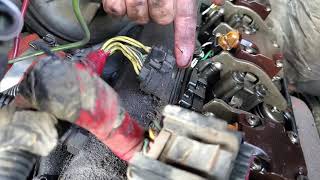
- Under Valve Cover Harness (UVCH) Failure (Ford 7.3L) (Very Common) — On Ford 7.3L Powerstroke engines, the wiring harness connecting the IDM to the injectors passes under the valve covers. The main pass-through connectors on the valve cover gasket vibrate loose from heat and vibration, severing the connection to the injectors. 🎬 Watch: How to perform the famous 25-cent UVCH repair. This is the number one cause of P1316 on these trucks.
- Worn or Faulty Spark Plugs (Gasoline Engines) (Very Common) — The most frequent cause on gasoline engines (Jaguar/Land Rover). Worn spark plugs fail to create a strong enough spark to ignite the fuel mixture, causing a misfire. 🎬 Watch: Troubleshooting and fixing a Land Rover Discovery misfire.
- Defective Ignition Coil(s) or Wires (Gasoline Engines) (Very Common) — Ignition coils transform 12-volt power into high voltage for the spark plugs. Coils, rubber boots, or spark plug wires fail from age and heat, preventing spark and causing misfires.
- Leaking Valve Cover Gaskets (Gasoline Engines) (Common) — On gasoline engines, degrading valve cover gaskets leak oil directly into the spark plug wells. This oil saturates the ignition coil boots and spark plugs, grounding out the spark and causing persistent misfires.
- Faulty Injector Driver Module (IDM) (Ford 7.3L) (Common) — The IDM fails when moisture breaches a degraded seal or electrical shorts fry the internal circuitry. This module sends the ~115V DC signal to fire the diesel injectors.
- Chafed Wiring Harness (Ford 7.3L) (Common) — The main external wiring harness running over the driver's side valve cover rubs against brackets. This chafes through the insulation, shorting wires to ground and triggering IDM faults.
- Faulty IDM Relay (Ford 7.3L) (Less Common) — The relay supplying power to the Injector Driver Module fails, preventing the IDM from powering up and operating the injectors.
- Vacuum Leak (Gasoline Engines) (Less Common) — A leak in a vacuum hose or intake gasket lets unmetered air into the engine, skewing the air-fuel ratio and causing lean misfires on gasoline engines.
- Bad Fuel or Clogged Fuel Filter (Less Common) — Contaminated fuel causes misfires across multiple cylinders. A severely clogged fuel filter restricts fuel flow, causing lean conditions and misfires under load.
- Faulty Fuel Injector (Less Common) — A clogged or electronically failed fuel injector prevents the correct amount of fuel from reaching a cylinder, causing a misfire.
- Low Battery Voltage (Rare) — Low system voltage from a weak battery or failing alternator causes communication errors between the PCM and IDM on the Ford 7.3L.
- Faulty Powertrain Control Module (PCM) (Rare) — The main engine computer (PCM) fails, causing communication issues with the IDM on Ford diesels or incorrectly reporting misfires on gasoline engines.
Symptoms
- Check Engine Light On or Flashing — A solid Check Engine Light is standard. A flashing light indicates a severe, catalyst-damaging misfire requiring immediate shutdown.
- Engine Hesitation or Loss of Power — The vehicle stumbles, bucks, or feels weak during acceleration because one or more cylinders fail to contribute power.
- Rough Engine Idle — The engine shakes or vibrates noticeably when stopped, feeling like it will stall.
- Hard Starting or No Start — The engine is very difficult to start or fails to start entirely, especially with Ford IDM issues or major gasoline misfires.
- Reduced Fuel Economy — Unburnt fuel from misfiring cylinders wastes gas, noticeably reducing MPG.
- Engine Runs on 4 Cylinders (Ford 7.3L) — A fault in the IDM or its wiring shuts down an entire bank of four cylinders, making the V8 run like a V4 with a dramatic loss of power.
Diagnostic Flowchart
Tap your situation to follow the diagnostic path that matches what you're seeing on this code.
Common Fixes & Costs
- Replace Under Valve Cover Harness (UVCH) & Gasket (Ford 7.3L) — Parts: $60-$150 per side, Labor: $200-$450 per side, ~2.5 hr book time (Intermediate)
- Perform the '50-Cent Mod' (Ford 7.3L) — Parts: $0.50, Labor: $150-$300, ~2.5 hr book time (Intermediate)
- Replace Spark Plugs — Parts: $40-$150, Labor: $150-$400, ~1.5 hr book time (DIY)
- Replace Ignition Coil(s) — Parts: $40-$200 per coil, Labor: $80-$150, ~0.8 hr book time (DIY)
- Replace Injector Driver Module (IDM) (Ford 7.3L) — Parts: $250-$500, Labor: $100-$200, ~1.0 hr book time (Intermediate)
Used vs. New Parts: Buying Guide
When a used part is worth it: For electronic modules like a Ford 7.3L IDM, a remanufactured unit offers significant savings over a new OEM part.
Donor-vehicle mileage cap: roughly under 100000 miles for the part to have meaningful remaining life.
Donor quality checklist:
- Verify the exact part number matches your original unit; software differences cause incompatibility.
- Buy from a reputable seller offering a warranty (30-90 days standard) and a clear return policy.
- Favor remanufactured units over used 'as-is' units, as they are rebuilt to factory specs.
Decision logic:
- If The part is a wear item like a spark plug → Always buy new; cost savings are negligible and risk is high.
- If The part is a complex module (like an IDM) → A remanufactured unit with a 1-year+ warranty is the best balance of cost and reliability.
- If A new part exceeds the car's value → A tested used part with a 90-day warranty is an acceptable risk.
Warranty tradeoff: Used parts offer a 30-90 day 'parts only' warranty. Remanufactured parts offer a 1-year to lifetime warranty. New OEM parts carry the manufacturer's warranty.
Worst-case if a used part fails: $300-600 if a used module fails after installation, representing repeated labor and a new part.
Cost of Not Fixing It

- Immediate: Failed emissions test, 5-15% drop in fuel economy, and poor engine performance. (Added cost: 0)
- 1-3 months: Damage to oxygen sensors from unburnt fuel and overheating of the catalytic converter. On a Ford 7.3L, driving with a bank of injectors down causes excessive engine wear. (Added cost: $200-$500)
- 3+ months: Complete meltdown of the catalytic converter substrate, requiring full replacement. Unburnt fuel washes oil from cylinder walls, leading to internal engine damage. (Added cost: $1200-$4200)
Diagnosis Steps
- Scan for All Trouble Codes
Use an OBD-II scanner to read all codes. For gasoline engines, look for P0300-P0308 to identify the misfiring cylinder. For a Ford Powerstroke, use a bi-directional scanner to retrieve secondary codes (P1271-P1278) directly from the IDM.
Tools: OBD-II Scanner (Advanced/Bi-directional for Ford) (Beginner) - Perform an Injector 'Buzz Test' (Ford 7.3L)
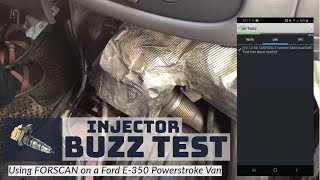
Using a bi-directional scan tool, perform a Key On, Engine Off (KOEO) injector electrical self-test. The scanner commands the IDM to 'buzz' each injector. A silent injector confirms a wiring or IDM issue on that specific circuit.
Tools: Bi-Directional Scan Tool (Intermediate) - Inspect Under Valve Cover Harness (UVCH) (Ford 7.3L)
Remove the valve cover(s) and check the main electrical connector plugging into the gasket. Wiggle the connector to check for play and inspect the plastic for brittleness. These connectors notoriously vibrate loose.
Tools: Socket Set, Wrenches (Intermediate) - Inspect Spark Plugs and Ignition System (Gasoline Engines)
Remove and inspect the spark plugs and wires. Look for worn electrodes, corrosion, physical damage, and oil in the spark plug tubes (indicating a leaking valve cover gasket).
Tools: Socket Set, Spark Plug Socket, Spark Plug Wire Puller, Feeler/Gap Gauge (Beginner) - Test Ignition Coils (Gasoline Engines)
Swap the ignition coil from the misfiring cylinder (e.g., Cylinder 2) with a known good cylinder. Clear codes. If the misfire follows the coil to the new cylinder, the coil is bad.
Tools: Basic Hand Tools, Multimeter (Intermediate) - Perform UVCH Resistance Test (Ford 7.3L)
With the valve cover off, unplug the harness. Set a multimeter to Ohms. At the 9-pin external connector, check resistance between the center 'C' (common) pin and each 'I' (injector) pin. Readings must be under 5 ohms. Open (OL) or high resistance confirms a bad harness.
Tools: Multimeter, 9-Pin Connector Pinout Diagram (Advanced) - Check IDM Wiring (Ford 7.3L)
Inspect the main wiring harness running over the driver's side valve cover to the IDM. Look for chafed loom or exposed wires shorting against brackets or the fender well.
Tools: Flashlight, Multimeter (Intermediate) - Analyze Fuel Trims (Gasoline Engines)
Observe Short-Term (STFT) and Long-Term Fuel Trim (LTFT) live data. Consistently high positive numbers (> +10%) indicate a lean condition (vacuum leak). If trims normalize at 2000 RPM, a vacuum leak is confirmed.
Tools: OBD-II Scanner with Live Data (Advanced) - Check Fuel Pressure (Gasoline Engines)
Connect a fuel pressure gauge to the Schrader valve. Jaguar XJ8 pressure should be 40-42 PSI (key on, engine off) and 31-38 PSI at idle. Land Rover Discovery II requires a steady 43 PSI.
Tools: Fuel Pressure Gauge Kit (Advanced) - Check IDM Output with Oscilloscope (Ford 7.3L)
Using an oscilloscope, back-probe the injector control wires at the IDM. A firing injector shows a sharp spike to ~115V DC followed by a sustained pulse. A weak waveform indicates a failing IDM.
Tools: Oscilloscope, Back-probe Pins (Professional)
When This Code Triggers (Freeze-Frame Conditions)
- Engine Coolant Temp: 180-210°F (82-99°C) (The engine is at full operating temperature when the misfire is definitively logged.)
- RPM: 1500-3000 (Occurs under light to moderate load, such as steady cruising or gentle acceleration.)
- Engine Load: 30-70% (Triggered when the engine is working, but not at full throttle.)
- Vehicle Speed: 40-65 mph (Occurs at city and highway cruising speeds, rather than at idle.)
Related Codes
- P0300 — Random/Multiple Misfire. P1316 acts as a severity qualifier, indicating the P0300 misfire is bad enough to fail an emissions test.
- P0301-P0308 — Specifies WHICH cylinder is misfiring. If you have P1316 and P0304, start diagnostics at cylinder 4's spark plug and coil.
- P1313 / P1314 — Misfire Catalyst Damage Fault. A step more severe than P1316, warning that you are actively melting your catalytic converter.
- P1271-P1278 — The actual fault codes stored inside a Ford 7.3L IDM. P1271 means 'Injector High Side to Low Side Open on Cylinder 1', pinpointing the exact failed circuit.
- P1668 / P1670 — Direct communication error between the Ford PCM and IDM, pointing to a wiring link failure rather than an individual injector issue.
Climate & Environmental Factors
- Cold Weather: Extreme cold thickens 7.3L engine oil, causing 'stiction' that makes injectors harder to operate. This mimics electronic faults and makes old wiring harnesses brittle.
- High Heat: Prolonged engine bay heat degrades plastic and rubber. This destroys the clamping force of Ford UVCH connectors and hardens wire insulation until it cracks.
- Humidity / Moisture: Moisture destroys the Ford 7.3L IDM. The factory case seal fails, allowing water to corrode the internal circuit board. On gas engines, humidity causes high voltage from weak coils to arc to ground.
How to Clear the Code After You Fix It
- Fix the root cause of the fault.
- Use an OBD-II scan tool to clear the Diagnostic Trouble Codes (DTCs).
- Perform a complete OBD-II drive cycle to allow readiness monitors to run.
Drive cycle (~20 minutes): A generic drive cycle includes a cold start, a 2-3 minute idle, 10 minutes of steady highway driving (55 mph), and 5-10 minutes of stop-and-go city driving.
Readiness monitors affected: Misfire Monitor, Catalyst Monitor, Heated Oxygen Sensor Monitor
Before emissions retest: drive at least 50 miles to fully set monitors.
Watch out for:
- Clearing the code without fixing the problem results in immediate return.
- Disconnecting the battery resets all readiness monitors to 'Not Ready', causing an automatic emissions failure.
Will This Fail Emissions / State Inspection?
Yes — this code typically fails an OBD-II emissions inspection.
- California: An active Check Engine Light is an automatic failure. The vehicle must complete a drive cycle to set readiness monitors before re-testing.
- New York: Automatic failure if the Check Engine Light is on. Clearing codes right before the test fails the vehicle due to 'Not Ready' monitors.
- Texas: In the 17 testing counties, an illuminated Check Engine Light is an automatic fail. The OBD-II test checks for active codes and readiness monitors.
Most Commonly Affected Vehicles
- Ford F-250/F-350 Super Duty (1999-2003) — Extremely common on 7.3L diesels. The single 9-pin pass-through connector on the valve cover gasket is the primary failure point.
- Ford Excursion (2000-2003) — Shares the 7.3L engine and 9-pin connector design, suffering identical IDM and UVCH failures.
- Ford E-Series Van (1999-2003) — Suffers the same 7.3L UVCH and IDM problems, but engine access is significantly more difficult.
- Land Rover Discovery II (1999-2004) — P1316 indicates a misfire caused by failing spark plugs, ignition wires, or coil packs.
- Jaguar XJ8 / XJR (X308) (1998-2003) — Points to an emissions-affecting misfire caused by aging ignition components, vacuum leaks, or oil-fouled spark plugs.
- Jaguar XK8 / XKR (X100) (1997-2006) — Signals an emissions-related misfire, distinct from catalyst-damage codes on later models.
- Hyundai / Kia Sonata, Tucson, Elantra, Optima, Sorento, etc. (2010-2021) — IMPORTANT: These makes use code P1326 (not P1316) for the Knock Sensor Detection System (KSDS). It detects premature engine bearing wear and triggers limp mode.
- BMW Various Models (E46, E39, etc.) (1998-2006) — Indicates 'Injector Circuit/IDM, Bank 2', pointing to a fault with the injector wiring or driver circuit on cylinders 4, 5, or 6.
Manufacturer-Specific Notes

- Ford: P1316 is purely informational; it does NOT mean the IDM is bad. It prompts you to retrieve internal IDM codes. The '50-cent mod' (shimming the connector with a quarter) is the most common fix.
- Jaguar / Land Rover: P1316 is a severe misfire code indicating excessive emissions. It always pairs with a P0300 or specific cylinder code (P0301-P0308) pointing to the real source.
- Hyundai / Kia: These brands use P1326 to detect catastrophic engine bearing wear. Owners should contact a dealer immediately for potential free engine replacement under Service Campaign 966.
- BMW: Defined as 'Injector Circuit/IDM, Bank 2', pointing specifically to injector control circuits on bank 2 rather than a general misfire.
Frequently Asked Questions
Is P1316 a serious code?
Yes. It indicates a severe engine misfire or major control module fault. Ignoring it causes expensive secondary damage to the catalytic converter.
What is the most common misdiagnosis for a P1316 on a Ford 7.3L?
Immediately replacing the Injector Driver Module (IDM). P1316 just means the IDM has stored codes. The actual fault is usually a loose Under Valve Cover Harness (UVCH) connector.
What does P1316 mean on my Ford 7.3L Powerstroke truck?
The Injector Driver Module (IDM) detected a problem with the fuel injectors or wiring. You need an advanced scan tool to read the specific secondary codes from the IDM.
What does P1316 mean on my Jaguar or Land Rover?
The engine is misfiring badly enough to fail an emissions test. The cause is almost always a bad spark plug, ignition coil, or ignition wire. Check for codes P0301-P0308 to find the specific cylinder.
Can a bad battery cause P1316 on a 7.3L Powerstroke?
Yes. The complex electronic modules are sensitive to voltage. Low voltage during startup causes communication glitches between the PCM and IDM, triggering the code.
What is the '50-cent mod' for a Ford 7.3L P1316 code?
A DIY trick where a U.S. quarter is wedged into the UVCH connector clip. The quarter acts as a shim, preventing the connector from vibrating loose and causing the P1316 code.
Can I pass an emissions test with a P1316 code?
No. P1316 specifically indicates 'Misfire Excess Emission' on gasoline vehicles. Any active Check Engine Light causes an automatic emissions test failure.
What is the first thing I should check for a P1316 code?
Use a scanner to read ALL fault codes. For gasoline cars, look for specific cylinder misfire codes. For Ford diesels, use a bi-directional scanner to read the secondary codes from the IDM.
Key Takeaways
- Code P1316 means 'IDM Codes Detected' on Ford 7.3L diesels, but indicates an 'Excessive Emissions Misfire' on Jaguar and Land Rover gasoline engines.
- On Jaguar and Land Rover vehicles, fix P1316 by replacing worn spark plugs, failing ignition coils, or leaking valve cover gaskets that allow oil into the plug wells.
- For Ford 7.3L diesels, P1316 requires a bi-directional scanner to read secondary IDM codes (P1271-P1278), with 90% of failures caused by a loose Under Valve Cover Harness (UVCH) connector.
- Stop driving immediately if the Check Engine Light flashes; continuing to drive dumps raw fuel into the exhaust and destroys the catalytic converter, adding up to $4,000 to your repair bill.
- Do not confuse P1316 with P1326 on Hyundai and Kia models; P1326 triggers 'limp mode' to prevent catastrophic engine bearing failure and requires immediate dealer inspection.
Helpful Videos


The information in this article is provided for general reference and educational purposes only. Vehicle specifications, procedures, and part compatibility can vary by production date, trim level, and region. Always consult your vehicle's factory service manual and verify part numbers before purchasing or performing repairs. Safety-critical components such as airbags, seat belts, and braking systems should be installed by a qualified professional.
- 🎬 Helpful Videos
- What Does P1316 Mean?
- Can I Drive With P1316?
- Common Causes
- Symptoms
- Diagnostic Flowchart
- Common Fixes & Costs
- Used vs. New Parts: Buying Guide
- Cost of Not Fixing It
- Diagnosis Steps
- When This Code Triggers (Freeze-Frame Conditions)
- Related Codes
- Climate & Environmental Factors
- How to Clear the Code After You Fix It
- Will This Fail Emissions / State Inspection?
- Most Commonly Affected Vehicles
- Manufacturer-Specific Notes
- Frequently Asked Questions
- Is P1316 a serious code?
- What is the most common misdiagnosis for a P1316 on a Ford 7.3L?
- What does P1316 mean on my Ford 7.3L Powerstroke truck?
- What does P1316 mean on my Jaguar or Land Rover?
- Can a bad battery cause P1316 on a 7.3L Powerstroke?
- What is the '50-cent mod' for a Ford 7.3L P1316 code?
- Can I pass an emissions test with a P1316 code?
- What is the first thing I should check for a P1316 code?
- Key Takeaways
- 🎟️ Get 5% Off