

OBD-II Code P1305: Igniter Circuit Malfunction
The Ultimate Guide to Diagnosing and Fixing P1305
- P1305 indicates an ignition circuit failure on a specific cylinder, most commonly cylinder #2 on Toyota, Lexus, and GM vehicles.
- Replacing the faulty ignition coil resolves P1305 in over 80% of cases and costs between $90 and $250 for parts and labor.
- Perform a free 'mechanic's swap' by moving the suspect coil to a different cylinder; if the misfire code follows the coil, you have confirmed a bad part.
- If a new coil fails to clear the code, inspect the plastic coil connector for broken locking tabs or frayed wires before replacing the $500+ Powertrain Control Module (PCM).
- Ford and Mazda vehicles use P1305 to indicate an Exhaust Gas Recirculation (EGR) calibration error, requiring a completely different diagnostic approach focused on emissions.
What Does P1305 Mean?

P1305 means the Powertrain Control Module (PCM) detected a fault in the ignition circuit for a specific cylinder. The PCM sends a trigger signal (IGT) to the ignition coil telling it to fire the spark plug. After firing, the coil sends a confirmation signal (IGF) back to the PCM. This code triggers when the PCM does not receive that confirmation signal.
Technical definition: Manufacturers like Toyota and Lexus define P1305 as "Igniter Circuit Malfunction No. 2". This indicates the PCM did not receive the Ignition Feedback (IGF) signal from the cylinder #2 igniter after commanding it to fire. Without this feedback, the PCM flags a fault and cuts fuel to that cylinder to protect the catalytic converter.
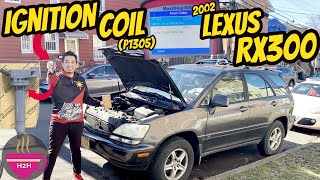
🎬 Watch: How to replace the ignition coil on a Lexus RX300Can I Drive With P1305?
Yes, But With Caution. You can drive, but expect poor engine performance like misfiring, rough idling, and hesitation. Driving for an extended period with a misfire dumps unburnt fuel into the exhaust, destroying the catalytic converter—a repair costing $800 to $2,500. Limit driving to essential trips and diagnose the vehicle immediately to prevent costly damage. The PCM also cuts fuel to the affected cylinder as a fail-safe, making the loss of power highly pronounced.
Common Causes

- Faulty Ignition Coil (Very Common) — The ignition coil is the most frequent point of failure. An internal short or open circuit in the primary or secondary windings prevents the coil from firing and sending the required IGF feedback signal.
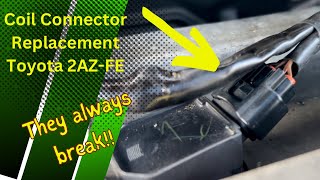
- Damaged Wiring or Connectors (Common) — Engine heat and vibration fray, burn, or corrode wires leading to the ignition coil. The plastic connector also becomes brittle and fails to make a secure connection, a frequent issue on older Toyotas where the locking tab breaks. 🎬 See this guide on replacing a broken Toyota ignition coil connector
- Faulty Ignition Module (Igniter) (Common) — On vehicles with a separate ignition module (igniter), this component acts as the intermediary between the PCM and the coils. The internal power transistors that fire the coils and generate the IGF signal fail, cutting off the signal for one or more cylinders.
- Aftermarket Coils with Incorrect Specs (Uncommon) — Cheap, low-quality aftermarket ignition coils trigger this code immediately after installation. These coils have incorrect internal resistance or generate an improper IGF signal that the PCM cannot recognize, leading to multiple P13xx codes even with brand-new parts.
- Worn, Fouled, or Incorrect Spark Plug (Less Common) — A fouled, worn-out, or incorrectly gapped spark plug increases resistance in the secondary ignition circuit. This high resistance strains the ignition coil, causing it to overheat and fail, which triggers P1305.
- Oil or Moisture Intrusion (Uncommon) — A leaking valve cover gasket or spark plug tube seal allows engine oil to seep into the spark plug tubes, flooding the ignition coil and connector. This causes a short circuit, disrupts the signal, and destroys the coil.
- Weak or Failing Battery (Rare) — A battery providing low or unstable voltage causes unpredictable behavior in the PCM and ignition system. Ensure the battery and charging system are healthy before chasing complex electrical faults.
- Faulty Powertrain Control Module (PCM) (Rare) — The driver circuit inside the PCM that sends the IGT signal or receives the IGF signal fails internally. A shorted ignition coil sometimes damages this PCM driver. Suspect this only after exhaustively ruling out all other possibilities.
Symptoms

- Check Engine Light is On or Flashing — The PCM activates the Check Engine Light immediately. A flashing light indicates a severe, catalyst-damaging misfire requiring you to pull over.
- Engine Misfire and Rough Idle — With one cylinder dead, the engine runs unevenly. You feel a noticeable vibration or shuddering, especially when stopped at a red light.
- Hesitation and Loss of Power — The car stumbles or feels sluggish during acceleration because it runs on fewer cylinders. The PCM often limits the engine to 3,000 RPM as a fail-safe.
- Engine Stalling or Hard Starting — The engine stalls unexpectedly at idle due to unstable combustion. If multiple coils or the main igniter fail, the vehicle refuses to start entirely.
- Reduced Fuel Economy — The engine burns excess fuel to compensate for the dead cylinder, dropping your MPG significantly.
Diagnostic Flowchart
Tap your situation to follow the diagnostic path that matches what you're seeing on this code.
Common Fixes & Costs
- Replace Ignition Coil — Parts: $40-$150, Labor: $50-$100, ~0.5 hr book time (DIY)
- Repair or Replace Wiring Harness/Connector — Parts: $15-$60, Labor: $120-$500, ~1.2 hr book time (Intermediate)
- Replace Spark Plugs — Parts: $15-$120, Labor: $60-$200, ~1.5 hr book time (DIY)
- Replace Ignition Module (Igniter) — Parts: $70-$400, Labor: $80-$180, ~0.8 hr book time (Intermediate)
- Replace Powertrain Control Module (PCM) — Parts: $500-$1,500, Labor: $150-$300, ~1.5 hr book time (Professional)
Used vs. New Parts: Buying Guide

When a used part is worth it: Buying used ignition coils is not recommended due to their high failure rate and low replacement cost. A used part is only viable for a rare, expensive igniter module or PCM, provided it comes from a low-mileage donor with a warranty.
Donor-vehicle mileage cap: roughly under 50000 miles for the part to have meaningful remaining life.
Donor quality checklist:
- Verify the donor vehicle's mileage and ensure the PCM/Igniter part number matches exactly.
- Avoid parts from vehicles scrapped due to engine fire or flood damage.
- Ensure the salvage yard offers a 30-90 day functional warranty.
Decision logic:
- If The part is an ignition coil → Buy new from an OEM brand like Denso. The cost is low and reliability is critical.
- If The part is an expensive igniter or PCM on an older vehicle → A used part from a reputable salvage yard is cost-effective, but remanufactured is safer.
- If Budget is the primary concern → Prioritize a new aftermarket coil over a used OEM coil to secure a warranty.
Warranty tradeoff: Used parts offer a 30-90 day warranty. New aftermarket parts include a 1-year to limited lifetime warranty. New OEM parts carry a 12-month warranty.
Worst-case if a used part fails: $150-$300 if a used coil or igniter fails immediately, requiring repeat labor and a second part purchase.
What Happens If You Wait — Timeline
- 0-1 month: Intermittent fault. Check Engine Light toggles on and off. Occasional hesitation occurs when the engine is cold or under heavy load. (MPG impact: 0-5%% · Added cost: $0-$25 in wasted fuel)
- 1-3 months: Fault becomes consistent. Check Engine Light stays on. Rough idle and hesitation are obvious. Fuel economy drops noticeably. (MPG impact: 5-15%% · Added cost: $50-$150 in wasted fuel)
- 3-6 months: Severe misfire. The Check Engine Light flashes. Unburnt fuel dumps into the exhaust, causing the catalytic converter to overheat and melt. (MPG impact: 15-25%% · Added cost: $900-$2,800 (Catalytic converter replacement required))
- 6+ months: Catastrophic failure. The catalytic converter clogs completely, creating massive exhaust backpressure. The engine refuses to rev or start. (MPG impact: 25%+% · Added cost: $1,500-$4,000+)
Cost of Not Fixing It
- 0-1 month: Noticeable drop in fuel economy (5-15%), rough idle, and poor acceleration. Risk of stalling. (Added cost: Negligible, besides extra fuel costs.)
- 1-6 months: Raw fuel from the misfiring cylinder washes over the catalytic converter, melting it internally and forcing a costly replacement. (Added cost: $900-$2,800)
- 6+ months: Complete catalytic converter blockage causes severe lack of power or a no-start condition. Guaranteed emissions test failure. (Added cost: $1,200-$4,000+)
Diagnosis Steps

- Read Codes and Freeze Frame Data
Use an OBD-II scanner to confirm P1305 and note related codes like P0302 (Cylinder 2 Misfire). Analyze the freeze frame data to identify the exact engine RPM, load, and temperature when the code triggered.
Tools: OBD-II Scanner (Beginner) - Swap the Ignition Coil (The "Mechanic's Swap")
This is the most definitive test for a bad coil. Swap the ignition coil from the faulting cylinder (#2) with a coil from a known good cylinder (#4). Clear the codes and drive. If the code changes to P1310 (cylinder #4), the coil is faulty. If P1305 returns, the coil is fine.
Tools: Socket wrench or screwdriver (Beginner) - Perform a Thorough Visual Inspection
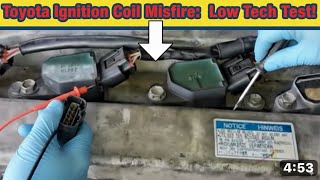
Inspect the ignition coil wiring harness for cylinder #2. Look for burns, cracks, or chafing. Check the plastic connector for corrosion, pushed-out pins, or a broken locking tab. Check the spark plug tube for pooled oil from a leaking valve cover gasket.
Tools: Flashlight, Mirror (Beginner) - Inspect the Spark Plug
Remove the spark plug from the affected cylinder. Check for a worn electrode, oil fouling, carbon tracking, or cracked porcelain. A damaged spark plug destroys ignition coils.
Tools: Spark plug socket, Ratchet, Extension (Intermediate) - Test the Coil Connector Voltages
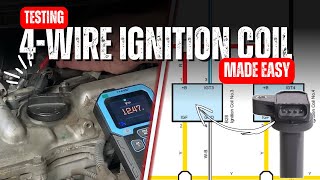
Turn the key ON (engine off). Back-probe the coil connector with a multimeter. Verify battery voltage (12V+) on the power wire (Pin 1) and a solid ground (less than 0.1V) on the ground wire (Pin 4). This confirms the circuit receives power.
Tools: Multimeter, Back-probe kit (Intermediate) - Check IGT and IGF Signal Wires
Unplug the connector and turn the key ON. Check the IGF wire voltage; it must read approximately 5 volts (the PCM pull-up voltage). A missing 5V signal confirms a broken wire or a failed PCM. Check continuity on both IGT and IGF wires back to the PCM (must be <1 ohm).
Tools: Multimeter, Wiring Diagram (Advanced) - Test Ignition Coil Resistance
Disconnect the coil and measure primary resistance between the positive and IGT terminals (typically 0.5 to 1.5 Ohms at 68°F). Measure secondary resistance between the high-tension output and the positive terminal (typically 9,000 to 15,000 Ohms). An "O.L." reading confirms an internally broken coil.
Tools: Multimeter, Service Manual (Advanced) - Analyze Signals with an Oscilloscope
Back-probe the IGT signal wire while cranking; look for a 0-5V square wave from the PCM. Back-probe the IGF wire; look for a corresponding 0-5V square wave returning from the igniter. A good IGT but missing IGF confirms a bad coil/igniter. Missing IGT confirms a PCM/wiring fault.
Tools: Oscilloscope, Back-probe kit (Advanced) - Test for a Shorted PCM Driver
Disconnect the battery and the PCM connector. Measure resistance between the IGT signal pin for cylinder #2 and the ground pin on the PCM. A low resistance reading confirms a shorted driver transistor inside the PCM, requiring replacement.
Tools: Multimeter, Vehicle Wiring Diagram (Advanced) - Check Fuel Pressure and Trims
Connect a fuel pressure gauge to verify correct pressure (e.g., 44-50 PSI on a Toyota 2AZ-FE). Monitor Short Term and Long Term Fuel Trims (STFT/LTFT) on a scan tool to rule out severe vacuum leaks or injector faults masquerading as ignition issues.
Tools: Fuel Pressure Gauge, OBD-II Scanner (Advanced)
When This Code Triggers (Freeze-Frame Conditions)
- Engine Coolant Temp: 170-210°F (Fully warmed up)
- RPM: 1500-3000 (Light acceleration or steady cruise)
- Engine Load: 25-60% (Under moderate load, not idling or full throttle)
- Vehicle Speed: 30-60 mph (City or highway driving)
Related Codes
- P0302 — Cylinder 2 Misfire. This almost always accompanies P1305 because the igniter circuit failure (P1305) prevents spark, creating the misfire (P0302). If you only have P1305, it is an intermittent electrical fault caught before a consistent misfire occurred.
- P1300, P1310, P1315 — These are identical 'Igniter Circuit Malfunction' codes for different cylinders (#1, #3, #4). Seeing multiple P13xx codes together confirms a common-point failure like a bad igniter module, shared wiring problem, or incorrect aftermarket coils.
- P0300 — Random/Multiple Cylinder Misfire. Appears if the underlying issue (failing igniter, bad battery) affects multiple cylinders intermittently.
- P0352 — Ignition Coil 'B' Primary/Secondary Circuit Malfunction. Functionally identical to P1305, pointing to an electrical fault in cylinder #2's coil circuit. P035x is common on domestic/European cars, while P13xx is standard for Toyota/Lexus.
Climate & Environmental Factors
- High Engine Bay Temperatures: Heat breaks down the epoxy potting material and internal windings of the ignition coil, causing internal shorts. This is why P1305 often appears only after the engine reaches operating temperature.
- Humidity and Moisture: Direct water intrusion from pressure washing the engine corrodes the ignition coil connector pins. This corrosion increases resistance and disrupts the 5V IGF signal.
- Cold Weather: Extreme cold makes plastic wiring insulation and connector tabs brittle. Attempting to unplug a coil in freezing temperatures frequently snaps the locking tab, creating a loose connection.
How to Talk to a Mechanic About This Code
Say this: "I have a P1305 code for an igniter circuit malfunction on cylinder 2. I already performed a 'mechanic's swap' of the coil, and the code did not move. I need a technician to perform an electrical diagnosis on the coil connector, wiring harness, and IGF signal circuit."
This proves you performed the basic diagnostic step, preventing the shop from charging you to replace a good coil. It directs them straight to the wiring/signal issue.
Avoid saying:
- 'My check engine light is on, can you look at it?'
- 'The car is shaking, I think it's the spark plugs.'
- 'Just fix whatever is wrong.'
Questions to ask before authorizing the repair:
- Did you find the failure in the wiring, the connector, or do you suspect the PCM?
- Can you show me the continuity or voltage test readings that confirm the failure?
- If the connector needs replacement, does the estimate include splicing in a new pigtail?
- What is your warranty on electrical diagnostic work?
Where to Take It: Dealer vs Independent vs Chain
- Dealer:
Best for: Vehicles under powertrain or emissions warranty., Complex electrical issues where an independent shop failed.
Downsides: Highest labor rates., Dealers often recommend replacing an entire $1,500 wiring harness instead of repairing a single broken wire. (Typical cost: +50% vs. baseline) - Independent Shop:
Best fit. An experienced independent technician knows to check the brittle connector first and performs wiring repairs for a fraction of the dealer's cost.
Best for: Out-of-warranty vehicles., Common, well-documented codes like P1305., Brand-specific specialists (e.g., Toyota/Lexus experts).
Downsides: Diagnostic skill varies; vetting the shop through ASE certifications is crucial. (Typical cost: +0% vs. baseline) - Chain Shop:
Avoid for diagnosis and repair. They lack the expertise for the electrical testing required if a simple coil swap fails.
Best for: Getting the code read for free.
Downsides: Technicians are geared toward simple part swaps, not electrical diagnosis., High pressure to upsell unnecessary coils and spark plugs. (Typical cost: -10% vs. baseline)
When to Walk Away From the Repair
If the estimated repair cost exceeds 50% of the car's private-party value, consider selling or trading it in.
- Car worth $3000, fix is $1800: Walk away. The repair cost is 60% of the car's value. Sell as-is on Facebook Marketplace as a 'mechanic's special'.
- Car worth $10000, fix is $450: Fix it. This is a common repair and the cost is well under the threshold.
- Car worth $4000, fix is $1500: Borderline. This represents a worst-case PCM replacement. Get a second opinion before authorizing.
What Scan Tool You Need for This Code
Minimum: A basic code reader that reads/clears engine codes and shows Freeze Frame data.
A $20 reader performs the initial 'coil swap' test, but cannot view live data to diagnose wiring or signal issues if the swap fails.
Budget: BlueDriver Pro Scan Tool (~$99) — Connects via Bluetooth. Reads P1305, provides verified repair reports, and displays live data to monitor engine parameters.
Mid-range: Innova 5610 (~$320) — Offers live data graphing and accesses manufacturer-specific data streams to pinpoint intermittent electrical issues.
Professional: Autel MaxiCOM MK808 (~$450) — Provides full bidirectional control and deep diagnostic data, including the ability to view IGT/IGF signal waveforms.
How to Clear the Code After You Fix It
- Use an OBD-II scan tool to clear the diagnostic trouble codes (DTCs).
- Reconnect the battery if it was disconnected for the repair.
- Perform a complete drive cycle to allow the onboard readiness monitors to run.
Drive cycle (~20 minutes): From a cold start, idle the engine for 5-9 minutes. Drive at a steady speed between 40-60 mph for 10 minutes. Perform a mix of stop-and-go city driving for 5 minutes. Allow the vehicle to cool down completely.
Readiness monitors affected: Catalyst (CAT) monitor, Oxygen (O2) Sensor monitor, EVAP monitor
Before emissions retest: drive at least 50 miles to fully set monitors.
Watch out for:
- Disconnecting the battery clears codes but resets all readiness monitors to 'incomplete', causing an automatic emissions test failure.
- The code returns immediately if the root cause (e.g., broken wire) was not fixed.
- Failing to drive at a steady highway speed prevents the Catalyst monitor from running.
Will This Fail Emissions / State Inspection?
Yes — this code typically fails an OBD-II emissions inspection.
- California: An active P1305 code is an automatic smog check failure. Clearing the code resets OBD readiness monitors to 'incomplete', requiring a 50-100 mile drive cycle before a retest.
- New York: A vehicle with P1305 fails the mandatory OBD-II inspection. The check engine light must be off and readiness monitors must be 'ready'.
- Texas: In emissions-testing counties, an illuminated Check Engine Light results in automatic failure. Clearing the code right before the test leads to failure due to incomplete monitors.
Most Commonly Affected Vehicles
- Toyota Camry (1998-2006) — Extremely common on 4-cylinder (1AZ-FE, 2AZ-FE) and V6 models. The coil connector wiring harness becomes brittle and causes intermittent connections. Dorman offers a replacement harness (p/n 645-940).
- Toyota Celica GT / GT-S (2000-2005) — Often appears with other P13xx codes after a tune-up. The 2ZZ-GE engine requires OEM Denso/NGK plugs and coils; aftermarket parts trigger IGF signal errors.
- Toyota Corolla (2000-2008) — Frequently presents alongside a no-start or start-and-stall condition when multiple coils or the shared igniter circuit fails.
- Lexus RX300 (1999-2003) — Common on the 1MZ-FE V6 engine. These models are known for eventual PCM/ECU failure, where the ignition driver circuit fails internally.
- Toyota Avalon (1998-2004) — The separate ignition igniter module is a known failure point, leading to P1305 and related codes for other cylinders.
- Chevrolet/GM Various models (e.g., Prizm, Silverado) (2000-2009) — GM defines P1305 as 'Ignition Coil 2 Primary Feedback Circuit,' functionally identical to the Toyota definition. Diagnosis focuses on the coil, wiring, and PCM.
- Honda/Acura Various V6 models (2000-2019) — Honda defines P1305 as 'Cylinder 5 Misfire'. Diagnose this like a standard P0305 code, focusing on the coil, plug, and injector for cylinder #5.
- BMW Various models (2000-2019) — BMW defines P1305 as 'Ignition monitoring cylinder 5 spark duration too short'. Diagnosis focuses on the ignition system for cylinder 5.
- Land Rover Various models (2010-2019) — Land Rover uses P1305 to indicate a 'Cylinder 5 Misfire,' similar to Honda and BMW.
Manufacturer-Specific Notes
- Toyota/Lexus: The number in the code definition (e.g., 'No. 2') directly corresponds to the cylinder number. The PCM relies heavily on the IGF signal and immediately cuts fuel to the cylinder if it goes missing.
- Ford/Mazda: Ford and Mazda define P1305 as 'EGR Calibration Low.' This is an Exhaust Gas Recirculation (EGR) system fault and has absolutely nothing to do with the ignition system.
- Hyundai: Hyundai definitions vary by year. It indicates a 'Phase Sensor - Abnormal' issue related to timing, or a 'Cylinder 5 Misfire'. Always verify the exact definition for your specific VIN.
- Volvo: Volvo defines P1305 as 'Ignition coil cylinder 5'. Diagnosis focuses strictly on the coil, spark plug, and wiring for cylinder 5.
Real Owner Stories
1999 Toyota Land Cruiser at ~150K miles
Check Engine Light illuminated with hesitation under load. Code read P1305.
What they tried:
- Suspected bad gasoline.
- Replaced the ignition coil for cylinder #2.
Outcome: Replacing the single $85 ignition coil completely resolved the hesitation and cleared the code.
Lesson: For a single P13xx code, the corresponding ignition coil is the culprit 80% of the time. Start with the simplest failure point.
2002 Toyota Celica GT-S with multiple P13xx codes
Car threw P1300, P1305, P1310, and P1315 after a tune-up with aftermarket coils. The engine ran fine, but the Check Engine Light returned every 20 minutes.
What they tried:
- Swapped coils and plugs.
- Dealer replaced the ECM.
- Shop inspected the wiring harness.
Outcome: The issue was traced to the incorrect aftermarket ignition coils. Their electronic specifications were incompatible with Toyota's sensitive IGF feedback system.
Lesson: If multiple P13xx codes appear right after a tune-up, the new parts are the problem. Toyota engines require OEM-spec (Denso/NGK) coils.
2002 Lexus RX300 at ~180K miles
Vehicle had a P1305 code and a misfire. The owner attempted a DIY coil replacement.
What they tried:
- Attempted to remove the 10mm bolt holding the ignition coil.
Outcome: The retaining bolt snapped off due to age and corrosion, turning a 10-minute repair into a multi-hour bolt extraction project.
Lesson: On older vehicles, soak ignition component bolts with penetrating oil before removal to prevent snapping fasteners.
2009 Toyota Corolla with 147k miles
Owner experienced repeated ignition coil failures every 2-4 months across different cylinders, replacing six coils in 18 months.
What they tried:
- Mechanics replaced individual coils as they failed.
Outcome: The owner sold the car without finding the root cause. The likely culprits were a failing ECU, oil leaks fouling the coils, or counterfeit replacement parts.
Lesson: If ignition coils fail repeatedly, investigate systemic issues like oil leaks or wiring harness integrity instead of just swapping parts.
How to Prevent This Code From Triggering
- Replace Spark Plugs at Recommended Intervals (Every 100,000 miles for iridium plugs) — Worn spark plugs force the ignition coil to generate higher voltage, causing the coil to overheat and fail prematurely.
- Address Engine Oil Leaks Promptly (Inspect during every oil change) — A leaking valve cover gasket submerges the coil boot in oil, causing short circuits and triggering P1305.
- Use Dielectric Grease on Coil Boots (Whenever replacing coils or spark plugs) — Dielectric grease seals out moisture, prevents corrosion, and stops high voltage from arcing to ground.
- Keep Battery and Charging System Healthy (Test battery annually after 3 years) — Low voltage stresses the electronic components within the ignition coils and the PCM, leading to unpredictable failures.
- Avoid Low-Quality Aftermarket Coils (During any ignition repair) — Cheap coils fail to produce the precise Ignition Feedback (IGF) signal the PCM expects, causing P13xx codes even with new parts.
Frequently Asked Questions
I replaced the ignition coil and spark plug, but P1305 came back. What's next?
The problem is in the wiring or the connector. Inspect the wires for heat damage or breaks right at the plastic connector. If the wiring is intact, the ignition module (igniter) or the PCM is failing.
What's the most common mistake when diagnosing P1305?
Replacing the coil and plug without confirming they are broken. Always swap the suspect coil with a known good one from another cylinder first. Often, the real issue is a brittle, broken electrical connector clip.
Can a vacuum leak cause a P1305 code?
No. A vacuum leak causes a lean condition and sets codes like P0171 or P0300. It will not cause the specific electrical feedback fault required to trigger P1305.
Why did I get P1305 and other P13xx codes right after a tune-up?
This happens when you install incorrect or low-quality aftermarket ignition coils. Toyota engines are highly sensitive to coil electronic specifications. Always use OEM Denso or NGK parts to ensure the PCM receives the correct IGF signal.
Is an 'igniter' the same thing as an 'ignition module'?
Yes. It is the electronic component that takes the low-power trigger signal (IGT) from the computer and uses it to switch the high-power ignition coil on and off.
Why does my car misfire with P1305 only when the engine is hot?
This points to an electrical component failing under heat expansion. An ignition coil's internal windings separate when hot, creating an open circuit that closes again once cooled.
My scanner shows P1305 on my Ford. Is it still an ignition coil problem?
No. On a Ford, P1305 indicates 'EGR Calibration Low'. Diagnose this as an emissions fault by checking the EGR valve for carbon buildup and testing the EGR position sensor.
Key Takeaways
- P1305 indicates an ignition circuit failure on a specific cylinder, most commonly cylinder #2 on Toyota, Lexus, and GM vehicles.
- Replacing the faulty ignition coil resolves P1305 in over 80% of cases and costs between $90 and $250 for parts and labor.
- Perform a free 'mechanic's swap' by moving the suspect coil to a different cylinder; if the misfire code follows the coil, you have confirmed a bad part.
- If a new coil fails to clear the code, inspect the plastic coil connector for broken locking tabs or frayed wires before replacing the $500+ Powertrain Control Module (PCM).
- Ford and Mazda vehicles use P1305 to indicate an Exhaust Gas Recirculation (EGR) calibration error, requiring a completely different diagnostic approach focused on emissions.
Helpful Videos

The information in this article is provided for general reference and educational purposes only. Vehicle specifications, procedures, and part compatibility can vary by production date, trim level, and region. Always consult your vehicle's factory service manual and verify part numbers before purchasing or performing repairs. Safety-critical components such as airbags, seat belts, and braking systems should be installed by a qualified professional.
- 🎬 Helpful Videos
- What Does P1305 Mean?
- Can I Drive With P1305?
- Common Causes
- Symptoms
- Diagnostic Flowchart
- Common Fixes & Costs
- Used vs. New Parts: Buying Guide
- What Happens If You Wait — Timeline
- Cost of Not Fixing It
- Diagnosis Steps
- When This Code Triggers (Freeze-Frame Conditions)
- Related Codes
- Climate & Environmental Factors
- How to Talk to a Mechanic About This Code
- Where to Take It: Dealer vs Independent vs Chain
- When to Walk Away From the Repair
- What Scan Tool You Need for This Code
- How to Clear the Code After You Fix It
- Will This Fail Emissions / State Inspection?
- Most Commonly Affected Vehicles
- Manufacturer-Specific Notes
- Real Owner Stories
- 1999 Toyota Land Cruiser at ~150K miles
- 2002 Toyota Celica GT-S with multiple P13xx codes
- 2002 Lexus RX300 at ~180K miles
- 2009 Toyota Corolla with 147k miles
- How to Prevent This Code From Triggering
- Frequently Asked Questions
- I replaced the ignition coil and spark plug, but P1305 came back. What's next?
- What's the most common mistake when diagnosing P1305?
- Can a vacuum leak cause a P1305 code?
- Why did I get P1305 and other P13xx codes right after a tune-up?
- Is an 'igniter' the same thing as an 'ignition module'?
- Why does my car misfire with P1305 only when the engine is hot?
- My scanner shows P1305 on my Ford. Is it still an ignition coil problem?
- Key Takeaways
- 🎟️ Get 5% Off