

OBD-II Code P1300: Ignition System Fault & Manufacturer-Specific Meanings
The Ultimate Guide: What P1300 means, why it triggers, and how to fix it for good
- P1300 is a manufacturer-specific code, meaning it signals an Igniter Circuit Malfunction on a Toyota, but a Boost Calibration Fault on a Ford.
- A flashing check engine light with P1300 means raw fuel is entering the exhaust, which destroys a $1,500 catalytic converter in under 50 miles.
- Do not replace ignition coils without testing; on 1996-2005 Toyotas, a 'start and stall' symptom guarantees the issue is a missing 5V IGF signal from the igniter.
- If P1300 appears immediately after installing an aftermarket MAF sensor on a Ford, reinstall the OEM sensor to clear the calibration error.
What Does P1300 Mean?

P1300 is a manufacturer-specific code with entirely different definitions based on your car's brand. On Toyota and Lexus, it signals a primary ignition system failure, specifically the igniter circuit. On Fords, it indicates a 'Boost Calibration Fault,' while on Volkswagens, a low fuel level causing misfires triggers it.
Technical definition: The official definition of P1300 varies by manufacturer. For Toyota/Lexus, it is 'Igniter Circuit Malfunction No. 1,' indicating the powertrain control module (PCM) is not receiving a confirmation signal (IGF) from the igniter after commanding a spark. For other brands, it means 'Random Misfire' (Honda, Saab), 'Boost Calibration Fault' (Ford), or 'Crankshaft/Camshaft Position Sensor Synchronization Error' (Hyundai, Kia).
Can I Drive With P1300?
Yes, But With Caution. You can drive short distances, but expect stalling, rough running, and poor power. Driving more than 50 miles with a flashing check engine light sends unburned fuel into the exhaust, which overheats and destroys the catalytic converter—a secondary repair costing $1,200 to $2,500.
Common Causes

- Failed Igniter / Ignition Control Module (ICM) (Very Common) — The igniter acts as a high-speed switch, turning ignition coils on and off based on ECU signals. When it fails, coils receive no firing signal, or the ECU receives no confirmation signal (IGF), triggering the code.
- Faulty Ignition Coil (Very Common) — An ignition coil transforms low battery voltage into the high voltage needed for a spark. Heat and age degrade internal coil windings, causing a weak or missing spark.
- Damaged Wiring or Connectors (Common) — Wires and connectors linking the PCM, igniter, and coils corrode or break from engine heat and vibration. This interrupts critical ignition signals and is the most frequent cause of misdiagnosis after parts replacement.
- Worn or Fouled Spark Plugs (Common) — Old or dirty spark plugs widen the spark gap, forcing the ignition coil to work harder. This extra stress overheats and kills the coil, triggering P1300 as a secondary fault.
- Faulty Crankshaft or Camshaft Position Sensor (Less Common) — These sensors dictate engine timing. If they fail or fall out of sync, the ECU cannot time the spark correctly. This is the primary definition for P1300 on Hyundai, Kia, and Subaru.
- Major Vacuum or Boost Leak (Less Common) — A disconnected intercooler pipe or blown intake gasket allows unmetered air into the engine. This skews the air-fuel ratio, causing widespread misfires that trigger P1300 on Saab and turbocharged vehicles.
- Incorrect or Faulty Mass Airflow (MAF) Sensor (Rare) — On Fords, an incorrect or malfunctioning MAF sensor causes the engine computer to fail its startup calibration checks, triggering a P1300 'Boost Calibration Fault' even on non-turbo engines.
- Clogged EGR System (Rare) — On certain Honda models, a clogged Exhaust Gas Recirculation (EGR) valve disrupts the air-fuel mixture, leading to random misfires that set a P1300 code.
- Faulty Powertrain Control Module (PCM) (Very Rare) — The internal driver circuits inside the main engine computer that control the ignition system burn out, leading to a permanent P1300 code.
Symptoms

- Check Engine Light is On or Flashing — The Malfunction Indicator Lamp (MIL) illuminates. A flashing light indicates a severe, catalyst-damaging misfire requiring immediate shutdown.
- Engine Misfires, Shakes, or Stumbles — The engine runs rough, hesitates, and lacks power, especially when idling or accelerating under load.
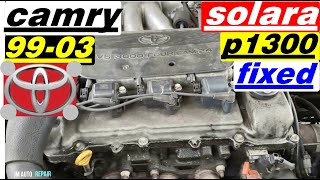
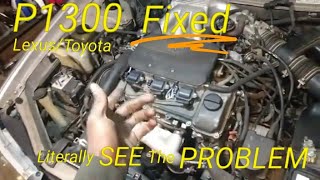
- Hard Starting or Immediate Stalling — The vehicle cranks excessively or fails to start. On Toyotas, it starts and immediately stalls 🎬 Watch: How to solve P1300 on a Toyota Camry or Solara because the ECU cuts fuel as a fail-safe.
- Increased Fuel Consumption (also visible on scanner) — An inefficient ignition system causes incomplete combustion, forcing the vehicle to burn significantly more fuel.
Diagnostic Flowchart
Tap your situation to follow the diagnostic path that matches what you're seeing on this code.
Common Fixes & Costs
- Replace Igniter / Ignition Control Module
— Parts: $70 - $400, Labor: $70 - $180, ~0.9 hr book time
(Intermediate)
: OEM - Replace Ignition Coil(s)
— Parts: $40 - $250 per coil, Labor: $75 - $150, ~0.8 hr book time
(DIY)
: OEM - Repair Wiring or Connectors — Parts: $10 - $50, Labor: $150 - $400, ~2 hr book time (Professional)
- Replace Spark Plugs — Parts: $20 - $120, Labor: $100 - $300, ~1.2 hr book time (DIY)
- Replace Mass Airflow (MAF) Sensor
— Parts: $100 - $300, Labor: $50 - $150, ~0.5 hr book time
(DIY)
: OEM - Replace Crankshaft or Camshaft Position Sensor — Parts: $50 - $200, Labor: $150 - $300, ~1.5 hr book time (Intermediate)
- Repair Vacuum Leak — Parts: $10 - $350, Labor: $100 - $500, ~2.5 hr book time (Professional)
DIY vs Professional
- Replace Ignition Coil(s) — Beginner:
Tools: ['Socket set', 'Ratchet', 'Screwdriver'] - Replace Spark Plugs — Beginner:
Tools: ['Spark plug socket', 'Ratchet with extension', 'Torque wrench'] - Replace Igniter / Ignition Control Module — Beginner:
Tools: ['Socket set', 'Screwdriver', 'Thermal paste'] - Repair Wiring or Connectors — Beginner:
Tools: ['Multimeter', 'Wire cutters/strippers', 'Soldering iron or crimping tool', 'Heat shrink tubing'] - Replace Crank/Cam Sensor — Beginner:
Tools: ['Socket set', 'Ratchet']
Used vs. New Parts: Buying Guide
When a used part is worth it: Buying used electronic ignition components is not recommended. They are wear-and-tear items with a finite lifespan determined by heat cycles.
Donor-vehicle mileage cap: roughly under 40000 miles for the part to have meaningful remaining life.
Donor quality checklist:
- Match the part number exactly to avoid compatibility issues.
- Avoid parts from vehicles with high mileage or from regions with extreme heat.
- Ensure plastic connectors are not brittle and terminals are free of corrosion.
Decision logic:
- If The part is an ignition coil or igniter/ICM → Buy new. Aftermarket new parts are affordable and come with warranties.
- If Vehicle is older (>150k miles) and budget is the primary concern → A used part is a gamble but serves as a temporary solution.
- If The part is a simple wiring connector or pigtail → Used is acceptable if the plastic is intact and terminals are clean.
Warranty tradeoff: Used parts offer a 30-90 day functional warranty. New aftermarket parts come with a 1-year or lifetime warranty. OEM parts offer a 12-month/12,000-mile warranty.
Worst-case if a used part fails: 300-600. If a used electronic part fails, you pay for a new part plus full labor costs a second time.
What Happens If You Wait — Timeline
- 0-100 miles: Check Engine Light illuminates solidly. You experience a rough idle, hesitation, and a 5-10% drop in fuel economy. (MPG impact: 5-10%% · Added cost: $5-15 in wasted fuel)
- 100-500 miles (or immediately if severe): Check Engine Light flashes. Unburned fuel dumps into the exhaust system. The engine stalls frequently and loses significant power. (MPG impact: 15-25%% · Added cost: $50-100 in wasted fuel)
- Driving more than 50 miles with a flashing light: Raw fuel ignites inside the catalytic converter, melting its internal ceramic honeycomb (above 1600°F) and permanently destroying it. (MPG impact: 25%+% · Added cost: $1,200 - $2,800 for catalytic converter replacement)
- Continued driving after catalyst failure: The melted catalytic converter creates extreme exhaust backpressure, causing severe engine overheating and burnt exhaust valves. (MPG impact: 30-50%+% · Added cost: $2,000 - $4,000+ for engine and exhaust repair)
Cost of Not Fixing It
- Immediate (0-100 miles): Reduced fuel economy (5-15% drop), poor engine performance, and risk of being stranded due to stalling. (Added cost: 5-20)
- Short Term (1-3 months): With a flashing check engine light, unburned fuel overheats and destroys the catalytic converter and downstream oxygen sensors. (Added cost: 1200-2800)
- Long Term (6+ months): Chronic misfires lead to internal engine damage, fouled spark plugs, and washed-out cylinder walls from excess fuel. (Added cost: 400-1500)
Diagnosis Steps

- Read Code, Definition, and Freeze Frame Data
Use an OBD-II scanner to confirm P1300. Note the specific manufacturer definition (e.g., 'Igniter Circuit' vs. 'Boost Calibration'). Analyze Freeze Frame data to see engine conditions when the fault triggered.
Tools: OBD-II Scanner (Beginner) - Perform a Thorough Visual Inspection
Inspect ignition coils, spark plug wires, and wiring harnesses. Look for cracked connectors, burnt wires, or corrosion. Check for disconnected vacuum hoses or intake pipes on turbocharged vehicles.
Tools: Flashlight (Beginner) - Perform an Ignition Coil Swap Test
If the code points to a specific cylinder, swap that ignition coil with one from another cylinder. Clear codes and drive. If the misfire code follows the moved coil, the coil is definitively bad.
Tools: Socket Set or Screwdriver (Intermediate) - Inspect Spark Plugs
Remove and inspect spark plugs for excessive wear, carbon fouling, or oil contamination. Worn plugs overload and kill ignition coils.
Tools: Socket Set, Spark Plug Socket, Ratchet (Intermediate) - Test Power and Ground at the Igniter/Coil
Verify the igniter and coils receive battery voltage (~12.6V engine off) on the power wire. Check for continuity to ground on the ground wire (resistance < 1 ohm). Bad grounds cause intermittent faults.
Tools: Multimeter (Advanced) - Check the IGF Confirmation Signal (Toyota/Lexus)
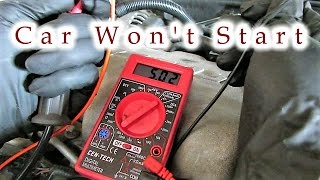
Backprobe the IGF wire at the ECU connector. With key on/engine off, it must read 4.5-5.5 volts. Missing voltage indicates a broken wire or faulty igniter. The voltage pulses during cranking.
Tools: Multimeter, Vehicle-Specific Wiring Diagram (Advanced) - Check Boost Sensor & Live Data (Ford)
For a 'Boost Calibration Fault', monitor live data. Compare MAP sensor readings with BARO readings (key on, engine off). They must be identical. A significant difference points to a faulty MAP sensor.
Tools: OBD-II Scan Tool (with Live Data) (Advanced) - Test Ignition Coil Resistance
Test primary resistance between positive and negative terminals (typically 0.4-2 ohms). Test secondary resistance between the output tower and a primary terminal (6,000-10,000 ohms). An open circuit (OL) means a bad coil.
Tools: Multimeter, Vehicle-Specific Service Manual (Advanced) - Smoke Test for Vacuum/Boost Leaks
To find a vacuum or boost leak (especially on Saab or Ford), fill the intake system with pressurized smoke. This reveals microscopic leaks from cracked hoses or bad gaskets.
Tools: Smoke Machine (Professional) - Analyze IGT/IGF Waveform Patterns
Probe the IGT (trigger) and IGF (feedback) signal wires with an oscilloscope. Both should show clean square waves during cranking. A missing waveform isolates the failure to the ECU or igniter.
Tools: Oscilloscope, Wiring Diagram (Professional)
When This Code Triggers (Freeze-Frame Conditions)
- Engine Coolant Temp: 170-210°F (The fault typically appears after the engine reaches full operating temperature, as heat causes failing electronic components to break down.)
- RPM: 1500-3000 RPM (P1300 sets under light to moderate acceleration or steady-state cruising, when the ignition system is under consistent load.)
- Engine Load: 25-70% (The code triggers when the engine is under moderate load, exposing ignition weaknesses that hide during idle.)
- Vehicle Speed: 30-60 mph (Correlating with RPM and load, the fault occurs during city or highway driving rather than at a standstill.)
Related Codes
- P0300 — P0300 is the generic code for 'Random Misfire.' P1300 identifies the root cause. P1300 is the cause; P0300 is the effect.
- P0301, P0302, etc. — These indicate a misfire on a specific cylinder. If a P1300 fault is specific to one cylinder's control circuit, you will see the corresponding P030X code. Diagnosing P1300 resolves the P030X code.
- P1305, P1310, P1315 — On Toyotas, these are companions to P1300. P1300 is for cylinder #1, P1305 is for #2, P1310 is for #3. This pinpoints which circuit failed.
- P0351, P0352, etc. — These signify an 'Ignition Coil Circuit Malfunction.' A P1300 code on a GM might set alongside a P035X code, with P1300 indicating a general module fault and P035X pointing to the specific coil.
Climate & Environmental Factors
- High Humidity / Moisture: Moisture penetrates older ignition coil housings and wiring, causing corrosion on connectors and creating electrical shorts.
- Extreme Cold: Plastic wiring insulation and vacuum hoses become brittle and crack in cold weather, leading to electrical opens or vacuum leaks.
- Engine Bay Heat: Constant exposure to high temperatures breaks down internal epoxy and electronic components inside coils and igniters, causing age-related failure.
How to Talk to a Mechanic About This Code
Say this: "I have a P1300 code on my [Make, Model, Year]. My scanner defines it as '[Your Scanner's Definition]'. I'd like to schedule a diagnostic appointment to confirm the cause. Based on my research for this car, the issue relates to the [igniter circuit/boost sensor/crank-cam sync]. Please focus the diagnostic time on testing that specific system."
This signals you are an informed customer. It directs the technician's time efficiently, saving diagnostic labor, and prevents them from replacing common parts without proper testing.
Avoid saying:
- 'Just fix whatever's wrong'
- 'My check engine light is on, can you look at it?'
- 'Whatever you recommend'
Questions to ask before authorizing the repair:
- What specific tests did you perform to confirm this part failed? (e.g., 'Did you test the IGF signal voltage?')
- Can you explain why the failed part caused the P1300 code?
- Will you provide a printout of the freeze-frame data?
- What is the warranty on this specific repair, including parts and labor?
Where to Take It: Dealer vs Independent vs Chain
- Dealer:
Recommended for warranty work or complex issues specific to your model that independent shops lack data on.
Best for: Vehicles under powertrain or emissions warranty., Complex manufacturer-specific quirks, like Hyundai/Kia crank/cam sync issues requiring proprietary software updates.
Downsides: Higher labor rates than independent shops., Often defaults to replacing expensive assemblies rather than repairing specific circuits. (Typical cost: +50% vs. baseline) - Independent Shop:
Best overall fit for most P1300 scenarios. Choose a shop that emphasizes diagnostics over parts swapping.
Best for: Out-of-warranty vehicles, especially for common P1300 causes like igniter failures on Toyota/Lexus., Shops with strong electrical and diagnostic reputations.
Downsides: Quality varies widely; vet the shop through reviews and ask about their electrical diagnostic experience. (Typical cost: +0% vs. baseline) - Chain Shop:
AVOID for initial diagnosis. The risk of misdiagnosis and unnecessary parts replacement is very high.
Best for: Simple, confirmed repairs like replacing an accessible ignition coil after a proper diagnosis is made elsewhere.
Downsides: Technician skill varies dramatically, and there is pressure to upsell. The complexity of P1300 makes it a poor fit. (Typical cost: -10% vs. baseline)
When to Walk Away From the Repair
If the estimated repair cost exceeds 50% of the car's private-party value, seriously consider replacing the vehicle.
- Car worth $4000, fix is $800: Fix it. The repair cost is well below the 50% threshold.
- Car worth $3000, fix is $1600: Borderline. The repair is over 50% of the car's value. Get a second opinion and evaluate the car's overall health.
- Car worth $2500, fix is $2000: Walk away. The repair cost is a huge percentage of the car's value, and other age-related repairs are looming.
What Scan Tool You Need for This Code
Minimum: A scanner that reads manufacturer-specific code definitions and displays live data.
A basic $20 code reader only shows 'P1300', which is useless as its meaning varies by carmaker. You must know if it's an 'Igniter Circuit Malfunction' or a 'Boost Calibration Fault'.
Budget: BlueDriver Pro Scan Tool (~$99) — Connects to your smartphone and provides manufacturer-specific code definitions, freeze-frame data, and live data graphing.
Mid-range: Foxwell NT510 Elite (~$180) — A handheld scanner offering deep, manufacturer-specific diagnostics and bidirectional controls to test components.
Professional: Autel MaxiCOM MK808 / MK906BT (~$450-1200) — Provides professional bidirectional control to command components. It graphs multiple live data PIDs at once, crucial for spotting correlations or signal dropouts.
Rent vs buy: If this is a one-time fix, auto parts stores offer free loaner tools. Buy a scanner only if you plan to do your own diagnostics regularly.
How to Clear the Code After You Fix It
- Use an OBD-II scan tool to clear the P1300 code and related fault codes.
- Reconnect any disconnected components, including the battery.
- Perform a drive cycle to allow the vehicle's readiness monitors to reset.
Drive cycle (~30 minutes): A generic drive cycle includes a cold start, 2-3 minutes of idling, 10-15 minutes of mixed city/highway driving at 55 mph, and several stop-and-go situations.
Readiness monitors affected: Misfire Monitor, Catalyst Monitor, Evaporative System Monitor, Oxygen Sensor Monitor
Before emissions retest: drive at least 100 miles to fully set monitors.
Watch out for:
- Disconnecting the battery clears the code but resets all readiness monitors, guaranteeing an emissions test failure until a full drive cycle completes.
- The code returns immediately if the root cause of the fault is not repaired.
Will This Fail Emissions / State Inspection?
Yes — this code typically fails an OBD-II emissions inspection.
- California: An active P1300 code is an automatic failure. After repair, all OBD-II readiness monitors must be set to 'Ready,' which requires driving 50-100 miles before a re-test.
- New York: The NYS DMV inspection includes an OBD-II scan. Any Check Engine Light results in an immediate emissions test failure.
- Texas: A vehicle fails the OBD inspection if the Check Engine Light is on. The Misfire and Catalyst readiness monitors must also be complete.
Most Commonly Affected Vehicles
- Toyota Tacoma, Camry, Corolla, 4Runner, Avalon (1996-2005) — Code P1300 means 'Igniter Circuit Malfunction.' The engine starts and immediately stalls because the ECU cuts fuel when it misses the IGF confirmation signal.
- Lexus ES300, GS300, RX300, IS300 (1996-2005) — Shares the Toyota ignition system; P1300 points to the igniter circuit for cylinder #1. A faulty igniter or coil is the cause.
- Ford Focus, Ranger, F-150 EcoBoost, Transit (1995-2014) — P1300 relates to a 'Boost Calibration Fault.' This is caused by a faulty boost sensor, a boost leak, or using an aftermarket MAF sensor.
- Honda Civic, Accord, Odyssey (1996-2018) — Defined as 'Random Cylinder Misfire.' Causes range from standard ignition faults to clogged EGR passages.
- Saab 9-3, 9-5 (1999-2009) — Indicates a severe misfire. While the Direct Ignition Cassette (DIC) fails often, a disconnected intercooler hose is a frequently misdiagnosed cause.
- Chevrolet / GM Silverado, Prizm, Suburban (1996-2004) — P1300 is a generic 'Ignitor Circuit' fault, pointing to a problem with the Ignition Control Module (ICM) or its wiring.
- Hyundai Tucson, Terracan, Santa Fe (2004-2008) — Defined as 'Cam/Engine Speed Sensor - Synchronization Error,' indicating a timing correlation problem between the crank and cam sensors.
- Volkswagen Jetta, Golf, Passat (1999-2005) — P1300 means 'Misfire detected because fuel level is too low.' A fuel pressure test confirms fuel delivery issues.
- Subaru Impreza, Forester, Legacy (2000-2019) — Defined as 'Crankshaft Position Sensor 2 Circuit Malfunction' or relates to igniter circuit issues.
- Kia Sedona, Sportage (2002-2005) — Points to a 'Crankshaft position / Camshaft position correlation' error, indicating a timing sync problem.
- Mazda 323, 626, MX-5 (1990-2005) — Used to indicate a random misfire, similar to the generic P0300 code.
Manufacturer-Specific Notes

- Toyota / Lexus: P1300 points to the igniter circuit for cylinder #1. If the computer misses the ignition confirmation signal (IGF), it cuts fuel to that cylinder as a fail-safe, causing a 'start and stall' symptom.
- Ford / Peugeot / Citroen: P1300 is defined as 'Boost Calibration Fault.' The engine computer failed its self-check of the turbo boost pressure sensor circuit at startup. It is also triggered by non-OEM MAF sensors.
- Volkswagen: VW uses P1300 to indicate 'Misfire Detected - Low Fuel Level'. Ensure the vehicle has at least 1/4 tank of fuel before diagnosing ignition components.
- Saab: P1300 indicates a severe, catalyst-damaging misfire. Always check for large vacuum leaks (e.g., a popped intercooler hose) before replacing the expensive Direct Ignition Cassette (DIC).
- Hyundai / Kia: P1300 means 'Cam/Engine Speed Sensor - Synchronization Error'. This points directly to a timing issue between the crankshaft and camshaft position sensors, not ignition coils.
- General Motors (Chevrolet, GMC, Buick): P1300 is a generic 'Ignitor Circuit' fault. It points globally to a problem with the Ignition Control Module (ICM) or its wiring harness.
Real Owner Stories
2000 Toyota Tacoma 3.4L V6 at 286K miles
Check Engine Light came on with code P1300. The truck developed a crank-no-start condition, firing for one second and immediately dying.
What they tried:
- Replaced all three coil packs and spark plug wires - code returned.
- Replaced spark plugs and valve cover gaskets to fix oil leaks.
Outcome: The root cause was a faulty igniter. The ECU was not receiving the IGF (ignition confirmation) signal, so it cut fuel delivery immediately after starting. Replacing the igniter resolved the stalling.
Lesson: On older Toyotas, a 'start and stall' symptom with P1300 strongly points to a loss of the IGF signal. Do not replace coils; test the igniter and its wiring.
2000 Ford Ranger 2.5L
Code P1300 'Boost Calibration Fault' appeared immediately after replacing the original MAF sensor with an aftermarket unit from an auto parts store.
What they tried:
- Read the code and researched the Ford-specific definition.
- Reinstalled the old OEM MAF sensor to test.
Outcome: The aftermarket MAF sensor caused the issue. The Ford ECU could not properly calibrate with the non-OEM part's voltage curve. Reinstalling the OEM sensor cleared the code permanently.
Lesson: For Ford's P1300, suspect recent MAF sensor replacements using non-OEM parts. The ECU performs a strict self-check and rejects sensors outside expected parameters.
1999 Saab 9-3
Car suddenly developed a severe misfire (P1300), rough idle, and was nearly undrivable. The owner suspected a failed Direct Ignition Cassette (DIC).
What they tried:
- Priced out a new DIC ($300+).
- Performed a visual inspection of the engine bay.
Outcome: A large intercooler hose had popped off, creating a massive vacuum leak. Reconnecting the hose fixed the severe misfire instantly, saving the cost of a DIC.
Lesson: On turbocharged vehicles, P1300 for severe misfire is often a major vacuum or boost leak. Always inspect intake hoses before buying expensive ignition parts.
1996 Toyota Camry
Car broke down with a P1300 code. The owner replaced the igniter and ignition coil, but the car broke down again two days later.
What they tried:
- Replaced the igniter and coil pack.
- Inspected the wiring harness after the code returned.
Outcome: The root cause was a bad wiring connector at the coil with a broken lock tab, causing intermittent contact. Splicing in a new $15 connector pigtail permanently fixed the problem.
Lesson: If a code returns immediately after replacing a part, the problem is the wiring or connector. Heat and vibration damage plastic connectors, mimicking part failure.
How to Prevent This Code From Triggering
- Replace spark plugs at recommended intervals (Every 60,000-100,000 miles) — Worn spark plugs create a wider gap, forcing the ignition coil to generate higher voltage. This extra strain overheats the coil and causes premature failure.
- Use only OEM or high-quality ignition coils (Denso, NGK) (When replacing a failed coil) — Cheap aftermarket coils use inferior windings and epoxy, making them susceptible to internal arcing and rapid breakdown from engine heat.
- Address engine oil and coolant leaks promptly (During regular oil changes) — Leaking valve cover gaskets allow oil to pool in spark plug tubes, fouling plugs and destroying coil boots. Moisture corrodes electrical connectors.
- Perform visual inspections of wiring (Annually) — Checking ignition wiring harnesses for cracking or chafing prevents shorts and open circuits before they leave you stranded.
- Keep battery connections clean and tight (Annually) — A weak battery provides insufficient voltage during cranking, stressing the igniter and triggering false ignition fault codes.
Frequently Asked Questions
I replaced the ignition coils and spark plugs, but P1300 came back. What now?
If new coils and plugs don't fix it, the problem is upstream in the primary ignition circuit. Inspect the wiring harness and connectors for damage or corrosion. On a Toyota, test the IGF signal voltage, which must be 4.5-5.5V with the key on, engine off.
What is an IGF signal and why is it important?
IGF stands for Ignition Confirmation, a signal the igniter sends the ECU after a successful spark. If the ECU sends a trigger but gets no IGF back, it sets P1300 and cuts fuel to protect the catalytic converter.
Can a bad ground wire cause a P1300 code?
Yes, the ignition system relies on a solid ground connection to complete its circuit. A loose or corroded ground wire at the igniter causes intermittent ignition failures and triggers P1300. A proper ground must measure less than 1 ohm of resistance.
My check engine light is flashing with P1300, what should I do?
A flashing check engine light indicates a severe misfire dumping unburned fuel into your exhaust, which destroys the catalytic converter rapidly. Pull over safely and shut off the engine immediately. Tow the vehicle to a repair shop to prevent thousands in secondary damage.
Can I fix P1300 myself?
Replacing a bad ignition coil or spark plug is a straightforward DIY repair for beginners. However, diagnosing a faulty igniter or wiring issue requires a multimeter and wiring diagrams, making it better suited for a professional.
What's the difference between an ignition coil and an igniter?
The igniter (ignition control module) is the switch that tells the ignition coil exactly when to fire based on ECU signals. The ignition coil is the transformer that amplifies 12-volt battery power into the 40,000+ volts needed to create a spark. The igniter triggers the event, while the coil provides the power.
Why does the code definition change for different cars?
Codes in the P1000-P1999 range are manufacturer-specific and not standardized across all brands. This is why P1300 means an igniter problem on a Toyota, a turbo calibration issue on a Ford, or a low fuel level on a VW.
Key Takeaways
- P1300 is a manufacturer-specific code, meaning it signals an Igniter Circuit Malfunction on a Toyota, but a Boost Calibration Fault on a Ford.
- A flashing check engine light with P1300 means raw fuel is entering the exhaust, which destroys a $1,500 catalytic converter in under 50 miles.
- Do not replace ignition coils without testing; on 1996-2005 Toyotas, a 'start and stall' symptom guarantees the issue is a missing 5V IGF signal from the igniter.
- If P1300 appears immediately after installing an aftermarket MAF sensor on a Ford, reinstall the OEM sensor to clear the calibration error.
Helpful Videos

The information in this article is provided for general reference and educational purposes only. Vehicle specifications, procedures, and part compatibility can vary by production date, trim level, and region. Always consult your vehicle's factory service manual and verify part numbers before purchasing or performing repairs. Safety-critical components such as airbags, seat belts, and braking systems should be installed by a qualified professional.
- 🎬 Helpful Videos
- What Does P1300 Mean?
- Can I Drive With P1300?
- Common Causes
- Symptoms
- Diagnostic Flowchart
- Common Fixes & Costs
- DIY vs Professional
- Used vs. New Parts: Buying Guide
- What Happens If You Wait — Timeline
- Cost of Not Fixing It
- Diagnosis Steps
- When This Code Triggers (Freeze-Frame Conditions)
- Related Codes
- Climate & Environmental Factors
- How to Talk to a Mechanic About This Code
- Where to Take It: Dealer vs Independent vs Chain
- When to Walk Away From the Repair
- What Scan Tool You Need for This Code
- How to Clear the Code After You Fix It
- Will This Fail Emissions / State Inspection?
- Most Commonly Affected Vehicles
- Manufacturer-Specific Notes
- Real Owner Stories
- 2000 Toyota Tacoma 3.4L V6 at 286K miles
- 2000 Ford Ranger 2.5L
- 1999 Saab 9-3
- 1996 Toyota Camry
- How to Prevent This Code From Triggering
- Frequently Asked Questions
- I replaced the ignition coils and spark plugs, but P1300 came back. What now?
- What is an IGF signal and why is it important?
- Can a bad ground wire cause a P1300 code?
- My check engine light is flashing with P1300, what should I do?
- Can I fix P1300 myself?
- What's the difference between an ignition coil and an igniter?
- Why does the code definition change for different cars?
- Key Takeaways
- 🎟️ Get 5% Off