

P1285 on 2019-2020 Lincoln Nautilus: Cylinder Head Overheat Causes & Fixes
On a 2019-2020 Lincoln Nautilus with the 2.0L EcoBoost engine, code P1285 is a critical warning for an overheating cylinder head. The most common causes are a leaking EGR cooler or outdated PCM software, both of which are documented in Lincoln Technical Service Bulletins. Unlike earlier EcoBoost engines, this model year is less prone to the infamous 'coolant intrusion' block failure, but the symptoms can be identical. Do not drive the vehicle until this is resolved.
- P1285 is a critical overheat warning for the cylinder head. Stop driving immediately to prevent engine damage.
- On the 2019-2020 Nautilus 2.0L, this code is most often caused by a leaking EGR cooler, a known issue covered by TSB 20-2234 and SSM 48345.
- Another common cause is outdated PCM software that can falsely trigger the code, as noted in TSB 19-2046.
- Diagnosis should start with checking for these TSBs and performing a cooling system pressure test focused on the EGR cooler.
- Do not simply replace the temperature sensor; it is almost always reporting a genuine (or software-induced) problem.
What's Unique About the 2019-2020 Lincoln NAUTILUS
For the 2019-2020 Nautilus and its platform-mate, the Ford Edge, this code is frequently linked to specific, documented issues rather than random component failure. Manufacturer TSBs point directly to two primary culprits: an EGR cooler that is prone to leaking coolant internally into the intake and exhaust, and PCM software that may have overly sensitive triggers for overheat codes. This makes diagnosis more targeted than on other vehicles where a generic overheat code might start with a thermostat or radiator fan. It's also important to distinguish this from the well-known 'coolant intrusion' issue (cracked engine block) that plagued earlier 2015-2018 2.0L EcoBoost engines, though the symptoms (coolant loss, white smoke) are similar.
Diagnostic Flowchart
Tap your situation to follow the diagnostic path that matches what you're seeing on this vehicle.
Symptoms You May Notice
- Check Engine Light (MIL) illuminated
- Over-temperature warning on the instrument panel.
- Low engine coolant level without obvious external leaks.
- White, sweet-smelling smoke from the tailpipe.
- Engine running rough or misfiring
- External coolant leak (can also be a symptom).
- No heat from the cabin vents, as described by an owner of a 2019 Nautilus with a diagnosed head gasket issue.
- Replacing the CHT sensor without diagnosing the cooling system. The sensor is usually reporting a real problem, not causing it.
- Assuming a simple thermostat failure without checking for the more probable TSB-related issues like the EGR cooler leak.
- Confusing the EGR cooler leak with the engine block coolant intrusion issue common on earlier 2.0L EcoBoost engines. For the 2019-2020 Nautilus, the EGR cooler should be the primary suspect.
Most Likely Causes
- Leaking EGR Cooler 🔴 High Probability As documented in Lincoln TSB 20-2234 and SSM 48345, the EGR cooler on the 2.0L EcoBoost can fail internally, allowing coolant to leak into the exhaust and intake systems, causing overheating and white smoke. This is the first component that should be inspected per the TSB when P1285 is present with coolant loss.
How to confirm: A technician will perform a cooling system pressure test and visually inspect the EGR cooler for signs of internal or external leaks, as outlined in TSB 20-2234. If coolant is found leaking from the coolant chamber into the exhaust chamber, the cooler is faulty.
Typical fix: Replacement of the EGR cooler, EGR outlet tube, and associated gaskets. The PCM software should also be checked for available updates as part of the same TSB.
Est. part cost: $300-$500 - Outdated PCM Software 🟡 Medium Probability TSB 19-2046 and TSB 20-2234 explicitly state that incorrect settings in the PCM software can cause P1285 and other related codes to be stored, sometimes without an actual mechanical fault. The TSB provides a specific labor operation to reprogram the PCM if no leaks are found.
How to confirm: A dealership or qualified shop can check the current PCM software calibration level against the latest available version from Ford/Lincoln using their diagnostic tools, such as the Ford IDS.
Typical fix: Reprogramming the Powertrain Control Module (PCM) to the latest software version. This is a standalone step if no other symptoms are present, or done in conjunction with an EGR cooler replacement.
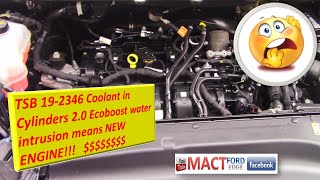
Est. part cost: $0 (if part of a TSB or warranty), otherwise labor cost applies (approx. 0.9 hours per TSB 20-2234). - Coolant Intrusion into Cylinders (Head Gasket/Block) ⚪ Low Probability While the infamous block design flaw was largely corrected for the 2020 model year with a revised block design, the 2019 models can still be susceptible. TSBs like 19-2346 🎬 Watch: Understanding the TSB for coolant intrusion and engine block issues. and 19-2208 cover coolant intrusion for earlier models with identical symptoms, and isolated cases can still occur. A Reddit user with a 2019 Nautilus reported a 'blown head gasket' diagnosis with symptoms of white smoke and no heat. This should be considered only after the more common EGR cooler issue is ruled out.
How to confirm: Perform a cooling system pressure test while monitoring for pressure loss. Use a borescope to inspect cylinders for coolant. A chemical block test can detect exhaust gases in the coolant.
Typical fix: This is a major repair, often requiring engine long block replacement if the block is cracked, which is the only permanent solution for the design flaw in earlier models.
Est. part cost: $4000-$8000+
Rare But Worth Checking
- Faulty Cylinder Head Temperature (CHT) Sensor or Wiring: While possible, the code usually indicates a genuine overheat event. However, a damaged sensor or wiring harness can send a false signal. A user on a forum noted that coolant from a separate leak sprayed onto the CHT sensor, causing a short and triggering codes P1285 and P1290. This should 🎬 See how a failed water pump can also trigger these codes. only be considered after all other cooling system issues are ruled out.
- Standard Cooling System Failure: Failures of components like the water pump, thermostat, radiator, or cooling fans can cause overheating. While less specific to the TSBs for this vehicle, they should be part of a comprehensive diagnostic check if the EGR cooler and PCM are found to be okay.
Diagnosis Steps
- DO NOT DRIVE THE VEHICLE. Allow the engine to cool completely.
- Check for any applicable Technical Service Bulletins (TSBs), specifically TSB 20-2234, SSM 48345, and TSB 19-2046.
- Visually inspect the coolant level in the reservoir. If low, check for any visible external leaks from hoses, the radiator, or the water pump.
- If no external leaks are found, proceed with the diagnostic steps outlined in TSB 20-2234.
- Perform a cooling system pressure test per Workshop Manual (WSM), Section 303-03A.
- During the pressure test, visually inspect the EGR cooler for any signs of internal or external coolant leaks. If coolant is leaking from the coolant chamber into the exhaust chamber, the cooler is faulty.
- If the EGR cooler is leaking, it must be replaced along with the EGR outlet tube and associated gaskets.
- Regardless of the outcome of the pressure test, check the PCM calibration level. If an update is available, reprogram the PCM. TSB 20-2234 outlines labor operations for both scenarios (passing and failing the pressure test).
- If the EGR cooler is not leaking and the issue persists after a PCM update, perform further diagnostics for internal engine coolant leaks (borescope inspection, chemical block test) or standard cooling system component failures (thermostat, water pump, CHT sensor circuit).
Parts You'll Likely Need
- EGR Cooler
(OEM #K2GZ-9F464-A)— This is the most likely mechanical failure causing P1285 on this vehicle, as identified in TSB 20-2234.
Trusted brands: Motorcraft
OEM price range: $350-$550
Aftermarket price range: $250-$450 - EGR Outlet Tube
(OEM #K2GZ-9E470-A)— TSB 20-2234 specifies replacing this tube along with the EGR cooler.
Trusted brands: Motorcraft
OEM price range: $50-$80 - EGR Cooler Gasket Kit
(OEM #K2GZ-9D476-A, K2GZ-9D476-B, K2GZ-9E464-D)— Required when replacing the EGR cooler to ensure proper sealing. These are explicitly listed in TSB 20-2234.
Trusted brands: Motorcraft
OEM price range: $40-$70
Aftermarket price range: $25-$50
Related Codes That Often Appear With This One
- P1299 — This code means 'Cylinder Head Overtemperature Protection Active' and is set when the PCM takes protective action (like cutting fuel to cylinders) because the P1285 condition has been met.
- P0217 — A generic code for 'Engine Over Temperature Condition' that often accompanies P1285 as a confirmation of the overheat event.
- P1026 — This code is often listed alongside P1285 in TSBs 20-2234 and SSM 48345 related to cooling system and EGR cooler faults.
- P044C — This code, related to the EGR sensor circuit, is mentioned in TSB 20-2234 along with P1285, pointing towards a fault in the EGR system.
- P0128 — Indicates 'Coolant Thermostat Rationality Check', meaning the engine is not reaching operating temperature as expected, which can be related to coolant level issues or software faults mentioned in TSB 20-2234.
Technical Service Bulletins (TSBs) & Recalls
- TSB 20-2234: Addresses an illuminated MIL with various DTCs including P1285, low coolant, and white smoke due to a faulty EGR cooler and/or PCM software.
- SSM 48345: Points to a leaking EGR cooler causing coolant to enter the intake/exhaust, triggering P1285 and other overheat-related codes.
- TSB 19-2046: States that P1285 can be caused by PCM software settings and requires a module update.
- TSB 19-2346 / 19-2208: While not directly for the Nautilus, these TSBs detail the coolant intrusion issue (cracked block) on other 2.0L EcoBoost platforms, which is a key differential diagnosis.
Platform-Specific Known Issues
- TSB 20-2234: The Primary Diagnostic Path: This bulletin is the most important document for this issue. It directly addresses P1285 on the 2019-2020 Nautilus 2.0L. It identifies a leaking EGR cooler and/or PCM software as the causes of symptoms like low coolant, white smoke, and overheating warnings. The TSB provides a clear diagnostic flow: check for PCM updates, then pressure test the cooling system while inspecting the EGR cooler. It also provides specific labor operation numbers (202234C for replacement, 202234D for reprogram and replacement) and part numbers for the repair.
Mechanic-Grade Diagnostic Values
- Cylinder Head Temperature (CHT) Sensor Resistance — expected: Resistance decreases as temperature increases. Approximately 2.75 kΩ at 194°F (90°C) and 2.03 kΩ at 212°F (100°C).. Failure: Infinite resistance (OL) indicates an open sensor; zero resistance indicates a shorted sensor.
- Cylinder Head Temperature (CHT) Sensor Voltage — expected: Ford uses a dual-switching resistor circuit, so voltage can be in two ranges. At ~194°F (90°C), voltage can be ~0.60V or ~3.71V. At ~212°F (100°C), it can be ~0.46V or ~3.41V.. Failure: A reading of 5V suggests an open circuit, while 0V suggests a short to ground. Voltage below 0.244V or above 4.96V will trigger a fault.
Scan Tool Commands That Help
- Ford IDS (Integrated Diagnostic System): Datalogger (PID Monitoring) — To monitor and graph the Cylinder Head Temperature (CHT) sensor value in real-time from a cold start to operating temperature. This helps verify if the sensor is reporting a plausible temperature rise or if it's giving erratic/stuck readings, which could indicate a sensor or wiring fault instead of a true overheat.
- Ford IDS (Integrated Diagnostic System): KOEO (Key On, Engine Off) and KOER (Key On, Engine Running) Self-Tests — To command the PCM to check all related sensor circuits for electrical faults (opens, shorts). This can quickly identify a wiring or sensor electrical issue before starting extensive mechanical cooling system tests.
- Ford IDS (or equivalent bidirectional scanner): Cooling Fan Control — To manually command the cooling fans on at various speeds. This is a crucial step to rule out a cooling fan failure as the cause of a genuine overheat condition before suspecting more complex issues like internal leaks.
Wiring & Ground Locations
- CHT Sensor Connector — On the cylinder head, often on the rear side, potentially under the intake manifold or cowl panel, making access difficult.. The connector itself can become corroded or have a poor connection, leading to false P1285/P1299 codes even without an actual overheat. TSBs for other Ford models highlight this as a common failure point.
- Main Engine Block Ground — A ground strap connecting the engine block to the vehicle's chassis/body.. A poor engine ground can cause erratic behavior from sensors that ground through the block, including the CHT sensor. While not a primary cause, checking for a clean, tight ground connection is a fundamental step in diagnosing any electrical sensor issue.
- Battery Ground Cable/Harness — Connects the negative battery terminal to the chassis. On the Nautilus, the battery is located deep in the engine compartment, and there are specific ground points on the chassis for jump-starting.. A compromised main ground connection can create voltage drops and electrical noise throughout the vehicle, potentially affecting PCM operation and sensor readings. The part number for the ground cable harness is K2GT-19A095-BC.
Real Owner Repair Stories
- Ford Escape Maintenance/Repairs forum user (2017 Ford Escape (similar 2.0L EcoBoost platform)) — Vehicle would not accelerate, mimicking a major engine failure, accompanied by overheat codes.
❌ Tried (didn't work) The owner was about to take the vehicle to a dealer for a major warranty claim.
✅ What actually fixed it The owner discovered a loose ground nut for the wiring harness on the valve cover. Tightening this nut resolved all symptoms completely, highlighting the importance of checking basic electrical connections. - 2CarPros forum user (2006 Ford F-150 with P1285/P1299) — Temperature gauge pegged to hot, but the engine was not actually overheating.
❌ Tried (didn't work) Replacing the CHT sensor., Checking wiring for power.
✅ What actually fixed it Replacing the thermostat resolved the issue, even though it did not present as a typical thermostat failure. This suggests the thermostat was failing in a way that caused a localized hot spot at the CHT sensor without causing a full system overheat.
OEM Part Supersession History
K2GZ-9F464-A→K2GZ-9F464-B— Part revision by the manufacturer, likely for improved durability or design.
Heads up: The new part number K2GZ-9F464-B is the correct replacement for the original.
Model Year Variations Within This Range
- 2020: The 2020 model year 2.0L EcoBoost engine received a revised block design that lacks the coolant channels between the cylinders. This change largely solved the 'coolant intrusion' issue that was more common on 2015-2019 engines. Therefore, on a 2020 model, P1285 with coolant loss is even more likely to be the TSB-documented EGR cooler leak rather than a cracked block.
Helpful Videos
We Have This Part in Stock


The information in this article is provided for general reference and educational purposes only. Vehicle specifications, procedures, and part compatibility can vary by production date, trim level, and region. Always consult your vehicle's factory service manual and verify part numbers before purchasing or performing repairs. Safety-critical components such as airbags, seat belts, and braking systems should be installed by a qualified professional.
- Lincoln NAUTILUS:
- 🎬 Helpful Videos
- 🛍️ Shop This Part
- What's Unique About the 2019-2020 Lincoln NAUTILUS
- Diagnostic Flowchart
- Symptoms You May Notice
- Most Likely Causes
- Rare But Worth Checking
- Diagnosis Steps
- Parts You'll Likely Need
- Related Codes That Often Appear With This One
- Technical Service Bulletins (TSBs) & Recalls
- Platform-Specific Known Issues
- Mechanic-Grade Diagnostic Values
- Scan Tool Commands That Help
- Wiring & Ground Locations
- Real Owner Repair Stories
- OEM Part Supersession History
- Model Year Variations Within This Range
- 🎟️ Get 5% Off