

OBD-II Code P1268: Cylinder 8 Injector Circuit Fault
What P1268 means, why it triggers, and how to fix it
- Code P1268 on a Ford Powerstroke specifically indicates a short circuit in the cylinder #8 fuel injector wiring or control module.
- The failing Fuel Injector Control Module (FICM) causes over 60% of P1268 codes, followed by a chafed Under Valve Cover Harness (UVCH) or a dead injector solenoid.
- Never replace the #8 injector without testing FICM voltage first; a reading below 45V during cranking confirms the module is the culprit, not the injector.
- Driving with an active P1268 code destroys catalytic converters within 1-3 months due to raw fuel dumping into the exhaust system.
- On non-Ford vehicles like Toyota or VW, code P1268 refers to entirely different systems like the 4WD transfer case or high-pressure injection pump.
What Does P1268 Mean?

P1268 is a manufacturer-specific code primarily found on Ford Powerstroke diesel engines. It means the Powertrain Control Module (PCM) detected a short circuit in the cylinder #8 fuel injector wiring. This fault prevents the injector from firing, causing a severe misfire and power loss.
Technical definition: The SAE definition for P1268 on Ford vehicles is "Cylinder #8 High To Low Side Short". This indicates the control circuit for the #8 injector has an improper connection to ground.
Can I Drive With P1268?
Yes, But With Caution. Driving is not recommended. You can drive under 50 miles to a repair facility, but the engine runs rough and stalls. Prolonged driving allows raw fuel to wash oil from the cylinder walls, causing scoring and piston ring damage. Unburned fuel also enters the exhaust and destroys the catalytic converter, an $800-$2,500 repair.
Common Causes

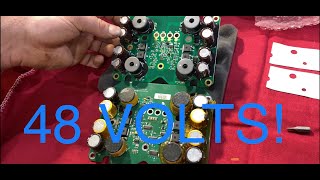
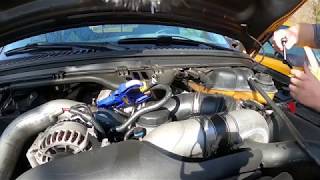
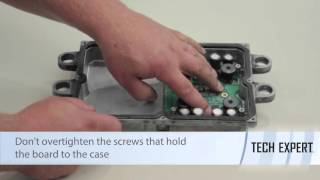
- Failing Fuel Injector Control Module (FICM) (Very Common) — The FICM (or IDM on 7.3L engines) provides the high voltage (48V on 6.0L, 115V on 7.3L) needed to fire the injectors. The internal power board is highly susceptible to failure from heat and vibration, making it the most frequent cause of injector circuit codes. 🎬 Watch: How to test and repair your 6.0 FICM power supply.
- Low System Voltage (Batteries/Alternator) (Very Common) — Weak batteries or a failing alternator provide insufficient voltage to the FICM (below 12.6V). To compensate, the FICM draws higher amperage, which overheats and destroys its sensitive internal electronics.
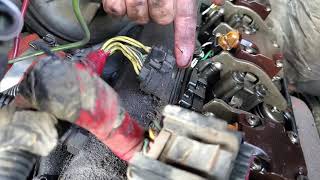
- Chafed or Shorted Under Valve Cover Harness (UVCH) (Common) — The UVCH is a notorious weak point, especially on the 7.3L Powerstroke. 🎬 See this simple DIY fix for the 7.3 UVCH connector. High heat degrades the wiring and the main pass-through connector, causing shorts to ground.
- Failed #8 Fuel Injector Solenoid (Common) — The electronic solenoid on the injector itself fails and develops an internal short circuit. This occurs frequently on high-mileage engines or when fuel quality is poor.
- Bad FICM Relay (Less Common) — The relay supplying main power to the FICM fails or overheats, causing intermittent low voltage and triggering false injector codes.
- Cracked Injector Driver Module (IDM) Case (Uncommon) — On 7.3L Powerstroke engines, the IDM case develops cracks, allowing moisture to enter and short the internal electronics.
Symptoms

- Rough Idle and Engine Misfire — The truck shakes violently at idle because cylinder #8 provides no power. This is significantly worse when the engine is cold.
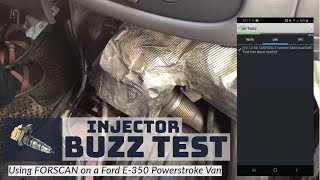
- Hard Starting or No Start — The engine cranks extensively before starting, or fails to start entirely. This occurs in cold weather when a weak FICM struggles to generate 48 volts to overcome thick oil. 🎬 Watch: How to perform an injector buzz test using FORSCAN.
- Loss of Power and Acceleration — The vehicle feels sluggish and accelerates poorly because it runs on seven cylinders instead of eight.
- White Exhaust Smoke and Raw Fuel Smell — Raw, unburned fuel from the dead cylinder pushes into the hot exhaust, creating puffs of white smoke and a strong diesel odor.
- Check Engine Light and 'Reduced Engine Power' (also visible on scanner) — The Check Engine Light illuminates, and a 'Reduced Engine Power' message appears on the dashboard.
Diagnostic Flowchart
Tap your situation to follow the diagnostic path that matches what you're seeing on this code.
Common Fixes & Costs
- Replace the Fuel Injector Control Module (FICM) — Parts: $300-$700, Labor: $150-$300, ~1.5 hr book time (Intermediate)
- Repair FICM Power Supply — Parts: $150-$250, Labor: $150-$300, ~1.5 hr book time (Intermediate)
- Repair or Replace the Under Valve Cover Harness (UVCH) — Parts: $50-$150, Labor: $200-$400, ~3.5 hr book time (Intermediate)
- Replace the #8 Fuel Injector — Parts: $250-$450, Labor: $300-$500, ~2.5 hr book time (Professional)
- Repair Chafed Main Engine Wiring Harness — Parts: $30-$70, Labor: $100-$250, ~1.0 hr book time (Intermediate)
Used vs. New Parts: Buying Guide
When a used part is worth it: A professionally remanufactured Fuel Injector Control Module (FICM) offers better value than a used junkyard unit. Used FICMs carry the same inherent factory design flaws. Reputable rebuilders upgrade the failure-prone power supply components, providing greater durability than a new OEM unit.
Donor-vehicle mileage cap: roughly under 50000 miles for the part to have meaningful remaining life.
Donor quality checklist:
- For a remanufactured FICM, choose a company that tests both the power supply and the logic board.
- Verify the warranty period; a quality rebuild includes at least a 1-year warranty.
- Ensure the part number matches exactly or is a verified superseded number for your truck's model year (4-pin vs. 7-pin).
Decision logic:
- If The budget is extremely tight and the vehicle is old → A used FICM from a low-mileage, accident-damaged vehicle is a gamble but works short-term.
- If Reliability is the primary concern → A professionally remanufactured FICM with an upgraded power board and a long warranty is the best choice.
- If The original FICM is physically damaged (cracked case, water intrusion) → An exchange program for a remanufactured unit is required, as your core is unrepairable.
Warranty tradeoff: Used salvage parts offer a 30-90 day warranty. Remanufactured FICMs from specialists carry warranties from 1 year to a lifetime. New OEM parts carry a 1-2 year warranty but are the most expensive option.
Worst-case if a used part fails: $500-$1000 if a used or poorly rebuilt FICM fails, factoring in the second replacement part and repeated diagnostic labor.
What Happens If You Wait — Timeline
- 0-1 month: Check Engine Light on with P1268. A noticeable 'miss' at idle and light load. Hard starting occurs when cold. Engine produces white smoke. (MPG impact: 5-10%% · Added cost: $0-$100 in wasted fuel)
- 1-3 months: Drivability worsens significantly. The engine runs very rough, power is reduced, and the risk of stalling increases. Raw fuel enters the exhaust system. (MPG impact: 10-20%% · Added cost: $100-$300 in wasted fuel)
- 3-6 months: The catalytic converter becomes saturated with raw fuel. It overheats, melting the internal ceramic substrate and causing an exhaust blockage. (MPG impact: 20-35%% · Added cost: $1,200-$3,500 for catalytic converter and O2 sensor replacement)
- 6+ months: Catastrophic engine damage begins. Unburned fuel washes lubricating oil off the cylinder #8 wall. This scores the cylinder wall and damages piston rings. (MPG impact: 35-50%+% · Added cost: $5,000-$15,000+ for major engine repair or a complete engine replacement)
Cost of Not Fixing It
- 0-1 month: Fuel economy drops by 3-5 MPG. The vehicle suffers poor drivability, fails emissions tests, and stalls in traffic. (Added cost: Negligible, besides extra fuel costs.)
- 1-6 months: Raw fuel washing over the catalytic converter substrate causes it to overheat and melt, destroying it. This also damages downstream O2 sensors. (Added cost: $1,200-$3,500 for catalytic converter and sensor replacement.)
- 6+ months: Continued driving with a misfire allows unburned fuel to wash lubricating oil off the cylinder #8 wall. This accelerates wear on the piston rings and scores the cylinder wall, requiring an engine rebuild. (Added cost: $5,000-$15,000 for major engine repair or replacement.)
Diagnosis Steps

- Check Batteries, Alternator, and FICM Relay
Ensure both vehicle batteries are fully charged (at least 12.6V) and pass a load test. Verify the alternator output is between 13.5V and 14.5V with the engine running. Low system voltage destroys FICMs. Swap the FICM power relay with the horn relay to rule it out.
Tools: Multimeter, Battery Load Tester (Beginner) - Test FICM Output Voltage
Remove the small Torx cover on the FICM. Place the negative multimeter probe on the battery negative terminal and the positive probe on the screw closest to the driver's side fender. The voltage must be 47-49 volts during key-on, cranking, and running. If it drops below 45 volts, the FICM's power supply is dead.
Tools: Multimeter, Torx T20 driver (Intermediate) - Perform an Injector 'Buzz Test'
Use an OBD-II scanner to command an injector buzz test. Listen for eight distinct, sharp buzzing sounds. A weak or missing buzz on cylinder #8 isolates the fault to that specific circuit (injector, wiring, or FICM driver).
Tools: OBD-II Scanner with bi-directional control (Intermediate) - Check Injector and Harness Resistance
Disconnect the wiring harness at the driver's side valve cover. Measure the resistance between the two pins for cylinder #8. A good injector solenoid reads between 2 and 4 ohms. A reading near 0 ohms indicates a short (P1268), isolating the problem to the injector or UVCH.
Tools: Multimeter, Pinout Diagram (Advanced) - Visually Inspect and 'Wiggle Test' Wiring
Set your multimeter to continuity mode and probe the suspected shorted wire at the FICM connector to a chassis ground. Wiggle the wiring harness along its entire length. If the meter beeps when you move a specific section, you found the short. Inspect the harness over the driver's side valve cover for chafing.
Tools: Flashlight, Multimeter with long leads (Advanced) - Advanced: Monitor Live Data PIDs
Using a scan tool, monitor FICM_MPWR (FICM Main Power); it must hold steady at 48V. FICM_SYNC must read 'Yes' or '1'. Monitor ICP (Injection Control Pressure); it must reach at least 500 PSI for the injectors to fire.
Tools: Advanced OBD-II Scanner (e.g., FORScan, Snap-on) (Advanced) - Pro Tip: Perform Injector Circuit Waveform Analysis
Using an oscilloscope, back-probe the signal wire for cylinder #8 at the FICM connector. A healthy waveform shows a sharp voltage spike, a flat current ramp, and a 'pintle hump' indicating the injector needle opened. A waveform shorted to ground confirms an electrical fault without disassembly.
Tools: Automotive Oscilloscope, Back-probe pins (Professional)
When This Code Triggers (Freeze-Frame Conditions)
- Engine Coolant Temp: 95-205°F (Triggers at any temperature, but cold starts exacerbate symptoms due to thick oil requiring higher FICM voltage.)
- RPM: 1500-2500 (Often sets during steady-state cruise or light acceleration.)
- Engine Load: 30-60% (Detected under moderate engine load, such as climbing a grade.)
- Vehicle Speed: 45-65 mph (Highway driving provides the sustained operation required for the PCM to run the injector monitor.)
Related Codes
- P1261-P1267 — These codes correspond to cylinders 1 through 7. Seeing multiple codes from this range indicates a failing FICM/IDM or its power supply, as multiple individual circuits rarely fail simultaneously.
- P0611 — This code means 'FICM Performance.' It is stored alongside P1268 and confirms the FICM failed an internal self-test. Diagnosis must focus immediately on FICM voltage.
- P1278 — This code means 'Cylinder #8 High To Low Side Open.' It is the opposite of P1268, indicating a broken wire instead of a short. P1268 shows near-zero resistance to ground, while P1278 shows infinite resistance.
- P1316 — This code indicates 'Injector Driver Module (IDM) Codes Detected' on 7.3L Powerstrokes. It acts as a flag that the IDM stored codes like P1268, often pointing to a loose UVCH connector.
Climate & Environmental Factors
- Cold Weather: Cold temperatures significantly worsen P1268 symptoms. Thick engine oil requires more energy from the FICM to fire the injectors. A weak FICM drops below the 45V threshold when cold, causing hard starts and rough running.
- High Heat: Sustained high under-hood temperatures, common in vans or trucks used for heavy towing, accelerate the degradation of electronic components. This heat destroys the FICM's internal power supply and breaks down wiring insulation.
- Humidity and Moisture: High humidity causes corrosion on connector pins at the FICM, IDM, and valve cover gaskets. On 7.3L engines, a cracked IDM case allows moisture to short the circuit board.
How to Talk to a Mechanic About This Code
Say this: "I have a Ford Powerstroke with a P1268 code. I've verified battery voltage and alternator output are normal. I suspect a FICM, wiring, or injector issue and would like you to perform a voltage test on the FICM under load, and an injector buzz test."
This language directs the technician to the most likely failure points (FICM, wiring, injector) and requests specific tests. This avoids wasted diagnostic time and prevents them from starting with unrelated checks.
Avoid saying:
- 'My truck is running rough, can you fix it?'
- 'I have a check engine light on.'
- 'I think I need a new injector, how much is it?'
Questions to ask before authorizing the repair:
- What was the FICM voltage during key-on, cranking, and running?
- Did the injector buzz test pass for all eight cylinders? If not, which ones failed?
- Did you perform a resistance test on the #8 injector circuit at the valve cover connector? What was the reading?
- Based on these tests, can you show me why you recommend this specific part for replacement?
- What is the warranty on the recommended parts and your labor?
Where to Take It: Dealer vs Independent vs Chain
- Dealer:
Use for warranty work. For out-of-warranty repairs, consider a specialist first, as dealers are very expensive for this known issue.
Best for: Vehicles still under an emissions or powertrain warranty., Complex electrical issues or when a new FICM requires programming (flashing) that an independent shop cannot perform.
Downsides: Typically the highest labor rates and parts costs., More inclined to replace entire assemblies rather than isolating a specific wire fault. (Typical cost: +50% vs. baseline) - Independent Shop:
Best fit, but only if it's a diesel specialist. A general auto shop is a poor choice. A Powerstroke specialist diagnoses this efficiently.
Best for: Out-of-warranty Powerstroke trucks where cost is a major factor., Shops that specialize specifically in diesel or Powerstroke engines., Getting an honest second opinion on a high-dollar quote from a dealer.
Downsides: Quality varies wildly. A general mechanic lacks the specific tools for Powerstroke injector issues., You must vet the shop carefully for diesel expertise. (Typical cost: +0% vs. baseline) - Chain Shop:
AVOID. This is not a job for a general-purpose chain shop. The likelihood of a correct diagnosis is extremely low.
Best for: Simple, unrelated maintenance like tires or oil changes.
Downsides: Technicians lack the specialized training and diagnostic equipment for complex diesel engine faults., High pressure to sell services leads to misdiagnosis and unnecessary parts replacement. (Typical cost: -10% vs. baseline)
When to Walk Away From the Repair
If the estimated repair cost for the P1268 fault and any related damage (like a catalytic converter) exceeds 50% of the truck's current market value, seriously consider selling it as-is.
- Car worth $15000, fix is $2500: Fix it. This repair cost is well within a reasonable limit for a vehicle of this value.
- Car worth $8000, fix is $4500: Borderline. The repair is over 50% of the truck's value. Get a second opinion to confirm the diagnosis. If the engine has other major issues, walk away.
- Car worth $5000, fix is $3000: Walk away. It is not economical to invest this much into an older, lower-value truck. The risk of another major failure is too high.
What Scan Tool You Need for This Code
Minimum: A scanner that reads Ford-specific codes and performs an injector buzz test (bi-directional control). A generic code reader is not sufficient.
A basic $20 scanner only shows a generic engine code. It cannot read the manufacturer-specific P1268 code, access vital live data from the FICM, or command the injector buzz test.
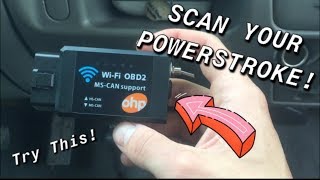
Budget: FORScan with OBDLink EX or MX+ Adapter (~$120) — FORScan is powerful software for Windows laptops that provides dealer-level diagnostics for Fords. It reads all codes, monitors FICM voltage, commands the injector buzz test, and performs a cylinder contribution test.
Mid-range: Autel MaxiCheck MX808S / Foxwell NT510 Elite for Ford (~$350) — These handheld units offer full system diagnostics and bi-directional controls like the injector buzz test. They are user-friendly and provide robust diagnostic capabilities for DIY users.
Professional: Autel MaxiCOM MK906BT / Launch X431 Series (~$900-1300) — Provides full professional-level, bi-directional control of all vehicle modules. These tools perform all necessary tests for P1268 and execute advanced functions like injector coding and module programming.
Rent vs buy: For P1268, buying is recommended. The necessary bi-directional scanners are not typically available in free rental programs from auto parts stores.
How to Clear the Code After You Fix It
- Clear the Diagnostic Trouble Codes (DTCs) using an OBD-II scan tool.
- Disconnecting the battery does not clear permanent codes or reset monitors.
- Perform a complete drive cycle to run all readiness monitors.
Drive cycle (~30 minutes): Cold start the engine and idle for 3 minutes. Drive in stop-and-go city traffic for 15 minutes, including several complete stops. Accelerate smoothly to 55-65 mph and maintain for 15 minutes. Allow the vehicle to cool completely overnight and repeat.
Readiness monitors affected: Comprehensive Component Monitor, Misfire Monitor, Catalyst Monitor, Fuel System Monitor
Before emissions retest: drive at least 100 miles to fully set monitors.
Watch out for:
- Clearing the code without performing a drive cycle results in a 'Not Ready' status and a failed emissions test.
- The code returns immediately if the underlying electrical short remains.
- Some states require permanent codes to clear via the vehicle's own diagnostics after 15 warm-up cycles, not just a scan tool.
Will This Fail Emissions / State Inspection?
Yes — this code typically fails an OBD-II emissions inspection.
- California: An active Check Engine Light is an automatic failure. After repair, all readiness monitors must be 'Ready'. For 2010+ models, a permanent DTC (pDTC) causes a failure until the vehicle drives 200 miles and 15 warm-up cycles.
- New York: The New York Vehicle Inspection Program (NYVIP) includes an OBD-II scan. An illuminated Check Engine Light results in an automatic emissions test failure.
- Texas: In counties requiring emissions testing, an illuminated Check Engine Light is an automatic failure. You cannot renew registration until the vehicle passes inspection.
Most Commonly Affected Vehicles

- Ford F-250/F-350/F-450/F-550 Super Duty (1999-2007) — Extremely common on 7.3L (IDM) and 6.0L (FICM) Powerstroke engines. The 7.3L is known for UVCH connector issues, while the 6.0L is famous for FICM power supply failures.
- Ford Excursion (2000-2005) — Equipped with the 7.3L and 6.0L Powerstroke engines, these SUVs suffer the exact same IDM/FICM and injector circuit failures as Super Duty trucks.
- Ford E-350/E-450 (1999-2010) — These vans use Powerstroke engines. The tighter engine bay leads to higher under-hood temperatures, accelerating the failure of the FICM and wiring harnesses.
- Ford F-650/F-750 (2000-2003) — Medium-duty trucks equipped with the 7.3L Powerstroke engine are susceptible to this code through IDM and UVCH failures.
- International VT365 (2002-2010) — The International VT365 is the engine that became the Ford 6.0L Powerstroke. These engines experience identical FICM failures.
- Volkswagen/Audi TDI Models (Golf, Jetta, Passat) (1996-2006) — On older VW/Audi TDI models, P1268 means 'Quantity Adjuster (N146) - Upper/Lower Limit Stop.' This is a fault within the high-pressure injection pump itself, not a specific injector.
- Toyota Land Cruiser, LX470 (1998-2007) — On these models, the code is typically C1268, meaning 'Transfer L4 Position Switch Circuit Fault.' This points to a problem with the 4WD transfer case actuator motor.
- Nissan Titan, Frontier, Xterra (2004-2015) — On Nissan vehicles, the similar code P1168 indicates a 'Closed Loop Control Function' fault for Bank 2, pointing to an Air/Fuel Ratio Sensor issue.
- General Motors (Chevy/GMC) Silverado/Sierra with Duramax (2001-2016) — P1268 is not a standard GM code. A similar fault (Cylinder 8 Injector Circuit) is P0208. On Duramax engines, these codes are frequently caused by poor terminal contact at the injector connector.
Manufacturer-Specific Notes
- Ford: Ford issued TSB 08-26-3 for 6.0L engines experiencing hard starts when cold, accompanied by P1261-P1268 and P0611. It advises that a failing FICM causes these codes even if injectors are good. The TSB details an updated FICM calibration to help with cold-start stiction.
- Volkswagen/Audi: On older VW and Audi TDI diesel models, P1268 means 'Quantity Adjuster (N146) - Upper/Lower Limit Stop.' This relates to a mechanical failure within the Bosch VP37 high-pressure injection pump.
- Toyota/Lexus: The code is almost always C1268, not P1268, and relates to the 4WD system. It means 'Transfer L4 Position Switch Circuit Fault,' caused by a seized transfer case actuator motor.
Real Owner Stories
2006 Ford F-250 6.0L at 180K miles - Classic FICM Failure
Truck became very hard to start in the morning, especially in cold weather. When it did start, it idled roughly and smoked until it warmed up. Eventually, it set the P1268 code along with P0611 (FICM Performance).
What they tried:
- Initially suspected a bad injector.
- Performed a FICM voltage test after reading forums.
- The voltage was 48V with the key on, but dropped to 35V while cranking.
Outcome: Replaced the original FICM with a remanufactured unit with an upgraded power supply for ~$450. The truck started immediately, and all codes cleared. The owner reported better throttle response and a smoother idle.
Lesson: Hard starting when cold is a classic sign of a failing FICM power supply. Always test FICM voltage during cranking, not just with the key on, as that is when a weak module fails.
1997 Ford F-Super Duty 7.3L - Misdiagnosis Chase
Bought a truck with a known engine miss and P1268. The previous owner had multiple mechanics fail to fix it. The truck had a stumbly idle and long crank times.
What they tried:
- Replaced Dorman valve cover gaskets and harnesses with Motorcraft parts.
- Swapped the #8 injector with a known good used one.
- Replaced the IDM (Injector Driver Module) with a used one, which got the truck running but the code persisted.
- Performed resistance tests and buzz tests, which were inconclusive.
Outcome: After chasing the issue through wiring and injectors, the owner tried a second used IDM. This replacement IDM finally fixed the problem, and the P1268 code resolved.
Lesson: Even replacement parts, especially used electronics, can be faulty. When a diagnosis points strongly to a specific module, but a replacement doesn't fix it, consider the possibility that the replacement part itself is bad.
2002 Ford F-350 7.3L at 215K miles - The '50 Cent Mod' Fix
While towing a heavy load, the engine suddenly started running very rough and lost power, setting a P1316 (IDM Codes Detected) and P1268. The symptoms were intermittent.
What they tried:
- Pulled over and checked connections. Noticed the main electrical connector on the driver's side valve cover seemed loose.
- Cleared codes, restarted the truck, and it ran fine for a while before the code returned.
- Performed the '50 cent mod' by wedging a quarter between the Under Valve Cover Harness (UVCH) plug and its clip.
Outcome: The quarter-shimmed connector no longer vibrated loose. The P1268 code did not return, and the misfire completely resolved. The owner later replaced the UVCH but confirmed the loose connector was the root cause.
Lesson: On 7.3L Powerstroke engines, the UVCH connector is a known weak point. Intermittent injector codes are often caused by this plug vibrating loose. The '50 cent mod' is a highly effective preventative fix.
How to Prevent This Code From Triggering
- Load test batteries annually and maintain a healthy charging system (Once per year, before winter) — Low system voltage forces the FICM to draw higher amperage to produce 48V, causing its internal power board to overheat and fail.
- Perform the '50 Cent Mod' on 7.3L engines (Once, during other maintenance) — It applies constant pressure to the Under Valve Cover Harness (UVCH) connector, preventing it from vibrating loose.
- Use a quality diesel fuel additive and oil stiction eliminator (Every fill-up (fuel) / Every oil change (oil)) — Additives clean injector nozzles and prevent stiction in the oil-actuated spool valves, promoting longevity.
- Change fuel filters on a strict schedule (Every 10,000-15,000 miles) — Clean fuel is critical for injector health. Waiting for performance to drop means contaminants already damaged the delicate injector components.
- Periodically check FICM voltage (Every 6 months) — A 5-minute voltage check catches a failing FICM before it leaves you stranded. If voltage dips below 47V on a cold start, plan for a repair.
Frequently Asked Questions
What is a FICM and why does it fail so often?
The Fuel Injector Control Module (FICM) boosts your truck's 12-volt battery power to 48 volts (on 6.0L) or 115 volts (on 7.3L IDM) to fire the diesel injectors. They fail frequently due to their location on top of the hot, vibrating engine. This heat, combined with stress from weak batteries, degrades the internal power supply board.
What is the '50 cent mod' for P1268?
The '50 cent mod' is a DIY fix for 7.3L Powerstroke engines to prevent codes caused by a loose Under Valve Cover Harness (UVCH) connector. It involves wedging a quarter between the connector's plastic housing and its locking tab to keep it from vibrating loose. It is a cheap, permanent way to prevent a common failure point.
Why are the symptoms worse when the engine is cold?
When the engine is cold, the oil is thicker, requiring more electrical energy to move the injector's internal parts. A weak FICM cannot supply the necessary 48 volts to overcome this resistance. Once the engine warms up and the oil thins, it takes less energy to fire the injector, temporarily masking the symptom.
What are the most common misdiagnosis mistakes for P1268?
The biggest mistake is replacing the #8 injector without testing the FICM and wiring first. Always test FICM voltage; if it drops below 45V at any point, the FICM is faulty. The second mistake is replacing the FICM when the Under Valve Cover Harness (UVCH) is actually shorted.
Can a bad battery or alternator cause code P1268?
Yes. Weak batteries (below 12.6V) or a failing alternator provide low voltage to the FICM. To compensate, the FICM draws more amperage to produce its 48-volt output, creating excess heat that destroys its internal circuits.
What is an injector buzz test?
An injector buzz test is a diagnostic function on a scan tool that commands the module to cycle each injector solenoid rapidly. This produces an audible 'buzz' from each injector, verifying the electrical integrity of the circuit. A missing or weak buzz from cylinder #8 isolates the fault to that specific wire or injector.
Can I just replace the one bad injector?
Yes, if diagnosis confirms only the #8 injector failed, you can replace just that one. However, on high-mileage engines, injectors wear at a similar rate. Replacing one is often a temporary fix before another fails.
Key Takeaways
- Code P1268 on a Ford Powerstroke specifically indicates a short circuit in the cylinder #8 fuel injector wiring or control module.
- The failing Fuel Injector Control Module (FICM) causes over 60% of P1268 codes, followed by a chafed Under Valve Cover Harness (UVCH) or a dead injector solenoid.
- Never replace the #8 injector without testing FICM voltage first; a reading below 45V during cranking confirms the module is the culprit, not the injector.
- Driving with an active P1268 code destroys catalytic converters within 1-3 months due to raw fuel dumping into the exhaust system.
- On non-Ford vehicles like Toyota or VW, code P1268 refers to entirely different systems like the 4WD transfer case or high-pressure injection pump.
Helpful Videos

The information in this article is provided for general reference and educational purposes only. Vehicle specifications, procedures, and part compatibility can vary by production date, trim level, and region. Always consult your vehicle's factory service manual and verify part numbers before purchasing or performing repairs. Safety-critical components such as airbags, seat belts, and braking systems should be installed by a qualified professional.
- 🎬 Helpful Videos
- What Does P1268 Mean?
- Can I Drive With P1268?
- Common Causes
- Symptoms
- Diagnostic Flowchart
- Common Fixes & Costs
- Used vs. New Parts: Buying Guide
- What Happens If You Wait — Timeline
- Cost of Not Fixing It
- Diagnosis Steps
- When This Code Triggers (Freeze-Frame Conditions)
- Related Codes
- Climate & Environmental Factors
- How to Talk to a Mechanic About This Code
- Where to Take It: Dealer vs Independent vs Chain
- When to Walk Away From the Repair
- What Scan Tool You Need for This Code
- How to Clear the Code After You Fix It
- Will This Fail Emissions / State Inspection?
- Most Commonly Affected Vehicles
- Manufacturer-Specific Notes
- Real Owner Stories
- 2006 Ford F-250 6.0L at 180K miles - Classic FICM Failure
- 1997 Ford F-Super Duty 7.3L - Misdiagnosis Chase
- 2002 Ford F-350 7.3L at 215K miles - The '50 Cent Mod' Fix
- How to Prevent This Code From Triggering
- Frequently Asked Questions
- What is a FICM and why does it fail so often?
- What is the '50 cent mod' for P1268?
- Why are the symptoms worse when the engine is cold?
- What are the most common misdiagnosis mistakes for P1268?
- Can a bad battery or alternator cause code P1268?
- What is an injector buzz test?
- Can I just replace the one bad injector?
- Key Takeaways
- 🎟️ Get 5% Off